Chapter XI · (continued 2)
Reading edition
One might stand on the quiet Plumstead marshes and suspect nothing whatever of all this. From thence the river is made invisible by its dyke; but one observes, with an interest not unmixed with wonder, the funnel of a steamer skirting along the level landscape, or the rich brown sail of a Thames barge, or the bellying canvas of one of those sailing-vessels which, to the number of 5,000 annually, still make use of the port of the Thames.
The larger sewer works of what is called the Northern Outfall are situated on the opposite side of the river, at Barking, where there still remains a relic of the once famous Barking Abbey—the ancient curfew tower, from which the inhabitants were wont to be warned to extinguish their fires. Barking Abbey, which was a foundation of the Benedictine order, dates back to the year 670, and was the first convent for women in England. It originated with the Saxon saint, Erkenwald, Bishop of London, whose sister, Ethelburgha, was its first abbess. This lady made the convent, so renowned that two queens—the wives of Henry I. and of King Stephen—thought it an honour to be appointed to the office which so distinguished a woman had held. All the abbesses of Barking were baronesses in their own right, and took precedence of all abbesses in England. The last of the long line was Dorothy Barley, who was compelled to surrender the abbey to “Bluff King Hal” in 1539. The abbey church stood just outside the present churchyard, and was 170 feet long, with a transept of 150 feet. The curfew tower is the old gate of the outer court, and the room, of which the window is shown in the engraving on the next page, was anciently the chapel of the Holy Rood. In the near neighbourhood is the house from which Lord Monteagle carried to the king a warning not to attend the Houses of Parliament on the day fixed for the carrying out of the Gunpowder Plot.
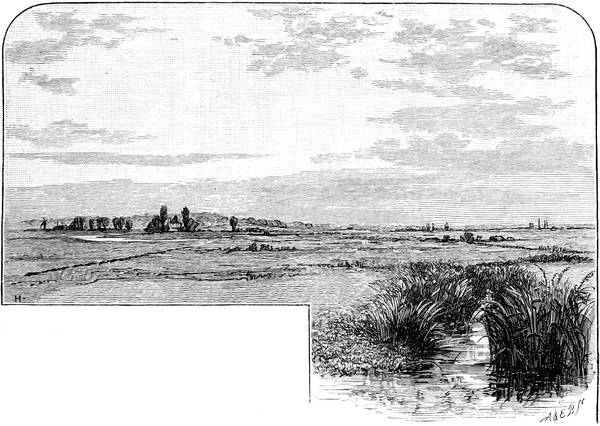
DAGENHAM MARSHES.
In Barking—sometimes called Tripcock—Reach we are afloat on a tide of sewage. It discolours the water all around; it is sometimes churned up by the wheels of the paddle-steamers; the odour of it assails the nostrils at every turn; and yet Barking Reach is, with this exception, an altogether delightful place on a spring or summer day, all the more delightful if the day is one which follows upon or precedes a day of rain; for the sky should be full of grey clouds and capricious light to do justice to the landscape below Barking Reach. Fortunately, even a vast burden of sewage, the refuse of the mightiest city in the world, cannot destroy the natural beauty of the river. By Erith and at Greenhithe it beslimes the low, muddy flats left exposed by the receding tide; but out in the centre of the Thames how can it avail against the influence of wind, and cloud, and sunlight? The river smiles and sparkles, and reflects grey cloud and blue sky, just as if it had no secrets to hide; and over the flat meadow-lands the shadows chase each other like happy children at play. Steamers, barges, sailing-vessels, coming and going, are almost as frequent here as in the higher reaches. It is the peculiarity of the Thames that it is never forsaken, or solitary, or at rest.
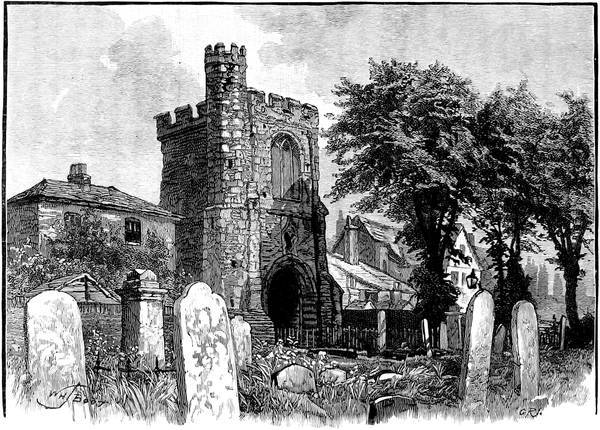
BARKING ABBEY.
On either bank, unsuspected by the chance excursionist, are frequent powder magazines, which are a sort of introduction to Purfleet, where there is such a store of explosives as, if they were fired, would shake London to its centre, and possibly to its foundations. At Purfleet, by the way, the river banks vary their monotony by rising up sheer and white, in modest imitation of the chalk cliffs of Folkestone and Dover. As we proceed further down the river the smell of chalk-burning will taint the air somewhat disagreeably, and great white clouds of smoke will fly in our faces and almost hide the sky.
Purfleet is a pretty and interesting town, notwithstanding the uses to which it has been put, and the danger there must always be in living there. The chalk hills are crowned with pleasant woods, and over the river one looks across Greenhithe to the Kentish hills. Of the country in that direction Cobbett, writing his “Rural Rides,” had only a disparaging account to give. “The surface is ugly by nature,” he said, “to which ugliness there has just been made a considerable addition by the enclosure of a common, and by the sticking up of some shabby-genteel houses, surrounded with dead fences and things called gardens, in all manner of ridiculous forms, making, all together, the bricks, hurdle-gates, and earth say, as plainly as they can speak, ‘Here dwell Vanity and Poverty.’” But Cobbett was by preference unjust, and the little grey houses, each with its own circle of trees, are an essential portion of the charm of these riverside landscapes, which, else, would look dead and solitary.
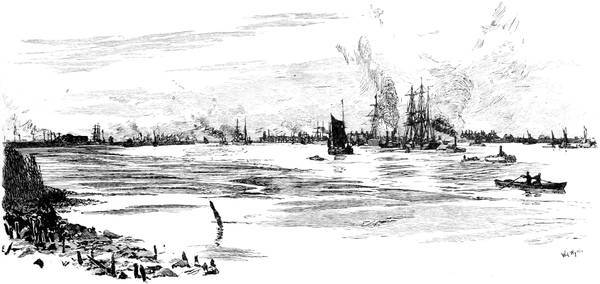
BARKING REACH.
Off Purfleet, on one of whose chalky cliffs the standard of England was unfolded when the Spanish Armada threatened our liberties, lies the reformatory training-ship Cornwall, once known as the Wellesley, the flagship of the brave and adventurous Lord Dundonald. These handsome old hulks, some of them used as reformatories, some of them as training-ships for boys who have been rescued from poverty, and one large group as a fever and small-pox hospital, are very frequent between Erith and Northfleet, and greatly increase the interest of a voyage down the Thames. Off Greenhithe, a famous yachting centre, the Arethusa and the Chichester lie moored; at Gray’s Thurrock, on the opposite side of the river, lie the Exmouth and the Shaftesbury, the latter being the vessel which has been found so costly by the London School Board.
The good-looking town of Erith faces the river just above Purfleet, half-surrounded in the summer months by a fleet of small yachts at anchor; and, just below, the Rivers Cray and Darent, making a clear fork of shining water, meet together and flow as one stream into the Thames. “Long Reach” Tavern, a quaint, solitary place, once much frequented in the old prize-fighting, cockfighting days, by persons who are usually spoken of as belonging to “the sporting fraternity,” stands on the flat muddy ground of this estuary of the conjoined rivers; and from this point the River Thames bends inland towards Dartford, again taking a new direction at Ingress Abbey, where Alderman Harmer once lived, in a house built out of the stones of old London Bridge.
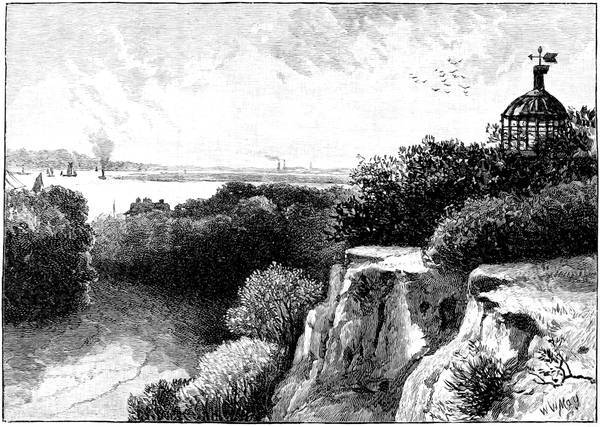
AT PURFLEET.
Around Ingress Abbey lies the village of Greenhithe, another yachting station, with forty feet of water at the end of the pier at low tide. Stone Church, said to have been designed by the architect of Westminster Abbey, and beautiful and elaborate enough in some parts of it to suggest close kinship with that great edifice, stands on a proud eminence above the village, and is visible for miles around.
At Greenhithe the cement works commence, and extend themselves to Northfleet, which is a town perpetually enveloped in a cloud of white smoke, floating over the river in great wreaths, so that Tilbury and Gravesend, lying only a brief distance away, are in some states of weather completely hidden from sight until Northfleet has been passed.
To Tilbury is now to fall the often forfeited glory of containing the largest docks in the world. The heavy traffic of the Thames is gradually being arrested at a lower portion of the river. “One thing hangs upon another,” remarks a recent writer, “and just as Tenterden Steeple is accountable for Goodwin Sands, so the Suez Canal is responsible for the Albert Dock, and for those that are being made at Tilbury. The long, weight-carrying iron screws that are built to run through the canal are not adapted for the turnings and windings of Father Thames in the higher reaches, and so, after the fashion of Mahomet, the docks now are sliding down the river to the ships instead of the ships coming up the river to the docks.” Thus it happened that some years ago the population of Gravesend began to be increased by immense gangs of navvies, builders, and masons, who during the day-time were engaged on the Tilbury side of the river in digging vast trenches, building huge walls, and scooping out of the peat and clay accommodation for the merchant navy of England.
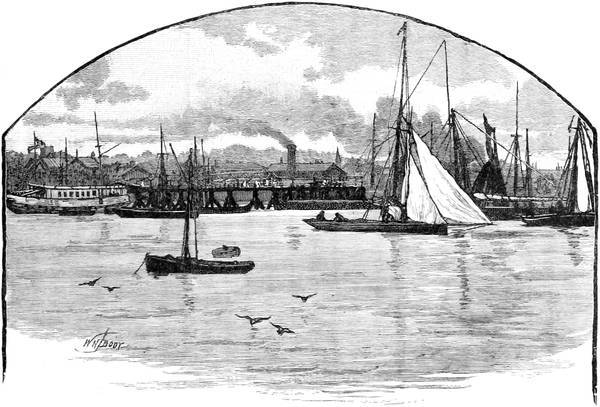
ERITH PIER.
The new docks at Tilbury are the property of the East and West India Dock Company, which is forestalling competition by thus competing with itself. They are being dug out of what has for centuries been a great muddy waste. An army of nearly 3,000 labourers has been employed on the excavations. When the docks are completed eight large steamers will be able to take in coal at one time; the largest vessels built will be able to enter the gates with ease; there will be wharves and warehouses capable of accommodating no inconsiderable portion of the entire trade of the Thames. Branch lines of railway will run along the wharves, and be connected with each warehouse. The main dock occupies fifty-three acres of ground. The jetties surrounding the basins will be forty-five feet wide. At Tilbury, it is probable, the great work of furnishing dock accommodation for the shipping using the Thames will be finally brought to an end. It is all but impossible to imagine that the time will ever arrive when the Albert, and Victoria, and Tilbury, and East and West India Docks, will be too small for the demands of a trade almost inconceivably greater than that which passes through the Port of London now.
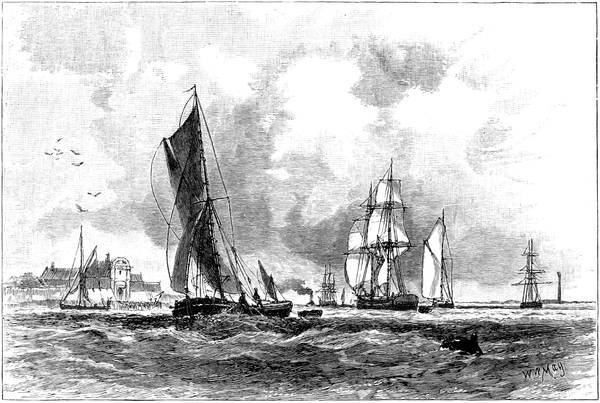
TILBURY FORT.
The proximity of this prodigious undertaking has driven away much of the solitariness which, for some centuries past, has hung around Tilbury Fort. That renowned but practically valueless fortification is best known through the popular engraving after Clarkson Stanfield’s picture. That artist, however, has used a painter’s license to the full. He has given to Tilbury Fort a massiveness and a dignity to which it can by no means lay claim. It is, on the contrary, rather mean-looking, and is only saved from insignificance by its great stone gateway, which is a sort of loftier Temple Bar.
It was when, in 1539, three strange ships appeared in the Downs, “none knowing what they were, nor what they intended to do,” that the idea of building a fort at Tilbury arose. Henry VIII., alarmed at possibilities, built bulwarks and block-houses both at Tilbury and Gravesend. It is stated, on authority which is somewhat doubtful, that Queen Elizabeth reviewed her troops at this place when the realm was threatened by the Spanish Armada, and that here she declared that she thought it “foul scorn that the Pope or any other foreign prince should dare to interfere with her.” On authority that is still more than doubtful, she is said to have slept in the one room over the great gateway. The statement that an Irish regiment, stationed here just before the abdication of James II., crossed the river and burnt and pillaged Gravesend, but was afterwards defeated with great slaughter, is more authentic. At Tilbury Fort, Sheridan has laid the scene of the burlesque tragedy embodied in The Critic, the heroine of that piece being the Governor’s daughter, who went mad in white satin, to the accompaniment of her faithful friend and companion, who considered it to be part of her duty to go out of her senses in white linen, as became the meaner condition of one who was paid to serve. A great mystery is preserved concerning Tilbury Fort by the military authorities, and any stray artist found sketching in its neighbourhood is usually treated as if he were making drawings for the advantage of the enemies of his country.
And now, having passed the Gardens at Rosherville, ingeniously constructed out of old chalk-pits, having seen Tilbury old and new, and having come to the end of this portion of our journey by water, it is time for us to land at Gravesend, where Hogarth and his merry companions put up at “Mrs. Bramble’s,” and, it is probable, took shrimps and tea. Gravesend, let it be said at once, is rapidly losing some of its most pleasant features. Coal-staithes and wharves have invaded the picturesque foreshore. Very dull and depressing is the entrance to the town, after passing those wonderfully grotesque baths which were built according to the sham Oriental taste popularised by George IV., who, as Praed says, was renowned
“For building carriages and boats, And streets, and chapels, and pavilions, And regulating all the votes, And all the principles, of millions.”
“The first gentleman of Europe,” it may be confidently stated, never built a boat half so neat, smart-looking, and handsome as the yachts which, at the proper season, lie in the river in front of those sham Oriental baths mentioned above. At Gravesend are to be seen assembled the finest yachts which frequent the Thames, vessels, some of them with twelve or fourteen stout sailors to man them, and as clean and smart-looking as anything to be seen within the whole compass of the seas.
As becomes one of the oldest ports in the kingdom, Gravesend—it was called Gravesham in Domesday Book—is a town of narrow streets, of quaint shops and houses, of old-fashioned inns and close courts and alleys. The face which it turns to the river is like that of a battered old sailor—scarred, sun-beaten, weather-worn, but pleasant and honest withal. As in most seafaring towns, there is one long, cramped street, in which the houses seem to elbow each other, running, a little back from the river, almost from end to end! Far as it is removed from the sea, there is a fine salt-water savour about Gravesend, and it has also the recommendation of being situated in a pleasant country, for, after ascending its steep streets and threading here and there a leafy lane, there bursts upon the sight a glorious stretch of agricultural land, beautifully uneven, with hills of gentle slope, and occasional patches of woodland and garden and copse.
Of the history of Gravesend there is little that need be said. James II. lived here, as Lord High Admiral, when he was Duke of York, and escaped hence in a girl’s clothes when he was flying from his enemies. On a hill behind the town there stands an old windmill, which is also a landmark, and which occupies the site of a beacon, the lighting of which was a call to arms. Aymer de Valence, one of the heroes of Thackeray’s boyhood, and of many thousands of other boys of his period, founded and endowed a church just outside Gravesend when Edward II. was king. In 1780 five thousand soldiers were marched here to make a sham attack on Tilbury Fort, and were handsomely refreshed, at the expense of the General, when they had energetically stormed that fortification with blank cartridge. About that time, or a little later, there was a great scheme to make a tunnel under the Thames, between the town and the fort, which scheme ended in nothing but the formation of a company which appears to have spent fifteen or sixteen thousand pounds to no purpose.
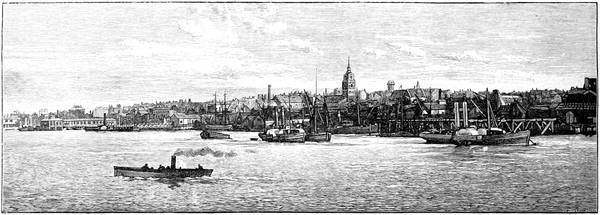
GRAVESEND.
At the present day Gravesend is much resorted to, first for the sake of Rosherville Gardens, and then for tea and shrimps, for which it has a reputation quite unique. Sam Weller’s pieman could make a beef, mutton, or “a weal-and-hammer” out of the same festive kitten. The good folk of Gravesend can serve up shrimps in ways so various, and so tempting, that it is possible to dine off shrimps alone. At Gravesend, too, whitebait may be eaten with as much pleasure as at Greenwich, and the visitor to one of the inns of the place may watch the boatmen fishing for the whitebait which is shortly to be served up to him hot from the kitchen.
It is at Gravesend, indeed, that whitebait is now caught in most profusion. The boatmen pursue the dainty little fish in small open boats, and take it in long, peak-shaped nets, very small of mesh and delicate of workmanship. Whitebait first became celebrated in connection with the British Parliament towards the end of the last century, when Sir Robert Preston, member for Dover, was in the habit of asking his friend, Mr. Rose, Secretary of the Treasury, to dine with him at Dagenham when the session closed. Whitebait must have been had at Dagenham in plenty, and Mr. Rose made favourable report of it to Mr. Pitt; so it came about that the Premier was invited to try the whitebait for himself. Then it was that an annual Ministerial dinner was organised, the scene of the whitebait banquets changing from Dagenham to Greenwich, with an occasional dinner at Blackwall. “Yesterday,” says the Morning Post of September 10th, 1835, “the Cabinet Ministers went down the river in the Ordnance Barges to Blackwall, to the ‘West India’ Tavern, to partake of their annual fish dinner. Covers were laid for thirty-five.” And for something like that number covers still continue to be laid, though the Ministerial whitebait dinner now depends on the taste of Premiers, and is no longer de rigueur.
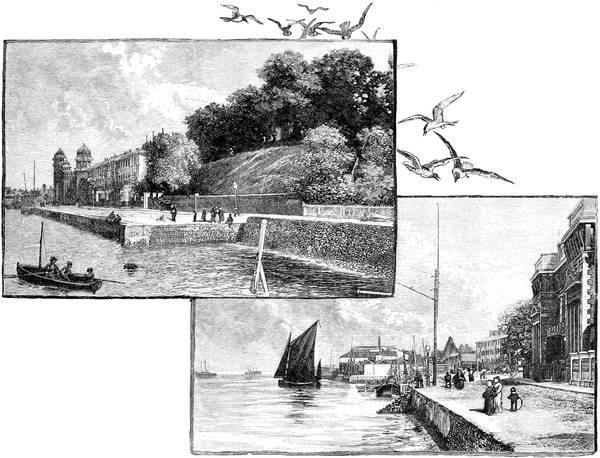
AT GRAVESEND.
The whitebait itself has been almost as much the subject of discussion as the origin of salmon. Is it the young of herring, or of sprats, or of fish of many varieties? The question would seem easy enough to answer, though it can scarcely be said to have been finally answered even now. The one thing really certain about whitebait is, that it is a very dainty fish, equally good whether white or “devilled,” as grateful to the palate whether fried in flour or broiled with a little cayenne. Scientific opinion, after once appearing to be convinced that whitebait is young shad, now inclines to the conviction that it is the young of a variety of species. The whitebait itself, however, seems to conspire in the concealment of its identity. Kept in captivity on one occasion, it will turn into herring, kept in captivity on another, it becomes the common sprat. Some specimens, indeed, have been known to assert themselves as pipe-fish, gobies, and stickleback, so that, though the whitebait fishermen resolutely assert the individuality of the species, it will perhaps be on the whole more safe to take sides with the men of science—and the accomplished cook.
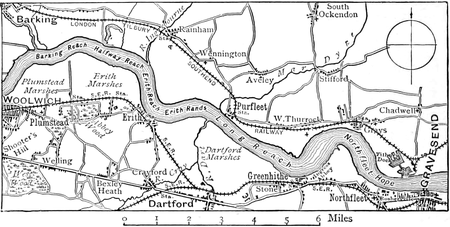
WOOLWICH TO GRAVESEND.
There is, from some points of view, no more interesting spot on the Thames than Gravesend Reach. Here, after narrowing for a portion of its distance, the river spreads out again, and proceeds on a perfectly straight course to Cliff Creek. Gravesend Reach is three miles and a half in length, and is usually more populous with shipping than any other point between the Nore Light Ship and the Pool. All outward bound ships must take their pilots on board at Gravesend, and so it frequently occurs that here the last farewells are said and the last kisses are given. In the Reach, vessels wait for the changing of the tide, so that at one period of the day it is full of ships with their sails furled, and, at another, of vessels newly spreading their canvas to the wind. A breezy, stirring place is Gravesend Reach, enthralling at all hours and in all weathers, stormy sometimes, sometimes as calm as a lake on a windless night, but most beautiful on grey, uncertain days, when the light shivers downward through flying clouds, and breaks and sparkles on tumbling crests of wave; when the ships at anchor sway hither and thither on the turbulent waters, and make with their masts and cordage a continuous and confused movement against the sky; when the barges coming up from the Medway tear and strain under their canvas like horses impatient of the bit; when the half-furled sail flaps and battles in the wind, and the sea-birds, now darting to the water, now leaping towards the flying clouds, seem to be driven about against their will. Gravesend Reach, where David Copperfield said adieu to Mr. Peggotty and Mrs. Gummidge, where little Em’ly waved her last farewell, where we lost sight of Mr. Micawber and the twins, where so many tears have been shed, and so many hearts have seemed to be broken! What a ceaseless current of commerce flows through it, inward to the mightiest of European cities, outward to every country that the sun shines on. Whither is bound the vessel that is unfurling its sails yonder? Whither! To far Cathay, it may be; to obscure ports on the furthermost verges of the world.
AARON WATSON.