SIR RODERICK FOWLE—A LEGEND OF THE OLDEN TIME.
Reading edition
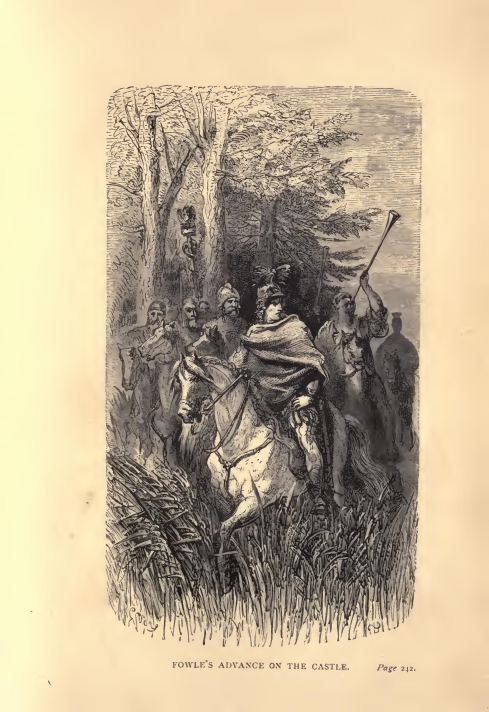
I. Sir Roderick Fowle has returned from the East, Where believers are fighting the Paynim; Though they slaughtered his squire, and they wounded his beast, No Saracen foeman has slain him. II. He has crossed the salt seas, and has come to the land Where no man of battle afraid is, But all have, in war, a keen blade and strong hand, And, in peace, a true heart for the ladies. III. To the land of the Gaul is Sir Roderick come (Concluded his Saracen fighting), And with joy and delight is struck perfectly dumb, On the shores of his country alighting— IV. The land where he’d lived as an innocent child (And now he’s a vigorous man, see!), Where Ida, the lovely, had first on him smiled And captured his heart and his fancy. V. Sweet Ida, the daughter of Montmolon’s lord (How blest to possess such a daughter!), Was fairest of fair demoiselles—in a word, All the marrying bachelors sought her. VI. But “attentions” she cared for but little, said she, And, really, seemed scarcely to heed’em; And for marrying! oh! ’twas like “felo de se,” If you could keep your spinsterly freedom. VII. So she turned up her aquiline nose at them all, And refused a round dozen of offers From lords and from knights, who would constantly fall At her feet with their hearts and their coffers. VIII. Till fate in her way threw Sir Roderick Fowle, Before he departed this war on, Then love made the damsel as blind as an owl, And she promised herself to the Baron. IX. The war was declared—there was no time to woo, When legions and armies were forming, But, handsome and bold, he knew well what to do, So he carried the fortress by storming. X. And she promised to wed, if he shouldn’t be dead, When the Christians had settled the Paynim. He must go there, he said; but she wanted, instead, By her apron-string still to detain him. XI. But he’d promised to go, and he would, and he must (These men are such obstinate cattle!), So his heart to her keeping the lover did trust, And set off, like a man, to the battle. XII. He went, and he came, and sustained his great name, For when was a Fowle e’er behindhand? And returned to receive the sweet laurels of fame From his Ida’s most willing and kind hand. XIII. When a man’s seeking laurels, to keep him at bay Is a deed most exceedingly cruel, So we’ll hasten our baron along on his way To the casket which held his bright jewel. XIV. Lofty and high were the Montmolon towers, And fortified, too, beyond measure, Lest any bold lord of the neighbouring powers Should harry the Montmolon treasure. XV. Sir Roderick gazed on the gloomy old wall, Which the ivy was slowly corroding, When a sight met his eyes which his heart did appal, And fill with a fearful foreboding. XVI. Where the Montmolon banner of old used to wave, And merrily flaunt in the breezes, No banner hung now—all was still as the grave, Or the form that death’s quietude seizes. XVII. The place looked so bleak—‘tis a sad thing to speak, But sad things sometimes must be spoken; And the winds they did shriek through that castle antique, For there wasn’t a window unbroken! XVIII. The mark of a foe did Sir Roderick know Full well—far too well to mistake it; And he groaned deep and low, in sad accents of woe, Ere he turned round his horse to forsake it. XIX. But he stopped; for a groan quite as sad as his own Seemed to come from the shrubberies near him, And an old man he spied, sitting there all alone, Who appeared in no manner to fear him. XX. He approached, and affright half gave way to delight At the chance his lost bride to regain her, When he recognised quite, in this dolorous wight, A Montmolon former retainer. XXI. “Old man!” he cried out, “what’s this fuss all about? And has there been any disaster? You seemed crippled, no doubt: is’t rheumatics or gout? And where are your mistress and master?” XXII. With a guttural sigh, like one going to die, The man raised him up on his knees, and Thus made him reply, though the news, by-the-bye, He scarce could get out of his weasand. XXIII. “I’ve a sad tale to crack. Noble sir, you’ve come back To a house sacked from basement to attics; Too long do I lack kitchen chimney and jack For gout—let alone the rheumatics! XXIV. “I speak but with pain, for I’m slaughtered and slain (Just look at my garments all gory), But my breath I would fain a while longer retain Till I’ve told you our terrible story. XXV. “Fair Ida, I fear, you will scarcely find here, Though the room which was hers still you may see, For ‘tis nearly a year since with bow and with spear Hither hastened Sir Marmaduke Tracy. XXVI. “With soldiers in scores, ammunition, and stores, He attacked our unfortunate village; He battered our doors (‘twas the greatest of bores). And allowed all his people to pillage. XXVII. “When the storm ‘gan to lower, folks fled to the tower, Young and old the same thing very soon did; We did all in our power, and young Ida’s own bower Was turned into a ward for the wounded. XXVIII. “For months four or five we continued to strive; None ventured on shirking or shamming, Till one-half of our hive were no longer alive— Consumed between firing and famine. XXIX. “When our lord ‘gainst the rout could no longer hold out, He gave in, like a sensible covey; No food was about, save one bottle of stout, Half a loaf, and a pot of anchovy. XXX. “Then at length did we let (though with wondrous regret) Sir Marmaduke through the portcullis; And the treatment we met no one there will forget, Unless he a regular gull is. XXXI. “The Tracy began, and took ev’ry tenth man ‘ Of the Baron of Montmolon’s people, Saying, ‘Fly, if ye can, for ye soon will be dan— Cling from top of the neighbouring steeple. XXXII. “‘Since ye foolishly list, Tracy’s arms to resist, Ye shall see how his mercy shall treat ye; And your wives shall be kissed, if by them ye are missed In your homes, while the carrion eat ye.’ XXXIII. “His men had the knack; not a rope was too slack, Not a victim could loosen or slip cord. Our baron looked black; but his arms ‘hind his back Were fastened together with whipcord. XXXIV. “He hanged these poor chaps, but I fancy that, perhaps, The other men’s lot was the sorest; Without clothes, shoes, or caps, but with plenty of slaps, He turned them adrift in the forest. XXXV. “Some starved, sank, and died; some few went beside Themselves with cold, hunger, and sorrow. 'Twas little you spied of the Montmolon pride, When you looked at this place on the morrow. XXXVI. “That truculent Goth, Sir Tracy, took both Our lord and his beautiful daughter. 'To wed me,’ he quoth, ‘though the damsel be loth, To reason I soon shall have brought her.’ XXXVII. “I, escaping from hurt, more by chance than desert (My brother on Tracy’s estate is), Have lived, I assert, sitting here in the dirt, Upon nothing but berries and praties. XXXVIII. “I was wounded, indeed; don’t you see how I bleed? And I’ve had ne’er a surgeon, which is hard; But my master’s sad need, and the loss of his breed, 'Tis that, sir, which sticks in my gizzard. XXXIX. “My strength ‘gins to fail: want of beef and of ale (How well I remember the brewin’!) My frame doth assail; but I’ve told you the tale, And your eyes may behold the sad ruin.” XL. He stopped: faint and sore, he could utter no more, But sank on the ground, softly sighing; His troubles were o’er: he was turned of four-score, And was dead ere he knew he was dying. XLI. Sir Roderick stood at the tidings aghast: Sad change from glad anticipation; But he spoke out at last; not too loud or too fast, But in accents of deep indignation. XLII. “By all that is holy, by all that is blue, By the eyes of adorable Ida, Sir Marmaduke Tracy shall bitterly rue The moment when first he espied her! XLIII. “I vow and declare, and I solemnly swear, That, fearless of dagger or bullet, I’ll rout out that bear from his murderous lair, And slit his detestable gullet. XLIV. “My life to the project henceforth I devote; All else to this one shall knock under, Till I fasten my hand on his treacherous throat And tear the vile spoiler asunder! XLV. “When next here I tread, it shall be to be wed; But I mustn’t stay now any longer; This old fellow’s dead—there’s no more to be said, He has perished of wounds and of hunger.” XLVI. Then he turned his horse round (who sprang off with a bound, Accustomed in battle to dash on), And with clattering sound, galloped over the ground In a most irrepressible passion. XLVII. Two months had elapsed since that terrible day When the Montmolon castle was taken, And the baron and Ida were carried away With small prospect of “saving their bacon.” XLVIII. The Tracy had taken them off to the rock On which his own castle was builded; Which, he boasted, was safe from an enemy’s shock, Whatever his valour or skill did. XLIX. Glenlighton its name; ’twas a beautiful place, As you saw when you came nigh and nigher it; But delectable Ida averted her face, Too wrapt in her grief to admire it. L. Arrived, they were placed in a large suite of rooms, Locked up, and a strong guard set by ‘em, And for weeks they saw none but retainers and grooms, Who were ordered with food to supply ‘em. LI. For Sir Marmaduke Tracy had reason to ride To some lord’s in the neighbouring valley: Ere he thought of a bride, he the spoils must divide With the friends who’d connived at his sally. LII. But returning (too soon!) one fine morning in June, When brightly and warmly the sun shone, He came whistling a tune all along the saloon, And joined the small party at luncheon. LIII. “Now, Baron,” quoth he, “prithee hearken to me: To escape you may shortly the way see: If you e’er would be free, you must quickly agree, That your daughter becomes Lady Tracy. LIV. “I am elderly, true; it were better for you That death hadn’t taken my son John. But refuse! if you do, why, the day you shall rue In a most insalubrious dungeon.” LV. Says the Baron, “I burn your assault to return, And, spite of your luncheons and he cook, My child will soon learn your proposals to spurn, You lubberly son of a sea-cook! LVI. “The battle you’ve won, vile son of a gun, Though more by your cunning than merit; But, much though you’ve done, I can tell you that none Can break the true Montmolon spirit. LVII. “Sir Guy de la Vaux, I assuredly know, Will avenge the foul trick that you’ve played me; And the Lord Montereaux to my rescue will go, Though houseless and homeless you’ve made me. LVIII. “No daughter of mine to a man will incline Who has murdered her father’s retainers. Those are my views in fine; my brave girl, I opine, Will in language more pretty explain hers!” LIX. Then Ida, “Papa, all your sentiments are My own—you are always so ready. And besides, much I fear, that though mighty in war, Sir Marmaduke’s rather unsteady. LX. “And I’m bound to declare, though hardly I dare (And my courage is quite down at zero), For another I care, and it wouldn’t be fair To give up my faithful young hero. LXI. “I met him, you know, nearly five years ago, Abroad, at the Henley regatta, So I’m bound to reply to Sir Marmaduke ‘No,’ Although his attentions may flatter.” LXII. The Tracy laughed loud at the maiden so proud, But, says he, “Come, a truce to your chaffing; It must be allowed that you don’t seem much cowed, But you’ll find it no matter for laughing. LXIII. “You, madam, when cool, your affections must school To follow Sir Marmaduke’s pleasure; And, Baron, you fool and cantankerous mule, In a dungeon shall ponder at leisure. LXIV. “Nor think you secure that your friends will be truer Than others have been in like cases; Sir Guy is too poor, and I’m perfectly sure 'Twill be long ere the Tracy he faces. LXV. “And the Lord Montereaux died lately, I know (He always was rather dyspeptic); 'Tis a good week ago since they popped him below, Carried off by a fit epileptic. LXVI. “‘Tis never my bent, you must know, to relent, And trouble you’re surely enough in, So your aid must be lent to make Ida consent, Unless you’re a regular muffin. LXVII. “Meantime, to a dungeon I’ll order you off, Where the damp very constant and dense is; And when crippled entirely with fever and cough, You’ll probably come to your senses.” LXVIII. He spoke, and withdrew, and the baron they threw Into dungeon both damp and unpleasant; And left him to ponder, as well he might do, On the change from the past to the present. LXIX. Still, with wonderful pluck, to his orders he stuck That his child shouldn’t marry the tyrant; And Ida, sweet duck, though quite “down on her luck,” Still frowned on the daring aspirant. LXX. Then Sir Tracy, irate, said she tempted her fate, Declining so firmly to choose him; For he ne’er could abate in his love for a mate, Who he knew would be sorry to lose him. LXXI. Ten days he’d allow her, he swore, when much vexed, And partially drunk on his own ale; But each day she refused to be his, on the next Should be wrenched from her father a toe-nail! LXXII. Now the baron was gouty and tender of feet, A man, too, of delicate nurture, And to injure him thus would be making complete The system of underground torture. LXXIII. So Ida she stood on the turreted wall On that very identical even, And loudly for aid and assistance did call On Roderick Fowle and on Heaven. LXXIV. What is it she sees through the leaves of the trees? By Jove! ’tis a warrior’s banner, And men, thick as bees, drawing nigh by degrees In a most unmistakable manner. LXXV. She views them approaching the castle so dread, And prays they may soon overwhelm it; For she sees they are led by a chief at their head With a Hen, painted large, on his helmet.
Original Size -- Medium-Size
LXXVI. At this gladdening sight, she exclaimed in delight, “My Fowle is at hand to assist me! I’m positive quite I shall soon be all right, And again those dear lips will have kissed me!” LXXVII. Sir Roderick true, as he came full in view And espied his adorable lady, Like a cock loudly crew, “Im coming to you!” And a spring towards the battlements made he. LXXVIII. He’d got a siege-train (as I here should explain), And a terrible ram for to batter, Which with might and with main, plied again and again, The walls of the fortress should shatter. LXXIX. Then he shouted his war-cry,—well known in the East,—’ “Cock-a-doodle!” and brandished his pennon, Rushed on to the castle, not fearing the least, But urging his valorous men on. LXXX. The cruel Sir Marmaduke Tracy, meanwhile, Had been taking a quiet siesta, For he’d promised poor Ida, with sinister smile, That day, that he wouldn’t molest her. LXXXI. But, hearing the shock, at the foot of the rock, He came up by the maiden upon it, Of his foeman took stock, and exclaimed, “My young cock, ‘Tis a daring attempt, had you won it!” LXXXII. Fowle, clambering high, could invent no reply; Says Tracy, “Though parleying you shun, Your end is so nigh, let me hope that to die You prepared ere you planned this intrusion.” LXXXIII. Then a vast mass of brickwork he moved on a ledge Just above the unfortunate lover, And with all his great strength pushed it just to the edge Of the turret, then toppled it over. LXXXIV. With a rush and a roar, it went tumbling o’er, With but little less rumble than thunder; Fowle’s chance, small before, what event can restore If that terrible mass he lies under? LXXXV. Then Sir Marmaduke bowed to the maiden quite cowed While her flesh with sheer terror was creeping, And said, “Madam so proud, it must now be allowed, There’s no catching the Tracy a-sleeping.” LXXXVI. “Come near, without dread,” he tauntingly said, “On this ledge I will make by my side room; See, your lover is dead! so we now may be wed, And I’ll make you a capital bridegroom!” LXXXVII. But she looked with disdain, for, that moment, again From the thick cloud of dust just emerging, Fowle stood forth quite plain ‘mid the wounded and slain His heroes to energy urging. LXXXVIII. “False Tracy,” he cried, “from my beautiful bride Avert your detestable gazes, Descend to my side that the fight may be tried!” Says Sir Marmaduke, “Fowle, go to blazes!” LXXXIX. Quoth he, with a sneer, and a laugh and a jeer, “Go home with your battering ram, Fowle; ‘Tis perfectly clear I am better up here, So I think I shall stay where I am, Fowle!” XC. He stood, winking his eye, on that battlement high, And was turning, poor Ida to wheedle, When the maiden, so spry, clapt her hand to his thigh, And thrust up to the hilt a sharp needle. XCI. With pain did he flush—gave a jump and a rush— Lost his balance—strove hard to re-win it, When she gave him a push, and with terrible crush He was over the cliff in a minute! XCII. The sides of the hill he clutched at, until— He found that he couldn’t quite come it, So at last had his fill, and, exhausted, lay still, Having rolled to the foot from the summit. XCIII. And there did he lay, dying fast, in a way Which nobody willingly chooses; For the light of the day did his carcase display, A mass of incurable bruises. XCIV. Fowle’s soldiers stood o’er the poor man in his gore, Who groaned, “I must go to ‘Old Harry;’ ‘Tis a terrible bore! I shall soon be no more, And you, Fowle, the damsel will marry. XCV. “Lady Ida,” quoth he, “has been too much for me; Her will in rough fashion she teaches. One comfort will be, that Fowle, do you see, Will find that his dame ‘wears the breeches’! XCVI. “I am, I confess, in the deuce of a mess, With numbers of sins to repent of: There are some you may guess, but a lot more, unless I told you, you’d never get scent of. XCVII. “I’ve had wives a full score: aye, I think twenty-four, Who at times I’d by fraud or by force court: And I own that before I sought after more I ought to have tried the Divorce Court! XCVIII. “In a dungeon down-stairs you’ll find some of the ‘fairs:’ I hadn’t the heart to destroy ‘em; But, in spite of their prayers, if they gave themselves airs, Sent them down, in the dark to enjoy ‘em. XCIX. “My soldiers are bold; they had better be told There’s nothing the fight should be won for: Their leader, though old, by a girl has been ‘sold,’ And is most undeniably ‘done for’!” C. He raised himself then, and bawled out to his men, “No reason, my hearties, to fight on: The crest of the Hen will float over my den— Farewell to the Lord of Glenlighton!” CI. Then he gave a great groan (as the Baron had done If they’d tortured and made him a sore nail), And his side turning on, exclaimed, “Crikey! I’m gone And was instantly “dead as a door-nail”! CII. What need to relate how they opened the gate, And admitted Sir Fowle and his forces? How he entered in state, and showed clemency great, All this a mere matter of course is. CIII. And how the fair Ida sprang into his arms; How they built up the Montmolon Tower, I Dare say you can guess; and additional charms Fowle found in her ladyship’s dowry. CIV. Glenlighton they seized; there was none to dispute: And Tracy’s broad lands fared the same, too: The place and the country their fancy did suit, So they took all the land they laid claim to. CV. Nor need it be said that ere long they were wed, These lovers, no more to be parted: Full soon the tree spread; and young children were bred; True Fowles—who were ne’er chicken-hearted. CVI. That fort on the rocks (when repaired from the knocks Received in Sir Roderick’s fighting) Made a snug little box, where, like true fighting-cocks, They live, at the hour I am writing. CVIII. Fowle’s deeds are well known—not in that land alone, But, where’er tales of valour hearts quicken, Men exclaim in loud tone to this day, “We must own Such or such man’s ‘as game as a chicken.’” CVIII. The Baron lived long; he was healthy and strong, And never ate things one had best shun; So went in “ding dong” at the sound of the gong, And was blest with a wondrous digestion. CIX. Now I’ve told all I know about Fowle and his foe, There’s no more that requires explanation: On all I’ll bestow my blessing, and so Conclude, with a bow, my narration.
As soon as the Monarch of the Rhine had finished his poetical legend (to which his companion listened with the most profound attention), he rose from his seat, and declared that he could really wait no longer, or he should be late for his appointment with those other continental rivers to which he had already alluded. Regret was plainly visible upon the countenance of Father Thames as his Brother Rhine expressed this determination, and he began to endeavour to persuade him to stay a little longer. He of the Rhine, however, seemed to be inexorable, and reminded his entertainer of the good old motto, “Welcome the coming, speed the parting guest,” which he declared that he had always held to be an exceedingly wise and proper saying.
Father Thames raised no objection to this, but at the same time observed that he also had several rivers who desired to see him, but that he had postponed their visit in order to do full justice to that of his foreign friend. The Isis and the Cam had indeed sent representatives to wait upon him, as was their annual custom, and enormous crowds of people in steamers, on barges, and on his banks had come out to witness the arrival and triumphant progress of these, which had taken place between Putney and Mortlake, and had as usual created great excitement. But other visitors he had put off, and had still more time to devote to the Rhine Monarch if he could be prevailed upon to stay. This, however, was impossible, and the two friends were about to part when Father Thames casually observed, “I hope all will go well with you, Brother Rhine, until we meet again.”
The other heaved a deep sigh. “I hope so, indeed,” he replied; “but in these days of progress who can tell what will happen next? Instead of haunted castles I have now Legislative Bodies, which are often possessed by much worse spirits than those which occupied the old ruins; instead of giants I have Ministers; and in the place of river-demons an enlightened Press; and goodness only knows what may become of me at any moment.”
“I, too,” responded Father Thames, “have trials which are almost beyond endurance. What with Water Companies, Conservancy Boards, and Embankments, I have of late years been driven nearly wild; and although they have at some places given up the fine old practice of draining into my waters everything that was foul and abominable, and thus creating a public nuisance in the shape of disagreeable and unwholesome odours, which they afterwards had the impudence to attribute to me, and associate the nuisance with my name, yet I am scurvily treated by mankind in general, and made the unwilling receptacle of dead cats and other unpleasant objects, and have my water taken from me in large quantities, when I would much rather retain it.”
“All this is very bad,” remarked the Rhine King. “Why not leave such a country and come home with me?”
“No, thank you,” drily returned Father Thames, “not even the blessings which you have enumerated as now in your possession could tempt me to take such a step. I should miss my beef and ale too much.”
“Ale!” hastily interrupted his companion. “How you continue to harp upon that beverage of yours, which, after all, cannot compare with that which I drink on mine own river. Come, good brother, before I go let me sing you one of our famous Rhine songs in honour of the immortal wine with which my banks are blessed.” And without more ado about the matter, the Rhine Monarch sang as follows in a rich and voice:—
I. “A fig for your sherry or foaming champagne! I’d not give a groat for the whole of your stock; Of thirst if I hear my companions complain, I hold out my bottle with—‘Accipe Hoc! Accipe Hoc, Accipe Hoc!’ I hold out my bottle with—‘Accipe Hoc!’ II. “At night your port-wine bibber drowsily nods, And wakes hot and heavy at crowing of cock; The liquor offer is fit for the gods, And blesses the drinker, so—‘Accipe Hoc! Accipe Hoc, Accipe Hoc!’ It blesses the drinker, so—‘Accipe Hoc!’ III. “Of brandy and whisky I sing not in praise, For feet they make stagger and heads they make rock; But the man who is hoping to lengthen his days, Should list to my counselling—‘Accipe Hoc! Accipe Hoc,’ &c. IV. “Away with your brewing, away with your ale! (Though such a proposal your feelings may shock;) For all your malt liquors infallibly pale Before my Rhine vintage, so—‘Accipe Hoc! Accipe Hoc,’ &c. V. “‘Tis wine that ne’er robs man of senses or wit, But hearts can make lively and tongues can unlock; Makes dull men for once for good company fit, And bright ones still brighter, so—‘Accipe Hoc! Accipe Hoc,’ &c. VI. “Come, fill up your glasses! the toast shall be mine, And loud in applause on the table you’ll knock; When I give you ‘The glorious vintage of Rhine!’ And long may each comrade sing, ‘Accipe Hoc! Accipe Hoc, Accipe Hoc!’ Long may each comrade sing, ‘Accipe Hoc!’”
As the Monarch of the Rhine proceeded, I observed a cloud gathering over the brow of Father Thames, which grew darker when uncomplimentary allusion was made to his favourite ale, and by the time that his guest had concluded his song had deepened into a tremendous and awful frown. Scarcely was the last word out of the singer’s mouth than he burst forth in fury. “Brooks and fountains!” he exclaimed in a loud voice, “is it thus I am to be insulted upon mine own waters? and am I to sit still and be silent while these insolent foreigners extol their thin and miserable drinks at the expense of the noble beverage upon which Britons have fattened and thriven ever since they were a people? Off with thee now, then, as soon as thou listest, thou hock-swilling loon, for I cannot put up with such trash!”
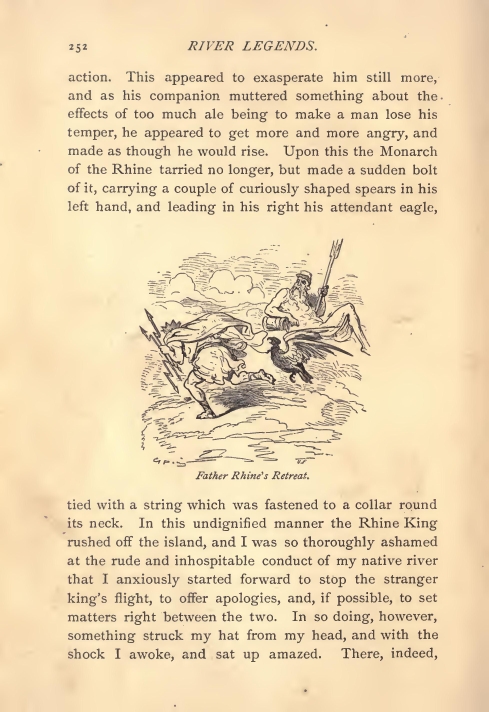
The Rhine King had already risen; but at these words the greatest astonishment was depicted upon his countenance, for he had really meant no offence, so far as I could see, and for my own part I was myself astonished at the conduct of Father Thames in taking notice of such a trifle. He did so, however, and was apparently quite ready to follow up his words with corresponding actions; for, reaching out his left hand, he raised from beside him a species of instrument somewhat resembling a three-pronged fork, which I had not noticed before, and overset his tumbler with his right hand in the action. This appeared to exasperate him still more, and as his companion muttered something about the effects of too much ale being to make a man lose his temper, he appeared to get more and more angry, and made as though he would rise.
Original Size -- Medium-Size
Upon this the Monarch of the Rhine tarried no longer, but made a sudden bolt of it, carrying a couple of curiously shaped spears in his left hand, and leading in his right his attendant eagle, tied with a string which was fastened to a collar round its neck. In this undignified manner the Rhine King rushed off the island, and I was so thoroughly ashamed at the rude and inhospitable conduct of my native river that I anxiously started forward to stop the stranger king’s flight, to offer apologies, and, if possible, to set matters right between the two. In so doing, however, something struck my hat from my head, and with the shock I awoke, and sat up amazed. There, indeed, was the dear old river flowing on and on at my feet; there was the island, and upon it were the reeds and willows as usual, but the River Monarchs were nowhere to be seen. They had passed away like a dream, and no doubt I should be told that all I had seen and heard was only the results of a visit to dreamland during my nap that afternoon.
It was getting dark, and I could only just see the stately shape of Windsor Castle rearing itself above the town in the distance, whilst, to the left, the buildings of my beloved Eton appeared to be shadows fading away in the fast-approaching darkness of night. “Absit omen!” I exclaimed as I sprang to my feet. “The glory of Eton shall never fail whilst England is England; and, least of all, shall the love of her sons for the dear old college ever fade or lessen whilst life endures. I, at least, will be a boy as long as I live in my love for Eton and Eton boys, and to their approval will I submit the legends which I have heard here to-day.”
Filled with these thoughts, I hurried home as fast as I could, and wrote down from memory what I had heard and seen, resolving, if possible, to obtain some further information from the same sources if ever the opportunity should again present itself.