RICO AND STINELI. (continued 3)
Louise Brooks translation
"Yes; when I was little," said the lad. "Then I went away."
"How did you get here when you were little, Rico?"
"I was born here."
"What! here? What was your father, if he came here from the mountains yonder?"
"He did not come here from the mountains; only my mother did."
"Do I hear aright, Rico? Was your father born here?"
"Certainly. He was a native of this place."
"You never told me this before. This is wonderful. You have not a name like the people here. What was your father's name?"
"What was his name? It was Henrico Trevillo."
Mrs. Menotti sprang up from the seat as if she had had a shock.
"What did you say, Rico?" she cried out. "What did you say just now? Tell me again."
"I told you my father's name."
Mrs. Menotti was not listening: she ran towards the door.
"Stineli, bring me a kerchief," she cried. "I must go to the priest at once: I am trembling all over."
In great surprise, Stineli brought out the kerchief.
"Come with me a few steps, Rico," said the good woman, as she went through the garden. "I must ask you something more."
Rico had to repeat his father's name twice over; and when they had fairly reached the door of the priest's house, for a third time Mrs. Menotti asked,—
"What did you say it was? Are you quite sure?"
She hurried into the priest's house, and left Rico wondering what could have happened to put her into such a way.
Rico had brought his violin with him, for he knew that Stineli was particularly pleased to hear it. When he reached Silvio's room, he found the little boy and his companion in the best of humor. Stineli had fulfilled her promise about the story of Peterli's funny doings, and this had amused Silvio exceedingly. When the latter espied the violin, he cried out at once, "Now let us sing; let us sing the 'Lambkins' with Stineli."
Stineli had never heard her song since it was composed that day on the mountain, for now Rico played such beautiful airs that she had quite forgotten the old ones. But she was astonished to hear Silvio asking for the German song, for she had no idea of the hundred times the two boys had repeated it during the three years that were past. She was much pleased to hear the old song again, and, above all, to sing it with Rico; and so they began. Silvio sang with all his might,—without understanding a single word, to be sure, but the tune was quite correct. It was the girl's turn to laugh now; for Silvio's pronunciation was most wonderful, and she could not join in for laughter, and it was contagious; for the child could not resist the merry expression of her face, and joined her in laughing, and sang again still more queerly and louder; and all the while Rico played his accompaniment without stopping.
And thus Mrs. Menotti's ears were greeted with laughter and song as she drew near the house on her return, and she could not understand how they could be so light-hearted and merry on such a momentous occasion. She came hastily through the garden, and into the room, and sank upon the nearest seat; for the shock and the joy, and the anticipation of what was to follow, had overpowered her, and she needed to recover herself a little. The sight of her agitation silenced the singers, and they gazed at her in surprise. At last she recovered, and said,—
"Rico,"—and her voice was quite solemn,—"Rico, listen to me. Look about you. This house, this garden, that field,—all, all that you can see, and much that you cannot see, belongs to you: it is all yours. You are the owner; it is your inheritance from your father; your home is here; your name stands in the baptismal record; you are the son of Henrico Trevillo, and he was my husband's dearest friend."
Stineli had understood the whole story at the first word, and her face beamed with unspeakable happiness.
Rico sat as if turned to stone, and made no sound; but Silvio broke out into shouts of delight,—it was all a play to him.
"Oh! now the house belongs to Rico, where is he going to sleep?"
"He can sleep in any room he chooses, Silvio. He can sleep in them all if he wishes to. He can turn us all out-of-doors if he has a mind to, and stay all sole alone in this house."
"I am sure I should much prefer to go away with you, then," said Rico.
"Oh, you good Rico!" cried Mrs. Menotti. "If you will let us stay here, we shall be so glad to remain. I have thought it out as I came along towards home, and know how we can arrange it so that we shall be happy. I will take half of the house of you, and the same with the garden and all the land; so one half will be yours, and the other Silvio's."
"I shall give my half to Stineli," said the child.
"So shall I," said Rico.
"Oh, ho! now the whole thing belongs to her,—the garden, and the house, and all that is in them; and Rico and his fiddle, and I too. Now let us go on with our song."
But Rico did not take the same view of the affair as his little friend. He had thought over Mrs. Menotti's words, and now asked, anxiously,—
"I do not understand how Silvio's house can belong to me because our fathers were friends."
It now occurred to Mrs. Menotti for the first time that Rico did not know any thing about the circumstances; and she told him the whole story, with all the particulars, even more minutely than she had told it to Stineli; and when she had finished they all understood perfectly how it was, and were at liberty to rejoice without restraint; for since the house and all belonged partly to Rico, there was no reason why he should not take possession at once, and never leave them again; and their rejoicing was great.
In the midst of their merry-making Rico said, suddenly,—
"Since things have turned out this way, Mrs. Menotti, do not let any of the arrangements be disturbed in the house; but every thing go on as usual. I will simply come here to live, and you shall be our mother."
"O Rico! to think that it is yours, that it is you who are the master. How good God is to let it all turn out in this way,—that I can give it all to you, and yet stay here myself with a clear conscience. I will be a mother to you, Rico; and indeed you have long been as dear to me as if you were my own child. Now you must call me 'mother,' and so must Stineli; and we shall be the happiest household in all Peschiera."
"Well, now let us finish our song," cried little Silvio; for he was so excited and glad that he felt that singing was the only way to express his joy; and the others were not unwilling to join him, and they did finish their song; then Stineli said,—
"Now will you not sing one other song with me, Rico? You know which one I mean."
And they sang the grandmother's hymn piously, and in beautiful accord, especially the favorite verses at the end,—
"He never yet has done amiss; And, perfect in His sight, All that He does or orders is Sure to be finished right. "Now only let His 'will be done,' Nor clamor constantly, Peace to the heart on earth will come, And joy eternally."
The next day Rico did not go to Riva. Mother Menotti advised him to go at once to the landlady, to explain to her the change in his circumstances, and to order another fiddler to be sent to Riva, while he at once entered upon his possessions. Well pleased with these suggestions, the youth hastened to carry them out.
The landlady heard his wonderful story with great interest, and at the end she called out to her husband and told it all over to him, and testified real pleasure at the good fortune that had befallen her young friend, and was sincere in what she said. She certainly was sorry to lose him; but she had suspected for some time that the hostess of the "Three Crowns" was making advances to Rico in the hope of enticing him away from her; and that would have been dreadful to the "Golden Sun." Now any danger of that misfortune was averted, and she was glad to hear that Rico was a house and land holder himself, for he was a great favorite with her. Her husband was particularly well pleased; for he had been a friend of Rico's father, and did not now understand why he had not earlier noticed that the lad was the exact image of the man.
So the farewells were all spoken in good feeling, and the landlady took his hand at parting, and asked for his patronage if ever there was occasion for her services in his house.
That very evening the news was known in all Peschiera, with all the true details, and a great many more; and everybody expressed pleasure, and said that Rico looked exactly as if he owned an estate, and would grace the position.
Mother Menotti did not know how she could do enough to make Rico comfortable in his own house. She arranged the big room for him—the one that had two windows overlooking the garden, and with a view over the lake—with beautiful marble statuettes adorning the walls; and on the table she placed a vase of flowers, and the whole room was most prettily furnished, so that Rico stood still on the threshold when, at Mrs. Menotti's request, Stineli led him up there. And when the kind, motherly woman took his hand and led him to the window, and he looked down in the shimmering lake, and over at the purple mountains in the distance, his heart filled to overflowing with thankfulness, and he could only murmur, softly,—
"Oh, how beautiful! And this is my home!" And now day after day the four happy friends lived their peaceful life in the comfortable room looking on the garden, where Silvio lay, and never perceived how the time was speeding away.
In the daytime Rico went about with his whistling servant lad through the fig-trees and over the fields planted with corn, for he wanted to learn the care of it all.
Now the servant naturally thought, "I know much more than my new master," and felt sensible of his superiority over Rico; but when, in the evening, beautiful and heart-stirring music came forth upon the evening breeze from the well-lighted room, where they all sat together, the boy leaned against the hedge and listened for long hours; for music was his greatest delight, and he said to himself, "My master knows more than I do, after all;" and he could not help feeling a great respect for Rico.
CHAPTER XXI.
SUNSHINE ON THE LAKE OF GARDA.
Two years have passed, every day bringing more enjoyment than the last.
To Stineli came the knowledge that it was time for her to return to her home, and she had many a hard battle with herself to keep up her courage and cheerfulness; for to go away, and probably never return, was the most dreadful prospect that ever presented itself to the young girl's imagination. Rico also knew what was before them, and sometimes he would only speak when it became absolutely necessary. And a strange, unnatural feeling took possession of mother Menotti, and she tried to discover the secret cause; for she had quite forgotten that Stineli was to go home again to be confirmed. When at last the cause of the trouble came out, she said, "Oh! you can put that off for another year;" and so things fell back into their old comfort again.
On the third year, however, a message came from Bergamo (some one came down there from the mountain) that Stineli was wanted at home, and must go. Now there was no help for it. Silvio might fight against it like one possessed: it did no good. Against fate it is useless to struggle.
Mother Menotti said, day after day, towards the end, "Only promise to come back, Stineli. You may tell your father I will do any thing he wishes, if he will only let you come back soon."
Rico said nothing at all. And Stineli went off; and day after day it seemed as if a big black cloud lay over the household, and as if the very sun outside had ceased to shine.
And so it went on from November to Easter, when everybody was rejoicing; but it was still sad in Rico's house. After the Easter festival was over, and every thing was beginning to be more beautiful than ever before in the garden, and flowers and sweet odors were spread all abroad, Rico sat by Silvio's bedside, and played every sad melody that he could remember, until the little fellow was in a most melancholy mood, when suddenly from the garden a merry voice called out,—
"Rico, Rico! have you no more cheerful welcome for me than this?"
Silvio screamed as if beside himself. Rico threw his violin on the bed, and ran out; and mother Menotti came in, half frightened.
On the threshold stood Rico with Stineli; and so in Silvio's room there was the long-lost sunshine back again, and they were as merry as ever again, and happy as they had never believed would be possible during their long separation. There they all sat at table by Silvio's bedside, and questioned and answered, and told all that had happened, and ever and again broke out into rejoicing over their reunion. Who would have thought, to see them there, that any thing could be wanting to the perfect happiness of these four people? But Rico knew another tale. In the midst of all the merriment, he became absent-minded, and fell into one of his old dreamy moods. It did not last as long as formerly, however. He must have reached a satisfactory conclusion pretty soon; for suddenly his reverie was over, and he said these words, with the utmost decision, "Stineli must be my wife this very moment, or else she will have to go away again directly; and that we could not endure."
This decision pleased Silvio mightily; and in a short time they were all of the same way of thinking, that the sooner the marriage took place the better.
On the very most beautiful May morning that ever shone over Peschiera, a long procession started from the church towards the "Golden Sun."
At the head, tall and well-proportioned, came Rico with his stately mien; and at his side walked Stineli, looking happy and pretty, her smooth braids crowned with the fresh bridal wreath. Next in the procession, in a well-upholstered little wagon, drawn by two merry Peschiera urchins, Silvio might be seen, beaming with satisfaction like a triumphant victor; and last of all followed mother Menotti, very much moved and affected, in a rustling wedding-dress; behind her the servant lad, with a nosegay that covered his whole shirt-front; and after them streamed all Peschiera, with the very noisiest kind of participation, for they all wanted to look at the handsome couple, and to do them honor. It was almost like a great family festival, in which they all joined to help the strayed and lost Peschiera boy to found his own home in his native town.
The joy of the landlady of the "Golden Sun," when she saw the procession coming towards her house, is quite indescribable. Whenever the question arose concerning any wedding, low or high, she always said, with emphasis,—
"That is nothing at all in comparison with Rico's wedding in the 'Golden Sun.'"
The house in the garden never again lost its sunshine, and Stineli took good care "Our Father" was never forgotten again; and on every Sunday evening the grandmother's hymn was sung in the garden in full chorus.
HOW WISELI WAS PROVIDED FOR.
CHAPTER I.
COASTING.
On one of the hills surrounding the city of Bern a little village is perched which shall be nameless in this story; but if you are curious, and go there in your travels, perhaps you may recognize it from the following description. On the very top of the hill stands one solitary house, with a beautiful garden about it. It is called "On the Height," and is the property of Colonel Ritter. The descent to the little square, where the church and parsonage stand, is sharp (in the parsonage the colonel's wife passed her happy days of childhood); and somewhat farther down is the schoolhouse, amid a little cluster of houses; while on the left, as you still descend, you see a lonely cottage with a pretty, well-kept garden, surrounded by currant-bushes, and adorned with mignonette and pinks, and a few roses amidst its chiccory and spinach. This is the last house on the road, which, from here on, makes one long stretch downward to the highway that goes far out into the country, parallel with the river Aar.
This long, unbroken descent forms, in winter, the most perfect coasting-ground imaginable; for once you are past the steep bit by the colonel's house, you may go on without interruption quite down to the road by the river; that is, always supposing that you make a fair start at the beginning.
This coast was an endless source of pleasure to the army of children who daily poured out of the door of the old schoolhouse when lesson hours were over, ran to the yard where they had piled their sleds on entering, took each his own from the heap, and scampered off in wild haste to begin their afternoon amusement. How the hours passed no one could imagine: down flew the sleds in a twinkling, and nobody felt the trouble of climbing up the hill, so full were all the little heads of the pleasure of going down again; and so the night, and the time for returning to their homes for supper, always took them by surprise.
This usually occasioned a stormy scene before they left the coasting-ground; for everybody wished to go down "once more," and then "just once more," and then "one single turn more,"—so that everybody hurried and jumped onto the sleds, and flew down and ran up again in a regular hurry-scurry.
A rule had been established to the end that no one should go down the coast while the others were still climbing up, but that all should go down one after the other in good order, to prevent confusion or accidents. Notwithstanding this good rule, there were often many lawless proceedings, especially towards the close of the day, when nobody wished to be the last, and when they all crowded onto the coast very closely together.
This was the state of affairs on a clear evening in January, when the snow fairly crackled under the children's feet as they mounted the hill, and the fields in every direction were frozen so firmly that you could have gone anywhere over them in a sleigh as if they were the highway. The children were all rosy and glowing with their exertions, for they were hurrying up the steep hill, pulling their sleds behind them, turning them about in a flash, jumping upon them, and off again head foremost, not to lose a second of the precious time until the moon shone brightly in the crisp sky, and the evening bells were ringing. All the boys were shouting, "Once more; just once more!" and the girls were as eager as they. At the top, however, where they all threw themselves upon their sleds, there was great excitement and uproar. Three boys each claimed to have reached the top first, and would not yield an inch to each other, but all must go down at once. And so they pushed this way and that, until a big boy called Cheppi was hustled quite against the bank of snow at the side of the coast, and found that his heavily ironed sled was fast in the snow. He was furious, for he saw that now all the other fellows would get off before he could extricate himself. He looked about, and presently espied a little slender girl standing near by in the snow. She was very pale, and held both arms wrapped in her apron to keep them warmer, for all that she trembled and shivered with cold from head to feet. She looked so feeble and miserable, that she seemed to Cheppi just the proper object upon whom to vent his rage.
"Can't you get out of a fellow's way, you stupid thing? What are you standing there for? You have not even a sled with you. Just wait a moment; I'll help you to get along!"
So saying, he thrust his boot into the snow, intending to kick it over the girl. She sprang back, however, quickly, so that she went quite up to her knees in the snow, and said timidly, "I was only looking on."
Cheppi was thrusting his boot into the snow again with the same intention towards the child, when he received such a tremendous box on the ear from behind, that it almost knocked him off his sled. "Just you wait a minute," he shouted, beside himself with anger, for his ear tingled as it had never tingled before; and doubling up his fists, he turned himself to see who was his hidden foe. A boy stood behind him, and looked on very quietly, holding his sled in position for another coast.
"Come on," he said calmly.
It was Otto Ritter, a class-mate of Cheppi, with whom he was always engaged in some little quarrel. Otto was a tall, slender boy, about eleven years old, and not nearly of the same strength as Cheppi; but the latter had learned more than once that with hands and feet Otto was much the more skilful of the two. He did not strike out, but held his fists doubled up, and cried out angrily, "Let me alone: I am not meddling with you."
"But I am with you," replied Otto, in a very warlike tone. "What business have you to chase Wiseli away like that, and then to kick snow at her, I should like to know? I have been looking at you, you coward! teasing a little girl who cannot defend herself."
With these words he turned his back contemptuously towards Cheppi, and called out to Wiseli, who was standing shivering all this time in the deep snow,—
"Come out of the snow, Wiseli. Oh, how you are shivering, child! Have you no sled really, and only been able to look on? Here, take mine, and go down once quickly. Do you know how?"
The pale, timid girl did not know what to make of this kindness. She had been looking on for some little time, watching the sleds as they flew down the hill, and thinking, "Oh, how I should like to go down to the very bottom just once!" when she saw two, and sometimes three, going down on the same sled. But now she might go down all alone by herself, and that, too, on the very handsomest sled on the coast,—the one with a lion's head, that went faster than any other, because it was light, and was bound with iron. She was so happy that she stood still, looking after Cheppi with a half feeling that he might strike her if she dared to enjoy such a piece of good fortune. But there he stood quite tranquilly, as if nothing whatever had happened; and by him stood Otto, with such a protecting air, that she took courage, and seated herself on the handsome sled; and when Otto called out, "Go on; go on, Wiseli!" she obeyed, and away she flew as if the wind were behind her. Very soon Otto heard the coasters all toiling up the hill again, and he called out, "Stay among the first, Wiseli, and go down again; after that we must go home." Wiseli was only too happy to do as she was bid, and enjoyed for a second time the long-wished-for pleasure. Then she brought the sled to its owner, thanking him shyly for his kindness, but more with her beaming eyes than with words; and off she scampered as fast as she could go. Otto felt decidedly happier. "Where is Pussy?" he called out, peering into the already scattering crowd. "Here she is!" replied a merry voice; and out of the knot of children appeared a red-cheeked, plump little girl, who slipped her hand into her big brother's protecting palm, and went with him towards their father's house as quickly as possible. It was very late, and they had over-passed the allotted time for coasting.
CHAPTER II.
AT HOME WHERE ALL ARE HAPPY.
When Otto and his sister came noisily in through the deep stone entrance of their father's house, the old servant Trine appeared in a doorway holding a light high above her head to see whence came all the uproar, and from whom. "So," at last she said, half scoldingly, half pleasantly; "your mother has been asking for you for a long time, but there was no trace of you, although it struck eight nobody knows how long ago." Old Trine had been maid-servant in the family when the children's mother came into the world, so she was an authority in the household, and felt that she was one of its members,—to tell the truth, the very head of the establishment; for surely she was the oldest in age and experience. The dear old woman was fairly foolish in her fondness for her master's children, and very proud of all their qualities and acquisitions. She would not let this be seen, however, but employed an indignant tone when speaking to them; for she thought it best for their education not to appear perfectly satisfied with their conduct.
"Off with your shoes, on with your slippers!" she called out at once, according to rule; but her order was immediately executed by the commander, for she knelt before Otto while she spoke, to take off his wet shoes. He had sunk down upon the nearest seat. His little sister stood perfectly still in the middle of the room without stirring, which was such an unusual circumstance, that Trine looked over her shoulder two or three times to see what it could mean. Now that Otto was equipped, it was Pussy's turn to sit down and be attended to; but she stood stock still, and did not stir. "Well, well! if we wait there until summer comes, our shoes will get dry of themselves," said Trine, still on her knees. "Hsh, hsh, Trine! I hear something. Who is in the big parlor?" said Pussy, lifting her forefinger up a little threateningly. "Everybody who has dry shoes: nobody else admitted. Now make up your mind to sit down," said Trine. But instead of sitting down, Pussy made a spring upward, and cried, "Now I hear it again; Uncle Max laughs just like that." "What!" cried Otto, and reached the parlor-door with one leap.
"Wait, wait!" Pussy called after him, and ran to the door at the same time; but she was caught and placed on the seat, although old Trine had hard work to get the shoes off the little kicking feet; but perseverance at last accomplished the business, and off ran Pussy out of one door and through the other into the big parlor, where truly sat Uncle Max in the arm-chair. Now there was a fine jubilee, and a hugging and kissing over and over. Uncle Max certainly made as much noise as the children, and it was a long time before they were quieted enough to speak a rational word to each other. A visit from this uncle was always a time of great delight for the children, and with good reason, for he was extravagantly fond of them. He was a great traveller, and only came to see them once in two years; but then he made up for his long absence by giving himself entirely to his little friends as if he were no older than they; and the queer and enchanting presents that he had stuffed into every pocket for his little niece and nephew would be hard to describe.
Uncle Max was a naturalist, and travelled to every corner of the world, bringing back something curious and interesting from each place.
At last supper was served, to the immense satisfaction of the whole party,—for the children always brought home new appetites from the coasting-ground, and were prepared, both old and young, to do full justice to the steaming dishes set before them.
"Well," said Colonel Ritter, glancing across the table at his little daughter, who was seated beside her mother, and already too busily engaged in satisfying her hunger to look up from her plate. "Well, well; it seems rather strange to think that Pussy has no hand to spare for her papa to-day. I have not had one single kiss, and now it is too late."
With a contrite air Pussy pushed back her plate, saying, "O papa, I forgot! I will give you"—
But her father said, quickly, "No, no; do not make a disturbance now, child. Give me your hand across the table; we will have the rest later. That will do now, Pussy."
"What was this child christened, Marie? I was certainly present at the ceremony, but I have utterly forgotten her name. Not Pussy, I am sure," said Uncle Max, laughing.
"You certainly were present, Max," replied his sister, "for you are the child's godfather. She was named Marie. At this time her father nicknamed her Pussy, and Otto has multiplied that in the most nonsensical manner."
"Oh, no, mamma; not nonsensical," cried Otto, quite seriously. "You see, uncle, it follows in very sensible order. When the little thing is gentle and good, then I call her 'Pussy.' That is not always the case, however, and 'Puss' does for some of her moods; but when she is angry, and looks like a regular cross-patch, then I call her 'Old Cat.'"
"Yes, yes, Otto," answered his sister; and when you are angry, you look like a—like a"—
"Like a man," said Otto; and as Pussy had no better comparison ready, she went on busily eating her pudding.
Uncle Max laughed heartily. "Pussy is right," he said. "She does far better in pursuing her present occupation than in answering back such slanders. But, children," he began again, after a pause, "it is more than a year since I was here, and you have not told me about any thing that has taken place during my absence."
The latest events were those that occurred first to the children; and they began to tell, generally both speaking together, the story of Cheppi's rude treatment of Wiseli on the coast, and of how cold the girl was, and how she stood shivering in the snow, and had no sled of her own, but got a chance to coast down twice after all.
"That is right, Otto," said his father. "You must honor your name. You must always be a true knight for the persecuted and unprotected. Who is this Wiseli?"
"You cannot know any thing about the girl nor her mother," said his wife. "But Uncle Max knows Wiseli's mother very well. You remember that thin weaver who was our neighbor, don't you, brother? He had an only daughter with big brown eyes, who often came to us at the parsonage, and sang so sweetly. Can't you remember her now?"
While Uncle Max was trying to recall the somewhat fading recollections of his youth, old Trine put her head into the room, saying,—
"The carpenter Andrew would like to speak to you, Mrs. Ritter, if it will not disturb you too much."
This apparently innocent message produced a wonderful effect upon the whole family. Mrs. Ritter put down the tablespoon, with which she was about to help her brother a second time to fruit, and said hastily, "If you will excuse me, gentlemen," and left the room. Otto sprang up so quickly that he knocked his chair over backwards, and then fell over it himself in his haste to get away. Pussy was about to follow the others; but her uncle, seeing the movement, put his arms about her, and held her fast. She struggled, however, and said, entreatingly,—
"Let me go, uncle; let me go. Really, I must go."
"Where do you want to go, Pussy?"
"To see the carpenter Andrew. Let me go quickly. Help, papa; help!"
"If you will tell me what you have to say to the carpenter, I will let you go."
"The sheep has only two legs left, and no tail at all; and the carpenter is the only person who can mend him. Now do let me go!" And now Pussy was off too.
The gentlemen looked at each other, and Max burst out into a merry laugh. "Who is this carpenter Andrew, pray, who seems to have the power of attracting your whole family to his feet?"
"You ought to be able to answer that question better than I," replied the colonel. "He must also be one of the friends of your youth. The fever of adoration you ought to understand also: it must be one of your family characteristics; and your sister has introduced it into her family. I can only tell you this much: this Andrew is the very corner-stone of my house. Every thing depends upon him, and we should all fall to pieces if his support were withdrawn from us. Andrew is the counsellor, comforter, safety, and aid in any trouble. If my wife thinks she wants any utensil for household use, even if she does not know how it should look, nor what use to put it to, Andrew the carpenter invents it, and makes it on the spot. If the kitchen is on fire, or the water gives out there, or in the laundry, Andrew the carpenter smothers the fire, and procures floods of water. If my son does some sad piece of mischief, Andrew the carpenter repairs the damage in a trice. If my daughter smashes all the crockery, Andrew the carpenter glues it together at once. So you see that this man is really the very pillar of my edifice; and if any thing should happen to him, we should straightway go to pieces."
Mrs. Ritter had returned to the room during this account of Andrew the carpenter's virtues, and her husband had heightened the description for her benefit. Uncle Max shouted with laughter.
"Yes, laugh away; laugh away!" said she. "For all that, I know very well what a treasure I possess in Andrew the carpenter."
"So do I, for that matter," said her husband, laughing merrily.
"I do, too," said Pussy, heartily, who was again on her seat at table.
"So do I," grumbled Otto, while he rubbed his shins, that ached from his recent fall over the chair.
"Well, now we are all of one mind about it, and the children can go quietly to bed," said their mother. These words did not tend to restore quiet, for the children became rebellious; but it was useless. Old Trine stood on the threshold, and was ready to carry out the family rules and regulations. Off marched the children, and presently their mother also disappeared again; for there were the evening prayers to be said, and she never failed to be at their bedside for that.
When, at last, every thing was in order in the house, Mrs. Ritter joined the gentlemen once more.
"At last!" said the colonel, with a sigh of relief, as if he had vanquished the enemy. "Now you see how it is, Max. My wife belongs first of all to the carpenter Andrew, then to the children, and only to her husband when there is nothing else for her to do."
"And now you see, Max," said his sister, laughing, "that, although my husband speaks scornfully of Andrew the carpenter, he does assign him a very high rank after all. Now acknowledge that, won't you? He has just given me a message for you. He has brought his yearly savings with him to-day, and begs for your assistance."
"That is true," said the colonel. "A more orderly, industrious, reliable man I do not know. I would trust my wife, my children, my goods and chattels to him rather than to any one else. He is the most honorable, trustworthy man in this parish, or in any other, I do believe."
"Now you see, Max," said his sister, laughing, "I could not say more than that." Her brother joined with her in her amusement at the zest which the colonel showed. Then he said,—
"You have all been so full of the praises of your marvel, that I have become curious, at last, to know where he comes from, and how he looks. Have I never seen him when I have visited you?"
"Oh, yes! you used to know him perfectly well," replied his sister. "You must remember Andrew, with whom we went to school. Don't you recall the two brothers who were always in the same classes with you? The elder was even then a perfect good-for-nothing,—he was not stupid, but would not study, and did not get on, and was put down into one of the lower classes with his brother and you. You must remember him,—his name was Jorg, and he had stiff, black hair. He always pelted us with something whenever he got a chance,—with green apples or pears, and in winter with snow-balls,—and always called us 'aristocrats.'"
"Oh, that fellow!" cried Max. "Yes; now I do remember all about him. Certainly he always called us 'aristocrats.' I wonder how he got hold of that word. He was a disagreeable fellow: I remember that well. I caught him once thrashing a little fellow most cruelly. I helped the little one, and he shouted after me at least twelve times in succession, 'Aristocrat, aristocrat!' And now it comes back to me about the other one, the lean Andrew, his brother. He was your Andrew, was he not, Marie?—the Andrew with the violets? Oh, now I comprehend this great friendship," said Max, laughing again.
"What is this about the violets? I want to know all about that," said the colonel.
"Oh! I can see the whole thing just as it happened as plainly as if it were only yesterday," said Max, quite animated over his recollections. "I must tell you all about it, Otto. You have probably heard from your wife that we had here, in the happy time of our childhood, an old schoolmaster, whose creed was that all faults could be whipped out of, and all virtues be whipped into, the children under his care. So he felt himself constrained to whip a great deal either for one thing or the other, and very often for both at once. Andrew's turn came one day, and the master applied his well-meant rule so heartily that poor, thin Andrew screamed with pain. At this moment my little sister, who had only entered the school a short time before, and did not understand the rules very well, stood up from her seat and hastened to the door. The teacher held his hand for a moment, and shouted after her, 'Where are you running to?' Marie turned about. The tears were running down her cheeks, and she said, very decidedly, 'I am going home to tell my father.' 'Wait, I will teach you!' cried the master, in the greatest surprise, and sprung after the girl. He did not strike her, however, but took her roughly by the arm, and set her down very hard upon the bench; then he said again, 'Wait, I will teach you!'
"It was the end of that, however. He did not touch Andrew again, and every thing passed off quietly that day. But the tears that Marie had shed for Andrew, and her protest against the whippings, were not forgotten. From that day forward a big bunch of violets was always placed on Marie's desk, and the whole room was perfumed with them; and later a still better scent filled the air, for there were every day great bunches of dark red strawberries, such as nobody else knew how to find. And so it went on for the whole year; but how the friendship reached the height at which it now stands, that I will leave to my sister to relate, for I do not know myself."
The colonel was much pleased with this story of the tears and the violets, and begged his wife to tell more about it. She said, "According to you, Max, violets and strawberries grow all the year round; but, in truth, it is not exactly the fact. But it is true that the good Andrew was never tired of bringing in any thing that he thought would give me pleasure all through the time we were in the school together. He left long before I did, and went to learn his trade of a joiner in the city. He came home very often, however, so that I never really lost sight of him; and when my husband bought this piece of land and we were married, it happened, also, that Andrew bought property, and wished to be settled. He had lost his parents, and was quite by himself, and a first-rate workman. He wanted the little house with the neat, pretty garden down there half-way to the church; but was not able to purchase it, because the owner wished for full payment at once, and Andrew could only pay in instalments, as he earned the money.
"But we knew all about him and his work. My husband purchased the place for him, and he has never had the least reason to regret it."
"No, indeed I have not," added the colonel. "Andrew has long ago paid for his house, and now he always brings me the yearly amount of his labor; and a very pretty sum it is, too. I invest it well for him, and have a sincere satisfaction in the welfare of the sturdy fellow. He is already a very well-to-do man, and adds to his property every year, and can make his little house into a big one if he have a mind to do so, the good Andrew. It is too bad that he is such a hermit, and cannot, therefore, properly enjoy his home and his possessions."
"Has he, then, neither wife nor family?" asked Max. "And what has become of his disagreeable brother Jorg?"
"No; he has really nobody," replied his sister. "He lives entirely alone, and really like a hermit. He has had a long and very sad history that I have been witness to, and which has taken away all the desire he once might have felt to look for a wife. His brother Jorg wandered about here in a disreputable way for several years, never working, but in the hope of getting something, by his infamous behavior, out of his family, who were respectable people, quite unlike himself. But, at last, he saw that there was no chance of this, and even the kind Andrew refused to pay any more of his debts, or to help him out of any more scrapes, so he disappeared, nobody knows where; but everybody rejoiced that he was out of the way."
"What was the sad story of which you spoke, Marie?" asked her brother. "I want to hear that, too."
"So do I," said the colonel; and lighted another cigar, in order to enjoy the tale more thoroughly.
"But, my dear husband," objected his wife, "I have at least told you this story ten times over."
"Really," said the colonel, quietly, "it seems that it pleases me then, if I ask for it again."
"Oh, do begin!" said her brother.
"You cannot have forgotten the child, Max," began his sister, "of whom I was speaking yesterday, who lived quite near to us. She belonged to the pale, thin weaver, whose shuttle we could always hear moving back and forth when we stood in our garden. The child always looked clean and neat, and had great lively, sparkling eyes, and beautiful brown hair. Her name was Aloise."
"I never knew anybody by the name of Aloise in my life," interrupted Max at this point.
"Oh! to be sure not," said his sister. "We never called her so, you especially. 'Wisi' we called her, to the horror of our dear departed mother. Don't you remember, now, how often you said yourself that we must get Wisi to sing with us when mamma played songs for us on the piano, and we could not make it go at all without Wisi's help?"
At last Max seemed to remember about it, and laughed at the recollection. "Oh, yes! I remember Wisi," he cried. "Yes, certainly that was Wisi. I can see her now, before my eyes, with her bright face, as she stood by the piano and sang so cheerily. I was very fond of her. I was very fond of her,—of Wisi. She was very pretty, too. I remember, too, what a shock it always seemed to mamma when I said, 'Wisi.' I really never knew her proper name."
"Oh, yes, you did," replied his sister; "because mamma always said it was perfectly barbarous to change the pretty name of Aloise into 'Wisi.'"
"I certainly never heard it each time," said Max. "But pray what has become of this Wisi?"
"You remember she was in my class at school, and we kept along together; and I often think of how Andrew always befriended and stood up for the girl through thick and thin, and that she knew well how to turn his friendship to good account.
"When she came with her slate full of examples, like the rest of us, her figures were not often correct; but she put the slate, with a merry laugh, on her desk, and lo! soon the sums were all rightly set down, for Andrew had put them in order. It often happened that she smashed a pane in the schoolroom window, or shook down the schoolmaster's plums in the garden; and yet Andrew was always the one who took the blame of these misdeeds,—not that anybody accused him, but he himself used to say, half aloud, that he believed it was his fault that the glass was broken, or the plums shaken down, and so he got the punishment. We children all knew well enough who was to blame; but we let it go, we were so used to it, and were so fond of the merry Wisi, that we all were pleased when she escaped punishment.
"Wisi had always pocketfuls of apples, pears, and nuts, that all came from Andrew; for every thing that he had, or could procure, he used to stuff into Wisi's satchel. I used often to wonder how it happened that the quiet Andrew liked the very most unruly and gayest girl in the school, and I also wondered whether she returned his affection. She was always very friendly with him, but she was the same with others; and as I once asked our mother how it could be, she shook her head a little, and said, 'I am afraid,—I am afraid that the nice little Aloise is a trifle heedless, and may have to suffer for it.' These words gave me much food for thought, and recurred to me again and again.
"We went together to the Bible-class; and every Sunday evening Wisi used to come regularly to our house, and we sang hymns together to the piano. She particularly enjoyed this. She knew all the lovely songs by heart, and sang them clearly and well; and mamma and I were very much pleased to know that Wisi liked to sing, and went gladly to the Bible-class, and seemed to take the religious teaching very much to heart. She had grown into a fine large girl now, with bright eyes; and, although she did not look very strong, like the peasant girls in the villages, still she had a fine color, and was far prettier than any of them.
"At this time Andrew was learning his trade in the town, but invariably came home on Sundays. He always came up to the parsonage to call, and was inclined to talk to me about our former schooldays; and gradually we worked round to Wisi, and talked about her most of the time. Andrew spoke most eloquently and feelingly on this subject; and, although everybody else had adopted the name 'Wisi' for Aloise, he never called her so, but said 'Wiseli' so softly and prettily, that it was very sweet to hear.
"But one Sunday (we were not quite eighteen years old, Wisi and I,—mamma was with us that evening) Wisi came in looking very rosy, and said that she had come to tell us that she was betrothed to a young workman who had come lately to live in the village, and that they would soon be married, as he had a good position, and it was arranged that they could be married in about twelve days. I was so surprised, and so sorry, that I could not say a word. Neither did my mother speak for a long time, but looked very much troubled.
"After a time she talked very seriously with Wisi,—told her that it was foolish in her to have taken up so quickly with a workman of whom she really could know very little, and especially when there was another who had sought her for long years, and plainly shown her how much he loved her; and, at last, she asked her if it could not be broken off, this engagement,—or, at least, put off for a while, Wisi was still so young, and ought to remain with her father. Then Wisi began to cry, and said that it was all arranged; that she had given her promise, and that her father was pleased. So my mother said no more about it; but poor Wisi cried bitterly, until my mother took her by the hand, and led her to the piano, and said kindly, 'Dry your tears: we will sing together.' And she played the accompaniment, and we sang,—
"'To God you must confide Your sorrow and your pain; He will true care provide, And show you heaven again. "'For clouds and air and wind He points the path and way; Your road He'll also find, Nor let your footsteps stray.'
"After this, Wisi left us apparently comforted, and my mother spoke kindly to her at parting; but I felt very sadly about the whole affair. I had a conviction that poor Wisi had passed her happiest days, and would never be light-hearted again; and I could not express my sorrow for Andrew. What would he say? He said nothing,—not one word,—but went about for several years like a shadow, and became more silent than ever, and had no longer the quietly happy expression that formerly distinguished him."
"Poor fellow!" cried Max. "And did he never marry?"
"Oh, no, Max!" replied his sister, rather reproachfully. "How could he do so? How can you ask such a question? He is faithfulness personified."
"How could I know that, dearest sister?" said Max soothingly. "I could not be expected to know that your gifted and inestimable friend possessed also the quality of steadfastness. But tell me some more about Wisi. I hope, truly, that the merry creature was not unfortunate. It would grieve me sadly to think that."
"I see plainly, brother, that all your sympathies are secretly with Wisi; and that you are not sorry for the faithful Andrew, whose heart was nearly broken when he found that he had lost her."
"Yes, yes," said Max. "I have the greatest sympathy for the good fellow. But do tell me how it was with Wisi: did she cry her pretty eyes out?"
"Almost, I believe," replied Marie. "I did not see her very often, and she had a great deal of work to do. I believe that her husband was not a bad fellow; but there was something very rough about him, and he was rude and unkind even to his own little children. Wisi had a hard time of it. She had a good many pretty children; but they were very delicate, and she lost them one after the other. Five she buried, and has only now one tender little girl,—a little Wiseli,—who is not much larger than our Pussy, though she is several years older. Naturally Wisi's health has been sadly tried with all this, and it is plainly visible now that it has almost reached the end with her. She is rapidly wasting away in consumption. I fear that there is no hope for her."
"Oh!" cried Max, "is this possible? Is it really so bad as that? Can nothing be done, Marie? Let us look after her, and try if we cannot mend matters somewhat."
"Oh, no! there is no chance for her," said his sister, sadly. "From the very beginning Wisi was too delicate for all the work and care that came upon her."
"And what became of her husband?"
"Oh! I quite forgot the sad trouble that poor Wisi had to endure with him also.
"About a year ago, he broke an arm and a leg in the workshop, and was brought home half dead. He was very ill, and could not work, and certainly was not a patient sufferer. Wisi had the care of him in his sickness, in addition to every thing else, and he died about six months after the accident. Wisi has lived alone with her child since that time."
"Then there will soon be nothing left but a little Wiseli, and what will become of her? But, no; it will not turn out so sadly, I am sure. Wisi will get well, and every thing be right again, as it should have been in the beginning."
"No, not so, Max; it is too late for that," replied his sister, decidedly. "Poor Wisi had to suffer sadly for her folly. But it is too late indeed!" she said, rising, almost frightened to see that it was after midnight, and that the colonel, who had been silent for some time past, was now sleeping in his arm-chair.
Max was not in the least sleepy, however. All this story of poor Wisi had awakened in him such lively recollections of his childhood, that he wanted to talk about many other events and people; but his sister was not to be persuaded. She took her bed-candle, and insisted upon going to bed.
There was nothing to be done but to awaken his brother-in-law, which he did with such a tremendous thump on the back, that the colonel sprang up with the feeling that he had been struck by an enemy's bomb-shell. But Max tapped him kindly on the shoulder, saying, "It is only a gentle warning from your wife that we must all beat a retreat." This was accomplished, and soon the house on the height stood quietly in the moonlight; and half way down the hill stood another house, where it would soon be silent, too, though a still feeble light glimmered there, casting a pale shadow through the little window out into the brilliant moonlit night.
CHAPTER III.
ALSO AT HOME.
At the same time that the colonel's children were going home, the little Wiseli ran along down the hill as fast as she could scamper, for she knew she had remained away longer than her mother liked that she should, and she very rarely did any thing of the kind. This evening had been one of such unusual pleasure for her that she had quite forgotten to go home at the usual time, and therefore ran all the faster, and so almost fell against a man, in her haste, who came out of the door of their cottage as she was rushing in. He stepped quietly to one side, and Wiseli hastened into the room, and went to her mother's side. To her great surprise, she found no light in the room,—her mother was sitting in the twilight, on a low chair by the window. "Mother," said the child, "are you angry because I was away such a long time?" and she put her arms around her mother's neck as she spoke. "No, no, Wiseli," said her mother, kindly; "but I am glad that you have come at last." The girl began at once to tell her mother about the delightful coast she had had on Otto's pretty sled,—how she had gone twice down the hill, and how pleasant it was. When she had finished her little story, she noticed, for the first time, how very quiet her mother was,—much more so than usual,—and she asked anxiously, "Why have you not lighted the lamp, mother?"
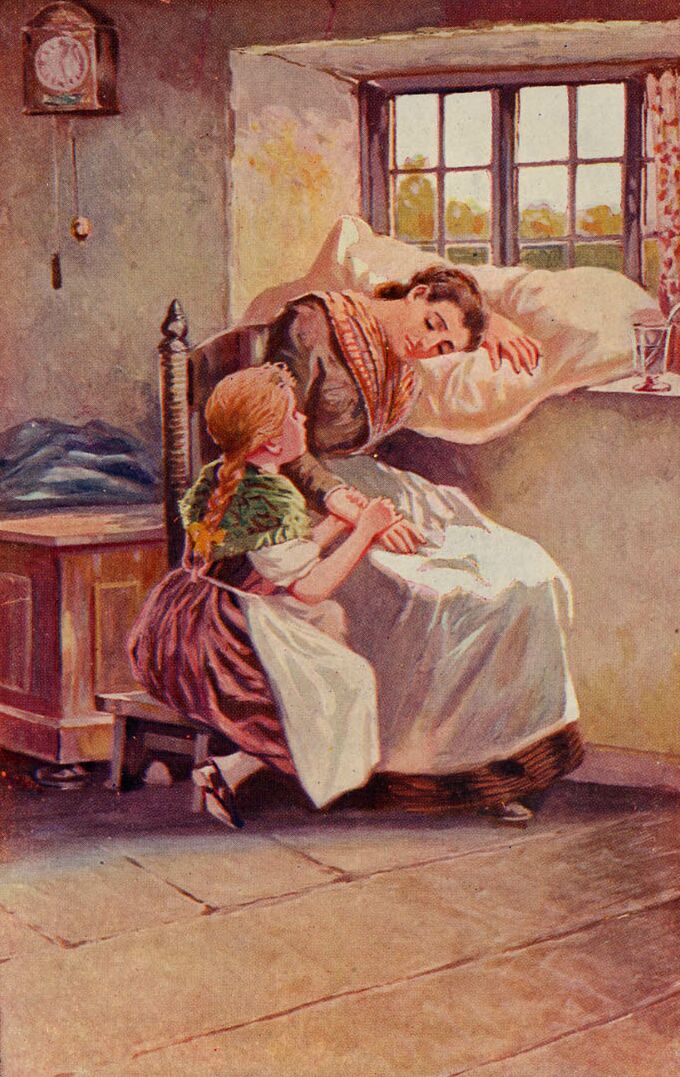
WISELI HASTENED INTO THE ROOM, AND WENT TO HER MOTHER'S SIDE
"I feel so weary this evening, Wiseli," replied her mother, "that I could not get up to light it. Go get it now, my child, and bring me a little water to drink at the same time, I am so very thirsty." Wiseli hastened to the kitchen, and soon returned with the light in one hand, and in the other a bottle filled with red syrup, that looked so temptingly clear and good, that the thirsty invalid called out eagerly, "What is that you are bringing me? It looks so good!"
"I do not know," said the child; "it was standing on the kitchen-table. See how it sparkles!" Her mother took the bottle, and smelled at it. "Oh!" she said, smelling again, "it is like fresh, wild strawberries. Give me some water, quickly, Wiseli; I must drink." The child poured some of the red syrup into a glass, and filled it with water, which her mother swallowed eagerly, as one parched with thirst. "You do not know how refreshing it is, child," as she handed back the empty glass. "Put it away, Wiseli, but not far. It seems to me as if I could drink it all the time, I am so thirsty. Who brought me this refreshment, Wiseli: do you know? It must be from Trine: she brought it from the colonel's."
"Did Trine come in here, mother?" asked the child.
"No; I have not seen her at all," said her mother.
"Then it is not Trine, I am sure," said Wiseli, decidedly. "She always comes into the room when she brings anything for you. But Andrew the carpenter came today: did not he bring this with him?"
"What, Wiseli," said her mother, very eagerly, "what are you saying? Andrew the carpenter never came to see me: what made you think of that?"
"He was here, certainly; certainly he was here within this house. He went out of the door so quickly that I almost ran into him. Did you not hear him at all?"
Her mother was quiet for a long time without speaking; then she said, "I did hear the kitchen door softly opened. At first I thought it might be you, and—it is true, I did not hear you enter until later. Are you sure, Wiseli, that Andrew the carpenter was the person who went out from our door?"
Wiseli was sure of her affair, and told her mother exactly how the coat and how the cap looked that Andrew wore, and how frightened he was when she almost ran into him; so that, at last, she convinced the good woman, who said softly, as if to herself, "Yes, it must be Andrew; he knows what I like best."
"Now I remember something else, mother," cried Wiseli, quite excitedly. "Now I know for sure who once placed a big pot of honey in the kitchen,—you remember how much you liked that,—and then the apple-cakes a day or two ago,—do not you remember? You wished to send your thanks by Trine when she brought you something from the colonel's kitchen, and she said that she knew nothing at all about them. Now I am sure that Andrew the carpenter brought them, and secretly placed them in the kitchen for you."
"Now I believe so, also," said her mother, and softly wiped her eyes.
"There is nothing sad about it, mother," said Wiseli, rather shocked to see how often her mother kept wiping her eyes.
"You must thank him for me, Wiseli: I cannot. Tell him that I send him my thanks for all the goodness he has shown me,—he has always been kind to me. Come, sit down here by me a little," said she, softly. "Give me some more of the syrup, and then come and repeat the verse that I taught you the other day."
Wiseli brought more water, and mixed it with the syrup again, and her mother drank of it eagerly; then she laid her head wearily upon the low window-sill, and beckoned her little daughter to come to her side. It seemed to the child that her mother could not be comfortable, and she fetched a pillow from the bed, and placed it carefully under her mother's head. Then she sat down close to her side on a footstool, and held her mother's hand in her own, and complied with her request to repeat the verses, thus,—
"'To God you must confide Your sorrow and your pain; He will true care provide, And show you heaven again. "'For clouds and air and wind He points the path and way; Your road He'll also find, Nor let your footsteps stray.'"
As Wiseli finished, she observed that her mother was almost asleep; but she heard her say, softly, "Think of this, my Wiseli; and when you do not know which way to turn, and every thing seems difficult and perplexing, then say to yourself these words,—
"'Your road He'll also find, Nor let your footsteps stray.'"
Now the weary head sank down to rest, and little Wiseli would not awaken her mother by a movement, but nestled up to her quietly, and slept also. And the feeble light of the little lamp burned dimly in the quiet room,—more and more feebly it burned, until it slowly flickered and went out, and the cottage stood a dark object in the bright moonlight.
The next morning the neighbor from the nearest house stopped, as usual, on her way to the fountain, to look through the window of the cottage to see if all was well within. She saw that the sick woman was sleeping on the pillow, with her head against the window-sill, and that Wiseli stood weeping by her side. This seemed so strange, that she put her head a little way into the room, and asked, "What is the matter, Wiseli? Is your mother worse?" The child sobbed dreadfully, and could scarcely say, "I do not know what ails my mother."
The poor child had a strong suspicion of what it all meant, but she could not realize that her mother was lost to her. For she was still there, but asleep,—asleep for all the rest of her daughter's life on earth,—and could not hear how sadly the child called to her. The neighbor stepped to the window and looked at the sleeping head upon the pillow; then she started back in alarm. "Run quickly, Wiseli; run and fetch your cousin Gotti. He must come at once. You have no other relation, and somebody must look after things here. Run as fast as you can: I will wait here until you come back."
The child ran, but not fast, her heart was so heavy within her, and her limbs trembled; and at last she had to stop and give way to her tears, for she became more and more sure, with every step, that her mother would never waken more. But she went on again soon, although she could not stop her tears, for her sorrow increased as she went. In the beech grove, full a quarter of an hour's walk from the church, stood the house of her cousin Gotti; and presently Wiseli entered the door, still crying bitterly. Her cousin's wife stood in the kitchen, and asked harshly, "What is the matter with you?" Wiseli replied, between her sobs, that the neighbor had sent her to ask her cousin Gotti to come quickly to her mother. Probably the woman suspected, from the child's look, that her mother was more ill, for she spoke a little less roughly than usual. "I will tell him. You can go home: he is not here now." So Wiseli turned about, and reached home more quickly than she came, for she was returning to her mother. The neighbor stood by the doorstep,—she could not wait inside the room: it was not pleasant to her. But the child stepped in, and went to her place by her mother's side that she had kept all through the night. There she sat weeping, and only said, now and then, softly, "Mother." But no answering word came to her. At last Wiseli said, bending over her, "Mother, you can hear me, although you are in heaven now, and I cannot hear your answer." And the child sat holding her mother's hand tightly until long after noontime. About that time her cousin Gotti entered the room, looked about him a little, and then called for the neighbor. "You must arrange things here a little,—you know what I mean," he said,—"so that things will be ready for the removal. Then carry the keys away with you, so that nothing will be taken." He then turned to Wiseli and said, "Where are your clothes, little one? Get them together and tie them up in a bundle, and we will go away."
"Where shall we go?" asked the child.
"We will go home to the beech grove. You can stay there with us, for you have nobody else in the world now but your cousin Gotti."
At these words, Wiseli felt herself stiff with fear. Go to the beech grove, and live with them there,—was that her fate? She had always had the greatest fear of the wife of her cousin Gotti, and always stood a long time before the door, when she was sent there with a message, before she could summon courage to enter. The eldest son, Cheppi,—that rough fellow,—lived there, and Hannes and Rudi; and they threw stones at all the children. Was that to be her home?
Fear caused the child to turn pale and immovable.
"You must not be frightened, my child," said her cousin Gotti, in a kindly tone. "There are more people in our house than there are here, but it is all the more lively for that."
Wiseli put her things silently together in a shawl, and tied the two corners together crosswise; then she tied her scarf about her head, and stood ready.
"So," said her cousin, "now we will go," and turned towards the door; but Wiseli sobbed out suddenly,—
"Then I must leave my mother all alone."
With these words she ran to her mother, and clasped her in her arms again.
Her cousin Gotti stood rather disconcerted, and looked on. He did not know how to explain how things were with her mother, if she did not understand without words; for he was not strong in the matter of expressing himself: he had never given himself the trouble to try. At last, he said,—
"Now come, come along. A little child like you must be obedient. Come; and, after this, no crying. That does not mend matters one bit."
The child swallowed her sobs, and followed the cousin Gotti silently through the door. Once only she glanced backward, and said softly, "God will watch over you, mother;" and then went forth with her bundle on her arm, and left the little house which had been home to her. Just as she and her cousin Gotti went together across the field, Trine came towards them down the road, with a covered basket on her arm. The neighbor stood in the doorway, and looked after the departing couple. Trine went towards her, saying,—
"To-day I am bringing the sick woman something good. A little late, to be sure. We have Uncle Max on a visit to us: that always makes me late."
"And even if you had come early in the morning, you would have come too late to-day. She died last night."
"That cannot be!" cried Trine, startled. "Oh, goodness me! what will my lady say?"
With these words she turned sharp about, and ran home as fast as possible. The neighbor went back into the quiet room, and performed the last kind offices for Wiseli's mother.
CHAPTER IV.
AT COUSIN GOTTI's.
When Wiseli made her entry into her cousin Gotti's house at Beech Grove, the three boys came running out of the barn, and, behind Wiseli, into the room, where they placed themselves in front of her in a row, and stared at the timid little thing with all their eyes. Her cousin's wife came out of the kitchen, and stared also at the little thing, as if she had never seen her before.
Her cousin Gotti seated himself behind the table, and said,—
"I think she can eat something: she has not had much to-day. Come here," he said, turning to Wiseli, who stood all this time in the same place, with her bundle under her arm. She obeyed. Now her cousin's wife put new wine and cheese on the table, also a huge loaf of black bread. Cousin Gotti cut a big slice, put a lump of cheese upon it, and pushed it towards the child. "There, eat, little one," he said. "You must be hungry, I'm sure."
"No, I thank you," said Wiseli, softly. She could not have swallowed even a crumb. She felt as if she were crushed under her load of sorrow and anxiety, and could scarcely even breathe.
The boys stood there all the time, and stared at her.
"Don't be frightened," said cousin Gotti, encouragingly. "Do eat something." But the child sat motionless, and did not touch her bread. Her cousin's wife came again; and, putting her hands on her hips, stood looking her over from head to foot.
"If you don't want it," she said, "you can leave it;" and turned on her heel, and went again into the kitchen.
When cousin Gotti had refreshed himself sufficiently he arose, and said, "Put it in your pocket. By and by you will feel like eating, only do not feel frightened;" and he went into the kitchen. Wiseli tried to do as he told her, to put the bread and cheese into her pocket; but they were too large, and she put them back upon the table again.
"I will help you," said Cheppi, snatching the pieces from the table; and was about to stuff them into his open mouth, but they flew up into the air instead, for Hannes had knocked Cheppi's hand up with a smart blow, and so the plunder was scattered, and Rudi darted upon it, and carried part of it away. With this the two oldest boys fell upon him, and they kicked and cuffed, and screamed and shouted, until Wiseli was terribly frightened. Presently their father opened the kitchen-door, and called out, "What does this all mean?" Then the boys all answered at once, from the floor; and one said, "Wiseli did not want it;" and another, "Wiseli had not any;" and "As long as Wiseli did not want any"—
Their father called out, loudly, "If you do not stop that, I will come in with the thong, and whip you." And he slammed the door again.
"It" did not "stop," however; but, as soon as the door was shut again, it began worse than ever, for Hannes found that the best way to treat the enemy was to grasp him by the hair; and so they all seized each other by the hair, and stood in a ring, uttering terrible noises. In the kitchen their mother sat on a stool, and peeled potatoes. When her husband closed the door again, she asked,—
"What is your idea about that child? Why did you bring her home with you at once?"
"I thought she would have to stay with somebody. I am her cousin Gotti, and she has no other relatives. You can make her useful. She can do what you are doing now. Then you will be able to do other things. You are always saying that the boys give you so much work,—more than is right."
"Yes, as regards them, a great help she will be! You can hear now what a racket there is in there, and she is only a quarter of an hour in the house."
"I have heard that sort of thing a good many times before the little one came. I do not think that she has much to do with it," said the cousin Gotti quietly.
"Oh, you did not hear them!" said his wife sharply; "how they kept calling out something about Wiseli?"
"Well, they may call out, if they want to," said their father. "You will soon have the little one in hand. I think she is not a troublesome child,—I noticed that in the beginning,—and is much more obedient than those boys of yours."
This was too much for his wife.
"I do not see what is the use of finding fault with the boys," she said; and she peeled the potatoes faster and faster. "And I should like to know where the girl is to sleep."
Her husband pushed his cap back and forth several times upon his head, and said, soothingly,—
"One can't think of every thing at once. She must have had a bed to sleep in; and she can, at least, have that. Tomorrow I will go to the pastor. To-night she can sleep on the bench by the stove. It is always warm there; and I can put a partition in the little passage that goes into our room later, and set her bed in there."
"I never heard of bringing home a child and getting a bed for it a week afterwards," said the woman crossly; "and I should like to know who will pay for it if we must build something more for her into the bargain."
"When the parish assigns the child to us, they will allow us something for her maintenance. I shall take her cheaper than any one else would do, and she will be more comfortable here too."
With this the cousin went out into the shed, and called out for Cheppi to come with him. It was hard for the cousin's wife to make herself heard in the room when she wished to give this message. They were all fighting away, and shouting angrily and loudly.
"I am surprised that you sit there looking on, and do not try to quiet them in the least," said their mother to Wiseli, who sat cowering against the wall, and did not dare even to move. Cheppi, however, was dispatched to the barn, and the two others ran after him.
"Do you know how to knit?" the cousin's wife asked Wiseli, who replied, timidly, "Yes, I can knit stockings."
"Well, then, take this," she said; and took from the cupboard a big brown stocking, with yarn almost as stout as Wiseli's little fingers. "Go on with the foot," she said, "and take care to make it big enough: it is for your cousin Gotti." Then she went back into the kitchen, and the little girl took her seat on the bench by the stove, with the long stocking coiled up in her lap,—for it was so heavy that she could scarcely knit if it hung down: it pulled the needles out of her hand. She had scarcely begun to work, however, before her cousin's wife came in again.
"I think you had better come out into the kitchen with me," she said. "Then you can see how I do things, and be able to help me a little by and by." Wiseli obeyed, and watched her cousin's wife at her work as well as she was able; but the tears kept coming into her eyes so that she could scarcely see, for she thought all the time of how she used to go about in the kitchen with her mother, who chattered so pleasantly with her, and how they would stop to kiss each other now and then. She knew very well that she ought not to give way to her tears, and tried to swallow her sobs, until she felt almost strangling.
"See here, look here," said the cousin's wife, every now and then; "then you will know how to do it by and by." And she went about, here and there, in the kitchen, letting Wiseli stand, and said nothing else to her. This went on for some time, when there was a terrible stamping in the entry, and the woman said, "Open the door as quick as you can: they are coming." The noise was made by the cousin and his sons, who were knocking the snow off their shoes before entering. Wiseli opened the door into the inner room as quickly as possible; and the cousin's wife lifted an enormous pan off the fire, and ran with it into the room, where she shook a great heap of potatoes out over the slate-topped table. Then she brought out a big jug of sour milk, and said, "Put the things that are in the table-drawer on the table, and then they can all sit down at once."
Wiseli pulled out the drawer as quickly as possible. There lay five spoons and five knives. She put these upon the table, and the supper was ready. The father and his sons came in, and sat down at once on the seats along the wall behind the table. At the other end stood a chair. Cousin Gotti made a motion towards the chair and said, "She can sit there, I think; or do you say no?"
"Oh, certainly!" said his wife, whose seat was nearest the kitchen-door. She did not remain seated a moment; but ran out into the kitchen and came back, took a spoonful of milk, and was off again.
Nobody knew why she ran about in this way, for there was nothing cooking in the kitchen, and nothing to bring out, but she always did so; and when, sometimes, her husband would say, "Do sit still, and eat something," then she seemed more hurried than ever, and said she had no time to sit still, there were so many things to be looked after.
When she had made two visits to the kitchen and returned, and began to peel a potato in great haste, she noticed, for the first time, that Wiseli sat idly by her side, her hands on her lap. "Why don't you eat something?" she said, angrily. "She has no spoon," said Rudi, who was seated on the other side, and had long been wondering why anybody should sit at table and not eat as long as there was any thing left. "Oh, yes, of course," said his mother. "Who would ever have thought that we should need six spoons? We have always found five enough; and we must have another knife too. Why can't you speak? You know well enough that to eat you want a spoon." These last words were addressed to Wiseli.
The child glanced timidly at the woman and said, "It is no matter: I do not need any. I am not hungry."
"Why not?" asked the woman. "Are you used to a different kind of food? I don't mean to change, if you are."
"I think it would be better to let the child alone for a while; we must not frighten her," said her cousin Gotti, soothingly. "She will feel better soon."
So Wiseli was unmolested, and the others were busily employed for a while. She sat there motionless until her cousin rose, took his fur cap from the nail, and began to look for the stable lantern; for "Spot" was sick, and must be looked after again that night. The table was quickly cleared. The empty potato-skins were brushed off into the empty milk-jug, the slate-top wiped off; and when the woman was done with this, she said, turning to Wiseli, "You have seen what I did; now you can do it the next time." Now Cheppi took his seat firmly behind the table again. He had his slate-pencil and arithmetic book, and prepared himself to do his examples. First, however, he stared for a while at Wiseli, who had again taken up her brown stocking, but did not make any progress; for she could not see a thing in the dark corner where she was seated, and she did not dare to draw nearer to the table where the dim lamp was placed. "You must have something to do," cried Cheppi, in an irritated tone. "You are not the smartest scholar in the school." The girl did not know what to answer. She had not been to school that day, and did not know what lessons were given out; and, besides, was quite out of her usual habits and life generally. "If I must do my examples, so must you, or I won't do them at all," cried Cheppi again. Wiseli kept as still as a mouse. "Well, then, it is all right," said the boy noisily. "I won't do another stroke of work." And he threw away his pencil.
"Then I won't do any thing, either," cried Hannes, and stuffed his multiplication-table into his satchel again; for learning his lessons was the hardest thing in the world for him.
"I will tell the master whose fault it is," began Cheppi again. "You can see, then, what you will get."
Probably Cheppi would have gone on in this unpleasant style for a long time, if his father had not soon returned from the barn. He brought in two big, empty grain-bags on his shoulders, and came up to the table with them.
"Make room," he said to Cheppi, who sat with his elbows on the table, supporting his head on his hands. Then he spread out his two bags, folded them together again, and then again. At last he went towards the bench behind the stove, and put them down on it. "There," he said, with an air of satisfaction, "that is good. Where is your bundle, little one?" Wiseli fetched it from her corner,—where it had lain ever since she arrived,—and looked with surprise at her cousin Gotti as he placed the bundle at the upper end of the folded bags, and pressed it down, so that it was not perfectly round.
"There, now you may go to sleep," he said, turning round to Wiseli. "You cannot be cold, for the stove is hot; and you can put your head on your bundle, and you will be as comfortable as if you were in your bed.
"And it is time for you three to go to bed, too. Off with you: make haste!" So saying, he took the oil-lamp from the table, and went towards the kitchen. The three boys clattered along after him.
When he reached the door, he turned again and said, "There, sleep soundly. Must not think any more to-night, and it will be better for you by and by," and he went out. Presently his wife came into the room with an oil-lamp in her hand, and looked at the place where Wiseli was to sleep. "Can you lie there?" she asked. "You will find it warm enough by the stove. There are plenty of people who have neither bed nor a warm place to be in. You won't suffer in that way, and ought to be thankful that you are under a good roof. Good-night."
"Good-night," replied Wiseli, softly; but the woman could not have heard her, for she was already away when she spoke, and had closed the door behind her immediately. Now Wiseli sat alone in the dark room. Every thing about her was suddenly silent,—not a sound to be heard. A straggling moonbeam shone through the little window,—enough to show the child where the bench by the stove was, upon which she must find her bed. She crossed the room, and seated herself there. For the first time that day since she had left her dear mother, she found herself alone, and able to think over what had befallen her. She had been constantly under excitement until this moment; for every thing that had happened frightened her. All that she heard or saw since she left her home had been so very unpleasant that she could not stop to think at all, but went from one alarm to another. Now there she sat alone, without her mother, and began to realize that it was all over,—that they would never see nor hear each other again in this world. And such a sense of loneliness, of utter desolation, took possession of Wiseli, that she believed herself uncared for and forgotten by everybody, and feared that she should be left there alone to die in the dark. The poor child laid her head down upon her bundle, and began to cry, bitterly and despairingly, "Mother, can you not hear me? Mother, do not you hear me call?"
Now Wiseli's mother had often told her little girl, that when things went very badly with us here below, then was the moment to lift up our voices and cry to God for help; for he would hear us in our trouble when all other's ears were deaf, and help us when no other help was possible. At this moment the child remembered these words, and she sobbed aloud, "Oh, you dear God in heaven! help me also, I am so unhappy, and my mother cannot hear me when I call!"
And when she had prayed thus several times over, she felt calmer. It comforted her poor little heart; for now she felt that God was really there in heaven, and could help her, and that she was no longer alone. And presently she recalled her mother's words,—almost the very last that she spoke: "My child, when you cannot see your way clearly before you, and every thing seems strange and difficult"—And now it was so; and how little she thought that it ever would be so, when her mother was talking to her. Her mother told her to remember the words of the hymn,—
"Your road He'll also find, Nor let your footsteps stray."
Now Wiseli first rightly understood these words, and felt their full meaning. Before she had repeated them mechanically, for not until now did she need them. But it was just her present case. Was not she full of perplexity? and what could she possibly have in her cousin Gotti's house but fear and trouble? And so she repeated, again and again,—
"Your road He'll also find, Nor let your footsteps stray."
The child had found her way to her heavenly Father, and knew that he was sure to help her; and she felt comforted. Folding her little hands, she began the hymn at the beginning, for it seemed like talking to a kind friend; and she said each word from her very heart:—
"To God you must confide Your sorrow and your pain; He will true care provide, And show you heaven again. "For clouds and air and wind He points the path and way; Your road He'll also find, Nor let your footsteps stray."
A quiet trust now took possession of the child's heart. She fell asleep soon after, her head supported on her little bundle, still repeating the last lines of the hymn. And a pleasant dream followed. She saw before her a dry bright pathway in the full sunlight, and the road led between beautiful red roses and lovely pinks that were so attractive that she longed to run to gather them. And by her side stood her dear mother, and held her hand tenderly in her own, as she always did; and her mother pointed along the pathway in her dream, and said, "See, my Wiseli; did not I tell you so? That is your way."
"'Your road He'll also find, Nor let your footsteps stray.'"
And the child was happy in her dream, and slept as soundly on her little bundle as if she were on a soft bed.
CHAPTER V.
HOW TIME WENT ON, AND SUMMER CAME.
When old Trine carried the news back to the heights, and told them there that Wiseli's mother was dead, and the child taken at once to her cousin Gotti's, the whole family became greatly agitated. Mrs. Ritter could not cease bewailing her neglect in not visiting the sick woman before, for she had been postponing it from day to day; but, of course, had not in the least realized how near the end might be. She was sadly cast down, and sorrowful. And Otto: he went raging up and down the room with great strides, and kept calling out angrily, "It is an injustice! It is a great injustice! But if he dares to lay a hand on her to harm her, he may look to his own bones, how many of them will be left whole in his skin!"
"Who do you mean, Otto? Who are you talking about in that way?" said his mother, looking curiously at her excited boy.
"About that Cheppi," he replied. "I do not know what dreadful things he will do to Wiseli when he has her there in his own house. It is not right, but just let him try"—But now Otto was interrupted by a repeated and heavy stamping that prevented his being heard. "Why do you make such a deafening noise, you pussy cat, there behind the stove?" he cried, turning his indignation towards another quarter. Pussy came out from behind the stove, but stamped more violently than before; for she was trying to force her feet into her wet boots, which it had taken the old Trine ever so long to pull off a while before. It was dreadfully hard work; and Pussy became as red as fire, while she said,—
"Don't you see that I have to do so? Nobody in the world could get these boots on without stamping."
"And what in the world do you want to put those wet boots on again for? I have just pulled them off, so that you should not have them on. I should just like to know what this means?" said Trine, who stood looking on all this time.
"I am going to the beech grove this very minute to fetch Wiseli to our house. She can have my bed," said Pussy, decidedly. But quite as decidedly old Trine stalked over to Pussy, at these words, lifted her up, placed her firmly on a chair, while she pulled off the boot that was half on; but said, in a pacifying tone, to the kicking and excited child,—
"That is all right! that is all right! but I will take care of you first. You must not get two pair of shoes and two pair of stockings wet through in one day. You can give up your bed. You can go up into the lumber-room, if you want to: there is room enough there."
But Pussy had a very different plan in her little head. She thought that she could free herself, in this wise, of a great and daily recurring trouble, that often gave her both inward and outward annoyance; namely, the being ordered off to bed every evening, and obliged to go, into the bargain, just as she was in the mood to enjoy herself especially. She thought that, if she gave up her bed to Wiseli, there would be none other at hand for her, and so she could stay up as long as she wanted to.
She was so delighted at this prospect, that she did not, at first, notice how the sly Trine had wisked off her wet boots, and that now there was no chance to fetch Wiseli.
When she fairly understood how she had been tricked, she set up such an outcry that Otto put his fingers in his ears, and her mother came in, a good deal alarmed at the uproar. She promised Pussy to talk over the matter with her father as soon as he came home; for he had gone away that very morning, with their Uncle Max, to pay a long-promised visit to an old friend. After a while peace and quiet were restored in the household. The gentlemen did not return for two weeks, however; but Mrs. Ritter kept her promise. The first thing that she mentioned to her husband, on the very evening of his return, was the fact of Wiseli being an orphan, and her new shelter; and the colonel promised to go to the pastor the very next day, to see what better arrangement could be made for the child; and, having visited the pastor, the colonel brought back the sad news, that, on the Sunday just past, the parish had taken the matter into consideration, and that it was now settled. Wiseli must be housed somewhere; and, as her mother had not left any property whatever, she must also be maintained at the expense of the parish until she could support herself. Moreover, her cousin Gotti had offered, in the first instance, to take the child for a very slight compensation. He wished to do an act of charity as far as he could afford it. He was known to be a well-conducted man; and, as he made so slight a demand, it was agreed and settled that the child should henceforth find her home with him.
"It seems to me a very good arrangement," said the colonel to his wife. "The child will be well cared for there; besides, what else could be done? She is much too small to be placed anywhere in service, and certainly you cannot take every orphan child in the neighborhood into your own house. You might as well turn it into an asylum at once."
Mrs. Ritter was very much disturbed by the news that every thing had been settled so soon. She had hoped to be able to have found a different home for Wiseli, who was, she knew, much too sensitive and delicate a child to be happy in a home where rudeness and roughness were the rule; but she had not a definite plan in her mind, and now there was nothing to be done but to try to look after the child's comfort a little, and to protect her, if possible.