Part 3 — DER RING DES NIBELUNGEN (continued 2)
Reading edition
"Siegfried charges her with shamelessness: faithful had he been to this blood brothership,—his sword he laid between Brünnhilde and himself:—he calls on her to bear him witness. Purposely, and thinking only of his ruin, she will not understand him."
In a speech of double meaning, she declares that the sword hung in its scabbard on the wall on the night when its master gained him a true love. Siegfried swears to his truth on the point of Hagen's spear, calling upon it to pierce him if he is false. This is a purely theatric touch. This spear does pierce him, yet was he not false. Brünnhilde swears upon the same spear that Siegfried has committed perjury. Thereupon Siegfried lightly says that she is daft, and bids the guests to let the festivities proceed. Brünnhilde now suspects some deviltry, but her runic wisdom is gone and she cannot fathom it. But she can and does confide to Hagen that she had made her hero invulnerable, except in the back. Gunther discerns that he has been dishonoured, yet he is loath, for his sister's sake, to be revenged upon Siegfried. This makes Brünnhilde all the more furious, and she readily assents to Hagen's proposition that Siegfried must die. The vacillating Gunther is overcome. Hagen shouts in triumph; the ring and the power will soon be his.
The last act shows the Rhine maidens sporting on the surface of the water in a little cove of the river. Siegfried, hunting and strayed from his party, appears on the rocks above them. They beg him to return the ring, and he is almost on the point of doing so when they warn him of its curse. He refuses to be scared into parting with it. This meeting with the Rhine maidens is not found in any of the old stories, because the ring which causes the trouble in "Götterdämmerung" is not in any way associated in the legends with the end of the gods. In both the Thidrek Saga and the "Nibelungen Lied," Hagen is warned of an evil by mermaids, and this may barely have suggested this scene, which so accentuates the immediately succeeding tragedy of Siegfried's death.
The hunting party arrives, and to cheer the gloomy Gunther Siegfried volunteers to tell the story of his youth. All this is original with Wagner. The hero narrates the incidents of the drama "Siegfried" to a wonderful epitome of its music, up to the slaying of Mime. Then Hagen administers an antidote to the drink of forgetfulness, and the hero reveals his discovery of Brünnhilde. Gunther is shocked as he realises Hagen's perfidy. Wotan's ravens fly past, and Hagen calls on Siegfried to interpret their tones. As the hero turns his back, Hagen drives the spear into it. Siegfried dies apostrophising his Valkyr love. To the strains of the great funeral march, the body is borne back to the home of the Gibichs, and laid at the feet of Gutrune, who is told, as in the Thidrek Saga, that a wild boar slew her lord. She accuses Gunther, who promptly denounces Hagen. The Nibelung demands the ring; Gunther opposes him; they fight, and Gunther is slain. Hagen reaches for the ring, but the dead hand of Siegfried rises in solemn warning, and sends him staggering back in terror. At this juncture Brünnhilde, who, as we vaguely learn from the text, has heard the truth from the Rhine maidens, enters the hall, a picture of outraged majesty.
After informing Gutrune that she was never the real wife of Siegfried, Brünnhilde sums up the dénouement of the entire tragedy in a speech which must be carefully read by anyone desiring thoroughly to understand Wagner's design. She perceives the whole of Wotan's plan, and upbraids him for throwing on a guiltless man the curse of his own crime. Let the ravens tell Wotan that his plan is accomplished. And let the weary god have rest. She takes the ring from Siegfried's finger, and places it upon her own. When she is burned with him on the funeral pyre, the Rhine maidens may get the ring again. And now fly home, ravens. Pass by the Valkyr's rock and bid the flickering Loge once more visit Walhalla, for the dusk of the gods is at hand, and with this torch will the bride of Siegfried fire the towers of Asgard. Then she addresses the wondering retainers and bids them, when she is gone, to put aside treaties and treacherous bonds as laws of life, and in their place to let Love rule alone. With her steed, Grani, she mounts Siegfried's funeral pyre. The flames rise to heaven. Upon the Rhine are seen the three maidens, one of them holding aloft the ring. Hagen madly springs into the water after the accursed bauble, and is drawn under by the maidens and drowned. The sky blazes and we see the assembled gods, as described by Waltraute, sitting in the burning Walhalla. It is the "Götterdämmerung."
So ends the tragedy. Nothing in the final scenes closely resembles the original legends except the burning of Walhalla. In the legends the gods are destroyed in battle with the powers of evil. Here they die in solemn atonement for sin. And their punishment, which is their release, is accomplished by the voluntary sacrifice of a woman through love. Brünnhilde, wiser in the end than Wotan himself, perfects and completes his plan. The death of the hero, innocent and unoffending, was not enough. The intentional sacrifice, hallowed by love, accomplishes what all Wotan's schemes failed to achieve. The ethical plot of the drama is finished. "The eternal feminine leadeth us upward and on."
This glorious Brünnhilde of Wagner is a grander figure than any conceived by the sagamen. Dimly, indeed, may her sacrifice be connected with the death of Nanna, the wife of Baldur, the bright one, who could not outlive her husband. But that death was merely from a broken heart. This one is a magnificent atonement.
Baldur's horse, fully caparisoned, was led to his master's pyre. Wotan placed on the pile his ring, Draupner, which every ninth night produced eight other rings. But none of these incidents have the enormous significance of Wagner's final scene. His reconstruction of the story of the end of the gods, of their release from the burden of sin by a voluntary, vicarious sacrifice, raises the poetic issue of his drama to a plane far above the conceptions of the old Norse and Teutonic skalds. With "Der Ring des Nibelungen," in spite of its defects, Wagner set himself beside the Greek dramatists.
III.—The Music of the Trilogy
In "Der Ring des Nibelungen" the leitmotiv system is found at its best. In this gigantic and complex drama it provides a musical aid to an understanding of the intent of the dramatist. It is a running commentary on the action, a ceaseless revealer of inner thoughts and motives. And, owing to the development of plot and character, the musical device of thematic development is employed with admirable effect in this work. Unfortunately for the credit of Wagner, the typical handbook of these dramas, and the fashionable "Wagner Lecture," which consists of telling the story and playing the principal motives on a piano, have gone far to convey wholly erroneous ideas of this unique musical system. The hearer of the lecture and the reader of the handbook are led to suppose that the score consists of a string of disconnected phrases, arbitrarily formed and capriciously titled, and that this is the whole result of the system.
The truth is that the score becomes symphonic in scope. The various motives are invented with a profound insight into the philosophy of musical expression and are repeated or developed according to the principles of musico-dramatic art formulated in the mind of Wagner when he had fully elaborated his theory of the organic union of the text and the music. Reading the handbooks or hearing the lectures and afterward recognising the motives as they appear in the dramas, even when their significance is known, is not all that Wagner asks of one who attempts to understand his system. It is necessary to study the scores very thoroughly, to note the intimate union of text and music, to observe the changes which motives undergo when new shades of meaning are to be expressed, to grasp the treatment of rhythm and tonality and the formation and expansion of themes, and generally to follow the composer through the various ramifications of the most elaborate plan for dramatic expression in music ever invented.
On the other hand, none of this study is essential to a mere enjoyment of these dramas. For that, only a perfect comprehension of the text is necessary; if you know what the characters are saying and doing, the music will do its own work. It will create the right mood for you, though you do not know the name of a single leading theme. But the thematic system is there, and to understand it will add enormously to your intellectual and artistic pleasure and give Wagner a far higher position in your estimation than he would otherwise occupy. Only, if you intend to study it, do not treat it as if it were nothing more than a thematic catalogue. What I am about to put before the reader cannot claim to be more than some pertinent hints. An exhaustive study of these scores would fill a volume.
Let the reader refer to the classification of motives given in Chapter III. of "The Artistic Aims of Wagner" (page 193), and apply it to the themes now to be considered. He will find in these scores all the classes there enumerated and will note that they are used and developed with extraordinary skill.
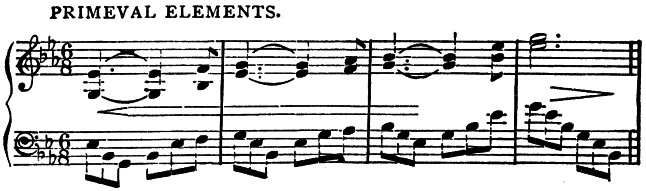
After the preliminary measures of the introduction to "Das Rheingold," we hear the first guiding theme of the drama, the motive of the Primeval Elements:
[Audio content is not currently supported on your device. [XML]
PRIMEVAL ELEMENTS.
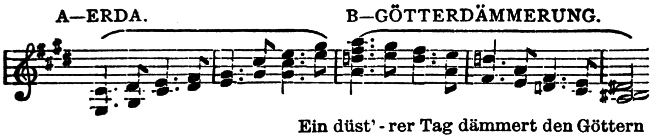
This motive plays an important part in the trilogy. When Erda rises from the earth in the last scene of the prologue we hear this same theme in the minor mode, and we at once perceive that by this simple process of musical development Wagner associates her with the primeval elements (earth, air, and water), but emphasises the sadness of her character and her peculiar office in the tragedy as a prophetess of woe. When she utters the words, "Ein düst'rer Tag dämmert den Göttern" ("A dismal day dawns for the Aesir"), we hear her motive first in its natural form, and then inverted, and we then learn that this inversion has an especial meaning, the end of the gods, the "Götterdämmerung":
[Audio content is not currently supported on your device. [XML]
A—ERDA. B—GÖTTERDÄMMERUNG. Ein düst'rer Tag dämmert den Göttern
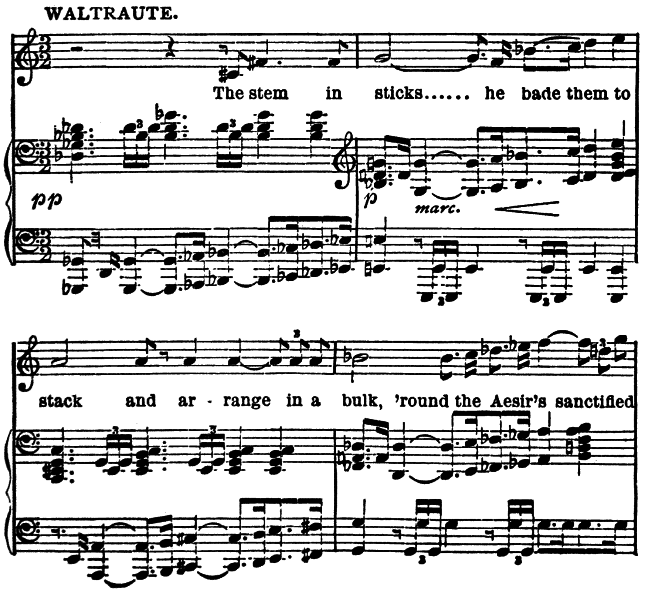
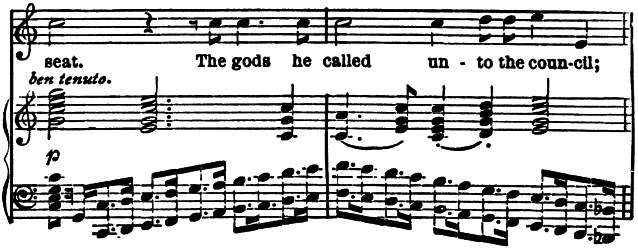
Now let us turn to the scene in which Waltraute comes to tell Brünnhilde how Wotan has had the ash cut down, hewn into faggots, and assembled the gods to wait for the end. In the accompaniment to her words appears the Erda theme, originally that of the Primeval Elements which surrounded the Rhinegold, transformed into a stately progression of octaves. Presently over these we hear the Walhalla theme, and then the octaves descend in a new development of the "Götterdämmerung" theme:
[Audio content is not currently supported on your device. [XML]
WALTRAUTE.
The stem in sticks he bade them to stack and arrange in a bulk, 'round the Aesir's sanctified seat. The Gods he called unto the council;
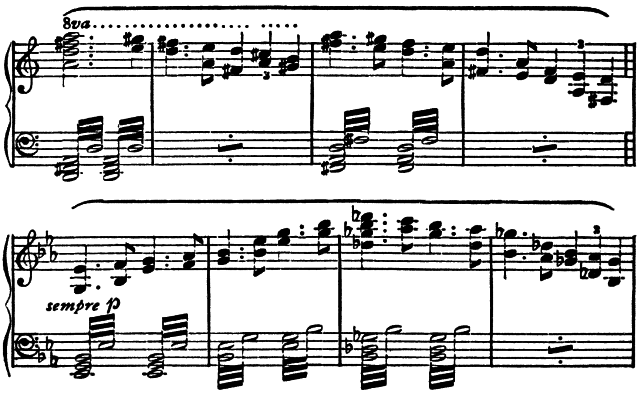
Turn next to the last scene of all, to the entrance of Brünnhilde. We find that the music is this:
[Audio content is not currently supported on your device. [XML]
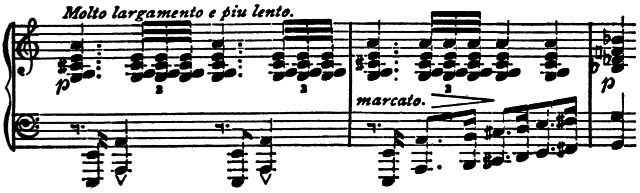
Brünnhilde has come to fulfil the prophecy of Erda; the dusk of the gods is at hand. And so when she commands the retainers to erect the funeral pyre, which is kindled at Walhalla, we hear once again the "Götterdämmerung" theme as it was introduced to us in the Waltraute scene:
[Audio content is not currently supported on your device. [XML]
This is an excellent demonstration of the leitmotiv system in its fullest expansion, and it should warn the reader against accepting these themes as merely arbitrary labels. Let him always seek for their musical philosophy and their relations to one another.
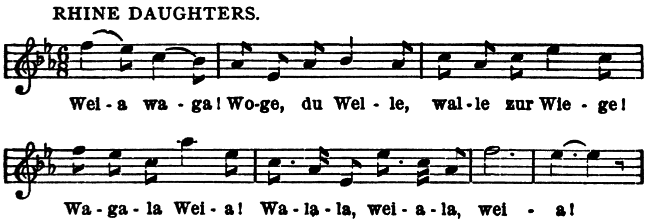
When the Rhine maidens appear swimming around the rock in which lies the gold, they sing these cabalistic words and this melodious music:
[Audio content is not currently supported on your device. [XML]
RHINE DAUGHTERS.
Weia waga! Woge, du Welle, walle zur Wiege! Wagala Weia! Wallala, weiala, weia!
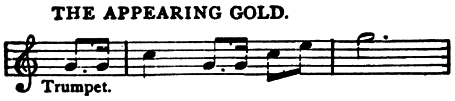
Presently, as narrated in the story, the gold discloses itself, and we hear the ascending theme of the Appearing Gold:
[Audio content is not currently supported on your device. [XML]
THE APPEARING GOLD.
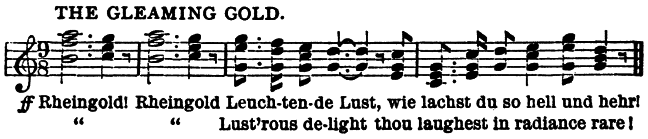
But when the maidens burst into song in its praise, they sing this:
[Audio content is not currently supported on your device. [XML]
THE GLEAMING GOLD.
Rheingold! Rheingold! Leuchtende Lust, wie lachst du so hell und hehr! Rheingold! Rheingold! Lust'rous delight, thou laughest in radiance rare!
The first measures of this melody are employed throughout the drama to signify the gold. Examination will show that the words "Rheingold! Rheingold!" are sung to precisely the same melodic form as "Weia" at the beginning and the end of the phrase quoted from the Rhine daughters' music. Here, again, we see how Wagner persists in preserving the musical associations of allied themes, and of deriving one from the other in the symphonic style. In the last act of "Götterdämmerung," when the maidens warn Siegfried of coming evil, they sing his name to the Rhinegold theme in the minor mode. The significance of this is unmistakable.
At the first mention of the ring, we hear the Ring theme:

[Audio content is not currently supported on your device. [XML]
THE RING.
This theme is subjected to so many developments that they cannot be enumerated in a work of this kind. A single glance, however, will show the reader how closely related it is to the "Götterdämmerung" motive. In certain passages, as in the scene between Brünnhilde and the disguised Siegfried in "Götterdämmerung" this theme and the Walhalla theme are combined, by an ingenious use of the rhythm and melodic sequence of the one with the melody and harmony of the other, to identify Brünnhilde's personality with possession of the ring. Other important motives introduced early in the "Rheingold" are the following:
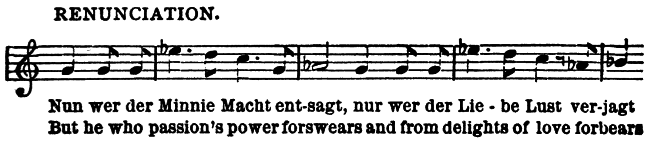
[Audio content is not currently supported on your device. [XML]
RENUNCIATION.
Nun wer der Minne Macht entsagt, nur wer der Liebe Lust verjagt But he who passion's power forswears, and from delights of love forbears

[Audio content is not currently supported on your device. [XML]
WALHALLA.

[Audio content is not currently supported on your device. [XML]
COMPACT.

[Audio content is not currently supported on your device. [XML]
GIANTS.
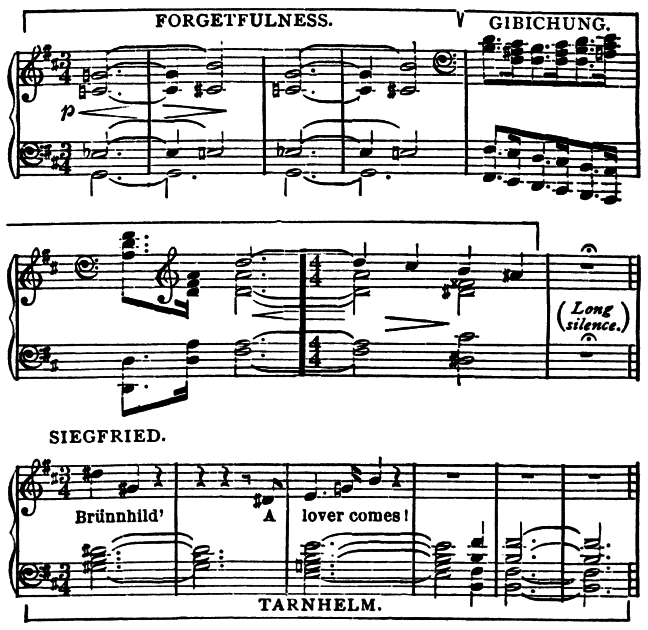
The Renunciation theme is employed throughout the tragedy to signify renunciation without regard to its original connection with the ring. The Walhalla motive indicates not only the place, but the origin of persons who come thence. In this sense it is sometimes applied to Brünnhilde, as well as to Wotan. The next theme of significance is that of the Tarnhelm (see page 195). Here, again, we meet with a theme for which there is a companion closely associated with it in form and in the action of the drama. This is the theme of Forgetfulness, heard in "Götterdämmerung" when Siegfried takes the drink offered him by Gutrune. The close relationship in the meaning of these themes is best displayed in the scene of Siegfried's arrival at the Valkyr's rock in the guise of Gunther. Brünnhilde says: "What man art thou?" And, as Siegfried stands at the rear and begins his answer, we hear these three motives in succession—Forgetfulness, Gibichung, and Tarnhelm.
[Audio content is not currently supported on your device. [XML]
FORGETFULNESS. GIBICHUNG.
SIEGFRIED. Brünnhild'! A lover comes! TARNHELM.
The meaning is clear, and the kinship of the Forgetfulness and Tarnhelm themes unmistakable. Siegfried uses the Tarnhelm but this once in the whole tragedy, and uses it because of the forgetfulness and in the guise of a Gibichung.
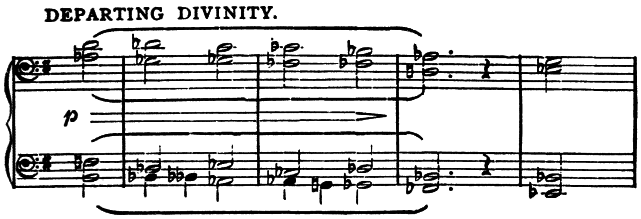
When Freia has been carried off by the giants to wait for Wotan's decision as to the ransom, Loge taunts the gods with their pallor and failing glory. As part of the accompaniment to his speech, we hear the motive of Departing Divinity:
[Audio content is not currently supported on your device. [XML]
DEPARTING DIVINITY.
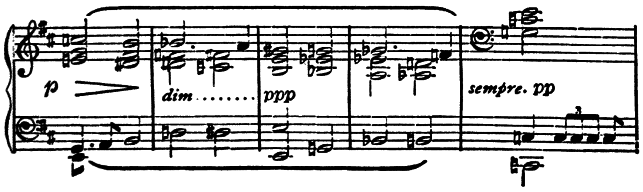
Now turn to the last scene of "Die Walküre," and when Wotan tells Brünnhilde that he will plunge her into unbreaking sleep we hear this same motive in this form:
[Audio content is not currently supported on your device. [XML]
The theme is heard again in its fullest harmonies when the god kisses her eyes and she sinks to sleep. Here, again, Wagner uses uncertainty of tonality to produce an effect of mystery in his music.
At the entrance of Loge we hear another important motive, that of the fire-god:

[Audio content is not currently supported on your device. [XML]
LOGE.
From this is developed the magic fire music of "Die Walküre," and the theme is heard frequently throughout the trilogy. Sometimes it ascends, and again it descends, and at times it becomes purely melodic in the diatonic scale and the major mode, but it never loses its flickering, wavering character. When Wotan and Loge descend into Nibelheim, we hear the important theme of the Nibelungs, the smiths:

[Audio content is not currently supported on your device. [XML]
NIBELUNG SMITHS.
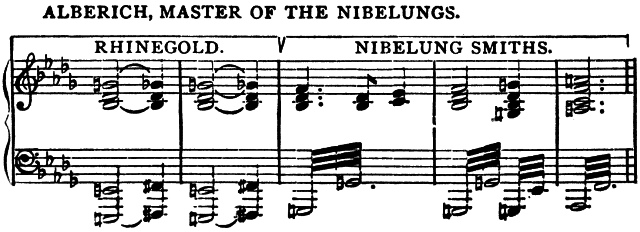
This is heard very often in the tragedy, and always signifies the Nibelung race. Alberich's appearance, driving before him the Nibelungs, who have become his slaves through the power of the ring, introduces the theme of Alberich's mastery:
[Audio content is not currently supported on your device. [XML]
ALBERICH, MASTER OF THE NIBELUNGS. RHINEGOLD. NIBELUNG SMITHS.
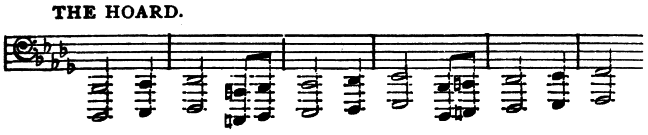
As it was the Rhinegold which made him lord of the Nibelungs, the theme is compounded of the Rhinegold motive and that of the Nibelungs, the latter being brought to a firm and definite close with a major chord. With the entrance of the dwarfs carrying the gold, we hear the theme of the Hoard:
[Audio content is not currently supported on your device. [XML]
THE HOARD.
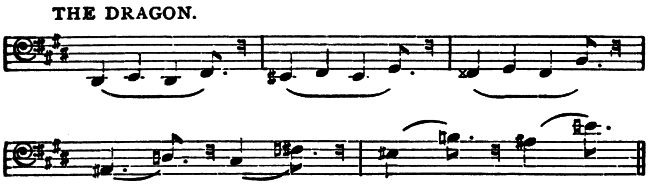
The Dragon motive appears when Alberich transforms himself for the first time:
[Audio content is not currently supported on your device. [XML]
THE DRAGON.
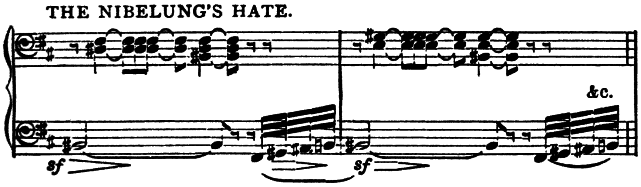
This theme is employed again in "Siegfried" for the transformed "Fafner." The motive of the Nibelung's Hate is used very often in "Siegfried" and "Götterdämmerung," as well as in the prologue:
[Audio content is not currently supported on your device. [XML]
THE NIBELUNG’S HATE.
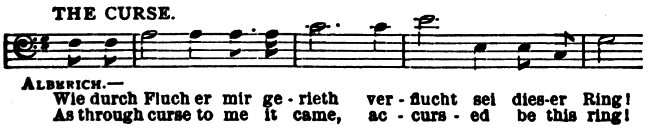
The instrumentation of this theme, the lower part being given to strings and the upper to clarinets, is especially expressive. It has a snarl and a sneer. The next important theme introduced in the prologue is that of the Curse:
[Audio content is not currently supported on your device. [XML]
THE CURSE.
Alberich.— Wie durch Fluch er mir geriet, verflucht sei dieser Ring! As through curse to me it came, accursed be this ring!
This is heard when Fafner kills Fasolt, and throughout the drama at points where the curse is especially significant, as at the death of Siegfried. The Sword theme (see page 195) appears when Wotan conceives his plan. I have not given the minor themes, which are heard only in the "Vorabend," such as those of Fricka, Froh, and Freia. Donner's theme is of little import, being heard again only in the storm music in "Walküre." There is a long list of minor themes, but their significance can always be learned from the text.
In "Die Walküre" a number of significant motives not heard in the prologue are brought forward. The first of these indicates the gentle and sympathetic personality of Sieglinde:

[Audio content is not currently supported on your device. [XML]
SIEGLINDE’S SYMPATHY.
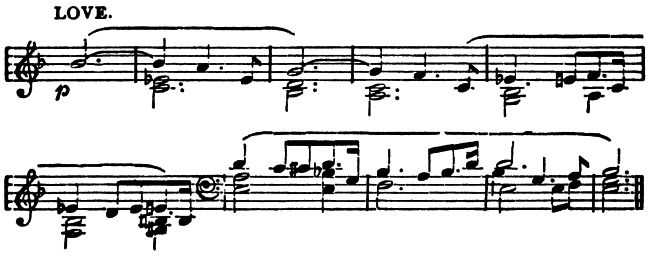
Next comes the Love motive, a melody of some length, written for celli, and full of feeling:
[Audio content is not currently supported on your device. [XML]
LOVE.
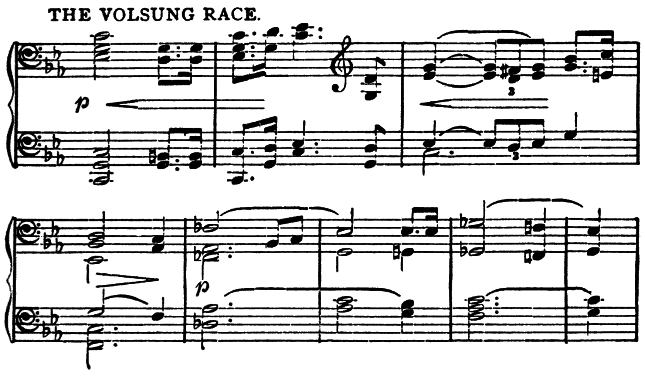
These two motives belong particularly to this drama; they do not figure in the other works. In the first act, however, appear two themes which are used thereafter throughout the tragedy, the themes of the Volsungs' sorrow and the Volsung race:

[Audio content is not currently supported on your device. [XML]
SORROW OF THE VOLSUNGS.
[Audio content is not currently supported on your device. [XML]
THE VOLSUNG RACE.
The reappearance of the Sword motive (see page 195) in this act should be noted for its pregnant meaning. Siegmund calls upon his father and says, "Where is the promised sword?" The firelight at this instant strikes the hilt of the sword in the tree, and the orchestra gives out the Sword theme with almost startling effect. It would be superfluous to trace the manifold treatment of the various melodic fragments through the score. The hearer of the works cannot fail to become acquainted with their import. The motive of the Volsung race is especially touching in its noble dignity and melancholy. It epitomises in a fragment of music the nature and suffering of the unhappy Volsungs. Much of the music of the first act is freely composed, the love song and most of the duet being thus written. A motive indicative of the personality of Hunding will be easily recognised when heard. With the opening of the second act we make the acquaintance of two motives associated with Brünnhilde in her character of Valkyr:

[Audio content is not currently supported on your device. [XML]
THE VALKYR’S CALL.

[Audio content is not currently supported on your device. [XML]
THE VALKYRS.
The second of these is afterward used whenever the nature of the Valkyr is of significance in the drama. The theme, it will be noted, is designed rhythmically to suggest the motion of the Valkyr steed. When Fricka imposes upon Wotan the oath to honour her rights, we hear the theme of Wotan's Wrath, a wrath in which there is a deep note of pathos:

[Audio content is not currently supported on your device. [XML]
WOTAN’S WRATH.
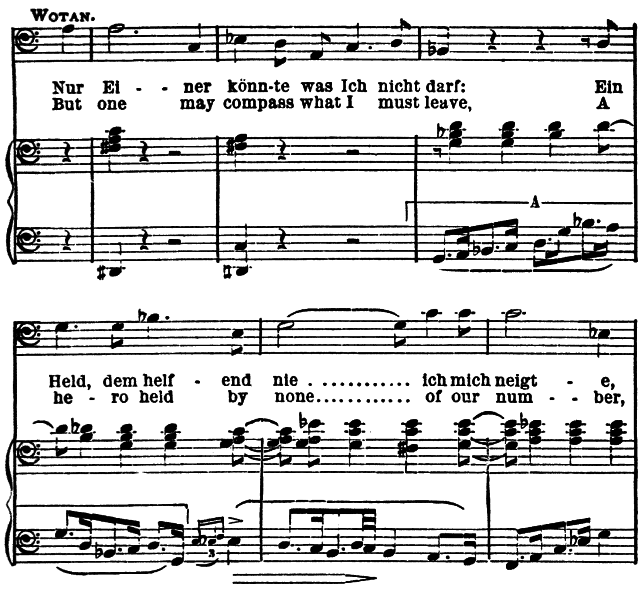
When Wotan informs Brünnhilde that only a free hero can make the atonement, we hear this theme beautifully combined with the Erda theme and a suggestion of the "Götterdämmerung" motive:
[Audio content is not currently supported on your device. [XML]
Wotan.
Nur einer könnte, was ich nicht darf: Ein Held, dem helfend nie ich mich neigte, But one may compass what I must leave, A hero held by none of our number,
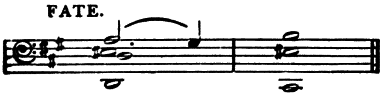
It is by such wonderful combinations of the guiding themes that the scores of these dramas become so rich in variety, beauty, and meaning. The significance of this passage is clear and eloquent. The plan must fail and the dusk of the gods must come. The phrase marked A is usually designated the theme of the "Gods' Stress." It is plainly, however, the Erda theme and a variant of the "Götterdämmerung." When Siegmund sits on the rock with Sieglinde fainting in his arms, we hear for the first time the motive of Fate, often used afterward:
[Audio content is not currently supported on your device. [XML]
FATE.
The treatment of the "Todesverkündigung" is free, the theme being heard only in that scene. Motives already made known form the warp of the score to the end of the act, and the third act opens with the familiar "Ride of the Valkyrs" built on the Valkyr's Call and the Valkyr theme. When Brünnhilde informs Sieglinde that she is to be the mother of the "highest hero of worlds," we hear for the first time the magnificent Siegfried theme, which is to play such an important part in the remainder of the tragedy:

[Audio content is not currently supported on your device. [XML]
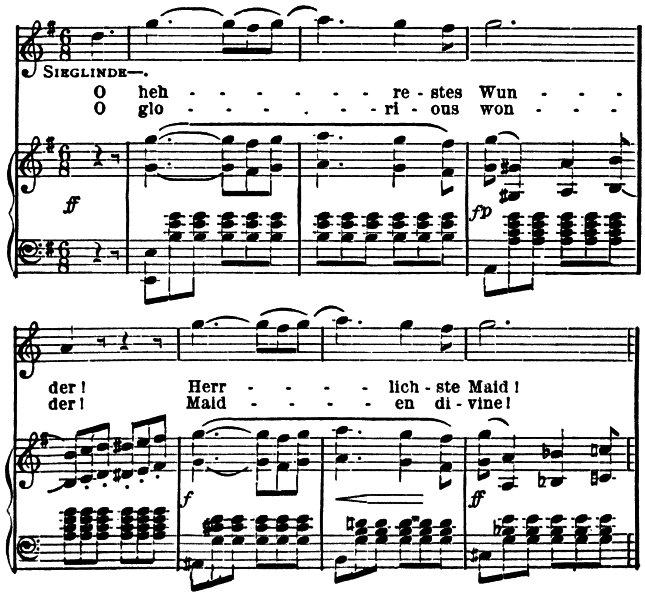
And in response to this announcement Sieglinde sings thus:
[Audio content is not currently supported on your device. [XML]
Sieglinde— O hehrstes Wunder! Herrlichste Maid! O glorious wonder! Maiden divine!
This theme is heard again at the close of the last scene of "Götterdämmerung," and there we instantly recognise its significance as an embodiment of the glorious divinity of Brünnhilde, the divinity of ideal womanhood, ennobled by love and sanctified by sacrifice. Another significant motive heard in this scene is that of Slumber:

[Audio content is not currently supported on your device. [XML]
SLUMBER.
This, with the Fire and Siegfried themes, forms the magnificent closing passage of this drama. The melody of Wotan's farewell, though it can hardly be described as a leitmotiv, reappears with beautiful effect in Waltraute's narrative, when she tells of Wotan's sadness.
In "Siegfried" we meet with a score which contains a great amount of freely composed music. There is so much that is external and incidental in this work that the constant employment of guiding themes was unnecessary. The result is that we enter an atmosphere of buoyant, jubilant out-door life, full of the vigour and sweetness of spring and young manhood. The whole of the scene of the forging of the sword is sung in music aglow with the flame of the forge, alive with the rhythm of the bellows and the hammer. The forest scene gives us the bird music and the "Waldweben," freely written, the latter a mood picture, using only the Volsung theme as a reminder. Wotan's splendid summons to Erda is free music, and in the matchless scene of the awakening we hear much that is new and belongs only to "Siegfried."
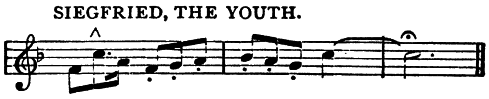
The first of the important new themes is that intoned by the young hero's horn. It is the theme of Siegfried, the buoyant, fearless, militant youth:
[Audio content is not currently supported on your device. [XML]
SIEGFRIED, THE YOUTH.
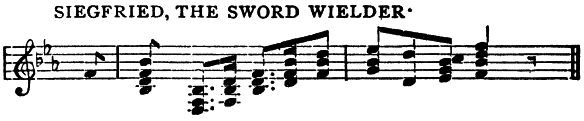
Out of this theme and that of the Sword, the melodies and rhythms being combined perfectly, is made the brilliant motive of Siegfried, the hero who welds and wields the sword:
[Audio content is not currently supported on your device. [XML]
SIEGFRIED, THE SWORD WIELDER.
This is heard often in the early part of the work. Wotan, disguised as a wanderer, is indicated by a theme without tonality, which, therefore, belongs to the same class as the Tarnhelm and Departing Divinity motives:

[Audio content is not currently supported on your device. [XML]
WOTAN, THE WANDERER.
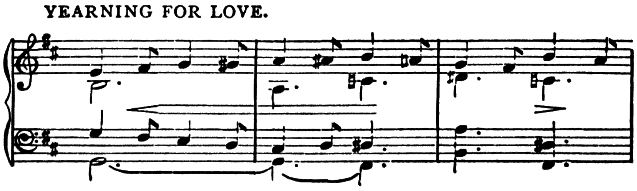
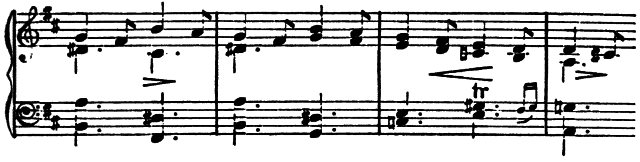
In the second act, while Siegfried is alone in the forest, is heard this beautiful and significant theme:
[Audio content is not currently supported on your device. [XML]
YEARNING FOR LOVE.
After this, till the first scene of the third act, the listener will not hear any motive of high import. All is either free music or the employment of themes whose significance has been previously made known. But in the opening of the last act appears the splendid melody of the Heritage of the World, which is used to embody the readiness of Wotan to resign himself to his approaching fate and to hand over his kingdom to the new race:

[Audio content is not currently supported on your device. [XML]
THE WORLD’S HERITAGE.
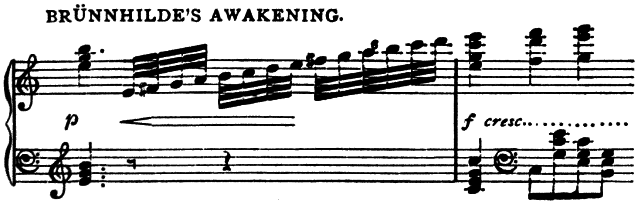
Wonderful, too, are the strains which accompany the arrival of Siegfried at the top of the Valkyr's mountain, but most wonderful is the music of Brünnhilde's Awakening:
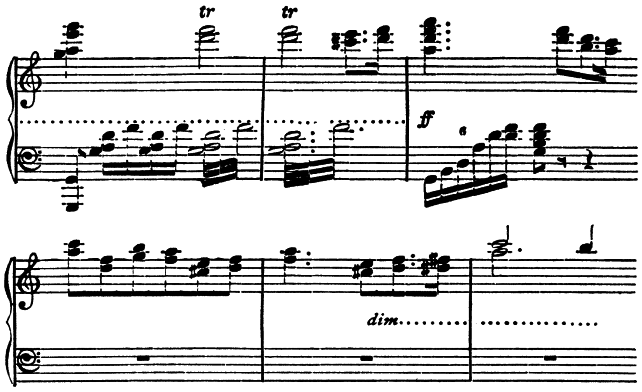
[Audio content is not currently supported on your device. [XML]
BRÜNNHILDE’S AWAKENING.
This is only a fragment of it, but it contains the pregnant phrase of marvellous beauty which returns with such agonising eloquence in the final speeches of the dying Siegfried in "Götterdämmerung." When the Valkyr maid is awake and has recognised Siegfried, their voices unite in the passionate measure of a duet, founded on the motive of Love's Greeting:

[Audio content is not currently supported on your device. [XML]
LOVE’S GREETING.
In "Götterdämmerung," when Siegfried raises the drink of forgetfulness to his lips, he drinks to the memory of Brünnhilde and intones the words to this very theme. That is one of Wagner's most poignant strokes of musical pathos. The drama of "Siegfried" comes to its end with a sweep of overmastering passion. The themes are peculiar to this work, but most of them are heard in the lovely "Siegfried Idyl," so often played in concert.
"Götterdämmerung" opens with a repetition of known themes in the Norn scene. In the second scene we meet with two new ideas, the themes of Brünnhilde, the woman, and Siegfried, the mature hero:

[Audio content is not currently supported on your device. [XML]
BRÜNNHILDE, THE WOMAN.

[Audio content is not currently supported on your device. [XML]
SIEGFRIED, THE MAN.
The first of these expresses very beautifully the loving, clinging nature of the transformed Valkyr. The second is a thematic development of the motive of Siegfried, the youth. The change is chiefly one of rhythm. Siegfried, the youth, is depicted musically in six-eighth measure, a rhythm buoyant and piquant. For Siegfried, the mature hero, the melodic sequence is preserved, but the rhythm is changed to a dual one. The change is one founded on the nature of music, for the dual rhythm is firm, square, and solid. The injection of minor harmony at the end is heard in the first announcement of this theme and serves to indicate approaching sorrow. This motive rises to its grandest development in the funeral march after Siegfried's death, when the orchestra passes in review, in a composition of wonderful beauty and power, the themes most closely associated with him. This theme forms the climax of the march and is pealed forth by the brass in this form:
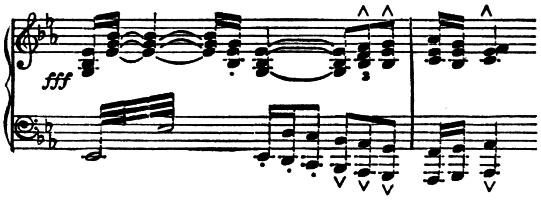
[Audio content is not currently supported on your device. [XML]
Two other new themes heard in "Götterdämmerung" are worthy of note. They are that of Gutrune and that of Brünnhilde's Despair, the former appearing in the third scene of the first act and the latter in the second act:

[Audio content is not currently supported on your device. [XML]

[Audio content is not currently supported on your device. [XML]
BRÜNNHILDE’S DESPAIR.
There are also themes for Gunther, the Gibichung (already quoted), and for Hagen. But "Götterdämmerung" is most wonderful, musically, for the manner in which the themes of the earlier dramas are repeated in it. The expressiveness of the system is nowhere more forcibly illustrated than in the hero's narrative of his youthful days, when the most significant themes of "Siegfried" pass before us, bringing the whole story back in all its vitality. And in the death of the hero and the wonderful apostrophe of Brünnhilde again we find that the recapitulation or development of familiar themes knits for us the substance of the long tragedy into a perfect texture of poetry. And with the use of the many-voiced orchestra Wagner weaves these motives into a glittering web of counterpoint, which cannot be copied even faintly by the piano arrangement. Several motives are sometimes heard at once, and by the aid of the device of instrumental colouring their expressiveness is greatly heightened.
Thus the orchestra becomes an actor in the drama, continually commenting on the passing action, revealing to us the hidden well-springs of emotion, explaining thoughts to us and flooding the whole drama with the light of its eloquence. Not by the mere cataloguing then of these themes are we to arrive at a full understanding of the composer's intent, but by a careful study of their repetitions and developments. The knowledge thus gained will add immeasurably to the intellectual pleasure of the hearer; but, as I have already said, Wagner's music makes the right mood pictures even for him who does not know the guiding themes. And that is one of the most satisfying proofs of his greatness.