Front matter
Reading edition
Cover art
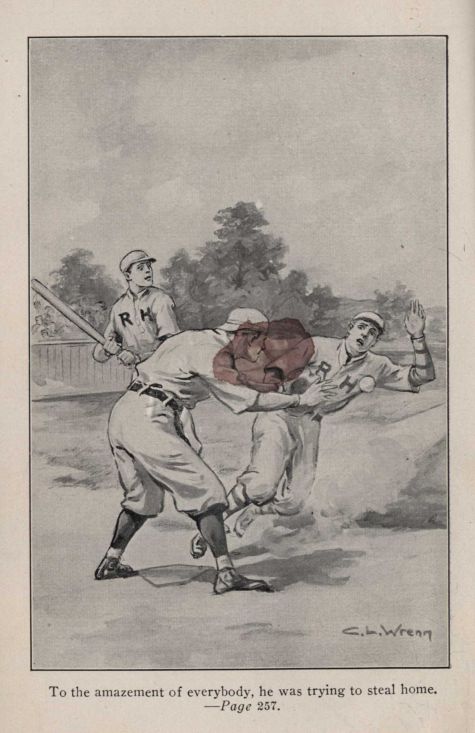
To the amazement of everybody, he was trying to steal home.—Page 257.
[Transcriber's note: the page number in the Frontispiece's caption was not linked because the caption's text does not appear anywhere in the book's main text. The Frontispiece may have been re-used from another book.]
REX KINGDON ON STORM ISLAND
By GORDON BRADDOCK
AUTHOR OF "Rex Kingdon of Ridgewood High," "Rex Kingdon in the the North Woods," "Rex Kingdon at Walcott Hall," "Rex Kingdon Behind the Bat," etc.
Title page picture
A. L. BURT COMPANY Publishers New York
Printed in U. S. A.
COPYRIGHT, 1917, BY HURST & COMPANY
Printed in U. S. A.
CONTENTS
CHAPTER
The Menace of the Law
In Stolen Plumage
The Catboat in the Squall
A Landing in the Dark
Behind the Lighted Canvas
Getting Back to the Boat
On the Verge of Something
A Bargain is Struck
A Challenge
Kingdon States a Determination
Enos Quibb Again
An Unexpected Difficulty
Rex Owns Up
A Lively Time
What's Sauce for the Goose
White Wings
An Off-Shore Blow
"The Happy Family"
More of Mr. Quibb
Kingdon's Surprising Move
Revenge
The Boulder on the Hillside
A Threatening Sky
A Lucky Move
The Eight-Oared Shell
Pence Defends Kirby
Visitors
Horace Proves Himself
Something in the Offing
Facing Defeat
Horace Shows the Right Spirit
In Form at Last
AUTHOR'S FOREWORD.
How would you like to spend a summer vacation on an uninhabited island off the Maine coast,—not alone, of course, but in company with a few chosen chums, all good fellows in their way and all of them ready for any sort of sport or adventure that might be found or borrowed? Surely, such a vacation would provide plenty of good fun, as well as some troubles and annoyances; but no vigorous, high-spirited American boy would mind a certain amount of inconveniences when he sets out to have a good time on a camping trip. In fact, he looks for some unpleasant things to happen, and he has a way of going right ahead and making the best of everything, so that many a time a source of irritation is turned into a spring of enjoyment and delight.
It was so with Rex Kingdon and his friends of the present story. When they arrived at Storm Island and found another party of campers located there, they at first were annoyed. They had understood that no one else would be given a permit to camp on that island. Imagine their astonishment when they discovered that the other party had deceived a local officer into letting them remain on the island by representing themselves to be "Rex Kingdon and friends," rightful holders of the camping permit. Trouble? Could anything spell trouble more plainly? But, after all, they managed to get more real fun out of it than they could have had if they had been the only campers on Storm Island. And, in the end, Rex wins a new recruit for Walcott Hall—and the prep. school baseball team.
This is the fifth story of The Rex Kingdon Series. It will be followed by the sixth and final volume of the series, which will bear the title, "Rex Kingdon and His Chums." In that forthcoming story Rex will finish his course at the Hall. As he regretfully bids good-by to the old school, the reader who has faithfully followed his career since he made his first bow in "Rex Kingdon of Ridgewood High" will have to bid good-by to him—as regretfully, I hope.
GORDON BRADDOCK.
New York, February 14, 1917.
Rex Kingdon on Storm Island.
CHAPTER I.
THE MENACE OF THE LAW.
"What's that noise? Say, Pudge, wake up and take a look."
"Hey? What noise?" stammered Pudge MacComber, startled out of serene slumber.
"Hear it? Sounds like a lot of soda-water bottles popping. Take a squint, Lazy."
The fat youth might have returned the compliment. Ben Comas lay on his back in the shade and did not even remove the cap over his eyes. Pudge, however, knew his cousin too well, and was too much in his debt, to file any objection to this command. Heaving a sigh, he struggled heavily to his feet. As he did so he became aware of a half-muffled put, put, put-a-put rising from the water which the camp site overlooked.
"Why, that's a motorboat!" he exclaimed before spying the craft in question.
"Noisy thing," grunted Ben, without moving.
"It's aiming this way," Pudge said, "right for our landing."
"Going to have visitors? Thought nobody ever came here."
"Wouldn't think many folks would, with the signs the Manatee Company have stuck up," chuckled Pudge. "Say!"
"Say it," grunted Ben.
"Only one man in the launch, an' I see something flash. Yes," Pudge gurgled, "I bet it is!"
"What's the matter with you?" grumbled Ben, finally sitting up. "You talk like a frog. What d'ye see?"
"He's got a badge," the fat boy said, solemnly. "I wish I could see his face."
"What d'ye mean?" Ben was now vastly and suddenly aroused. "Is it a constable? Where's Joe? He knows everybody 'round here—or he ought to."
"Joe's asleep."
"Wake him up. We didn't hire him to sleep, did we? Go on, you snail," ordered Ben.
Behind one of the two tents, pitched in this open glade on the rather steep northern shore of Storm Island, sprawled a roughly-dressed fellow. When Pudge had done Ben's bidding and aroused this individual, the latter uncovered his face, revealing features unmistakably those of an Indian boy. He came sullenly down to the other two lads.
"What y'want?" he asked, yawning.
"Who's that coming this way, Joe?" Ben Comas questioned. "That fellow in the launch?"
The Indian's eyes snapped open and he stooped a little, shading them with his hand, the better to view the approaching boat and its single occupant. Then he straightened up again, turning as though to retreat.
"Know him," he said.
"Who is he?" Pudge put in. "A cop?"
"Him Quibb."
"What'd I tell you?" cried Pudge. "That's the name of the constable we saw at Blackport—Enos Quibb."
"The one Horrors had the growl with," Ben agreed, rather faintly. "He's coming straight for us."
The Indian youth had already disappeared. The motorboat was nearing the shore of the island just below the camp. The cousins could plainly see the constable's face, as well as the big star upon his vest. Enos Quibb was not a handsome person at best, and just now his face was inflamed with anger and his frown was most portentous.
"He's got it in for us," said Pudge, apprehensively.
"All because of that fresh up there tossing the ball. It's up to him—that's what it is," declared Ben warmly. "Run, tell Horrors to come down here."
With a groan, the fat youth turned and waddled up the path into the thicker wood which seemed to crown the island. In the very middle of Storm Island, however, lay about two acres of open and level lawn. While yet Pudge was some distance from this spot the resonant slap of a ball as it landed in the catcher's mitt echoed flatly from the wall of tall trees completely surrounding the natural amphitheater.
"Hey! That's enough, Horrors!" the puffing fat boy heard Harry Kirby shout. "It's too hot to keep at it any longer. Quit, I say!"
Evidently he had flung the ball to the pitcher after removing his padded glove, and, just as Pudge came in sight of the two, the one called "Horrors" wound up again and whipped a sizzler over the marked square on the turf serving as the home plate.
"Quit, I say!" again yelled the backstop, as he leaped into the air, letting the low ball pass between his legs. "Think I'd be silly enough to try to stop that with my bare hands? That arm of yours has got dynamite in it, Horrors."
The pitcher was grinning in reply when a wild yell sounded from Pudge at the edge of the wood behind the catcher's station.
"Hey, you fellers! What're you tryin' to do—kill me? Nobody but a wild squawpaw could send in such a bullet. Ouch!"
Pudge limped forward, rubbing his shin where the pitched ball had nicked him.
"Come on—retrieve it," ordered the pitcher, strolling toward the platter.
"Chase your own ball," returned Pudge. "I didn't come 'way up here to play Fido. Why'd Kirby let it go by him?"
The backstop was wiping his brow with a torn shirtsleeve. "Catch me trying to stop one of Horrors' fast ones without my mitt. Not much!"
"Say, you fellers!" exclaimed Pudge, remembering his errand. "Ben says come on down to the camp—and in a hurry. There's a motor launch in sight."
"Didn't you fellers ever see a motor launch before?" demanded Kirby.
"But it's aiming right for our landing."
"What if?" drawled the tall fellow whom his mates called "Horrors."
"Who's in the launch?" asked Kirby.
"It's that constable Horrors had the fuss with at Blackport. Remember?"
"Shall I ever forget him?" murmured the tall lad. "The chap with the big tin star and the lovely yellow freckles."
"Enos Quibb," Kirby said, chuckling. "He's one sure enough farmer—that's right."
"Just the same," said the fat boy, wagging his head, "I wish he'd keep away from here—and so does Ben."
"Poof!" scoffed Kirby. "If Ben expressed a dislike for the sunshine or the sweet air, you'd keep in the shade and put on an overcoat, Pudge. What Ben says is law and gospel for you."
"We-ell," drawled Pudge MacComber frankly. "You know I wouldn't be up here if it wasn't for Cousin Ben. He paid my way."
"Yes," muttered Kirby to the taller fellow, "and I know Ben didn't give Pudge any return ticket, either. Keeps Pudge in leash better if he has no money in his jeans."
The fat youth did not hear this aside. He was saying: "We shouldn't have camped down there so near the shore. It's too exposed. Ben said that in the first place."
"Aw—Ben!" scoffed Kirby, while the tall chap smiled quizzically at the fat boy.
"He was right just the same. Here comes Enos Quibb, and we're going to get the boot, sure. We haven't permission from the Manatee Lumber Company to camp here, and you fellows know it. We'll have to sing 'It's Moving Day,' all right-o—and just as we got comfortably settled, too," finished Pudge with a groan.
"Come on," said Kirby. "Don't stand there weeping over it."
Already their leader was striding into the wood, and Kirby hastened to catch up with him. Pudge MacComber plodded on behind. It was a hot day, and he suffered from his exertions.
"What'll we do?" asked Kirby, at the tall fellow's elbow.
"About what?" countered the other, with a lift of his eyebrows and a tantalizing smile that seemed an index of his character. "What's fussing you up, Harry?"
"This Quibb can put us off the island. Of course, the Lumber Company did issue a permit for a party to camp here—and we're here first—huh?"
His friend had grabbed his arm suddenly, stopping dead in the path. "You do have an idea once in a while in that cranium of yours, Harry," he drawled.
"I don't feel any different from usual," said Kirby, rubbing his head and grinning. "If there's an idea milling around in there I don't sense it."
"But I do. Leave it to me." His friend started onward again, leading the procession to the encampment.
It was a beautiful spot they had selected in which to set up their tents—an open grove sloping easily to the edge of Manatee Sound which lay, on this particular June day, as smooth as a millpond between the island and Manatee Head, five miles away.
Ben Comas, much excited, hurried toward them. "Whatchu goin' to do about this, Horrors? See that fellow? He's mad's a hatter."
"He'll have a stroke—I shouldn't wonder," drawled the tall lad. "Too hot a day to let one's dander rise."
"You can joke," snapped Ben. "But he means business."
The launch was now close to the shore, and the exhaust ceased popping. Enos Quibb, the Blackport constable, stood in the bow boathook in hand, scowling threateningly at the group above him.
CHAPTER II.
IN STOLEN PLUMAGE.
"My, my!" murmured the only member of the camping party who seemed to take the visit of the constable with any degree of composure. "He seems savage enough to eat nails."
"Now, don't, Horrors!" begged Ben Comas. "Don't make it worse!"
"Better be smooth with him, old man," urged Kirby.
"See if you can pacify him," groaned Pudge. "I worked like a dog helping Joe get this camp fixed."
Their leader chuckled as he walked down to the natural dock where the two canoes, in which the party had reached Storm Island, were moored. The view of the sound, the rugged, well-wooded and scantily-inhabited mainland in the distance, expanded before his gaze. For several miles in either direction this mainland, as well as Storm Island itself, was either owned or leased by the Manatee Lumber Company. On the mainland the timber was properly policed by the company's guards; but Storm Island, far off shore, was considered secure from invasion by irresponsible fishing parties and the like, by the trespass signs posted upon its beaches. Blackport, the nearest town, ten miles from the western point of the island, was hidden from it by the wooded and rocky "crabclaw" sheltering Blackport Cove.
There was scarcely a habitation to be seen from the spot where the boys' camp had been established. There were fish-weirs visible at several points along the shore; but the catches gathered from these traps were, as a usual thing, taken to Blackport to be cleaned and iced, and then shipped to Portland or Boston by train. The locality was, therefore, as deserted as any spot along the entire stretch of the Maine coast.
Enos Quibb caught his boathook in the exposed root of one of the two great trees at the landing, drew the launch closer, and moored it. Then he sprang ashore. He was not a very big man save in his sense of importance. Being of a sandy complexion, his innumerable freckles were painfully yellow and prominent. His large, high-bridged nose was of a cold blue color even on this hot summer's day.
"Say, you boys!" he began. "Can't ye read them signs?"
"What signs, kind sir?" asked Horrors, languidly. Ben Comas, at his elbow, nudged the taller lad and whispered:
"Don't make it worse! Don't nag him!"
"Them 'No Trespass' signs," said the constable. "You know well enough they was put up to warn such chaps as you be off the island."
"But suppose we don't believe in signs? You know, I never was superstitious myself; I'd just as soon walk under a ladder—or take a bath on a Friday—as not."
Pudge began to chuckle, and the wrath of the constable was flagged in his thin cheeks by a rising flush.
"Stop it! Stop it!" ejaculated Ben Comas, under his breath. "We're in a bad enough scrape as it is."
The other gave no heed. He showed his even teeth in a sudden smile, that was all. Enos Quibb said, harshly:
"You're one smart boy, I don't dispute; but if you and your friends don't pack up and git off of this island shortly, you'll be smarter. Don't you know I can arrest you for trespass?"
"No," was the quiet reply. "I don't know that."
"Well, you'll find out!" declared the constable. "Nobody's allowed to camp on this island—not even to land here——"
"No-body?" put in the youth he addressed, in the same gentle tone.
"Why—we—well, say! The company did give a permit to one party for this summer."
"Well?" was the suave query.
"Say! Be you them?" demanded Quibb, flushing again. "I remember seeing you in Blackport, and you didn't say nothing to me then about comin' over here. Le's see," and he began fumbling in the inside pocket of his coat. "I got notice of this crowd that got permission from the Manatee Company to camp here——"
He drew out a letter. Ben Comas groaned. Kirby whispered emphatically: "Good-night! It's all off!" The constable unfolded the letter, and then quickly glanced up again at the quartette.
"This permit's issued to 'Rexford Kingdon and friends.'" Again he addressed the tall lad. "Does your name happen to be Kingdon?"
"Now you've said a mouthful," returned the leader of the camping party airily.
"Well! Well!" ejaculated the constable. "Why didn't you say so before?"
"You didn't ask me," the other returned, shrugging his shoulders, while his mates behind him stood in speechless amazement.
"Well! Well!" Enos Quibb exclaimed again, his watery eyes blinking. "If you air the right party I ain't got nothin' more to say. Only ye might have told me over to the port yesterday who ye was. I'd ha' been saved this trip, an' gas is mighty expensive." He seemed aggrieved.
The tall lad, who had dominated the situation so easily, may have considered the part of the pacifist just then a wise move.
"You didn't ask me who we were, my friend. You bawled us out over there at Blackport—told us we were blocking the sidewalk with our canoes, and drove us into the gutter. I suppose you had to do something like that," he added, gently, "or we might have overlooked the fact that there was a constable around."
Quibb flushed again at this last suggestion, but made no reply. He stepped into the launch, seized the boathook, and shoved off.
Kirby grabbed at his friend's arm. "He's never going to go without asking to see the permit?" he whispered.
But that is exactly what Quibb did. He spun the flywheel, and the exhaust began to spit.
"Dear me!" sighed Horrors. "And he's going without even bidding us good-by."
"Great Peter's uncle!" exploded Kirby. "The nerve of you, Horrors!"
"Now you've done it!" fretted Ben Comas. "What do you suppose he'll do to us when he finds out——"
"Dear, dear Bennie," sighed the bold youth. "You're at it again, are you? Always looking for trouble."
"Just as well be prepared for trouble when you're bossing things, that's sure," grumbled Ben.
"Oh, jumping mackerel!" giggled Pudge, who had dropped to the sod and was now having difficulty in smothering his desire to give broader vent to his delight. "The way you did it, Horrors! You're a dandy! You're a bird! And he swallowed it whole."
"He didn't have much to swallow," the leader of the party said quietly.
"Huh? 'Tain't much, I suppose, for you to string him along that you are this Rex Kingdon? Oh, no!"
"I didn't tell him I was," said the tall lad, smiling easily.
"What's that?" exclaimed Kirby. "Well, you just as good as did."
"I let him think so if he wanted to," the other returned, plainly enjoying the admiration of his companions. "Quibb did it all. He can't blame me."
"But you don't get me," continued Pudge, sitting up and with tears of laughter running over his fat cheeks. "You don't get me, Horrors. You to pose as this Kingdon chap."
"Well, why not?" asked the tall lad.
"You as black as Joe, yonder—almost; and him a strawberry blond. I remember him plain enough now. Saw him play against Winchester last year. In size you are not far out, old boy; but blond and brunette were never farther apart—believe me!"
"What do I care?"
"Maybe you will," Ben Comas put in. He begrudged Horrors the admiration of the other lads. He was not generous enough in any particular to be a leader himself, and he envied the good-looking youth's lordly ways and the subservience that he commanded so easily of his mates. "This business isn't finished."
"Well, we'll stay till the finish, Bennie," drawled the other. "What's the use of crossing bridges till you come to them? That doesn't get you anywhere."
"Aw—well," muttered Comas, shaking his head.
"But suppose this Kingdon and his gang walk in on us?" asked Harry Kirby, suddenly. "What about that?"
"The island's big enough, isn't it, for two camps?" demanded Horrors.
"Mebbe it isn't," grunted Pudge. "This Rex Kingdon is a fighter."
"Pshaw! You don't mean it, Pudge? Who told you so much, and your hair not curly?" drawled Horrors with lifted brows and his usual lazy smile that displayed the line of his white and even teeth.
That smile marred his rather attractive countenance, for the lift of the lip was almost canine. He was dark-haired, and his brows seemed painted over his steady eyes, so clear was his olive complexion. The contrast of his black hair and brows with his almost colorless skin was somewhat startling. The budding mustache on his lip was jet black, too. This "down" on a blond fellow would scarcely have been observed; it made Horace Pence seem several years older than he actually was.
"I suppose," he pursued, his drawling accents making Pudge MacComber flush, "you think this constable is going to put us all in the calaboose over at Blackport? That is what is troubling all you fellows."
"Well, of course he can do that. We're trespassing. Goodness knows there are enough signs all around the island forbidding landing upon it," Harry Kirby said.
"Bosh!" sneered Horace Pence. "I know the law against trespassing. They've got to prove we've done some damage by landing here and setting up our tents."
"And building fires," put in Kirby.
"That's all right," agreed the leader, quite unruffled. "We've only built one fire, and it is properly guarded. I saw to that. And Joe knows the fire law, you bet. Don't you fellows fret; I know what I am about."
"You seem to," admitted Harry Kirby admiringly. "I never knew a fellow like you, Horrors. You are always just skirting the edge of trouble, but never get into it."
"He'll get into it now, all right-o," grumbled Ben Comas. "We know well enough that there's a party did get a permit to camp here this summer; that's why my father couldn't work it for us—and he owns some stock in the Manatee Company, too."
"We heard about that before," said Kirby. "Is it true or just one of your false alarms?"
"That's no false alarm," defended Ben, vigorously. "It's straight. A bunch from that prep. school out Scarsdale way, with this Rex Kingdon at their head, got permission to come here, and the company wouldn't allow two camps on Storm Island."
"What prep. school's that?" demanded Kirby.
It was Horace Pence that made answer, to the surprise of his companions. "Walcott Hall," he said briefly.
"Huh!" exploded Pudge. "How'd you know?"
"I heard about this crowd coming here, in town before we started," confessed the leader of the camping party.
"Say! An' you never told us!" Kirby complained.
"Because that Rex Kingdon and his crew were coming is why I suggested Storm Island. Say, Kirby! don't you remember that slim, slick, blond chap who played with the Ridgewood High only a couple of years ago when they beat our nine so badly? I haven't forgotten him, if you fellows have. That's Rex Kingdon, and I've had it in for him ever since they gave us such a walloping. Kingdon and I had words after the game, too—some!"
"Why didn't you lick him then, and get it over with?" scoffed Ben Comas.
"He got out o' town with his crowd, that's why," Pence responded rather more earnestly than was his wont.
"And did Kingdon go to this Walcott Hall School?" asked Kirby.
Horace nodded. He was not much of a talker and, if he could convey his meaning without speech, he seldom troubled to open his lips. He felt as though he had been actually garrulous in speaking of Rex Kingdon.
"I know who you mean," Pudge said; "he's catching for the Walcott nine. And he's a bear at football, too. Played on the Hall 'leven against Winchester last fall I tell you. And, say, Horrors!"
The tall youth looked at him questioningly, and the fat boy continued:
"You don't want to be too sure of that blond fellow. He's a fighter. He can use his fists."
"So can I," said Pence succinctly. "If he and his crowd land here and make camp, maybe we'll find out who's who, eh?" His lip lifted again with a sneering smile.
"Hoh!" ejaculated young MacComber. "You don't suppose those prep. school fellers would stand for us being here, too, do you?"
"Why not?"
"Why, if they've got a permit, and know that they're responsible for what's done over here——"
"Forget it!" exclaimed Pence, now rather tired of the controversy. "Let's wait till they come. You're as bad as your cousin, Pudge. Maybe this Kingdon fellow and his gang won't show up at all. If they do——"
"Well, what if they do, Horrors?" asked Kirby eagerly, as the tall fellow became silent.
"We're here first. I don't know why we shouldn't stay. Quibb says we can. Let the other fellows worry—not us."
"Whew!" murmured Kirby, his eyes flashing. "I see. As one of our professors says, 'the onus of proving the case is on the other party.'"
"I s'pose you're right," grudgingly admitted Ben Comas. "My father says that 'Possession is nine points of the law.'"
When Joe Bootleg, the Indian, appeared and asked for particulars, Pence left it to his mates to answer.
Without being in the least "grumpy" Horace Pence was a strangely silent lad. He had a good mind and a quick wit. Had he not been lazy he might have already matriculated at college, for his people were in circumstances to send him there. But for nearly two years he had loafed around his home town, having had trouble with his instructors in the last school at which he was entered, and thenceforth refusing to go to another.
In a fair way of becoming rather a useless member of society, if he maintained his present irresponsible attitude toward the world, Pence had thus far been saved from any very pronounced vices by a natural distaste for them. Honor meant little to him, however, as his present action showed. He had usurped the name and status of another fellow to his own advantage, and he really thought that he had turned a very smart trick by doing so.
If he and his friends, being first on the island, could "put over" this substitution of identity, Pence considered only the fun of the situation and the fact that they would not have to move camp. There was no place for miles along the mainland where they could make camp without being warned off by the lumber company's fire warden. Storm Island was a "beauty spot," and Horace determined to remain here with his companions.
The sound offered sheltered and quiet water for small craft while the Atlantic billows soughed upon the southern beaches and, in time of storm, the foam-crested surf drove high against the rocky interland of the island. These outer beaches of Storm Island were not considered perilous to shipping, however, as the course of deep-bottomed craft lay well off shore. The nearest light was at Garford Point, just visible in the East, while the only life-saving station within twenty miles was on Blackport Beach beyond the mouth of the cove.
It seemed as though there might be plenty of fun and chance for adventure on and about Storm Island, but these five fellows, who had established their camp here, had made a false step at the very outset of their vacation.
CHAPTER III.
THE CATBOAT IN THE SQUALL.
"If we had some more fellows here," Kirby said as he stopped another of Pence's hot ones, Pudge having swung at it with a ferocious grunt, "we might at least get up a decent game of two-old-cat. But Joe's struck; says he won't chase any more balls. And Pudge and Ben want to bat all the time."
Idleness was beginning to wear on the party of campers. Horace Pence was satisfied to exercise his pitching arm a little every day. They had plenty to eat, and nobody seemed to care much for fishing. If idleness can be condoned, it is not in camp—that is one sure thing. Something doing all the time is the only way to spend a pleasant vacation. One kind of work offsets another. If the mind goes stale, rest it by vigorously using the body; if the latter is overworked, nothing so quickly and easily aids in resting it as mental exercise.
These boys in camp on Storm Island were using neither their minds nor their muscles sufficiently. They were not happy. The days already began to seem too long, although they had not been in camp a week. They were becoming more and more quarrelsome. Instead of enjoying their vacation, they were likely to be bored to distinction very shortly.
Pudge threw away his bat. Horace came in from the mound and seated himself with the others upon the turf under a spreading tree.
"We ought to do something," complained Kirby.
"You'll have a chance shortly," drawled Horace Pence, squinting skyward. "A home run for the tents. It's going to rain."
"Those are thunder-heads all right," Ben admitted.
"Let's go over to t'other side of the island. Can see the storm roll up. She's coming from seaward," proposed Kirby.
"Let 'er come," grunted Pudge.
"I've seen a thunder storm before," stated Ben, without moving.
"Never on Storm Island," snapped Kirby. He was fretful from lack of occupation. But it was not until Horace stood up that Harry moved. "What, ho?" he cried.
"Good idea," said the languid Horace. "I never saw a tempest at sea."
"Then you're going to improve your mind?" asked Pudge.
"Aren't you coming?"
"My mind doesn't need improving," announced the fat youth, lolling back again and pulling the cap over his eyes.
As Pudge stretched out his short legs more comfortably, Horace and Kirby passed, one on either side of him. At a given signal from the former, they stopped, each seizing one of the fat youth's ankles. They started off at a trot, dragging Pudge with them over the smoothly slipping pine needles that covered the ground.
"Leggo! Stop it!" bawled Pudge as his coat crawled up his back and he lost his cap and a suspender button in his struggles. He flopped about like a sea turtle turned on its upper shell—and just as gracefully—to the delight of Ben Comas who followed, kicking his cousin's cap.
"You'd oughtn't to complain, Pudge," Ben said. "You're going without any exertion on your part."
"Hey! Quit, you fellers!" cried the fat lad. "What d'ye think I am? There goes another of my suspender buttons. Ouch! stop it——"
He managed to kick free of Kirby's hold, and the laughing Pence had to release the fat boy's other ankle to save himself from being kicked. Pudge scrambled up, breathing dire threatenings.
"How'd you think I'm going to hold up my pants—two buttons busted off?" he grumbled. "And they're lost, too."
"Use a belt, like a normal human being, son," advised the much amused Pence.
"Huh!" Pudge responded, patting his protuberant waistline ruefully. "I don't like a belt. 'Tain't comferble. Ow!"
A startling clap of thunder broke directly over their heads. A chill breath of air swept through the aisles of the wood.
"We're going to get wet," sang out Ben.
"Well, we're neither sugar nor salt. We won't melt," Kirby returned. "There's the sea. My! Get onto the whitecaps, boys!"
A vivid flash of lightning stained the slate-colored horizon. Again the thunder broke and rolled away in reverberating echoes. The sky was completely overcast on the seaward side of the island, and the clouds were now rolling up to the zenith. The sun was wiped out, while the wind soughed in the treetops.
"My!" murmured Pudge, having recovered his cap and his good temper. "Going to be some storm."
It was Pence who spied the catboat. Not a sail nor a smudge of smoke betrayed the presence of any larger vessel upon the skyline; but close in under the island—so close that it seemed Horace might have thrown the ball in his hand into her cockpit—sailed a catrigged boat, perhaps twenty-four feet long, and broad of beam.
She was just tacking and, as her boom swung heavily to port, the boys on the brink of the wooded cliff noted that there were five figures visible in the boat. They were evidently preparing for the coming squall, although no reef had been as yet taken in the sail.
"Getting into their slickers," said Harry Kirby. "They're all young chaps, aren't they?"
"Don't see any that look as though they'd voted many times," drawled Horace.
"See!" cried Pudge. "One's just a kid—that little feller."
"There's one with hair as red as a rheumatic bandage," chuckled Kirby. "Some hair, that! Now he's put on his hat and quenched the sunset."
"How about the fellow steering?" asked Ben. "Hi! There goes his hat."
The sou'wester the steersman had carelessly clapped upon his head, without fastening the chinstrap, suddenly sailed like a hydroplane over the leaping whitecaps. The wind tossed his blond hair like a girl's.
"Observe that football mop!" yelled Pudge. "That's some hirsute adornment, Harry—eh?"
"Look at that sail belly, will you?" Kirby was saying, for he knew something about boat-sailing and was keenly watching the handling of the catboat. "He must be mighty sure of his stick."
"Got to claw off shore," Horace said briefly, likewise watching the maneuvering of the craft with interest. "This squall came suddenly when the wind shifted. She's too close in for comfort."
"Suppose they'll be capsized?" asked Ben.
"Wouldn't want to be in their shoes right now," grunted Kirby. "There! The wind's puffing again. This squall is dangerous."
"Here comes the rain, fellows," cried Pudge in his high-pitched voice.
The curtain of falling rain swept over the sea, beating down for the moment the jumping waves. It struck the staggering catboat. Through the half-opaque wall of it the watchers on the cliff could still see the tall fellow standing at the tiller, hanging on with both hands.
"Looka that feller!" gasped the excited and admiring Pudge. "Some lad that—what d' you say, Horrors?"
"He's no quitter," admitted the tall lad, his gaze never leaving the chap managing the staggering catboat.
"Shucks!" grunted Ben. "He's just got to hang on. Who wouldn't?"
"You!" snapped Kirby like the bark of a spaniel. "You never scarcely smelt salt water before. You don't know what it means to cling to that kicking tiller!"
"You've said it," rejoined Horace softly.
The curtain of rain lifted a little. The boys in the catboat had managed to reduce sail; but if she lost headway and fell into the trough between two waves, she might wallow over, and turn turtle entirely.
"He's trying to keep in the shelter of the island, isn't he?" Pudge asked.
"Trying to wear 'round the easterly point of it. The water'll be smooth there, and the island will break the force of the wind," Kirby replied. "Ah! Good for him! 'Atta boy!"
The fellow with the flying hair had tacked again—a move calling for much judgment and no little courage. When the boom went over it almost carried the craft upon her beam ends.
Her counter rose till the watchers could see the green water wash into the cockpit over the starboard rail.
But she righted, and before the rain-curtain shut down again the spectators saw that the boat was headed right for the sheltered point of the island.
"Say, you fellows," Ben objected, "this rain is no fun. I'm going to hustle for the camp."
"Me, too," agreed his cousin, clutching at the waistband of his trousers. "I wish I could find them buttons."
"We'll all go," Horace Pence said. "That boat will show up in the sound in half an hour—or she won't show up at all."
"She won't be swamped? Not as bad as that?" cried Pudge, somewhat worried.
"She'll pull through," said Horace more confidently.
"Of course," agreed Kirby. "I'd like to see that fellow close to," with increasing admiration. "The one sailing her I mean. He's some pilot, all right."
The heavily falling rain now shut out all view of the staggering catboat. How she fared could not be learned from the point where the quartette stood. They returned through the wood, the rain drumming sharply upon the leaves overhead.
CHAPTER IV.
A LANDING IN THE DARK.
As suddenly as it had swept down upon the catboat, the squall passed. But the veering wind drove the billows in from the open sea until, before it arrived in the shelter of the eastern point of Storm Island, the Spoondrift was riding a series of rising waves that would have threatened the safety of a much larger craft.
Her centerboard, however, aided in keeping the boat on even keel. The coolness of her steersman, and his knowledge of how to handle a cat, did the rest. The wind, driving behind, threatened no danger once the craft was headed right. There were five young fellows aboard the Spoondrift. Four of them were lined up along the weather rail and hanging on for dear life. Their expressions of countenance were as varied as their characters.
The red-haired chap, stout and stocky of build, looked calm enough; but the lids of his eyes were narrowed and his steady glance seldom left the foaming seas boiling under the lifting bow of the boat. His keen attention was given to what lay ahead.
Beside him was a little fellow with rosy cheeks, who clutched the "lubber line" till his knuckles were white. He was plainly excited and, perhaps, not a little fearful. At every plunge or kick of the boat he seemed to jump and grip the line more tightly if possible.
The third youth in the row was a long-limbed chap—a giant beside the little fellow—whose brick-red countenance, glistening with spray, gave no hint of fear, only of wonder. He was staring out over the tumbling waves with wide open orbs.
"What d'ye think of it, Applejack?" squealed the younger lad shrilly. "Not much like your bounding plains, eh?"
"She's a-bounding all right," croaked the one addressed. "And then some!"
The fourth chap uttered a harsh laugh. "It's only a squall. Wait till you see a real storm, Cloudman," he said.
"This is sufficient—ab-so-lute-ly!" squealed the little fellow. "Old Mid takes this like he does everything else—as though it were for the good of his soul."
The person thus referred to was rather a grim looking chap. His eyes were gloomy, his brow frowning, his lips set in a tight line. There was more strength and determination in his features than beauty, that was sure. Only when his gaze turned upon the steersman, standing like a young Viking at the helm, did his expression seem to soften.
The latter was curly haired and comely of both face and figure. Even the bulky oilskins he wore could not hide the grace of his posture. He smiled, too, as he handled the kicking tiller and gazed out over the tumbling sea as though he really enjoyed it and was exhilarated by the danger of the moment.
The red-haired youth turned suddenly and yelled to the steersman: "Hi! You peroxide beauty, you're running in too close to that point! You'll have her stubbing her toe on some sandbar, first you know."
"No such animal hereabout, Larry," drawled the helmsman serenely. "I didn't wrestle with that chart for nothing. Leave it to your noble pilot. The beach there drops away to four fathoms within thirty yards of high water mark. Hold your breath, fellows; I'm going to tack again.
"Great glory, Rex! You'll have the stick out of her!" shrieked the more than a little frightened Peewee Hicks.
"Calm yourself," urged the other, smiling indulgently at the little fellow. "Don't be such a calamity howler. Now! Low bridge, everybody."
Larry Phillips—he of the auburn hair—handled the sheet. The boom swung over, the hand's breadth of sail filled on the other tack, and it seemed as though on the instant the Spoondrift darted into comparatively calm water, the shoulder of the island intervening between them and the wind. But the rain, now descending in torrents, quite blotted out all view of the land so close to them.
"Get over the iron, Jawn," advised the fellow at the tiller, speaking to the dark and gloomy-looking chap. "We don't want her to climb aboard the island. Careful, boy! Don't throw yourself after the anchor. Whew! I think this shower will lay the dust on the ocean."
"Now you've said something, Blue Eyes," grunted Phillips. "It's just as wet rain as ever I felt."
"Looka the boat," complained Peewee Hicks. "It's all a-wash."
"Reach into the locker there, get a bailer and set to work," ordered the skipper of the Spoondrift. "You need exercise, Runt."
"I didn't ship aboard this old hooker to work."
"We know you came to give us the pleasure of your society, but right now it's up to you to imitate the busy little bee."
"Didn't you tell us this would be a pleasure trip?" demanded Hicks. "I thought I could bank on your word, Rex Kingdon."
"Of all the ungrateful persons!" cried Red Phillips. "You shipped as cabin boy, and you haven't done a lick of work yet."
"I feel like I'd been working for the last hour, all right. Hand's blistered holding onto that line to keep from flopping overboard. Ouch!"
"Never mind that," grunted the serious Midkiff. "It would have been small loss."
"And that's off your chest, Grouch," laughed Phillips.
"There aren't any of you fellows worked on this voyage but Kingdon and me," quoth the heretofore silent Cloudman. Despite the pouring rain he had fished an apple out of some pocket underneath his oilskins, and now he bit deeply into it.
"Oh, we'll do our share later," Phillips said airily. "Don't worry about the division of labor, Applejack."
"That's right, Rusty; but I always notice you dodge everything that looks like work, if you can," Cloudman returned.
"That's what he does," sputtered Hicks, who was splashing about in the cockpit, his trousers rolled up to his knees, and trying to use a tin bailer effectively. "And the rest of you are in the same class. Why don't you come on and help me? Think I can bail the whole Atlantic Ocean out of this blame' boat, alone?"
Midkiff had come aft after pitching the anchor overboard. The catboat tugged at this mooring with the action of a calf jerking at a lead-line. It was not at all an easy matter to move about in the jouncing craft.
"Say," said Midkiff to Kingdon, who seemed not at all troubled by either the beating rain or the pitching of the boat. "Say, can't we crawl into the cuddy and get dry? I'm not in love with this."
"Jawn," drawled the good-looking skipper, "I've got a hunch."
"What about?" asked Midkiff. "If it's anything to do with getting dry and comfortable, I vote we follow it."
"I think we'd better get our feet on terra firma as soon as possible," said his friend more seriously.
"In this rain? We'll get everything sopping wet. And it's going to be dark pretty soon anyway."
"You'll find most of our plunder extremely damp, as it is," returned Kingdon. "We took aboard a heavy cargo of water out there. Another night in this crowded cabin isn't a thing I yearn for with joy, old scout. And then—I want to get on to that island as soon as possible."
"Why the haste?" asked Midkiff eyeing Rex curiously.
"To satisfy an ingrowing suspicion," was the smiling answer. "I don't know that you saw what I saw when we were out yonder. Up on the heights of the island, I mean."
"Didn't see anything on the island," grunted his friend. "Wasn't even looking that way. The sea filled my eye, literally. And I should think it would have yours while we were floundering through those waves in this clumsy old cat."
"Don't imbitter your sweet young life, Jawn, by dwelling upon troubles past and gone," drawled the skipper. "The old Spoondrift is considerable of a tub, I admit. She'd been all right, though, if that auxiliary engine hadn't fainted dead away. But we'll fix that."
"Well, what about your hunch? What did you say you saw on the island?"
"Didn't say."
"Well, for the love of peace, say it!" implored Midkiff impatiently.
"Keep your hair on, Jawn," drawled the blue-eyed chap, casting a hasty glance at their trio of friends and drawing Midkiff into the stern. Here, with their backs to the beating rain, they were quite out of earshot of the others. "Listen. Didn't you see those fellows up there on the island?"
"What fellows?" demanded John Midkiff. "You told us the island was uninhabited, and that nobody would be allowed to camp there but us."
"Ke-rect! The Manatee Company's mighty strict, too. Just the same, my eagle eye perceived several figures on the heights on the other side of the island just as the squall broke," Kingdon declared earnestly.
"How many? Men or boys?"
"The deponent knoweth not. I was too busy to scrutinize them with care," admitted Kingdon. "But I yearn to know who, what and why they are—and particularly if they intend to linger around here."
"There's room enough for us all, I suppose," muttered Midkiff.
"Probably. But I know right well, old man, that the company has only issued one permit for a party to camp on Storm Island this season. We got it. Anybody else is here without authority."
"What'll we do—run 'em off?"
"If they don't run us off," and Kingdon chuckled. "But we're not hired to police the Manatee Company's property, that's sure. We're not wearing bristles, either. Only——"
"What?"
"I have a remote notion that fellows who would come to Storm Island, where it is so well known that trespassing is forbidden, should not be clasped at once to our friendly bosoms."
"I get your point. Perhaps they're crooks hiding out from the police, or something like that."
"Your perspicacity," drawled the other, "is something wonderful. These fellows may be a bothersome crew. We should know what and who they are before we set up our lares and penates on these savage shores. Maybe they are pirates. Yo, ho, ho! And a bottle of grape-juice! I don't want to get you infants into trouble with real bad men. I am weighted down by my responsibilities in the matter, Jawn."
"I see," said Midkiff. "It isn't your idea that all of us shall pile ashore, then——"
"Nay! Nay! You and I, Jawn—just we-uns. Methinks this rain is going to keep on the job all evening. It will be dark soon. Those fellows must hole up somewhere for the night. I want to know where, and I want to know how they are fixed—if they are passing or permanent guests."
"You're going to call on them?" grunted Midkiff.
"That's according," Rex said lightly. "Say nothing to the other fellows. It's going to be a dusty time getting supper, but we might's well get it over with. Then you and I will adorn our manly forms in bathing suits and go reconnoitering."
Midkiff had his doubts about the advisability of this venture in the dark, and on an island quite unfamiliar to them. But he was loyal and had to confess that Rex Kingdon's ideas were almost always good.
As evening fell, the rain decreased in violence.
The bulk of the island was merely a huge shadow not more than two cable-lengths away. No light appeared upon it, nor did the crew of the Spoondrift hear a sound from the wooded shore.
Being curious when Rex and John got into their bathing togs, the others demanded an explanation.
"An exploring party," said Rex briefly. "We're going—Jawn and I—like those Thingumbobs of old, to see if this promised land is flowing with milk and honey. You're in command here, Red. See that little Hicks doesn't fall overboard and make a dent in the water, or that Cloudman doesn't choke on an appleseed. We'll return anon."
He and Midkiff slipped silently into the water and struck out for the shore. In the shelter of the island the surge of the sea was not difficult to breast. Both being strong swimmers, they soon came close in under the black bulk of the land.
The beach was narrow. The island rising, almost from the edge of the sound, was heavily wooded. Their vision having become adjusted to that partial light always present on the surface of moving water even in the darkest night, they made an easy landing upon the pebbly beach.
CHAPTER V.
BEHIND THE LIGHTED CANVAS.
"Now what?" Midkiff asked in a whisper, the water dripping from every part of his big body. Then he jumped, for a light flashed in his friend's hand. "What you got there—a lamp?"
"A tiny glow worm. 'You, in your small corner, and I in mine,' Jawn. You remember the old infant class 'rondeloo'? Won't do for us to go stumbling about here, mauling ourselves and announcing our presence—perhaps—to the enemy," chuckled Rex.
"If they're still here," grumbled his friend. "If they're not, so much the better. But I have a sneaking idea that nobody got off this island in the storm."
"Looks reasonable."
"Quite. Maybe, at that," Kingdon added, "they have no intention of remaining for more than over night. Fishing party, maybe—picnic bunch."
"Then, for goodness' sake what are we mouching around here in the dark for?" snarled the short-tempered Midkiff, for he had already barked his bare shin on a tree root.
"Sh! sh! and a couple of hushes," advised his mentor. "Ha! Jawn, I see a light."
The other's reply was another growl: "Let me see that light you've got, will you? Not right in my eyes. That blinds a fellow."
It was true Kingdon was chuckling softly. He took his finger off the latch of the electric spotlight, and they were again in gloom; but, having scrambled up the rough bank from the water a few yards, there was visible before them—at least, to his eyes—a faint glow.
"That isn't a campfire," grunted Midkiff, finally observing the odd illumination.
"A campfire wouldn't have much of a chance in this rain," suggested Kingdon. "That light's behind canvas."
"A tent!" exclaimed Midkiff.
"You can risk your last iron man on it, old boy and—listen to the voices!"
"I hear 'em," admitted his comrade. "What you going to do? Sneak up and stretch your ear?"
Rex nodded, but gestured for Midkiff to remain where he was. They had drawn too near to the encampment for further conversation to be wise.
The radiance of the lantern inside the nearest tent rendered approach to it easy. The second, and totally dark canvas shelter, was beyond.
"Eavesdropping isn't my long suit," thought Rex Kingdon, "but all's fair in love and war—and several other things! We've got the rights of this. Whoever these chaps are, they're in wrong."
"'Tis no casual fishing party; they're here with tents and boats, I fancy—all the trappings of a stable camp. The unmitigated gall of them!"
In a minute he learned more important things. There were four in the tent, and they were playing cards. One fellow was whining:
"I don't wanta play any more. Ben has all the luck. I've lost too much now."
"Why, you poor fish!" said another voice. "This isn't real money we're playing for. It's only for fun."
"Just the same, Kirby, Ben always sets it down against me when he wins; and I owe him enough already—more'n I can pay," was the frank statement.
"Aw, come on, Pudge! Be a sport," urged a third speaker.
"So Cousin Ben keeps a day-book account on you, does he?" drawled the fourth player. "Ben's going to be a wealthier man than his father some day."
"Mind your own business, Horrors," snapped the one called "Ben." "If you and Harry Kirby are silly enough to play for matches, not me. I want some go in the game—and so does Pudge."
"That so, Pudge?" drawled the same laughing voice.
"I wouldn't mind if I won once in a while," confessed the fat youth, whose humped shoulders were so near Rex Kingdon on the other side of the canvas that the listener could have trumped him—and was tempted to!
The brief dialogue, however, had told the eavesdropper much. There were four in the tent, and all boys. From the manner of their talk and their occupation, he was sure that they were fellows who would not be too squeamish about breaking trespass laws. Rex was confident, too, that they must be settled here on Storm Island for some time.
Rex did not much fancy his situation and would have crept away almost immediately, having discovered enough for the time being, had not a topic of conversation arisen between the quartette in the tent that could not fail to hold his attention.
"Wonder if that catboat got around the point all right?" Kirby ruminated, evidently scanning his cards. "Say, Pudge! You're some poor dealer."
"Didn't see a thing of it after we got back to camp," the fat fellow said.
"Too dark," grunted Ben's voice.
"May be lying off there at anchor—shouldn't wonder," the fourth fellow lazily observed.
"You don't think so, do you, Horrors?"
"Why not?"
"If they anchored here they mean to land on the island in the morning—what?"
"Thought nobody ever came here," complained Ben.
"There's one party we can expect—is that your idea, Harry?" drawled the languid fellow.
"You get me, Horrors. Kingdon and his gang."
"Whoo!" puffed Pudge. "That couldn't be them in the cat?"
"It might," Ben Comas said in evident gloom.
"Those fellows aren't cannibals, I suppose?" proposed the laughing Pence.
"Supposin' Enos Quibb shows up again?" retorted Ben. "Then we will be in a pickle."
"Bah! you're a reg'lar grumbler, Ben," scoffed Kirby.
"Well, if it's those Walcott Hall fellows out there——"
"If anybody's out there," drawled Pence. "Let's wait till daylight before worrying over that. Your lead, Pudge."
At that moment Rex was startled—if those under the canvas were not—by a half smothered cry from the other side of the tent, and the fall of a heavy body.
"Ugh!" was expelled from the lungs of the victim of this accident, and Rex knew he must have fallen over a guy rope. He darted swiftly around the lighted tent, hearing a sibilant "Sh!" from within as the quartette forgot their cards to listen. Rex was convinced that he knew the meaning of the disturbance—and who caused it; but before spying the victim of the accident he saw the fly of the second tent parted, and a crouching figure darted out.
There was a larger party than he supposed in this encampment. In another minute the whole crowd would be in action.
"Hey, Mid!" hissed Rex.
He got no reply from his friend, but the individual from the second tent turned as quick as a flash and sprang to tackle him. The charge was so unexpected that Rex went down under the weight of his silent opponent. Whoever the fellow was he didn't shout for help.
Rex twisted and heaved, using every wrestling trick he knew to break the hold of his antagonist. It was like a band of steel about his middle. Rex was too plucky himself, however, to call again for his friend, as long as this stranger fought the battle in silence.
They rolled over and over upon the saturated ground. Rex realized that there was confusion inside the lighted tent. The cardplayers had jumped up and were stumbling over each other to get outside and investigate the disturbance.
"Whole pack will be on me in a minute!" thought the Walcott Hall youth, and the idea stirred him to additional effort.
He managed to get a grip on the other fellow's shoulders, and held him off. His thumbs sought the bunch of muscles and nerves at the joint of the upper arm and shoulder. Pressure here brought a pained grunt from his victim's lips.
His grip on Kingdon relaxed. Slippery as an eel in his bathing suit, the latter wriggled free, rolled over, and leaped to his feet.
Between him and the lighted tent loomed suddenly an unmistakably lanky figure. "Hold 'em in the tent, Jawn," Rex panted, "till I find out what sort of a thing this is that grabbed me. It strikes me it's deaf and dumb."
"Right-o!" agreed the big fellow, and a sudden smack upon the wet canvas, and a wild roar inside, betrayed the collision of the spare tent stake in Midkiff's hands athwart the parting fly of the main tent.
"Ow! Let us out!" yelled the beleaguered boys as Midkiff slammed the canvas curtain a second time with his weapon.
"Joe! Joe Bootleg!" shrieked Ben Comas.
The fellow who had tackled Rex had scrambled to his feet. The Walcott boy cried: "Believe I'm favored with the attention of Mr. Shoetop—or whatever he's called. Ah! Would ye?"
He parried a swing dealt at him, and the next instant he and the silent Indian were clinched again.
"Want—help?" panted Midkiff, who had brought on all this trouble by disobeying Kingdon's order.
"No!" was expelled from Rex's lips. "I'm—going—to take—this—Boot—let apart—and see how it's made. Ah! would ye?"
His apparel did not gain Rex so much advantage after all. Joe had gone to bed with his boots on. Now he unceremoniously trampled on the other's bare feet. Rex could not entirely repress a cry of pain, and for the second time the Indian uttered a sound. He laughed.
If anything was needed to make Kingdon fighting mad, it was that. He broke away from the Indian, dancing back a pace or two. As Joe Bootleg came at him again, Rex sent in a quick right drive to the point of the other's chin.
His antagonist went to the earth, and lay there.
CHAPTER VI.
GETTING BACK TO THE BOAT.
At another time Rex Kingdon would have been more careful about striking such a blow with his bare fist, no matter how angry he might have been with his opponent, for there is danger of cracking a knuckle when one's hand is ungloved.
The foot Joe Bootleg had trampled on, hurt him cruelly, however; he saw, too, that the Indian meant to repeat his unfair tactics. So it was "down and out" for the Indian, and the Walcott youth sprang away.
"Run, Mid!" he hissed. "This bunch is getting lively. There!"
Inside the tent somebody suddenly yelled: "That's right, Horrors! Slit up the back canvas. We'll show 'em!"
"They know there are only two of us, I guess," said Midkiff. "But don't you hate to show the white feather?"
"Too dark right now for anybody to see whether our plumage is white or some other color," chuckled Rex. "The race is not always to the swift or the battle to the strong."
"Huh!" grunted his friend. "Where's that fellow who downed you?"
"I downed him. But he's coming back to life again," Rex said, having gone back for another look at the dazed Indian boy to make sure. "Whew! He's strong, that chap. But he don't know much about using his fists. Here they come! Scoot!"
He picked up the flash-lamp he had dropped in the fracas, and set the pace down the hill. But he hobbled, and Midkiff immediately noticed his chum's lameness, although they were out of the radiance of the lighted tent in half a minute.
"That fellow hurt you, Rex," exclaimed the big chap.
"Maybe I didn't hurt him!" returned the other lightly. "Drop over this bank and get under cover. The hounds will scent the trail in a minute."
Midkiff did not like to run. That wasn't his way when he got into a row. But Rex was chuckling in spite of the pain he suffered.
"I believe we could have licked 'em if we had stayed," growled the big fellow.
"Doubtless, Jawn. You could go out and slay a host of the Philistines with a jawbone——"
"The knuckle bones are good enough for me," put in his friend, still disgruntled. "You always have all the luck, Rex. You're the only one who struck a blow."
"How about you hammering on that canvas?" demanded Kingdon.
"With your fist, I mean."
"True. And I'm not so happy over that," muttered the other.
They had scrambled down upon a narrow strip of beach under the high bank. This was not the spot where they had landed, as Kingdon well knew.
They hobbled along the beach where it was hard going, and Midkiff stepped on a pebble that gave him a pretty stone bruise.
"Let's take to the water," the big fellow proposed. "This is no fun."
"Right! It doesn't tickle one's funny-bone to any extensive degree," rejoined his friend. "But do you know where the Spoondrift is?"
"Of course not. That's up to you."
"Thanks. Well, I don't know its location—not from here. We've got to get around to that place where we landed. I marked that."
"Come on——" Midkiff choked his words short as there came a shout over their heads.
"This way, Horrors!" yelled the voice of the chap named Kirby. "They came this way. I heard 'em then."
"Heard 'em what—splashing? They came in a boat—if they didn't fly to the island," was the reply.
"Heard 'em talking," Kirby called back.
The two Walcott Hall youths had seized each other's hand simultaneously, warning each other to silence. Now Kingdon stooped, secured a branch upon which he had stepped the moment before, and began to splash in the water with it.
"Sh, Clumsy!" gasped Midkiff, in a panic. "Want to bring the whole gang down upon us?"
Rex was splashing the water in quick, but rhythmic time. One of the fellows on the bank above cried out:
"They've got a rowboat—they're getting away in it."
"Then it can't be that crew from the cat," retorted the languid voice of the one called Horrors. "There was no tender trailing her."
"Come on!" whispered Rex to his companion. "Let 'em stand there and argue about it."
The two friends went hurriedly on along the beach, taking care how they stepped. When they were far enough away so that the voices of the campers were merely murmurs in the fog and rain, the big fellow said admiringly:
"Cute trick, Rex. They still believe we are at sea."
"Whereas they are at sea," chuckled his friend.
"What are we going to do about them in the morning? Reckon they're a gang of toughs, eh?"
"Just about as tough as you and Red are," returned Rex. "They're only boys, same as ourselves."
"That was no boy you were walloping," exclaimed Midkiff.
"Wasn't much more, I guess. One of these tame Indians that hire out for camp work to summer parties. Joe Bootleg is a famous name."
"Huh?"
"Maine is full of 'em. 'Bootleggers,'" Rex chuckled. "The decent majority are fighting them all the time."
"So you had to do your share?" grinned Midkiff.
"He's strong as a bull, and as ugly. Sorry I had a muss with him," Rex Kingdon confessed. "These people with Indian blood in their veins aren't like white folks. They're revengeful and unforgiving. Have to watch out for Joe Bootleg."
"Pshaw! I wouldn't lose any sleep over it," Midkiff said. "These fellows will have to get off the island. That's plain."
"Not as plain as the nose on your face, Jawn," chuckled Rex.
"We're not going to let them have the island and we go somewhere else?" demanded the big fellow in surprise.
"Hardly."
"Going to fight 'em, then?"
"Arbitrate. Maybe. Oh! Great smoke!"
Suddenly he had tripped over something and splashed on hands and knees into shallow water. It was as dark as a pocket down there under the bank.
"Rope," explained Midkiff, having caught hold of it.
"Don't tell me!" murmured Rex, touching his shin tenderly. "It raked me up and down. Lost some peeling that time, I did!"
"It's hitched to a boat," whispered Midkiff.
"That's what I thought," grunted Rex. "Haul her in. Reckon we've found something now."
"Give us a flash of your lamp, Rex," begged the other. "Let's see what sort of a tub this is."
The other did so, and the bow of a heavy canoe was revealed.
"There's another," Kingdon exclaimed under his breath. "Two-paddle boats, each. Bet that's what these fellows came in. They must have hired a dory to bring over their camp stuff."
"Well, come on!" urged his friend. "Let's get back to our own boat. What's the good of fooling here? What are you doing, Rex? Untying that canoe?"
"Untie the other, Buddie," whispered Rex. "And don't raise your voice again. You'll have that bunch down here."
"Going to set them adrift? Then they can't get away if they want to," grumbled Midkiff, yet obeying the other's command. "What's the idea?"
"Give me the other rope. Now into the water with you, Jawn. We're going to coax these away—not set them adrift."
"Steal 'em?" gasped Midkiff.
"Don't use such rude language," advised his friend. "Hypothecate—embezzling—spoliation—my boy! There are lots nicer terms than the vulgar 'stealing.'"
"Huh!" grunted Midkiff. "They all lead to the same old vulgar jail."
Rex chuckled. Both waded in to shoulder depth. Midkiff said, shortly: "Where are the paddles?"
"Ashore, I should hope. Those chaps couldn't have been foolish enough to leave 'em in the canoes. Come on! We'll tow 'em out to the Spoondrift. We don't need paddles."
"Don't see what good it's going to do us," grumbled his friend.
"How would you feel yourself if you were stuck on that island without any means of getting off?"
"Huh?"
"Think it over. Those chaps might object to our landing there in the morning—and there's sure as many of them as there is of us."
"But we got a right there, haven't we?" demanded Midkiff, excitedly. "Can't we go to the authorities?"
"You don't mean that, Jawn," drawled Rex. "You wouldn't be a tattle-tale?"
"Aw——"
"We'll arbitrate, just as I said," chuckled Rex. "They'll be willing to concede several things—-perhaps—for the sake of getting these canoes back. Anyway, we'll wait and see."
"Oh!"
"Come on, now, and swim. The cat's just off yonder. Push along, Jawn."
"But I don't get you," sputtered his friend. "Why do you want to mix it up with these fellows at all?"
"Maybe for instance," laughed Rex. He did not tell Midkiff that he suspected the party encamped on Storm Island was actually expecting the arrival of the crowd from Walcott Hall.
CHAPTER VII.
ON THE VERGE OF SOMETHING.
Through the smother of fine rain the mast and rigging of the Spoondrift loomed above the two swimmers. Midkiff observed, as he caught the anchor cable:
"Must be the boys are asleep. Anybody could steal 'em."
"What for?" chuckled Rex. "Nobody'd want to kidnap this bunch. Tie that painter securely, old man. We don't want to lose the canoes."
"Going to keep watch?" asked Midkiff as they swung over the catboat's rail.
"For what?"
"Those fellows over there may have more boats."
"Not likely. They'd have 'em all moored at one point—below their camp. No. We've appropriated all their means of water locomotion."
"Like to know what good it's going to do?" was Midkiff's characteristic grumble.
"Don't let it worry you, Jawn. Come on down and dry off—and see if the others have left us room to stretch out for a sleep. 'Sleep, baby, sleep! Close your sweet eyes!'"
"Huh!" grunted Midkiff again; but he went to bed without further argument.
Rolling mists masked island and sound at daybreak; the crew of the catboat was astir, however, without anybody having rung the rising bell. Four of the Walcott Hall crowd hopped into their bathing suits and prepared for the early plunge.
"This beats waiting in turn at the showers. What say?" cried Red Phillips, at the rail. "Hey! where's Peewee?"
"Why, the little fox!" said Cloudman, sticking his head down the hatchway. "He's rolled up tight in his blanket."
"Oh! Oh!" gasped the auburn-haired youth. "Say not so! Trying to grab another nap, is he?"
"It shouldn't be. Bad for children to sleep too long," the Westerner said.
"Bad? It's awful! Come on! We've got to save him from the effects of such a course."
Rex and Midkiff were struggling to get into their own wet suits, so were behind the others. But little Hicks was not allowed to be last into the rather chilly sound. Red and Applejack brought him on deck in his shirt, struggling and sputtering.
"Lemme go! Rex! King! Middy, old boy! Give a hand!"
"Can't," chuckled Kingdon. "Both of 'em's busy."
"You go fish," growled Midkiff. "I'd like to see you get started early in the morning for once. You're the laziest young one I ever saw."
"One!" sing-songed Red, he and the Colorado youth swinging the squalling Peewee. "Two! Three—and over!"
They chucked him, feet foremost, over the side. Peewee sank like a plummet, his nightshirt floating up around his neck.
"That shirt will strangle him," suggested Rex, with some seriousness. "He can't swim in a thing like that."
"Then why doesn't he wear pajamas, like a sane male human being?" growled Red Phillips.
"Cause his mother won't make 'em for him. And he's just come from home with a new outfit. Say, you murderers, go after him!"
Thus adjured, both Red and Cloudman went overboard, each in his own way. Red made a long, graceful dive; the Colorado youth went in like a frog.
It was a fact that some seconds passed and Peewee Hicks did not come up. Midkiff stared over the rail, with his shirt half on, growling:
"What's the matter with those microbes? Can't they have a little fun without drowning the child? Red Phillips is as gentle as a wild dog, and Cloudman's no better——"
Phillips' hectic thatch shot to the surface. He rose breast high, dashed the water from his eyes, and squawked:
"Where is he?"
"Hasn't come up!" roared Midkiff. "He's tangled up in that nightshirt somewhere down there."
Red disappeared, and John wrenched his way into the clinging woolen upper half of his bathing suit. Cloudman's red face appeared. He blew like a whale.
"Didn't the kid come up, fellers?" he gasped, having cleared his mouth of water.
"No. He's down there. Get after him!" commanded Midkiff, preparing to throw himself over the boat's side.
A mellow chuckle from behind him made the big fellow pause. He glanced over his shoulder, wondering what Rex Kingdon found to laugh about in this serious moment. There were two hands clinging to the port rail, and the grinning face of Peewee was in sight above it, as he hung on. He had dived under the catboat's keel, and was perfectly safe while Red and Cloudman combed the depths on the other side.
"Let 'em look," he begged. "Big loafers! Took two of 'em to throw me in, at that."
This amused Kingdon much more than it did his roommate. Midkiff glowered at the shrewd face of the youngster.
Up came Red again, evidently greatly excited. He wanted to know, choking and sputtering:
"Hasn't he come up at all? What's the matter with him? Is he made of lead? That boy ought to be an anchor; he'd never drag on any kind of a bottom——"
Cloudman shot to the surface. He wasn't as good a swimmer as Red, and he was about all in.
"I—I can't find him!" he chattered. "Got to get aboard and get my wind. Hey! why ain't you fellows doing something?"
"We are," said Rex, broadly smiling. "We're crying over your distress. Come on in and eat an apple, Cloudman." With one hand he reached for Hicks and hauled him over the rail by his wet shirt.
Hicks declared himself satisfied with his temporary bath. In fact, a single plunge seemed about all any of the party cared for, the water being several degrees cooler than the inland streams and lakes with which the boys were familiar, as well as the tempered needle-showers of the Walcott Gym.
Before they were dressed the sun broke through the mist, and then they saw something that was worth looking at—Storm Island glorified by the morning sun. It blazed like a green jewel, surrounded by the rolling sea fog—the upper reaches of the isle at first revealed, and then, gradually, all the wooded northern shore down to the lapping little waves that kissed it.
"Some ugly spot, old man!" Red said, addressing Kingdon. "You certainly pick lemons!"
"Purty as a little red wagon with yellow wheels," announced Cloudman.
"I wish I was an artist," murmured Peewee.
Midkiff had nothing to say until the mists were dissipated sufficiently to reveal the spot where he and Rex had had their nocturnal adventure. Then he said, grumpily enough:
"They're there yet, Rex."
The two tents were plainly visible from the Spoondrift.
"Well, you wise owl!" was the polite response. "How'd you think they'd leave? Swim?"
At that moment Peewee spied the two canoes moored to the Spoondrift's stern. The excitement attending the brief morning bath had quite dimmed the eyes of those of the crowd who had not been ashore.
"Where'd they come from?" Hicks wanted to know. "You fellows bring 'em out last night? What did you find on that island, anyway?"
Cloudman had spied the tents as well. He drawled: "Guess there's somebody ahead of us. Is that what took you and Midkiff ashore?"
"Who are those fellows, Rex?" demanded Red Phillips. "And how did you clutch on to their canoes? Don't you know
'It is a sin
To steal a pin;
It is a greater
To steal a "tater"'?"
"Maybe those fellows stole the canoes first," muttered Midkiff.
"Hustle up the breakfast, Cloudman," Rex commanded. "And I'll tell you all our tale of woe. It's some tale, too. How's your stone-bruise, Jawn?"
"About the same as your scraped shin, I reckon; and your foot. Why, that's badly bruised, Rex," he added, with sudden commiseration, as he saw how tenderly the skipper of the Spoondrift was bathing his injured foot with arnica.
"Goodness gracious! Yes!" barked Rex. "Hospital job, very likely. That Indian has a foot like an elephant's."
"Vicious scoundrel," acclaimed his friend.
"He's a hard hitter—with his feet. Perhaps the rest of them are when they're not hived up in a tent."
"We'd better sail over to that Blackport place and get a constable," the older boy suggested. "Those chaps are trespassers, all right."
"Leave it to yours truly," Rex said, putting on his canvas shoe with care.
"What's your scheme?"
"Haven't any. I'll roll my sleeves up to prove my innocence," returned Rex. "But I am awfully curious."
"I believe, on my soul," said Midkiff with vigor, "that you'd rather get into trouble than not."
"No, I like to get out of it," confessed Rex. "Of course, a fellow can't slip out of a row unless he first gets into it. See?"
"Sounds foolish," declared the older fellow. "That's because you don't know all the facts in these premises, as old Yad would say. Wait till we're hitting the eats, then I'll talk. Don't that smell good?"
For some minutes the sputtering of pork, frying out in the pan, had come from below. Now the fragrance of frying fish was wafted to the nostrils of those in the cockpit. Cloudman and Peewee were busy with the breakfast. Red came up, fully dressed, and began to spy out the encampment and its surroundings through a pair of opera glasses.
"What do you see, Father William?" queried Rex.
"Not much," grunted Phillips.
"They must be sleeping late after our call last night," muttered Midkiff.
"Sleep? They must be dead," said the red-haired youth. "What do you know about fellows camping out, sleeping till this time of day?"
"They are rich. Don't have to work," said Cloudman, coming up to breathe.
"Say, King," little Hicks begged to know, "did you and Mid call on those chaps last night? I suppose they gave you the canoes?"
"Sure," Red grumbled. "Bet there was a pretty mess—and the rest of us out of it."
"You could have my lame foot, for all I care," Rex said sweetly. "Keep your hair on, Reddy. Maybe it isn't as bad as you think. At any rate, I fancy you will be in plenty of time for the next mess—if it comes off."
Cloudman darted down to dish out the first relay of fried soup and potatoes. Hardtack took the place of bread, and the coffee was good. The cowboy had not lived most of his life on the plains for nothing.
"You're a pretty fine cook, Applejack," admitted Rex, beginning on his plateful with gusto.
"Don't jolly me," said the Westerner. "I've pretty near got fed up with that. When we get ashore, it's somebody's turn beside mine—don't you forget it."
"Are we going to get ashore—on this island, I mean?" put in Midkiff.
"Come on," Red urged. "Give us the yarn, Rex. Who are those fellows over there?"
"Haven't the first idea—only I got their names down pat. But I never heard of them before, that I know. However, that makes no difference. They know us."
"They do?" exploded Midkiff.
"One-sided introduction, eh?" giggled Peewee.
"At least," explained Kingdon more fully, "they are expecting us on the island. Our coming to camp here is known to them, and they know that they are in for trouble. Of course, the signs along shore would tell them that much, even were they greenhorns from afar."
"What do you know about that?" said Red, scowling.
"We'd better sail over to Blackport and bring the constable," urged the cautious Midkiff.
"Let's go put 'em off, bag and baggage," cried Phillips.
"They can't get off if we don't give 'em back their canoes," cried Peewee. "Hi, King! What do you mean to do?"
Just then, while all eyes were fastened upon the encampment on the shore of Storm Island, the first of the lazy campers appeared from the main tent. He was a tall, black-haired fellow; they could see that easily enough without the use of Red's glasses.
He came down toward the place where the canoes had been moored, wearing a scarlet bathing suit and carrying a towel over his arm. Suddenly he appreciated the fact that the canoes were gone. A glance showed him the catboat with the missing craft tied to her stern.
He turned to shout something to his friends still in the tent. Midkiff muttered:
"Now there'll be a stir!"
CHAPTER VIII.
A BARGAIN IS STRUCK.
The fellow in the red bathing suit descended to the edge of the water and plunged in without hesitation. Three others came running from the larger tent—a fat chap, a lean one, and the third almost as stocky as Red Phillips. Rex Kingdon could identify them all by what he had heard the night before.
After a minute a fifth youth appeared from the smaller tent, and by his look and dress Rex knew this last must be the Joe Bootleg with whom he had had the struggle.
"Five of 'em," said Peewee. "Even Stephen."
"We ought to be able to hold our own with that crowd," Red murmured.
"You can have my share of the Indian, Red," Kingdon drawled.
"Well, what are you going to do?" demanded Midkiff.
Only the tall fellow of the party of campers ventured into the water. The others dressed hastily, chattering excitedly the while. The tall fellow went ashore, stripped, rubbed himself down, and got into his own clothes leisurely.
"Well set up lad, that," Phillips said to Rex, admiringly. "He looks about your build, Beauty. Made of whipcord and wire cable, too. Notice those biceps when he put on his shirt?"
Red had been looking through the glasses, and forgot that the rest were not eagle-eyed. Hicks chuckled:
"If it comes to a rough-and-tumble, I choose the fat one for my meat. He must be so clumsy he can't get out of the way of his own feet."
"Always looking for the easy work, infant," said Rex. "Go wash up the dishes; that's your job. We'll up anchor and——"
"Make sail for Blackport?" put in Midkiff.
"Like fun we will!" cried Phillips. "Aren't going to turn tail and run from those chaps, are you, Rex?"
"Guess we'd better have a pow-wow first," admitted Kingdon. "Time enough to shout for help when we find we need it."
"I wouldn't say a word to them," complained John Midkiff.
"Gentle lamb, Jawn is," drawled Kingdon. "He doesn't like a fuss, of course—oh, no!"
"Not for the sake of the fuss, as you and Red do," snapped Midkiff. "You two are always hunting trouble."
They paid little attention to Midkiff's complaints. The anchor was dragged over the bows. The sail was hoisted. It filled, and the Spoondrift began to move. She was not a graceful craft, but she slid through the water rapidly. The painters of the canoes tautened and they hobbled along astern. Rex shortened the line of one so that they would not bump and damage each other. He steered the cat for the deep mooring place under the two arching trees below the encampment.
"They chose a pretty place to set up their tents," Peewee said, lying on his stomach and trailing dish after dish overboard to wash them. "Just as pretty places all along the shore here," Rex said. "A hundred parties could easily find room on the island."
Midkiff stared at him. "I know you're getting ready to do something foolish," he declared, sourly.
"I'd hate to have your suspicious nature, Jawn," was the retort as Kingdon skillfully steered the Spoondrift shoreward.
"Hey! What are you doing with our canoes?" was the shouted greeting of the fellow whom Rex suspected was named Ben.
"Why, I declare! are these your boats?" drawled the blond chap. "Don't you think you were mighty careless with them?"
"Now you said a mouthful," barked the belligerent Kirby. "But we didn't know there were thieves about."
"No?"
"We hadn't seen anybody who looked dishonest before," said the good-looking, black-haired fellow they called Horrors, as Red Phillips let out the sheet at a gesture from Rex and the flapping sail came down on the run.
"What's the matter?" squealed little Hicks in reply to the last speech. "Did you all forget to bring your pocket mirrors?"
"You come ashore here, you little chipmunk," blustered Ben Comas, "and I'll show you something. It won't be in a looking-glass, either."
"Naughty! Naughty!" laughed Kingdon. "Don't threaten; it isn't nice. Drop the anchor again, Jawn. You fellows let me do a little of the talking, will you?"
"Aw, well——" began Hicks. But Cloudman reached for him and laid him carefully on his back.
"Hush up, infant!" the Westerner advised. "We can't hear ourselves think for your chatter."
"Going to give us back our canoes?" shouted Kirby.
"For a price," Kingdon coolly told him. "Of course, you don't expect to get anything for nothing? It isn't done, my boy; it isn't done."
Before Harry Kirby could sputter again, the tall, dark fellow interfered. The catboat now swung so near the shore on the morning tide that a conversational tone between the two parties was all that was necessary.
"I say," Horace Pence said, "you're Rex Kingdon, aren't you?"
"Bull's-eye," admitted the blond youth lazily. "But I haven't the pleasure, have I?"
"That makes no difference. I suppose it was you who came ashore here last night?"
"Seems to me I remember something like that," admitted Rex suddenly a-smile. He saw the Indian behind the group of other boys, and the smile was for him. But Joe Bootleg did not respond; only stared down at his erstwhile antagonist threateningly.
"What do you want here at Storm Island, anyway?" demanded Pence boldly.
"You ought to go ashore and tell him, Rex," declared Red Phillips in disgust. "The gall of him!"
"We ought to go to Blackport and get a constable to put the whole gang off the island," added Midkiff.
"Why be childish?" said Rex. "I rather like our neighbor with the black eyebrows."
"Well?" demanded Pence. "Lost your voice?"
"Not any," quoth Kingdon. "Was just wondering how much you fellows would be willing to pay for your canoes? We might keep 'em, you know."
"You'd better not!" yelled Ben Comas, red in the face and shaking his fist at the catboat's crew.
"My father——"
"Drop it!" growled Kirby, yet loud enough for the Walcott Hall boys to hear. "If your father knew where you were——"
"They're a bunch of thieves," declared Ben, just as wildly. "Ain't they, Pudge?"
The fat boy kept discreetly silent. The black-haired youth said:
"Stop your yipping, you fellows, and let somebody talk sense. Hey, Kingdon! You needn't think you've got us caged here for the rest of the summer. We could hail a fishing party before the day's over, and get a boat from Blackport. Don't fool yourself."
"Got it all planned out, haven't you?" said Cloudman.
Rex made a gesture to quiet Applejack, and said:
"I have an idea you don't care to stir up any inquiry at the port. Am I right? Let's settle this between ourselves—right in the bosom of the family, as it were. What do you say?"
"Shoot!" said Pence. "Let's have your idea."
"We give up the canoes. You let us land and set up our camp, and let us alone. Is it understood?" asked Rex with more seriousness.
The expressions on the faces of the fat fellow, Ben, and Kirby showed relief. Horace Pence said:
"It's a bargain. The island's big enough."
"All agreed?" drawled Rex.
"I think we are," Kirby said.
"Sure!" chimed in Ben and Pudge MacComber. Yet the former murmured: "There's something up his sleeve. There must be!" Pudge looked doubtful, too. Joe Bootleg scowled in the background, saying nothing.
"Hope you may die, cross your heart, and all the rest of it," said Rex, cheerfully. "I put you all on honor. It may be an awful strain; but they say a singed cat is often better than it looks. We're to camp where we choose, and let you alone. You fellows ditto with us. Is it agreed?"
"Come along," invited the black-haired chap. "You needn't waste so much breath over it."
Rex looked inquiringly at the others. Kirby, Ben and Pudge nodded. But it was noticeable that the Indian youth made no sign of acquiescence.
CHAPTER IX.
A CHALLENGE.
They chose a pretty cove, half way along the northern shore of the island, where there was a little beach but where the water deepened quickly so that the Spoondrift could be moored inshore. With her centerboard raised, her draught was small.
"We should have a tender, King, just as I said," Red Phillips declared. "What's the good of a fellow getting wet to his waist every time he wants to 'board ship?"
"Hold your horses, you scarlet pimpernel," requested Rex. "Maybe this isn't the only water vehicle we'll have. The summer's young yet."
"And you're fresh," growled Red. "Pimpernel, indeed! I'm a healthy looking roadside flower."
"We might have kept one of those canoes," suggested Peewee, with one of his impish grins.
"I don't want anything to do with them or their canoes," Midkiff announced. "I've a mighty poor opinion of that gang."
"Here, too," said Red. "I've a notion they're not going to be good neighbors."
"They promised," Hicks observed seriously.
"What's a promise to fellows like them?" growled he of the auburn hair.
"What do you know about them, Reddy?" Kingdon asked. "Jumping at conclusions, aren't you?"
"If a dog shows his teeth I take it for granted he can bite," was the prompt reply. "I don't have to go up to him and put my hand in his mouth to make sure."
"True, true, Carrots. And quite philosophical. You are improving."
Suddenly, Cloudman appeared from the wood that covered the heights of the island behind the camping place. He came scrambling down toward the tent that had already been set up and secured.
"Here comes the P.L.," said Phillips, squinting up at the lank Western youth.
"What's that?" asked Midkiff. "'P.L.'—pretty lucky? He's missed most of the work."
"Principal Loafer," explained Red. "And my hands are sore tugging at those guy-ropes."
"You said something," agreed Hicks. "Cloudman's a regular pet, isn't he? He's too strong for work."
"He's got a bad wing, and you know it," Kingdon put in admonishingly. "Don't want him to make it worse. He's had a lame arm ever since that chap from Winchester—the one that nicked Henderson's brother for his roll—hit Cloud with a club. I told him to go easy."
"How about me?" growled Midkiff. "That same fellow took a twist at my arm, too. If he'd been trying to break up our nine so Winchester could win the pennant, that scoundrel couldn't have done better."
"But you showed 'em, Middy, in the last game—didn't he, fellows?" cried Peewee. "You put the starch into those last few innings, believe me!"
"And near ruined your arm," said Kingdon, eyeing his roommate with lazy pride. "I've got a couple of cripples on my hands. That's why I was particularly anxious for you and Applejack to come on this cruise, Midkiff."
"How's that?" asked the Colorado lad, landing suddenly with a crash beside them.
"Want you both to get into A-1 shape by fall. We'll have a series to play off in September and October, and you two fellows must be able to do your very best on the mound."
"How 'bout Henderson?"
"Hen's promised to keep in trim, too. Walcott is mighty weak in its pitching staff. We've got three—three, mind you! And we ought to have half a dozen good twirlers."
"Don't you suppose any of those fellows Stanley Downs was nursing along on the scrub nines will develop, Rex?" Red Phillips asked anxiously.
His place was fixed in the infield, but Red was thoroughly loyal to old Walcott. Indeed, it had been his scouting for athletic material that had brought Rex Kingdon to the school.
"About as much chance of the coach developing a comer out of that bunch as you have of developing a love for mathematics, Sunset," responded Rex.
"There isn't a natural born pitcher among 'em, and if there's no natural talent, what can we expect of the coach? It isn't his fault."
"I'm going right to work with John and Applejack, here. If there's a level spot on this whole island——"
"I've found it," interposed Cloudman.
"Eh?"
"Found just the place. Right on the top of this hill. Big enough for a three-ring circus."
"Fine!" Kingdon exclaimed. "Let's have dinner and a nap, and then go up and look it over. If we could get those chaps over there into it, we could have a half decent ball game—all positions filled and somebody to rap out a few."
"Oh, prunes!" grunted Red. "They don't look as though they could play beanbag."
"Don't you get attached to that idea so that you can't be pried loose, old man," Kingdon advised. "That tall fellow looks good to me."
They had drawn lots and it had fallen to Rex to get dinner, with Phillips to assist. Hunger urged them to prepare a "bounteous repast," but neither of the cooks would ever win a medal from the Association of Chefs, and Peewee so declared.
"If it wasn't for the canned beans, this layout would be a frost," croaked that diminutive critic. "Who couldn't warm over beans? Is that dish going to be about all we get our teeth clamped on this week?"
"I'll try some flapjacks for supper," promised Phillips.
Cloudman grinned. "Ever make any?" he asked.
"No. But we've got a cook at home that makes 'em fine."
"What are you going to make 'em out of?"
"There's a package of flapjack flour. All you got to do is to mix 'em up and fry 'em, I s'pose."
"The directions say, 'Mix with buttermilk,'" chuckled Applejack.
"Huh!"
"Oh, my!" chortled Peewee. "Where you going to get buttermilk, Red?"
"We got canned milk and butter. Can't we combine 'em and make buttermilk? Nothing to it!"
"Listen to that!" cried Midkiff. "This red-headed lunatic will poison us before he gets through."
"Wish we'd hired an Injun to cook for us, same as that other crowd have," Cloudman said.
"Not a bad idea," Peewee agreed patronizingly. "You're pretty near as wild as any Indian, Cloud. I move you be made permanent cook."
"Like fun!" said the Colorado youth. "I cooked all the way over in that boat. No more."
"What do you know about this, Red?" Rex said. "Mutiny, hey?"
"And the worst kind," agreed Phillips. "It's a great deal worse to mutiny against the cook than against the skipper and other officers."
"Here we have both forms of the iniquity. What, ho! call the guard! Sentinels to their places! Let the pork and cabbage fall—I mean the portcullis! I sentence the entire mutinous gang to sharp practice at three o'clock. Let the dishes alone, Red, till later. I hanker for forty winks. Talk as you please, fellows, canned beans are filling."
The island, which had been steaming all the morning after the rain, was beginning to cool off by three o'clock. The five Walcott Hall lads climbed the stiff hill to the hidden lawn, and were delighted with it. It was not long before they discovered that others had been ahead of them.
"Those interlopers, I suppose," Midkiff said, sniffing.
"Here's where they laid out their diamond," said Hicks. "Home plate, first base, third. Yonder's second. Looks like the real thing."
"And the box," Cloudman said, stepping into place, vigorously swinging his arm the while. "Somebody's pitched ball from here, Kingdon, that's sure."
"And now you're going to pitch some," Rex told him, adjusting his mitt. "See if you can put something on it, Wild-and-Woolly."
Cloudman's performance pleased him. Midkiff was taking his turn on the mound when there was a sudden sound of voices in the wood behind the catcher's station. The Walcott lads turned to see the crowd from the other camp appear.
"Oh, see who's here!" murmured Hicks.
The four approached the spot where Midkiff was shooting them over. Kirby swung his catcher's mask and mitt while Pence juggled a couple of balls. Pudge trudged behind the scowling Ben Comas, bearing the bats.
"Hoh!" grunted Ben. "What did I tell you? These prep. school fellows have grabbed our place. You might have known it."
Rex put up his hand to stop Midkiff in the middle of his wind-up, and looked over his shoulder.
"Why don't you keep a dog and let him do the growling for you?" he asked Comas. "Any crime in our tossing a few here? 'Bout the only level spot on the island—what?"
"It's our place," said Ben, weakly.
"I don't suppose you mean to camp here all day?" Pence said lazily. Then to Ben: "There's time enough. Let 'em go ahead with their practice," he added, patronizingly. "Let's see what they can do."
Phillips, who had got up from his seat in the shade, sat down again, with a grunt. Pence threw himself beside the red-haired youth. Midkiff scowled, but took the signal from Kingdon.