III ASHES—SIGNIFYING DESOLATION
Reading edition
After all, thought I, ashes follow blaze inevitably as death follows life. Misery treads on the heels of joy; anguish rides swift after pleasure.
“Come to me again, Carlo,” said I to my dog; and I patted him fondly once more, but now only by the light of the dying embers.
It is very little pleasure one takes in fondling brute favorites; but it is a pleasure that when it passes, leaves no void. It is only a little alleviating redundance in your solitary heart-life which, if lost, another can be supplied.
But if your heart, not solitary—not quieting its humors with mere love of chase, or dog—not repressing, year after year, its earnest yearnings after something better and more spiritual—has fairly linked itself by bonds strong as life, to another heart—is the casting off easy then?
Is it then only a little heart-redundancy cut off, which the next bright sunset will fill up?
And my fancy, as it had painted doubt under the smoke, and cheer under warmth of the blaze, so now it began under the faint light of the smoldering embers, to picture heart-desolation.
What kind, congratulatory letters, hosts of them, coming from old and half-forgotten friends, now that your happiness is a year, or two years old!
“Beautiful.”
—Ay, to be sure, beautiful!
“Rich.”
—Pho, the dawdler! how little he knows of heart-treasure, who speaks of wealth to a man who loves his wife as a wife only should be loved!
“Young.”
—Young indeed; guileless as infancy; charming as the morning.
Ah, these letters bear a sting: they bring to mind, with new and newer freshness, if it be possible, the value of that which you tremble lest you lose.
How anxiously you watch that step—if it lose not its buoyancy. How you study the color on that cheek, if it grow not fainter. How you tremble at the luster in those eyes, if it be not the luster of death. How you totter under the weight of that muslin sleeve—a phantom weight! How you fear to do it, and yet press forward, to note if that breathing be quickened, as you ascend the home-heights, to look off on the sunset lighting the plain.
Is your sleep, quiet sleep, after that she has whispered to you her fears, and in the same breath—soft as a sigh, sharp as an arrow—bid you bear it bravely?
Perhaps—the embers were now glowing fresher, a little kindling, before the ashes—she triumphs over disease.
But Poverty, the world’s almoner, has come to you with ready, spare hand.
Alone, with your dog living on bones, and you on hope—kindling each morning, dying slowly each night—this could be borne. Philosophy would bring home its stores to the lone man. Money is not in his hand, but knowledge is in his brain! and from that brain he draws out faster, as he draws slower from his pocket. He remembers; and on remembrance he can live for days and weeks. The garret, if a garret covers him, is rich in fancies. The rain, if it pelts, pelts only him used to rain-peltings. And his dog crouches not in dread, but in companionship. His crust he divides with him, and laughs. He crowns himself with glorious memories of Cervantes, though he begs; if he nights it under the stars, he dreams heaven-sent dreams of the prisoned and homeless Galileo.
He hums old sonnets, and snatches of poor Jonson’s plays. He chants Dryden’s odes, and dwells on Otway’s rhyme. He reasons with Bolingbroke or Diogenes as the humor takes him, and laughs at the world, for the world, thank Heaven, has left him alone!
Keep your money, old misers, and your palaces, old princes—the world is mine!
I care not, fortune, what you me deny.
You cannot rob me of free nature’s grace,
You cannot shut the windows of the sky;
You cannot bar my constant feet to trace
The woods and lawns, by living streams, at eve,
Let health, my nerves and finer fibers brace,
And I, their toys, to the great children, leave.
Of fancy, reason, virtue, nought can we bereave!
But—if not alone?
If she is clinging to you for support, for consolation, for home, for life—she, reared in luxury, perhaps, is faint for bread?
Then the iron enters the soul; then the nights darken under any skylight. Then the days grow long, even in the solstice of winter.
She may not complain; what then?
Will your heart grow strong, if the strength of her love can dam up the fountains of tears, and the tied tongue not tell of bereavement? Will it solace you to find her parting the poor treasure of food you have stolen for her, with begging, foodless children?
But this ill, strong hands and Heaven’s help will put down. Wealth again; flowers again; patrimonial acres again; brightness again. But your little Bessie, your favorite child, is pining.
Would to God! you say in agony, that wealth could bring fullness again into that blanched cheek, or round those little thin lips once more; but it can not. Thinner and thinner they grow; plaintive and more plaintive her sweet voice.
“Dear Bessie”—and your tones tremble; you feel that she is on the edge of the grave? Can you pluck her back? Can endearments stay her? Business is heavy, away from the loved child; home, you go, to fondle while yet time is left—but this time you are too late. She is gone. She can not hear you; she can not thank you for the violets you put within her stiff white hand.
And then—the grassy mound—the cold shadow of head-stone!
The wind, growing with the night, is rattling at the window panes, and whistles dismally. I wipe a tear, and in the interval of my reverie, thank God, that I am no such mourner.
But gaiety, snail-footed, creeps back to the household. All is bright again:
The violet bed’s not sweeter
Than the delicious breath marriage sends forth.
Her lip is rich and full; her cheek delicate as a flower. Her frailty doubles your love.
And the little one she clasps—frail too—too frail: the boy you had set your hopes and heart on. You have watched him growing, ever prettier, ever winning more and more upon your soul. The love you bore to him when he first lisped names—your name and hers—has doubled in strength now that he asks innocently to be taught of this, of that, and promises you by that quick curiosity that flashes in his eye, a mind full of intelligence.
And some hair-breadth escape by sea, or flood, that he perhaps may have had—which unstrung your soul to such tears as you pray God may be spared you again—has endeared the little fellow to your heart a thousandfold.
And, now with his pale sister in the grave, all that love has come away from the mound, where worms feast, and centers on the boy.
How you watch the storms lest they harm him! How often you steal to his bed late at night and lay your hand lightly upon the brow, where the curls cluster thick, rising and falling with the throbbing temples, and watch, for minutes together, the little lips half-parted, and listen—your ear close to them—if the breathing be regular and sweet!
But the day comes—the night rather—when you can catch no breathing.
Aye, put your hair away—compose yourself—listen again.
No, there is nothing!
Put your hand now to his brow—damp indeed—but not with healthful night sleep: it is not your hand, no, do not deceive yourself—it is your loved boy’s forehead that is so cold; and your loved boy will never speak to you again—never play again—he is dead!
Oh, the tears—the tears: what blessed things are tears! Never fear now to let them fall on his forehead, or his lip, lest you waken him! Clasp him—clasp him harder—you can not hurt, you can not waken him! Lay him down, gently or not, it is the same; he is stiff; he is stark and cold.
But courage and patience, faith and hope recovers itself easier, thought I, than these embers will get into blaze again.
But courage, and patience, faith, and hope have their limit. Blessed be the man who escapes such trial as will determine limit!
To a lone man it comes not near; for how can trial take hold where there is nothing by which to try?
A funeral? You reason with philosophy. A graveyard? You read Hervey and muse upon the wall. A friend dies? You sigh, you pat your dog—it is over. Losses? You retrench—you light your pipe—it is forgotten. Calumny? You laugh—you sleep.
But with that childless wife clinging to you in love and sorrow—what then?
Can you take down Seneca now, and coolly blow the dust from the leaf-tops? Can you crimp your lip with Voltaire? Can you smoke idly, your feet dangling with the ivies, your thoughts all waving fancies upon a church-yard wall—a wall that borders the grave of your boy?
Can you amuse yourself by turning stinging Martial into rhyme? Can you pat your dog, and seeing him wakeful and kind, say, “It is enough?” Can you sneer at calumny, and sit by your fire dozing?
Blessed, thought I again, is the man who escapes such trial as will measure the limit of patience and the limit of courage!
But the trial comes—colder and colder were growing the embers.
That wife, over whom your love broods, is fading. Not beauty fading—that, now that your heart is wrapped in her being, would be nothing.
She sees with quick eye your dawning apprehension, and she tries hard to make that step of hers elastic.
Your trials and your loves together have centered your affections. They are not now as when you were a lone man, wide-spread and superficial. They have caught from domestic attachments a finer tone and touch. They cannot shoot out tendrils into barren world-soil and suck up thence strengthening nutriment. They have grown under the forcing-glass of home-roof, they will not now bear exposure.
You do not now look men in the face as if a heart-bond was linking you—as if a community of feeling lay between. There is a heart-bond that absorbs all others; there is a community that monopolizes your feeling. When the heart lay wide open, before it had grown upon, and closed around particular objects, it could take strength and cheer from a hundred connections that now seem colder than ice.
And now those particular objects—alas for you!—are failing.
What anxiety pursues you! How you struggle to fancy—there is no danger; how she struggles to persuade you—there is no danger!
How it grates now on your ear—the toil and turmoil of the city! It was music when you were alone; it was pleasant even, when from the din you were elaborating comforts for the cherished objects—when you had such sweet escape as evening drew on.
Now it maddens you to see the world careless while you are steeped in care. They hustle you in the street; they smile at you across the table; they bow carelessly over the way; they do not know what canker is at your heart.
The undertaker comes with his bill for the dead boy’s funeral. He knows your grief; he is respectful. You bless him in your soul. You wish the laughing street-goers were all undertakers.
Your eye follows the physician as he leaves your house: is he wise, you ask yourself; is he prudent? Is he the best? Did he never fail—is he never forgetful?
And now the hand that touches yours, is it no thinner—no whiter than yesterday? Sunny days come when she revives; color comes back; she breathes freer; she picks flowers; she meets you with a smile. Hope lives again.
But the next day of storm she is fallen. She cannot talk even; she presses your hand.
You hurry away from business before your time. What matter for clients—who is to reap the rewards? What matter for fame—whose eye will it brighten? What matter for riches—whose is the inheritance?
You find her propped with pillows; she is looking over a little picture-book be-thumbed by the dear boy she has lost. She hides it in her chair; she has pity on you.
—Another day of revival, when the spring sun shines, and flowers open out of doors; she leans on your arm, and strolls into the garden where the first birds are singing. Listen to them with her—what memories are in bird-songs! You need not shudder at her tears—they are tears of thanksgiving. Press the hand that lies light upon your arm, and you, too, thank God, while yet you may!
You are early home—mid-afternoon. Your step is not light; it is heavy, terrible.
They have sent for you.
She is lying down; her eyes half closed; her breathing long and interrupted.
She hears you; her eye opens; you put your hand in hers; yours trembles—hers does not. Her lips move; it is your name.
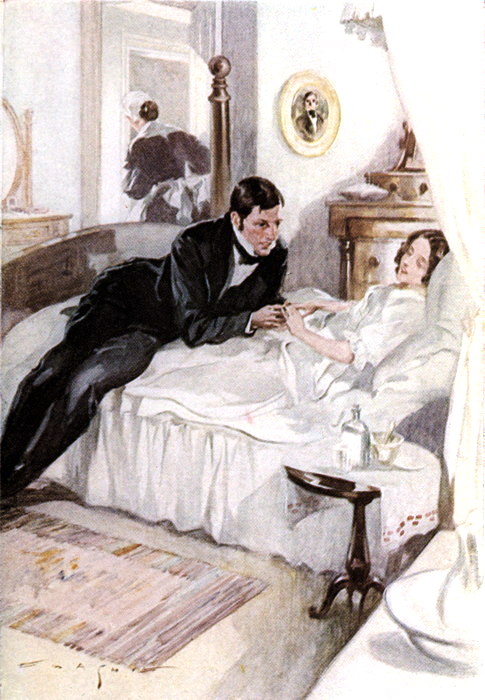
“Be strong,” she says, “God will help you!”
She presses harder your hand: “Adieu!”
A long breath—another; you are alone again. No tears now; poor man! You cannot find them!
—Again home early. There is a smell of varnish in your house. A coffin is there; they have clothed the body in decent grave clothes, and the undertaker is screwing down the lid, slipping round on tip-toe. Does he fear to waken her?
He asks you a simple question about the inscription upon the plate, rubbing it with his coat cuff. You look him straight in the eye; you motion to the door; you dare not speak.
He takes up his hat and glides out stealthful as a cat.
The man has done his work well for all. It is a nice coffin—a very nice coffin! Pass your hand over it—how smooth!
Some sprigs of mignonette are lying carelessly in a little gilt-edged saucer. She loved mignonette.
It is a good stanch table the coffin rests on; it is your table; you are a housekeeper—a man of family!
Ay, of family! keep down outcry, or the nurse will be in. Look over at the pinched features; is this all that is left of her? And where is your heart now? No, don’t thrust your nails into your hands, nor mangle your lip, nor grate your teeth together. If you could only weep!
—Another day. The coffin is gone out. The stupid mourners have wept—what idle tears! She with your crushed heart, has gone out!
Will you have pleasant evenings at your home now?
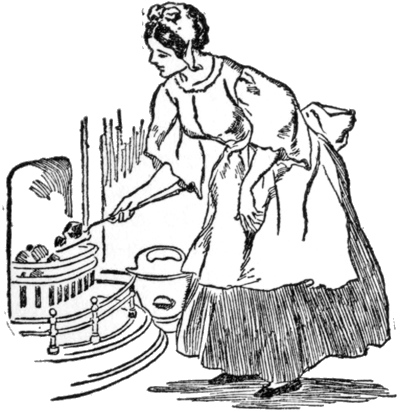
Go into your parlor that your prim housekeeper has made comfortable with clean hearth and blaze of sticks.
Sit down in your chair; there is another velvet cushioned one, over against yours—empty. You press your fingers on your eye-balls, as if you would press out something that hurt the brain; but you cannot. Your head leans upon your hand; your eye rests upon the flashing blaze.
Ashes always come after blaze.
Go now into the room where she was sick—softly, lest the prim housekeeper come after.
They have put new dimity upon her chair; they have hung new curtains over the bed. They have removed from the stand its vials, and silver bell; they have put a little vase of flowers in their place; the perfume will not offend the sick sense now. They have half opened the window, that the room so long closed may have air. It will not be too cold.
She is not there.
—Oh, God! thou who dost temper the wind to the shorn lamb—be kind!
The embers were dark; I stirred them; there was no sign of life. My dog was asleep. The clock in my tenant’s chamber had struck one.
I dashed a tear or two from my eyes; how they came there I know not. I half ejaculated a prayer of thanks, that such desolation had not yet come nigh me; and a prayer of hope—that it might never come.
In a half hour more, I was sleeping soundly. My reverie was ended.
BY A CITY GRATE
Blessed be letters—they are the monitors, they are also the comforters, and they are the only true heart-talkers! Your speech, and their speeches, are conventional; they are molded by circumstance; they are suggested by the observation, remark, and influence of the parties to whom the speaking is addressed, or by whom it may be overheard.
Your truest thought is modified half through its utterance by a look, a sign, a smile, or a sneer. It is not individual; it is not integral: it is social and mixed—half of you, and half of others. It bends, it sways, it multiplies, it retires, and it advances, as the talk of others presses, relaxes, or quickens.
But it is not so of letters—there you are, with only the soulless pen, and the snow-white, virgin paper. Your soul is measuring itself by itself, and saying its own sayings; there are no sneers to modify its utterance—no scowl to scare—nothing is present but you, and your thought.
Utter it then freely—write it down—stamp it—burn it in the ink!—There it is, a true soul-print!
Oh, the glory, the freedom, the passion of a letter! It is worth all the lip-talk in the world. Do you say, it is studied, made up, acted, rehearsed, contrived, artistic?
Let me see it, then; let me run it over; tell me age, sex, circumstance, and I will tell you if it be studied or real—if it be the merest lip-slang put into words, or heart-talk blazing on the paper.
I have a little packet, not very large, tied up with narrow, crimson ribbon, now soiled with frequent handling, which far into some winter’s night, I take down from its nook upon my shelf, and untie, and open, and run over, with such sorrow, and such joy—such tears and such smiles, as I am sure make me for weeks after, a kinder and holier man.
There are in this little packet, letters in the familiar hand of a mother—what gentle admonition—what tender affection!—God have mercy on him who outlives the tears that such admonitions, and such affection call up to the eye! There are others in the budget, in the delicate, and unformed hand of a loved, and lost sister—written when she, and you were full of glee, and the best mirth of youthfulness; does it harm you to recall that mirthfulness? or to trace again, for the hundredth time, that scrawling postscript at the bottom, with its i’s so carefully dotted, and its gigantic t’s so carefully crossed, by the childish hand of a little brother?
I have added latterly to that packet of letters; I almost need a new and longer ribbon; the old one is getting too short. Not a few of these new and cherished letters, a former reverie[1] has brought to me; not letters of cold praise, saying it was well done, artfully executed, prettily imagined—no such thing: but letters of sympathy—of sympathy which means sympathy—the παθημί and the συν.
It would be cold and dastardly work to copy them; I am too selfish for that. It is enough to say that they, the kind writers, have seen a heart in the reverie—have felt that it was real, true. They know it; a secret influence has told it. What matters it, pray, if, literally, there was no wife, and no dead child, and no coffin in the house? Is not feeling, feeling; and heart, heart? Are not these fancies thronging on my brain, bringing tears to my eyes, bringing joy to my soul, as living, as anything human can be living? What if they have no material type—no objective form? All that is crude—a mere reduction of ideality to sense—a transformation of the spiritual to the earthy—a leveling of soul to matter.
Are we not creatures of thought and passion? Is anything about us more earnest than that same thought and passion? Is there anything more real—more characteristic of that great and dim destiny to which we are born, and which may be written down in that terrible word—Forever?
Let those who will then, sneer at what in their wisdom they call untruth—at what is false, because it has no material presence: this does not create falsity; would to Heaven that it did!
And yet if there was actual, material truth, superadded to reverie, would such objectors sympathize the more? No! a thousand times, no; the heart that has no sympathy with thoughts and feelings that scorch the soul, is dead also—whatever its mocking tears, and gestures may say—to a coffin or a grave!
Let them pass, and we will come back to these cherished letters.
A mother, who has lost a child, has, she says, shed a tear—not one, but many—over the dead boy’s coldness. And another, who has not lost, but who trembles lest she lose, has found the words failing as she read, and a dim, sorrow-borne mist spreading over the page.
Another, yet rejoicing in all those family ties, that make life a charm, has listened nervously to careful reading, until the husband is called home, and the coffin is in the house—“Stop!”—she says; and a gush of tears tells the rest.
Yet the cold critic will say—“It was artfully done.” A curse on him!—it was not art: it was nature.
Another, a young, fresh, healthful girl-mind, has seen something in the love-picture—albeit so weak—of truth; and has kindly believed that it must be earnest. Ay, indeed is it, fair, and generous one—earnest as life and hope! Who, indeed, with a heart at all, that has not yet slipped away irreparably and forever from the shores of youth—from that fairyland which young enthusiasm creates, and over which bright dreams hover—but knows it to be real? And so such things will be read, till hopes are dashed, and death is come.
Another, a father, has laid down the book in tears.
—God bless them all! How far better this, than the cold praise of newspaper paragraphs, or the critically contrived approval of colder friends!
Let me gather up these letters, carefully—to be read when the heart is faint, and sick of all that there is unreal, and selfish in the world. Let me tie them together, with a new and longer bit of ribbon—not by a love-knot, that is too hard—but by an easy-slipping knot, that so I may get at them the better. And now, they are all together, a snug packet, and we will label them, not sentimentally (I pity the one who thinks it!), but earnestly, and in the best meaning of the term—Souvenirs du Coeur.
Thanks to my first reverie, which has added to such a treasure!
And now to my Second Reverie.
I am no longer in the country. The fields, the trees, the brooks are far away from me, and yet they are very present. A letter from my tenant—how different from those other letters!—lies upon my table, telling me what fields he has broken up for the autumn grain, and how many beeves he is fattening, and how the potatoes are turning out.
But I am in a garret of the city. From my window I look over a mass of crowded house-tops—moralizing often upon the scene, but in a strain too long and somber to be set down here. In place of the wide country chimney, with its iron fire-dogs, is a snug grate, where the maid makes me a fire in the morning, and rekindles it in the afternoon.
I am usually fairly seated in my chair—a cozily stuffed office chair—by five or six o’clock of the evening. The fire has been newly made, perhaps an hour before: first, the maid drops a withe of paper in the bottom of the grate, then a stick or two of pine-wood, and after it a hod of Liverpool coal; so that by the time I am seated for the evening, the sea-coal is fairly in a blaze.
When this has sunk to a level with the second bar of the grate, the maid replenishes it with a hod of anthracite; and I sit musing and reading, while the new coal warms and kindles—not leaving my place, until it has sunk to the third bar of the grate, which marks my bedtime.
I love these accidental measures of the hours, which belong to you, and your life, and not to the world. A watch is no more the measure of your time, than of the time of your neighbors; a church clock is as public and vulgar as a church-warden. I would as soon think of hiring the parish sexton to make my bed, as to regulate my time by the parish clock.
A shadow that the sun casts upon your carpet, or a streak of light on the slated roof yonder, or the burning of your fire, are pleasant time-keepers full of presence, full of companionship, and full of the warning—time is passing!
In the summer season I have even measured my reading, and my night-watch, by the burning of a taper; and I have scratched upon the handle to the little bronze taper-holder, that meaning passage of the New Testament—Νυξ γαρ ερχεται—the night cometh!
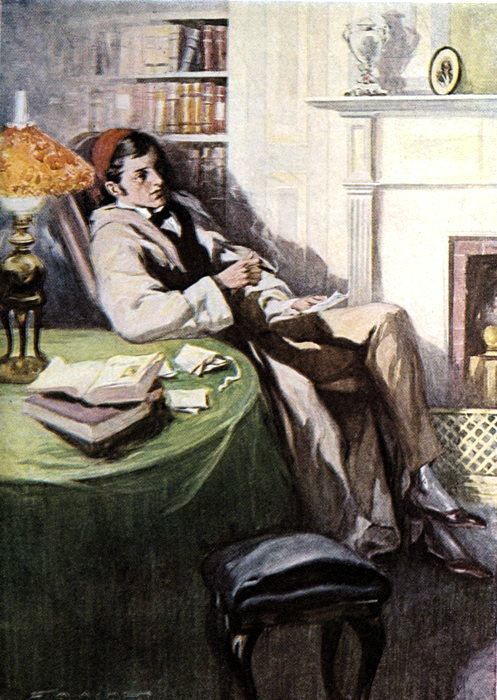
But I must get upon my reverie; it was a drizzly evening; I had worked hard during the day, and had drawn my boots—thrust my feet into slippers—thrown on a Turkish loose dress, and Greek cap—souvenirs to me of other times, and other places, and sat watching the lively, uncertain yellow play of the bituminous flame.