Report of GOVERNOR’S REPRESENTATIVES for California at Alaska-Yukon-Pacific Exposition
Reading edition
Sacramento, Cal., December 27, 1910.
To Hon. James N. Gillett, Governor of California, and Ex-Officio Commissioner Alaska-Yukon-Pacific Exposition.
Dear Sir:—
As your Representatives, charged with the details of California’s representation at the Alaska-Yukon-Pacific Exposition, held at Seattle, Washington, from June 1st to October 15th, 1909, inclusive, we take pleasure in submitting to you the following report of our work.
It was right that California should aid and participate in a Western Exposition, and it was wise to make the appropriation for the purpose sufficient to insure a creditable representation of the State’s resources. Accordingly, on your recommendation, the Legislature of 1907, set apart from the General Fund the sum of $100,000, and authorized you, as Commissioner for California, through such Representatives as it might be your pleasure to appoint, to supervise the general expenditure of the appropriation in the erection of a suitable building on the Alaska-Yukon-Pacific Exposition grounds, and the collection and installation therein of such an exhibit as would do credit to the State, and exemplify in as striking and effective manner as possible the great variety and superior quality of California’s products.
REPRESENTATIVES.
In accordance with the authority thus conferred it was your pleasure to appoint the undersigned to represent you in this work. You acted promptly and gave your Representatives ample time to take advantage of the seasons to secure samples of everything necessary for a complete display of the State’s resources. To this one fact is due largely the greater completeness of the Seattle exhibit than any California had previously made. You also relieved your Representatives of possible embarrassment by allowing them to appoint their own assistants and fix their compensation and term of service. In the exercise of this authority preference was given to those best qualified to perform the work required, and the term of employment depended on efficiency and good behavior. No help was hired that was not absolutely necessary, and no one was kept on the pay-roll a moment longer than his or her services were required. In short, it was our determined purpose from the start to try and secure maximum results at a minimum cost in every department of the work, to the end that the final outcome might be an improvement on any previous effort made by California of a similar character.
We considered this to be necessary, not only in deference to our own reputation, but more particularly for the credit and benefit of the State. You can understand if the display made at Seattle had been less complete or in any way less attractive than the one made at Portland, for instance, the impression created would be that those in charge were becoming careless, or that California was retrograding, a condition that would probably have resulted in as much harm as good, and largely or entirely neutralized the object of the Legislature in making the appropriation.
IMPROVEMENT IMPERATIVE.
We felt that we must improve on previous showings made by the State at other Expositions, or resign and ask that the responsibility be placed in other hands, or that the money be allowed to remain in the State Treasury. With a larger appropriation, corresponding with the larger expenditures in freight and numerous other items at Seattle as compared to Portland, the effort for an improved display would not have been difficult; but with the appropriation practically the same, considering the salvage benefit realized for Portland from California’s exhibit the previous year at St. Louis, the planning, the economizing, the denials and the extra personal labor imposed in order to accomplish the desired result can never be fully appreciated, except by those who had immediate charge of the work. Those efforts were made the more difficult by reason of California’s reputation for open handed hospitality, and the ever present consciousness that nothing must be done or left undone that might tend to impair that reputation. You can understand it is no easy task to maintain a show of generous hospitality all day, and then set up at night to figure out how you can do the same thing to-morrow without unduly impairing a limited revenue.
BUILDING AND EXHIBITS SUPERIOR.
But we did it. We built the best and second largest State Building ever erected at a World’s Fair; we collected and installed the most complete and most attractive exhibit of California’s resources that the State ever made; we maintained stereoptican lectures, gave out verbal information to all inquirers, and distributed attractive literature; we gave frequent receptions and dispensed true California hospitality; we filled the measure of our aim; we did what we believe the State expected us to do, and it is a proud moment now the work is ended and we are able to record the fact that we did it without exceeding the appropriation.
THE CALIFORNIA BUILDING.
The California building was of the Spanish renaissance style of architecture. The broad steps that led up to the five large arches which opened on to the wide portico or colonnade were eighty feet long, and through any of the five broad doors that fronted the arches visitors entered the main exhibition hall. This hall was one hundred and forty feet square with gallery on all four sides twenty-one feet high and thirty feet wide. Four flights of easy stairs, one at either corner, led to the spacious gallery. Light was diffused from side windows under the gallery and in the gallery high enough from the floor so as not to interfere with the wall for exhibit purposes, and from an iron-framed skylight sixty-four feet square. On either side of the main building and in line with the front there were wings thirty-two feet wide and thirty-five feet long. This gave a total frontage to the building of two hundred and ten feet, or a little more than two-thirds of an average city block. The wings were so arranged as to provide a lecture hall, offices, parlor, reception room, buffet, and living rooms for the Representatives and some of the employees. The structure as a whole presented an imposing appearance and was ideal for the purpose intended. It was designed and built by the State Engineering Department, with an occasional inspection by one of the Representatives. Builders figured on the plans and variously estimated the cost at from $50,000 to $56,000. We had asked for a building to cost not exceeding one-third of the appropriation. For a time we feared the dimensions would have to be reduced, but State Engineer Ellery, after figuring carefully on the job, expressed the opinion that he could erect the structure as planned for an amount pretty close to our figures. He was finally requested to go ahead with the work. He put one of his trusted superintendents in charge, hired his help by the day, and when completed as nearly as desired for exposition purposes, it was found to have cost, including preparation of grounds and finishing of lecture room, just $40,333.84, and it was better finished outside and more substantially constructed than Exposition buildings usually are.
NOW A MUSEUM.
As you are aware it has been deeded to the Washington University, on whose grounds the Exposition was held, and, barring accidents, will remain for many years as the University Museum building.
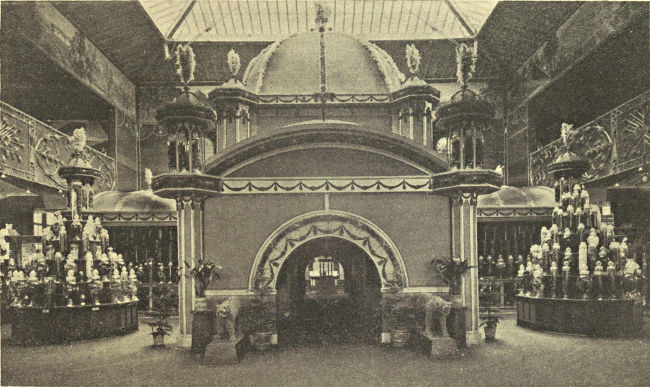
GENERAL VIEW, CALIFORNIA EXHIBIT, SEATTLE, 1909 Center Piece or Fruit Palace
THE GENERAL DISPLAY.
The installation would be tedious to describe, and we will not attempt it further than to say that harmony in color and arrangement was maintained throughout the building, all balancing from an imposing center-piece, or Product Palace, which was covered entirely with natural products of the State, including dried fruits, seeds, cereals, raisins, nuts, etc., so artistically arranged as to give the whole a very attractive appearance. This center-piece or palace was admitted to be not only the most beautiful feature of the California Building, but the most original, elaborate and artistic feature of the entire Exposition. The editor of Illustrated Northwest Farm and Home visited the California Building during the early part of the Fair, and returning home gave expression to his impressions through the columns of his paper in these words:
“In the California Building there is everything to delight the eye and the entertainers can talk English. The statuary and ornaments in fruits and nuts surpasses anything that the eye of man ever beheld. For instance; the representation of carvings over the finished woods are created of various kinds of fruits; at the entrance to the center-piece within the main building, are two life-size mountain lions made of peaches; a black knight mounted on a black horse, are made of California prunes; an elephant, full size, is made of California walnuts; a life-size cow is created of California almonds; a large black bear has California raisins for a robe; a lemon as large as a hogshead, is composed of California lemons.”
These were some of the fruit features designed to set off the general display and emphasize the products that composed them. But these were only incidental to the strong and imposing exhibit of all of California’s material products. There was a generous display of processed fruits, including all varieties known to the State. The dried fruit department was strong and attractive, embracing three separate features, one of miscellaneous dried fruits, one of raisins and one of prunes. There were separate stands or features of wines, olive oil, pickled olives, mineral water, canned fruit, preserved fruit, vegetables, flowers, oranges, nuts, honey, beans, cereals, seeds, sugar, silk, wool, ostrich feathers, fibers, canned milk, canned fish, etc., etc., besides many suitable show cases containing samples of other products more delicate and less in quantity. There was a strong show of incubators and an attractive feature of borax. Models were shown, and in operation where practicable, of such articles or machinery as could not be accommodated otherwise, as for instance the working model of a complete gold dredge, manufactured especially for this exhibit by the Risdon Iron Works of San Francisco.
MINING EXHIBIT.
The Mining Department of the display on the main floor of the California Building was attractively installed and as complete as the State has ever made, being strong in the minerals in which we are strong, but embracing in all forty-four separate commercial varieties, including a strong showing of mineral oils and structural materials. A beautiful illuminated case of gold specimens and free gold ores from Siskiyou County, and an equally beautiful illuminated case of rough and cut gems from San Diego County, including gem jewelry, constituted very attractive features of the mineral department. The onyx and onyx ware from San Diego made a fine showing, as did also the large display of slate in all forms of utility from El Dorado.
FORESTRY.
The Forestry Department included all the commercial woods of the State and many that have a prospective value for cabinet purposes. The variety displayed in this feature was so great, the installation so attractive, and the quality of the raw and manufactured samples so superior, that the Jury readily awarded to it a Grand Prize, the highest recognition possible, and this in a State where forestry is a leading industry, and by a Jury composed largely of Washingtonians. This was a victory to be proud of. All the available space on the walls of the main exhibition hall was covered with enlarged views of California scenes and industries.
THE GALLERY.
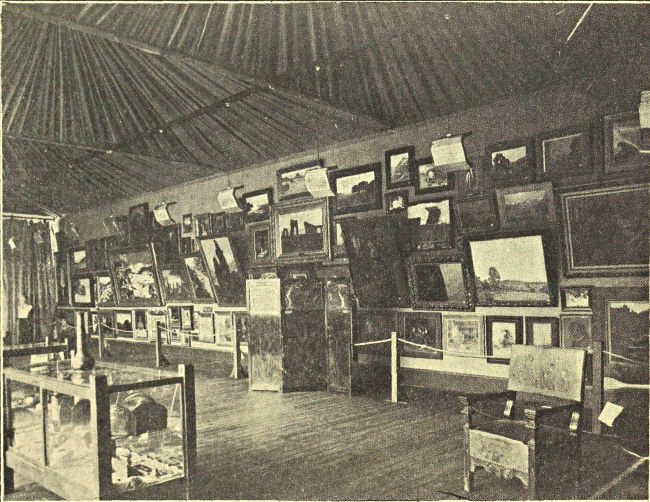
SECTION OF ART GALLERY, CALIFORNIA EXHIBIT, SEATTLE, 1909
On the upper floor, one gallery (the front) was reserved for display pictures, a hotel information bureau and receptions, one for an exhibit of manufacturers’ samples, one for Art, and one for Education.
THE MANUFACTURERS’ SAMPLES,
while largely a new departure, constituted a very interesting and instructive feature. Even many Californians were surprised to learn that all of the articles found there were made in this State. Leather and leather goods, silk and silk fabrics and nautical instruments in this department, each were awarded the highest prize it was possible to obtain.
FINE ARTS.
The Art Display collected largely by Miss Evelyn Almond Withrow of San Francisco, as a labor of love, her services being gratuitous, as was her time in superintending the installation of the exhibit later, was freely admitted by those informed on such things to be the best and most complete representation of California art and handicraft ever brought together on any previous occasion either at home or abroad. It comprised nearly three hundred pictures, all the best work of the best artists in the State, besides busts of statuary, samples of modeling and eight large and specially designed show cases filled with beautiful samples of all classes of handiwork known to art.
EDUCATION.
Our Educational Display was the best and most complete ever made, and was very much the best exhibit of the kind at the Seattle Exposition. It was collected and superintended by Mr. Robert Furlong of San Rafael, an expert in this line of work, and embraced a representative showing of every department of California’s educational system from the kindergarten to the university, not omitting the libraries and private educational institutions. There could be only one criticism to this department and that was its crowded condition, as there was too much material for the space that could be allowed for it. In an exhibit of products, quantity can be reduced without material detriment, but if one sample of an educational exhibit is left out, the work perhaps of some fond son or daughter whose parents may come looking for it, there is likely to be trouble. Nearly all portions of California contributed to this Department, making the display representative in every sense.
OUR LOCATION AND GROUNDS.
The California building, though some distance back from the main entrance, was on high ground and eligibly located as to attractive surroundings and accessibility. The grounds for so large a structure were necessarily extensive, and the work of clearing, leveling, sodding and planting these grounds involved an expenditure much greater than at previous expositions, where the grounds were smaller and required less preparatory work.
Mr. Geo. C. Roeding of Fresno, our Superintendent of Horticulture, giving his talents and time, as did Miss Withrow, for the love of the work and the good he could do the State, collected from different nurseries in California two car loads of fruiting trees, flowering plants, palms and shrubs, and traveled to Seattle to personally superintend the work of converting these grounds into a typical California park, with clusters of palms, geranium beds and orange groves. It gave to the Exposition a semi-tropic feature which visitors greatly enjoyed, and which was highly appreciated by the Exposition management as a rare and valuable acquisition to their already beautiful landscape effects. It might be said, however, that the citrus trees and other tender plants did not thrive well even in the Seattle summer, and though the grounds thus planted, as a side attraction and subject of favorable comment, were perhaps worth all they cost, yet they were not so beautiful as they would have been under more favorable climatic conditions. Mr. Roeding’s work in the department was prompted by love of his art and pride in his State. He contributed liberally from his own nurseries and gave time and technical assistance that money could hardly have bought, and for his unstinted services, not only your Representatives, but all Californians, owe him a debt of lasting gratitude.
COUNTY AID.
Striving to obtain the best exhibit possible with the means available, your Representatives early solicited the co-operation of all the counties of California, offering in return for their efforts such distinctive representation as the merits of their respective products would warrant, consistent with a general harmonious plan of installation. Some responded very generously, others modestly and some not at all. On the whole, however, the help from counties was very material, particularly the services of their respective representatives in entertaining visitors to the California building and answering the constant flow of questions provoked by an inspection of the exhibits. Those counties that supported one or more representatives at the Exposition and which contributed more or less to the general display were, San Diego, Los Angeles, Riverside, Ventura, Santa Barbara, Santa Cruz, Alameda, San Francisco, Tulare, Sacramento and Siskiyou. Material was contributed by Kern, Fresno, San Joaquin, Monterey, Santa Clara, and here and there a little from others, but none of these latter maintained a representative, while some of those first named had at least two people with us all the time. It can be readily understood that with the regular State employees, reenforced by all the county representatives indicated, selected generally by reason of their especial qualifications for the position, the California force was very strong, and if any one visited the building and left without learning all he or she wanted to know about our State, or any part or industry thereof, it was because they did not make the desire for such information known. The work of the able floor representatives and lecturers was strongly reenforced by a well equipped
LITERATURE BUREAU.
A neat booth with spacious counter was provided at a prominent and convenient place in the building and well supplied with attractive literature all the time, free to all comers. In addition to the State book, a large edition of which was compiled and published at the expense of the appropriation, and which, we desire to say here, was as comprehensive a publication on California as was ever gotten out, nearly every progressive county contributed to the supply, thus making it possible to meet the eager demand that always exists for information regarding this State. Altogether from first to last we estimate that more than a car load of literature was handed out from our literature booth or given to visitors by those on the floor, and yet no one was ever asked to take a line who had not previously expressed a desire for it. If you force literature on people much of it is thrown away as soon as they are out of your sight. If put within convenient reach people take what they want and no more, and what they want they keep. No California literature was thrown away.
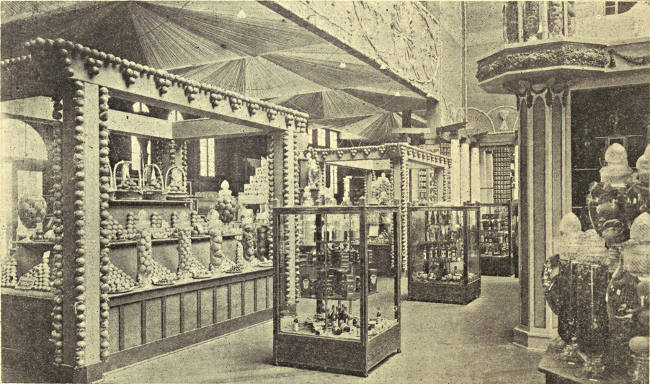
GENERAL VIEW, CALIFORNIA EXHIBIT, SEATTLE, 1909
THE FREE ILLUSTRATED LECTURES
were a strong reenforcement to the literature. These lectures were given by the different County Representatives in a hall built and equipped by the State especially for the purpose, and which opened off the main exhibition room. The number of lectures varied from nine to twelve a day, each occupying half an hour, twenty-five minutes for the talk and five minutes to empty and re-fill the hall. They were a popular feature and always well patronized, and their far-reaching and convincing lessons will be realized in benefits to California, and especially to the sections represented, for many years to come. A new departure in Exposition work was the maintenance in the California building of a California
HOTEL INFORMATION BUREAU.
Room and accommodations were gladly given for this feature, which, however, was maintained at the expense of certain contributing hotels that represented practically all important centers of the State. It relieved your Representatives of the duty of supplying information in this particular line of inquiry and insured the work being done better than it could have been otherwise.
DEMONSTRATING BOOTHS
were maintained in the California Building by a number of exhibitors to whom we were pleased to give space for the purpose, as experience teaches that one of the most effective ways of impressing the merits of any particular article is to prove its value by sample. Our preserved fruits, our canned mackerel and our borax products were shown and sampled from artistic booths, while beans, wine, olive oil and other products were demonstrated as occasion required but in a more modest way.
HOSTESSES.
Mrs. Wiggins and Mrs. Filcher who had served so successfully as hostesses at the St. Louis Exposition and at the Portland Exposition, were installed as hostesses of the California Building at Seattle, the compensation to be determined after the close of the Exposition when our financial condition would be better understood, they agreeing in advance to abide by the outcome. This arrangement was an incentive to extra economy on their part, and it may be said they seconded every effort of your Representatives in that direction, and yet they maintained California’s reputation for hospitality admirably, and became favorites in the large Hostesses’ Association of the Exposition, of which Mrs. Wiggins was one of the leading officials.
SECRETARY.
Mr. Geo. A. Dennison, who had a long prior record with the State Board of Trade, and who served us so efficiently as Secretary at St. Louis and at Portland, was appointed Secretary at Seattle, and remained with us to the close of our work. In this connection it may be said that other State Representatives had as their office force a secretary, a bookkeeper and a stenographer. Mr. Dennison, possessing the qualifications, filled all three of those positions for California, and being an expert in each branch filled them all with marked efficiency.
ATTENDANCE.
The splendid exhibit made by California proved one of the principal attractions of the Exposition. It became to be the general remark that if you did not see the Government exhibit and the California exhibit you did not see the show. As a consequence all who attended the Exposition visited the California building, and as may be supposed, we had a crowd passing through the exhibits all the time the building was open. The average attendance at the Exposition was close to 25,000 a day; allowing that each visitor spent two days on the grounds, and that in one of the two days practically all visited our building, it may be estimated that the number who inspected the California exhibits daily was about 12,000. This we believe is a fair estimate.
CALIFORNIA VISITORS.
We had a separate card register for visitors from this State, and it will surprise you perhaps to learn that the number of Californians who registered with us averaged nearly two hundred a day, or twelve hundred a week. In one day during the height of the season we registered 372 people from our home State. It is not only possible, but very probable, that many come and went without registering; making allowance for these, and figuring those who did register at 1,200 a week, and counting twenty weeks for the Fair (19 weeks and 5 days to be exact), we estimate the number of Californians who attended the Seattle Exposition at 25,000.
AWARDS.
If other evidence were wanting to establish the claim that the Seattle exhibit was the best and most complete ever made by California, it would be found in the record of prizes won by this State. In proportion to the number of entries we not only beat all the other States in the number of high awards, but we beat all past records made by California, and this in face of the fact that the juries as a rule set a high standard and were very critical in their examinations. California’s greatest total premiums at any previous Exposition was 518, while at Seattle the total was 800. To win gold medals or higher on half the entries is considered a remarkable record, and yet out of the total of 800 at Seattle, 90 were grand prizes, an award only made in case of extraordinary excellence, 414 were gold medals, 155 silver medals, 108 bronze medals and 33 honorable mentions. A careful analysis by one who understands what is required to win a high award at an International Exposition and what it stands for, will show at once that this is a most extraordinary record, one which we confidently believe has never been equalled by any State or country at any Exposition in the world, and one which is not likely to be equalled except possibly by California itself, for many years to come. It will be noticed from the detailed list of the awards, which follows in this report, that they are well distributed throughout the State, nearly every locality and every industry sharing in the honors, a further evidence of the representative character of the exhibit.
SALVAGE.
At the close of the Exposition we took sufficient time to safely pack all material that had to be returned and to label it carefully so as to facilitate its distribution in California. In the meantime we sold some of the edible goods and some on order we turned over to local agents of the owners. All money received therefor has been remitted to the parties who furnished the articles and receipts received for the same. The furniture, fixtures and other material which belonged to the State and which we deemed it advisable to sell, was disposed of to the best advantage possible, considering the great quantity of this class of goods that were being thrown on the market. From this source we realized the sum of $5,135.16. From rent of soft drink stand in the building we realized the sum of $300.00, and from the sale of building $750.00, making the total salvage exclusive of building $5,435.16, which is fully accounted for in the financial statement which follows in this report. The $750.00 received for the building was turned over to the State Printer on account and never passed through our hands.
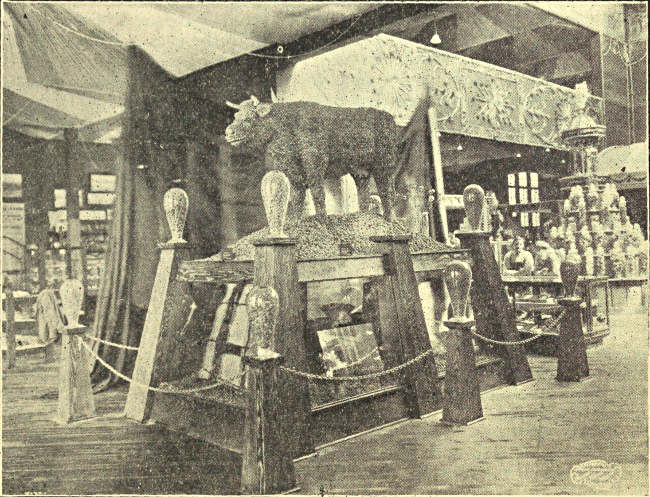
THE ALMOND COW, LIFE SIZE, CALIFORNIA EXHIBIT, SEATTLE, 1909
MATERIAL ON HAND.
There was certain office furniture which it was deemed unwise to sacrifice, and some permanent exhibition material that is worth more to the State for future expositions than any amount that could be realized from it at a forced sale. Consequently this material was returned and the furniture has been turned over to the State Agricultural Society and the exhibition material has been stored in a shed which we built for the purpose on the grounds of the State Agricultural Society. The latter consists of eight mineral show cases, a collection of California ores and mineral specimens, a large assortment of California woods, including burls and rare specimens, a lot of framed and unframed pictures of California scenes and industries, and about 500 glass jars, most of which are filled with seeds, cereals, sugar or processed fruits. The furniture returned at 50 cents on the dollar, the usual selling price at an Exposition of good material, is worth $75.00, the showcases $425.00, exhibit material, estimated at half what it would cost to collect it, $2,000.00, and the glass jars $1,000.00. This totals a heritage to the State from the Seattle Exposition of $3,500.00. This will be available and worth even more than the sum stated whenever the State desires to make another exhibition.
BENEFITS TO CALIFORNIA.
Summing up the benefits of an exhibit is a good deal like a merchant trying to estimate the good derived from a sign over his door. Occasionally a patron may say, “I saw your sign and came in,” and occasionally a party may say, “I saw your exhibit and it prompted me to come to California.” The money dropped from travelers alone who passed through this State going to or returning from the Exposition, has probably recompensed California for its outlay, but this is only the beginning of the harvest. Many people from the eastern and central States who visited the Exposition with a view of ascertaining in which part of the Northwest it would be best to settle, changed their minds after seeing the exhibits made by the different States and came on to California. Besides, thousands of others already settled, after inspecting the exhibits made by this State, openly declared that if they ever moved again they would land in California. The tons of literature on this State carried away by visitors to supplement and strengthen their impressions, both impressions and literature to be disseminated among their neighbors, will have an effect that cannot be estimated, but which must inevitably bear fruit for California for many years to come. Then again, the seeing of our splendid products naturally excites a desire to try them, and the increased demand for our fruits, oil, wines, etc., growing out of such a display, is far-reaching. But more than all this, the greater intercourse, the better acquaintance, the more friendly feeling between the people of the different sections of the country, and particularly of the west, and more particularly between the people of this State and Washington, or Oregon and Washington, if you please, is bound to lead to a better understanding in regard to trade relations and result in commercial benefits that cannot be estimated. That the participation of California was wise there is no doubt, and that the benefits received and to be received will be many fold greater than the cost is as certain as the future. The follow-up letters that have already come to your Representatives from people of the Northwest and other sections who saw and inspected our exhibit, is further proof that an interest in this State has been awakened among them that will not soon die out.
ACKNOWLEDGEMENTS.
We are under obligations to so many that it would be tedious to enumerate them. The higher officials of the Exposition, President J. E. Chilberg, Director-General I. A. Nadeau and Director of Exhibits H. E. Dosch, showed us every courtesy and manifested a desire to do all they could to facilitate our work; while from the other departments, and even from the subordinates in all departments, a request from California was promptly considered and always conceded when not inconsistent with the Exposition rules. There were differences at first, as is always the case, but on a better understanding these were adjusted to the satisfaction of all concerned.
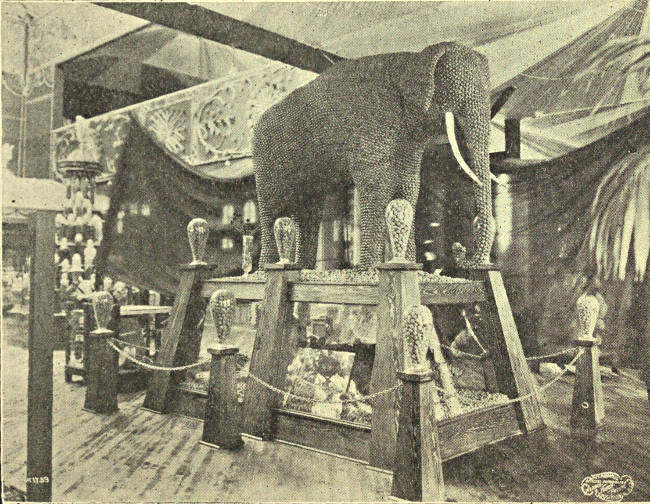
WALNUT ELEPHANT, LIFE SIZE, CALIFORNIA EXHIBIT, SEATTLE, 1909
The Southern Pacific Company and the Northern Pacific Company carried our freight at a one-way rate, and their respective agents were prompt and accommodating, setting a new mark for railroad efficiency at Expositions. The Southern Pacific Passenger Department also loaned us some very fine pictures of California scenes which were valuable not only as wall decorations but as object lessons on certain features of our State. To the Golden Gate Park officials of San Francisco, and also the officials of the Stockton State Hospital, we are under obligations for liberal contributions of ornamental plants and shrubs for the decoration of the California building and grounds. Mr. R. M. Teague of San Dimas and the Fancher Creek Nursery of Fresno, also contributed liberally of their choicest stock, for which we owe them a debt of gratitude. The same is true of J. Dietrich, Howard & Smith, Elysian Park and Edward H. Rust, all of Los Angeles, and of the Orange County Nursery & Land Co., of Fullerton.
To the counties and other subdivisions of the State that through organized effort and at their own expense collected valuable exhibition material, prepared descriptive literature and sent representatives to Seattle, thereby strengthening the exhibit and adding to the force of California workers, we are under obligations. To their efforts and to the efficiency of the people they sent much of California’s success at the Seattle Exposition is due, and we want them to know and feel that their efforts and co-operation are fully appreciated.
To producers, manufacturers and packers, to lumbermen and miners, who responded to our request for samples of their output we owe a debt which we tried to pay in part by caring for their goods as they would have cared for them, and by looking out for their interests in the matter of awards as carefully as they could have done had they been there.
In this connection we wish to express our obligation to the Niles-Pease Furniture Company for the generous loan of the finest art mission furniture for our reception room, to Byron Mauzy of San Francisco, the Star Piano Company and Salyer-Baumeister of Los Angeles, for the loan of pianos for the use of our guests, and to the Eilers Piano Company for the free use of a pianola for our lecture room. To Arthur Harris, designer, and to C. L. Wilson, Superintendent of Installation, both experts in their line, is due largely the attractive character of California’s exhibit, admitted to be the most beautiful in arrangement and display, as well as the most comprehensive ever put up by this or any other State, at Seattle or any other Exposition.
CONCLUSION.
We do not hesitate to affirm that California’s participation at the Seattle Exposition was a success from every point of view, and knowing our trust was conscientiously performed, and that our best efforts were exerted in the interest of our State, we dare to hope that you who trusted us are not disappointed, and that the people of California who generously advanced the money for the work are satisfied with the showing made, and that they will reap substantial and lasting benefit as the result of their enterprise and liberality. We want to thank you sincerely for the confidence reposed in us, for your kindly co-operation and advise, and particularly for the generous rein given to us in carrying out a work for which you, in the eyes of the law, were primarily responsible. Our studied efforts were continually directed toward trying to get the greatest results at the least cost, for, though handling a generous appropriation, we never lost sight of the fact that it was the people’s money, and consequently we consented to the expenditure of a dollar only where in our judgement a dollar’s worth or more benefit would accrue to California; neither did we lose sight of the high standard which has characterized your course in the handling of public affairs. We acted on the principle that public office is a public trust, and that public money should be handled with greater care than one would handle his own.
The following pages contain a complete list of the awards made to California exhibitors and a statement of all moneys received and expended, and accompanying this report we hand you the vouchers showing all our transactions and just how the money was expended. We have settled every honorable claim, we have concluded the work in full, even to the distribution of the awards, and if there is a dollar left to go back into the Treasury it is because that dollar was not needed for the full satisfaction of the duties imposed.
Respectfully,
J. A. FILCHER,
FRANK WIGGINS,
Governor’s Representatives.