"Renshaw Fanning's Quest" (continued 4)
Reading edition
“Well, it’s certainly an infernal labyrinth so far, and I suppose likely to get worse. Still, I’ll take extra notice of the landmarks,” growled Sellon.
Then he rolled himself up in his blanket to turn in, characteristically leaving his companion to do whatever watching was necessary. And there was some of the latter to be done, for ever and anon the scream of a leopard away among the crags, or the growling snuffle of some beast, unseen in the darkness, slaking his thirst at the waterhole just below, would cause the horses to snort wildly, and tug and strain at their picket reims in alarm. It needed the sound of a human voice, the touch of a human hand, and that frequently, to allay their fears—peradventure to prevent them from breaking loose and galloping madly off into the night; and however his less inured companion may have been able to revert to more congenial scenes in the blissful illusions of dreams, there was little sleep that night for Renshaw Fanning.
Chapter Twenty Six.
Selwood’s Dilemma.
The post at Sunningdale was a weekly, not a daily event. Happy Sunningdale!
It was conveyed from the nearest Field Cornet’s, by a ragged native, bestriding a still more ragged pony, and who was “run” by general contribution on the part of those residents whose letters he delivered.
We have said that the postal delivery at Sunningdale was a weekly event. After rainy weather, when the Umtirara and other rivers were down, it was a fortnightly business; sometimes even three weeks would go by without postal communication with the outer world. Happy, happy Sunningdale!
To-day, however, the courier was up to time, and Christopher Selwood, unlocking the weather-beaten leather bag, began to sort and distribute its contents.
“Miss Avory—Miss Avory—Miss Avory—heavens! There’s no end to them. We shall have the postboy striking for double pay if Miss Avory’s correspondents don’t hold their hand.”
Violet—devouring with her eyes the contents of the bag as they came forth—laughed at her host’s remark, but the laugh was a hollow one. The missive she hungered for was not there. True, she had expected this contingency sooner or later—yet now that it had come it did not seem any the less poignant. Every post hitherto had brought letters from her lover, each with a different postmark. Now his silence meant that he was beyond the reach of any such civilised institutions. She would see no more of his handwriting until she should again have heard the sound of his voice. But—what if it were fated that never again should she hear that voice?
“That’s all the ‘hopes and fears’ this week,” said Selwood, holding the leather bag upside down. Then gathering up the bundle of his own correspondence he crammed it carelessly into his pocket and went out.
There was some irrigating to be attended to down at the “lands,” and for the next two hours Christopher was very busy. Then as he returned to the house, he suddenly remembered his unopened correspondence. It was near sundown, but there was half an hour to spare before counting-in time.
Looking around, he espied a seat—the same rustic bench where we first witnessed Violet’s stolen interview. The place was shady, and cool and inviting withal. Selwood sat down, and dragging the letters out of his pocket and having laid them out, face downwards, along the bench, proceeded to open them one by one.
They were mostly of the ordinary kind—business letters relating to the sale of stock or corn—an official notification or two—soon disposed of. But one he had opened near the last must have been of a different nature. First a puzzled look came into his eyes—then he guffawed aloud.
“Pray do not flatter yourself,” began the missive, dispensing entirely with the regulation formality of opening—“pray do not flatter yourself in the idea that I am in ignorance of your whereabouts. Clever as you may imagine yourself, not one of your disreputable movements takes place unknown to me. I know where you are now, and who is with you. But it is of no use. If you exercise your influence over that abandoned creature to the utmost she can never be anything but your mistress. For mark my words, Maurice Sellon, whatever you may do I will never set you free. You are bound to me by a tie that nothing but my own will or my death can sever. But I will never consent to play into your villainous hands or into those of your creature Violet Avory—”
“Oh, good God in heaven,” cried Selwood, horror-stricken. “What in the world have I gone and done now! ‘Maurice Sellon! Violet Avory!’ Good Lord, what does it all mean?” Then, instinctively he did what he should have done at first, turned the sheet to glance at the signature. There it was.
“Your shamefully injured wife,
“Adela Sellon.”
“Oh, good Lord, I’ve done it now!” he cried again, the horrible truth dawning upon him that he had not only opened and read another man’s letter, but had surprised another man’s secret, and that a secret of a peculiarly awkward nature. How he anathematised his carelessness. He snatched up the envelope, which he had thrown down among the others. There was the address—plain as a pikestaff. Yet, stay, not so very plain after all. It was directed “M. Sellon, Esq.” But the long letters were dwarfed and the short extended. The “M” at a casual glance looked not unlike “Ch,” a common abbreviation on envelopes of Selwood’s longish Christian name. Then like lightning, his memory sped back to the day of his guest’s arrival and his own joke relative to each of them holding half their names in common. “We are both ‘Sells,’” he had said with a laugh, and now into what a cursed mistake had that coincidence led him.
Poor Chris groaned aloud as he thought of the awkward position in which his carelessness had placed him. It would have been bad enough had the letter been of an ordinary nature. But being such as it was, the probabilities that its real owner would believe in accident having anything to do with the matter were infinitesimal. No. He would certainly suspect him of a deliberate intention to pry into his affairs. And what made things worse was the fact of the other man being his guest.
But only momentarily did this idea serve to divert his thoughts from the extreme awkwardness of his own position. Violet Avory was his guest, too; and with far greater claim on his consideration than this stranger—for was she not under his care? And as the full force of the disclosure with which he had so involuntarily become acquainted—and its consequences—struck home to his mind, honest Chris felt fired with hot anger against the absent Sellon. What business had the latter—a married man—laying himself out to win poor Violet’s heart? That he had succeeded—and thoroughly succeeded—had been only too obvious to every member of the Sunningdale household—and that for some time past. No, no. Sellon had abused his hospitality in a shameful manner, and in so doing had almost forfeited any claim to consideration. Had he learned the ugly secret in the ordinary way Christopher would not have hesitated for a moment. He would have forbidden Sellon the house in terms which should leave no sort of margin for dispute. But then—the manner of his information. There lay the rub. Never in the whole course of his life had Christopher Selwood found himself in so difficult—so perplexing a situation.
Then he did the very worst thing he could have done. He resolved to take his wife into confidence in the matter at once. Bundling the whole heap of correspondence into his pocket again, he rose, and took his way to the sheep-kraals for the evening count-in. But it is to be feared that if Gomfana or old Jacob had carelessly left a sheep or two in the veldt that evening pro bono the jackals, their master was too uncertain in his count to be sure of it.
Mrs Selwood’s indignation at the disclosure was as great as that of her husband, but the method by which that disclosure had come about, womanlike, she dismissed as a comparative trifle. Indeed, had she been the one to open the letter, it is pretty safe to assert that so far from resting content with the fragment which Christopher had found more than enough, she would have read it through to the bitter end. For to the feminine mind the axiom that “the end justifies the means” is a thoroughly sound one. Not one woman in fifty can resist the temptation of reading a letter which she is not meant to read when it is safe to do so, and not one in ten thousand if she suspects any particular reason why she should be left in ignorance of its contents.
“Well, now, Hilda, what’s to be done?” said Selwood, when he had told her—for with scrupulous honour he had refused to let her see one word of the letter itself. It was only intended for one person’s eyes. It was horribly unfortunate that two had seen it, but it would be worse still to extend the privilege to a third.
“What’s to be done?” she echoed. “It’s a shocking business, and the man must be an arrant scoundrel. The only thing to be done is, in the first place, to request him not to return here; in the next, to sound Violet herself. Things may not have gone so far as we think, but I’m very much afraid they have. Why, latterly the girl has become quite changed, and for a week or so before he left she could hardly bear him out of her sight.”
“Yes, that’ll be the best plan, I suppose,” acquiesced Chris, ruefully.
“I hope Violet will show a proper amount of sense and self-respect,” concluded Mrs Selwood, in a tone which seemed to convey that the hope was but a forlorn one. “But remember, Chris, we must take up a firm position and stand to it. The girl is very young, and we are responsible for her until she returns home, and indeed I begin to think the sooner she does that the better, now. She is very young, as I said, but she has turned one and twenty, and there’s no knowing what mad suicidal act of folly a girl of her temperament, and legally her own mistress, may be capable of under these circumstances.”
“It’ll be a difficult thing for me to explain matters about the letter,” said Selwood, ruefully. “The fellow is sure to scout the idea of a mistake. However, there’s no help for it. I must explain, and that, too, at the earliest opportunity.”
Tact is not, as a rule, a feminine characteristic, but Hilda Selwood possessed a larger share of it than many women with considerably the advantage over herself in training and general knowledge of the world. She began as she had said by literally “sounding” Violet. But there was something in the latter’s manner which seemed to show that the news of Sellon’s previous appropriation was no news to her at all—in fact, that she had known it all along. Finally she admitted as much, and rather gloried in it.
Then ensued a tolerably lively scene. What if he was chained to a fiend of a woman whose sole end and object had always been to make life a burden to him? burst forth Violet, with livid face and flashing eyes. The creature would die some day, it was to be hoped, and then ten thousand heavens were as nothing to the happiness before them both. Give him up? Not she! She would rather die a thousand times over, and would do so first. She was his real wife in the sight of God, she declared, as the stock blasphemous balderdash runs, whatever the other woman was in name, and so forth. Rebuke, reason, appeals to pride, to self-respect were all alike in vain before this furious outburst of uncontrollable passion. The girl seemed possessed of a very demon. She hurled reproaches at her hostess and friend, taxing her with playing the spy upon her—conspiracy, amateur detective business, everything—and declared she would sooner sleep in the veldt than pass another night under that roof. Finally she went off into a fit of shrieking, violent hysterics, and in this condition articulated things that set Hilda Selwood’s ears tingling with outraged disgust.
“The most painfully shocking scene I ever witnessed in my life, and I hope and trust I never may again,” was the latter’s comment to her husband some time afterwards.
“And the curious part of it is I can’t for the life of me make out what the deuce she can see in the fellow,” had been Christopher’s rejoinder. “He’s not much to look at, and although he’s good company in a general way, I don’t think his brain-box holds a very close fit.”
A common enough speculation, and one which must ever remain in the category of things speculative. “What the deuce can she see in the fellow?” Who is to say?
Chapter Twenty Seven.
The Key at Last.
“Well, Fanning, I guess this time it’s all U.P.”
Renshaw made no reply. He gazed wearily at the great iron-bound hills, whose cliffs were now beginning to reflect the glow of the declining sun—and chipped mechanically at the rocks with the geological hammer in his hand. His mind upon the subject was much the same as that of his companion; but in actual fact his despondency was far greater. Still with the desperate tenacity born of the habits of a lifetime, he was unwilling to give in.
Four days have gone by since we last saw our two adventurers bivouacking under the cliff—four days of threading mazy defiles and climbing the roof-like sides of mountains—four days of burning, sweltering exhaustion, ever eager, ever energetic with the tenfold vigour of a fierce hunt for riches. Three out of the four have been devoted to nothing but prospecting for their quest, for they passed the third beacon—the third turret-headed mountain of the clue—early on the day following that on which we last saw them—and now, worn out with toil and disappointment! they are resting in the sweltering afternoon heat deep down in a rock-bound valley where not a breath of air can come—not a whisper of a stir to relieve the oven-like glow which is rendering Sellon, at any rate, almost light-headed.
“A blank draw this time,” growled the latter, wearily. “And what an awful business it has been to get here! I wouldn’t go through it again for a thousand pounds. And then, just think what a brace of fools we shall look to the people at Sunningdale.”
Then as if the thought of Sunningdale—and what he had left there—put the crowning stone upon his misery, Sellon proceeded to curse most vehemently.
With weariness and disappointment, misfortune had overtaken our two friends since we saw them last. While riding along the burning sandy bottom of a dreary defile towards evening, the led horse had inadvertently trodden on a puff-adder—which, sluggish brute that it is, rarely gets out of the way. Blowing himself out with rage, this hideous reptile had flung up his squat bloated length, fastening his fangs in the leg of the unfortunate horse. The animal was doomed, and, indeed, in less than an hour was in its expiring throes.
Now, this was a terrible misfortune, for not only was the climbing and digging gear among the pack-load, but also the water-skin, and by far the greater part of their provisions; nearly the whole of the latter had to be abandoned, and loading up all that was indispensable upon their riding horses—already fast losing their former freshness—the two adventurers had pushed on. But by now the contents of the water-skin had run very low indeed; were it not for the lucky find of a tiny pool of slimy fetid water standing in a cavity of a rock, the horses would have given out already. As it was, they drank it up every drop, and felt the better for it.
“I doubt whether that bag of bones will carry me back, as it is,” said Sellon, gloomily, eyeing his dejected steed, now too weary to graze.
“Sellon,” said Renshaw, earnestly, still gazing around and completely ignoring his companion’s last remark—“Sellon, I can’t make it out now any more than the first time I was here. We have followed out the clue most minutely: ‘Straight from the smaller turret-head, facing the setting sun. Within a day’s ride.’ Now, we have explored and surveyed every point westerly between north and south, and within a good deal more than a day’s ride, thoroughly and exhaustively. There isn’t the shadow of a trace of any such valley, or rather crater, as old Greenway describes. But let’s go over the thing carefully again.”
Suddenly Maurice sat up from his weary lounging attitude.
“By Jove, Fanning, but you’ve given me an idea,” he said, speaking eagerly and quickly.
“One moment,” said Renshaw, holding up his hand. “I have an idea, too, and indeed it’s astonishing it should never have struck me before. You must remember old Greenway was talking very disjointedly at the end of his yarn—poor old chap. He was nearly played out. Well, I tried to take down his words exactly as he uttered them. Look at this ‘Straight from—the smaller one—facing the setting sun. Within—day’s ride.’ Does nothing strike you now?”
“Can’t say it does,” growled Sellon, “except that the old sinner must have been telling a most infernal lie. We’ve spent the last four days fossicking around within a day’s ride of his turret-top mountain, and devil a valley of the kind he describes exists.”
“Well, what strikes me is this. He may have meant to say ‘Within two days’, or three days’, or four days’ ride.’ See?”
“Yes. If that’s so he might as well have told us there was plenty of gold to be found between this and Morocco. It would have helped us about as much. But now I’ll give you my idea. It sounds ‘tall,’ and I dare say you’ll laugh.”
“Never mind. Drive on,” rejoined Renshaw, looking up from the paper which he had been studying intently.
“Well, you mentioned the word ‘crater’ just now. If this ‘valley’ of old Stick-in-the-mud’s really exists, it is, as you say, a crater-shaped concern. Now we’ve fooled away days in hunting for this place at the bottom of each and every mountain around. What if, after all, we ought to be looking for it at the top?”
An eager flash leaped from the other’s eyes.
“By Jove! That is an idea!” he burst forth.
“Eh! Not a bad one, I think?” said Sellon, complacently.
“No. It just isn’t.”
For a few moments both sat staring at each other. Sellon was the first to speak.
“How about that queer cock’s-comb-looking peak we came round this morning?” he said. But Renshaw shook his head.
“Not that. There’s no room for any such place on top of it.”
“Not, eh? Look here, Fanning. Have you ever been up it?”
“No. But I’ve been to the top of every blessed berg of any considerable height around. I never went up that because it commands no range of ground that the others don’t.”
“Very well. My theory is that the best thing we can do is to make the ascent forthwith. Let me look at the yarn for a moment. Ah, here it is,” he went on, pointing out a place on the soiled and weather-beaten document. “‘We were looking about for a hole in a cave to sleep in, for it was coldish up there of nights.’ ‘Up there’ you notice. Now, from its conformation, that cock’s-comb is about the only mountain top around here where they would be likely to find ‘a hole or a cave,’ for ‘up there’ points to the top of the mountain or near it. Do you follow?”
Renshaw nodded.
“All right. ‘I saw we were skirting a deep valley—though it was more like a hole than a valley, for there was no way in or out,’” quoted Sellon again. “Now, you would hardly find such a formation at the bottom of a mountain—though you very conceivably might at the top.”
“But I tell you there can’t be room for such a thing at the top of that cock’s-comb,” objected Renshaw, dubiously. “I’ve been all round the mountain more than once, and it’s narrow at the top.”
“Maybe. On the other hand, it may not be so narrow as you think. A mountain is the devil for changing its shape from whatever point you look at it—almost in whatever light or shade. Then, again, Greenway may have exaggerated the size of the hole. I tell you what it is, Fanning old chap. I believe I’ve solved the riddle that has been besting you all these years. As you said when we first talked the affair over, ‘two heads are better than one—even donkeys’ heads,’ There’s a third head, and that’s the head of the ‘right nail,’ and I believe we’ve hit it. Saddle up.”
“Don’t be too sanguine, Sellon. You’ll be doubly sold if your idea ends in smoke.”
They were not long in reaching the mountain referred to. It was of conical formation and flat-topped. But from one end of its table-like summit rose a precipitous, razor-backed ridge—serrated and on its broader side taking the shape of a cock’s-comb.
Though steep and in parts rugged, the ascent was easy; indeed, it seemed likely they could ride to the very summit. Renshaw eyeing the towering slope, shook his head.
“It’s rough on the horses,” he said. “They haven’t got any superfluous energy at this stage of the proceedings, and that berg can’t stand much under three thousand feet. Still they’ve got to go with us. If we left them down here they might be jumped; and then, again, if your idea should be the right one, we might be days up there. I only hope we shall find water, anyhow.”
Chapter Twenty Eight.
“It is a White Man’s Skull.”
It was, as Renshaw had put it, “rough on the horses.” But the colonial horse, in contrast to his English brother, is pre-eminently an animal for use, and not for show and the primary object of supporting a crowd of stable hands. So puffing and panting, stumbling a little here and there, the poor beasts gallantly breasted the grassy steep in the wake of their masters, who had elected to spare their steeds by leading instead of riding them.
“The mountain certainly is built on a larger scale than one would think from below,” pronounced Renshaw, as he surveyed the summit which they were now very near. “We shall have to make a cast round to the left and look for a gully. The horses will never be able to climb over these rocks.”
The said rocks lay strewn thickly around; remnants of a cliff at one time guarding this side of the summit, but which in past ages must have fallen away into fragments. From below they had seemed mere pebbles.
“Right you are,” acquiesced Sellon, “Lead on.”
A détour of a couple of hundred yards and they rounded the spur, which had ended abruptly in a precipice. They were now on the western angle of the mountain. Immediately above rose a lofty wall of rock, the nearer end of the cock’s-comb ridge. It continued in unbroken fall some hundreds of feet from where they stood. They had reached the extremity of the slope, and halting for a moment paused in admiration of the stately grandeur of the great cliff sweeping down into giddy depths.
“Let’s take a look over,” said Maurice, advancing cautiously to the angle formed by the projection whereon they stood, and lying flat to peer over the brink.
“Yes; only be careful,” warned his companion.
As he peered over there was a “flap—flap—flap” echoing from the face of the cliff, like so many pistol-shots, as a cloud of great aasvogels, startled from their roosting places beneath, soared away over the abyss. So near were the gigantic birds that the spectator could see the glitter of their eyes.
“By Jove, but I’d like to go down and have a look at the beggars’ nests,” said Sellon, trying to peer still further over the brink, but in vain, for the aasvogel is among the most suspicious of birds, and, wherever possible, selects his home beneath a jutting projection, and thus out of eyeshot from above.
“They don’t make any, only lay one egg apiece on the bare rock,” said Renshaw, impatiently. “But come on. Man alive, we’ve no time for bird’s-nesting. In half an hour it’ll be dark.”
The sun had gone off the lower world, though here, on high, he still touched with a golden splendour the red burnished face of the giant cliff. And now from their lofty elevation they were able to gaze forth upon a scene of unsurpassable wildness and grandeur. Mountains upon mountains, the embattled walls of a cliff-girdled summit standing in contrast beside a smooth, hog-backed hump; here and there a lofty peak sheering up defiant above its fellows, but everywhere a billowy sea of giant heads towering over the darkling grey of desolate valleys and gloomy rifts now merging into night. But all is utter lifelessness in the complete silence of its desolation—not a sound breaks upon the now fresh and cooling air—not a sight to tell of life and animation—save the ghostly wings of the great vultures floating away into space. Then the sun sinks down behind the further ridge in ruddy sea, leaving the impression that, the whole world is on fire, until the lustrous afterglow fades into the grey shades of gloaming.
“No time for the beauties of Nature,” went on Renshaw, as his companion, rising from his prostrate posture, rejoined him. “Look. There is our way up, if we are to get up at all. And a precious cranky staircase it is, too.”
It was. A steep, stony gully, looking as if, in past ages, it had served for a water-shoot round the extremity of the razor-backed ridge. It ran right down to the brink of the projection whereon they were standing, and, in fact, to reach it, at any rate with the horses, was a very risky feat indeed. Sellon suggested leaving them below—but this his companion would not hear of.
“Stick to the horses, wherever possible,” he said. “Once lose them, we are like a man in mid-ocean with oars but no sail. Besides, we may find another way down—a much better one than this.”
A dozen yards of steep slope, right on the brink of the abyss, covered with loose shingle, had to be crossed prior to gaining the secure foothold of the gully itself. A false step, a jerk back of the bridle on the part of the led horse, might send steed, or rider, or both, into space.
“Up, old horse!” said Renshaw, encouragingly, as he took the lead. His steady old roadster, however, fully took in the situation. He gave one snort, a scramble or two, and he was safe within the gully.
But Sellon’s steed was disposed to show less gumption. At first he refused to try the place at all; then nearly hurled his master over the brink by rucking at the bridle when half-way across; and the hideously suggestive sound of a shower of loosened rubble sliding into the abyss fairly made his said master’s blood curdle. However, with much snorting and scrambling, he ultimately suffered himself to be led into safety.
The ascent was now comparatively easy, though with horses it was a tedious and tiresome business. The gully itself formed a huge natural staircase, seemingly about a couple of hundred feet in height. Up they went, stumbling, scrambling—the ring of the horses’ hoofs upon the stones waking the echoes in the dead silence of the spot. The grey shades of briefest twilight had already enshrouded the passage in gathering gloom.
“Well, Fanning, what’s the betting on my shot being the right one?” cried Sellon, whose mercurial spirits had gone up sky-high under the influence of a new excitement. “We must be more than halfway up this beastly water-pipe. A few minutes more will decide it. What’s the betting?”
“I still say, don’t make too sure, Sellon. I’m sorry to say it occurs to me that the expression ‘up there,’ on which this new idea of yours turns, may mean nothing more than when a man talks of ‘up country’. It may not mean on top of a mountain, don’t you know.”
“The devil it mayn’t! What an old wet blanket you are, Fanning. Well, we shall soon see now. Hallo! What have you got there?”
For the other was gazing attentively at something. Then without a word he dropped the end of his bridle, and clambering over a couple of boulders, was stooping over the object which had caught his eye.
It was something round and white. Maurice could see that much before following his companion, which, however, he hastened to do. Then both men stood staring down at the object.
The latter was embedded in a hole in the ground, firmly wedged between two rocks, half of it projecting. At first sight it might have been mistaken for an ostrich egg.
Renshaw bent down and picked up the object. Something of a tug was necessary to loosen it from the imprisoning rock. He held in his hand a human skull.
“What’s the matter, old chap?” said Sellon, wonderingly, noticing his companion’s face go deadly white, while the hand that held the skull trembled violently. “You seem rather knocked out of time, eh? A thing like that is a queerish sort of find in this God-forsaken corner; but surely your nerves are proof against such a trifle.”
“Trifle, do you call it?” replied Renshaw, speaking quickly and eagerly. “Look at the thing, man—look at it.”
“Well, I see it. What then?” said Maurice, wondering if his friend had gone clean off his head, and uncomfortably speculating on the extreme awkwardness of such an occurrence away here in the wilds.
“What then? Why, it is a white man’s skull.”
“How do you know that?” said Sellon, more curiously, bending down to examine the poor relic which seemed to grin piteously at them in the falling gloom. One side of the lower part was battered in—giving to the bony face and eyeless sockets a most grisly and leering expression.
“By the formation, of course. But, man alive, don’t you see what this find means—don’t you see what it means?”
“I suppose it means that some other fellow has been fool enough to scramble up here before us, and has come to mortal grief for his pains. Wait, though—hold on—by Jove, yes—I do see! Greenway’s mate; what does he call him? Jim. That’s it, of course. It means that we are on the right track, Fanning, old man. Hooroosh!”
“That’s just what it does mean. Observe. This skull is alone—no bones or remnants of bones—no relics of clothing. Now, the absence of anything of the kind points to the fact that the poor chap wasn’t killed here. He must have been killed up top, and the skull eventually have been brought here by some wild animal—or possibly lugged to the edge and rolled down of its own accord. Greenway’s story points that way too. He says they were attacked while looking down into the valley, for if you remember they had just watched the ‘Eye’ fade away. Yes, ‘Jim,’ poor chap, was killed on top of the mountain, and there lies the ‘Valley of the Eye.’ How does that pan out, eh?”
“Five ounces to the ton at least,” replied Sellon. “Well, we’ve, as you say, panned out the whole thing to a nicety. There’s one ingredient left, though. How about ‘the schelm Bushmen’?”
“Oh, we must take our chances of them. The great thing is to have found the place at all. And now, excelsior! It’ll be pitch dark directly.”
Replacing the skull where he had found it, Renshaw led the way back to the horses, and the upward climb was resumed. But Sellon, following in his wake, was conscious of an unaccountable reaction from his eager burst of spirits, and not all the dazzling prospects of wealth untold to be had for the mere picking up—which awaited him up yonder—could altogether avail to dispel the fit of apprehensive depression which had seized upon him. The discovery of that grisly relic of poor humanity in that savage spot, there amid the gathering shades of night—eloquent of the miserable fate of the unfortunate adventurer done to death on the lonely mountain top, his very bones scattered to the four winds of heaven—inspired in Sellon a brooding apprehension which he could not shake off. What if they themselves were walking straight into an ambush? In the shadowy gloom his imagination, run riot, peopled every rock with lurking stealthy enemies—in every sound he seemed to hear the hiss of the deadly missiles. Then there came upon him a strange consciousness of having been over that spot before. The turret-like craggy gorge, the beetling rocks high overhead in the gloom, all seemed familiar. Ha! His dream! He remembered it now, and shivered. Was it prophetic? It was frightful at the time, and now the horror of it all came back upon him, as, leading his horse, he scrambled on in the track of his companion. He could have sworn that something brushed past him in the darkness. Could it be the spirit of the dead adventurer, destined to haunt this grisly place, this remote cleft on the wild mountainside? A weird wailing cry rang out overhead. Sellon’s hair seemed to rise, and a profuse perspiration, not the result of his climbing exertions, started coldly from every pore. What a fool he was! he decided. It could only be a bird.
“Up at last!” cried the cheery voice of his companion, a score of yards distant, through the darkness. “Up at last. Come along!”
The voice seemed to break the spell which was upon him. It was something, too, to be out of that dismal gully. A final scramble, and Sellon stood beside his companion on the level, grassy summit of the mountain.
Chapter Twenty Nine.
Renshaw’s Discovery.
The summit seemed quite flat and level as far as they could judge, for the night had now fully set in. But at the side of it on which they stood the great cock’s-comb ridge rose high in the air, the loom of its precipitous sides sheering up against the starry zenith, showing indistinct and shadowy in the darkness. The night wind, cool and refreshing, sang in tuneful puffs through the grasses, and aloft in the gold-spangled sky the Southern Cross and many a flashing constellation glowed forth with that clear incandescence never so vivid as when gazed upon from desert solitudes.
“We can do nothing until the moon rises,” pronounced Renshaw. “There are some lively krantzes around here, I reckon, and it would never do to take a five-hundred foot header, for want of a little patience. We’ll make for the foot of the ridge, and lie by until the moon gets up.”
Proceeding cautiously, he led the way up the slope which culminated in the precipitous cliffs of the ridge. He was close under the latter, when his horse suddenly swerved aside, snuffing the air.
“What is it, old horse?” he murmured soothingly, reining in, and peering eagerly into the gloom. Was there a deep cleft in front—or did the rocks shelter a lurking enemy? Both these speculations flashed through his mind, as he whispered back a caution to his companion.
But the horse didn’t seem inclined to stand still either. He gently sidled away at an angle, and his rider, curious to fathom the mystery, let him have his head. A few steps more and they were right under the cliff. Then something flashed in the starlight. The horse came to a standstill—down went his head, and a long continuous gurgle told of the nature of his find. He drank in the grateful fluid as if he was never going to stop.
“Well done, old horse!” said his master, dismounting to investigate this inexpressibly welcome phenomenon. It was a deep cleft in the rock about six feet long by three wide, full to the brim of delicious water, in which a great festoon of maidenhair fern trailing from above, was daintily dripping. “Sellon, this is a find, and no mistake. We’ll camp down here, and wait for the moon.”
“And won’t we have a jolly good sluice in the morning. We’ll fill that goat-skin of ours, and pour it over each other. I believe it’s a week since I had a good wash—not since we left the river. The fellow who laid down the axiom that you’re never thoroughly comfortable until you’re thoroughly dirty must have been born in a pigsty himself. I know that for the last few days I’ve been wondering whether I’ve been looking a greater brute than I felt—or the other way about. Hooray for a good sluice to-morrow, anyhow.”
Both were too excited to sleep. Even the consolation of tobacco they denied themselves lest the glimmer of a spark of light should betray their whereabouts to hostile eyes. And they were on short commons, too; the death of the packhorse and the necessity of jettisoning a portion of his load having narrowed down their stock of provisions to that which was the most portable, viz. biltong and ship-biscuit; which comestibles, as Renshaw declared, besides containing a vast amount of compressed nutriment, had the additional advantage of being so hard that a very little of them went a long way. So they lay under the cliffs munching their ration of this very hard tack, and speculating eagerly over the chances the next day might bring forth.
The night wore on. Save for the tuneful sighing of the wind in the grass, no sound broke through the calm of that wild and elevated solitude. Meteors and falling stars flashed ever and anon in the spangled vault. A whole world seemed to slumber.
Soon Renshaw began to notice an incoherency in his companion’s replies. Fatigue versus excitement had carried the day. Sellon, who was of a full-blooded habit, and uninured to such calls as had of late been made upon his energies, had succumbed. He was fast asleep.
Left alone in the midst of a dead world, while the whole wilderness slumbered around, Renshaw strove to attune his faculties to the prevailing calm—to try and gain a few hours of much-needed jest. But his nerves were strung to their utmost tension. The speculation of years, the object of his thoughts sleeping and waking, were about to be attained. Sleep utterly refused to visit him.
He could not even rest. At last he rose. Taking up his trusty double gun—rifle and shot-barrel—he wandered forth from the fireless camp.
By the light of the burning stars he picked his way cautiously along the base of the rocky ridge, keeping a careful eye in front of him, above, around, everywhere. Yes, the object of years of anxious thought, of more than one lonely and perilous expedition into the heart of these arid and forbidding wilds, was within reach at last. It must be. Did not that gruesome find down there in the gully point unmistakably to that?
The cool night wind fanned his brow. All the influences of the dead, solemn wilderness were upon him, and his thoughts reverted to another object, but to one upon which he had schooled himself to think no more.
In vain. There on that lonely mountain-top at midnight, in his utter solitude, the man’s heart melted within him at the thought of his hopeless love—at the recollection of that anguished face, that broken voice pleading for his forgiveness; for his sympathy in her own dire extremity. What was she doing at that moment, he idly speculated? Ah! her regrets, her longings, her prayers were not for him, were all for the other; for the man who shared his present undertaking, who slumbered so peacefully but a few hundred yards away.
Why had he brought this man to Sunningdale, to steal away that which should have been his? Why had he brought him here now, to enrich him in order that nothing might be wanting to complete his own utter self-sacrifice? He owed him nothing, for had he not twice paid the debt in full? Why had he stepped between him and certain death? But for his ready promptitude Maurice Sellon would now be almost as sad a relic of humanity as that upon which they had gazed but a few hours back. But the solemn eyes of the stars looking down upon him, the very grandeur of the mountain solitude, seemed to chide him for such thoughts. What was the puny fate of a few human beings compared with the immensity of ages upon which those stars had looked down—the roll of centuries during which those silent mountains had stood there ever the same?
A perceptible lightening suffused the velvety vault above. The horned moon rose higher over the drear sea of peaks. The crags stood forth silvery in the new-born light—and then, as his glance wandered downwards, Renshaw felt every drop of blood flow back to his heart.
Far below shone a tiny glimmer—the glimmer of a mere spark. But withal so powerful that it pierced the darkness of the far depths as the flash of a ray of fire.
He stood as one turned to stone, holding his very breath. He rubbed his eyes, and looked again. There it was still. Again he averted his gaze, and again he looked. The distant spark was glittering more brilliantly than ever. It seemed to gain in size and power as he looked. It held him spellbound with its green incandescence flashing forth from the darkness down there in the far depths.
He tore out the white lining of his soft hat, and bending down, nailed it to the ground with his pocket knife. Then he walked away a few yards and looked again. The spark had disappeared.
Feverishly he returned to the mark which he had set, now almost fearing to look. He need not have feared. There shone the “Eye”—more dazzling than ever.
Maurice Sellon, sleeping the dreamless slumber of a thoroughly exhausted man, started up with a smothered imprecation, as a hand gently shook him by the shoulder. But his deadened faculties sprang into quick life at the low impressive voice.
“At last! Come and look. The ‘Eye’ is shining like a star.”
Chapter Thirty.
“Like a Star.”
“Like a star!”
The two men stood gazing in silence not untinged with awe, upon this wonderful, this beautiful phenomenon. For how many ages—for how many generations of the human race had that marvellous Eye shone forth in the gloom of its untrodden solitude. The heart of the earth was unfolding a glimpse of its treasure-house.
Like a star! Yet that Eye, flashing, scintillating in its mysterious bed—was it not in a measure diabolical, luring men to destruction? Of the two who had sought to meddle with it, one had returned only to die; the other—had they not but a few days since handled his bleached and unburied skull?
These thoughts passing through Renshaw’s mind could not but temper the degree of wild exultation which he felt now that he had conquered at last. Sellon, on the other hand, could hardly restrain the wild hurrahs wherewith, but for the consciousness of probable peril, he would fain have given vent to his feelings.
“How far down is it, old chap?” said the latter, eagerly.
“Impossible to say. We can go forward a little now, and explore. It’s not much of a moon, but there’s light enough. But, for Heaven’s sake, Sellon, restrain that excitable temperament of yours, or we shall have you plunging over one of these krantzes before you know where you are.”
“All right, old boss. I’ll keep cool. You can take the lead, if you like.”
The light was misty and uncertain. The ground here took an abrupt fall. Proceeding cautiously for a little distance down, they halted. The Eye had disappeared.
“Come on. We shall see it again directly,” said Sellon, starting forward again.
But the other’s hand dropped on his shoulder like a vice.
“Stop—for your life!”
“Eh? What’s up?—Oh, Lord!”
He stood still enough then. Three or four steps further and he would have plunged into space. In the faint illusive light of the spent moon, the treacherous cliff brow was well-nigh indistinguishable even to Renshaw’s tried vision. But the unerring instincts of the latter were quick to interpret the sudden puff of cold air sweeping upwards, and well for the other that it was so.
“Pheugh!” shuddered Sellon, turning pale as he awoke to the awful peril he had escaped. “What a blundering ass I am, to be sure. But—look! There’s the Eye again—larger—brighter than ever—by Jove!”
“Yes; and I don’t believe it’s a couple of hundred feet below us either. Let’s see what sort of a drop there is here.”
Lying full length on the edge of the cliff, he peered over. Then loosening two or three stones, he let them fall—one after the other. A single clink as each struck the bottom.
“We can’t get down this side, Sellon. It’s sheer—as I thought, even if it doesn’t overhang. The stones never hit the side once. But now, to mark the Eye. It won’t shine in the daylight.”
He proceeded to untie what looked like a bundle of sticks. In reality it contained a short bow and several arrows. Next he produced some lumps of chalk rolled up in rags.
“What an ingenious dodger you are, Fanning!” cried Sellon, admiringly, watching his companion carefully fitting the lumps of chalk on the heads of several of the arrows. “So that’s what you brought along that bundle of sticks for. I thought you had an eye to the possibility of our ammunition giving out.”
Renshaw smiled. Then stringing the bow, he bent it once or twice, tentatively.
“That’ll do, I think. It’s pretty strong is this little weapon of war. Old Dirk made it for me after the most approved method of his people. You know Korannas and Bushmen are archers in contra-distinction to the assegai-throwing Kafir tribes. Now for a shot.”
Drawing out one of the chalk-tipped arrows to its head, he took a careful aim and let fly. The bow twanged, and immediately a faint thud told the expectant listeners that the shaft had struck very near the mark.
“That’ll make a good splash of chalk wherever it has struck,” said the marksman approvingly, fitting another arrow. But on the twang of the bow there followed a metallic clink instead of the softer thud of the first missile.
“That bit of chalk’s come off,” said Renshaw. “However, let’s try again.”
This time the result seemed satisfactory. Again and again was it repeated until half a dozen arrows had been shot away.
“That’ll put half a dozen chalk splashes round the Eye, or as near it as possible, for our guidance at daybreak,” said Renshaw, approvingly. “Now we’ll drop a white flag or two about.”
Fixing small strips of rag, well chalked, to the butt-ends of several more arrows, he shot them away, one after another, in the direction of the first.
“We’ll go back now, and get out our gear. We can’t do anything before daybreak. The place may be easy to get down into on one side, or it may be well-nigh impossible. But, hang it all, Sellon, there ought to be no such word for us as impossible with that in front of us.”
Once more they turned to look back, as though unwilling to go out of sight of the marvel, lest it should elude them altogether. Opposite, the misty loom of cliffs was now discernible, and between it and them, down in the shadowy depths, that flashing star still shone clear in its green scintillations.
Dawn rose, chill and clear, upon the endless tossing mountain waste. But before the night silvered into that pearly shade which should preface the golden flush of the sunrise, our two adventurers, loaded with all the implements of their enterprise, stood waiting on the spot where Renshaw had left his mark on first making the discovery.
Then as the lightening earth began to unfold its mysteries, they took in the whole situation at a glance. Standing with their backs to the precipitous cock’s-comb ridge, they looked down upon the terraced second summit of the mountain. But between this and where they stood yawned a crater-like rift. An ejaculation escaped Renshaw.
“By Jove! Just look. Why, the crater itself is the exact shape of an eye!”
It was. Widening outward at the centre and terminating in an acute angle at each extremity, it was indeed a wonderful formation. Shaped like an eye-socket, and shut in on every side by precipitous rock walls, the gulf looked at first sight inaccessible. It seemed about half a mile in length, by four hundred yards at the widest point, and although this extraordinary hollow extended nearly the whole width of the mountain, dividing the flat table summit from the sheering ridge—yet there was no outlet at either end. Both stood gazing in amazement upon this marvellous freak of Nature.
“What did I tell you, old chap?” cried Sellon, triumphantly. “There’s more room on the top of this old berg than you’d think. Who’d have thought of finding a place like that up here? I believe it’s an extinct volcano, when all’s said and done.”
“Likely. Now let’s get to work.”
They descended the steep slope to the spot whence the arrow experiment had been made, and where Sellon had so narrowly escaped a grisly death. It was near the widest part of the rift. As they had expected, the cliff fell away in a sheer, unbroken wall at least two hundred feet. Nor did the opposite sides seem to offer any greater facility. Whichever way they looked, the rock fell sheer, or nearly so.
“We can do nothing here!” said Renshaw, surveying every point with a fairly powerful field-glass. “There are our chalk-marks all right—flags and all. We had better make a cast round to the right. According to Greenway’s story, the krantzes must be in a sort of terrace formation somewhere. That will be at the point where he was dodging the Bushmen.”
Skirting the edge of the gulf, they soon rounded the spur. It was even as Renshaw had conjectured. The ground became more broken. By dint of a not very difficult climb, they soon descended about a hundred feet. But here they were pulled up by a cliff—not sheer indeed, but apparently unnegotiable. It dropped a matter of thirty feet on to a grassy ledge some six yards wide, thence without a break about twice that depth to the bottom of the crater.
“We can negotiate that, I guess!” cried Renshaw, joyously, as he unwound a long coil of raw-hide rope. “I came prepared for a far greater drop, but we can do it well here. I don’t see any other place that seems more promising. And now I look at it, this must be the very point Greenway himself tried from. Look! That must be the identical rock he squatted under while the Bushmen were peppering him. Yes, by Jove, it must!” pointing to a great overhanging mass of stone which rose behind them. “Why, he had already found a diamond or two even here. What shan’t we find down yonder?”
There was a boyish light-heartedness about Renshaw now, even surpassing the spirits of his companion. The latter stared. But the consciousness of being within touch of fabulous wealth is a wonderful incentive to light-heartedness.
He measured off a length of the rope for the shorter drop. Then they drove in a crowbar, and, securing the rope, a very few minutes sufficed to let themselves down to the grassy ledge.
“Pheugh! that’s something of a job!” cried Sellon, panting with the exertion of the descent. “Something of a job, with all this gear to carry as well. I could have sworn once the whole thing was giving way with me. I say, couldn’t we leave our shooting irons here, and pick them up on the way back?”
“H’m! Better not. Never get a yard away from your arms in an enemy’s country!”
The reply was unpleasantly suggestive. To Sellon it recalled all his former apprehensions. What a trap they would be in, by the way, in the event of a hostile appearance on the scene.
“You’re right,” he said. “Let’s get on.”
The second crowbar was driven in. This time they had some difficulty in fixing it. The turf covering the ledge was only a few inches thick. Then came the hard rock. At length a crevice was struck, and the staunch iron firmly wedged to within a few inches of its head.
“Our string is more than long enough,” said Renshaw, flinging the raw-hide rope down the face of the rock. The end trailed on the ground more than a dozen feet. “This krantz is on a greater slant than the smaller one. Don’t throw more of your weight on the reim than you can help. More climbing than hanging, you understand. I’ll go down first.”
Slant or no slant, however, this descent was a ticklish business. To find yourself hanging by a single rope against the smooth face of a precipice with a fifty-foot drop or so beneath is not a delightful sensation, whatever way you look at it. The crowbar might give. There might be a flaw in the iron—all sorts of things might happen. Besides, to go down a sixty-foot rope almost hand under hand is something of a feat even for a man in good training. However, taking advantage of every excrescence in the rock likely to afford passing foothold, Renshaw accomplished the descent in safety.
Then came Sellon’s turn. Of powerful and athletic build, he was a heavy man, and in no particular training withal. It was a serious ordeal for him, and once launched in mid-air the chances were about even in favour of a quicker and more disastrous descent than either cared to think of. The rope jammed his unwary knuckles against the hard rock, excoriating them and causing him most excruciating agony, nearly forcing him to let go in his pain and bewilderment. The instinct of self-preservation prevailed, however, and eventually he landed safely beside his companion—where the first thing he did on recovering his breath was to break forth into a tremendous imprecation. Then, forgetting his pain and exertion, he, following the latter’s example, glanced round curiously and a little awed, upon the remarkable place wherein they found themselves—a place whose soil had probably never before been trodden by human foot.
And the situation had its awesome side. The great rock walls sheering up around had shut in this place for ages and ages, even from the degraded and superstitious barbarians whose fears invested it and its guardian Eye with all the terrors of the dread unknown. While the history of civilisation—possibly of the world itself—was in its infancy, this gulf had yawned there unexplored, and now they two were the first to tread its virgin soil. The man who could accept such a situation without some feeling of awe must be strangely devoid of imagination—strangely deficient in ideas.
Chapter Thirty One.
The “Valley of the Eye.”
The floor of the crater was nearly level, though somewhat depressed in the centre. Great masses of rock spar protruded here and there from the soil, which latter was gravelly. On turning up the surface, however, a formation of whitey-blue clay lay revealed.
“This is the place for the ‘stones,’” said Renshaw, exultantly, making a tentative dig or two with his pick. “The Eye apart, we ought to find something here worth having. Ah, I thought so.”
He picked up a small, dingy-looking crystal about the size of a pea. It was of perfect symmetry even in the rough, the facets being wonderfully even.
“You’d better put that aside, Sellon, and stick to it as the first stone—apart from our division of the swag. Knock it into a pin or something.”
It was a small act. But it was thoroughly characteristic of the man’s open-souled unselfishness. The first instalment of the treasure, attained at the cost of so much anxious thought—of so much hardship and lonely peril—he offered to his companion. And the latter accepted it without hesitation—equally characteristically.
“We’d better get on to the big thing now, though,” he continued, “and leave the fossicking until afterwards.”
In a few minutes they crossed the crater. Then carefully scanning the opposite cliff they made their way along the base of the same.
“There’s one of our ‘flags,’” cried Renshaw, suddenly. “And by Jove—there are our chalk splashes! Not bad archery in the dark, eh? Look. They are all within half a dozen yards of each other.”
A great boulder some dozen feet in height and in shape like a tooth, rose out of the soil about twenty yards from the base of the cliff. It was riven obliquely from top to bottom as if split by a wedge; a curious boulder, banded with strata of quartz like the stripes of an agate.
On the face of it were four white marks—all, as the speaker had said, within a few yards of each other, and bearing the relative formation of the stars composing the Southern Cross. Two of the arrows with the strips of rag attached, lay a little further off, while the shafts which had so faithfully left their mark lay at the foot of the boulder, the chalk shattered to pieces.
The intense excitement of the moment was apparent in both men, and it took widely different phases. Sellon advanced hurriedly to the face of the boulder, and began scrutinising it, eagerly, fiercely, from top to base. Renshaw, on the other hand, deliberately sat down, and, producing his pipe, proceeded leisurely to fill and light it.
“It isn’t on the face of the rock we’ve got to look, Sellon,” he said, when this operation was completed. “It’s here.”
He rose, advanced to the cleft, and gazed eagerly inside. It was just wide enough to admit a man’s body. Just then the first arrowy gleams of the risen sun shot over the frowning rock walls, glowing athwart the grey chill atmosphere of the crater. They swept round the searcher’s head, darting into the shaded cleft.
And then one swift reflected beam from the shadow of that rocky recess, one dart of fire into his eyes, and Renshaw started back. There, not two yards in front of his face, protruded from the rough surface of the quartz, a dull hard pyramid; but from the point of that pyramid darted the ray which had for the moment blinded him.
“HERE IT IS! THE EYE!”
The other was at his side in a moment. And thus they stood side by side, speechless, gazing upon a truly magnificent diamond.
Well might they be struck speechless. To one the retrospect of a hard, lonely life, sacrificed in detail to the good of others, a struggling against wind and tide, a constant battle against the very stars in their courses—rose up and passed before his eyes in a lightning flash at that moment. To the other what experience of soured hopes, of reckless shifts, of a so far marred life, of failure, and confidence misplaced and unrequited—of gradual cutting loose from all principle—a confusion between the sense of right and wrong, and, following immediately upon all, a golden glow of hope no longer deferred, a sunny ideal of abundant consolation; of love and happiness! But to both comfort, ease, wealth.
Wealth. The riches lying waste for ages in this remote solitude must at length yield to the grasping hand of their predestined owner—Man. With the first human footfall in this solemn untrodden recess rushed in the jarring cares and considerations of the busy world in all its whirling haste—its feverish strivings. Wealth!
With the point of his geological hammer Renshaw next proceeded to chip a circle around the great diamond. Clink, clink! The hammer bit its way slowly but surely into the face of the hard rock. Clink, clink! The circle deepened. The chips flew into their eager faces. No thought of pausing to rest.
It was a long job and a tedious one. At length the quartz cracked, then split. The superb stone rolled into Renshaw’s hand.
“Seven or eight hundred carats, if it’s one,” he said, holding it up to the light, and then passing it to his companion. “Look what a shine it has, even in the rough. It must have been partially ‘cut’ by the splitting of the quartz, even as old Greenway conjectured. Directly I saw this boulder, split in half like that, I knew that it was in the cleft that we had to search. Yet the thing is a perfect marvel, well-nigh outside all experience.”
“I wonder what the schelm Bushmen will think when they find that their ‘devil’s eye’ has knocked off shining,” said Sellon. “By Jove, we should look precious fools if they were to drop down and quietly sneak our rope!”
“We should,” assented Renshaw, gravely. “We should be pinned in a trap for all time.”
“Pho! The very thought of it makes one’s blood run cold. But, I say, let’s hunt for some more stones, and then clear out as soon as possible.”
A careful search having convinced Renshaw that such a freak of Nature was not likely to repeat itself, and that neither the cleft nor the sides of the great boulder offered any more of its marvellous treasures to be had for the taking, they turned away to search the gravelly soil of the crater, with what intensity of eagerness only those who have experienced the truly gambling passion involved in treasure-seeking can form an idea. No food had passed their lips since the previous evening, yet not a moment could be spared from the fierce, feverish quest for wealth. They ate their dry and scanty rations with one hand while wielding pick and shovel with the other. Even the torments of thirst, for the contents of their pocket flasks were as a mere drop to the ocean in the torrid, focussed heat now pouring down into this iron-bound hollow, they hardly felt. Each and every energy was merged in that intense and craving treasure hunt.
“Well, this can’t go on for ever,” said Renshaw at last, pausing to wipe his streaming brow. “What do you say to knocking off now, and leaving this for another day? Remember, we are not out of the wood yet. There is such a thing as leaving well alone. And we have done more than well.”
They had. It wanted about two hours to sunset. In the course of this long day’s work they had found upwards of sixty diamonds—besides the superb Eye. All were good stones, some of them indeed really magnificent. This long-sealed-up treasure-house of the earth, now that its doors were opened, yielded its riches in no niggardly fashion.
“Perhaps we had better clear out while we can,” assented Sellon, looking around regretfully, and making a final dig with his pick. There hung the good rope, safe and sound. A stiff climb—then away to spend their lives in the enjoyment of the fruits of their enterprise.
“If you don’t mind, I’ll go first. I am so cursedly heavy,” said Sellon. “And just steady it, like a good chap, while I swarm up.”
A good deal of plunging, and gasping, and kicking—and we are sorry to add—a little “cussing,” and Sellon landed safely upon the grassy ledge. Renshaw was not long in following.
There remained the upper cliff, which was, it will be remembered, nearer the perpendicular than the other one, though not so high. Up this Sellon proceeded to climb, his companion steadying the rope for him as before. Pausing a few moments to draw up and coil the longer line, Renshaw turned to follow. But—the rope was not there. Looking up, he saw the end of it rapidly disappearing over the brow of the cliff above. What did it mean?
It could not be! He rubbed his eyes and looked again. The rope was gone. What idiotic practical joke could his companion be playing at such a time? Then, with a shock, the blood flowed back to his heart, and he turned deadly cold all over.
Alas and alas! It could mean but one thing. Renshaw’s feelings at that moment were indescribable. Amazement, dismay, burning indignation, were all compressed within it, and following upon these the warning words of Marian Selwood, spoken that sunny morning under the cool verandah, flashed through his brain.
“He is not a man I should trust. He doesn’t seem to ring true.”
Heavens and earth—it could not be! No man living, however base, could be guilty of such an act of black and bitter treachery. But in Maurice Sellon’s possession was the great diamond—the superb “Eye.”
Even then it could not be. Surely, surely, this man whose life had been saved twice now; whom he had been the means of enriching for the remainder of that life—could not be capable of requiting him in such a manner as this. It must be a mere senseless practical joke.
“Anything gone wrong with the rope?” he called up, striving to suppress the ring of anxiety in his voice.
No answer.
Again he called.
No answer. But this time, he fancied he heard receding footsteps clambering up the steep hillside beyond.
Renshaw Fanning’s life had not held many moments more bitter than those which followed. The hideous treachery of his false friend, the terrible fate which stared him in the face—pent up within that deathtrap, and—hollow mockery—wealth untold lying at his feet. And the cold-bloodedness which had planned and carried out so consummate a scheme! Why had not the villain drawn up the longest rope, and left him below in the crater instead of up here on the ledge? Why, because he knew that he himself could be shot dead from below while climbing the upper rope, whereas now he was safe. The whole thing was as clear daylight. There was no room for doubt.
Chapter Thirty Two.
Judas Impromptu.
One of those inexplicable problems which now and again crop up to puzzle the student of human nature and to delight the cynic is the readiness wherewith a man, who on the whole is rather a good fellow, will suddenly, and at a moment’s notice, plunge into the lowest depths of base and abject villainy.
When Maurice Sellon first laid his hand upon the lower rope to ascend out of the crater, he had no more idea of committing this act of blackest treachery than his generous and all too trusting friend had. It came to him, so to speak, in mid-air—begotten of a consciousness of the priceless treasure now in his possession—of the ease wherewith he could draw up the rope.
The temptation became too strong. That splendid stone, worth a fortune, would be all his. Renshaw might eventually work his way out by some other point—but not until he himself had got a long start to the good. He remembered his friend’s words earlier in their expedition. “Do you think you could find your way back alone?” Strangely prophetic! Yes, he thought he could do that. At any rate, with the fabulous wealth about him, it was worth while making the trial.
We think we have hitherto made it clear that Sellon was not without some good impulses. Equally we seem to have made it clear that he was at the same time what is commonly, and expressively, known as a “slippery character.” From a slip to a downright—a heavy—fall is the work of an instant. So, too, had been the dastardly resolve which he had formed and carried out.
He could not have lifted a hand against his friend—his nature was too weak for any such aggressive act of villainy. But to leave him to perish miserably of starvation, shut up there in the crater, involved the playing of a comparatively inactive part. And again, it did not look so bad. Renshaw was a man of infinite resource. He might eventually succeed in finding a way out—probably would. Thus was conscience seared.
Sellon climbed up to where the horses were grazing, closely knee-haltered. He untied the reims, and led them back to the place where they had camped. It was a short distance, but it gave him time to think.
He saddled up his own horse. Then he took out the great diamond. How it flashed in the sinking sunlight. It must be worth a fabulous sum. All his own—all, not half.
His foot was in the stirrup. He took one more look around. There was their resting-place, just as it had been left in the small hours of the morning. His friend’s blanket still lay there, as it had been thrown aside. His friend’s saddle and bridle—a few reims and other gear. The sight of these objects set him thinking.
The sweet golden sunshine slanted down into the hollow, its course nearly run. Opposite, the great cliffs flushed redly at its touch; below, the crater was already in shade. And upon that lonely ledge stood the man who was thus treacherously left to die a lingering death—never again to look upon a human face, never again to hear the sound of a human voice.
Why had he been so blindly, so besottedly confiding? Had he not by the very fact placed temptation in the other’s way? Marian was right. “He does not seem to ring true,” had been her words. Her quick woman’s instinct had gauged the risk, while he, in his superior knowledge, had suffered himself to be led blindfold into the trap. Ah, well, these considerations came just a trifle too late. He must make up his mind to meet his end, and that soon, for even to his resourceful brain no glimmer of a way out of the difficulty presented itself.
“Hallo! Fanning!”
The blood tingled in his veins at the call. He paused a moment before replying to the treacherous scoundrel—and then it was in one single stern monosyllable.
“Well?”
“Look here, old chap. I want to talk to you.”
“Why don’t you show yourself?”
For although the voice came from the cliff’s brow above, not even the speaker’s head was visible.
“Look here, old boss,” went on the latter, ignoring the question. “I’m a pretty desperate sort of a chap just now—because I’m desperately in want of the needful—all of it that I can lay hands on, in fact. Now, with you it’s different; for you went out of your way to tell me as much. Remember?”
“Go on.”
“Well, you said you’d be content with moderate riches. Now you’ve got them. With me it’s different. I want a good deal more than anything moderate.”
He paused, but no answer came from below.
“Well, what I want to propose is this. You hold on to what you’ve got, and I’ll stick to what I’ve got. Is that a bargain?”
“No.”
“Now, Fanning, do be reasonable. By-the-by, you remember when we first talked about this place. I told you I had an object in trying to make a pile, and rather chaffed you on having one too. Said I believed our object was the same. Remember?”
“Well?”
“Well, I little thought how I was hitting the right nail on the head. Now, by agreeing to my suggestion, you can benefit us both—benefit all three of us, in fact. For you behaved devilish well over that other business, mind, devilish well. Look here now. Agree that we shall start quits from this moment—that we each stick to what we’ve got on us—mind you, we’ve had no division yet, and you may have as many stones as I have—or nearly so—for all I—for all either of us—know. Give me your straight word of honour that you agree to this, and—I’ll let down the rope again.”
Here again the speaker fell unconsciously into an inconsistency so paradoxical as to be almost grotesque. Had the position been reversed, would he have scrupled at passing his own “word of honour” a score of times, if necessary, in order to get out of the present quandary. And once out of it would he have hesitated to break his pledged word equally a score of times, and to pursue his claim to the uttermost. Not for a moment would he have so scrupled. Yet he was prepared to accept this other man’s word in perfect good faith. Wherein is indeed a paradox, and, as we have said, a grotesque one.
“And if I refuse?” said Renshaw.
“If—? In that case I shall not let down the rope again.”
“I do refuse, then.”
The stern determined tone left no room for doubt. That, once it was formed, there was no shaking this man’s resolution Maurice was well aware.
“Then you are committing suicide,” he said.
“And you murder—murder in the blackest and most diabolical form in which it has ever been committed. And—believe me or not, as you please—I would rather be myself here, than be you, at large with the results of your villainy. And those results—mark my last words—you will never benefit by.”
To this there was no reply, and some minutes went by in silence. Again Renshaw heard his name called. But he deigned no answer.
“I say, Fanning,” came the voice from overhead again. “Hang it, man, say you agree.”
“Never,” now replied Renshaw, speaking coldly and deliberately. “I have never been a grasping man, and I defy my worst enemy to charge me with a single instance of taking advantage of anybody. But—I have always tried to be a man of principle—to act on principle. And in utterly refusing to play up to your villainous hand I am following out that line consistently. And now, Maurice Sellon, I will just add this. I am alone in the world, and having no ties my life is to that extent my own. I will let it be sacrificed rather than violate a principle. But you, from the hour you leave this place, you will never know a moment’s peace, never for a moment will the recollection of what you have done to-day cease to haunt you. Here from my living tomb I can afford to pity you.”
Again there was silence. But there was an awfulness about those parting words, the more forcible that they were spoken without heat or anger—a solemnity which could not but live in the recollection of him to whom they were addressed. How did they strike him now?
Suddenly something shot out into the air from above, falling with a ‘thwack’ against the face of the cliff. It was the raw-hide rope.
Renshaw merely looked at it. The end trailed at his feet. Yet he put forward no hand to seize it.
“Come on, old chap,” sung out Sellon in his heartiest manner. “Why, I’ve only been playing off a practical joke on you—just to see how ‘grit’ you are. And you are ‘grit’ and no mistake.”
But Renshaw shook his head with a bitter smile. Still he made no move forward.
“Do you want to finish me off more quickly than at first?” he said. “I suppose the line will be cut by the time I’m half-way up.”
“No. I swear it won’t,” called out the other. “Man alive, can’t you take a little chaff? I tell you I’ve only been humbugging you all along.”
Renshaw did not believe a word of this. But as he stood there the whole truth of the matter seemed to flash upon him. Sellon had been beset by a terrible temptation, and had yielded—for the moment. Then his better instincts had come uppermost, and this was the result.
Still, as he seized the rope, and having tested it, started on his climb, he more than half expected every moment of that climb to be his last. Then as he rose above the brink Sellon put out his hand to help him. This, however, he ignored, and drew himself up unaided.
“What a game chap you are, Fanning,” began Sellon, trying to laugh. But the other turned to him, and there was that in the look which cut him short.
“I only wish I could believe in your ‘practical joke’ theory, Sellon,” said Renshaw, and his tones were very cold and stern. “But I can’t, and I tell you so straight. Do you know that for the bare attempt at the hideous treachery you proposed just now you would be lynched without mercy, in any mining camp in the world. Wait—let me say it out. I have shared my secret with you, and have given you wealth, and even now I will not go back on our bargain—share and share alike. But there is one condition which I must exact.”
“And what’s that?” asked Sellon, shortly, not at all relishing the other’s way of looking at things.
“I trusted you as fully as any man ever was trusted. I thought the large diamond was as safe in your possession as in my own. I left it in your possession, thereby placing temptation in your way. Now I must insist on taking charge of it myself.”
“Oh, that’s another pair of shoes. Possession, you know—nine points—eh?” answered Maurice, defiantly.
“Why, the very fact of your hesitating a moment proves what your intentions were, and are,” said Renshaw, speaking rather more quickly, for even he was fast reaching the limits of patience. “I must ask you to hand it over.”
“And suppose I decline?”
“One of us two will not leave this place alive.”
Sellon started. Well he might. There was a look upon the other’s face which he had never seen there before. Accustomed as he was to trade upon his friend’s good nature, he could hardly believe him in earnest now. He had felt a real liking for Renshaw, sincere, but dashed with a touch of superiority. A fine fellow in many ways, but soft in others, had been his verdict. And now this man was actually dictating terms to him. Even then, however, some faint stirrings of his better impulses moved Sellon, but greed of gain, selfishness, self-importance, came uppermost.
“I’m not the sort of man to be bullied into anything,” he answered.
They stood there facing each other—there on the brink of that marvellous treasure house—on the brink, too, of a deadly quarrel over the riches which it had yielded them. To the generous mind of one there was something infinitely repulsive—degrading—in the idea of quarrelling over this question of gain. But in this instance it was to him a question of self-respect, and therefore of principle. How was it going to end?
They stood there facing each other; the countenance of one set and determined, that of the other sullen, defiant, dogged. How was it going to end?
Suddenly an ejaculation escaped Sellon, and the expression of his face changed to one of vivid alarm.
“Oh, good God!” he cried. “Here they come! Look! look!” and, turning at the same time, he started off up the hill towards where the horses were standing, fortunately ready saddled.
Renshaw, suspecting a new trick, sent a quick glance backward over his shoulder. But the other had spoken truly.
Swarming over the opposite brow of the mountain, came a crowd of uncouth shapes. Baboons? No.
Ape-like, it was true, but—human.
Chapter Thirty Three.
The “Schelm Bushmen.”
No further thought of their quarrel now. That must be put aside in the face of the common enemy.
They had several hundred yards of stiff uphill work before they could reach the horses. The savages were still nearly a mile distant, but above, and running on the level. It would be a near race.
As soon as they perceived that their approach was discovered the barbarians set up a shrill yell, and redoubled their efforts to arrive in time to cut off our two adventurers from their horses. It became a stirring race for life.
Up the steep mountain-side they pressed. Renshaw, being in hard training, easily took the lead. The other began to pant and blow in most distressful fashion almost before he was half way.
“Keep up, Sellon. Put on a spurt, if you can,” said Renshaw, dropping on one knee and taking aim at the onrushing crowd.
The weapon cracked. It was a long shot, but he had fired “into the brown.” There was a splash of dust, just short of the mob. Then the savages scattered, leaping and bounding like bucks. One could be seen crawling on the sward, evidently badly wounded by the ball in its ricochet.
But the check was only momentary. On pressed the pursuers, now in more scattered formation, zigzagging along the rocks at the base of the cock’s-comb ridge, nearer, nearer. They were a hideous group—some squat and monkey-like, others long and gaunt—grotesque mud-coloured figures, their ragged wool and staring, horn-like ears given them the aspect of so many mediaevally depicted fiends. They were armed with assegais and bows. Already many of them were fitting arrows to the string.
Sellon, hardly able to put one foot before the other, had reached his horse. Staggering with exhaustion, he just managed to throw himself into the saddle. But he had completely lost his head.
“Down the gully, Sellon—it’s our only chance—but it’s neck or nothing. Follow my lead—and—keep your head.”
It crossed Renshaw’s mind to deliver another shot. But it would only be precious time lost. There were at least fifty of their assailants. One shot, however fatal, would not stop them, and it was of the first importance to keep beyond range of the poisoned arrows.
Rugged as the gully had seemed in ascending, it was a tenfold more formidable business now. It was like riding down a flight of stairs, with the difference that here the evenness of the stairs was lacking. Large boulders and small ones, sharp stones and smooth stones, loose stones and rubble—all had to be got over somehow. And then, that awful precipice at the bottom!
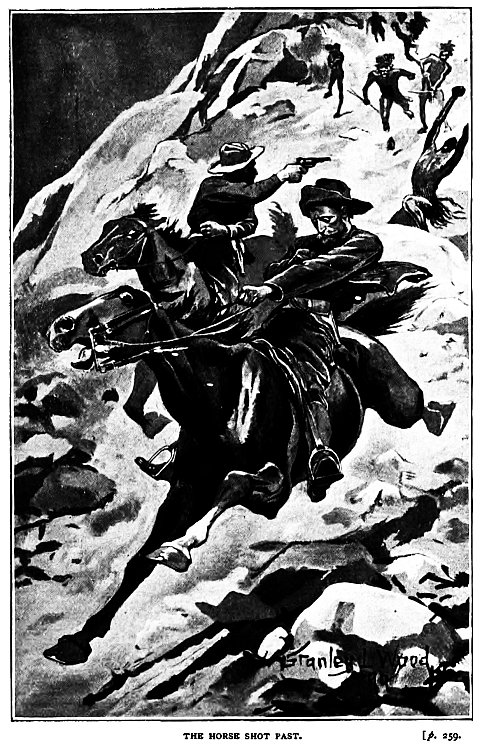
And now the cliffs resounded with the shrill yells of the pursuers. They had reached the head of the gully, and, dropping from rock to rock with the agility of monkeys, were gaining on the two white men. Renshaw, turning warily in his saddle, while still keeping an eye on the guidance of his steed, got in one revolver shot at a gaunt Koranna, who had sprung to the top of a boulder, and was on the point of launching a spear. The fellow threw up his arms and toppled backwards, but not before he had hurled his weapon, which, inflicting a flesh wound on Sellon’s horse, caused the animal to squeal and bound forward.
Perfectly unmanageable, frenzied with pain and terror, the horse shot past Renshaw, his rider vainly endeavouring to restrain him. One stride—two—three—the horse was among the loose rubble on the cliffs brow. There was a prodigious plunging of hoofs—a cloud of dust and gravel—a slide—a frantic struggle—then with a scream, which even at that stirring moment curdled the listeners’ blood, the poor steed disappeared into space—while his rider, who, in the very nick of time, had slipped to the ground, stood bewildered and pale at the thought of the frightful danger he had escaped.
But there was peril enough behind to allow no time for thought. The barbarians, profiting by the moment’s confusion, came swarming down the rocks, yelling and hissing like fiends. A shower of assegais and arrows came whizzing about the ears of the fugitives.
The latter, in about three bounds, had cleared the fearful “elbow” overhanging the abyss, and which they had crossed so circumspectly in cold blood the previous day. Rounding it safely, they had gained one advantage; they were out of arrow range for the moment.
“Lay hold of my stirrup-leather,” cried Renshaw, “and run alongside. There’s clear going now for some way to come.”
But Sellon had sunk to the ground groaning with pain.
“I can’t,” he gasped. “My ankle’s sprained.”
Here was a situation. A dismounted comrade with a sprained ankle, unable to walk even, let alone run; a crowd of bloodthirsty barbarians close behind swarming down the mountain-side in pursuit. Surely one of the two must be sacrificed.
But Renshaw did not hesitate. The other had planned and willingly carried out a diabolical scheme of robbery and murder—even up to the time they were surprised had plainly shown a resolve to rob him of his share of the undertaking. Why should he sacrifice his own life for the benefit of such a worthless ungrateful scoundrel?
Nothing is quicker than thought. In that moment of deadly peril—in the mad heat of a race for life—swifter than the lightning flash there swept through his mind the promise Violet had exacted from him during that last ride together. “Promise that you will stand my friend. Promise that if ever you can help me you will.” And with it there flashed a serious doubt as to whether it would in fact be the act of a friend to be instrumental in placing her at the mercy of such an unprincipled rascal as Maurice Sellon.
But to this succeeded a far graver consideration. The last Mass in the little church at Fort Lamport—doubly solemn because perforce so seldom attended—the white-headed old priest and his simple, straightforward counsels, and above all at that moment the words, intoned in the Sunday’s epistle, “Sed si esurierit inimicus tuus, ciba illum; si sitit, potum da illi.” (“But if thine enemy be hungry, give him to eat; if thirsty, give him to drink.”)
Renshaw’s Christianity was of pure gold. He did not hesitate now.
“Jump up,” he said, dismounting, and helping the other to gain his own saddle, “I’ll run alongside.”
The pursuers had now doubled the spur which had afforded temporary concealment to the fugitives. At sight of one of these on foot, they set up a shrill yell of triumph, and streamed down the declivity.
The latter was fearfully steep. No horse could put his best pace forward without going head over heels, to a dead certainty.
“Turn off to the right, quick!” said Renshaw. At the same moment he was conscious of a slight pricking in the foot. But he heeded it not.
By the above “double” they gained a slight advantage. Unless, however, they could reach ground more level before the pursuers should come within bow-shot, their fate was sealed.
On, on swept the wild man-hunt; nearer, nearer came the shrill yells of the savages. The twang of bow-strings now was heard. The elf-like little demons were already beginning to discharge their deadly, poisoned shafts.
But hope, well-nigh dead in the breasts of the fugitives, arose once more. The scarp of the mountain-side became less steep. In a minute or two they would gain the comparatively level and winding valley by which they had approached. The Korannas seeing this, redoubled their efforts.
But so, too, did the fugitives. The horse-hoofs thundered down the slope, the staunch steed tearing at his bit, and snorting with mingled excitement and apprehension.
The leaping, bounding crowd of hideous barbarians came shambling down like a troop of apes, in hot pursuit, eagerly anticipating the sport of tearing limb from limb the two white invaders. On—on!
At last! The valley was gained. On comparatively level ground the speed of the horse would tell. Yet it would not do to loiter. All manner of short cuts would be known to their enemies; short cute which these human apes in their native wilds could take across the mountains, and arrive at a given point more quickly than a horseman. Our adventurers had good reason to fear such an eventuality. There was no time to be lost.
“Let me hold on to the stirrup leather, Sellon,” said Renshaw. “I can get along at twice the pace then. I’m beginning to feel rather blown now.”
There was that about Sellon’s acquiescence which seemed to show that had the danger been more pressing, it would not have been so readily accorded. Nothing easier than to spur on the horse and dart away. And he still had the great diamond in his possession. But the shouts of the pursuers seemed already growing fainter behind.
The sun was setting. Peak and mountain-wall were gleaming golden in the parting light, but down there in the kloof the darkling grey of evening had already fallen. In half an hour it would be night. Yet they slackened not in their flight. The clinking flash of the horse-hoofs rasped the stony way, but the yelling of the pursuers had died away completely. Still it would not do to slacken their efforts.
Suddenly Renshaw running alongside stumbled, then staggered a few yards and sank to the ground. A curious numbed feeling had come into his legs. They had literally given way beneath him. As he tried to rise, he was conscious of feeling half paralysed.
“Come along, man!” cried the other, impatiently. “Why, what’s the row?”
“This!” he said, slowly, pointing to a small puncture in his boot just on the instep. “I felt the sting when you first came to grief. I’ve been pinked by a poisoned arrow.”
The place was a wild one, shut in between lofty cliffs, gloomy now with the falling shadows of night. Renshaw knew that he would never leave it alive.
“Good-bye, Sellon,” he said, the stupor deepening upon him even as he spoke. “Don’t bother any more about me. You’re on the right track now, and must find your way as best you can. Go on and leave me.”
“Nonsense, old chap—make an effort, and try what you can do.”
But Renshaw shook his head. “No,” he said. “I cannot even get up. You must take care of yourself now. Go on and leave me.”
Sellon looked at him for a moment without a word. Then he—went on.
Chapter Thirty Four.
Left to Die.
The glooming shadows of night crept on apace.
Renshaw, lying there in the wild rocky defile, felt the poison stealing insidiously through his veins in a kind of slow drowsy stupor. He knew that he was doomed; he realised that even if the wild Korannas did not speedily come up and put an end to his sufferings yet his hour had come. The poison was too deadly for antidote, and he had no antidote.
In his stupor he hardly heard the receding hoof-strokes of his companion—his companion for whose life he had given his own, and who now rode away leaving him alone in that remote and savage solitude to die.
He lay there as he had sunk down. The night grew pitchy black between those grim, frowning walls of cliff. The faint stir of a cool breeze played in fitful puffs about his pallid brow already cold and moist with the dews of approaching death. The stars flashed from the vault above in a narrow riband of gold between the loom of the great cliffs against the sky. The melancholy howl of some prowling beast rose now and again upon the night.
There was a patter, patter of stealthy feet among the stones—a gleam of scintillating green from ravening eyes. Nearer, nearer came the pit-pat of those soft footfalls. The wild creatures of the waste had scented their prey.
Man—the lord of the beasts of creation. Man—before whose erect form the four-footed carnivora of the desert fled in terror—what was he now—how was he represented here? A mere thing of flesh and blood, an abject thing—prostrate, helpless, dying. An easy prey. The positions were reversed.
The gleam of those hungry eyes—the baring of gaunt jaws, the lolling tongues—were as things unknown to the stricken adventurer. The shrill yelp, echoing from the great krantzes, calling upon more to come to the feast—the snapping snarl, as hungry rivals drew too near each other—all passed unnoticed. Nearer, nearer they came, a ravening circle. For they knew that the prey was sure.
What a contrast! This man, with the cool, dauntless brain—the hardened frame so splendidly proportioned, lay there in the pitchy blackness at the mercy of the skulking, cowardly scavengers of those grim mountain solitudes. And what had wrought this strange, this startling contrast? Only a mere tiny puncture, scarcely bigger than a pin prick.
A cold nose touched his cheek. The contact acted like a charm. He sat bolt upright and struck out violently. A soft furry coat gave way before his fist—there was a yelp, a snarl of terror, and a sound of pattering feet scurrying away into deeper darkness, but—only to return again.
As though the shock had revived him, Renshaw’s brain began to recover its dormant faculties. It awoke to the horror, the peril of the position. And with that awakening came back something of the old adventurous, dauntless resolution. He remembered that violent exercise—to keep the patient walking—was among the specifics in cases of venomous snake-bite, which in conjunction with other antidotes he had more than once seen employed with signal success. But in his own case the other antidotes were wanting.
Still the old dogged determination—the strength of a trained will—prevailed. He would make the effort, even if it were to gain some inaccessible ledge or crevice where he might die in peace. Even in the midst of his numbed and torpid stupor the loathing horror wherewith he had encountered the touch of the wild creature’s muzzle acted like a whip. To be devoured by those brutes like a diseased sheep—faugh!
Gaining his feet with an effort, he unscrewed the stopper of his flask and drank off the contents. With the poison working in his system the fiery spirit was as water to him. But its effect was invigorating, and setting his face toward the cliffs he staggered forth into the darkness.
Before the once more erect figure of their dread enemy, Man, the skulking jackals and hyenas slunk back in dismay. But only into the background. Stealthily, warily they watched his progress, following afar softly and noiselessly upon his footsteps. For their keen instinct satisfied them that this stricken representative of the dominant species would never leave their grisly rock-girt haunt alive. It was only a question of patience.
The instinct, too, of the latter led him on. His stupefied brain still realised two things. Under the shelter of the crags he would be in safer hiding from human enemies, and that haply a ledge among the same would afford him a secure refuge from the loathsome beasts now shadowing him, and ready to pounce upon him when he should be too weak to offer any resistance.
On—on, he pressed—ever upward. Steeper and steeper became the way. Suddenly he stopped short. Before him was a wall of rock.
He peered searchingly upward in the darkness. A cleft slanted obliquely up the cliffs face. His knowledge of the mountains and their formation told him that here might be the very thing he sought. His instinct still guiding him, he began to scale the cleft. He found it an easy matter. There were plenty of rough projections, affording hand and foot hold. The ghoul-like scavengers of the desert could not follow him here.