THE ROYAL FUSILIERS (City of London Regiment)
Reading edition
Raised in 1685. In the Peninsular War it took a glorious part, and no troops hazarded their lives more freely for their country's cause, than the Royal Fusiliers. At Talavera they met the storm of war with unshaken firmness, and captured seven of the enemy's guns, but the undying lustre of the glory they won at Albuhera, almost overshadows their other gallant exploits at this time. They had marched from Badajos at 2 a.m. the same day, and the night march of 20 miles, followed by the supreme effort which regained the lost heights of Albuhera, must rank as an unsurpassed feat of arms. During the Crimean War the conduct of the Royal Fusiliers won further glory.
It was once known as "The Hanoverian White Horse," and also as the "Elegant Extracts" from the fact that the officers were selected from other corps.
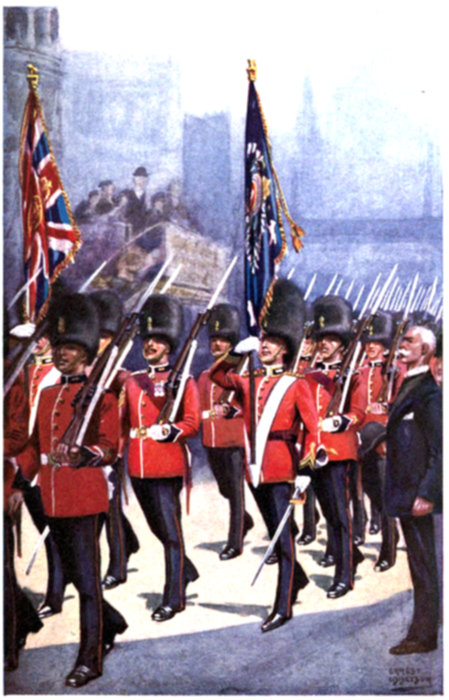
The Royal Fusiliers marching through the City of London.
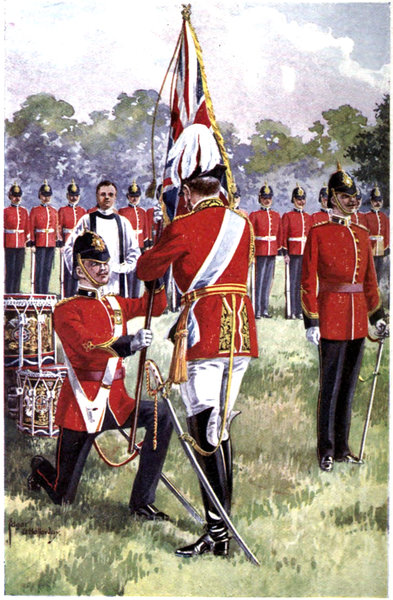
Presentation of Colours.
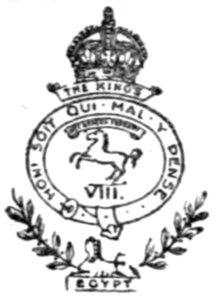
(Depot, Seaforth.)
(Record Office, Preston.)
The Sphinx, superscribed "Egypt."
"Blenheim," "Ramillies," "Oudenarde," "Malplaquet," "Dettingen," "Martinique, 1809," "Niagara," "Delhi, 1857," "Lucknow," "Peiwar Kotal," "Afghanistan, 1878-80," "Burma, 1885-87," "Defence of Ladysmith," "South Africa, 1899-1902."
Motto: Nec aspera terrent (Nor do difficulties deter).
Uniform, Scarlet.
Facings, Blue.
Head-dress, Helmet.
Cap, Blue with red band.
Regimental March, "Here's to the maiden of bashful fifteen."
Allied Regiment, 8th Australian Infantry Regiment.