X
Reading edition
The School of Carmen—In Search of Health—Chelsea once more—The End.
To please Madame Carmen Rossi, who as a child had been one of his best models, Whistler consented in 1897 to criticise the work of such students as might attend her school. As a result Carmen’s atelier was for the time being the most distinguished in Paris, and it was not uncommon to see carriages with coachmen and footmen in livery before the door on the days that Whistler was expected.
As he passed about among the pupils he seldom praised and was never enthusiastic. He would sometimes stand many minutes before a canvas that merited his attention and would suggest changes and improvements; and now and then he took a brush and made the alterations himself, remarking, if the student were a young woman, “Now you have a Whistler all to your charming self.”
The story is told that once he stopped before a very brilliant canvas, and exclaimed, “Hideous! hideous!” The student said, somewhat proudly, that she had taken private lessons from Bouguereau, and he blandly inquired, “Bouguereau, Bouguereau,—who is Bouguereau?”
A pupil has printed some reminiscences of those days:[47]
“Usually Mr. Whistler came once a week to criticise us, and on those days the class, numbering anywhere from fifteen to forty, had been instructed to adopt a certain respectful mode of bearing on the arrival of the master; so, when the concierge threw wide the door and formally announced, ‘Monsieur Whistler,’ every student had risen to return his ceremonious salutation. Vividly I recall the scene: a man of not much more than medium stature, but so slight as to give the impression, when standing apart from others, of being much taller; dressed entirely in black, even to the suéde gloves; every garment immaculate in fit and condition; a little red rosette of the Legion of Honor of France forming the only spot of color about him until a faint flush rose to his cheek as he greeted the class with kindly smile.
“Then, as massier (or monitor, in charge of the class), he passed me his long, black, fur-lined coat and tall, straight-brimmed hat,—those well-known targets for the caricaturist,—and began his criticism by inspecting every drawing and weighing its merits—if any there were, as only too rarely happened—before uttering a word. This silent inspection finished, Mr. Whistler usually asked for a palette,—preferably mine, because it was patterned after his own, and made him ‘feel at home,’ as he expressed it,—and then, without removing his gloves, painted a few strokes here and there on some of the pupils’ work. Even in the matter of a palette he evinced marked sentiment. A carelessly kept one was, above all, his particular abhorrence, and generally elicited some such remark as the following: ‘My friends, have you noticed the way in which a musician cares for his violin—how beautiful it is? how well kept? how tenderly handled? Your palette is your instrument, its colors the notes, and upon it you play your symphonies.’
“As an instructor he was courteous to each pupil, but naturally most interested in those who followed his precepts closest. Sometimes he jested at the expense of a luckless pupil. I remember an amusing instance. Smoking was prohibited on the days for criticism, since our master believed it clouded the atelier and in some degree obscured a view of the model. One day, upon entering, Mr. Whistler noticed an Englishman, much addicted to his huge cigars, who continued puffing away contentedly during the ‘criticism.’ Mr. Whistler turned quickly, asking me why his wishes were not enforced; but before I could frame a reply he had addressed our British friend, saying, ‘Er—my dear sir, I know you do not smoke to show disrespect to my request that the students should refrain from smoking on the days I come to them, nor would you desire to infringe upon the rules of the atelier—but—er—it seems to me—er—that when you are painting—er—you might possibly become so absorbed in your work as to—er—well—let your cigar go out.’ I often remarked a whimsical affectation of Mr. Whistler in his manner of speech with different pupils in his class,—we were a diverse lot from many lands, Americans and English predominating. If criticising an American, for instance, Mr. Whistler’s choice of language, and in some cases his accent, would become markedly English in form; while in addressing an Englishman he would adopt the Yankee drawl, sometimes adding a touch of local slang. I subsequently learned that these were his customary tactics, even in society, but in class criticism he always addressed us in French.”
His methods of teaching were original. He laid little stress on drawing. He hated and despised academic treatment. He wanted the pupil to paint. A few careful charcoal strokes on the canvas as a guide, the rest to be drawn in with brush and color. And he preached simplicity,—as few tones as possible, as low as possible. But it is painful to record that the endeavors of a certain proportion of the class to attempt the achievements of the master in this respect resulted in a unique crop of posters. The constant theme of his discourse was “mixtures.” He advised a pupil to get first on his palette a correct and sufficient mixture of each tone required for his picture. Often he would give a long criticism without so much as glancing at the canvas,—a criticism on the mixtures he found on the pupil’s palette; and he himself would work indefinitely at the colors, and all the while talking, till it appeared to him to be satisfactory. “And then,” says an enthusiastic young artist, “when he did take up some of the color and transfer it to the canvas, why, it would just sing.”
“One day on entering the class-room he discovered that a red background had been arranged behind the model. He was horrified, and directed the students to put up something duller in tone.
“Then he scraped out the red paint on a pupil’s canvas and proceeded to mix and lay on a new background. Somehow the red would show through, and he found it difficult to satisfy himself with the effect he produced. He mixed and studied and scraped, working laboriously, surrounded by a group of admiring students. Finally, he remarked:
“‘I suppose you know what I’m trying to do?’
“‘Oh, yes, sir,’ they chorused.
“‘Well, it’s more than I know myself,’ he grimly replied.”
It is to be hoped that his epigrammatic utterances which hung on the walls of the Carmen Rossi school have been preserved, for they would be valuable additions to the “Propositions” and “Ten o’Clock” already published.
With none of the instincts of the teacher, he in time lost interest in the school. After a year or two his visits became infrequent, and upon leaving Paris his connection ceased.
The studio in Notre Dame des Champs and the home on the Rue du Bac were closed a few years after the death of Mrs. Whistler, and he made his home once more in Chelsea, at 74 Cheyne Walk, with frequent excursions to the Continent.
In the winter of 1901 he was at Ajaccio, and he wrote to a friend: “You will be surprised at this present address. But it’s all right,—‘Napoleon and I, you know.’”
In another letter to the same friend, speaking of a public official with whom he had some legal transactions, he remarks: “Say that I know how devotedly kind he has been in his care of me, but the care of the state overwhelms him. You cannot serve the republic ... and Whistler.”
For many years his heart had troubled him, and towards the last the warnings came more frequently and persistently. The year before his death he was quite ill at The Hague, and one of the London papers printed the following of a semi-obituary flavor:
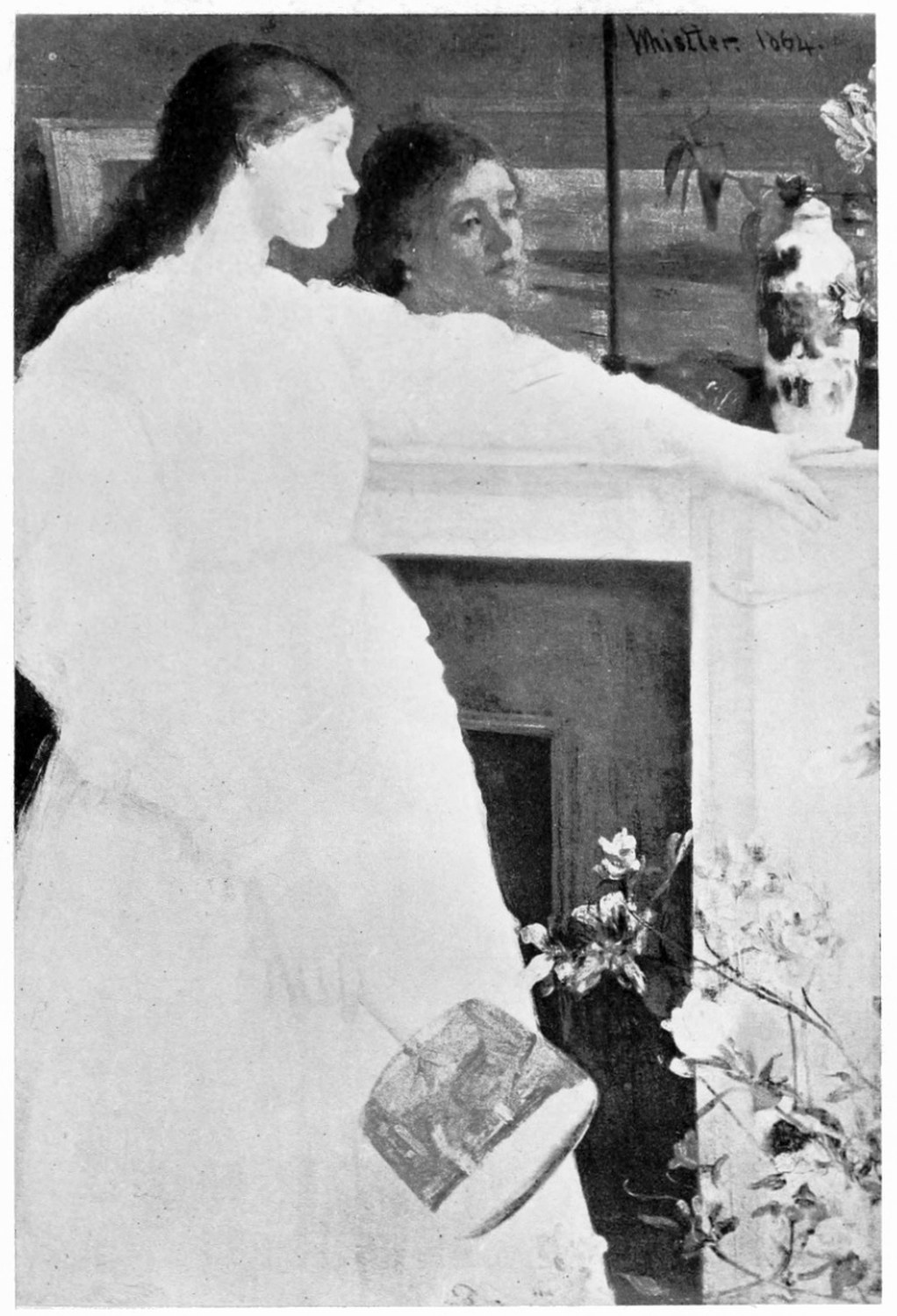
“Mr. Whistler is so young in spirit that his friends must have read with surprise the Dutch physician’s pronouncement that the present illness is due to ‘advanced age.’ In England sixty-seven is not exactly regarded as ‘advanced age;’ but even for the gay ‘butterfly’ time does not stand still, and some who are unacquainted with the details of Mr. Whistler’s career, though they may know his work well, will be surprised to hear that he was exhibiting at the Academy forty-three years ago. His contributions to the exhibition of 1859 were ‘Two Etchings from Nature,’ and at intervals during the following fourteen or fifteen years Mr. Whistler was represented at the Academy by a number of works, both paintings and etchings. In 1863 his contributions numbered seven in all, and in 1865 four. Among his Academy pictures of 1865 was the famous ‘Little White Girl,’[48] the painting that attracted so much attention at the Paris Exhibition of 1900. This picture—rejected at the Salon of 1863—was inspired, though the fact seems to have been forgotten of late, by the following lines of Swinburne:
“‘Come snow, come wind or thunder High up in air, I watch my face and wonder At my bright hair, etc., etc.’”
The item called forth the following characteristic correction, dated from The Hague:
“Sir: I feel it no indiscretion to speak of my ‘convalescence’ since you have given it official existence.
“May I therefore acknowledge the tender little glow of health induced by reading, as I sat here in the morning sun, the flattering attention paid me by your gentleman of ready wreath and quick biography.
“I cannot, as I look at my improving self with daily satisfaction, really believe it all; still it has helped to do me good. And it is with almost sorrow that I must beg you, perhaps, to put back into its pigeon-hole, for later on, this present summary, and replace it with something preparatory—which, doubtless, you have also ready.
“This will give you time, moreover, for some correction,—if really it be worth while. But certainly the ‘Little White Girl,’ which was not rejected at the Salon of ’63, was, I am forced to say, not ‘inspired by the following lines of Swinburne,’ for the one simple reason that those lines were only written, in my studio, after the picture was painted. And the writing of them was a rare and graceful tribute from the poet to the painter—a noble recognition of one work by the production of a nobler one.
“Again, of ‘the many tales concerning the hanging, at the Academy, of the well-known portrait of the artist’s mother, now at the Luxembourg,’ one is true—let us trust your gentleman may have time to find it out—that I may correct it. I surely may always hereafter rely on the Morning Post to see that no vulgar Woking joke reach me.
“It is my marvellous privilege, then, to come back, as who should say, while the air is still warm with appreciation, affection, and regret, and to learn in how little I had offended.
“The continuing to wear my own hair and eyebrows, after distinguished confrères and eminent persons had long ceased their habit, has, I gather, clearly given pain. This, I see, is much remarked on. It is even found inconsiderate and unseemly in me, as hinting at affectation.
“I might beg you, sir, to find a pretty place for this, that I would make my ‘apology,’ containing also promise, in years to come, to lose these outer signs of vexing presumption.
“Protesting, with full enjoyment of its unmerited eulogy, against your premature tablet, I ask you again to contradict it, and appeal to your own sense of kind sympathy when I tell you I learn that I have, lurking in London, still ‘a friend’—though for the life of me I cannot remember his name.
“And I have, sir, the honor to be
“J. McNeill Whistler.”
In the spring of 1903, only a few months before his death, three of his pictures were withdrawn from the annual exhibition of the Society of American Artists in New York. They had not been sent in by him, but loaned by the owner upon the understanding they would be given the prominence which he thought Whistler’s work deserved.
In the absence of the owner in Europe the whole matter was left in charge of a member of the society,—a well-known artist,—who, when he saw where the committee had placed the little pictures, promptly withdrew them, and notified the owner of his action, which was approved.
Whistler learned of the matter, and wrote the following letter:
“Dear Mr. L—— : I have just learned with distress that my canvases have been a trouble and a cause of thought to the gentlemen of the hanging committee.
“Pray present to them my compliments and my deep regrets.
“I fear also that this is not the first time of simple and good-natured intrusion,—‘looking in,’ as who should say, with beaming fellowship and crass camaraderie upon the highly-finished table and well-seated guests,—to be kindly and swiftly shuffled into some further respectable place, that all be well and hospitality endure.
“Promise, then, for me, that I have learned and that this ‘shall not occur again.’ And, above all, do not allow a matter of colossal importance to ever interfere with the afternoon habit of peace and good will and the leaf of the mint so pleasantly associated with this society.
“I could not be other than much affected by your warm and immediate demonstration, but I should never forgive myself were the consequences of lasting vexation to your distinguished confrères, and, believe me, dear Mr. L——, very sincerely,
“J. McNeill Whistler.
"London, April 7, 1903."
To the end he worked with indefatigable energy, save only those days and hours when he was compelled by exhaustion or by the physicians to rest.
Work was a tonic to him, and, while painting, the rebellious organs of his body were submissive to his genius.
He would forget himself when, brush in hand, he stood before a canvas.
During the spring of 1903 he had been far from well. Into May he worked, but not regularly nor for long at a time. In June he was quite ill, and his friends were apprehensive; but in the early part of July he began to gain, so that he took long drives and planned resuming his work.
On the afternoon of July 16 he was out for a drive and in the best of spirits, with plans for the future that even a younger man could not hope to execute.
Art, the ever-youthful mistress of his life, urged him on. Should he confess before her the ravages of years? In dauntless enthusiasm, in boundless ambition, in spirit unsubdued he was still young. He struggled to his feet and for the last time stood before the canvas,—the magic mirror from which he, wizzard-like, had evoked so many beautiful images; he thought of the things he yet would do, of lines that would charm for all time, of colors that would play like the iridescent hues upon the surface of the shimmering sea, of the wraith-like images of people which lurked in the depths of the canvas awaiting the touch of his wand to step forth in all their stately dignity and beauty.
And the soul of the master was filled with delight.
But the visions of beauty were shattered, Like forms of the mist they were scattered— As bubbles are blown by a breath— By the grim, haunting spectre of Death.
The tired body could not respond, and there where he had worked, on the afternoon of Friday, July 17, the great painter died.
On the following Wednesday the funeral services were held in the old church at Chelsea where he often went with his mother, and he was buried beside her in the graveyard at Chiswick.
“We have then but to wait—until with the mark of the gods upon him—there come among us again the chosen—who shall continue what has gone before. Satisfied that, even were he never to appear, the story of the beautiful is already complete—hewn in the marbles of the Parthenon—and broidered, with the birds, upon the fan of Hokusai—at the foot of Fusiyama.”—Whistler’s “Ten o’Clock.”