Front matter
Reading edition
Illustrated by BILL BOWMAN
It was the greatest scientific breakthrough of all time: reanimation after death. The trouble was, it created more problems than it solved.
[Transcriber's Note: This etext was produced from Infinity June and August 1958. Extensive research did not uncover any evidence that the U.S. copyright on this publication was renewed.]
CHAPTER I
That morning James Harker was not expecting anything unusual to happen. He had painstakingly taught himself, these six months since the election, not to expect anything. He had returned to private law practice, and the Governorship and all such things were now bright memories, growing dimmer each month.
Morning of an Ex-Governor. There was plenty to do: the Bryant trust-fund business was due for a hearing next Thursday, and before that time Harker had to get his case in order. A pitiful thing: old Bryant, one of the glorious pioneers of space travel, assailed by greedy heirs in his old age. It was enough to turn a man cynical, Harker thought, unless a man happened to be cynical already.
He reached across his desk for the file-folder labeled Bryant: Hearing 5/16/33. The sound of the outer-office buzz trickled into the room, and Harker realized he had accidentally switched on the inter-office communicator. He started to switch it off; he stopped when he heard a dry, thin voice say, "Is the Governor in?"
His secretary primly replied, "Do you mean Mr. Harker?"
"That's right."
"Oh. He—he doesn't like to be called the Governor, you know. Do you have an appointment with him?"
"I'm afraid not. Terribly foolish of me—I didn't realize I'd need one. I don't live in New York, you see, and I'm just here for a few hours—"
"I'm extremely sorry, sir. I cannot permit you to see Mr. Harker without an appointment. He's extremely busy."
"I'm quite aware of that," came the nervous, oddly edgy voice. "But it's something of an emergency, and—"
"Dreadfully sorry, sir. Won't you phone for an appointment?"
To the eavesdropping Harker, the conversation sounded like something left over from his Albany days. But he was no longer Governor of New York and he was no longer the fair-haired boy of the National Liberal Party. He wasn't being groomed for the Presidency now. And, suddenly, he found himself positively yearning to be interrupted.
He leaned forward and said, "Joan, I'm not very busy right now. Suppose you send the gentleman in."
"Oh—uh—Mr. Harker. Of course, Mr. Harker." She sounded startled and irritated; perhaps she wanted to scold him for having listened in. Harker cut the audio circuit, slipped the Bryant file out of sight, cleared his desk, and tried to look keenly awake and responsive.
A timid knock sounded at his office door. Harker pressed the open button; the door split laterally, the segments rising into the ceiling and sliding into the floor, and a man in short frock coat and white unpressed trousers stepped through, grinning apologetically. A moment later the door snapped shut behind him.
"Mr. Harker?"
"That's right."
The visitor approached Harker's desk awkwardly; he walked as if his body were held together by baling wire, and as if his assembler had done an amateur job of it. His shoulders were extraordinarily wide for his thin frame, and long arms dangled loosely. He had a wide, friendly, toothy grin and much too much unkempt soft-looking brown hair. He handed Harker a card. The lawyer took it, spun it around right-side-up so he could read it, and scanned the neat engraved characters. It said:
Beller Research Laboratories Litchfield, N. J. Dr. Benedict Lurie
Harker frowned in concentration, shook his head, and said, "I'm sorry, Dr. Lurie. I'm afraid I've never heard of this particular laboratory."
"Understandable. We don't seek publicity. I'd be very surprised if you had heard of us." Lurie's head bobbed boyishly as he spoke; he seemed about as ill-at-ease a person as Harker had ever met.
"Cigarette?" Harker asked.
"Oh, no—never!"
Grinning, Harker took one himself, squeezed the igniting capsule with his index-finger's nail, and put the pack away. He leaned back. Lurie's awkwardness seemed to be contagious; Harker felt strangely fidgety.
"I guess you're wondering why I came here to see you, Mr. Harker."
"I guess I am."
Lurie interspliced his long and slightly quivering fingers, then, as if dissatisfied, separated his hands again, crossed his legs, and gripped his kneecaps. He blinked and swiveled his chair slightly to the left. Sensing that the sun slanting through the window behind the desk was bothering Lurie, Harker pressed the opaque button and the room's three windows dimmed.
Lurie said finally, "I'll begin at the beginning, Mr. Harker. The Beller Research Laboratories were established in 2024 by a grant from the late Darwin F. Beller, of whom you may have heard."
"The oil magnate," Harker said. And a notorious crank. The lawyer began to regret his impulsive action in inviting the gawky stranger in to see him.
"Yes. Beller of Beller Refineries. Mr. Beller provided our group with virtually unlimited funds, established us in a secluded area in New Jersey, and posed us a scientific problem: could we or could we not develop a certain valuable process? I'll be more specific in a moment. Let me say that many of the men Mr. Beller assembled for the project were openly skeptical of its success, but were willing to try—a triumphant demonstration of the scientific frame of mind."
Or of the willingness to grab a good thing when it comes along, Harker thought. He had had little experience with scientists, but plenty with human beings. Lurie's speech sounded as if it had been carefully rehearsed.
"To come to the point," Lurie said, uncrossing his legs again. "After eight years of research, our project has reached the point of success. In short, we've developed a workable technique for doing what we had hoped to do. Now we need a legal adviser."
Harker became more interested. "This is where I'm to come in, I suppose?"
"Exactly. Our process is, to say the least, a controversial one. We foresee multitudes of legal difficulties and other problems."
"I'm not a patent lawyer, Dr. Lurie. That's a highly specialized field of which I know very little. I can give you the name of a friend of mine—"
"We're not interested in a patent," Lurie said. "We want to give our process to mankind without strings. The problem is, will mankind accept it?"
A little impatiently Harker said, "Suppose you get down to cases, then. It's getting late, and I have a lot of work to do before lunch-time."
A funny little smile flickered at the corners of Lurie's wide mouth. He said, flatly, "All right. We've developed a process for bringing newly-dead people back to life. It works if there's no serious organic damage and the body hasn't been dead more than twenty-four hours."
For a long moment there was silence in Harker's office. Harker sat perfectly still, and it seemed to him he could hear the blood pumping in his own veins and the molecules of room-air crashing against his ear-drums. He fought against his original instincts, which were to laugh or to show amazement.
Finally he said, "I'll assume for the sake of discussion that what you tell me is true. If it is, then you know you're holding down dynamite."
"We know that. That's why we came to you. You're the first prominent figure who hasn't thrown me out of his office as soon as I told him why I had come."
Sadly, Harker said, "I've learned how to reserve judgment. I've also learned to be tolerant of crackpots or possible crackpots. I learned these things the hard way."
"Do you think I'm a crackpot, Mr. Harker?"
"I have no opinion. Not yet, anyway."
"Does that mean you'll take the case?"
"Did I say that?" Harker stubbed his cigarette out with a tense stiff-wristed gesture. "It violates professional ethics for me to ask you which of my colleagues you approached before you came to me, but I'd like to know how many there were, at least."
"You were fourth on the list," Lurie said.
"Umm. And the others turned you down flat, I take it?"
Lurie's open face reddened slightly. "Absolutely. I was called a zombie salesman by one. Another just asked me to leave. The third man advised me to blow up the labs and cut my throat. So we came to you."
Harker nodded slowly. He had a fairly good idea of whom the three others were, judging from the nature of their reactions. He himself had made no reaction yet, either visceral or intellectual. A year ago, perhaps, he might have reacted differently—but a year ago he had been a different person.
He said, "You can expect tremendous opposition to any such invention. I can guess that there'll be theological opposition, and plenty of hysterical public outbursts. And the implications are immense—a new set of medical ethics, for one thing. There'll be a need for legislation covering—ah—resurrection." He drummed on the desk with his fingertips, "Whoever agrees to serve as your adviser is taking on a giant assignment."
"We're aware of that," Lurie said. "The pay is extremely good. We can discuss salary later, if you like."
"I haven't said I'm accepting," Harker reminded him crisply. "For all I know right now this is just a pipe-dream. Wishful thinking on the part of a bunch of underpaid scientists."
Lurie smiled winningly. "Naturally we would not think of asking you to make a decision until you've seen our lab. If you think you're interested, a visit could be arranged sometime this week or next—"
Harker closed his eyes for a moment. He said, "If I accepted, I'd be exposing myself to public abuse. I'd become a storm-center, wouldn't I?"
"You should be used to that, Mr. Harker. As a former national political figure—"
The former stung. Harker had a sudden glaring vision of his rise through the Nat-Lib Party ranks, his outstanding triumph in the 2024 mayoralty contest, his natural ascension to the gubernatorial post four years later—and then, the thumping fall, the retirement into private life, the painful packing-away of old aspirations and dreams—
He nodded wearily. "Yes, I know what it's like to be on the spot. I was just wondering whether it's worthwhile to get back on the firing line again." He moistened his lips. "Look, Dr. Lurie, I have to think about this whole business some more. Is there someplace I can call you this afternoon?"
"I'm staying at the Hotel Manhattan," Lurie said. He retrieved his calling-card with surprising deftness and scribbled a phone number on it, then a room number, and handed it back to Harker. "I'll be there most of the afternoon, if you'd like to call."
Harker pocketed the card. "I'll let you know," he said.
Lurie rose with typical lack of grace and shambled toward the door. Harker pressed the open button and the two halves of the door moved into their slots. Rising from the desk, he accompanied Lurie through the door and into the outer office. The scientist's stringy frame towered five or six inches over Harker's compact, still-lean bulk. Harker glanced up at the strangely soft eyes.
"I'll call you later, Dr. Lurie."
"I hope so. Thank you for listening, Governor."
Harker returned to the office, reflecting that the final Governor had either been savagely unkind or else a bit of unconscious absent-mindedness. Either way, he tried to ignore it.
He dumped himself behind his desk, frowning deeply, and dug his thumbs into his eyeballs. After a moment he got up, crossed to the portable bar, and dialed himself a whiskey sour. He sipped thoughtfully.
Resurrection. A crazy, grotesque idea. A frightening one. But science had come up with a method for containing the hundred-million-degree fury of a fusion reaction; why not a method for bringing the recent dead back to life?
No, he thought. He wasn't primarily in doubt of the possibility of the process. It was dangerous to be too skeptical of the potentialities of science.
It was his own part in the enterprise that made him hold back. What Lurie evidently had in mind was for him to act as a sort of public advocate, arguing their case before the courts of law and of human opinion. It was a frighteningly big job, and if the tide swept against him he would be carried away.
Then he smiled. What have I to lose?
He eyed the tri-dims of his wife and sons that occupied one corner of his desk. His political career, he thought, couldn't be any deader than it was now. His own party had cast him loose, refusing to name him for a second term when he indiscreetly defied the state committee in making a few appointments. His law practice did well, though not spectacularly; in any event, he was provided for financially by his investments.
He had nothing to lose but his good name, and he had already lost most of that in the political mess. And he had a whole world to win.
Revival of the dead? How about a dead career, Harker wondered. Can I revive that too?
Rising from his desk, he paced round the office, pausing to depolarize the windows. Bright morning sunshine poured in. Through his window he could see the playground of the public school across the street. Thin-legged girls of nine or ten were playing a punchball game; he could hear the shrieks of delight and anguish even at this distance.
A sudden sharp image came to him: himself, nine years before, standing spread-legged on the beach at Riis Park, with Lois staring white-faced at him and three-year-old Chris peeking strangely around her legs. It was a blisteringly hot day; his skin, to which sand had adhered, was red, raw, tender. He heard the booming of the surf, the overhead zoop of a Europe-bound rocket, the distant cry of refreshment-venders and the nearer laughter of small girls.
He was not laughing. He was holding a small, cold, wet bundle tight, and he was crying for the first time in twenty years. He huddled his drowned five-year-old daughter to him, and tried to pretend it had not happened.
It had happened, and Eva was dead—the girl-child who he had planned would be America's darling when he reached the White House, fifteen years or so from now.
That had been nine years ago. Eva would have been nearly fifteen, now, flowering into womanhood. He had no daughter. But she could have lived, Harker thought. Maybe.
He returned to his desk and sat quietly for a while. After twenty minutes of silent thought he reached for the phone and punched out Lurie's number.
CHAPTER II
Harker had an appointment with old Richard Bryant at three that afternoon. He was not looking forward to it. Since Bryant was confined to his home by doctor's orders, it meant that Harker would have to visit the old man, and that meant entering a house where death seemed to hang heavy over the threshold, a house filled with graspingly impatient relatives of the venerable hero of space travel's infancy.
At half past two Harker notified his secretary that he was leaving; he gathered up the portfolio of relevant papers, locked his office, and took the gravshaft down to street level. He emerged on First Avenue, and walked quickly downtown toward 125th Street.
It was a bright, warmish, cloudless May afternoon. A bubble of advertising was the only blot on the otherwise flawless sky. The Manhattan air was clean, tingling, fresh. Harker never breathed it in without thinking of the vast dynamos of the puritron stations every ten blocks apart, gulping in tons and tons of city soot each second. In his second year as Mayor, the entire Brooklyn puritron assembly had "accidentally" conked out for four hours, thanks to some half-forgotten labor squabble. Harker remembered the uproar that had caused.
At 125th Street he boarded the crosstown monorail and moments later found himself disembarking at the Riverside Drive exit. He signaled for a cab; while he waited, a bleary-eyed old man shuffled over to him, shoved a gaudy pamphlet in his hands, greeted him by name, and shuffled away.
He looked at it. It was one of the many official organs of the Watchtower Society. As he stuffed it in the corner disposal-bin, he smiled in recollection of that organization's motto: Millions now living will never die.
Gravely he proposed a substitute: Millions now dead will live again.
The attendant images effectively choked off the mood of good humor that had been stealing over him. He remembered that in only two days he would be journeying across the Hudson to see whether the Beller Laboratories people had actually hit on something or not.
The cab drew up. Harker slid into the back seat and said, "Seventy-ninth and West End, driver."
The house was a massive, heavily-chromed representative of late twentieth-century architecture, settling now into respectable middle age. Harker had visited it on three separate occasions, and each time his discomfort had increased.
It had no gravshaft; he rode up in a human-operated elevator. The operator said, "I guess you're going to visit Mr. Bryant, eh, Mr. Harker?"
"That's right."
"The old gentleman's been poorish lately, sir. Ah, it'll be a sad thing when he goes, won't it?"
"He's one of our greatest," Harker agreed. "Many people up there today?"
"The usual lot," the operator said, halting the car and opening the door. It opened immediately into the foyer of the huge Bryant apartment. Almost at once, Harker found himself staring at the fishy, cold-eyed face of Jonathan Bryant, the old man's eldest son.
"Good afternoon, Jonathan."
"Hello, Harker." The reply was sullenly brusque. "You're here to see my father?"
"I didn't come for tea," Harker snapped. "Will you invite me in, or should I just push past you?"
Jonathan muttered something and gave ground, allowing Harker to enter. The living room was crowded: half-a-dozen miscellaneous Bryants, plus two or three whom Harker did not know but who bore the familiar Bryant features. A horde of vultures, Harker thought. He nodded to them with professional courtesy and passed on, through the inner rooms, to the old man's sick room.
The place was lined with trophies—one room, Harker knew, consisted of the cockpit of the Mars One, that slender needle of a ship that had borne Rick Bryant to the red planet nearly fifty years ago, an epoch-making flight that still stood large in the annals of space travel. Trophy cases in the halls held medals, souvenir watches, testimonial dinner menus. Old Bryant had been a prodigious collector of souvenirs.
His doctor, a tiny man with the look of an irritated penguin, met him at the door to the sick room. "I'll have to ask you to limit your stay to thirty minutes, Mr. Harker. He's very low today."
"I'll be as brief as I can," Harker promised. He stepped around the barricade and entered.
Helen Bryant, oldest of the daughters, sat solicitously by her father's bedside, glaring at him with the tender expression of a predatory harpy.
Harker said, "If you'll excuse me, Miss Bryant, your father and I have some important business to discuss."
"I'm his daughter. Can't I—"
"I'm afraid not," Harker said coldly. He waited while she made her proud retreat, then took her seat at the side of the bed.
"Afternoon, Harker," Bryant said in a tomblike croak.
He was not a pretty sight. He was seventy-three, and could easily pass for twice that age—a shrunken, leathery little man with rheumy, cataracted eyes and a flat, drooping face. There was little about him that was heroic, now. He was just a dying old man.
The needles of an intravenous feed-line penetrated his body at various points. He no longer had the strength to swallow or to digest. It was difficult to believe that this man had made the first successful round-trip flight to another planet, back in 1984, and that from his early thirties until his stroke four years ago he had been a figure of world importance, whose words were eagerly rushed into print whenever he cared to make a statement.
He said, "How does it look for next Thursday?"
Harker's jaws tightened. "Pretty good. I hope to be able to swing it."
"How have you set it up?"
Harker drew the papers from his portfolio. "Twenty million is to be established as a trust fund for your grandchildren and for the children of your grandson Frederick. Thirty million is to be granted to the Bryant Foundation for Astronautical Research. Fifty thousand is to be divided among your children, ten thousand to each."
"Is that last bit necessary?" Bryant asked with sudden ferocity.
"I'm afraid it is."
"I wanted to cut those five jackals off without a penny!" he thundered. Then, subsiding, he coughed and said, "Why must you give them so much?"
"There are legal reasons. It makes it harder for them to overthrow the will, you see."
The old man was reluctant to accept the idea of giving his children anything, and in a way Harker could see the justice of that. They were a hateful bunch. Bryant had garnered millions from his space journey, and had invested the money wisely and well; there had been an undignified scramble for the old hero's wealth when a stroke appeared to have killed him in '28. He had confounded them all by recovering, and by cutting most of them out of his revised will—a document that was being contested in the courts even while the old man still lived.
At three-thirty, the penguinish doctor knocked discreetly at the bedchamber door, poked his head in, and said, "I hope you're almost through, Mr. Harker."
At that moment old Bryant was trying to sign a power-of-attorney Harker had prepared; his palsied hand could barely manage the signature, but in time he completed it. Harker looked at it: a wavy scrawl that looked like a random pattern on a seismograph drum.
"I'm leaving now," Harker told the doctor.
Bryant quavered, "What time is the hearing next Thursday, Harker?"
"Half-past-eleven."
"Be sure to call me when it's finished."
"Of course. You just relax, Mr. Bryant. Legally they can't trouble you at all."
He reaped a harvest of sour glances as he made his way through the trophy-cluttered halls to the elevator. It was a depressing place, and the sight of the shattered hero always clouded his mind with gloom. He was glad to get away.
Riding a cab downtown to Grand Central, he boarded the 4:13 express to Larchmont, and eleven minutes later was leaving the Larchmont tube depot and heading in a local cab toward his home. At quarter to five, he stepped through the front door.
Lois was in the front room, standing on a chair and doing something to the ceiling mobile. Silently Harker crept in; standing with arms akimbo at the door, he said, "It's high time we junked that antique, darling."
She nearly fell off the chair in surprise. "Jim! What are you—"
"Home early," Harker said. "Had an appointment with old Bryant and the medics tossed me out quick, so I came home. Gah! Filthy business, that Bryant deal."
He slipped out of his jacket and loosened his throat-ribbon. He paused for a moment at the mirror, staring at himself: the fine, strong features, the prematurely iron-gray hair, the searching blue eyes. It was the face of a natural leader, an embryo President. But there was something else in it now—a coldness around the eyes, a way of quirking the corners of his mouth—that showed a defeated man, a man who has climbed to the top of his string and toppled back to the ground. With forty years of active life ahead of him.
"Hello, Dad. Want a drink?"
It was the already-deepening voice of twelve-year-old Chris that drew him away from his reverie. In recent months he had let the boy prepare his homecoming cocktail for him. But today he shook his head. "Sorry, son. I don't happen to be thirsty tonight."
Disappointment flashed briefly in the boy's handsome face; then it faded. Minor setbacks like this meant little to a boy who had expected once to live in the White House, and who knew now it wouldn't be happening.
"Where's Paul?" Harker asked.
"Upstairs doing his homework," Chris said. He snorted. "The ninny's learning long division. Having fits with it, too."
Harker stared at his son strangely for a moment; then he said, "Chris, go upstairs and give him some help. I want to talk to Mum."
"Sure, Dad."
When the boy had gone, Harker turned to his wife. Lois at forty—three years his junior—was still slim and attractive; her blonde hair had lost its sheen and soon would be shading into gray, but she seemed to welcome rather than fear the imprint of age.
She said, "Jim, why did you look at Chris that way?"
In answer, Harker crossed to the table near the window and his fingers sought out the tri-dim of dead Eva, its bright colors losing some of their sharpness now after nine years. "I was trying to picture him as a teen-age girl," he said heavily. "Eva would have been fifteen soon."
Her only outward reaction was a momentary twitch of the lower lip. "You haven't thought of her for a long time."
"I know. I try not to think of her. But I thought of her today. I was thinking that she didn't have to be dead, Lois."
"Of course not, dear. But it happened, and there was no help for it."
He shook his head. Replacing Eva's picture, he picked up instead a tiny bit of bric-a-brac, a kaleidoscopic crystal in whose depths were swirling streaks of red and gold and dark black. He shook it; the color-patterns changed. "I mean," he said carefully, "that Eva might have been saved, even after the accident."
"They tried to revive her. The pulmotor—"
"No. Lois, I had a—a person visit me this morning. A certain Dr. Lurie, from a certain research laboratory in New Jersey. He claims they've developed a technique for bringing the dead back to life, and he wants me to handle promotion and legal aspects. For a fat fee, may I add."
She frowned uncertainly. "Reviving the dead? What kind of crazy joke is that?"
"I don't know. But I'm not treating it as a joke; not until I've seen the evidence, anyway. I made an appointment to go out to Jersey and visit their lab on Friday."
"And you'll take the job, if they've really hit on something?"
Harker nodded. "Sure I'll take it. It's risky, of course, and there's sure to be a lot of public clamor in both directions—"
"And haven't we had enough of that? Weren't you satisfied when you tried to reform the state government, and wound up being read out of the party? Jim, do you have to be Quixote all the time?"
Her words had barbs. Harker thought bleakly that being able always to see both sides of a question, as he could, was a devil-granted gift. Wearily he said, "All right. I tried to do something I thought was right, and I got my head chopped off as a result. Well, here's my second chance—maybe. For all I know they're a bunch of lunatics over there. I owe it to myself and to the world to find out—and to help them, if I can."
He pointed at the tri-dim of Eva. "Suppose that happened now—Eva, I mean. Wouldn't you want to save her? Or," he said, making his words deliberately harsh, "suppose Paul dies. Wouldn't you want to be able to call him back from—from wherever he had gone?"
For a moment there was silence.
"Well? Wouldn't you?"
Lois shrugged, turning her hands palm outward. "Jim, I don't know. I just honestly don't know."
CHAPTER III
At three minutes past two on Friday afternoon Harker's secretary buzzed him to let him know Dr. Lurie had arrived. Harker felt momentary apprehension. Cautious, even a little conservative by nature, he felt uneasy about paying a visit to a laboratory of—for all he knew—mad scientists.
He turned on an amiable grin when Lurie arrived. The scientist looked less gawky than before, more sure of himself; he wore what seemed to be the same rumpled clothing.
"The car's downstairs," Lurie said.
Harker left word at the front desk that he was leaving for the day, telling the girl to refer all calls to one of the other partners in the firm. He followed Lurie into the gravshaft.
The car idled in the temporary-parking area outside—a long, low, thrumming '33 turbo-job, sleekly black and coming with a $9,000 price-tag at the least. There were three men inside. Lurie touched a knob; the back door peeled back, and he and Harker got in. Harker looked around.
They were looking at him, too. Minutely.
The man at the wheel was a fleshy, hearty-looking fellow in his late fifties, who swiveled in a full circle to peer unabashedly at Harker. Next to him was a thin, pale, intense young man with affectedly thick glasses (no reason why he couldn't wear contacts instead, Harker thought), and sitting at the far side in back was the third, a coolly self-possessed individual in unobtrusive black clothes.
The fleshy man at the wheel said, "How do you do, Governor Harker. I'm Cal Mitchison—no scientist I, heh-heh! I'm public-liaison man for Beller Labs."
Harker smiled relatively courteously.
Mitchison said, "Man next to me is Dr. David Klaus, one of Beller's bright young men. Specialty is enzyme research."
"H-h-hello," Klaus said with difficulty. Harker smiled in reply.
"And to your left is Dr. Martin Raymond. Mart's the Director of Beller Labs," Mitchison said.
"Pleased to meet you," said Raymond. His voice was deep, well-modulated, even. Harker sensed that this was a man of tremendous inner strength and purpose. Raymond was a type Harker had seen before, and respected: the quietly intense sort that remained in the background, accumulating intensity like a tightening mainspring, capable of displaying any amount of energy or drive when it was needed.
"And you already know Ben Lurie, of course," Mitchison said. "So we might as well get on our way."
The trip took a little over an hour, with Mitchison making a crosstown hop via the 125th Street overpass, then ducking downtown to 110th Street and taking the Cathedral Avenue rivertube across the Hudson into New Jersey. The village of Litchfield turned out to be one of those Jersey towns of a thousand souls or so that look just like every other small Jersey town: a railroad siding, a block or two of shopping center, bank, post office, then a string of old split-levels rambling away from the highway in every direction.
Mitchison, handling his big car with an almost sensuous delight, drove on through the main part of town, into the open country again, and about a mile and a half past the heart of the village suddenly turned up a small road prominently labeled Private: Keep Out. Trespassers Will Be Prosecuted.
The road wound inward through a thick stand of close-packed spruce for more than a thousand feet, at which point a road-block became evident. Two apparently armed men stood guard at either side of the road.
Mitchison opened the doors and the five occupants of the car got out. Harker took a deep breath. The air out here was sweet and pure, and not with the mechanical purity of Manhattan's strained and filtered atmosphere. He liked the feel of fresh air against his nostrils and throat.
Lurie said to the guards, "This is Mr. James Harker. We've brought him here to visit the labs."
"Right."
The guard who had grunted assent took a red button from his pocket and jammed it against Harker's lapel. It adhered. "That's your security tag. Keep it visible at all times or we can't answer for the consequences."
"What if it falls off?"
"It won't."
Harker and his companions followed around the road-block while Mitchison took the car somewhere to be parked. Harker saw three large buildings, all of them very old, and several smaller cabins behind them, at the very edge of the encroaching forest.
"Those are the dormitories for the researchers," Lurie said, pointing to the cabins. "The big building over here is the administrative wing, and the other two are lab buildings."
Harker nodded. It was an impressive set-up. The group turned into the administrative building.
It was every bit as old-fashioned on the inside as outside. The lighting was, of all things, by incandescent bulbs; the air-conditioners were noisily evident, and the windows did not have opaquing controls. Harker followed the other three into a small, untidy, book-lined room—and, suddenly, he realized that Dr. Raymond was taking charge.
"This is my office," Raymond said. "Won't you be seated?"
Harker sat. He reached for his cigarettes and Raymond interjected immediately, "Sorry, but no smoking is permitted anywhere on the laboratory grounds."
"Of course."
Raymond sat back. Klaus and Lurie flanked him. In a quiet, terribly sane voice, Raymond said, "I think Dr. Lurie has explained the essentials of our situation."
"All I know is that you claim to have perfected a process for restoring the dead to life, and that you want me to act as legal adviser and public spokesman. Is that right?"
"Indeed. The fee will be $600 per week for as long as your services will be required."
"For which you'll insist on my full-time participation, I expect."
"We have confidence in your ability, Mr. Harker. You may apportion your time as you see fit."
Harker nodded slowly. "On the surface, I don't see any objections. But naturally I'll expect a thorough demonstration of what you've achieved so far, if I'm to take on any kind of work for you."
Levelly Raymond said, "We would hardly think of employing you unless we could take you into our fullest confidence. Come with me."
He opened an inner door and stepped through; Harker walked around the desk to follow him, with Klaus and Lurie bringing up the rear.
They now were in a large room with the faint iodoform odor Harker associated with hospitals; it was brightly, almost starkly lit, and Harker saw two lab tables, one empty, one occupied by a dog, both surrounded by looming complex mechanical devices. A bearded, grave-looking young man in the white garb of a surgeon stood by the dog-laden table.
"Are we ready, Dr. Raymond?"
Raymond nodded. To Harker he said, "This is Dr. Vogel. One of our surgeons. He will anesthetize the dog you see and kill it."
Harker moistened his lips nervously. He knew better than to protest, but the idea of casually killing animals in the name of science touched off a host of involuntary repugnance-reactions in him.
He watched stonily as Vogel fitted a mask over the dog's face—it was a big, shaggy animal of indeterminate breed—and attached instruments to its body.
"We're recording heartbeat and respiration," Raymond murmured. "The anesthetic will gradually overcome the dog. In case you're concerned, the animal feels no pain in any part of this experiment."
Some moments passed; finally Vogel peered at his dials, nodded, and pronounced the dog in full narcosis. Harker fought against the inner tension that gripped him.
"Dr. Vogel will now bring death to the dog," Raymond said.
With practiced, efficient motions the surgeon slit the animal's blood vessels, inserted tubes, adjusted clamps. An assistant glided forward from the corner of the room to help. Harker found a strange fascination in watching the life-blood drain from the dog into dangling containers. The needle registering the heartbeat sank inexorably toward zero; respiration dropped away. At last Vogel looked up and nodded.
"The dog is dead," he declared. "The blood has been drained away. This pump will ensure oxygenation of the blood during the period of the animal's death. We will now proceed to the next table—"
Where, Harker saw, another dog had been placed while his attention had been riveted on the death scene. This dog lay in a slumped furry heap that grotesquely reminded Harker of Eva as she had looked when they pulled her from the sea. His throat felt terribly dry.
"This animal," Vogel said stiffly, "underwent the killing treatment nine hours and thirteen minutes ago. Its blood has been stored during that time. Now—"
Spellbound, Harker watched the surgeon's busy hands as he and the assistant fastened tubes to the dead animal's body and lowered a complicated instrument into place. "We are now restoring blood to the dead animal. When the indicator gauge reads satisfactorily, injection of adrenalin and other hormones will restore 'life' to the animal. The blood is being pumped back at the same rate and rhythm that the animal's own heart uses."
"In some cases," Raymond remarked, "we've restored animals dead nearly thirty-six hours."
Harker nodded. He was forcing himself to a realization of the gulf that lay between these calmly efficient men and himself. Yet they needed him and he needed them; neither type of mind was complete in itself.
The resuscitation of the second dog took fifteen minutes. At length Vogel nodded, withdrew the reviving apparatus. The heartbeat indicator was fluttering; respiration was beginning. The dog's eyes opened wearily. It wagged its tail feebly and almost comically.
Lurie remarked, "For the next several hours the dog will show signs of having undergone a serious operation—which it has. In a day or two it'll be as good as new—once the stitches have healed, of course. In Lab Building Two we can show you dozens of dogs that have been through the killing process and were returned to life, happy, hearty—"
"This dog," Raymond said calmly, "is the son of a dog we temporarily 'killed' two years ago. The period of death doesn't seem to interfere with later mating or with any other life-process."
While they spoke, Vogel was repeating the process of revivification on the dog that had been killed twenty minutes before. This time Harker watched with less revulsion as life returned to the animal.
In a dry voice he said, "Your experiments—are—well, impressive."
Raymond shook his head. "On the contrary. We've merely repeated work that was first carried out more than eighty years ago. These techniques are far from new. But our application of them to—"
"Yes," Harker said weakly. "To human life. That's—that's the clincher, I'd say."
Harker realized that Raymond was staring at him coldly, appraisingly, as if trying to read his mind before proceeding to the next demonstration. Harker felt his face reddening under the scrutiny.
"We're lucky enough to be able to—ah—clinch things," Raymond said.
"With a human being?"
Raymond nodded. "You understand that getting human specimens for research has been our gravest problem. I'll have to ask you not to voice any of the questions that may arise in your mind now."
Harker nodded. He could recognize a security blanket when it was lowered.
Raymond turned and said in a mortuary voice, "Bring in Mr. Doe."
Two attendants entered, carrying a sheet-shrouded form on a stretcher. They deposited the figure on the vacant lab table that had held the second dog. Harker saw that it was a man, in his late sixties, bald, dead.
"Mr. Doe has been dead for eleven hours and thirteen minutes," Raymond said. "He died of syncope during an abdominal operation. Would you care to examine the body?"
"I'll accept the evidence on faith, thanks."
"As you will. Dr. Vogel, you can begin."
While Vogel worked over the cadaver, Raymond went on, "The process is essentially compounded out of techniques used for decades with varying success—that is, a combination of pulmotor respiration, artificial heart massage, hormone injection, and electrochemical stimulation. The last two are the keys to the process: you can massage a heart for days and keep it pumping blood, but that isn't restoration of life."
"Not unless the heart can continue on its own when you remove the artificial stimulus?"
"Exactly. We've done careful hormone research here, with some of the best men in the nation. A hormone, you know, is a kind of chemical messenger. We've synthesized the hormones that tell the body it's alive. Of course, the electrochemical stimulation is important: the brain's activity is essentially electrical in nature, you know. And so we devised techniques which—"
"Ready, Dr. Raymond."
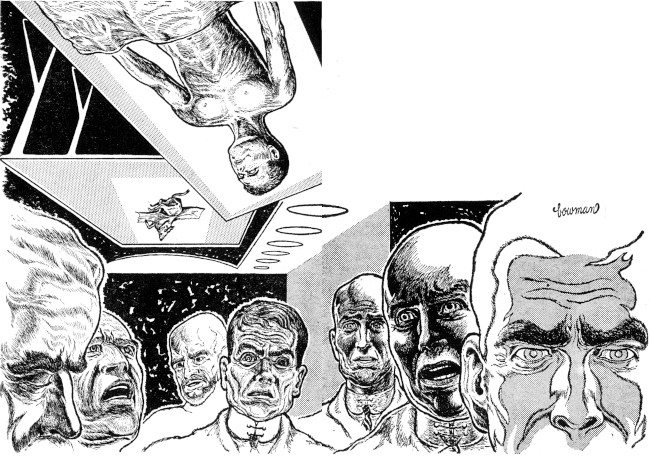
Harker compelled himself to watch. Needles plunged into the dead man's skin; electrodes fastened to the scalp discharged suddenly. It was weird, vaguely terrifying, laden with burdensome implications for the future. All that seemed missing was the eery blue glow that characterized the evil experiments of stereotyped mad scientists.
He told himself that these men were not mad. He told himself that what they were doing was a natural outgrowth of the scientific techniques of the past century, that it was no more terrifying to restore life than it was to preserve it with antibiotics or serums. But he sensed a conflict within himself: he knew that if he accepted this assignment, he could embrace the idea intellectually but that somewhere in the moist jungle-areas of his subconscious mind he would feel disturbed and repelled.
"Watch the needles," Raymond whispered. "Heartbeat's beginning now. Respiration. The electro-encephalograph is recording brain currents again."
"The test, of course, is whether these things continue after your machinery is shut off, isn't it?" Harker asked.
"Of course."
Time edged by. Harker's over-strained attention wandered; he took in the barren peeling walls of the lab, the dingy window through which late-afternoon light streamed. He had heard somewhere that the old-fashioned incandescent bulbs emitted a 60-cycle hum, and he tried unsuccessfully to hear it. Sweat-blotches stippled his shirt.
"Now!" Vogel said. He threw a master lever. The equipment whined faintly and cut off.
The heartbeat recorder and the respiration indicator showed a momentary lapse, then returned to their previous level. The EEG tape continued recording.
Harker's eyes widened slightly. A slow smile appeared on Raymond's face; behind him, Harker could hear Lurie cracking his knuckles nervously, and bespectacled Dr. Klaus tensely grinding his molars together.
"I guess we did it," Vogel said.
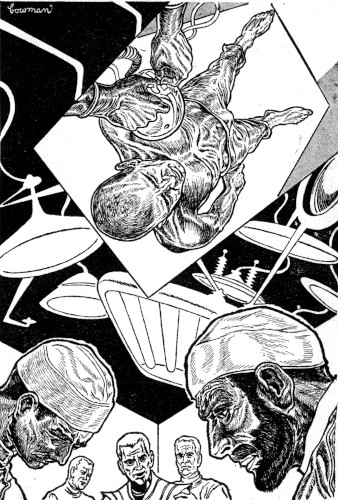
The dead man's arms moved slowly. His eyelids fluttered, but the anesthetic ensured continued unconsciousness. His lips parted—and the soft groan that came forth was, for Harker, the clincher he had been half-hoping would not be forthcoming.
The man groaned again. Harker felt suddenly weary, and turned his head away.
CHAPTER IV
Harker's shock reaction was violent, instinctive, and brief. He quivered uncontrollably, put his hands to his face, and started to lose his balance. Raymond was right there; he caught him, held him upright for a moment, and released him. Harker wobbled and grinned shamefacedly.
"That's strong stuff," he said.
"I've got stronger stuff in my office. Come on."
He and the lab director returned to the adjoining room. Raymond closed the door and clicked it; Lurie and Klaus remained in the lab. Raymond reached into his bookcase, pushed a thick black-bound volume to one side, and withdrew a half-empty bottle of Scotch. He poured a double shot for Harker, a single for himself, and replaced the bottle.
"Drink up. Straight."
Harker swallowed the liquor in two frantic gulps. He gasped, grinned again, and shakily set down the glass. "God. I'm roasting in my own sweat."
"It isn't a pleasant sight the first time, I guess. I wish I could share some of your emotional reaction, but I'm blocked out. My dad was a biochemist, specialty life-research. He had me cutting up frogs when I was three. I'm numb to any such reactions by now."
"Don't let that trouble you," Harker said. He shivered. "I could live very happily without seeing another demonstration of your technique, you know."
Raymond chuckled. "Does that mean you're convinced we aren't quacks?"
Harker shrugged. "What you have is heap big medicine. I wonder if I've got the voltage needed to handle the job you want me to do."
"You wouldn't be here if we didn't think so."
"I was fourth on the list," Harker said. "Lurie told me."
"You were my personal choice. I was outvoted. But I knew you'd accept and the other three would turn us down without even coming out here to investigate."
"I haven't said I've accepted," Harker pointed out.
"Well? Do you?"
Harker was silent for a moment, his mind returning to the impact of the scene he had just witnessed. There was still plenty he had to know, of course: the corporate set-up of this lab, including knowledge of the powers that had "outvoted" the director; the financial resources behind him; the possible bugs in the technique.
A dozen implications unfolded. His mind was already at work planning the campaign. He was thinking of people to see, wires to pull, angles to check.
"I guess I accept," he said quietly.
Raymond smiled and reached into his desk. He handed Harker a check drawn on a Manhattan bank for $2,400, payable to James Harker, and signed Simeon Barchet, Treasurer.
"What's this?"
"That's four weeks salary, in advance. Barchet's the trustee who administers the Beller Fund. I had him write the check yesterday. I was pretty confident you'd join us, you see."
Harker spent a quietly tense weekend at home with his family. He told Lois about the assignment, of course; he never kept things from her, even the most unpleasant. She was dubious, but willing to rely on his judgment.
He worked off some of his physical tension by playing ball in the backyard with his sons. Chris, entering adolescence, was developing an athlete's grace; seven-year-old Paul did not yet have the coordination needed for catching and throwing a baseball, but he gave it a good try.
On Sunday the four of them drove upstate to a picnic ground, ate out, even went for a brief swim though it was really too early in the season for that. Harker splashed and laughed with his sons, but there was an essential somberness about him that Lois quietly pointed out.
"I know," he admitted. "I'm thinking."
"About the Beller Labs business?"
He nodded. "I keep finding new angles in it. I try to guess what the reaction of the organized churches will be, and what political capital will be made. More likely than not the parties will take opposite stands. Somebody will dig up the fact that I used to be a National Liberal bigwig, and that'll enter into the situation. After a while it'll become so confused by side-issues that—" He stopped. "I don't sound very enthusiastic about this job, do I?"
"No," Lois said. "You don't."
"I guess I really haven't made up my mind where I stand," he said. "There are too many tangential things I don't know about yet."
"Like what?"
Harker shook his head. "I'm trying not to think about them. This is my day off, remember?"
On Monday he polished off his routine work early, by half-past-ten, and stepped out of his office. He walked down the beige corridor to the door inscribed William F. Kelly and knocked sharply.
"Bill? Me, Jim."
"Come on in, boy."
Kelly was sitting back of an impeccably clear mahogany desk, looking well-barbered, well-manicured, well-fed. He was the senior partner of the law firm that now called itself Kelly, Harker, Portobello, and Klein. In his late fifties, ruddy-faced, quick-witted, Kelly was by religion a loyal Catholic and by politics a determined maverick.
He said, "How's the ex-Governor this morning?"
Harker grinned. Kelly was the one man who could not offend him with those words. "A washed-up has-been, as usual. Bill, I've got a big offer to do some work for a Jersey outfit. I think it's going to tie me up for the next few months. I thought I'd let you know."
Kelly blinked, then grinned, showing even white teeth. "Full-time?"
"Pretty near."
"How about your pending cases?"
Harker said, "I'm keeping the Bryant case. Fuller and Heidell will have to be handed over to someone else, I'm afraid."
"I guess you know what you're doing, Jim. Who's the big client?"
"Hush-hush. Nice pay, though."
"Can't even tell old Bill, eh? Well, I know better than to pry. But how come you're telling me all this, anyway? I don't give a damn what work you take on, Jim. You're a free agent here."
Calmly Harker said, "I thought I'd let you know because the account's a controversial one. I want you to realize that I'm doing it on my own hook and not as a member of K.H.P. & K. When and if the boomerang comes around and hits me in the face, I don't want you and Mike and Phil to get black eyes too."
Dead seriousness replaced the amiable grin on Kelly's pink face. "Have I ever backed off a hot item, Jim?"
"You might back off this one."
Kelly leaned forward and turned on all his considerable personal charm. "Look here, son, I'm a decade older than you are and a damned sight cagier. Maybe you better talk this thing out with me. If you're free for lunch—"
"I'm not," Harker said doggedly. "Bill, let's drop the whole thing. I know what I'm getting into and I didn't come here for advice. Okay?"
Kelly began to chuckle. "You said the same damn thing the night you were elected Governor. Remember, when you started telling me about how you were going to turn the whole State machine upside-down? I warned you, and I warn you again, but you don't learn. The only thing that got turned upside-down was you."
"So I'm a fool. But at least I'm a dedicated fool."
"That's the worst kind," Kelly drawled amiably. As Harker started to leave the older man's office Kelly added, "Good luck, anyway, on whatever you're getting your fool feet tangled up in."
"Thanks, Bill. Sorry I have to be so tight-mouthed."
On his way back to his office he passed the reception-desk; Joan looked up at him and said, "Oh, Mr. Harker—call just came in for you. Mr. Jonathan Bryant's on the phone. He's waiting."
"Switch it into my office," Harker told her. His brows contracted. Jonathan? What does that particular vulture want?
Harker cut round the desks in the outer office and let himself into his sanctum. He activated the phone. There was the usual three-second circuit-lag, and then the gray haze of electronic "noise" gave way to the fishbelly face of Jonathan Bryant.
"Hello, Harker," he said abruptly. "Just thought I'd call you up to let you know that I've obtained a stay of the hearing on my father's will. It's being pushed up from the 16th to the 23rd."
Harker scowled. "I don't have any official notice of that fact yet."
"It's on its way via court messenger. Just thought I'd let you know about it."
"Go ahead," Harker said. "Gloat all you want, if it gives you pleasure. Your father's will is unbreakable, and you know it damn well. All this stalling—"
"Legal delay," Jonathan corrected.
"All this stalling is just a waste of everybody's time. Sure, I know you're hoping the old man will die before the hearing, but I assure you that can't influence the outcome. If you're that anxious to collect, stop obtaining postponements and just pull the old man's feeding-plugs out. It'll save a lot of heartache for all of us, him included."
"Harker, you lousy politico, you should have been debarred twenty years ago."
"The word you want to use is disbarred," Harker said coldly. "Suppose you get off my line and stop bothering me now? I'd call you a filthy jackal except that I'm too busy for slander suits just now, even suits that I'd win."
Angrily he snapped off contact and the screen blanked. Nuisance, he thought, referring both to Jonathan and to the postponement of the hearing. He didn't seriously believe that the Bryant heirs were going to upset the old man's will, and the quicker he got the case off his personal docket the faster he would be free for full-time work on the Beller Labs account.
He took a doodlepad from his desk and scrawled three names on it:
Winstead.
Thurman.
Msgnr. Carteret.
Leo Winstead was the man who had succeeded him in the Governor's mansion in Albany—a steady, reliable National-Liberal party-line man, flexible and open in his views but loyal to the good old machine. He would be one of the first men Harker would have to see; Winstead would give him the probable Nat-Lib party line on the resurrection gimmick, and he could be trusted to keep things to himself until given the official release.
Clyde Thurman was New York's senior Senator, a formidable old ogre of a man with incalculable influence in Washington. Harker had been a Thurman protege, fifteen years ago; publicly old Clyde had soured on Harker since his futile attempt at political independence, but Harker had no idea where the old man stood privately. If he could win Thurman over to his side, Senate approval of revivification legislation was a good bet. The Nat-Libs controlled 53 seats in the 123rd Congress; the American-Conservatives held only 45, with the other two seats held down by self-proclaimed Independents. In the House, it was even better: 297 to 223, with 20 Independents of variable predictability.
Harker's third key man was Monseigneur Carteret. The Father was a highly-respected member of New York's Catholic hierarchy, shrewd and liberal in his beliefs, and already (at the age of 38) considered a likely candidate for an Archepiscopacy and beyond that the red hat.
Harker had met Father Carteret through Kelly. While he was no Catholic himself, nor currently a member of any other organized group, Harker had struck up a close friendship with the priest. He could rely on Carteret to give him an accurate and confidential appraisal of the possible Church reaction to announcement of a successful technique for resuscitating the dead.
Harker ripped the sheet off the doodlepad and pocketed it. He hung poised over his desk, deep in thought, his active mind already picturing the interviews he might be having with these people.
After a moment he reached for his phone and punched out the coordinates of Father Carteret's private number. Might as well begin with him, Harker thought.
A pleasantly monkish face appeared on the screen after several rings. "Yes? May I help you?"
"I'd like to speak to Father Carteret, please. My name is James Harker."
"Pardon, Mr. Harker. Father Carteret is in conference with Bishop O'Loughlin. Would you care to have him call you when he's free?"
"When will that be?"
"A half hour, I'd say. Is your matter urgent?"
"Reasonably. Tell the Monseigneur I'd like to make an appointment to see him some time today or tomorrow, and ask him to call me at my office."
"Does he have your number?"
"I think so. But you'd better take it anyway, just to make sure. MON-4-38162."
He blanked the screen, waited a moment, and dialed the number Raymond had given him to use when calling the laboratory. The pale, goggle-eyed face of David Klaus appeared on the screen.
"I'd like to talk to Raymond."
"Dr. Raymond's busy in the hormone lab," Klaus said sharply. "Try again in an hour or so."
Harker frowned impatiently; he had taken an immediate dislike to this jittery little enzyme researcher. He said, "You tell Raymond—"
"Just a minute," a new voice said. There was confusion on the screen for an instant; then Klaus' face disappeared and the precise, tranquil features of Martin Raymond took their place.
"I thought you were busy in the hormone lab," Harker said. "Klaus told me so."
Raymond laughed without much humor behind it. "Klaus is frequently inaccurate, Mr. Harker. What's on your mind?"
"Thought I'd let you know that I'm getting down to immediate operation. I'm lining up interviews with key people for today and tomorrow as a preliminary investigation of your legal situation."
"Good. By the way—Mitchison's prepared some publicity handouts on the process. He wants you to okay them before we send them to the papers."
Harker repressed a strangled cough. "Okay them? Listen, Mart, that's exactly why I called. My first official instruction is that the present wrap of ultra-security is to continue unabated until I'm ready to lift it. Tell that to Mitchison and tell him in spades."
Raymond smiled evenly. "Of course—Jim. All secrecy wraps on until you give the word. I'll let Mitchison know."
"Good. I'll be out at the lab sometime between here and Wednesday to find out some further information. I'll keep in touch whenever I can."
"Right."
Harker broke contact and stared puzzledly at the tips of his fingers for a moment. His uneasiness widened. His original suspicion that behind the smooth facade of the Beller Research Laboratories lay possible dissension was heightened by Klaus' peculiar behavior on the phone—and the idea of Mitchison doing anything as premature as sending out press handouts now, before the ground had been surveyed and the ice broken, gave him the cold running shudders.
It was going to be enough of a job putting this thing across as it was—without tripping over the outstretched toes of his employers.
CHAPTER V
Monseigneur Carteret's private office reminded Harker of Mart Raymond's. Like Raymond's, it was small, and like Raymond's it was ringed with jammed bookshelves. The furniture was unostentatious, old and well-worn. As a concession to the 21st century Carteret had installed a video pickup and a telescreen attachment to go with his phone. A small crucifix hung on the one wall not encumbered with books.
Carteret leaned forward and peered curiously at Harker. The priest, Harker knew, suffered from presbyopia. He was a lean man with the sharp facial contours of an ascetic: upthrust cheekbones, lowering brows, grizzled close-cropped hair turning gray. His lips were fleshless, pale.
Harker said, "I have to apologize for insisting on such a prompt audience, Father."
Carteret frowned reprovingly. "You told me yesterday it was an urgent matter. To me urgency means—well, urgency. My column for the Intelligencer can wait a few hours, I guess."
His voice was dramatically resonant. He flashed his famous smile.
Harker said, "Fair enough. I'm here seeking an ecclesiastical opinion."
"I'll do my best. You understand that any real opinion on a serious matter would have to come from the Bishop, not from me—and ultimately from Rome."
"I know that. I wouldn't want this to get to Rome just yet. I want a private, off-the-record statement from you."
"I'll try. Go ahead."
Harker took a deep breath. "Father, what's the official Church position on resurrection of the dead? Actual physical resurrection here and now, I mean, not the Last Trump."
Carteret's eyes twinkled. "Officially? Well, I've never heard Jesus being condemned for raising Lazarus. And on the third day after the crucifixion Jesus Himself was raised, if that's what you mean. I don't see—"
"Let me make myself clear," Harker said. "The resurrections of Jesus and of Lazarus both fall into the miracle category. Suppose—suppose a mortal being, a doctor, could take a man who had been dead eight or nine hours, or even a day, and bring him back to life."
Carteret looked momentarily troubled. "You speak hypothetically, of course." When Harker did not answer he went on, "Our doctrine holds that death occurs at the moment of 'complete and definitive separation of body and soul.' Presumably the process you discuss makes no provision for restoring the soul."
Harker shrugged. "I'm not capable to judge that. Neither, I'd say, are the men who have developed this—ah—hypothetical process."
"In that case," Carteret said, "the official Church position would be that any human beings revived by this method would be without souls, and therefore no longer human. The whole procedure would be considered profoundly irreligious."
"Blasphemous and sacrilegious as well?"
"No doubt."
Harker was silent for a moment. He said at length, "How about artificial respiration, heart massage, adrenalin injections? For decades seemingly dead people have been brought back to life with these techniques. Are they all without souls too?"
Carteret seemed to squirm. His strong fingers toyed with a cruciform paperweight on his desk. "I recall a statement of Pius XII, eighty or ninety years ago, about that. The Pope admitted that it was impossible to tell precisely when the soul had left the body—and that so long as the vital functions maintained themselves, it could be held that the person in question was not dead."
"In other words, if resuscitation techniques could be applied successfully, the patient is considered never to have been dead?"
Carteret nodded slowly.
"But if the patient had been pronounced dead by science and left in that state for half a day or more, and then reanimated by a hypothetical new technique—?"
"In that case there has been a definite discontinuity of the life-process," Carteret said. "I may be wrong, but I can't see how the Vatican could give such a technique its approval."
"Ever?"
Carteret smiled. "Jim, it's a verity that the Church is founded on a Rock, but that doesn't mean our heads are made of stone. No organization lasts two thousand years without being susceptible to change. If in the course of time we're shown that a reanimation technique restores both body and soul, no doubt we'll give it approval. At present, though, I can foresee only one outcome."
Harker knotted his fingers together tensely. The priest's response had not been a surprise to him, but he had hoped for some wild loophole. If any loophole existed, Carteret would have found it.
Quietly he said, "All right, Father. I'll put my cards on the table now. Such a process has been invented. I've seen it work. I've been retained as legal adviser for the group that developed it, and I'm shopping around for religious and secular opinions before I let them spring the news on the public."
"You want my secular opinion, Jim, now that you've had the religious one?"
"Of course."
"Drop it. Get out of this thing as fast as you can. You're asking for trouble."
"I know that. But I can only see this process as a force for good—for minimizing tragedy in everyday life."
"Naturally. And I could offer you six arguments showing how it'll increase suffering. Is it a complex technique requiring skilled operators?"
"Yes, but—"
"In that case it won't be available to everybody right away. Are you going to decide who lives and who stays dead? Suppose you're faced with the choice between a good and virtuous nobody or an evil but talented creative artist."
"I know. The Doctor's Dilemma. I don't have any slick answers to that, Father. But I still don't think it's any reason to suppress this thing."
"Maybe not. On a purely secular level, though, I tell you it's sheer dynamite. Not to mention the opposition you're bound to get from religious groups. Jim, listen to me: you had a wonderful career once. You wrecked it. But now you're continuing your headstrong ways right to the point of self-destruction."
"Which is frowned upon by your Church," Harker snapped, irritated. "But—"
"I'm not talking about my Church!" Carteret thundered. "I'm talking about you, your family, the rest of your life. You're getting into very deep waters."
"I'll shoulder the responsibility myself."
"I wish you could," the priest murmured. "I wish any of us could. But we can't ever do that, of course."
He shrugged, "Go in peace, Jim. Any time you want to talk to me, just pick up the phone and call. I guarantee no proselytizing."
"Of course everything we've just said is confidential, you understand."
Carteret nodded. He lifted his arms, shaking the sleeves of his cassock back. "Observe. No concealed tape-recorders under my garments. No telespies in the wall."
Chuckling, Harker opened the door and stood at the threshold a moment. "Thanks for talking to me, Father. Even if I can't agree with you."
"I'm used to disagreement," Carteret said. "If everyone who came in here agreed with everything I said, I think I'd lose my faith. So long, Jim."
"Good-bye, Father."
Harker emerged on the steps of the old cathedral where Carteret had his office, paused for a few deep breaths, and looked around. Fifth Avenue was humming with activity, here at noontime on a Tuesday in mid-month.
He thought: Tuesday, May 14, 2033. A pleasant late-spring day. And any time I decide to give the word, the entire nature of human philosophy will change.
Harker walked downtown to 43rd Street, stopped in for a quick coffee, and headed toward the Monorail Terminal. Puffing businessmen clutching attache cases sped past him, each on some business of no-doubt-vital importance, each blithely shortening his life-span with each new ulcer and each new deposit of cholesterol in the arteries. Well, before long it would be possible to bring these fat executives back to life each time they keeled over, Harker thought. What a frantic speedup would result then!
He bought a round-trip ticket to Litchfield, put through a call to the laboratory, and boarded the slim graceful yellow-hulled bullet that was the New Jersey monobus. He sat back, cushioning himself against the first jolt of acceleration, and waited for departure.
The eleventh commandment: Thou need not die. Harker shivered a little at the magnitude of the Beller project; each day he realized a little more deeply the true awesome nature of the whole breakthrough.
Mitchison was waiting for him at the Litchfield monobus depot in the big black limousine. Harker climbed in, sitting next to the public-relations man on the front seat.
"Well?" Mitchison jammed his cigar into one corner of his mouth. "What did the padrè have to say?"
"Precisely what we all expected."
"Nix?"
"Double-double nix with molasses and cherries on top," Harker said. "His unofficial feeling is that the Church will ixnay this thing the second it's announced."
"Umm. Take some heavy thinking to cancel that out. How about the politicos?"
The car pulled into the Beller Labs' private road. Harker said, "I'm going to Albany later in the week to see Governor Winstead. After him I'll go after Senator Thurman. Depending on what they say—"
"The hell with that," Mitchison growled. "When do you figure we can release this thing to the public?"
Harker turned round in his seat. In a level voice he said, "When you're planning to touch off a fusion bomb, you look around first and make sure you won't get scragged yourself. Same here. This project's been kept under wraps for eight years, and I'm damned if I'll release anything now until I see exactly where we all stand."
"And you'll pussyfoot around for months?"
"What do you care?" Harker demanded. "Are you getting paid by the week or by the amount of publicity you send out?"
Mitchison grunted something but made no intelligible answer. They pulled up at the road-block and Harker got out at the right; the guards nodded curtly to him this time but made no attempt to interfere as he headed toward the administration building. Mitchison took his car to the parking-area.
Knocking at Raymond's door, Harker said, "You there, Mart?"
The door opened. A diminutive hatchet-faced man peered up at him. "Hello, Harker."
Taken off balance, Harker blinked a moment, then said, "Hello. I don't think we've met, have we?"
"You've seen my name. At the bottom of your check. I'm Barchet. Administrator of the Beller Fund."
Harker smiled at the little man and looked past him to Raymond. He shook his head. "It's no go, Mart. The Father says the Church will oppose us."
Raymond shrugged. "We could have figured on that, I guess. What's the next step?"
Harker nodded. "I see Winstead on Friday. I hope for better luck there."
"Doubtful," Barchet snorted. His voice was an annoying saw-edged whine. Harker wondered whether the little man was going to be around the Litchfield labs very often; he had a deep dislike for moneymen.
Ignoring Barchet's comment, Harker said to Raymond, "Mart, how solid is the tenure of the people in this organization?"
"What do you mean?"
"Do all the affiliated men have verbal contracts like me, or are some inked in black-and-white?"
"Most of the research men have verbal agreements."
"How about Mitchison?"
Barchet turned to peer at Harker. Raymond frowned and said, "Why Mitchison?"
"I'll be blunt," Harker said. "I'd like to bounce him. He does not seem very capable and he's awfully trigger-happy about releasing data on the project. If it's okay with you, I'd like to bring in a couple of the boys who handled my gubernatorial campaign. They—"
Interrupting icily, Barchet said, "It seems to me we have more than enough people of radical political affiliation working for us now. Anyone who handled a Nat-Lib campaign would be no asset to our work."
Harker goggled. "I was a Nat-Lib Governor! You hired me, and you think that two press-agents—"
"I might as well tell you," Barchet said. "You were hired over my positive objections, Mr. Harker. Your party happens to be the one in power, but it definitely does not represent the main ideological current of American enterprise. And if we succeed in our aims, I like to think it will be despite your presence on our team, not because of it."
"Huh? Who the hell—"
"Wait a minute, Jim," Raymond cut in. "And you too, Simeon. I don't want any fighting in here!"
"I'm simply stating views that I expound regularly at our meetings," Barchet said. "For your information, Mr. Harker, Cal Mitchison is the best publicity agent money can buy. I will not consent to his dismissal."
"You may have to consent to my resignation, then," Harker said angrily. "Dammit, Mart, if I knew this outfit was run by—"
"Watch yourself, Mr. Harker," Barchet warned.
"Calm down, Jim." Raymond disengaged himself from his desk and, glowering down at Barchet, said, "Simeon, you know damned well Harker was approved by a majority of the shareholders. You have no business raising a squabble like this now. He was hired and given free rein—and if he wants to fire Mitchison, it's within his province."
"I insist on bringing the matter before the Board—and if Mitchison is dismissed without full vote, I'll cause trouble. Good day, Dr. Raymond."
The little man sailed past Harker without a word and slammed the door. Harker grinned and said, "What was he so upset about?"
Raymond slumped wearily behind his desk. "Barchet's the official voice of old Beller in this outfit—and Beller was as conservative as they come. Barchet thinks you're an arch-radical because you held office for the Nat-Libs. And the little bugger carries a lot of weight on the Board, so we have to humor him."
Harker nodded. He understood now what Raymond had meant when he said he had been "outvoted" in the matter of hiring Harker as first choice. It did not increase his opinion of Beller Research Laboratories.
"I wouldn't blame you if you quit today," Raymond said suddenly. "With Mitchison on pins and needles to give the word to the public, and that idiot Klaus battling for my job because he's tired of enzyme work—"
"Klaus? But he's just a kid!"
"He's twenty-nine, and for an ex-prodigy that's ancient. Degree from Harvard at fifteen, that sort of thing. I have to keep close watch on him or he'll put a scalpel in my back."
"Why not fire him?" Harker suggested.
"Two reasons. He's got a contract, for one—and for another I'd rather have him with us than agin us, if you know what I mean. Lesser of two evils."
Raymond sighed. "Great little place we have here, Jim. Sometimes I feel like closing the windows and turning up the gas." He shook his head reflectively. "But it wouldn't work. Some bastard would drag me next door and bring me back to life again."
He reached into the bookshelf and produced the liquor bottle. "One quick shot apiece," he said. "Then I want to take you round back to show you the rest of the lab."
CHAPTER VI
The grand tour of the laboratory grounds was as disturbing as it was stimulating. Seemingly tireless, Raymond marched him through room after room where elaborate experiments were going on.
"Serotonin-diffraction goes on in here. This room's plasma research; remind me to bring you back some time when the big centrifuge is running. Fascinating. This is Klaus' enzyme lab, and down here—"
Harker puffed along behind the lab director, listening to the flow of unfamiliar terms, dazzled by the array of formidable scientific devices. He saw kennels where lively dogs bounded joyfully up and down and struggled to lick his hands through the cage; it was a little jarring to learn that every dog in the room had been "dead" at least once, for periods ranging from a few minutes to twenty-eight hours. He met a grave little rhesus monkey that held the record; it had been dead thirty-nine hours, two months before.
"We had a pair of them," Raymond said. "We brought this fellow back at the 39-hour mark, and held the other off for nine more hours in hopes of hitting a full two days. We didn't make it. The surviving monk moped for days about it."
Harker nodded. He was swept on; into a large room lined with ledgers, which Raymond said contained all the records of the Beller Laboratories since its opening in 2024. White-smocked researchers turned to look up as Harker and his guide passed through into a long, well-lit lab room, then out into the afternoon warmth and across to the other building, for more of the same.
"Well," Harker said finally, after they had returned to Raymond's office. "It's a busy place."
Raymond nodded. "We keep it moving. And it gets results. Despite everything, it gets results."
Despite everything. Harker didn't like the implications of that. He was beginning to form a picture of Raymond as an able man surrounded by stumbling-blocks and obstacles, and bulling his way through none the less. He wondered how it would be once he got the campaign into full swing, not too many weeks from now.
Harker leaned back, trying to relax. Raymond said, "Is it too early for you to give me an outline of the program you're planning?"
Harker hunched his shoulders forward uneasily. "It's still in the formative stage. I'm seeing Governor Winstead on Friday, as you know, and early next week I'll go down to Washington and talk to Senator Thurman. If we get them on our side, the rest is relatively easy."
"And if we don't?"
Harker did not smile. "Then we have a fight."
"Why do you say that? Can't we just set up an instruction center and start resuscitating?"
"Pardon me, Mart, if I say that your approach's a naive one. We can't do any such thing. Not even if you limit use of the apparatus to fully qualified M.D.'s. You see, anything as radical as this will have to be routed through the Federal Health Department, and they'll simply boot it on up to the President, and he'll refer it to Congress. What we need is a law making use of your technique legal."
"Is there any law saying it's illegal to reanimate the dead?" Raymond asked.
"Not yet. But you can bet there'll be an attempt to ram one through, before long. Which is why we have to put through a law of our own."
Raymond fell silent; his blue-cheeked face looked grave. An idea occurred to Harker and he said, "Do you have any idea how big our public-relations budget is?"
Raymond shrugged. "Pretty big. I guess you can have three or four hundred thousand, if you need it."
"Three or four hundred million is more in line with what we'll need," Harker said. He saw the stunned expression on Raymond's face and added, "Certainly at least a million, to begin with."
"But why? Why should it be necessary to sell the idea of restoring life? You'd think the people of America would rise up and acclaim us as saviors."
"You'd think so, wouldn't you?" Harker shook his head bleakly. "It doesn't work that way, Mart. For one thing, they'll be afraid to try it. There'll be plenty of 'zombie' jokes, and behind those jokes will be unvoiced fear. Uh-uh, Mart. If we're going to put this thing across, we'll need a big public-relations budget. And we can't let a bubble-head like Mitchison handle the job."
"It'll take a little time to fire him."
"Why?"
"You heard Barchet. Mitchison's Barchet's man. We'll have to go through shareholder channels to get rid of Mitchison."
"How long will that take?"
"Two weeks, maybe three," Raymond said. "Will that hold things up too badly?"
"We'll manage," Harker said tiredly.
Harker spent the next morning, Wednesday, at his office, tidying up unfinished business. The delayer on the Bryant hearing had come through, and he read the document carefully, scowled, and jammed it into his desk drawer. He phoned the Bryant home and learned that the old man was very low; the penguinoid doctor refused to let Harker speak with him. Harker suspected the fine hand of Jonathan Bryant lurking behind that ukase, but there wasn't much he could do about it. The old man wasn't going to last forever, anyway—but Harker genuinely wanted him to hold out until after the hearing, at least.
Nasty business. Jonathan had deliberately obtained the stay of hearing in hopes that his father would die before the case came up.
He left the office at noon, spent some time downtown in the public library trying to find some books that would give him a little scientific background, and headed for home about four that afternoon. His home life had been suffering, a bit, in the week since he had plunged himself fully into the Beller Labs project. He had been coming home at odd hours, which upset Lois' routine, and his attitude was one of withdrawn introversion, which made things tough on the children. Still, they all were very cooperative about it, Harker thought. He hoped he could make it up to them when the pressure let up.
If the pressure ever let up.
Thursday passed slowly. Harker remained at home, in his study, and tried to read the books he had brought from the library. He was surprised to learn that formal resuscitation research dated from the middle years of the past century. He traced down a few of the terms Raymond had thrown at him, and learned a bit about the mechanics of the Beller reanimation technique.
But, he realized when he put the books down, he knew very little in detail. He had simply skimmed the surface, acquiring a veneer of terms which he could use to impress the even-less-educated.
A politician's trick, he thought. But what else could he do?
He woke early on Friday, before six, and made breakfast for himself. By the time he had turned off the autocook and set the kitchen-servo to mop-up, Lois and the children were moving about upstairs. They had come down for breakfast before he was ready to leave.
"Morning, Dad," Chris said. "Up early, eh?"
"I have to make a 9:30 jet," he explained. "It's the last one before noon."
Paul appeared, thumbing his eyes, yawning. "Where you going, Daddy?"
"Albany," Harker said.
The seven-year-old looked awake immediately. "Albany? Are you Governor again, Daddy?"
"Hush, stupid!" Chris said savagely.
But Harker merely smiled and shook his head. "No, I won't be Governor any more, Paul. I'm going to visit Mr. Winstead. He's the Governor now."
"Oh," the boy said gravely.
Harker reached the West Side jet terminal at ten after nine. The big 150-seater was out on the field, surrounded by attendants. It would make the trip to Albany in just under thirteen minutes.
It was a silly business. It took him twice that long to get to the terminal from his home. But modern transportation was full of such paradoxes.
At nine-thirty-five the great ship erupted from the landing-strip; not much later it was roaring over Westchester, and not very much after that it was taxiing to a smooth and uneventful landing just outside Albany.
Thirteen minutes. And it took twenty-five minutes more for the jetport bus to bring them across the Hudson into Albany proper after the flight.
His appointment with Governor Winstead was for eleven that morning. Declining the public transport service, Harker walked through town to the governor's mansion—a walk that he had come to know well, in his four years in Albany.
The town hadn't changed much. Still third-rate, dirty, bedraggled; one of his proposed reforms had been to move the Capitol downstate to New York City, where it really belonged, but naturally the force of sentiment was solidly against him, not to mention the American-Conservative Party, whose New York stronghold Albany was.
He smiled at the memory. He had fought so many losing battles, in his four years as Governor.
The guards at Winstead's mansion recognized him, of course, and tipped their hats. Harker grinned amiably at them and passed through, but he felt inward discomfort. Their jobs were pegged down by civil-service regulations; his had not been, and he had lost it. In an odd way it made him feel inferior.
He traveled the familiar journey upstairs to the Governor's office. Winstead was there to greet him with outstretched hand and a faintly abashed smile.
"Jim. So glad you could come up here."
"It's not a courtesy call, Leo. I'm here to ask some advice."
"Any way I can help, Jim, you know I will."
Harker experienced a moment of disorientation as he took a seat facing Winstead across the big desk that had been his until a few months ago. It was strange to find himself sitting on this side of the desk.
He looked for ways to begin saying what he had come here to say. He sensed the other man's deep embarrassment, and shared it in a way, because the awkwardness of this first meeting between Governor and ex-Governor was complex and many-leveled.
Winstead was ten years his senior: a good party man, a reliable workhorse who had come up through the ranks of the Manhattan District Attorney's office, and who had turned down a judgeship because he thought he had a shot at the race for Governor. But the party had chosen the bright, meteorically-rising young Mayor, James Harker, to be the standard-bearer instead, and an avalanche of Nat-Lib votes from downstate had swept Harker in.
Then it had been necessary to discard Harker four years later, and good dependable old Leo Winstead was trotted out of private law practice to take his place. The Nat-Lib tide held true; Winstead was elected, and now it was the ex-prodigy who entered private law practice instead of using the Governorship as a spring-board into the White House.
Harker said, "Leo, you carry weight with the party. I don't any more."
"Jim, I—"
"Don't try to apologize, Leo, because it's my own fault and none of yours that I'm where I am now. I'm simply asking you to exert some influence on behalf of a project I'm involved in."
It was a naked attempt at lobbying. Harker hoped Winstead's unconscious guilt-feelings would lead him to support the Beller people.
"What sort of project is it, Jim?"
"It's—it's a sort of revolutionary breakthrough in science, Leo. A process to reanimate people who have been dead less than twenty-four hours."
Winstead sat up. "Are you serious?"
"Dead serious. I'm going down to Washington next week to see Thurman. This thing really works—and I want to get it legally approved."
"And exactly where do I come in?"
"You're a powerful official, Leo. If you came out in praise of this new development—"
"Dangerous business, Jim. The Church—"
"I know all about the Church. And you can bet our friends the American-Conservatives will make some kind of political capital about the news. The Nat-Libs will have to take a favorable stand on this."
"Suppose we don't?" Winstead asked. His voice was tense and off-center; he ran his knotty hands nervously through his bushy shock of white hair. "You know as well as I do that this is no time to hop off supporting anything too far-fetched."
Harker began to feel a sense of exasperation. "Far-fetched? Leo, I saw a dead man come back to life right in front of me. If you think—"
"I don't think anything. Thinking's not my job. If you'll pardon my saying so, Jim, you did too much thinking for your own good when you were in Albany. This thing has to be handled with kid gloves. It would not surprise me if the government clamps down and bottles it all up until all its aspects have been fully explored."
"Federal Research Act of '92," Harker said thinly. "It guarantees freedom of research without government interference, as you know well enough."
Winstead seemed to be perspiring heavily. "Laws can be repealed or amended, Jim. Listen here: why don't you go see Thurman? Find out how he stands on the matter. Then come back here and maybe we can talk about it again."
It was obviously a dismissal. Winstead had no intentions of getting involved with something that had so many ramifications as this.
Tiredly Harker rose. "Okay. I'll see Thurman."
"Good."
"One more thing, Leo—this project hasn't been announced to the public yet. Since you're aware of the fuss it's going to kick up, I hope you'll be thoughtful enough to keep your mouth shut until we're ready to spring it ourselves."
"Of course, Jim. Of course."
CHAPTER VII
It was a very long weekend.
Harker reached his home at five-thirty that evening, having left Winstead around noon. He had had a miserable chlorella-steak lunch on the wrong side of State Street and spent the early afternoon strolling around Albany, easing the inner tension that gripped him. He made the 4:15 jet back to New York.
Chris was watching the video when he came in; it was a weekend, and the boy had no homework. He hopped up immediately and said, "Drink, Dad?"
"Martini. Very dry."
The boy busied himself with the pushbutton controls of the autobar while Harker hung up his hat and jacket. Lois appeared from the general vicinity of the kitchen.
"Did you see Winstead?"
He nodded. "Yeah, I saw him. He obviously doesn't want any part of the project."
"Oh. Dr. Raymond called, from the labs. He wanted to know if you were back yet. I told him you'd call as soon as you came home."
Harker picked up the phone, yanked down on the long-distance switch, and punched out Raymond's number. He waited, hoping Raymond himself would pick up and not Klaus or Barchet or someone like that.
Raymond did. He looked inquisitively out of the screen and Harker told him exactly what Winstead had said. When he had finished the flat, weary recital, he added, "I'm going to Washington on Monday. But if Thurman gives me the brush-off, we may be in trouble."
Raymond grinned with unconvincing heartiness. "We'll get through somehow, Jim. Have faith."
"I sincerely wish I could," Harker said.
He sipped the drink Chris put in his hand, and after a little of the cold gin had filtered into his bloodstream he felt better. It was a false comfort, he knew, but it was comfort all the same. He went upstairs to the sitting-room, picked out a musictape almost at random, put it on. The selection was a mistake: Handel's Messiah, Part III. He listened to the big alto aria that opened the section:
... I know that my redeemer liveth, and that he shall stand at the latter day upon the earth:
And though worms destroy this body, yet in my flesh shall I see God.
For now is Christ risen from the dead....
After the final notes of the aria had died away came the chorus, slow, grave:
... Since by man came death, by man came also the resurrection of the dead.
For as in Adam all die, even so in Christ shall all be made alive....
The jubilant tones of "Even so in Christ" sent startling shivers of illumination through him; it was as if he had never listened to these words before. ("Since by man came death, by man came also the resurrection of the dead....") The words pursued him everywhere.
Twenty minutes later, after the last melisma of "Amen," he abruptly turned the set off; dinner was about ready, or at least it should be. It was. He ate quietly, deep in thought.
On Saturday he was a little more lively; he worked around the house, took Chris and Paul for an hour-long hike in the early afternoon, spent some time before dinner watching the telecast of the Yankee-Dodger inter-league game from Los Angeles. He and Lois visited neighbors in the evening; it was a pleasant, relaxed three or four hours. He was beginning to think he could forget about the problem that was starting to grow.
But Sunday his short-lived forgetfulness ended. It was breakfast-time; Paul was struggling under the bulk of the Sunday Times, which had been left in the box outside, and Lois was bringing the pancakes to the table. As he took the paper from his youngest son, Harker turned to Chris and said, "Switch on the audio. Let's see what the morning news is like."
There was a click. A resonant, almost cavernous voice said:
"... he saith unto them, Our friend Lazarus sleepeth; but I go, that I may awake him out of sleep. Then said his disciples, Lord, if he sleep, he shall do well. Howbeit Jesus spake of his death: but they thought that he had spoken of taking rest in sleep. Then said Jesus unto them plainly, Lazarus is dead. And I—"
Impatiently Chris reached out and changed the station. Harker shook his head, annoyed. "No, Chris. Get that back. I want to hear it."
"The Bible, Dad?"
Harker nodded impatiently. As Chris searched for the original station Lois said, "That's St. Matthew, isn't it?"
Chuckling, Harker said, "St. John, unless I've forgotten all my Sunday Schooling. Your father ought to hear you say a thing like that."
Lois' father had been a stern Bible-reading Presbyterian; he had never approved of Harker. The radio preacher said:
"... Then they took away the stone from the place where the dead was laid. And Jesus lifted up his eyes, and said, Father, I thank thee that thou hast heard me. And I knew that thou hearest me always: but because of the people which stand by I said it, that they may believe that thou hast sent me. And when he thus had spoken, he cried with a loud voice, Lazarus, come forth! And he that was dead came forth, bound hand and foot with grave-clothes; and his face was bound about with a napkin. Jesus said unto them—"
"All right," Harker broke in suddenly. "You can change the station now."
Chris said, "How come you wanted to hear that, Dad?"
"It's a very famous passage." Harker smiled. "And I have a feeling we're all going to get to know it pretty well before summer comes."
After supper Sunday he packed for his trip to Washington; he took an extra change of clothes, because Thurman's secretary had warned him that the Senator was very busy and might not be able to see him until Tuesday. Harker reflected privately that that was fine treatment to accord a man who had once been virtually the titular head of the party, but complaining would have done him less than no good.
He came downstairs again after packing, and spent the next several hours watching video with the family: a silly, mindless series of programs, ideally designed to give the mind a rest.
At quarter-past-nine, in the middle of an alleged ballet sequence, the screen went blank. Harker frowned, annoyed; then an announcer's face appeared.
"We interrupt this program to bring you a special announcement from our newsroom.
"Richard Bryant, hero of Earth's first successful voyage to another planet, died quietly in his sleep an hour ago, in his Manhattan apartment. He would have been seventy-four next month.
"He was assured of immortality on the first of August, 1984, when he radioed from Mars the triumphant message, 'Have landed Mars One safely. Am on way back. Mars is pretty dreary.' From that day on, Rick Bryant was a hero to billions.
"We return you now to the regularly-scheduled program."
Cavorting dancers returned to the screen. In a soft, barely-audible voice, Harker cursed eloquently.
"Gee, Dad! Rick Bryant died!" Chris exclaimed.
Not long after he had taken the case, Harker had induced the old man to autograph a copy of his book I Flew to Mars for Chris; since then, the boy had taken deep interest in Bryant's career.
Harker nodded. To Lois he said, "They didn't even give him a chance. The hearing would have been last Thursday, but his son got it postponed."
"Do you think this will affect the outcome, Jim?"
"I doubt it. That document was pretty solid. Damn, I wanted old Bryant to have the satisfaction of knowing he died on top." Broodingly he stared at his slippers. "If any of them had any guts, they would have lied to him, told him his will was upheld. But of course they didn't. They're just so many vultures. Hell, I guess I'd better phone. As the old man's lawyer, I'd better get in touch."
He went upstairs to his den and switched on the phone. Punching out the Bryant number, he waited a moment; an intercepting service took the call and said, "We represent the Bryant family. Only friends of the family and immediate relatives can be put through just now, sir."
"I'm the late Mr. Bryant's lawyer," Harker said, staring at the monogrammed pattern on the screen. "James Harker. Will you put me through?"
There was a momentary pause; then: "I beg your pardon, sir. Your name does not seem to be on the list. You understand that in a time of grief such as this the Bryant family accepts your condolences in the sincere spirit in which they are offered, and regrets that it cannot devote personal time to you as yet. We suggest that you call back tomorrow, when the shock of Mr. Bryant's departure has lessened."
The intercepting-service monogram disappeared from the screen. Harker scowled.
The cold-blooded lice. Hiring a service to dish out all that unctuous crap, meanwhile making sure I don't have a chance to talk to anybody there.
He took a deep breath and punched out another number: the home phone of District Judge Auerbach, who was scheduled to conduct the Bryant hearing next Thursday.
Auerbach appeared on the screen, plump, sleepy-looking. Harker said, "Sorry to disturb you on a Sunday night, Tom. You've heard about the Bryant business?"
Auerbach nodded. "Too bad, I guess. He was very sick."
"No doubt of that. Look, Tom, his sons are being sticky about their phone. I'm on the spit-list and can't get through to them. Has Jonathan phoned you tonight?"
"No. Is he supposed to?"
"I don't know. I just want to notify you that I'll be out of town on business tomorrow and maybe Tuesday, in case you or he or anybody is trying to reach me. But I'll be back in plenty of time for the hearing on Thursday. There isn't another motion for a postponement, is there?"
"Not that I know of," Auerbach said. "Be seeing you in court on Thursday, then?"