Chapter XXXI
Reading edition
THE FEDERAL RESERVE SYSTEM
The Federal Reserve Act[287]
THE SPIRIT AND OBJECTS OF THE ACT
The primary purpose of the Federal Reserve Act of December 23, 1913, is to make certain that there will always be an available supply of money and credit in this country with which to meet unusual banking requirements. Banks of a new class, to be known as Federal Reserve Banks, are to be established, and upon these banks is to rest the heavy responsibility of supporting the structure of credit in periods of financial strain. The new banks are expected to keep themselves in a condition of such strength in ordinary times that the other banks may safely rely upon them for all needed cash and credit in emergencies. In the past, the banks in this country, when subjected to financial pressure, have relied mainly upon loan contraction and the selling of securities. In future it is expected that they will resort to the Federal Reserve Banks, securing additional funds from these by rediscounting commercial loans. If the new arrangements work well, loans in future will not be reduced merely for the purpose of strengthening the banks. Loan contraction will take place only when there is evidence of an over-extended condition of business; and even then contraction will be carried through gradually, so as to conserve all interests so far as may be possible. Under the new system a most important influence, if not the most important single influence determining the character of banking operations, will be just the reverse of what it has been in the past.
To meet the heavy responsibilities placed upon the Federal Reserve Banks, two things are absolutely essential—good management, and ample powers and resources. Good management cannot be secured with certainty by means of legislative provisions, however carefully designed with that end in view. In the particular instance of the Federal Reserve Act, an ingenious combination of government and banking influence in selecting the management is provided. Purely banking operations are very largely to be handled by boards of directors, a majority of the membership of which is to be chosen by banks. General supervision, and for some purposes control, is placed with the Federal Reserve Board, which is to be appointed by the President of the United States, by and with the advice and consent of the Senate. Experience alone can determine the wisdom of these arrangements for securing effective management.
The Federal Reserve Banks are to exercise wide powers, and would seem likely to have ample resources. The country is to be divided into not less than eight, nor more than twelve districts, in each of which a federal reserve bank is to be established.[288] All national banks are required, and qualified state banking institutions are invited, to subscribe to the capital of the reserve bank in their district. Subscribing banks, to be known as member banks, are required to keep a part of their reserve with their Federal Reserve Bank. These banks will presumably receive most if not all of the general funds of the United States Government. They will provide an elastic currency, issuing notes secured by their commercial assets. They are also empowered to undertake the business of collecting, and clearing checks throughout the entire country, thus providing an organization for making settlements between banks in different places, the lack of which has been one of the most serious defects in our banking system.
Each Federal Reserve Bank will be a central bank for the section of the country which it is to serve. It will have all the responsibilities and most of the powers of central banks in the various European countries; but largely because the system is to be superimposed upon a fully developed banking system, some important provisions of the Federal Reserve Act are unlike anything to be found in European legislation. The Federal Reserve Banks are to receive deposits from the Government and from member banks only. Ordinarily they will lend to member banks only. All European central banks, though the bulk of their business is with banks and bankers, may deal with the general public and do so. The most striking divergence from European example, however, is the really novel plan of a system of regional banks in place of a single central bank. But the extent of this divergence is generally exaggerated. Political boundaries are indeed in large measure economic and financial boundaries as well; but central banks in the European countries do act and react upon each other, often working in harmony, and yet at times very much at cross purposes. If all Europe were brought under a single government, very likely the various existing central banks would be merged into a single institution. In some respects this would be advantageous, but it would not be absolutely necessary. Certainly European arrangements are not so fundamentally unlike those of a system of regional banks in a single country of great size, as to afford ground for the opinion that in setting up this system foreign experience has been altogether disregarded.
The various considerations which led to the adoption of the plan for regional banks, rather than a single central institution, deserve careful attention, since they indicate the spirit and purpose of the Federal Reserve Act. A single central bank was the solution of the banking problem reached without a dissenting voice by the members of the National Monetary Commission. The bill which the commission prepared was a notable achievement. Pioneer work though much of it necessarily was, very few defects on the technical banking side were disclosed in the discussion which followed the statement of the proposed measure. Its provisions regarding banking operations, including relations with other banks, are embodied with few changes of an essential character in the Federal Reserve Act. Most of the important differences between the bill and the Federal Reserve Act reflect differences in spirit and purpose rather than in methods. A central bank and also the system of regional banks necessarily involve placing somewhere very extensive power to influence and control credit. In the present temper of public opinion, the possession of great economic power is not tolerated in the absence of a large measure of government supervision and control. But unfortunately, in framing its measure the monetary commission failed to realize the fundamental importance of this consideration as a factor in securing general public approval. In devising a form of organization, competent management and approval in banking circles were evidently the controlling factors. An organization was proposed under which out of forty-five directors, but three were to represent the Government, the remainder being selected in various ways by bankers. Support from some who were the most bitter opponents of the measure might have been secured if the bill had provided for a larger measure of government control; but an equal or even greater number of adherents would probably have been lost. Under the plan of the commission and indeed under any central bank plan, government supervision and control cannot be made effective without at the same time placing the details of operation in charge of government officials. Few of the most ardent advocates of a central bank were prepared to take this extreme step.
Under the plan of organization of regional banks, the difficulty of combining government control and private management vanished. Purely banking matters, such as the granting of loans, could be placed with boards entirely or mainly composed of persons selected by the bankers whose funds were to provide most of the necessary resources. On the other hand, supervision and whatever measure of control might be deemed advisable, could be placed with a board mainly or entirely appointed by the President of the United States. Differences of opinion may be entertained regarding the particular arrangements in the Federal Reserve Act for selecting the various administrative bodies, and regarding the division of power between the directorates of the federal reserve banks and the Federal Reserve Board. If experience should disclose defects in this form of organization, it is flexible enough to permit at any time an extension of government or of banking influence.
Another important advantage of the regional system is to be noted. The operation of a central bank would be far more likely to give rise to sectional antagonism. This danger was apparently fully realized by the members of the National Monetary Commission, and elaborate arrangements for selecting the management were devised in order to make certain that each section of the country should be properly represented. But obviously regional banks, managed by local people, are very much more certain to meet this requirement. Apparently it was an endeavor to remove still further the danger of sectional dissatisfaction that led the Monetary Commission to make its one serious departure from sound banking principle in framing its bill. A provision was inserted requiring rediscounts to be made at a uniform rate throughout the entire country, regardless of the wide differences in the demand and supply of capital, which occasion the existing wide differences in lending rates. Under the regional plan no such indefensible provision was found necessary. This important feature of the Federal Reserve Act outweighs such advantages in economy of resources and effectiveness in management as were sacrificed in substituting for a central bank the regional banks.
The Monetary Commission in framing its bill seems to have been guided by two principles generally wise in legislation—the scope of the measure was limited to the single purpose of removing purely banking defects in our banking system, and no greater departure from existing arrangements was proposed than was essential for the purpose in hand. The Federal Reserve Act certainly runs counter to the first of these principles. Its primary purpose is similar to that of the bill of the monetary commission; but a secondary purpose evidently exercised a potent influence. This purpose was to decentralize credits by lessening the concentration of banking funds in a few large banks in the chief financial centers, and especially in New York. The regional system itself gained much support because it was believed by many that it would lessen the financial predominance of New York City. No comprehensive scheme of legislation with this object in view was inserted in the bill; but wherever two or more means of accomplishing the primary purpose of the bill were open, that one was evidently selected which it was believed might tend toward decentralization. In general the desire to decentralize credits explains why the act makes very much greater changes in existing arrangements than were proposed in the bill of the Monetary Commission. In the latter, the practice of depositing a part of the required reserves of the banks with reserve agents was left undisturbed. Under the terms of the Federal Reserve Act, such deposits are to be reduced by successive installments, and discontinued entirely three years after the passage of the act. From a purely banking point of view, much can be said for this great change; but it was certainly not absolutely necessary in order to secure the desired improvements in the working of our banking system.
The new banking institutions for which the Federal Reserve Act makes provision cannot be put in successful operation (and in this it resembles the bill of the Monetary Commission) unless a considerable number of the existing banks enter into relations with them. An institution might have been established with large capital, and a monopoly of the right of note issue, authorized to act as government fiscal agent, and to deal with the general public. Such an institution would presumably in the course of time have become a central bank, the main reliance of other banks in emergencies. In order to avoid competition with existing banks, the act provides that the receipt of deposits by the Federal Reserve Banks, and their normal lending operations shall be confined to those banks which subscribe to the capital and maintain balances with them. Obviously, then, if banks in large numbers do not accept the arrangement, subscribing to the capital and relying upon the new banks for accommodation, the system cannot be put into effective operation. Moreover, it is necessary that many banks shall enter the system at the outset. An attitude of hesitation would change to one of positive distrust, if the initial response were inadequate.
In the case of the bill of the Monetary Commission, reliance was placed simply upon the attractiveness of the measure. No bank would have suffered positive loss from failure to enter the system, though certain slight inducements were held out to those banks which accepted the arrangement at the outset. Whether a sufficient number of banks would have entered that system, if it had been established, may be thought probable but is not certain. Bankers are naturally and properly a conservative class and the inclination of many would have been to wait until the system was in successful operation. The attitude of bankers toward the Federal Reserve Act while it was passing through Congress was distinctly unfavorable. Most of its provisions already referred to, as well as others in which it differed from the Monetary Commission bill, were disliked. It was evident that in the absence of positive pressure, the number of banks which would accept its terms would be too small to make successful operation possible. No attempt was made, however, to insert provisions which would bring pressure upon state banking institutions. Perhaps it would be possible, either under the inter-state commerce or the postal clause in the Constitution; but it would have been contrary to the constitutional traditions of the party in power, and it was not necessary. If the national banks very generally enter the system, the resources of the Federal Reserve Banks will be sufficient to test the effectiveness of the measure. Accordingly the Federal Reserve Act contains a number of provisions designed to bring pressure to bear upon these to enter the system immediately. Failure to accept the terms of the act within one year after its passage involves forfeiture of the national charter. This alone would be no great business sacrifice, since banking in most States is quite as profitable under a state as under a national charter. Loss of the national charter, however, involves a loss of the right to issue bank notes and calls for the deposit of lawful money in Washington equivalent to the amount of outstanding circulation. Most national bank notes are secured by 2 per cent. government bonds, the price of which, in the absence of the circulation privilege, would be perhaps about two-thirds of the price (somewhat above par) at which they were purchased by the banks. No considerable number of national banks could refuse to enter the system without involving themselves in a heavy immediate loss. A further provision in the act puts more immediate pressure upon the national banks in reserve cities. If within sixty days after the passage of the act, a reserve agent bank fails to signify acceptance of its terms, it must cease to exercise the reserve-holding right upon thirty days' notice from the Federal Reserve Board.
Many bankers bitterly condemned the compulsory features in the act while it was on its passage through Congress. This feeling was perfectly natural, but it was not very generally shared outside banking circles. Impartially considered, the act imposes no unreasonable burden upon those who have invested capital in national banks. No one fears the loss of the funds which may be subscribed to the capital stock of the federal reserve banks or placed on deposit with them. If loss should be incurred, it would be primarily due to unsound banking on the part of the boards of directors of the Reserve Banks, a majority of the membership of which is to be chosen by the banks themselves. Some bankers have doubted whether the act would prove an effective measure of banking reform; but few if any have felt that results under its operation could possibly be more unsatisfactory than those under the present system; and all agree that it is a long step toward a perfected system.
ORGANIZATION
The new system is to be organized under the supervision and direction of the "Reserve Bank Organization Committee," consisting of the Secretary of the Treasury, the Secretary of Agriculture, and the Comptroller of the Currency. The most important function of this committee is to determine, "with due regard to the convenience and the customary course of business," the number and area of the Federal Reserve districts into which the country is to be divided, and to designate the city in each district in which a Federal Reserve Bank is to be established. Not less than eight, nor more than twelve districts are to be created. This is a most difficult task. However carefully the initial lines of demarcation may be drawn, more or less modification is to be expected after there has been some experience with the working of the system. Changes in area of districts, and additional districts if the organization committee designates less than twelve, may be made at any time in the future by the Federal Reserve Board. While the rivalry of cities may tempt the committee to start the system with a larger number, it is to be hoped that it will be found feasible to begin with no more than eight or nine districts. The problems which will confront the management of the Federal Reserve Banks are in many respects unlike those with which our bankers have had experience. A somewhat higher average of capacity in the management may more confidently be looked for if the smaller number of banks is established. Moreover, especially at the outset, mere size will contribute not a little to the prestige of the banks, and so inspire public confidence in the new system. A greater variety of occupations in large areas will lessen, though not much, extremes of seasonal variation in demands for accommodation upon the federal reserve banks. Then, too, the task of the Federal Reserve Board in supervising and co-ordinating the system will be materially simplified, if the minimum rather than the maximum number of federal districts is decided upon.
Within sixty days after the passage of the act, in other words before February 22, 1914, national banks are required, and properly qualified state banks are invited, to signify their acceptance of the terms of the act. Within thirty days after the reserve districts have been designated, each national bank must subscribe to the capital of the reserve bank of its district an amount equal to 6 per cent. of its capital and surplus. One-sixth of this subscription is to be paid at the call of the organization committee, another sixth within three months, and still another within six months thereafter. The remaining half of the subscription may be called at any time by the Federal Reserve Board. All these payments are to be made in gold or in gold certificates. It will be observed that the exact time when the system will be established is uncertain. The organization committee is only required to designate the reserve districts as soon as is practicable; thirty days is then allowed for the banks to subscribe; and payments will begin sometime thereafter at the call of the committee....
After the minimum capital (four million dollars for any federal reserve bank) has been subscribed, the certificate of organization is to be executed by any five member banks designated for the purpose by the organization committee. The final duty of the committee will be to supervise all arrangements for the election of the six of the nine directors of each Federal Reserve Bank, who are to be chosen by the member banks. For electoral purposes the banks of each district are to be divided into three groups—each group to "contain as nearly as may be one-third of the aggregate number of the member banks ... and as nearly as may be banks of similar capitalization." While the number of banks in each group will be the same, the capitalization will be very different. All the banks with a capitalization above the average in a district will certainly be in one group; those of somewhat less than average capital, in the second group; while the third group will be composed of banks having a very small capitalization. Under this ingenious arrangement, it is evident that the direct influence of the banks of the large cities in selecting the directorates of the Federal Reserve Banks is limited. Local alignments are also avoided. On the other hand, this is not a grouping to which the banks have been accustomed in the past, and therefore there is some uncertainty as to whether at the outset it will be conducive to the selection of capable directorates.
Each group of banks is to choose two directors: a Class A director, who is to be an active banker representing the stock-holding banks, and a Class B director, who must be actively engaged in commerce, agriculture, or some other industrial pursuit in his district. The board of directors of each member bank is to elect a district reserve elector. Candidates for the position of director of a Federal Reserve Bank may be nominated by any member bank; but nomination is not necessary. Electors are to signify their first, second, and other choices for one director in each class on a preferential ballot.
In addition to the six directors chosen by the banks, three directors (Class C) are to be appointed by the Federal Reserve Board. Two of these must be persons of "tested banking experience," one to serve as chairman of the board of directors and district reserve agent, the other as deputy chairman and deputy reserve agent. These reserve agents are the official representatives of the Reserve Board, through whom it will exercise its powers of supervision and control over the reserve banks. The act contains no provision regarding the officers to whom the operation of the banks will be entrusted. Presumably each board of directors will appoint one of its members (probably one of the Class A directors) as president and manager. The term of office of all directors is three years, but at the outset they are to be classified so that the term of one director of each of the three classes shall expire annually. The appointment of Class C directors will be the first duty of the Federal Reserve Board; inasmuch as the organization of the system can hardly be completed before the beginning of the summer, the appointment of this board could be deferred until that time. The selection of these directors for each of the eight or more Federal Reserve Banks is, however, no small task in itself; and since public confidence in the new system will largely be based at the outset upon the character of the Federal Reserve Board, its early selection is much to be desired.
The Federal Reserve Board itself is to consist of seven members: the Secretary of the Treasury and Comptroller of the Currency ex officio, and five members appointed by the President of the United States by and with the [advice and] consent of the Senate. Of the five appointed members, at least two must be persons experienced in banking or finance. Not more than one shall be appointed from any federal reserve district, and due regard is to be given to the different commercial, industrial, and geographical divisions of the country. The term of office of the appointed members is ten years; but those first selected are to serve one for two, one for four years, and so on, so that the term of office of one member may expire every two years.
Under this arrangement a majority of the board, in the absence of death and resignation, will never be reconstituted at any one time. Each President will select two of the appointed members: one in the second year of his term of office, and one in the fourth. The Secretary of the Treasury will, of course, be a new member appointed at the beginning of each presidential term. The term of office of the Comptroller of the Currency is for five years, so that here a variable element is introduced. It may happen that some Presidents will never appoint more than three members during their term of office. Generally, however, each President will appoint four members; but the last appointment, giving a majority on the board, will not be made until his final year of office. Lack of continuity and the possibility of a political board were much greater under the provisions for selecting the Federal Reserve Board which were in the measure at various stages while it was passing through Congress. The arrangements finally adopted would seem to make it reasonably certain that the Federal Reserve Board will be free from both these defects.
Organization of the system will be complete[289] with the selection of the members of the Federal Advisory Council. This Council is to consist of as many members as there are Federal Reserve districts, the board of directors of each Federal Reserve Bank selecting one member. The function and powers of the council are purely consultative. It is to meet regularly four times each year at Washington, and at other times there or elsewhere if deemed necessary by the Council itself. It is authorized to confer directly with the Federal Reserve Board, to call for information, and make oral or written representations concerning matters within the jurisdiction of the Federal Reserve Board. It may prove to be an important part of the organization, but this does not seem probable. With a scattered membership and holding regular meetings only at long intervals, it is not to be expected that the Council will be in close touch with the Federal Reserve Board, or in a position to formulate policies and urge them effectively. From individual members of the Council, the Federal Reserve Board should secure valuable information regarding conditions in different parts of the country; but the work of the council itself as an organized body seems likely to be of a formal and perfunctory nature. The importance of the Council would doubtless have been measurably increased if the proposal had been adopted that its chairman should sit, even though without a vote, on the Federal Reserve Board.
CAPITAL, EARNINGS, DEPOSITS OF THE FEDERAL RESERVE BANKS
Since the capital stock of each of the Federal Reserve Banks is to be exactly 6 per cent. of the capital and surplus of the member banks in its district, it will always be subject to slight variations. If all national banks enter the system at the outset, the total subscribed capital of the Federal Reserve Banks will be a little more than one hundred million dollars. Subscriptions may perhaps fall somewhat below this amount, since with the exception of the reserve agent banks, no penalty attaches to failure to subscribe until twelve months after the passage of the act. Few state banking institutions will enter the system at the beginning. In many states legislation is necessary to permit them to invest in the stock of the Federal Reserve Banks, and to enable them to count balances with the Federal Reserve Banks as a part of their required reserves. It is to be presumed also, that such institutions, since they can enter at any time, will wait to see whether the system is working to the satisfaction of neighboring national banks.[290]
There will always be wide differences between the capital and other resources of the various Federal Reserve Banks. Neither the capital nor the resources of existing banks can be made the basis for dividing the country into Federal Reserve districts. Geographical consideration will necessarily require the creation of a number of districts in sparsely settled parts of the country, in which banking resources are comparatively small. No Federal Reserve Bank may, however, be established until it has a subscribed capital stock of at least four million dollars. It would, therefore, seem to follow that the organization committee is precluded from forming any district in which 6 per cent. of the capital and surplus of the national and state banks is less than this minimum amount. There are indeed provisions in the act designed to meet the contingency of failure by banks to subscribe in sufficient numbers to provide a minimum capital; but they would not seem to authorize the organization committee to create districts in which resort to these provisions would be inevitable.[291]
Whether the capital of the Federal Reserve Banks is large or small is a matter of no great importance. Subscriptions to capital provide a comparatively small part of the resources of banks. The capital is an indication that those conducting a bank have something at stake, and is also a margin of safety against loss to depositors. These Federal Reserve Banks are, however, to accept deposits from banks only, and are ordinarily to confine their dealings to the banks. In these circumstances, there is practically no difference between the funds which the federal reserve banks will secure from member banks in payment of subscriptions to capital stock, and the funds which will be deposited with them by member banks. The depositors are the stockholders and, therefore, there is no separate interest to be protected by a margin of safety.
Shareholders in the reserve banks are entitled to a cumulative dividend of 6 per cent. A limited dividend is obviously wise, since it tends to eliminate the profit-making motive in the management. Whether all the Federal Reserve Banks will regularly earn the 6 per cent. dividend is, of course, not certain; but it seems highly probable, since the danger of serious losses is remote, and interest will presumably not be paid to the member banks on their balances. All earnings in excess of the dividend are to be paid to the Government of the United States as a franchise tax; but half of these surplus earnings are to be paid into a surplus fund until it has become 40 per cent. of the capital stock. Whatever is received by the Government from the Federal Reserve Banks is to be used at the discretion of the Secretary of the Treasury, either to increase the gold reserve against United States notes or for the reduction of the interest-bearing debt.
The federal reserve banks will doubtless secure very large resources through the deposit with them of the moneys held in the general fund of the Treasury of the United States, although no power over the disposition which shall be made of these funds is granted either to the Federal Reserve Banks or to the Federal Reserve Board. Entire discretion remains with the Secretary of the Treasury. He may continue the independent treasury system without change; he may continue to deposit funds with member banks, just as hitherto he has placed deposits with national banks; and finally he may deposit with any or all of the Federal Reserve Banks, using them as government fiscal agencies. The responsibility of the Secretary of the Treasury is in no way changed. Almost certainly in practice, however, the bulk of the free funds of the Government will be placed with the Federal Reserve Banks, and doubtless the opinion of the Federal Reserve Board will determine the distribution of these funds between the various banks.
The lion's share of the cash resources of the Federal Reserve Banks will come from the reserves and working balances deposited with them by member banks. Under the terms of the act, part of the required reserves of member banks must be placed with Federal Reserve Banks. This is a novelty in central banking legislation, but is based upon sound principle, and is especially to be commended for this country where, on account of the absence of branch banking, the number of banks to be served by the regional banks will be very great. It makes certain some increase in the resources of the Federal Reserve Banks, along with the expansion of the credit liabilities of the member banks. It also lessens somewhat the danger of unnecessary withdrawals of funds from the reserve banks in emergencies.
Reserve requirements of the national banking law are radically changed. In addition to the requirement that a part of the reserve of the banks be kept with the Federal Reserve Banks, the reserve ratio is reduced for all classes of banks: the practice of keeping a part of the reserve of country and reserve city banks with reserve agents is to be discontinued; and a distinction for reserve purposes is made between time and demand deposits. Some of these changes become effective as soon as the new system is established; others are to be made in a succession of steps and completed three years after the passage of the act.
Time deposits are to comprise deposits payable after thirty days, and are to include certificates of deposit and savings accounts subject to thirty days' notice. A reserve of 5 per cent. is required against these deposits, and no distinction is made between country and city banks. This low reserve requirement will certainly lead the banks to encourage the conversion of demand obligations into time obligations. A relatively large part of the deposits of banks in most European countries is payable at notice. It is obviously an arrangement which shields the banks somewhat from the effects of sudden waves of distrust.
Against demand deposits the ratio of reserves is also to be reduced at once; but the existing classification of banks is to be retained. The required ratio for country banks is reduced from 15 to 12 per cent., for reserve city banks, from 25 to 15 per cent., and for central reserve city banks from 25 to 18 per cent. A provision in the bill excluding from reserves the 5 per cent. fund held in Washington against outstanding circulation is a slight offset to this reduction in reserve ratios.
As regards the banks in central reserve cities, the initial arrangement regarding the disposition to be made of their reserve is also the final arrangement. They must hold 6/18 of their reserve in vault, 7/18 in their Federal Reserve Bank, and the remaining 5/18 either in vault or with their federal reserve bank. Other banks are allowed a period of transition. Reserve city banks for three years must hold 6/15 of their reserve in vault, thereafter 5/15; for twelve months they must keep with their Federal Reserve Bank 3/15, adding an additional 1/15 every six months; so that at the end of two years they will have a deposit of 6/15. During the three year period the remainder of the reserve may be deposited with reserve agent banks in a central reserve city, or by what would seem to be an inadvertent extension of existing practice with those in reserve cities; but thereafter it must be either in vault or with a Federal Reserve Bank. Country banks must hold in vault 5/12 of their reserve for three years, thereafter 4/12; for twelve months must deposit with their Federal Reserve Bank 2/12, and an additional 1/12 every six months until 5/12 are deposited at the end of two years. The remainder of the reserve may be kept for three years with reserve agent banks, but at the end of that period must be either in vault or in a Federal Reserve Bank.
Whether these changes in reserves, together with payments by the banks of subscriptions to the capital stock of the reserve banks, will make necessary any considerable amount of loan contraction, cannot be precisely determined. If numbers of state banking institutions enter the system at the beginning, some strain may be occasioned, since, although these requirements are less than those to which the national banks have been subject, they exceed those imposed upon banks by the law of many of the states. In order to enable the banks to avoid contraction, the act contains a provision under which one-half of each instalment of reserve to be placed in reserve banks may be received in the form of the kinds of commercial bills of exchange which the reserve banks may purchase in the open market. It is, however, most unlikely that the banks will be able to make much use of this arrangement, because of the scanty amount of such paper available.
FEDERAL RESERVE NOTES AND NATIONAL BANK NOTES
The power to issue notes is a useful but not indispensable resource for institutions having the responsibilities which are placed upon the Federal Reserve Banks. The issue of notes by a central bank enables it to supply domestic requirements for currency without reducing its holdings of reserve money. In the absence of the right of issue, it would only be necessary to accumulate in ordinary times a somewhat greater amount of reserve money, to provide for seasonal and emergency needs. General public confidence in the Federal Reserve Banks would, however, be far less secure if they were not empowered to issue notes. This is because of the exaggerated importance almost universally attached to the right of note issue, even in countries in which the check has become a universal medium of payment.
The particular provisions in the act regarding the issue of notes are extremely complicated, and are in some respects quite without precedent. The notes for which provision was made in the bill of the Monetary Commission were to be bank notes pure and simple, subject to a variety of restrictions designed to keep the total amount issued within safe limits. The notes which are to be issued under the provisions of the act are certainly quite as well safeguarded in this respect. In addition, the notes are made obligations of the Government of the United States, which also undertakes to redeem them at Washington. The obligation of the Government is in addition to and does not take the place of any banking safeguard. It is designed to meet the desires of the very large number of people throughout the country who believe that the issue of money is a government function. To many bankers and others familiar with our past financial history, this provision in the bill was most distasteful. Their opposition, though natural, was, however, neither very practical nor reasonable. It was based very largely upon the fear that the government obligation on the notes would prove an entering wedge for an issue of fiat money at some future time. But paper money cannot be issued under the terms of the act for the purpose of meeting government expenditures. Additional legislation would be necessary, and the possibility of such legislation is not appreciably increased by making the notes which are to be issued by the reserve banks an obligation of the Government. On the other hand, this provision won many friends for this important piece of banking legislation; it allayed opposition which would always have been a serious menace to the permanence of the new system.
The quantity of the new notes which may be issued is wholly within the control of the Federal Reserve Board; but the initiative in taking out circulation rests entirely with the boards of directors of the reserve banks. Applications for notes may be made at any time by a reserve bank to its district reserve agent, the member of its board of directors who is the medium of communication between the bank and the Board. Rediscounted commercial loans equal in amount to the notes applied for must be deposited with the agent, and a reserve in gold of 40 per cent. must be maintained. (A reserve of 35 per cent. in gold or lawful money is required against deposits.) The Board may grant in whole or in part, or reject entirely, applications for notes, and may also impose such interest charge upon the notes as it may deem advisable. The notes are to be a prior lien on the assets of the issuing banks, and there is, therefore, no possibility of loss to note holders, nor any to the Government on account of the obligation which it assumes.
Such part of the 40 per cent. gold reserve against the notes as may be deemed advisable by the Secretary of the Treasury, but in no case less than 5 per cent., must be deposited in the Treasury of the United States for the redemption of the notes in Washington. Each Reserve Bank is required to redeem not only its own notes but also those of the other Reserve Banks either in gold or in lawful money; redemption in Washington is in gold alone. In practice it is certain that Reserve Banks will redeem the notes in gold over the counter; and it is also certain that slight use will be made of the redemption machinery at Washington. Member banks will certainly deposit the notes with their own reserve banks, which are required to accept the notes of other banks at par. The reserve banks, in turn, are required under the law to return for redemption the notes issued by other reserve banks. Redemption at Washington has apparently been provided because national bank notes are redeemed there in large volume every year; a result of the circumstance that the present number of issuing banks is so large as to make counter redemption much more costly.
Various provisions in the act are evidently designed to keep the issue of notes within safe limits; but not much reliance should be placed upon them. Reserve Banks may not, under penalty of a prohibitive tax of 10 per cent., pay out the notes of other Reserve Banks. If these banks, like the Scotch banks, were working in the same territory, regular redemption would check over-issue on the part of any one of them. But under a system of regional banks, each with its own territory, there will be only a very irregular relation between the amount of notes put out by any one and the amount which will be received by the others. Moreover, it should be borne in mind that regular redemption is no check whatever upon general expansion, either in the form of notes or of deposits, when all banks are expanding credit at the same time.
Not much effect also in checking over-issue is to be looked for from those provisions in the act which require a 40 per cent. reserve in gold and impose a graduated tax upon reserve deficiencies. A considerable part of the total reserves of the Reserve Banks is certain to be in gold; and deposit liabilities are certain to be vastly greater than those for notes in circulation. The circumstances are hardly conceivable in which a Reserve Bank would not have an amount of gold in its entire reserve ample to provide a gold reserve for such notes as it might issue. The special tax on note reserve deficiency can therefore be readily evaded by shifting the deficiency to the reserve against deposits. Deficient reserves are only allowed when reserve requirements are suspended by the Federal Reserve Board. The Board is to impose a graduated tax on all deficiencies except in the note reserve. On note reserve deficiencies, the tax imposed in the law is to be added to the rate of discount of the reserve banks. The arrangement would seem to be a most unworkable one, since there is no means of knowing to what extent a borrowing bank will have occasion to use the proceeds of its loan in the form of notes. Fortunately this provision of the act is never likely to become operative.
After all, for proper use of the right of issue under the act the main reliance must and should be on wise and experienced management for the reserve banks, and above all on a conservative Federal Reserve Board. Restrictions which would make over-issue impossible would also deprive the right of issue of all usefulness as a means of extending credit. Moreover, the danger of the over-expansion of credit in the form of deposits is vastly greater than it is in the form of bank notes in any country in which deposit credits have become the more important credit medium.
One of the most perplexing questions that presented itself in framing the act was the disposition to be made of the national bank notes and the 2 per cent. government bonds which secure very nearly all of them. When the measure reached the Senate, it contained provisions which contemplated the gradual substitution of Federal Reserve notes for the national bank notes. But when it was pointed out that this would require the Reserve Banks regularly to rediscount at least seven hundred million dollars of commercial paper, in order to support the existing volume of currency, it was felt that some other arrangement must be made. A plan to unify all the varieties of paper money now in circulation, with the exception of the silver certificate, by the issue of an equal amount of United States notes, backed by an ample gold reserve, found influential support; but it was wisely decided to present this in a separate measure. The particular provisions regarding the national bank notes and the bonds contained in the act should be regarded, therefore, as a temporary arrangement pending future legislation.
In order to avoid the contraction of the currency which would follow the refusal of many national banks to enter the system, each Reserve Bank is authorized to purchase bonds and take out circulation similar in all respects to the notes issued by the national banks. After the end of a period of two years, additional bonds may be purchased, but only from member banks, and at the discretion of the Federal Reserve Board. Member banks desiring to retire circulation and dispose of their bonds, may make application to the Board, which may require the Reserve Banks to purchase them. No more than twenty-five million dollars of bonds may be purchased in any one year, and the amount purchased is to be distributed among the various Reserve Banks in proportion to their capital stock. Bonds thus purchased may be used as a basis for additional national bank notes by the reserve banks, or they may be converted into 3 per cent. government obligations—one-half into thirty-year 3 per cent. bonds, and one-half into one-year 3 per cent. notes, both issues without the circulation privilege. In taking the one-year notes, a Reserve Bank enters into an obligation to purchase an equal amount at each successive maturity for thirty years. The purpose of the notes is to provide the Reserve Banks with a readily marketable asset, the sale of which abroad may prove serviceable in periods of strain, and the domestic sale of which will enable the Reserve Banks to make their discount rates effective in the money market. Government short-term obligations are used for these purposes by many of the European central banks.
The existing volume of national bank notes will not be reduced under the terms of the act, except in so far as the Reserve Banks convert 2 per cent. bonds into 3 per cent. bonds or notes. There may even be some slight increase in the total of national bank notes in circulation, since banks may use for this purpose the small quantity of bonds not already absorbed in this way. Little concern, however, need be felt because the national bank notes are not to be retired. Present requirements for money to be used outside the banks are sufficient to absorb all the notes at present; and with the growth in population a somewhat greater quantity could be absorbed in future.
LENDING OPERATIONS OF THE FEDERAL RESERVE BANKS
The normal lending operations of the Federal Reserve banks are limited to the rediscounting for member banks of commercial loans maturing within ninety days. Commercial loans are generally defined in the act as "notes, drafts, and bills of exchange arising out of actual commercial transactions; that is, notes, drafts, and bills of exchange issued or drawn for agricultural, industrial, or commercial purposes, or the proceeds of which have been used or are to be used for such purposes." The Federal Reserve Board is authorized to define more precisely the nature and character of eligible paper. To make assurance doubly sure, the rediscount of loans secured by stocks and bonds is specifically prohibited. The act also provides that six months' maturities of paper drawn and used for agricultural purposes or based on live stock may be rediscounted.
In confining rediscounts to commercial loans, the act is more stringent than that governing the operations of central banks in Europe. In practice, however, the bulk of the loans of these institutions are in connection with commercial transactions. While this restriction may in some particular emergency hamper the Reserve Banks in giving assistance to some threatened bank, it is upon the whole amply justifiable. Under our banking system in the past the collateral loan has enjoyed a prestige which it is hoped will be transferred to commercial loans. Exclusion of collateral loans from rediscount will certainly contribute much to bring this about. The restriction also gives the public greater confidence that the resources of the Reserve Banks will be generally available throughout the entire country.
One of the reasons which has been advanced for confining rediscounts to commercial loans is based upon certain misconceptions of the true nature of commercial paper—misconceptions which, if adopted by the management of the Reserve Banks in formulating their policy, may have disastrous consequences. It has been contended on all sides during the last few years that commercial paper was from its very nature liquid; and further, that credit could therefore safely be granted to an extent limited only by the amount of such paper. Both of these contentions are hopelessly fallacious. In an emergency, no kind of loan is liquid to any considerable extent. Business cannot suddenly be deprived of the amount of credit to which it has become adjusted. It is, indeed, often said that loans based upon any commodity entering into general consumption can be quickly liquidated. This can be done as regards any particular loan; but supplies for the immediate and distant future must be in process of production and they will require a new batch of loans. The view that credit can be safely granted to the full extent of merchandise in process of distribution and even in process of manufacture is equally fallacious. Credit affects price. Liberal discounts may cause speculative advances in commodity prices, stimulating excessive prices by wholesalers, jobbers, and retailers, as well as by speculative holders pure and simple. There is no mechanical or statistical test for the amount of credit which may be safely granted, whether the loans be commercial or collateral. Over-expansion is possible by both operations.
Commercial loans will become the most liquid asset that member banks can hold, simply because they can be rediscounted with the Reserve Banks. A smaller amount of Bank funds will be employed in the call loan market. But whatever amount remains available for that use will be subject to far less seasonal fluctuation both in volume and in rates. The retention of fixed reserve ratios, even though they may be suspended by the Federal Reserve Board, will probably lead many city banks to use the call loan market to a moderate extent, since it will enable them to avoid the necessity of resorting to the reserve banks for rediscounts whenever reserves momentarily drop below legal requirements. A somewhat larger proportion of time loans will doubtless be used in connection with stock exchange dealings; but the available supply of call money will presumably be sufficient to permit the continuance of the present American practice of daily delivery of securities.
At the outset, on account of the widespread prejudice among bankers against rediscounting, the demand for accommodation from the Reserve Banks may not be large; but this prejudice will surely die away in time, and most if not all of the Reserve Banks will suffer from no lack of regular business, except in periods of business depression. Member banks in those parts of the country in which the supply of credit is inadequate for local requirements will lend more closely, while banks which regularly have more funds than can be thus employed will purchase more commercial paper from note brokers and perhaps rediscount for banks in those parts of the country in which rates are normally high.
Aside from the government account, member banks are to provide the funds for the reserve banking system. Competition with member banks would therefore and justly occasion serious dissatisfaction. Managed by boards of directors a majority of the membership of which is to be selected by the member banks, there would seem to be little danger of serious competition from the Reserve Banks. Nevertheless the act places such restrictions upon dealings by the Reserve Banks with the general public that little or no competition will be possible.
The Reserve Banks are permitted to engage in three kinds of open market operations: (1) dealings in government securities, and also in obligations of the states and local bodies, maturing within six months and issued in anticipation of taxes; (2) dealings in foreign exchange; and (3) dealings in domestic bills of exchange.
The purchase and sale of government bonds and notes and state and local short-term obligations require no detailed consideration. In periods of inactive demand for rediscounts, investments of this kind will doubtless be made by the Reserve Banks in order to employ surplus funds.
The right to engage in foreign exchange dealings will also be similarly useful, surplus funds being invested in foreign bills. Moreover, if any of the Reserve Banks find that their resources are regularly in excess of domestic requirements, they may be used to facilitate the financing of the foreign trade of the country with domestic capital. It is also very generally believed that the power to engage in foreign exchange operations may be so used that it will be possible to rely upon securing abundant foreign funds in periods of financial strain. This is most unlikely. It is entirely possible for a small country to rely upon holdings of foreign bills as a means of influencing the foreign exchanges, and even for such supplies of gold as may be needed on occasions when confidence is threatened. But the banks of a large country must rely mainly upon domestic resources, since the amount of cash and credit needed in an emergency is too great to be secured from foreign money markets. It should be the policy of the Reserve Banks to maintain themselves in a condition of such abundant strength as to be wholly independent of foreign assistance. Moreover, if they maintain strong reserves in ordinary times, they will not be disturbed on account of gold exports. Gold exports amounting to fifty, or even a hundred million dollars should not be made the occasion for obstructive measures such as are adopted by many of the European central banks. Measures of this kind are generally an indication that the credit structure rests upon an inadequate foundation. New York has been a free gold market in the past, and even under our imperfect banking system, there has always been a sufficient amount of gold for every banking purpose. Moreover, restrictions placed upon gold movements can have but temporary effects; in the long run the distribution of gold among the various commercial countries is determined by fundamental influences which override all such artificial barriers.
The act permits only one kind of banking business between Reserve Banks and the general public. They are allowed to buy and sell to or from individuals, firms, and corporations, as well as domestic and foreign banks, bills of exchange of the kinds which are made eligible for rediscount. The purpose of this provision in the act is to enable the Reserve Banks to secure some employment for their funds when the demand for rediscounts slackens, and to develop a broad discount market. A broad discount market may be developed under the new banking arrangements; but the prediction is ventured that this provision in the act will not contribute to its development and that in general it will be barren of results. It should be observed that the promissory note, the usual borrowing instrument in this country, although it may be used for rediscounting purposes, cannot be bought and sold in the open market by the reserve banks. Aside from foreign trade, the mercantile bill of exchange, payable at a future date, has largely fallen into disuse in most advanced commercial countries. More and more cash payments are either insisted upon, or are favored by the offer of trade discounts for cash considerably greater than bank discounts. When a purchaser pays cash, obviously a mercantile time bill of exchange cannot come into existence. In European countries, many purchasers who pay at once often draw a bill of exchange on their own bank and, after it has been accepted, discount it in the open market. In this country banks are to be allowed under the act to accept only bills drawn in connection with merchandise exports and imports. Material will, therefore, be lacking for a broad discount market, if its development is dependent upon open market operations by the Reserve Banks.
Fortunately the development of a broad discount market does not require open market operations on their part. A broad discount market is one to which many borrowers resort with full assurance that they will find many lenders. Even under past banking arrangements, many borrowers and lenders have been brought together through note brokers; but owing to the lack of an available supply of cash and credit with which to meet emergencies, this market has been subject to violent perturbations, and at times dealings have been almost entirely discontinued. In the future a solvent borrower will feel more certain that his paper can always be marketed by his note broker; and banks will purchase more largely, since they will prefer to use such paper for rediscounting purposes rather than that of their own regular customers.
ADDITIONAL POWERS OF NATIONAL BANKS
Nearly half of the national banks have established savings departments and now hold more than eight hundred millions of savings deposits. This has been a recent development, and one for which there was no specific authority in the national banking law; but under the liberal interpretation of that law by the Comptroller of the Currency in recent years, it has been permitted because it was not forbidden. Many have doubted, however, whether the banks could enforce the thirty and sixty days' notice of the withdrawal of deposits which, following the practice of regular savings banks, appeared on the passbooks issued to depositors. This uncertainty has been removed by implication by the new act, which includes in its definition of time deposits, savings accounts subject to at least thirty days' notice. It is of course a great advantage to the national banks, that in the employment of these deposits they are subject to much less restriction than is imposed upon savings banks in many of the states.
Subject to the permission of the Federal Reserve Board, and when not in contravention of state laws, national banks may act as trustees, executors, administrators, and registrars of stocks and bonds. Many banks will find this a useful extension of their powers. If trust companies may properly engage in banking, there can be no good reason why banks should not undertake trust functions. The department store principle in banking has made rapid headway in most countries in recent years. Under proper supervision every kind of reasonable and safe financial business can be handled by a single institution safely and in a way which is convenient for the business community. In some states legislation may be necessary to permit national banks to undertake trust functions. In Massachusetts, it seems to be the opinion among lawyers that no legislation is required.
Inability to lend on mortgage security has been the most serious disadvantage experienced by country national banks in competition with state institutions. Land has been by far the best local security available over large parts of the country. Rural bankers have, in fact, taken it into account in making loans and by various devices have succeeded in making it the security for many of the loans which they have granted. Under the Federal Reserve Act all banks, except those in central reserve cities, may lend for periods not exceeding five years 25 per cent. of their capital and surplus, or one-third of their time deposits, on the security of unencumbered and improved farm land to 50 per cent. of its market value.
Two changes are made in the law for the purpose of facilitating financial business with foreign countries. National banks having a capital of at least one million dollars may establish foreign branches, subject to the approval of the Federal Reserve Board, and to such regulations as it may formulate for conducting this business. Banks may also accept bills of exchange maturing within six months drawn in connection with exports and imports of merchandise. These are desirable changes in the law. It is not, however, probable that many foreign branches will be established in the near future, and it is most unlikely that the American acceptance will make rapid headway in foreign markets.
The scope of the following provision in the act is uncertain. "Other than the usual salary or director's fee paid to any officer, director, or employee of a member bank, and other than a reasonable fee paid by said bank to such officer, director, or employee for services rendered to such bank, no officer, director, employee, or attorney of a member bank shall be a beneficiary of, or receive, directly or indirectly, any fee, commission, gift, or other consideration for or in connection with any transaction or business of the bank." This prohibition obviously covers payments to bank directors and officers in return for aid in securing accommodation from the banks. It may be held that all purchases by a bank of commercial paper from a firm of note brokers, or of securities from a banking house, are forbidden if any of the partners of such firms are on its board of directors. In this event, a few banks would lose valuable directors; but the question of the wisdom of such exclusion is too complex to be given consideration in this paper.[292]
SUPERVISORY FUNCTIONS OF THE FEDERAL RESERVE BOARD
A variety of functions of a supervisory or administrative nature are to be exercised by the Federal Reserve Board. It is to formulate detailed regulations regarding various matters concerning which only general provisions are contained in the act. Among important matters regarding which the Board is to formulate regulations may be mentioned: rules for conducting branch offices; the regulation of state banks which become member banks; rules defining precisely commercial loans eligible for rediscount; and the regulations for the operation of foreign branches.[293] The Board is to exercise many supervisory functions over the reserve banks which are similar to those which have long been exercised by the Comptroller of the Currency over the national banks. Examination of the Reserve Banks is under its direction. There must be one examination each year, and additional examinations must be ordered upon the application of ten member banks.[294] The Board is also to publish once each week, a statement showing the condition of each Reserve Bank, and a consolidated statement for all these institutions. It is also given a number of important powers to be exercised at its discretion. It may suspend reserve requirements for a period of thirty days, and renew such suspension for successive fifteen day periods. For violations of law, it may suspend the operation of a reserve bank, and administer or liquidate it. The Board may also reclassify cities as reserve or central reserve cities, or terminate their designation as such.
The method of banking reform which has now been adopted, necessarily involves placing somewhere enormous power to expand credit. This power cannot be surrounded by sufficient safeguards to prevent all possibility of its misuse, because in so doing, its wise use would be quite as seriously interfered with. Competent management is therefore absolutely essential if satisfactory results are to follow the passage of the Federal Reserve Act. In the operation of the new system, the boards of directors of the reserve banks may prove the most important part of the organization; or that place may be occupied by the Federal Reserve Board. The boards of directors will exercise all the ordinary powers of such boards, except in so far as they are subject to control by the Board. All the loans of the Reserve Banks are to be made by the boards of those banks. In this matter, the Board has no power whatever, except that it may require, on the affirmative vote of five members, one Reserve Bank to rediscount paper for others. Here is a power that seems to be designed merely to prevent any working at cross purposes among the Reserve Banks. Few or no occasions for its use will present themselves if all the Reserve Banks are well managed by their own boards. All rates of discount are to be fixed in the first instance by the boards, subject to review and determination by the Federal Board. Here again the decision of the Reserve Bank boards is altogether unlikely to be overruled if these banks are skilfully managed.
THE FEDERAL RESERVE DISTRICTS
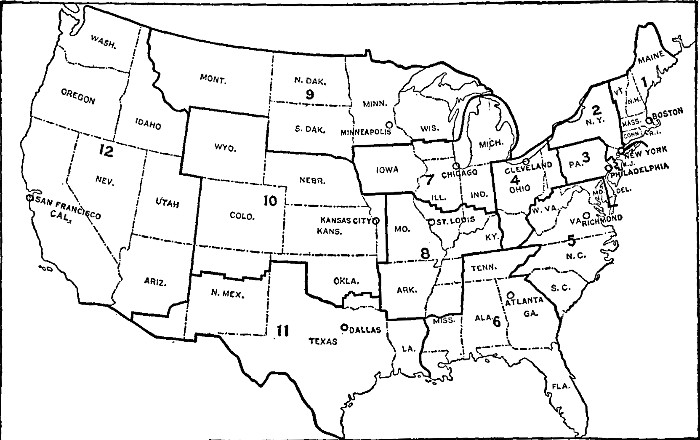
The power of the Federal Reserve Board to restrain the Reserve Banks is vastly greater than its power to force them to take positive action which might lead to the inflation of credit. This was clearly the purpose in view in giving the Board the more important of its many powers. It may, for example, reject applications of Reserve Banks for notes, but this will not endanger assets, it will simply lessen power to expand operations. Its power over the discount rates of Reserve Banks will obviously be more effective when used to advance rates which it deems too low than it will be if used to enforce a rate lower than the management approves. The directors of the Reserve Bank would still determine the amount of accommodation which it might safely grant to member banks at the enforced low rate. Officers and directors of Reserve Banks may be removed at any time by the Federal Board, which is merely required to communicate its reasons for removal in writing; but the right of member banks to choose successors will still remain.
While it is impossible to make any prediction as to the relative place which the Reserve Bank directors and the Federal Board will hold, it is evident that, in the absence of harmonious co-operation, the system will not work smoothly, even if it can be made to work at all. If all the Reserve Banks and the Federal Board adopt a wise and conservative policy, the system will surely work well. If the Reserve Banks alone are conservative, the system may work well but with much friction. If the Federal Board alone is conservative, it may force good results from the system. On the other hand, if some of the Reserve Banks and the Federal Board are reckless, the system will probably break down; and if all the Reserve Banks and the Federal Board adopt a reckless policy, the results will be disastrous.
Both the directors of Reserve Banks, and the Federal Board will be confronted with numerous problems, many novel and some intricate. The possibilities of the new system cannot be foreseen, and the extent and nature of the responsibilities resting upon the Reserve Banks cannot be determined beforehand....
The Federal Reserve Act—an Experiment
[295]Banking is the most delicate and sensitive of all businesses in which men engage. It goes without saying that it is a business in which the law maker should not needlessly interfere. Perhaps some of you may not know that modern banking is a product of evolution. In this respect it is like all great human institutions. No language worth while was ever invented by a human being. Speech, with all its intricacies and inconsistencies of grammar and syntax, was not planned by some master mind centuries ago, but is the result of countless ages of effort on the part of the human animal, guided only by his sub-conscious intelligence—that which we call instinct in the lower animals—to give expression to his emotions and his more or less hazy concepts. Language, like the comb in which the bee stores its honey, has come to us as the product of the labor of our ancestors through many millions of years. Money, credit, and banking are in like manner evolutionary products. If we attempt to tinker with them artificially without regard to the lessons of experience and in disregard of the forces of evolution, believing that our reason transcends the consolidated experience of our ancestry, we shall meet the fate that we deserve, the fate of the conceited bee who thinks he can improve the honey comb, or of the conceited grammarian who would make me walk a literary Bridge of Sighs for saying "it is me."...
I am quite willing to admit that in some of its details the Federal Reserve Act[296] has taken leaves from the experience of banking institutions of this and other countries, but in its essentials, in its anatomy, in its bony structure as it has been called, it is an animal absolutely unknown to the natural history of finance. Let me briefly call attention to the following novelties in banking:
First. It provides for a system of twelve competing banking institutions which shall control the currency supply of this country, and over which there shall be no controlling body with power sufficient to compel them to regard the national welfare in the issue of currency and in the extension of their credit. It is taken for granted that the financial welfare of the people will be safe provided that these competing regional banks are required to hold gold or lawful money reserves of 35 per cent. against deposits and 40 per cent. gold (free from tax) against notes, and are not permitted to issue notes except upon deposit of good commercial paper.[297]
Second. The act provides that the Federal Reserve Banks shall have the right to deal only with banks, nay more, they may deal only with such banks as have contributed to their capital stock. This again is a novelty in the banking world. If these banks are to be in touch with all American business and industry and be powerful agents for the prevention and alleviation of panic, why should they be thus restricted in their operations?
Third. The capital of these regional banks is not a matter of voluntary subscription. It is not founded on business principles. The framers of the measure seemed to fear lest the banks they were planning might not prove profitable investments, hence, they have provided that our national banks must subscribe the necessary capital or forfeit their charters. No country on this green and prosperous earth has ever found it necessary to resort to such undemocratic compulsion in order to persuade people to go into the profitable business of banking.
Fourth. The bank notes issued by these Federal Reserve Banks are called government obligations and must be redeemed on demand by the United States Treasury. In no country will you find that any such bank note has ever been issued or even proposed, and I submit that in the United States, whose people for half a century have confessedly been subject to periods of anxiety and distress and panic because of the Government's liability for the daily redemption of paper money, this provision of the Federal Reserve Act is amazing, inexplicable, and indefensible. The United States Treasury is not a bank and is not made one by this act. It cannot control the issue of the notes, nor the credit operations of the banks who do issue them. Why then should the treasury be compelled to redeem these notes?
Fifth. The Federal Reserve Act provides for an arbitrary shifting of bank reserves such as has never been attempted before. Nobody can foretell what the result will be, but we know nothing of the sort has ever been attempted before and we also know that many banks will be obliged to reduce their loans and discounts, and that their customers, the business men of the country, may suffer serious losses in consequence.
The United States has tried many financial experiments—indeed, our present national banking system was an experiment in finance and has been found wanting—but the Federal Reserve Act, if it could be put on exhibition in a world's financial museum, would, I feel sure, be voted the newest and most spectacular thing we have yet constructed.
The Federal Reserve Act and Democracy in Banking
[298]Beneath his skin every American citizen of every station and avocation, and whatever party name he may wear, is a Democrat in all the essentials and fundamentals. That is, he is attached passionately to the principles of local self-government, of the widest individual liberty compatible with the general weal and order of society. This new currency measure is democratic essentially. It looks to decentralisation of direct financial control, to financial local self-government, so far as is consistent with stability and the general safety; to a currency which will be worth its face value everywhere, which will be based on the actual values it purports to represent, as well as the faith and credit of the General Government, and which yet will be elastic, expanding to meet needs where and when they develop, receding when not needed; a system fitted to meet any emergency, moving smoothly and noiselessly for the ordinary uses of business in tranquil times.
Too much money and too little money are alike evil and dangerous. Opinions differ as to which is the worse. Probably one is as bad as the other. The design of the new law is to supply just enough money or credit, when and where business needs it, to create for our commerce, as has been said, foundations so even, so broadly laid, and so deeply planted that they can not be shaken.
As it is, the country bleeds and sweats to the big financial centres. Take the South as an instance—and the conditions with which you here in North Carolina are familiar exist everywhere in the country. Most of our railway systems are controlled frequently through the trust known as the voting trust—by men who are interested in the great banks in the three central reserve cities. So it happens that the large deposits of the railways, their collections from the Southern people, as also from the Western people, are sent on largely to those banks. The same is true of the telegraph and telephone companies, the life and fire insurance companies, and of many of the larger manufacturing enterprises. The merchants and manufacturers of North Carolina pay their freight bills to the railways. The money goes largely and promptly to New York, and is lent out and used there in stock-market operations, or as the directors of the banks, who are also often the directors of the roads and other corporations, may elect. Of course there is no law which provides for the carrying of the reserves and bank balances of railways and industrial corporations in the central reserve cities, where the national banks of the country have also been accustomed to keep their reserves.
When North Carolina needs money to move the cotton crop her banks must call on New York for money which should be in their own vaults; for the return of money paid in here in freight bills, insurance premiums, and otherwise; and your banks sometimes think themselves lucky if they can be allowed the use of any part of it....
It is not hard to see how centralization of financial resources and money supply and concentration of financial power has been forced, and the invisible and irresponsible despotism created by acts of Congress and policies of government made necessary by those acts.
Now, we do not propose to use violence to force disintegration and decentralization, to do anything with a jolt and a jerk. It is understood clearly that to rush headlong and at full speed over an evil or an obstacle may cause derailment or jarring, uncomfortable and bad for passengers. The thought or plan, as I understand it, is to invite decentralization, to encourage it, to give opportunity for it, to make local self-government possible, to remove the influences which draw to a few centres the money that is paid out to the corporations and deposited in the local banks....
The law does not require a single business man to change his account from the bank with which he has kept it or any business man or bank to suspend dealings with the bank or banks in the central reserve or reserve cities with which they have in the past been doing business. It does offer to banks freedom of choice. It says to the banker that he can follow his preferences, sentiments, or habit in selecting the source of his borrowing; and the member banker of any federal reserve district may feel free and peaceful and at ease when he knows that he has in his portfolio notes, drafts, and bills of exchange arising out of actual commercial transactions, which he can convert into money at his federal reserve bank with greater ease and promptness than it has sometimes been possible for him to withdraw his cash balances from his reserve agents and almost with as much ease as it has ever been possible to draw on credit balances with any correspondent. He is not dependent on the whims or fortunes of any other bank. He need not shiver at the prospect of abundant crops for fear he may not have available the funds with which to meet demands for moving them. He will know that if he needs money to accommodate the bank's customers he can, as a matter of right, call on his federal reserve bank.
Among other benefits the new currency law, by its direct system of clearances, will release and make available for purposes of trade and commerce hundreds of millions of dollars which under the old system have been tied up in tedious processes of collection. It will also save to banks and to merchants and business men generally some millions of dollars which they are now paying, directly and indirectly, for the collection of country checks and checks on outside cities.
To refer more particularly to your own district, the fifth, I will try to explain to you how the new method will work in transactions of domestic exchange.
In this district, embracing the States of North and South Carolina, Virginia, West Virginia (except four counties), the District of Columbia, and Maryland, there are some 475 member banks.
A cotton mill at Columbia, S. C., under the old plan sends its check on its Columbia bank for a shipment of coal to the coal company at Bluefield, W. Va. The local bank at Bluefield forwards this check to its correspondent in Richmond. This correspondent sends the check to its own correspondent in Columbia, who makes the collection from the Columbia bank and then draws a check on New York for New York exchange, which it remits to Richmond. The Richmond bank thereupon notifies the Bluefield bank of the collection of the item. The collection and exchange charges on distant country banks amount usually to from one-tenth to one-fourth of 1 per cent., or possibly more, and probably a week or more elapses between the remittance of the South Carolina check to the Bluefield bank and the time when the Bluefield bank gets its report that the item has been collected and placed to its credit in Richmond.
Under the new currency act "every Federal Reserve Bank shall receive on deposit at par from member banks ... checks and drafts drawn upon any of its depositors." That means that the Bluefield bank receiving the check on the Columbia, S. C., bank mails it to the federal reserve bank at Richmond. The federal reserve bank at Richmond thereupon charges the Columbia bank with the amount of the check, credits the Bluefield bank with the proceeds, and notifies the two banks accordingly.
The Federal Reserve Act also provides that each federal reserve bank shall receive at par, and credit accordingly, all checks and drafts drawn upon any of its member banks, from every other federal reserve bank; that all checks and drafts drawn by any depositor—that is to say, by any member bank—on any federal reserve bank shall be received and credited at par by every other federal reserve bank. This means that the checks of the member banks in the country towns throughout these five States are worth their full face value, without deduction for exchange or collection charges, to every other member bank, and that the amount of each check may be cashed at par immediately, without following the devious and roundabout courses now observed in the collection of checks. Virtually every bank in the fifth district is only one night distant from Richmond, and a check mailed one afternoon in the most distant portions of the district should reach Richmond the following day in time to be included in that day's operations of the federal reserve bank.
Let us now consider another aspect of the new law: Under the old National Bank Act a national bank with a capital of, say, $200,000, deposits of, say, $1,500,000, bills receivable amounting to $1,200,000, and $300,000 reserve, would only be permitted to borrow a total of $200,000, the amount of its capital. If a run should start on such a bank, the amount which it could raise by loans, if strictly held to the old law, would be but $200,000, the amount of its capital, which might be quite inadequate to meet a run, and the bank, though thoroughly solvent, might be forced to suspend.
Under the new law, however, if a bank with $200,000 capital and deposits of $1,500,000 should have loaned $1,200,000 to its customers on commercial paper and should encounter an unexpected run, in addition to borrowing $200,000, the amount of its capital, such a bank would have authority to rediscount with the federal reserve bank of which it is a member, notes, drafts, and bills of exchange issued or drawn for agricultural, industrial, or commercial purposes, having not more than ninety days to run, to any reasonable extent which may be approved by the federal reserve bank to which application for such rediscounts may be made....
We can not overestimate the value of the additional security which this provision of the act confers upon every honestly, capably managed member bank, and the relief from strain and anxiety and from the fear and apprehension of panics and unreasoning runs which it gives to the officers of every member bank.
Another important change provided by the Federal Reserve Act is the new arrangement for the compensation of national bank examiners. Under the present law the compensation of national bank examiners is based, except as to reserve cities, on the capital stock of the bank examined. Under the operations of this law a national bank examiner has been receiving for the examination of a certain national bank in the fifth district, with over $9,000,000 of assets and many thousands of accounts, the munificent sum of $25. It is, of course, clear that an examiner could make only an imperfect examination of such a bank in the space of three days at a compensation of, say, $8 per day, out of which $8 allowance he has to pay his own railroad fare, hotel expenses, as well as clerical assistance. It is not unnatural that but few examiners would willingly spend the ten days or two weeks which it might require to make a thorough examination of such a bank when he is running personally in debt in doing so.
Under the new currency law the Federal Reserve Board, upon the recommendation of the Comptroller of the Currency, is given authority to fix the compensation of bank examiners on the basis of annual salary, so that those banks which need additional time and attention from the examiner may receive the careful, close scrutiny which the case may call for. It is believed that the new system of bank examinations will reduce materially the number of bank failures and enable the department to check up many abuses and correct many evil situations which in the past have been ignored or glossed over by examiners in their hasty and incomplete investigations.
I thank you, gentlemen, for the opportunity to address you. Approaching the study of this new and revolutionary measure with the caution natural to every man trained in banking under the system with which we have grown up, I have become more thoroughly aroused to its merits and more deeply impressed as I have watched the methods of construction, the processes of growth, and have considered the underlying principles directing those who did the work.
The Elasticity of Note Issue Under the New Currency Law[299]
To anyone who has been interested in currency reform for, say, twenty years, probably nothing is more striking than the change in emphasis which has taken place among the advocates of reform during this period. The typical reform plan of the earlier time, for example the so-called Baltimore plan brought forward in 1894, devoted itself almost exclusively to providing a thoroughly elastic note issue, based on ordinary assets. In contrast, the new law has as its central, primary object the organization into at least regional unity of something like the entire banking system of the country. Doubtless this difference in the two reform plans was not altogether due to a fundamental difference of opinion with respect to what would be the ideal scheme. The reformers of the earlier period were not indifferent to the need for centralized organization in the banking system. But they considered any scheme involving a central bank, like the old Bank of the United States, quite chimerical; and they were probably right. But times change; and men change with them. For one reason or another we have all become more tolerant of centralization in business matters, as also more tolerant of that increase in governmental control which increased centralization in business seems to make necessary. With at least fairly general approval, a system of regional organization has been set up, involving a very high degree of centralization and a very high degree of governmental control. But with this change in the method of reform, it became inevitable that the more important ends which earlier schemes sought to accomplish by giving the note a high degree of elasticity should be, in no small measure, attained by other means. In consequence, the need for elasticity in the note issue will be much diminished under the new law. Nevertheless, it is admitted that this need will not disappear altogether. Elasticity in the note issue will be wanted partly to assist in utilizing the newer methods of dealing with the difficulties involved and partly to supplement those newer methods. Accordingly, the question "How far does the note issue under the new system seem likely to prove an elastic one?" is still important.
From the beginnings of agitation for currency reform the advocates of elasticity have recognized more or less clearly two kinds: (1) what we may call seasonal or ordinary elasticity, and (2) what we may call emergency elasticity. By the former was meant the power of a note issue to adjust its volume to those moderate changes in the need for money which show themselves in the course of an ordinary year. By emergency elasticity was meant the power of a note issue to adjust its volume to those extraordinary changes in need which connect themselves with the typical banking panic. The evils which it was believed that seasonal or ordinary elasticity would remedy were principally (1) the summer shortage of currency for moving crops, together with the temporary but more or less serious stringency in the New York money market which accompanies that shortage, and (2) the plethora or excess of currency which usually appears three or four months after the crop-moving period has terminated. The evils which emergency elasticity was expected to relieve were principally (1) the stringency which precipitates the panic, (2) the money famine consequent on general bank suspension after the panic has fully developed, and (3) the glut of currency which attends the depression following a panic, often leading to excessive exports of gold and thus endangering the whole credit system of the country.
Let us, now, take up seasonal or ordinary elasticity, and ask ourselves whether the new notes are likely to possess this characteristic. First, how about the expansibility needed to supply adequate funds for crop-moving? At this point, it must at once be admitted that the new currency does not meet the demands of the case in quite the thoroughgoing way which the earlier schemes thought to be necessary. The ideal of the earlier plans was to provide an adequate and easily utilized power of issue, located at the very place where the need for expansion is felt, i. e., in the local bank. The new law gives up this idea entirely. The local bank will not have power to issue the new currency at all. In so far as its customers are to get any benefit from that currency the benefit must come through two channels which the country bank could use in getting the needed funds, even if the currency had no expansibility, namely, (1) calling in its balances kept with banks more centrally situated, and (2) borrowing from such central banks. In other words, the new power of issue will help out in the crop-moving period merely because it will put the reserve banks in a better position to respond to the call of the country banks for the return of their own balances and for advances on discounted paper. Judged from this point of view only, the elasticity provided by the new law is doubtless adequate. If the reserve banks have not kept themselves in a position to meet the calls of their country members from money already in possession, they will surely be able to put themselves into such a position by expanding their issue of notes. In one sense, then, the new issue has adequate expansibility for ordinary needs. There still perhaps remains a doubt whether effective elasticity is after all assured, for it is not clear that the country bank which needs money for crop-moving purposes will have the wherewithal to get advances from the reserve bank—that is, that it will have paper of the proper kind and in sufficient amount for rediscount. However, it seems probable that the act as finally passed has met this need by providing that agricultural paper shall be admitted on rather more liberal terms than paper arising out of ordinary commercial or manufacturing business. If this be so, it would seem that the provisions of the new law for securing one phase of seasonal elasticity—expansibility—are fairly adequate.
Passing, now, to the other side of elasticity—i.e., contractility—can we say as much? Will the new issues promptly retire when their special task is over? Prima facie, the verdict here is less favorable than in the previous case. In general, there are two principal processes by which a note circulation may be contracted: (1) driving the notes out of circulation, and (2) drawing them out. In so far as the former process is depended upon, means are devised to make sure that the notes shall persistently return to the issuer even against his will—they shall have good homing power. By the second process, it is made to the advantage of the issuer of the notes to hasten their withdrawal himself.
As respects insuring contractility by the former of these processes, the act certainly cannot claim to promise high efficiency. The driving-out process requires roughly the fulfilment of two conditions: (1) keeping the channels for the return of notes to the issuer fairly open, and (2) supplying outsiders with a motive for sending the notes home. As regards the former of these conditions, the new system probably is all right. The return of the notes to the issuer seems not to be impeded by the inconvenience or expensiveness of the process. All member banks and all reserve banks must receive these notes; and the reserve banks will probably have branches within easy reach of any part of the district. Hence, any holder desiring to get notes back to the issuing bank will find the process easy and the way open. But good homing power requires more than this. It requires, namely, that adequate motives be supplied to people generally, or, at least, to banks generally, for seeing that the notes get back. It is not enough that the track be smooth; people must desire to use it. Now, earlier plans for securing elasticity relied on two principal motives for inducing holders to send notes back to the issuer: (1) the desire of such holders to make room for their own notes, and (2) their desire to exchange money which has various limitations imposed upon it for money which is free from those limitations. It is plain that the new system makes only a limited use of the former of these methods of procedure. Within the district for which any particular reserve bank is the central bank, this particular force will be practically inoperative; for the power to issue notes on the basis of common assets is not given to any but the reserve banks, and the profitableness of the power to issue the old type of note has always proved too low to induce banks generally to take much trouble to get their own notes into circulation. As between the reserve banks of the different districts, however, this particular motive will, of course, be more or less in evidence, since these reserve banks will all be competitors for this opportunity. But even here the motive in question will not play a large part, since more effective means for insuring the return of the notes from outside reserve banks are provided in other parts of the law.
As regards the second motive for returning idle notes—that is, the desire to exchange a money subject to various limitations or disabilities for one not subject to those limitations—the new act does somewhat better than it does in respect to the first motive. It is, indeed, true that, within their own district, no special disability, like being forbidden to be paid out by other banks, is put on the new notes. But they are always subject to the disability of not being legal reserve money in the case of federal banks; and hence such banks will be more or less disposed to return the notes issued by their own reserve banks, in order to exchange them for reserve money. It may be doubted, however, whether in ordinary times this will prove a very potent force, since country banks will usually keep reserves considerably in excess of legal requirements, and so will not need to discriminate nicely between the two sorts of money. As between different districts, the case for the homing power of the new notes is rather stronger, since reserve banks are prohibited from paying out the notes of other reserve banks under penalty of a 10 per cent. tax. Even here, however, the provisions are none too adequate. While the notes of a particular reserve bank must not be paid out by the reserve banks of other districts, there is no prohibition against their being paid out by the member banks of other districts; and it is doubtful whether there is sufficient motive to induce said member banks of other districts to send in these notes to their own reserve banks and so start them on their homeward journey. The desire to exchange money which cannot be used as reserve for that which can be would have some force; but, under many circumstances, it would probably prove rather inadequate.