PREFACE
Reading edition
Nearly a century ago, James Boswell made an expedition to Corsica, and was entertained with distinction by Pascal Paoli. Next to conducting Samuel Johnson to the Hebrides, the exploit of penetrating to what was then considered a sort of Ultima Thule in southern Europe, was the greatest event in the famous biographer's life; and, next to his devotion to the English sage, was the homage he paid to the Corsican chief.
Soon after his return from this expedition, in 1767, Boswell printed his Journal, with a valuable account of the island; but from that time to the present, no Englishman has written on Corsica except Mr. Robert Benson, who published some short “Sketches” of its history, scenery, and people in 1825. During the war of the revolution, Nelson's squadron hung like a thunder-cloud round the coast, and for some time an expeditionary force of British troops held possession of the island. Our George the Third accepted the Corsican crown, but his reign was as ephemeral as that of King Theodore, the aspiring adventurer, who ended his days in the Fleet Prison.
These occurrences, with any knowledge of the country and people arising out of them, have passed from the memory of the present generation; and it may be affirmed, without exaggeration, that when the tour forming the subject of the present work was projected and carried out, Corsica was less known in England than New Zealand. The general impression concerning it was tolerably correct. Imagination painted it as a wild and romantic country,—romantic in its scenery and the character of its inhabitants; a very region of romance and sentiment; a fine field for the novelist and the dramatist; and to that class of writers it was abandoned.
Corsica had yet to be faithfully pictured to the just apprehension of the discerning inquirer. Naturally therefore the author, whose narratives of his wanderings in more than one quarter of the globe had been favourably received, was not indisposed to commit to the press the result of his observations during his Corsican rambles. Just then, translations of an account of a Tour in the island by a German traveller, appeared in England, and being written in an attractive style, the work commanded considerable attention. It seemed to fill the gap in English literature on the subject of Corsica; and though the writer of these pages felt that M. Gregorovius' pictures of Corsican life were too highly coloured, he was inclined to leave the field in the hands which had cultivated it with talent and success. Eventually, however, being led to think that Corsica was still open to survey from an English point of view, and that it possessed sufficient legitimate attractions to sustain the interest of such a work as he had designed, the author was induced to undertake it.
If the field of literature connected with Corsica was found barren when examined in prospect of this expedition, that of Sardinia presented an embarras de richesses. The works of La Marmora, Captain, now Admiral, Smyth, and Mr. Warre Tyndale, had seemingly exhausted the subject, with a success the mere Rambler can make no pretensions to rival; but the former being a foreign work, and the two latter out of print, neither of them is easily accessible. They have been sometimes used, in the following pages, to throw light on subjects which came under the author's own observation. He has also consulted a valuable work, recently published at Naples, by F. Antonio Bresciani, of the Society of Jesus[1], on the manners and habits of the Sardes compared with those of the oldest Oriental nations. The comparisons are chiefly gathered from scenes and usages depicted in the narratives of Homer and the Bible, still singularly reflected in the habits and traditions of the primitive and insular people of Sardinia.
Some of these are noticed in the present volume, and the author intended to draw more largely on the rich stores accumulated by the researches of the learned Jesuit; but time and space failed. Like truant boys, the Ramblers had loitered on their early path, idly amusing themselves with very trifles, or stopping to gather the wild flowers that fell in their way, till the harvest-field was reached too late to be carefully gleaned. For a work, however, of this description, attention enough has perhaps been paid to the subject of Sarde antiquities; it being intended to be amusing as well as instructive, to convey information on the character of the people on whom it treats, as well as on their institutions and monuments.
If, in conclusion, it be mentioned that the delay in bringing out the volume, long since announced, has been caused by ill health and other painful circumstances, the Author is only anxious that it should not be misinterpreted, as attaching to the work an importance to which it does not pretend. But there is the less reason for regretting this delay, as it has afforded him another opportunity of visiting Sardinia, as well as of witnessing the operation of laying down the submarine electric telegraph cable between Cagliari and the African coast; an event in Sardinian history, some notice of which, with the accompanying trip to Algeria, may form a not uninteresting episode to the Rambles in that island.
May, 1858.
CONTENTS.
CHAPTER I.
Inducements to the Expedition.—Early impressions concerning Corsica.—Plan of the Tour.—Routes to Marseilles.—Meeting therePage 1
CHAP. II.
Marseilles.—Cafe de l'Orient.—Cannebière and Port.—Sail to the Islands in the Gulf.—The Château-d'If and Count de Monte-Cristo.—A sudden Squall 8
CHAP. III.
Embark for Corsica.—Coast of France and Italy.—Toulon.—Hyères Islands, Frejus, &c.—A stormy Night.—Crossing the Tuscan Sea 21
CHAP. IV.
Coast of Capo Corso.—Peculiarity of Scenery.—Verdure, and Mountain Villages.—Il Torre di Seneca.—Land at Bastia 28
CHAP. V.
Bastia.—Territorial Divisions.—Plan of the Rambles.—Hiring Mules.—The Start38
CHAP. VI.
Leave Bastia.—The Road.—View of Elba, Pianosa, and Monte-Cristo.—The Littorale.—An Adventure.—The Stagna di Biguglia44
CHAP. VII.
Evergreen Thickets.—Their remarkable Character.—A fortunate Rencontre.—Moonlight in the Mountains.—Cross a high Col.—Corsican Shepherds.—The Vendetta.—Village Quarters 53
CHAP. VIII.
The Littorale.—Corsican Agriculture.—Greek and Roman Colonies.—Sketch of Mediæval and Modern History.—Memoirs of King Theodore de Neuhoff65
CHAP. IX.
Environs of Olmeta.—Bandit-Life and the Vendetta.—Its Atrocities.—The Population disarmed.—The Bandits exterminated 77
CHAP. X.
The Basin of Oletta.—The Olive.—Corsican Tales.—The Heroine of Oletta.—Zones of Climate and Vegetation90
CHAP. XI.
Pisan Church at Murato.—Chestnut Woods.—Gulf of San Fiorenzo.—Nelson's Exploit there.—He conducts the Siege of Bastia.—Ilex Woods.—Mountain Pastures.—The Corsican Shepherd 102
CHAP. XII.
Chain of the Serra di Tenda.—A Night at Bigorno.—A hospitable Priest.—Descent to the Golo117
CHAP. XIII.
Ponte Nuovo.—The Battle-field.—Antoine's Story129
CHAP. XIV.
Filial Duty, Love, and Revenge: a Corsican Tale134
CHAP. XV.
Morosaglia, Seat of the Paolis.—Higher Valley of the Golo.—Orography of Corsica.—Its Geology145
CHAP. XVI.
Approach to Corte.—Our “Man of the Woods.”—Casa Paoli.—The Gaffori.—Citadel.—An Evening Stroll156
CHAP. XVII.
Pascal Paoli more honoured than Napoleon Buonaparte.—His Memoirs.—George III. King of Corsica.—Remarks on the Union.—Paoli's Death and Tomb164
CHAP. XVIII.
Excursion to a Forest.—Borders of the Niolo.—Adventures.—Corsican Pines.—The Pinus Maritima and Pinus Lariccio.—Government Forests179
CHAP. XIX.
The Forest of Asco.—Corsican Beasts of Chase.—The Moufflon.—Increase of Wild Animals.—The last of the Banditti 191
CHAP. XX.
Leave Corte for Ajaccio.—A Legend of Venaco.—Arrival at Vivario200
CHAP. XXI.
Leave Vivario.—Forest of Vizzavona.—A roadside Adventure.—Bocagnono.—Arrive late at Ajaccio205
CHAP. XXII.
Ajaccio.—Collège-Fesch.—Reminiscences of the Buonaparte Family.—Excursion in the Gulf.—Chapel of the Greeks.—Evening Scenes.—Council-General of the Department.—Statistics.—State of Agriculture in Corsica.—Her Prospects213
CHAP. XXIII.
Leave Ajaccio.—Neighbourhood of Olmeto.—Sollacaró.—James Boswell's Residence there.—Scene in the “Corsican Brothers” laid there.—Quarrel of the Vincenti and Grimaldi.—Road to Sartene.—Corsican Marbles.—Arrive at Bonifacio227
CHAP. XXIV.
Bonifacio.—Foundation and History.—Besieged by Alfonso of Arragon.—By Dragut and the Turks.—Singularity of the Place.—Its Medieval Aspect.—The Post-office.—Passports.—Detention.—Marine Grottoes.—Ruined Convent of St. Julian242
CHAP. XXV.
Island of Sardinia.—Cross the Straits of Bonifacio.—The Town and Harbour of La Madelena.—Agincourt Sound, the Station of the British Fleet in 1803.—Anecdotes of Nelson.—Napoleon Bonaparte repulsed at La Madelena258
CHAP. XXVI.
Ferried over to the Main Island.—Start for the Mountain Passes of the Gallura.—Sarde Horses and Cavallante.—Valley of the Liscia.—Pass some Holy Places on the Hills.—Festivals held there.—Usages of the Sardes indicating their Eastern Origin 272
CHAP. XXVII.
The Valley narrows.—Romantic Glen.—Al fresco Meal.—Forest of Cork Trees.—Salvator Rosa Scenery.—Haunts of Outlaws.—Their Atrocities.—Anecdotes of them in a better Spirit.—The Defile in the Mountains.—Elevated Plateau.—A Night March.—Arrival at Tempio, the Capital of Gallura.—Our Reception280
CHAP. XXVIII.
Tempio.—The Town and Environs.—The Limbara Mountains.—Vineyards.—The Governor or Intendente of the Province.—Deadly Feuds.—Sarde Girls at the Fountains.—Hunting in Sardinia.—Singular Conference with the Tempiese Hunters.—Society at the Casino.—Description of a Boar Hunt295
CHAP. XXIX.
Leave Tempio.—Sunrise.—Light Wreaths of Mist across the Valley.—A Pass of the Limbara.—View from the Summit.—Dense Vapour over the Plain beneath.—The Lowlands unhealthy.—The deadly Intempérie.—It recently carried off an English Traveller.—Descend a romantic Glen to the Level of the Campidano.—Its peculiar Character.—Gallop over it.—Reach Ozieri310
CHAP. XXX.
Effects of vast Levels as compared with Mountain Scenery.—Sketches of Sardinian Geology.—The primitive Chains and other Formations.—Traces of extensive Volcanic action.—The “Campidani,” or Plains.—Mineral Products 320
CHAP. XXXI.
Ozieri.—A Refugee Colonel turned Cook and Traiteur.—Traces of Phenician Superstitions in Sarde Usages.—The Rites of Adonis.—Passing through the Fire to Moloch331
CHAP. XXXII.
Expedition to the Mountains.—Environs of Ozieri.—First View of the Peaks of Genargentu.—Forests.—Value of the Oak Timber.—Cork Trees; their Produce, and Statistics of the Trade.—Hunting the Wild Boar, &c.—The Hunters' Feast.—A Bivouac in the Woods.—Notices of the Province of Barbagia.—Independence of the Mountaineers344
CHAP. XXXIII.
Leave Ozieri.—The New Road, and Travelling in the Campagna.—Monte Santo.—Scenes at the Halfway House.—Volcanic Hills.—Sassari; its History.—Liberal Opinions of the Sassarese.—Constitutional Government.—Reforms wanted in Sardinia.—Means for its Improvement358
CHAP. XXXIV.
Alghero—Notice of.—The Cathedral of Sassari.—University.—Museum.—A Student's private Cabinet.—Excursion to a Nuraghe.—Description of.—Remarks on the Origin and Design of these Structures376
CHAP. XXXV.
Sardinian Monoliths.—The Sepolture, or “Tombs of the Giants.”—Traditions regarding Giant Races.—The Anakim, &c., of Canaan.—Their supposed Migration to Sardinia.—Remarks on Aboriginal Races.—Antiquity of the Nuraghe and Sepolture.—Their Founders unknown389
CHAP. XXXVI.
Oristano.—Orange-groves of Milis.—Cagliari.—Description of.—The Cathedral and Churches.—Religious Laxity.—Ecclesiastical Statistics.—Vegetable and Fruit Market.—Royal Museum.—Antiquities.—Coins found in Sardinia.—Phenician Remains.—The Sarde Idols407
CHAP. XXXVII.
Porto-Torres.—Another Italian Refugee.—Embark for Genoa.—West Coast of Corsica.—Turin.—The Sardinian Electric Telegraph.—The Wires laid to Cagliari422
CHAP. XXXVIII.
Sardinian Electric Telegraph.—The Land Line completed.—Failures in Attempts to lay a Submarine Cable to Algeria.—The Work resumed.—A Trip to Bona on the African Coast.—The Cable laid.—Importance of Cagliari as a Telegraph Station.—Its Commerce.—The return Voyage.—Conclusion 432
INDEX TO THE ILLUSTRATIONS.
LITHOGRAPHS.
AJACCIOfrontispiece
MAP OF CORSICA AND SARDINIAfacing p. 1
ERSA, CAPO CORSO“ 33
CORTE“ 157
VIVARIO“ 205
BONIFACIO“ 242
VALLEY OF THE LISCIA, SARDINIA“ 275
THE LIMBARA, FROM TEMPIO“ 296
THE PLAN OF OZIERI“ 318
WOOD ENGRAVINGS.
CORSICA.
MARSEILLES, FROM THE RAILWAY7
ISLETS OFF MARSEILLES12
CHÂTEAU-D'IF14
MARSEILLES, FROM THE CHÂTEAU-D'IF17
FRENCH COAST, OFF CIOTAT23
OFF TOULON24
IL TORRE DI SENECA34
ISLE OF MONTE-CRISTO47
MEETING OF MOUNTAIN AND PLAIN NEAR BASTIA48
OLMETA77
ISLE OF MONTE-CRISTO, THROUGH A GORGE91
BETWEEN OLMETA AND BIGORNO95
PONTE MURATO103
CAPO CORSO, FROM CHESTNUT WOODS107
NEAR BIGORNO122
CITADEL OF CORTE161
PINUS MARITIMA185
PINUS LARICCIO185
CONE OF THE PINUS LARICCIO186
BARK OF THE PINUS LARICCIO186
BOCAGNONO209
HARBOUR OF AJACCIO217
BONIFACIO, ON THE SEA-SIDE240
OUTLINE OF SARDINIA, FROM BONIFACIO253
CAVES UNDER BONIFACIO255
BONIFACIO, FROM THE CONVENT IN THE VALLEY256
SARDINIA.
LOOKING BACK ON CORSICA259
A SALVATOR ROSA SCENE282
DESCENT TO THE CAMPIDANO313
THE CAMPIDANO321
EXTERIOR OF A NURAGHE379
ENTRANCE TO A NURAGHE381
INTERIOR OF A NURAGHE381
SEPOLTURA DE IS GIGANTES390
THE SAME391
SARDO-ROMAN COIN417
CARTHAGINEAN COIN418
SARACEN COIN418
PORTO-TORRES425
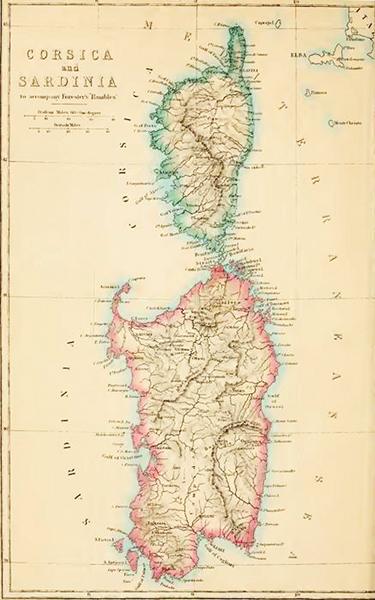
CORSICA and SARDINIA to accompany Forester's “Rambles.”