THE POET’S COUNTERSIGN.
Reading edition
An Ode read by F. B. Sanborn, at the opening of the Concord School, July 17, 1882.
“I grant, sweet soul, thy lovely argument
Deserves the travail of a worthier pen;
Yet what of thee thy poet doth invent,
He robs thee of, and pays it thee again;
He lends thee virtue,—and he stole that word
From thy behavior; beauty doth he give,
And found it on thy cheek; he can afford
No praise to thee but what in thee doth live.”
I.
Across these meadows, o’er the hills,
Beside our sleeping waters, hurrying rills,
Through many a woodland dark, and many a bright arcade,
72Where out and in the shifting sunbeams braid
An Indian mat of checquered light and shade,—
The sister seasons in their maze,
Since last we wakened here
From hot siesta the still drowsy year,
Have led the fourfold dance along our quiet ways,—
Autumn apparelled sadly gay,
Winter’s white furs and shortened day,
Spring’s loitering footstep, quickened at the last,
And half the affluent summer went and came,
As for uncounted years the same—
Ah me! another unreturning spring hath passed.
II.
“When the young die,” the Grecian mourner said,
“The springtime from the year hath vanished;”
The gray-haired poet, in unfailing youth,
Sits by the shrine of Truth,
Her oracles to spell,
And their deep meaning tell;
Or else he chants a bird-like note
73From that thick-bearded throat
Which warbled forth the songs of smooth-cheeked May
Beside Youth’s sunny fountain all the day;
Sweetly the echoes ring
As in the flush of spring;
At last the poet dies,
The sunny fountain dries,—
The oracles are dumb, no more the wood-birds sing.
III.
Homer forsakes the billowy round
Of sailors circling o’er the island-sea;
Pindar, from Theban fountains and the mound
Builded in love and woe by doomed Antigone,
Must pass beneath the ground;
Stout Æschylus that slew the deep-haired Mede
At Marathon, at Salamis, and freed
Athens from Persian thrall,
Then sung the battle call,—
Must yield to that one foe he could not quell;
74In Gela’s flowery plain he slumbers well.[2]
Sicilian roses bloom
Above his nameless tomb;
And there the nightingale doth mourn in vain
For Bion, too, who sung the Dorian strain;
By Arethusa’s tide,
His brother swains might flute in Dorian mood,—
The bird of love in thickets of the wood
Sing for a thousand years his grave beside—
Yet Bion still was mute—the Dorian lay had died.
IV.
The Attic poet at approach of age
Laid by his garland, took the staff and scrip,
For singing robes the mantle of the sage,—
And taught gray wisdom with the same grave lip
That once had carolled gay
Where silver flutes breathed soft and festal harps did play;
75Young Plato sang of love and beauty’s charm,
While he that from Stagira came to hear
In lyric measures bade his princely pupil arm,
And strike the Persian tyrant mute with fear.
High thought doth well accord with melody,
Brave deed with Poesy,
And song is prelude fair to sweet Philosophy.
But wiser English Shakspeare’s noble choice,
Poet and sage at once, whose varied voice
Taught beyond Plato’s ken, yet charming every ear;—
A kindred choice was his, whose spirit hovers here.
V.
Now Avon glides through Severn to the sea,
And murmurs that her Shakspeare sings no more;
Thames bears the freight of many a tribute shore,
But on those banks her poet bold and free,
That stooped in blindness at his humble door,
Yet never bowed to priest or prince the knee,
Wanders no more by those sad sisters led;
76Herbert and Spenser dead
Have left their names alone to him whose scheme
Stiffly endeavors to supplant the dream
Of seer and poet, with mechanic rule
Learned from the chemist’s closet, from the surgeon’s tool.
With us Philosophy still spreads her wing,
And soars to seek Heaven’s King—
Nor creeps through charnels, prying with the glass
That makes the little big,—while gods unseen may pass.
VI.
Along the marge of these slow-gliding streams,
Our winding Concord and the wider flow
Of Charles by Cambridge, walks and dreams
A throng of poets,—tearfully they go;
For each bright river misses from its band
The keenest eye, the truest heart, the surest minstrel hand,—
They sleep each on his wooded hill above the sorrowing land.
77Duly each mound with garlands we adorn
Of violet, lily, laurel, and the flowering thorn,—
Sadly above them wave
The wailing pine-trees of their native strand;
Sadly the distant billows smite the shore,
Plash in the sunlight, or at midnight roar;
All sounds of melody, all things sweet and fair,
On earth, in sea or air,
Droop and grow silent by the poet’s grave.
VII.
Yet wherefore weep? Old age is but a tomb,
A living hearse, slow creeping to the gloom
And utter silence. He from age is freed
Who meets the stroke of Death and rises thence
Victor o’er every woe; his sure defence
Is swift defeat; by that he doth succeed.
Death is the poet’s friend—I speak it sooth;
Death shall restore him to his golden youth,
Unlock for him the portal of renown,
And on Fame’s tablet write his verses down,
78For every age in endless time to read.
With us Death’s quarrel is: he takes away
Joy from our eyes—from this dark world the day—
When other skies he opens to the poet’s ray.
VIII.
Lonely these meadows green,
Silent these warbling woodlands must appear
To us, by whom our poet-sage was seen
Wandering among their beauties, year by year,—
Listening with delicate ear
To each fine note that fell from tree or sky,
Or rose from earth on high:
Glancing that falcon eye,
In kindly radiance as of some young star,
At all the shows of Nature near and far,
Or on the tame procession plodding by,
Of daily toil and care,—and all life’s pageantry;
Then darting forth warm beams of wit and love,
Wide as the sun’s great orbit, and as high above
These paths wherein our lowly tasks we ply.
79IX.
His was the task and his the lordly gift
Our eyes, our hearts, bent earthward, to uplift;
He found us chained in Plato’s fabled cave,
Our faces long averted from the blaze
Of Heaven’s broad light, and idly turned to gaze
On shadows, flitting ceaseless as the wave
That dashes ever idly on some isle enchanted;
By shadows haunted
We sat,—amused in youth, in manhood daunted,
In vacant age forlorn,—then slipped within the grave,
The same dull chain still clasped around our shroud;
These captives, bound and bowed,
He from their dungeon like that angel led
Who softly to imprisoned Peter said,
“Arise up quickly! gird thyself and flee!”
We wist not whose the thrilling voice, we knew our souls were free.
X.
Ah! blest those years of youthful hope,
When every breeze was Zephyr, every morning May!
80Then as we bravely climbed the slope
Of life’s steep mount, we gained a wider scope
At every stair, and could with joy survey
The track beneath us, and the upward way;
Both lay in light—round both the breath of love
Fragrant and warm from Heaven’s own tropic blew;
Beside us what glad comrades smiled and strove!
Beyond us what dim visions rose to view!
With thee, dear Master! through that morning land
We journeyed happy: thine the guiding hand,
Thine the far-looking eye, the dauntless smile;
Thy lofty song of hope did the long march beguile.
XI.
Now scattered wide and lost to loving sight
The gallant train
That heard thy strain;
’Tis May no longer,—shadows of the night
Beset the downward pathway; thou art gone,
And with thee vanished that perpetual dawn
Of which thou wert the harbinger and seer.
Yet courage! comrades,—though no more we hear
Each other’s voices, lost within this cloud
That time and chance about our way have cast,
Still his brave music haunts the hearkening ear,
As ’mid bold cliffs and dewy passes of the Past.
Be that our countersign! for chanting loud
His magic song, though far apart we go,
Best shall we thus discern both friend and foe.
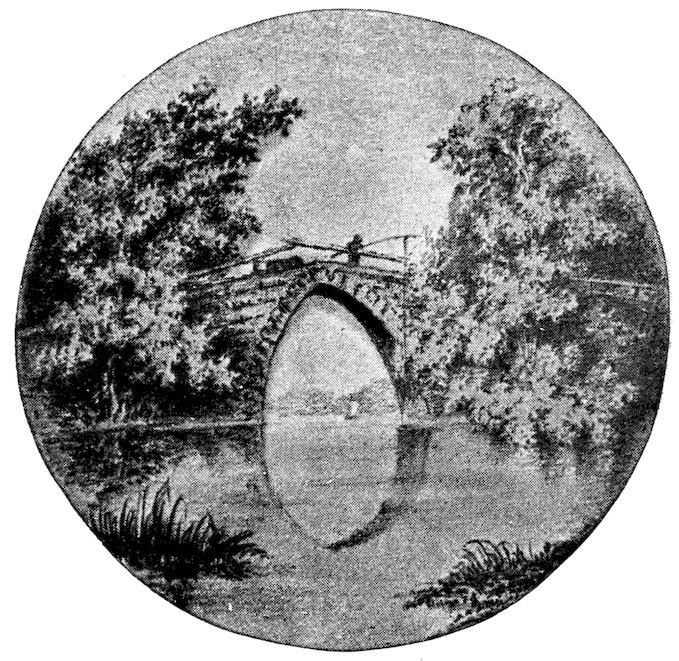
Bridge at Concord.
Recent Publications
OF
Cupples & Hurd,
PUBLISHERS, GENERAL BOOKSELLERS, AND LIBRARY AGENTS,
94 Boylston Street, Boston, Mass.
⁂ Note.—In order to insure the correct delivery of the actual works, or particular Editions specified in this List, the name of the Publishers should be distinctly given. These books can be had from any local bookseller; but should any difficulty be experienced in procuring them, Messrs. Cupples & Hurd will be happy to forward them direct, postage paid, on receipt of cheque, stamps, or Postal order for the amount, with a copy of their complete catalogue.
THE AMERICAN TAUCHNITZ SERIES.
Square 16mo. Paper covers, 50 cents. Cloth, $1.00.
I.
Miss Frances Merley:
A Novel. By John Elliot Curran. 420 pages.
The first important work of an author familiar to American readers by his remarkable sketches to Scribner’s and other magazines.
II.
Autobiography of a New England Farm House:
A Romance of the Cape Cod Lands. By N. H. Chamberlain. 380 pages.
A novel of singular power and beauty, great originality and rugged force. Born and bred on Cape Cod, the author, at the winter firesides of country people, very conservative of ancient English customs now gone, heard curious talk of kings, Puritan ministers, the war and precedent struggle of our Revolution, and touched a race of men and women now passed away. He also heard, chiefly from ancient women, the traditions of ghosts, witches and Indians, as they are preserved, and to a degree believed, by honest Christian folk, in the very teeth of modern progress. These things are embodied in this book.
OTHER VOLUMES OF THIS SERIES IN PREPARATION.
A SUMMER CRUISE ON THE COAST OF NEW ENGLAND. By Robert Carter. With an Introduction by Rossiter Johnson. 12mo. Cloth, with Map. $1.50.
A new edition of one of the most fascinating of salt-water yarns, full of genial humor, vivid word-painting, accurate information, and practical “wrinkles.” A classic by reason of the esteem in which it is held by yachtsmen, and as a literary production equal to anything of the kind in the Anglo-Saxon tongue.
A New Book by W. H. H. Murray.
DAYLIGHT LAND. The experiences, incidents, and adventures, humorous and otherwise, which befell Judge John Doe, Tourist, of San Francisco; Mr. Cephas Pepperell, Capitalist, of Boston; Colonel Goffe, the Man from New Hampshire, and divers others, in their Parlor-Car Excursion over Prairie and Mountain; as recorded and set forth by W. H. H. Murray. Superbly illustrated with 150 cuts in various colors by the best artists.
Contents:—Introduction—The Meeting—A Breakfast—A Very Hopeful Man—The Big Nepigon Trout—The Man in the Velveteen Jacket—The Capitalist—Camp at Rush Lake—Big Game—A Strange Midnight Ride—Banff—Sunday among the Mountains—Nameless Mountains—The Great Glacier—The Hermit of Frazer Cañon—Fish and Fishing in British Columbia—Vancouver City—Parting at Victoria.
8vo. 350 pages. Unique paper covers, $2.50; half leather binding, $3.50.
Mr. Murray has chosen the north-western side of the continent for the scene of this book; a region of country which is little known by the average reader, but which in its scenery, its game, and its vast material and undeveloped resources, supplies the author with a subject which has not been trenched upon even by the magazines, and which he has treated in that lively and spirited manner for which he is especially gifted. The result is a volume full of novel information of the country, humorous and pathetic incidents, vivid descriptions of its magnificent scenery, shrewd forecasts of its future wealth and greatness when developed, illustrated and embellished with such lavishness and artistic elegance as has never before been attempted in any similar work in this country.
ADIRONDACK TALES. By W. H. H. Murray. Illustrated. 12mo. 300 pages. $1.25.
Containing John Norton’s Christmas—Henry Herbert’s Thanksgiving—A Strange Visitor—Lost in the Woods—A Jolly Camp—Was it Suicide?—The Gambler’s Death—The Old Beggar’s Dog—The Ball—Who was he?
Short stories in Mr. Murray’s best vein—humorous; pathetic; full of the spirit of the woods.
HOW DEACON TUBMAN AND PARSON WHITNEY KEPT NEW YEARS, and other Stories. By W. H. H. Murray. 16mo. Illustrated. $1.25.
A HEART REGAINED. By Carmen Sylva (Queen of Roumania). Translated by Mary A. Mitchell. Fcap. 8vo. Cloth. $1.00.
A charming story by this talented authoress, told in her vivid, picturesque manner, and showing how patient waiting attains to ultimate reward.
JOHN BROWN. By Hermann Von Holst, author of “Constitutional History of the United States,” &c., together with an introduction and appendix by Frank P. Stearns, a poem by Mr. Wason, and a letter describing John Brown’s grave. Illustrated. 16mo, gilt top. $1.50.
This book, the author of which is so well known by his “Constitutional History,” and by his biography of John C. Calhoun, cannot fail to be of interest to all students of American history, who appreciate a calm, impartial criticism of a man and an episode which have been universally and powerfully discussed.
MARGARET; and THE SINGER’S STORY. By Effie Douglass Putnam. Daintily bound in white, stamped in gold and color, gilt edges. 16mo. $1.25.
A collection of charming poems, many of which are familiar through the medium of the magazines and newspaper press, with some more ambitious flights, amply fulfilling the promise of the shorter efforts. Tender and pastoral, breathing the simple atmosphere of the fields and woods.
AROUND THE GOLDEN DEEP. A Romance of the Sierras. By A. P. Reeder. 500 pages. 12mo. Cloth. $1.50.
A novel of incident and adventure, depicting with a strong hand the virile life of the mine that gives its name to the story, and contrasting it with the more refined touches of society in the larger cities; well written and interesting.
SIGNOR I. By Salvatore Farina. Translated by the Baroness Langenau. 12mo. Cloth. $1.25.
A dainty story by an Italian author, recalling in the unique handling of its incidents, and in the development of its plot, the delicate charm of “Marjorie Daw.”
MIDNIGHT SUNBEAMS, OR BITS OF TRAVEL THROUGH THE LAND OF THE NORSEMAN. By Edwin Coolidge Kimball. On fine paper, foolscap 8vo, tastefully and strongly bound, with vignette. Cloth. $1.25.
Pronounced by Scandinavians to be accurate in its facts and descriptions, and of great interest to all who intend to travel in or have come from Norway or Sweden.
WOODNOTES IN THE GLOAMING. Poems and Translations by Mary Morgan. Square 16mo. Cloth, full gilt. $1.25.
A collection of poems and sonnets showing great talent, and valuable translations from Gautier, Heine, Uhland, Sully-Prudhomme, Gottschalk, Michael Angelo, and others. Also prose translations from the German, edited and prefaced by Max Müller.
RALPH WALDO EMERSON, Philosopher and Seer. An Estimate of his Character and Genius. By A. Bronson Alcott.
With portraits and other illustrations. Foolscap octavo. Gilt top. $1.50.
One hundred copies will be printed on larger and finer paper, 8vo, suitable for the insertion of extra illustrations. Bound in Roxburgh, gilt top. Price to Subscribers, $3.00.
A book about Emerson, written by the one man who stood nearest to him of all men. It is an original and vital contribution to Emersonia; like a portrait of one of the old masters painted by his own brush.
[In Press.
HERMAN GRIMM’S WORKS.
THE LIFE OF RAPHAEL as shown in his principal works. From the German of Herman Grimm, author of “The Life of Michael Angelo,” etc. With frontispiece, after Braun, of the recently discovered portrait, outlined by Raphael in chalk. Cr. 8vo. Cloth. $2.00.
[Nearly ready.
ESSAYS ON LITERATURE. From the German of Herman Grimm, uniform with “The Life of Raphael.” New and enlarged edition carefully corrected. Cr. 8vo. Cloth. $2.00.
BY JAMES H. STARK.
ANTIQUE VIEWS OF YE TOWNE OF BOSTON. By James H. Stark, Assisted by Dr. Samuel A. Green, Ex-Mayor of Boston, Librarian of the Massachusetts Historical Society; John Ward Dean, Librarian of the New England Historic Genealogical Society; and Judge Mellen Chamberlain, of the Public Library. An extensive and exhaustive work in 378 pages. Large quarto. Illustrated with nearly 200 full size reproductions of all known rare maps, old prints, etc. 1 vol. 4to. Cloth. $6.00.
BERMUDA GUIDE. A description of everything on or about the Bermuda Islands, concerning which the visitor or resident may desire information, including its history, inhabitants, climate, agriculture, geology, government, military and naval establishments. By James H. Stark. With Maps, Engravings and 16 photo-prints. 1 vol. 12mo, cloth, 157 pp. $2.00.
PAUL REVERE: Historical and Legendary. By Elbridge H. Goss. With reproductions of many of Revere’s engravings, etc.
[In press.
A DIRECTORY OF THE CHARITABLE AND BENEFICENT ORGANIZATIONS OF BOSTON, ETC. Prepared for the Associated Charities. 1 vol., 196 pp. 16mo. Cloth, $1.00.
PROF. CLARK MURRAY’S WORKS.
SOLOMON MAIMON: An Autobiography. Translated from the German, with Additions and Notes, by Prof. J. Clark Murray. 1 vol. Cr. 8vo. Cloth. 307 pp. $2.00.
A life which forms one of the most extraordinary biographies in the history of literature.
The London Spectator says: “Dr. Clark Murray has had the rare good fortune of first presenting this singularly vivid book in an English translation as pure and lively as if it were an original, and an original by a classic English writer.”
George Eliot, in “Daniel Deronda,” mentions it as “that wonderful bit of autobiography—the life of the Polish Jew, Solomon Maimon”; and Milman, in his “History of the Jews,” refers to it as a curious and rare book.
HANDBOOK OF PSYCHOLOGY. By Prof. J. Clark Murray, LL.D., Professor of Mental and Moral Philosophy, M’Gill College, Montreal. Cr. 8vo. 2d edition, enlarged and improved. $1.75.
Clearly and simply written, with illustrations so well chosen that the dullest student can scarcely fail to take an interest in the subject.
ADOPTED FOR USE IN COLLEGES IN SCOTLAND, ENGLAND, CANADA, AND THE UNITED STATES.
Prof. Murray’s good fortune in bringing to light the “Maimon Memoirs,” together with the increasing popularity of his “Handbook of Psychology,” has attracted the attention of the intellectual world, giving him a position with the leaders of thought of the present age. His writings are at once original and suggestive.
AALESUND TO TETUAN. By Chas. R. Corning. A Volume of Travel. 12mo, 400 pp. Cloth. $2.00.
[Ready in September.
Table of Contents.—Portsmouth—Isle of Wight—Channel Islands—Normandy—Nice—Monte Carlo—Genoa—Naples and its Environments—Rome—Verona—Venice—Norway—Sweden—St. Petersburg—Moscow—Warsaw—Berlin—Up the Rhine—Barcelona—Valencia—Seville—Cadiz—Morocco—Gibraltar—Granada—Madrid and the Royal Wedding—Bull Fights—Escurial—Biarritz—Bordeaux—Paris.
TAPPY’S CHICKS: or, Links Between Nature and Human Nature. By Mrs. George Cupples. Illustrated. 16mo. Cloth. $1.25.
The tenderness and humor of this volume are simply exquisite.—E. P. Whipple.
The title is altogether too insignificant for so delightful and valuable a work.—Spectator (London).
It is not merely a work of talent, but has repeated strokes of undeniable genius.—George Macdonald.
[In preparation.
THOMAS CARLYLE’S COUNSELS TO A LITERARY ASPIRANT (a Hitherto Unpublished Letter of 1842), and What Came of Them. With a brief estimate of the man. By James Hutchinson Stirling, LL. D. 12mo, boards, 50 cents.
Gives a side of the rugged old Scotchman which will be new to most readers. It shows that he was not always gruff and bearish, and that he could at times think of somebody besides himself. The letter is one which every young man who has a leaning towards literary work will read and ponder over.
SOCIAL LIFE AND LITERATURE FIFTY YEARS AGO. 16mo, cloth, white paper labels, gilt top. $1.00.
By a well-known litterateur. It will take a high place among the literature treating of the period. A quaint and delightful book, exquisitely printed in the Pickering style.
CIVILIZATION IN THE UNITED STATES. By Matthew Arnold. And Other Essays concerning America. 16mo, unique paper boards. 75 cents. Cloth, uncut, $1.25. The cloth binding matches the uniform edition of his collected works.
Comprises the critical essays, which created so much discussion, namely, “General Grant, an Estimate.” “A Word about America,” “A Word more about America,” and “Civilization in the United States.”
⁂ This collection gathers in the great critic’s last contributions to literature.
LEGENDS OF THE RHINE. From the German of Prof. Bernard. Translated by Fr. Arnold. Finely Illustrated. Small 4to. Cloth.
An admirable collection of the popular historical traditions of the Rhine, told with taste and picturesque simplicity.
[In press.
A SELECTION FROM THE POEMS OF PUSHKIN. Translated, with Critical Notes and a Bibliography. By Ivan Panin, author of “Thoughts.” Foolscap 8vo. Unique binding. $2.00.
The first published translation by the brilliant young Russian, Ivan Panin, whose lectures in Boston on the literature of Russia, during the autumn of last year, attracted crowded houses.
WIT, WISDOM, AND PATHOS, from the prose of Heinrich Heine, with a few pieces from the “Book of Songs.” Selected and translated by J. Snodgrass. Second edition, thoroughly revised. Cr. 8vo, 338 pp. Cloth, $2.00.
“A treasure of almost priceless thought and criticism.”—Contemporary Review.
Cupples and Hurd, Publishers, Booksellers, Library Agents, BOSTON.
TRANSCRIBER’S NOTES
Typos fixed; non-standard spelling and dialect retained.