Front matter (continued 3)
Reading edition
They alighted on the rim, at a landing stage outside the transparent covering. They were soon walking along a warm, beautifully laid out street. Here was neither bustle nor noise. The deepest calm prevailed. There were small houses of an old-fashioned design. There were shops in great profusion. There were playgrounds, neatly-laid-out parks, but without looking at the humans that were walking around, the visitors felt as if they had gone back many centuries.
There were no power roller skates, no automatic vehicles. There were no aeroflyers beneath the glass ceiling. Instead a serene calm prevailed, while people with happy expressions on their faces were leisurely walking to and fro.
Very much puzzled, Alice wanted to know what this mysterious glass-encased city was.
"This," explained Ralph, "is one of our many vacation cities that I hope will soon dot every part of the world. People are living entirely too intensely nowadays and with the many functions that they have to perform, with all the labor-saving devices they have, their lives are speeded up to the breaking point. The businessman or executive must leave his work every month for a few days, if he is not to become a wreck. Heretofore we have sent him to the mountain tops or to the seashore; there he found no rest. The noise, even on top of the mountains, due to aeroflyers and other vehicles, did not give a man a real rest. On our floating city there is absolute rest. There is no noise, no excitement, not even a radio telephone.
"The city, 20,000 feet above the ground, is floating in perfectly clean and uncontaminated air. This air, while less dense than that further down, is renewed automatically every few hours. It is invigorating, just the same as mountain air with all its benefits.
"The roof is made of steel lattice work, thick glass panes being fitted in between the steel frames. The shape is in the form of a huge dome covering the entire city, which measures about a little over a mile in circumference. The height of the center of the dome from the floor of the city is about 200 feet. At night the city is illuminated by cold light from high frequency wires running below the dome, similar to the system now used to light up our cities.
"The floor upon which the entire city rests is steelonium, and the city is held up by means of anti-gravitational impulse. By neutralizing the gravity for the area below the floating city and a little beyond it, it is possible to keep the floating city at any distance from the earth. In other words, we use a gravitational 'screen,' and then build a city on top of this screen.
"By charging the gravitational screen at a very high potential, we nullify gravity and as the city no longer has any weight it can be placed on any level and remain there practically indefinitely. A few air propellers keep the city from being blown away by storms or wind.
"Although it was very cold in our aeroflyer as we came up, it is nice and warm on the streets here. Nor is there any artificial heating during the daytime. There is perpetual sunshine during the day at this level, at which practically no clouds ever form.
"The city being entirely roofed over by the glass dome, and the interior being filled with air, the sun quickly heats up the atmosphere. Within two hours after the sun rises the air is balmy, and it would become stifling hot if the air was not renewed from time to time. Air is a poor conductor of heat, and if the air were not renewed, it would soon be 150 degrees in the shade. Cold air, however, from the outside, is continually drawn in so that an even temperature is maintained. Only at night is the city heated artificially, as without the sunlight at this altitude it soon becomes exceedingly cold.
"All the heating is done by electricity, and a uniform temperature is maintained during the night, which is somewhat less than the temperature during the day.
"There is nothing that a man or woman can do up here except rest, and that is precisely what they do. One week's rest up here is equivalent to a month's rest down below."
Ralph, with Alice and her father strolled through the suspended city in which the simple life was the keynote. There were recreation parks, gymnasiums, baths of various kinds, such as hydrotherapy, electrotherapy, and others. There were sun parlors and sun baking parks. The din of the city, the curse of man's own handiwork, was absent. Everyone wore either felt or rubber shoes. The entire atmosphere was delightful and restful.
It was with genuine regret that Alice and her father returned to the aeroflyer and back to New York.
That night after dinner Ralph took his guests to a new entertainment that had just become popular. They entered a big building on which, in big fiery letters, was inscribed
GRAVITATIONAL CIRCUS
Ralph explained to his guests that with the invention of the nullifying of gravitation, many new and wonderful effects had come about. Gravity, he explained, was an electromagnetic manifestation, in the ether, the same as light, radio waves, etc. It had always been the dream of scientists for hundreds of years to nullify the effect of gravitation. "In other words," Ralph continued, "if you pick up a stone and open your hand, the stone will fall to the ground. Why does it fall? First, because the earth attracts the stone, and second because the stone attracts the earth. There is a definite gravitational pull between the two. The effect of the stone in pulling up the earth is, however, inconsequential, and while the stone does exert a certain amount of pull towards the earth, the latter is so tremendously larger that the effect on the earth is not felt at all.
"'If,' scientists had argued for hundreds of years, 'you could interpose between the stone and the earth a screen which nullified gravitation, the stone would not fall down when let go, but would remain suspended just exactly where you left it.'
"Scientists also argued that if gravitation was an electromagnetic manifestation of the ether, it should be possible to overcome and nullify it by electrical means.
"It took hundreds of years, however, before the correct solution was found. It was known that certain high frequency currents would set up an interference with the gravitational waves, for it had been found in the first part of our century that gravitation was indeed a wave form, the same as light waves, or radio waves. When this interference between the two waves, namely, the gravitational waves and the electrical waves was discovered, it was found that a metallic screen charged by electric high frequency waves would indeed nullify gravitation to a certain extent. If you charged a metal netting in this fashion and you weighed yourself on a spring scale on top of the screen, insulated of course from the screen itself, your weight would be roughly diminished one-half.
"In other words, about half of the gravitation had been nullified, the other half still remaining. Thus things stood until about two years ago, when I began to occupy myself with the problem. I reasoned that while we had achieved much, still much more remained to be done. Our anti-gravitational screen still let through some of the gravitational waves, or fifty percent of the energy, which we could not seem to counteract. I felt that it was not so much the effect of the current as the material of the screen which seemed to be at fault. Experimental work along this line convinced me that I was on the right track and that if ever gravitation was to be annulled in its entirety a screen of a special material would have to be evolved in order to obtain the desired results.
"I finally found that only the densest material known, namely thoro-iridium, would completely stop the gravitational waves, providing that the metal screen was uninterruptedly bombarded with alpha rays which are continually emitted by radium.
"The screen finally evolved was expensive to make at first, but quantity production now has very considerably lowered the price."
By this time the party had found their seats in the amphitheater, and they had seated themselves. Seats were all around a ring, which did not look much different from the old-fashioned circus ring, except that it was, perhaps, a little larger. The gravitational screen, Ralph explained, was located below and could not be actually seen. The machinery, too, was located in the basement. A fine wire netting surrounded the entire arena, from top to bottom, the purpose of which became apparent later.
It was an old-fashioned horse and bareback rider act. Suddenly the gravitation was cut off, and the horse rose, beating the air with his hoofs, while the rider, in a sitting position hung onto the horse with his legs. The horse and rider no longer having any weight, they could not of course entirely control their movements. Both horse and rider at times hung with their heads downwards, then sideways, until finally, by jerking, they arrived in the center of the arena.
The horse had been well trained and ceased pawing the air, and his legs hung limp.
The rider mounted on the back of the horse, and with a slight jump reached the ceiling of the arena, some hundred feet up. Having no weight left, he bounced by the least muscular effort. Pushing against the ceiling with one of his fingers, he bounded down to the floor of the arena, only to rebound again to the ceiling. He kept this up for a few minutes, and then repeated the same thing sideways, where he hit against the wire netting, stretched from top to bottom of the arena to keep the performer from falling into the audience.
The gravitational field extended only vertically, but was not in evidence immediately beyond the sides of the arena. Had there been no screen, the performer, when passing outside the gravitational boundary, would have immediately regained his full weight and would have fallen.
The performer could jerk himself around anywhere in the arena, and being a good acrobat, he had no difficulty in reaching his horse. Much care had to be exercised, however, because the slightest kick against the horse would have sent the horse to the opposite side.
Slowly the gravitation was turned on, and both horse and rider sank gracefully toward the ground, where with the full gravitation restored, the horse and rider made their exit.
The next act was one that even Ralph had not seen. Two experts at juggling bounded into the arena and after the gravitation was cut off one of them placed a billiard cue on his forehead, and an old-fashioned hand lamp on top of the cue. The juggler then took the cue away and withdrew jerkily. The lamp remained in the same position, until brought down by one of the performers.
The tricks aroused great enthusiasm among the audience. An acrobat, using one of the billiard cues as a standing trapeze, revolved around the trapeze as if it were held securely in place. By jerking around the billiard cue, it was made to appear as if he was actually swinging around under his full "weight."
A beautiful effect was obtained when the jugglers brought several colored glass pitchers, filled with different-colored liquids. When the pitchers were inverted, nothing happened, because the liquid, having no weight, could not flow out. However, by turning the pitcher upside down and suddenly jerking it away the colored liquid, due to its own lag or inertia, stayed behind.
Due to the surface tension of liquids, it did not retain the shape of the pitcher, but formed itself immediately into a globe. The jugglers emptied a number of pitchers all in a row, leaving behind the globular liquid balls, formed of water and fruit juices.
The jugglers approached the balls and began to drink, simply by placing their lips against them. They then demonstrated the mobility of the water balls by pushing their fingers into them and cutting the balls in two, the halves immediately becoming new and smaller balls. Then by carefully giving each of the balls a slight push, the water balls would gravitate up to the ceiling of the arena and still having enough momentum left they would rebound and come back, only to be pushed up again by flat tennis racquets.
This had to be done carefully because the slightest false motion spread out the water balls into a flat sheet. The surface tension of the liquid always reasserted itself and the water balls came down sometimes in an elliptical shape. Every time the flat tennis racquet hit the balls, they lost their shape momentarily, but soon were globular again.
The two jugglers finally managed to push the liquid spheres one into another, until finally all balls had been joined into one. This, of course, amalgamated the various colors, but the colors had been made in such a way that the ball became a somewhat dirty-looking white, all the colors having recombined, making one color, just as all the hues of the rainbow, if combined together, make white.
The final act was where a huge water ball, about twenty-five feet in diameter, was pushed to the center of the arena, while a number of pretty girls entered the liquid itself and swam within the ball. The ball was lit up by strong searchlights, and the entire arena darkened, as the girls swam within the clear crystal water ball. When the swimmers needed air, all they had to do was to push their heads out of the sphere, breathe, and then resume "swimming," or jerking themselves around within the weightless water.
10
TWO LETTERS
During September Alice and her father had remained Ralph's guests, extending their stay at his urgent request. James 212B 422 made a most satisfactory chaperon. If they visited one of the great historical museums he always managed to disappear in search of some exhibit, leaving the other two to sit on a bench to wait his return, which was often delayed purposely.
But to his daughter and the scientist time had become of little importance and though the engineer was sometimes gone an hour, when he returned he would find them still sitting on the bench, sometimes deep in conversation, sometimes absorbed in a silence that meant more than any words could express.
Together they were blissfully happy, apart they were wretchedly lonely.
Ralph, it appeared, had completely forgotten numerous of his lectures in which he had labeled love as "nothing but a perfumed animal instinct." No lover more abject than he now, none more humble in the presence of his divinity. During those weeks they had arrived at a mutual understanding.
All the world knew and rejoiced in their happiness. Ralph had always been extremely popular with the people. Even the Planet Governor himself had been moved to privately express his approval. Many times had the scientist worried him. Ralph had so often been restive under the restraints which must of necessity be imposed upon one so important to the Earth's progress. And now, with this new influence to hold him, the Governor felt that the task of keeping Ralph contented had been lifted from the official's already over-burdened shoulders.
All the world rejoiced—all but two, and for them the knowledge of the two lovers' happiness was gall and wormwood.
One was roused to fury, the other plunged in despair.
To Fernand the scientist was one hitherto unforeseen obstacle to be removed from his path in his conquest of Alice. To the Martian, knowing beforehand that his passion was hopeless, the knowledge that she loved another was, nevertheless, a bitter blow. Before, at least, she had been heartfree. Wretched as he had been, bitter as he had been against the laws that made such a union impossible, there had been the barren comfort of the fact that she belonged to no one else. Now, even that was taken from him, and he felt that he could bear no more.
In his desperation he made up his mind to leave Earth, and immediately booked his passage to Mars. But on the very eve of his departure he found himself unable to make the decision that would separate him from her forever, and the next inter-planetary liner, which left Earth for Mars, carried, not himself, but this code letter to his best friend on his distant planet.
New York, September 20, 2660. To Rrananolh AK 42,
Although I am booked on the Terrestrial which departs tomorrow, I have cancelled my reservation and consequently will not arrive on Mars November 31st as planned. I do not know whether I shall take passage on the next transport or not. In fact, I don't know what I shall do. I am mad with despair and anguish. A thousand times over have I wished that I had never come to this planet!
I have not told you before, but as perhaps you have guessed from my previous letters, I am in love with a Terrestrial woman. Never mind her name. I loved her from the first moment I saw her. You, who have never visited the Earth, can hardly understand. It does not matter.
I have tried in every way to free myself from this mad infatuation, but it is hopeless. Chemicals and Radio-treatments seem but to accentuate my longing for that which is forever beyond my reach. I thought at first that I could conquer myself, but I know now that I cannot, and the knowledge is driving me to madness.
She has never known, and I think no one else here does. I have told none but you, my friend. Always I feared that in some way I might betray myself to her. There are times now when I wish that I had.
And yet—to have her suffer as I am suffering—I could not have borne that.
I will, I suppose, go the way of all Martians who have had the misfortune to care for a Terrestrial. A little Listadinide injected under the skin will free me from an existence which has become a daily torture unless I find a way to evade the harsh laws.
Please hand the enclosed documents to my Second. If I do not see you again do not grieve for me, but remember our friendship, and think sometimes of your unhappy friend.
Llysanorh'
Long after his missive had gone, he sat rigid, motionless, by the window with unseeing eyes fixed on the city below him. At last he rose with a sigh and left the room. Was there no way out of such misery? Was there no straw he could grasp?
Of a very different caliber was an epistle sent by Fernand 60O 10 to his friend Paul 9B 1261.
New York, Sept. 28th, 2660. Dear Paul:
You have heard the gossip, but don't fear my having a broken heart. I am not easily downed, and I have a card or two yet to play in this game.
Fact is, Alice is as hard to conquer as a steelonium wall is to break through. That, however, is to my liking, my dear Paul. I love obstacles, particularly when the goal is as pretty as Alice. I have never wanted her more than now that she has thrown me down. Perhaps if she had ever encouraged me I would not have cared a rap for her. But—this opposition inflames me! Now I will have her. I will have her, and she shall love me, mark my words.
I have mentioned to you before the ridiculous Martian, Llysanorh', I believe. It is very amusing to see him staring at Alice with adoration in those enormous eyes of his. I really believe he is in love with her, but these Martians are so self-controlled it is hard to tell anything about them.
If Alice had fallen in love with this lanky, seven-foot Llysanorh' she would have been lost to me, and to all the rest of the world. That fellow certainly can be sugary when he wants to. However, she really imagines that she's in love with this crazy scientist, and right now I'm decidedly de trop. That worries me very little, I assure you. She will soon learn to love me once I can get her away from him. And I am going to provide for that.
Everything has been arranged, and I am only awaiting my opportunity. If I am successful, I will take her out into space for a few months. My machine is in readiness. It is the latest type, and the finest I have ever seen. Provisions, books, reels for the Hypnobioscope, instruments, etc., in fact, everything you can think of is on board. I have even provided a well trained maid. I can assure you Alice won't find it lonesome. Besides, I flatter myself that I can be very entertaining.
Before I close I must ask you to attend to several matters for me, as per enclosed rolls. You will understand everything better after you read the instructions. I do not expect to be away more than three months at the latest, and you will see from the gray document that I empower you to take charge of my affairs. I will send you a message from on board the machine if all goes well.
Until then, Fernand.
It was the night of the full moon. There was a faint touch of crispness in the early autumn breeze that now and again gently ruffled the waters of the ocean. A thousand stars danced lightly in the sky and were reflected in the undulating waves below. And in the moonlit path over the waters hovered an aerocab gleaming silvery white in the radiance.
The cab was far from New York, away from the beaten traffic. Occasionally other aircraft came into view but always at a distance.
To Alice and Ralph this solitude was Paradise. Night after night they hired an aerocab and flew to this lonely airway, where seated side by side, with only the driver for a chaperon, they were absolutely happy.
The driver was a silent man who, as long as he was well paid for his time, was content to describe endless circles indefinitely.
On this particular evening Alice seemed, to Ralph, more lovely than he had ever before seen her. In the caressing light of the mellow moon her flowerlike face glowed with a new radiance, and her dark eyes, shadowed with long curling lashes, were mistily tender.
Between these two there was no need for words. So perfectly were their thoughts attuned that each knew what the other felt.
And so, presently, their hands stole out and met, and clasped. And it seemed to both that Heaven could hold no greater happiness than this, until, with one accord, they turned their faces to each other, and their lips met. To them nothing existed beyond themselves and their love.
The voice of another aerocab driver hailing them made them realize that there were still ties that bound them to Earth, and they moved apart a little self-consciously, as a cab drew alongside their own.
"Having some trouble with my motor," called the newcomer. "Could you let me have a few copper connectors to repair the damage?"
"Sure," returned their driver, and the two cabs came together and were made fast.
Ralph, seeing that his man could attend to the matter, turned away from them towards Alice, and again drew her hand into his own, where it snuggled confidingly.
Quite suddenly he was aware of a sickish, sweet odor, which almost instantly became suffocating. He was conscious of the pressure of Alice's fingers and then blackness overwhelmed him.
11
THE FLIGHT INTO SPACE
How long he was unconscious Ralph did not know, but when he came to his senses the moon had sunk low on the horizon. He felt unbearably weary and his limbs seemed too heavy to move. For a time he half lay in his seat looking stupidly down at the ocean, his mind a blank.
All at once it dawned upon him that the seat next to him was empty. "Alice, Alice," he muttered, trying to shake off his stupor, "Alice, where are you?"
There was no reply. The driver, his hands on the steering disc, was slumped forward in his seat, his head sunk on his breast.
With a stupendous effort Ralph managed to open the glass window in front of him. Instantly the strong odor of chloroformal almost overpowered him, and a terrible sensation of nausea forced him to cling blindly to his seat. In a moment it passed and he was able to collect his senses somewhat. His first thought was for Alice. His dimmed sight had cleared sufficiently for him to see that she was not in the cab. He thought she must have fallen into the sea, and in his agony he cried aloud her name again and again.
And then a recollection came to him, of her father's words on the first morning of their visit. He had feared for Alice. Someone had threatened her. Ralph forced his still wandering mind to concentrate. Some one had threatened to kidnap her, and that someone was Fernand 60O 10.
He recalled the stranded aerocab. Its helplessness had been a trick to deceive him, and to get near enough to drug him and his driver while they took Alice away.
The thought aroused him from his dreadful lethargy. With a rush his vitality came back. He flung himself upon the stupefied driver and shook him violently.
The cab was still flying at an even speed in a great circle and Ralph saw that it was imperative that he get control of it at once, for another machine, bound evidently for New York, was bearing down upon the helpless men.
With a powerful shove he got the driver into the auxiliary seat and climbed over, seizing, as he did so, the steering disc. He flung it over, just in time to escape the onrushing cab, whose occupants, as it passed, leaned out, and in fluent profanity inquired if he wanted the whole airway.
Unheeding, Ralph set the steering disc toward New York, and proceeded to lighten the cab. Overboard went the glass doors, cushions, matting, even the hood of the machine. Everything that he could wrench off he tossed to the dark waters beneath him.
The cab, relieved of the weight of its equipment shot ahead at tremendous speed, and in less than ten minutes dropped onto the landing place on top of the scientist's laboratory. Leaving the driver where he was Ralph dashed into the building. Meeting Peter he did not stop, only motioned him to the cab while he himself sprang to the nearest Telephot. And within fifteen minutes every detective and special agent had been notified of the disappearance of Alice. Ralph had immediately transmitted the lost girl's photograph to the Central Office where it was placed before a Telephot connecting with every member of the entire police force, and the picture was reproduced for them in their portable radio instruments for ten seconds, enabling them to get her features firmly impressed on their minds.
His next act was to call the Intercontinental Hotel where Fernand had been stopping.
Upon inquiry he was informed that Fernand had left three hours ago with his baggage. His destination was unknown.
"I knew it!" Ralph muttered to himself.
On second thought it occurred to him that it might be of advantage to visit the hotel, and as it was only a few blocks away he flew over to it, leaving his assistants in charge of his radio stations, with strict orders to record every message, to tune into everything, and to take the messages down on the recorder discs.
At the hotel he was recognized at once, and as the news had spread over the city like wild-fire, he was treated with every consideration.
He closely questioned everyone and then asked to see the rooms which Fernand 60O 10 had occupied.
The rooms were just as their occupant had left them and Ralph requested that he be undisturbed there for a short time.
He examined every nook and corner without finding anything to give him a clue to Fernand's whereabouts, and he was about to leave when his eye caught the reflection of a light-ray falling on a bright object under the dresser.
Insignificant as the little metal object was, it was enough to convey a fearful picture to his mind. He recognized it at once as a metal turning belonging to the balancer of the Gyro-Gyrotor of a Space Flyer. Evidently the metal part had been dropped and Fernand had not had the time to look for it. Ralph decided that Fernand had obtained a supply of the parts which are only required on a prolonged flight into space.
He was now positive that Fernand 60O 10 had carried off his sweetheart in a space flyer and that the machine by this time was probably far away from the earth, headed for unknown regions. It would also be practically impossible to follow without knowing the direction of the space-defying machine.
In a daze Ralph returned to his laboratory, where he again called the Central Office. As all space flyers must be licensed by law, he had no trouble in getting the information he desired. A new machine of a well-known Detroit firm had been registered four days ago, and the description of the owner answered to that of Fernand 60O 10.
Late as it was, Ralph immediately communicated with the Detroit manufacturer, who, upon hearing his reasons for the request, supplied him with all the necessary details.
Ralph learned from him that the purchaser of the new machine, one of the very latest models, was Fernand, beyond any doubt, and when he was informed that the latter had plentifully supplied himself with spare parts as if for a long journey, and moreover, the most significant fact that the cabin had been fitted out as a lady's boudoir, then indeed were his worst suspicions confirmed.
The manufacturer also told him that the entire outside shell was of Magnelium—an invention of Ralph's—and that this flyer was the first to be equipped with the new metal.
As he concluded his conversation and disconnected, Ralph brought his clenched fist down upon the desk. "Magnelium," he muttered between set teeth, "the only machine out in the universe made with Magnelium. Magnelium, my own Magnelium, about which no one in the world knows more than I do. Perhaps the odds are not all with you, Fernand, damn you!"
At first thought it might be considered a difficult feat accurately to locate a machine thousands of miles from the earth, speeding in an unknown direction somewhere in the boundless universe. The feat was easy to the scientist. As far back as the year 1800 astronomers accurately measured the distance between the earth and small celestial bodies, but it was not until the year 2659 that Ralph 124C 41+ succeeded in accurately determining the exact location of flyers, in space, beyond the reach of the most powerful telescope.
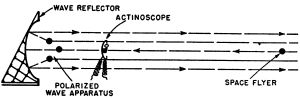
A pulsating polarized ether wave, if directed on a metal object can be reflected in the same manner as a light-ray is reflected from a bright surface or from a mirror. The reflection factor, however, varies with different metals. Thus the reflection factor from silver is 1,000 units, the reflection from iron 645, alomagnesium 460, etc. If, therefore, a polarized wave generator were directed toward space, the waves would take a direction as shown in the diagram, provided the parabolic wave reflector was used as shown. By manipulating the entire apparatus like a searchlight, waves would be sent over a large area. Sooner or later these waves would strike a space flyer. A small part of the waves would strike the metal body of the flyer, and these waves would be reflected back to the sending apparatus. Here they would fall on the Actinoscope (see diagram), which records only reflected waves, not direct ones.
From the actinoscope the reflection factor is then determined, which shows the kind of metal from which the reflection comes. From the intensity and the elapsed time of the reflected impulses, the distance between the earth and the flyer can then be accurately and quickly calculated.
The reflection factor of Magnelium being 1060, Ralph succeeded in locating Fernand's space flyer in less than five hours' search. He found that Fernand's machine at that time was about 400,000 miles distant from the earth and apparently headed in the direction of the planet Venus. A few seconds' calculation showed that he was flying at the rate of about 45,000 miles an hour. This was a great surprise to Ralph and it puzzled him somewhat. He knew that Fernand's machine was capable of making at least 75,000 miles an hour. Ralph reasoned that if he were in Fernand's place, he would speed up the flyer to the utmost.
Why was Fernand flying so leisurely? Did he think himself secure? Did he think that nobody could or would follow? Or was he having trouble with the Anti-Gravitator?
Ralph could not understand it. However, his mind had already been made up. He would pursue Fernand even though it took him into those parts of the solar system yet uncharted, and, if necessary—kill him!
It was now noon, and he gave sharp, quick instructions to his assistants, ordering his space flyer, the "Cassiopeia," to be made ready at once. Provisions sufficient to last for six months were put on board and Ralph himself installed a great number of scientific instruments, many of which he considered he might find useful. He also ordered a large number of duplicate parts of the flyer's machinery to be stowed on board in case of emergency.
To the astonishment and dismay of Peter and the others, the scientist announced his intention of making the journey alone.
"The fight is to be man against man, brain against brain," he said as he stood by his space flyer which was in readiness upon the tower-platform. "Today it is not brute force that counts, but scientific knowledge. I will demonstrate to the world that crimes of this kind need not be tolerated."
He stepped onto the running board as he spoke and was about to step into the flyer when the sound of an aeroflyer descending close by made him hesitate. It was a government flyer, and even as Ralph paused, it landed on the platform beside his own machine, and a smartly uniformed young official sprang from the seat beside the driver. Saluting Ralph he handed him a transcribed telegram with the words:
"Message from the Planet Governor, sir."
Dismay seized the scientist, as, breaking the seal of the wrapper, he read the printed words:
Unipopulis, Sept. 34, 2660, Planet Governor's Capitol.
I have just received news of the calamity that has befallen you.
I extend to you my sincere sympathy.
I will this afternoon place at your disposal six Government space flyers, the crews of which are absolutely under your instructions.
I must, however, caution you not to enter into any pursuit in person.
As Planet Governor it is my duty to advise you that you have not the right to place your person in unnecessary danger.
Allow me furthermore to point out to you that under the law "+" scientists are not allowed to endanger their lives under any circumstances.
I therefore command you not to leave the earth without my permission.
I have ordered your space flyer to be guarded.
In high esteem, William Kendrick 21K 4, The 18th Planet Governor. To Ralph 124C 41+, New York.
Ralph read the radiogram twice before he folded it slowly and deliberately thrust it into his pocket.
Then slowly withdrawing his hand and extending it to the government official, he said:
"Well, I must obey orders."
The official took the proffered hand, and no sooner had he grasped it than he stiffened and became as rigid as stone.
With one bound Ralph was in his machine crying to the stupefied audience:
"Don't worry about him. I pricked his hand with a little Catalepsol. In fifteen minutes he will be all right again."
He slammed the door of his space flyer and simultaneously the machine rose as if shot from a cannon, and in ten seconds was lost to sight.
Since the Dark Ages, men have had a powerful longing to leave Earth and visit other planets. Towards the end of the twenty-first century, when atmospheric flying had become common, scientists began seriously to think of constructing machinery to enable man to leave the confines of the planet to which humanity had been chained for ages.
Towards the beginning of the twenty-second century economic conditions had become acute and the enormous population of Earth, which had passed the twelve billion mark, clamored for an adequate outlet which the planet itself could no longer furnish.
The moon was regarded with longing eyes, and although that body was known to have no atmosphere and was known to be sterile, it was equally well known that Earth's scientists and engineers felt that they could, in a few years' time, make it habitable.
Atmospheric flying machines were, of course, totally unsuited, as they could not even reach the limits of the Earth's atmosphere, only forty miles away.
Obviously to reach the moon or any other celestial body, it was necessary to devise a method of overcoming the enigmatical force known as the Earth's gravity, which chains all bodies to the planet.
A multitude of inventions and suggestions were made, but none proved to be of any value until the Anti-Gravitator was invented by the American 969L 9 in the year 2210.
This scientist had made extensive studies of the gyroscope and had finally evolved a machine which when set in motion would rise freely and continue to rise as long as power was supplied.
The action, moreover, was purely gyroscopic.
969L 9 took a large hollow sphere (the rotor) inside of which he built a number of independent gyroscopes, all of which traveled in fixed orbits. The large sphere which hung in a gyroscopic frame was made to spin around on its axis at great speed. This sphere thus acted as the fly-wheel of a gyroscope and as such was not influenced by the so-called horizontal gravity. As in the case of simple gyroscopes, its axis would always be in a vertical line as long as the spheric rotor was in motion.
If, however, the independent gyroscopes inside of the sphere were set in motion by means of electrical current, the Vertical Gravity (weight) was overcome, the entire contrivance rising into the air, its rising (lifting) speed being directly proportional to the speed of the enclosed gyroscope rotors.
From 969L 9's experimental work the anti-gravitators were perfected, and it became possible to lift a weight of 1,000 kilograms with an anti-gravitator weighing but 12 kilograms.
Space flyers were equipped with from six to twelve large anti-gravitators attached to various points of their shells, all of which could be worked in unison, or operated independently in order to control the direction of the flyer.
As Ralph's space flyer rushed through the atmosphere, the friction of the machine against the air made the interior uncomfortably hot in spite of the fact that the machine had triple walls, the spaces between being filled with poor heat conducting materials.
After the flyer, however, had left the atmosphere, the stellar cold rapidly made itself felt.
Ralph then took his bearings, after he had verified, by means of the polarized wave transmitter that Fernand's flyer was still headed towards Venus. He then locked the steering disc and the space flyer continued its journey in a straight line of pursuit toward the machine of Fernand.
This done, Ralph flashed a radiogram asking the Planet Governor's indulgence for disobeying the law. Then he took his first look at the earth, which, since he was traveling at the rate of 80,000 miles an hour, had shrunk to the dimensions of a medium-sized orange. As he was flying toward the sun, Earth, being directly behind him was fully illuminated and appeared like a full moon. The continents and oceans were visible except where temporarily obscured by mist or clouds.
The general aspect of the Earth as seen from Ralph's flyer was that of a delicate faint blue green ball with white caps at each of the poles. The ball was surrounded by a pinkish ring near the circumference. This was the earth's atmosphere, the white caps being snow and ice around the north and south poles.
The brilliantly lighted earth was silhouetted against the inky black sky in sharp contrast.[8] The moon, hidden behind the earth, was not in evidence, when Ralph first looked earthward.
The stars shone with a brilliancy never seen from Earth; distant constellations which ordinarily cannot be seen, except, with a telescope, were plainly visible to him, in outer space.
The sun shone with a dazzling brilliancy in a pitch-black sky, and had he looked directly into its rays he would have been stricken blind.
The heat of the sun in the outside space when striking objects was tremendous. Had he held his hand against the glass window of the space flyer where the sun could strike it full, his hand would have been burned in a few seconds.
There was of course no night in the outer space (within the bounds of the planetary system). The sun shone uninterruptedly.
Time was an unknown quantity. Had it not been for the chronometer, reeling off seconds and minutes according to man's standard, time would cease to exist in a space flyer.
To a man who had never left the Earth, the phenomena encountered inside of a space flyer in the outer space was still more amazing.
"Weight" is synonymous with the gravity of the Earth. The denser a celestial body, the greater its gravity. The larger such a body is, the more strongly it will attract its objects. The smaller the body (if it has the same density), the smaller its force of attraction.
Thus a man weighing eighty kilograms on a spring scale on the earth, would weigh but thirty kilograms on the planet Mars. On the sun, however, he would weigh 2232 kilograms.
Inside of a space flyer, which had an infinitely small gravity, objects weighed practically nothing. They were heaviest near the walls of the machine, but in the exact center of the flyer, all objects lost their weight entirely. Thus any object, regardless of its earthly weight, hung freely suspended in the center of the space flyer. It could not move up or down, of its own accord, but hung stationary, motionless, like a balloon in the air.[9]
The occupant of a space flyer, having no weight, moved around with astonishing ease. He almost floated around in the machine. There was no physical labor. The biggest table was no heavier than a match. The passenger in a flyer could perform an incredible amount of work without tiring and without effort.
He could walk up the walls or walk "upside down" on the ceiling without danger of falling, as there is no "up" or "down" in outer space.
Sleep was practically impossible. There being nothing to tire the occupant, sleep is unnecessary. Dozing off is all he can do, and that could never last long, except after strenuous mental work.
As long as a space flyer was not too far distant from the sun (within the orbit of Mars, at least), little artificial heat was needed. The sun heated one-half of the flyer's shell to a fierce heat, but the side turned away from the sun was exposed to the terrible stellar cold (absolute zero) and a fairly comfortable temperature was the result.
The air supply was manufactured by chemical means on board, but very little was needed, as the original supply taken from the earth is used over and over by altering the carbonic acid gas by means of automatic generators.
It was of course of the utmost importance that no port-hole or doors leading to the outside be opened. The air would have rushed from the flyer instantly, resulting in a perfect vacuum inside of the flyer, and instant death to all living organisms.
As the flyer moved away from a celestial body, the less the mechanical energy needed to propel it. There were of course exceptions. Thus between every two celestial bodies a point will be found where the attraction that one body exerts on the other is zero. If the flyer were brought to this point its gyroscopes could be at rest, as the machine would not be attracted by either body. It would "hang" between the two just as an iron ball hangs between two powerful magnets if carefully balanced. Give it the slightest push, however, and the ball will fly to either of the magnets.
The same was true of a space flyer, between two bodies at the "zero point." If it moved over that point it was immediately attracted by one of the bodies, and if its gyroscopes refused to work, the flyer would have been dashed to pieces against the attracting body.
If, however, the machine came to rest at the "zero point" it would begin to turn around on its own axis, while at the same time moving in an elliptical orbit around the sun—the space flyer would become a tiny planet, and as such was subject to the universal laws of the planetary system.
It was not hard to steer the space flyer; the nearer it came to a celestial body, the faster the gyroscopes worked; the further it drew away, the slower their movement.
After Ralph had thoroughly inspected the entire flyer he devoted his full attention to the course of Fernand's machine. At the rate at which he was flying he computed that he would overtake Fernand in ten hours, provided the latter did not increase his speed meanwhile.
Fernand, when Ralph left Earth, had a handicap of 400,000 miles. He was moving at the rate of 45,000 miles an hour. Ralph's machine had made 80,000 miles an hour since its start. If everything went well he would overtake the other in ten or eleven hours.
As there was nothing else to do, he busied himself in the laboratory near the conning tower at the top of the flyer in an attempt to make the hours pass more rapidly. With all its speed his machine seemed to crawl. He was in an agony of impatience.
At the end of the ninth hour he finally sighted Fernand's machine through his telescope. He then tried to signal Fernand by radio, but the other either did not hear or else did not want to answer.
Eleven hours after his departure from Earth, his machine drew to within a few hundred meters of Fernand's. After careful maneuvering he brought the machine parallel to the other, and looking through one of the heavy plate windows saw the strained, drawn and ghastly white face of Fernand staring at him.
Ralph moved a few levers and then closed a switch. A hissing sound was heard, and Fernand was seen to fall backwards, the window turning green at the same moment.
Ralph had struck him senseless with his Radioperforer.
In a few minutes he anchored his flyer to the other by means of a powerful electromagnet. He then pushed the connecting tube of his flyer into the tube-joint of Fernand's machine. With great care he made the joint air-tight. Taking a coil of rope he opened the port-hole and crawled through the tube leading into the other flyer.
Arrived at the other end he made sure that the joint at Fernand's machine was tight before he moved on.
Fernand lay unconscious on the floor and in a twinkling Ralph had bound him with the rope.
In high excitement he bounded upstairs to gain the room Alice should be occupying. His heart throbbed tempestuously. In another moment he would hold his sweetheart in his arms.
Arriving on the next floor he stood still for a moment and listened. There was no sound except for the gentle purring of the gyroscopic machinery.
He went from one room to another, then to the last one. The door was open. He entered with a strange feeling of dread. The room was empty. Apparently it had never been used.
In terror Ralph ran from one end of the flyer to the other. He looked in every corner, in every closet. He could find neither Alice nor her maid. Where were they hidden? To make sure he went all over the ground again more thoroughly.
After the most careful scrutiny of every inch of the machine he fell limply into a chair, and buried his face in his hands.
Alice was not on board the flyer!!
FOOTNOTES:
12
LLYSANORH' STRIKES
For some minutes, Ralph stood motionless, completely bewildered. To have spent so much time and effort to no avail, hours—days wasted in a fruitless search! The thought was maddening.
Obviously, she was not on board Fernand's space flyer. Where, then, was she? Certainly Fernand himself had had no opportunity to hide her, unless his whole flight into space were a trick to deceive the searchers, and that was more than unlikely. Fernand was cunning—was this some new piece of duplicity?
Turning from the empty room he ran down to where Fernand lay, still unconscious. Kneeling by his side Ralph applied a small electrical shocking device to the spine of the insensible man, with the result that in a few minutes Fernand opened his eyes and stared dazedly into those of his captor.
"Where is she?" asked Ralph hoarsely. "What have you done with her? Answer me, or by God, I'll blow you into Eternity!" and, aiming his Radioperforer at Fernand's head, he spoke with such ferocity that the other shrank involuntarily.
"I don't know," he muttered, weakly. "It's God's truth I don't know. The Martian got her. He took her away and left me drugged." His voice trailed off and he seemed about to collapse.
"You're a liar!" growled Ralph, but his tone lacked the conviction of the words. There was that in the other's voice that rang true. Mechanically, he cut the cords that bound Fernand, and the man rolled over helplessly. He was weak and dazed, and altogether too broken in spirit to make any further trouble. His nerve was gone.
Ralph propped him up against the wall, but he slumped over on his side limply. Impatient at the delay, Ralph went in search of water, and finding a pitcher of it in Fernand's laboratory, unceremoniously dumped the contents over the prone man's head. This had the desired effect of restoring him somewhat, and in a short time he was able to tell the story in detail.
"When I applied the chloroformal to you that night, I used the same drug on Alice, while Paul 9B 1261, a friend of mine, took care of your driver. We dragged Alice into our cab, and made for the outskirts of New York where I had the space flyer in readiness. A maid for her was already on board. We got Alice on and I put her in the care of Lylette, and in a few seconds we were off.
"When we got well out in space I locked the steering disc and helped the maid revive Alice, and in a few minutes she was herself again, which she fully demonstrated by slapping my face and then trying to tear me apart like a wildcat, when she found where she was." He gave a wry smile at the recollection.
"Go on!" snapped Ralph.
"It was an hour later, and we were burning up space, traveling at a rate of 70,000 miles an hour, that the radio signalling apparatus began ringing furiously. I tuned in, and heard a faint, gasping voice from somewhere out in the great void. With difficulty I learned that there was another space flyer somewhere near me, with two men and four women on board, and that their oxygen supply was being rapidly exhausted, due to the spoiling of some of the oxygen-producing chemicals. They asked for a small supply of oxygen, enough to get them back to Earth. Otherwise they would be doomed.
"Knowing myself to be safe from pursuit for some hours, even had you known I abducted Alice, I decided to aid the crippled flyer, and answered that I would assist them as soon as possible. I went up to the conning tower and, with the telescope, located the other machine. Then I reversed the anti-gravitator machinery and within a short time I had drawn up level with the flyer.
"We made fast, and ran the connecting tube between the two machines. When the joints were made air-tight I crawled through, and just as my head came through the opening into the other, two hands gripped me around the throat and I was jerked into the machine. I made a desperate effort to wrench myself free but I was absolutely helpless in such hands. I found myself gripped by Llysanorh', the Martian, and I might as well have fought a tiger as that seven-footer.
"He said nothing, only stared at me with his enormous eyes, while he dragged me to a small compartment, manacled my hands, and left me, locking the door behind him. But he was back in fifteen minutes or so, with a triumphant look in his eyes. He picked me up and pushed me through the connecting tube into my own flyer. He dragged me into my machine-room, and forced me to watch while he, using a big hammer, smashed the mechanism of my six anti-gravitators, so that I would not be able to steer, and could fly in only one direction. He ruined all the spare parts, to make sure that I could not make any repairs or replacements.
"Then catching me by the back of the neck, he said:
"'I intercepted your letter to Paul 9B 1261, and followed you. You didn't count on me, Fernand, when you stole Alice. Neither you nor that fool scientist Ralph 124C 41+ shall have her. No man shall have her but myself. I will kill her first. I don't know why I don't kill you, except that you are scarcely worth the trouble. You can't pursue me with your machine in this condition, and when—if ever—you are found, it will be too late.'
"'Good God, man,' I said, 'surely you won't take a helpless Terrestrial girl!'
"'It is only what you did,' he replied, 'and at least, I love her!' And with that he pressed a cloth saturated with some drug unknown to me against my face, and that is all I remember.
"I must have been unconscious at least six or seven hours and when I came to, it was another hour before I shook off the effects sufficiently to recollect anything. Llysanorh' had taken off the manacles, but I was as helpless as if I had been bound. I must have dozed off, for I had only just awakened when I looked out and saw your flyer approaching. And that's the whole story."
Ralph had listened to the amazing narrative with growing apprehension. He knew enough of the Martian character to realize that Alice was in the hands of a man who, once the die was cast, would stop at nothing. He had been hopelessly, pitifully in love with Alice. It was easy to see that, having, probably quite by accident, intercepted Fernand's letter to Paul telling of his plans, he had in a moment of desperation, born of despair, determined to carry her off himself. Perhaps, in the first place, he had only intended to save her from Fernand, and then, considering the small possibility of discovery and pursuit, had succumbed to his overwhelming passion for her, and abducted her instead of returning with her to Earth. But whither was he bound? Surely, not to Venus where the inhabitants were nearly all Terrestrials, and whose laws were identical with those of Earth.
Mars? Possible, but improbable, although Llysanorh' might have some friend in his sect who would perform the Martian marriage ceremony secretly. But even if this were the case where could he take his captive bride? They would not be permitted to live on Mars, neither would Earth or Venus accept them.
The intolerably hot planet Mercury was out of the question, and the two moons belonging to Mars had no atmosphere.
There remained only the Asteroids.
At this thought Ralph sprang to his feet with an exclamation.
"I've been a fool not to think of them before," he cried. "Of course he would get her to one of them, and once there she will be lost forever. Good God, I must find his machine and head him off before it's too late."
He turned savagely on Fernand still crouched against the wall. "I'm tempted to leave you to the fate the Martian intended for you. God knows it wouldn't be half what you deserve."
"Don't do that, in Heaven's name," mumbled the other. "Don't leave me here like this."
The scientist looked at him contemptuously for a moment.
"Bah!" he said scornfully, "can't you even take your medicine like a man? But I'll turn your machine around and direct it Earthward. You will intercept the Earth in about thirty hours. You can't steer, but you can accelerate or retard the speed of your flyer, and need not collide with the Earth if you are careful.
"And remember this," he added grimly, "if you and I ever meet again I will pound your miserable cowardly body into jelly!"
He turned his back on the abject man, and returned to his own flyer. Then he turned Fernand's machine around, disconnected the two from each other, and in a few seconds Fernand's flyer had disappeared.
Ralph sprang into action. He immediately began taking observations. These told him that it would take him at least thirty days to reach Mars, even though he forced his machine to the utmost. He could not travel over 90,000 miles an hour, but, on the other hand, he felt sure that Llysanorh's machine was incapable of making more than 85,000 miles an hour. But the Martian had a handicap of probably 600,000 miles, and if Ralph gained on him at the rate of only 5,000 miles an hour, it would take 120 hours, or five terrestrial days to overtake him.
Ralph turned his machine towards the point in space where Mars would be at the end of thirty days, and now set himself to the task of making a search for the other flyer with the polarized wave apparatus.
For four wearisome and anxious hours he sought through space perseveringly, and was at last rewarded by locating another machine which he was certain was that of the Martian, as he had reasoned, heading for Mars.
At the same time the results of his calculations dismayed him greatly, for they revealed that Llysanorh's machine was making no less than 88,000 miles an hour. At this rate, Ralph was gaining only 2,000 miles an hour, and it would take thirteen or fourteen days to overhaul the other flyer. But as the Martian could not hope to reach Mars under twenty-nine days himself, Ralph figured that he, barring some unforeseen accident, would overtake him long before he landed there.
It was absolutely imperative that he do so, for once the Martian left Mars and headed for the Asteroids further pursuit would be useless. There were over 4,000 of these little planets already known[10] and it would be the work of a lifetime to search on each one for the fugitive and his victim. Speedy action on Ralph's part was urgent.
These little Asteroids, revolving in an orbit between Mars and Jupiter were practically uninhabited, although most of the larger ones had a good atmosphere, and a fair climate, considering their distance from the sun.
Some of them were only a few miles in diameter, and the largest measured but 485 miles. An electromobile, running at the slow rate of 60 miles an hour could circle such a tiny planet in 24 hours!
The larger planetoids had a superb vegetation, and as the gravity on these bodies was only a fraction of that on the Earth, the trees and shrubs were gigantic, while colossal fruits and vegetables grew in abundance. These plants helped to create a dense atmosphere, in spite of the small gravity, and life, on one of these little planets, was, in many respects, far more comfortable and pleasant than on Earth or Mars.
Now began the hardest part of the chase for Ralph. There was nothing more to do than he had already done. From now on he must wait with what patience he could summon to his aid, until such time as his machine should catch up with that of the Martian. He could force his own no further, and he was very sure that Llysanorh' was also flying at his utmost speed.
At work, he had not had much time for thought.
Now, with time hanging heavily on his hands, his conjectures as to the fate of his sweetheart drove him, at times, nearly to madness.
FOOTNOTES:
13
ALICE OBJECTS
Alice, on being aroused to consciousness by the ministrations of Lylette, the maid, and Fernand, and finding herself a prisoner on board a space flyer at the mercy of the latter, was overwhelmed with fury. This cool abduction of herself provoked her to such a passionate outburst that Fernand had actually retreated before it.
"You coward," she blazed, "how dare you keep me here! Turn around and take me back at once—at once, do you hear?"
Fernand, in the act of opening her door and going back to his laboratory, paused smilingly.
"My dear girl," he said mockingly, "ask of me anything and I will grant it—except that. You have a temper that delights me. Your smiles will be all the sweeter, later."
Her answer was to fly at him with such passion that he involuntarily took a step backwards. In a flash she had run by him, was down the stairs and tugging at the fastening of the door that led outward. Fernand bounded after her calling to Lylette as he ran, and in a moment they were both struggling with the girl, who had indeed become a veritable wildcat. She had both hands fastened around the great bar that held the door and fought madly to unfasten it. Let that door be opened the fraction of an inch and all three would instantly have been blown to pieces. Fernand wrenched at her hands in real fear that she would succeed in her purpose, which was evidently their destruction.
She was a strong athletic girl, and at the moment her desperation gave her added vigor. But the combined strength, and by no means gentle handling of Fernand and Lylette, who herself was a large and powerfully built woman, forced Alice to relinquish her hold, and she was dragged, struggling, back to her room, and left there, with the door double-locked.
Alone, she passed from the high exaltation of anger to a state of nervous apprehension. Another woman in her place might have wept, have begged piteously for mercy where there was no mercy, but this girl was made of sterner stuff. She might be frightened but Fernand should never guess it.
Dry-eyed, with lips set in a firm line, lest they tremble and betray her, she sat facing the door, gripping in her small hands the only weapon she had been able to find—a small metal vase, having a round, and fairly thick base.
Knowing that Fernand would come back, prepared as she was for his return, she was unable to repress a start of genuine terror when she heard someone unbolting the door. She clutched the vase more tightly, white-faced, but courageous.
Fernand entered alone, carefully closing the door behind him. He wore his customary, rather bland smile, and his voice was suave to the point of oiliness.
"All over our little fit of temper?" he asked.
Alice stared at him, disdainfully, unanswering. Then her eyes fell upon something in his hand—manacles of glistening steelonium!
The horror she felt was depicted in her face, for he said, holding them out for her to see, "A pair of bracelets for you, sweetheart. Just as a precautionary measure. You are rather too quick with those hands of yours. But I am not unkind, my dear. You need not wear them if you will only give me your word not to repeat your recent performance."
Beyond the door she saw Lylette standing in readiness, and she knew that physical resistance would be ineffectual. Far better to give her promise and be free than to be bound and helpless. Besides, there was the laboratory. In it there were many roads to freedom—there were poisons that killed instantly and painlessly. Unmanacled she might reach them eventually. Bound, even that way would be closed.
Coldly, clearly, she gave her promise, but inwardly she offered up a prayer of thankfulness when he turned and handed the handcuffs to Lylette.
"You can lay down your weapon, Alice," he said, still with his mocking smile. "I can assure you that you have no need of it. You will find me a gentle lover, and one who is willing to wait for his lady's favors." He stopped suddenly, and turning his head in the direction of the stairs, listened intently.
From the laboratory, came the insistent ringing of the radio calling apparatus.
With a muttered order to Lylette, he was gone.
What was happening, Alice did not know. She could not read radio messages, but she knew that only something of grave import could have made Fernand rush like that to the radio. She strained her ears, but heard nothing.
Her hopes rose with a great bound with the thought that perhaps Ralph was on his way to her. Perhaps it was he signalling. She had been sure that he would follow her as soon as possible, and now her dark eyes brightened with hope.
At this moment Lylette, without a glance in her direction, closed the door, and Alice was once more alone and a prisoner behind bolted doors.
It was then that she gave way to her loneliness and despair. She knew that if it had been Ralph signalling, Fernand would at once, having received the news that the scientist was in pursuit, set about making plans to elude him. She knew that Fernand was desperate, that his life, under the law, was forfeit for this crime he had committed. He would stop at nothing. Instinctively, she felt that he would destroy her and himself, rather than be taken. Certainly, he would not hesitate to murder Ralph if the opportunity presented itself.
She flung herself upon the couch, and burst into tears of agony, and terror. Suddenly she sprang to her feet, still sobbing, wide-eyed with dread of what she knew not.
The space flyer had stopped. The throb of the machinery had stilled and the flyer was hanging motionless in space.
Standing in the middle of the room, rigid with suspense, Alice waited with beating heart. Suddenly she heard the sound of rapid steps on the stairs. Now they halted at the door, and someone fumbled at the bolts and locks.
The next instant the door was flung wide open, and Llysanorh' the Martian stood upon the threshold!
14
THE TERROR OF THE COMET
During the next few days Ralph passed midway between Earth and Venus. This was the spectacle that at times greatly increased the transport space flyer travel between Earth and Mars, many of the inhabitants of both planets making the long journey simply to get a view of the beautiful planet Venus.
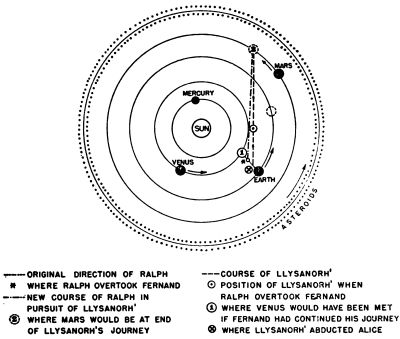
Ralph ran almost parallel for a time with the two planets (see diagram), Venus to his left, Earth to his right. Although he was quite near the former he could hardly see it, as the bright rays of the sun precluded detailed observation. A few days later, however, it had swung sufficiently far enough to the left to afford him occasional glimpses of its beauties.
Ralph worked almost continuously in his laboratory in the conning tower. In the course of the week since he had left the Earth, he had only catnapped for about two hours, since sleep was impossible.
He constructed several new pieces of apparatus, which he considered might be useful in case of a possible encounter with Llysanorh'. He knew that Llysanorh' could not be as easily subdued or caught as Fernand. This tall Martian was an inventor himself and knew much about handling modern death-dealing weapons. It would be useless to try the Radioperforer as he probably would carry a Silonium armor, proof against all Radium emanations.
One of the first things he had done was to lead wires from the steering apparatus up to the conning tower. On the floor of the tower he arranged contacts in such a manner that he could press them together with his feet. The control was similar to the foot pedals of an organ. He then practised for some days until he could steer the flyer wholly with his feet. Thus his hands were free to control any apparatus he would need for attack or defense. With his feet he could so control the machine as to avoid projectiles if necessary.
As the days rolled by, however, Ralph became more and more disturbed. He now took observations hourly, his eyes glued to the indicator. With a sinking heart he saw that he was not gaining on the Martian. The latter had his machine well tuned up and was covering almost 90,000 miles an hour. At this rate Ralph could never catch up with Llysanorh'. It was maddening. The days became a long, drawn-out agony. Ralph had done everything in his power to accelerate the speed of his flyer and to strain the machinery further meant inviting certain death. Within eight days Llysanorh' would land on Mars—his course now plainly showed that he was headed for the planet. At best Ralph would be ten hours behind—time enough for the Martian to accomplish his purpose. And he, Ralph 124C 41+, the greatest inventor the world had ever produced, was powerless.
Again he took observations, and again the results were the same. A weariness of the spirit swept over him. The dark waters of despair seemed to inundate his very soul. To have been physically exhausted would have been a relief. To know the blessedness of but an hour's sound sleep, to be free from this terrible tension—
He sank down upon a seat and buried his head in his hands, and as he sat, striving to quiet his worn and troubled mind there came to him an idea—nay, more than an idea, an inspiration, by which he would overcome the formidable difficulties that beset him.
An idea, so simple that, having once formulated it, it seemed ridiculous not to have thought of it before.
His soul-weariness fell from him like a discarded garment. He sprang to his feet, once more the scientist, the man of action, triumphant, dominant.
His marvelous ingenuity saw the way out. His mind would again triumph over time and space. He would achieve the impossible, surmount the insurmountable.
The battle was not lost—it had but begun!
He knew he could not overhaul Llysanorh'. Neither could he intercept him. A wireless decoy message was futile. Llysanorh' would never be caught by such a flimsy trick. But he must do something to prevent Llysanorh' from reaching Mars.
How could it be accomplished? By sending a message to the Martian authorities? A futile thought. Even if the distance could be bridged, which was doubtful, Llysanorh' would, in all likelihood, intercept the message with his recorder. He would simply send a message to his friend to board a space flyer and to rush to him at top speed. The marriage ceremony could then be performed out in space.
No, Llysanorh' must not know that he was pursued and still he must be prevented from landing.
Ralph would literally move the heavens. He would threaten Mars with a comet! Llysanorh's patriotism could be depended upon to make an effort to divert the comet from its course, to avoid the imminent collision with Mars. This, Llysanorh' could do without danger to himself, simply by steering his flyer close to the head of the comet—within a few hundred kilometers. The gravitational action of his machine on the comet would deflect the course of the latter enough—even a few degrees would be sufficient to change the path of the meteor.
But where was the comet to come from? To Ralph this was simplicity itself. He did not need to "catch" a comet—he would manufacture one for himself—a comet more unique than ever rushed through space.
He knew that comets had been reproduced artificially on a small scale, centuries ago;[11] however, no one had ever tried to make a real comet. He also knew that the largest comets have a very small mass, and that the tail is composed mainly of gas and dust, which is so thin that the stars may be readily observed through the tail of almost any comet.[12]
Ralph thus became the first human being to create a heavenly body. As comets are composed mainly of hydrogen gas and dust, the creating of Ralph's artificial comet was absurdly simple to the scientist.
By means of scraps of zinc and iron filings, over which sulphuric acid was poured, Ralph produced a great quantity of hydrogen. This he filled in tanks and when he had generated enough of the gas he connected the tanks with a large metal stop cock in the wall of the space flyer. As soon as the stop cock was opened the hydrogen rushed out into the open with a roar.
Immediately Ralph connected his high frequency apparatus with the outside aerials of the space flyer and the expected phenomenon took place.
The hydrogen particles which heretofore had been invisible, began to glow with a wonderful light, enveloping the entire flyer. For thousands of miles behind the machine stretched a true comet's tail, the flyer forming its head or nucleus. The tail, as in all comets, was turned away from the sun, and although Ralph could not see the end of the tail, he knew that what he had created could be seen for hundreds of thousands of miles, like any natural comet.
Ralph, however, was not fully satisfied, and he therefore started to "improve" the comet. He manufactured several other gases in large quantities, which he ejected into space, greatly enhancing the brilliancy and size of the comet's head as well as of its tail.
The head, however, he thought was not "solid" enough as yet, and so he set about correcting this defect.
Comets are composed chiefly of gases, but contain a large amount of dust. The dust particles act very much like the dust particles upon which a sun ray falls, and it is these particles which create the comet's appearance. If the atmosphere is eliminated and the same dust placed into outer space, a small comet will result. The small particles will be highly electrified by the sun and begin to glow. Each particle repels the other and thus even a handful of light dust will form a respectable comet in space.
Ralph made his dust by grinding paper and wood and other materials on a fine carborundum wheel.
After he had made a few pails full, he blew the dust out into space, and if his comet had been a magnificent sight before, it was really awe-inspiring to look upon now from a great distance.
The heavier particles clung close to the flyer, on account of gravitational action, but completely enveloped it. The machine was now a true planet, while the fine dust particles had become little satellites, revolving around their central body, the flyer.
The lighter dust particles found their way into the tail, as the powerful pressure of the sun's light overcame the attraction which the flyer brought upon them.
Ralph turned off the high frequency current and yet the comet was not extinguished and its brilliance was not in the least dimmed. The gas and dust particles had no way to dissipate their initial electrical charge, being in an absolute vacuum; and Ralph's artificial comet had become a real one.
Inasmuch as the dust was quite dense immediately around the flyer, Ralph's outlook was not as clear as it had been before. He could just see the stars, which seemed enveloped in a haze. This, however, pleased him greatly, as he knew that his artificial comet must look like a natural one from a great distance.
In this he had not been mistaken. As he afterwards learned, his comet had been "discovered" simultaneously on Earth, on Venus, and on Mars the same day he had made it. It had been charted and named, and on account of its great brilliance and long tail, had been immediately termed "The Great Comet of 2660."
That Llysanorh' would see the comet Ralph never doubted for a second. He headed his comet-space flyer exactly toward the point where it would collide with Mars at the end of six days. He figured that the Martians would be on the lookout, and inasmuch as Ralph's careful search did not reveal another space flyer anywhere near him, he knew that the Martian officials would surely locate and attempt to communicate with Llysanorh'.
In this he was not mistaken. His chronometer pointed to 5 p.m. when he first recorded weak signals coming from Mars. Several messages were exchanged between the Martians and Llysanorh'. Llysanorh' gave his number and position in the heavens and he in turn received instructions to approach as near to the "comet's" head as feasible in order to change its course. He was also instructed to bombard the comet's nucleus with time-set torpedoes, if he could not deviate the comet from its course. Llysanorh' answered that he would follow instructions as far as his equipment allowed.
During the next few days Ralph was relieved to note that the distance between him and Llysanorh' diminished with great rapidity. His trick had worked. Llysanorh' was rushing at top speed toward Ralph's flyer, firmly believing it a comet.
Confident of success, sure of victory, Ralph was jubilant. Hope, so long deferred, flooded his spirit. He whistled cheerily at his work.
Was not every minute bringing him closer to his sweetheart, his Alice? Was not every second drawing nearer to that moment when he would hold her in his arms?
What wonder that he whistled all day long, and laughed to himself from sheer joy and relief.
At last the Martian came into range. Llysanorh' approached the "comet" up to about 150 kilometers and then receded. He then took observations, but somehow or other the "comet," instead of being deflected, commenced to pursue him. This was opposed to all astronomical knowledge and reasoning, and Llysanorh', fearing collision with the "comet" began to fire explosive torpedoes into its nucleus. As the distance between it and his machine was only 100 kilometers, he could watch the torpedo in its flight. Through his telescope he could see the torpedo rushing toward the "comet's" head.
But the "comet" dodged, and the torpedo shot far above the nucleus! It was uncanny. His aim had been accurate, he could have sworn. The distance was short. Yet he had missed. The "comet" had moved out of the projectile's path.
He had fired again, with equal accuracy. The torpedo would surely strike now. But the "comet" this time "side-stepped," as it were, and the torpedo sped on through space, missing its target by a wide margin.
Llysanorh' was bewildered. Fear gripped him.
Gravitational action had not made the "comet" act in this strange manner. He fired one torpedo after another, but the "comet" dodged them all.
He suddenly stopped firing torpedoes. He next tried to destroy the infernal "comet" by electricity.
Soon his aerials were white hot with the energy he threw into them. He then turned his flyer into such a position as to direct the outflowing energy towards the "comet's" head. The only result was to increase the luminosity of the "comet."
Suddenly Llysanorh' realized that the "comet" was only fifty kilometers away. He noticed with horror that the head of the "comet" now seemed to fill up almost one-quarter of the "sky." Another discovery that came simultaneously was that instead of the "comet's" head being solid, there was a mysterious small black speck in the center of the nucleus. This was against both knowledge and theory of comets.
When Ralph had brought his "comet" within fifty kilometers of Llysanorh', he felt that the time had come to throw off the mask. He had lured Llysanorh' to within striking distance. It was now time to strike.
He had one great advantage over Llysanorh'. The latter was wholly unprepared, believing he had to deal with a comet. This facilitated Ralph's movements.
He carefully insulated himself by sitting on a tall glass tripod. He then attached to his ears the telephone receivers that were connected with the induction balance,[13] which he had attached to one of the glass port-holes.
He then started to turn the glass wheel of the ultra-generator, connected to the outside aerials.
A terrible screaming sound came from the generator and the whole flyer shook. Ralph continued to turn the wheel quickly. The generator shrilled higher and higher, until the frequency had become so high that no sound could be heard. The vibrations had passed 35,000.
Ralph turned the wheel a few more notches and everything became pitch-dark over a space sixty kilometers in diameter.
As in his Switzerland exploit, two months before, Ralph's aerial on the space flyer due to the powerful action of his ultra-generator, attracted the ether so fast that it could not be replenished quickly enough. It acted much like an immense vacuum pump on the atmosphere.
Darkness spread over a large area as the inky fluid of the octopus blackens the sea. Both flyers became invisible to each other.
Ralph, however, pointed his machine on its former course and speeded it up.
Llysanorh', dismayed by the unexpected darkness, had brought his machine to a dead stop. He was almost frantic with terror and stood like one paralyzed, unable to think or to act.
Within a few minutes Ralph's induction balance caused his telephones to emit higher and higher notes, indicating, despite the pitch-black darkness, just how near he was to the other flyer.
When he was certain that he had approached Llysanorh's machine, he suddenly shut off his ultra-generator. Quick as lightning he had grasped his radioperforer, and although the light which returned instantly blinded him for a few seconds, he had glimpsed Llysanorh's terrified face, just a few meters distant, his forehead pressed tight against the glass plate of the port-hole.
Ralph took quick aim and pressed the trigger.
There was a silent flash and Llysanorh' seemed to topple over. Simultaneously the glass of the port-hole turned green.
In a flash Ralph jumped up and peered anxiously out one port-hole, then another, hoping to catch sight of Alice.
There was nobody to be seen.
He rushed to the wireless and signaled frantically for several minutes. Breathlessly he clasped the receivers to his ears.
There was no answer—no sound—nothing.
With sinking heart, he rushed to the connecting tube. In his excitement it took him twenty minutes to make the connection between the two machines and the tube air-tight. Before crawling into the connecting tube he grabbed up his radioperforer as a precaution.
The sight that presented itself to him as he crawled into Llysanorh's machine drew from him an involuntary agonized cry.
Llysanorh's dead body lay across that of Alice, his sharp dagger sunk into the upper part of her arm. Ralph hurriedly moved the rigid body aside.
There lay Alice in a terrible pool of her own blood, her eyes closed—dead.
FOOTNOTES:
15
LLYSANORH' THROWS OFF THE MASK
When Alice saw that it was Llysanorh' standing on the threshold of her room she experienced at once great disappointment and overwhelming relief.
The second space flyer was not driven by Ralph, but she was at least safe from Fernand.
"Oh," she cried with a sob of relief, "I am so glad it is you, Llysanorh'! I have been so frightened."
He made no answer, but regarded her with enormous eyes in which burned a somber flame.
"You are going to take me off this horrible flyer, aren't you, Llysanorh'? You won't leave me here alone with that—that beast, will you?"
He shook his head soberly, and extended one hand to her.
"Come," he said briefly.
She put her own hand confidently in his, and he led her down the stairs, and past the laboratory. She shrank back as she saw Fernand's bound and motionless form.
"Is he—dead?" she whispered.
"No," said Llysanorh', leading her to the connecting tube. He helped her through with gentle hands, and in a moment she found herself in the other flyer. Taking her hand again in his, Llysanorh' led her to a luxuriously furnished room.
"Stay here until I come back," he said. "I won't be long."
He turned to go but she, catching his sleeve, detained him.
"Are you going to—to kill him?" she asked.
"Perhaps. I haven't decided yet," he replied, unsmiling. And then, gripping her shoulders with startlingly sudden emotion, "Has he harmed you?"
"No, no," she said, frightened, "he just tried to terrify me, that was all."
He released her, and strode to the door.
"I won't kill him," he said, and for the first time he smiled, but in that smile there was no mirth. "I shall let him live, that he may pray for the death I have denied him."
And he was gone.
Presently Alice heard him disconnecting the two machines, and a moment later she knew that Llysanorh's flyer was moving. A half hour passed and still she was left alone. Beyond the vibration of the machinery there was no sound to indicate that she was not absolutely alone on the flyer.
Feeling a little panicky she finally left the room and made her way through a corridor. Several doors that she opened led into rooms even more luxurious and splendid than the one she had left.
So this was the space flyer owned by the Martian of which there had been so much gossip. Stories she had heard before of its spaciousness and magnificence came back to her.
It was like the palace of the Beast in the ancient fairy story, where Beauty had wandered for hours through room after room filled with new marvels. Alice smiled whimsically at the thought. She was "Beauty," she reflected, and Llysanorh'—yes, he made a very good "Beast." Her buoyant spirits were rapidly recovering from the strain of her imprisonment.
Finally, she tried one more door, and entered a wonderful laboratory fully equipped.
And at the farther end, seated before a low table sat the Martian, his head resting on his folded arms. His whole attitude suggested hopeless desolation. He looked very lonely and remote, and somehow, to her, very pathetic.
She stood, hesitating, uncertain of whether to advance or retreat. Finally she spoke his name softly. At her voice he raised his head and stared at her. And she saw that his face was lined and furrowed as if with some terrible strain, but his eyes were steady with resolve.
"How serious you look," she said, coming into the middle of the room. "You seem so worried and anxious, Llysanorh'. Has something gone wrong with the flyer? And what did you do with Fernand and his machine?"
"I left him recovering from the effects of the drug," he said, in a forced and unnatural voice which betrayed, even more than his expression, the disturbed state of his mind. "And nothing is wrong with the flyer. It is I—I with whom everything is wrong."
"Oh, surely it can't be as bad as you think," said the girl, her quick sympathies aroused by his obvious misery. "Would it make you feel any better to tell me? We have always been such good friends, Llysanorh', and I might be able to help you."
"Later, perhaps, later," he said, and then with an effort, "can you make yourself comfortable here for a few days, do you think? I brought the maid with me. You will find her waiting in your rooms for you. I don't think she will give you any trouble."
"Oh, yes, I surely can," she replied. "It is lovely here. I have heard so much of this flyer. Why haven't you shown it to father and me before? The rooms are like those of a fairy palace. Tell me, Llysanorh', will it be long before we get back to Earth? Everyone"—she had been about to say Ralph, but checked herself—"everyone will be so worried about me."
"We are never going back to Earth," he said.
"Never going—why, what has happened then? Is there something wrong that you won't tell me?—or are you joking? But of course you're joking, Llysanorh', and for a minute I thought you were serious."
"I was never more serious," he said, rising to his feet and facing her. "We are never going back, you and I."
Alice looked at him wide-eyed, amazed and bewildered.
"But I don't understand," she faltered. "Why, Llysanorh'?"
It was then that the pent-up emotion of months burst the bonds of self-restraint that he had forced upon himself.
"Why!" he cried passionately, "you ask me why! Can't you see why? How can you look into my eyes and not know why? Because I am a man—because I am a fool—good God, because I love you!" He flung himself upon his knees, clasping her about the waist with his arms.
"I worship you, I adore you—I always shall. You must love me, you cannot help but love me, I love you so much, Alice, Alice, my dearest, my beloved."
He threw his head back and looked into her face imploringly, as if by the very force of his love she must respond, but he read there only terror and a growing abhorrence. It cooled him more effectually than any words she could have spoken, and he relinquished his hold on her, rose and went back to his former position at the table, while she watched him speechlessly.
For a time neither spoke. At last he said in quiet tones strangely in contrast with his late passion, "You can't hate me, Alice, I love you too much."
"No," she said, gently, "I don't hate you, Llysanorh', but oh, can't you see how hopeless all this is? I love Ralph, and if you keep me here forever I will still love him."
She got a glimpse, then, of the terrible struggle this man of Mars had had with his conscience.
"I know, I know," he groaned, "I have gone over that ground many times—many times, but I can not—will not—give you up. I tell you," he went on with a return of his former frenzied emotion, "that rather than let him have you I will kill you with my own hands. At least, when you are dead I will be sure that no other man can possess you."
She was a courageous girl, but before the madness in his face she fled shuddering.
During the next several days Alice kept close to her rooms. She saw little of Llysanorh', who seemed to be avoiding her purposely, and the maid, Lylette, was uncommunicative. Alice was horribly lonely and afraid. At first she had confidently expected Ralph to rescue her at any moment, but as the days dragged on, and still the space flyer drew nearer to Mars, and there were no signs of Ralph, she became increasingly aware that her situation was desperate.
She knew that Llysanorh' controlled powerful interests on his native planet, and that once there, all her pleadings would be in vain and he would make her his bride.
The few times she saw him he was quiet in manner, showing a courteous deference to her. But he could not hide the triumphant light in his eyes, which, the nearer they came to Mars, he took less pains to disguise from her. And yet, she could not deny the fact of his genuine, and fervent love for her. Only once, did he again speak of it.
One day she was sitting in the beautifully appointed library reading, with Lylette near by, when he entered. He gazed at her a moment in silence. Then he said, "You know, Alice, just to have you here with me, where I can see you occasionally, is wonderful to me."
Her eyes filled with quick tears, for she was worn and unhappy. And seeing them he quickly withdrew.
Later, he seemed very busy in the machine room. Passing it, once, she saw him working frantically at something; what, she could not see. But a glimpse of his face revealed it haggard and drawn. It was but a few minutes after that, back in her own room, a complete and terrifying blackness obliterated everything. She heard Lylette screaming somewhere in dreadful panic, and she heard Llysanorh' shout something hoarsely.
Stumbling, she made her way as fast as she could in the darkness back to the machine room. She heard him at one of the windows. Apparently he was trying to pierce the blackness, to ascertain its cause. She started toward him, when the light returned in a blinding flash, and she saw Llysanorh' stagger as if struck by something.
"Llysanorh'," she cried, "what is it? What is happening?"
He lurched toward her and caught her in his arms savagely. "I'll tell you what has happened," he shouted, "I see it all now. The comet—a trick, damn him! And now he's got me. But not you, Alice, not you. You are going with me—"
The Martian's face was distorted with passion. He had a gleaming dagger in his right hand poised over her. Then, just as it was about to strike she saw his face go blank and felt a terrific blow on her arm. The next instant she was slumping—seemed to drop off into a dreamless sleep.
16
THE SUPREME VICTORY
When Ralph burst into the machine room of the Martian's flyer and saw Alice lying dead in a pool of her own blood the shock was almost more than he could bear. Falling on his knees beside her he caught her small, yet warm hand in his, calling her name again and again in agonized tones. He covered her lovely white face with kisses, while dry tearless sobs tore at his throat.
Then, thinking that perhaps he had made a mistake, that her heart must still beat, he tried, with trembling hands to discover the extent of her injuries. Llysanorh' had aimed at her heart but the dying man had missed his mark, and the sharp point of the dagger had slashed her arm, cutting into the large artery. And in those precious moments when Ralph had been connecting the two flyers, and making his way from one to the other, her warm rich life's blood had ebbed rapidly away.