Part 6 — CHAPTER VII. RADIO-ACTIVE EMANATIONS. (continued 2)
Reading edition
It is possible that the condensation of the emanations may not occur in the gas itself but at the surface of the containing vessel. Accurate observations of the temperature of condensation have so far only been made in a copper spiral, but condensation certainly occurs in tubes of lead or glass at about the same temperature as in tubes of copper.
169. In experiments that were made by the static method with a very large quantity of radium emanation, a slight amount of escape of the condensed emanation was observed several degrees below the temperature at which most of the emanation was released. This is to be expected, since, under such conditions, the electrometer is able to detect a very minute proportion of the whole quantity of the emanation condensed.
Special experiments, with a large quantity of emanation, that were made with the spiral immersed in a bath of rapidly boiling nitric oxide, showed this effect very clearly. For example, the condensed emanation began to volatilize at -155° C. In 4 minutes the temperature had risen to -153·5°, and the amount volatilized 287was four times as great as at -155°. In the next 5-½ minutes the temperature had increased to -152·3° and practically the whole quantity, which was at least fifty times the amount at the temperature of -153·5°, had volatilized.
It thus seems probable that, if the temperature were kept steady at the point at which volatilization was first observed, and the released emanation removed at intervals, the whole of the emanation would in course of time be liberated at that temperature. Curie and Dewar and Ramsay have observed that the emanation condensed in a U tube, immersed in liquid air, slowly escapes if the pump is kept steadily working. These results point to the probability that the condensed emanation possesses a true vapour pressure, but great refinements in experimental methods would be necessary before such a conclusion could be definitely established.
The true temperature of condensation of the thorium emanation is probably about -120° C., and that of radium about -150° C. Thus there is no doubt that the two emanations are quite distinct from each other in this respect, and also with regard to their radio-activity, although they both possess the property of chemical inertness. These results on the temperatures of condensation do not allow us to make any comparison of the condensation points of the emanations with those of known gases, since the lowering of the condensation points of gases with diminution of pressure has not been studied at such extremely minute pressures.
170. It has been found[264] that the activity of the thorium emanation, when condensed in the spiral at the temperature of liquid air, decayed at the same rate as at ordinary temperatures. This is in accord with results of a similar kind obtained by P. Curie for the radium emanation (section 145), and shows that the value of the radio-active constant is unaffected by wide variations of temperature.
288
Amount of Emanation from Radium and Thorium.
171. It has been shown in section 93 from experimental data that 1 gram of radium bromide at its minimum activity emits about 3·6 × 1010 α particles per second. Since the activity due to the emanation stored up in radium, when in a state of radio-active equilibrium, is about one quarter of the whole and about equal to the minimum activity, the number of α particles projected per second by the emanation from 1 gram of radium bromide is about 3·6 × 1010. It has been shown in section 152 that 463,000 times the amount of emanation produced per second is stored up in the radium. But, in a state of radio-active equilibrium, the number of emanation particles breaking up per second is equal to the number produced per second. Assuming that each emanation particle in breaking up expels one α particle, it follows that the number of emanation particles present in 1 gram of radium bromide in radio-active equilibrium is 463,000 × 3·6 × 1010, i.e. 1·7 × 1016. Taking the number of hydrogen molecules in 1 c.c. of gas at atmospheric pressure and temperature as 3·6 × 1019 (section 39), the volume of the emanation from 1 gram of radium bromide is 4·6 × 10-4 cubic centimetres at atmospheric pressure and temperature. Assuming the composition of radium bromide as RaBr2, the amount from 1 gram of radium in radio-active equilibrium is 0·82 cubic millimetres. Quite independently of any method of calculation it was early evident that the volume of the emanation was very small, for all the earlier attempts made to detect its presence by its volume were unsuccessful. It will be seen, however, that, when larger quantities of radium were available for experiment, the emanation has been collected in volume sufficiently large to measure.
In the case of thorium, the maximum quantity of emanation to be obtained from 1 gram of the solid is very minute, both on account of the small activity of thorium and of the rapid break up of the emanation after its production. Since the amount of emanation, stored in a non-emanating thorium compound, is only 87 times the rate of production, while in radium it is 463,000 times, and the rate of production of the emanation by radium is about 1 million 289times faster than by thorium, it follows that the amount of emanation to be obtained from 1 gram of thorium is not greater than 10-10 of the amount from an equal weight of radium, i.e. its volume is not greater than 10-13 c.c. at the ordinary pressure and temperature. Even with large quantities of thorium, the amount of emanation is too small ever to be detected by its volume.
172. Volume of the emanation from radium. The evidence already considered points very strongly to the conclusion that the emanation possesses all the properties of a chemically inert gas of high molecular weight.
Since the emanation continuously breaks up, and is transformed into a solid type of matter, which is deposited on the surface of bodies, the volume of the emanation, when separated from radium, should contract at the same rate as it loses its activity, i.e. it should decrease to half value in about four days. The amount of emanation to be obtained from a given quantity of radium is a maximum when the rate of production of new emanation balances its rate of change. This condition is practically attained when the emanation has been allowed to collect for an interval of one month. The probable volume of the emanation to be obtained from 1 gram of radium was early calculated on certain assumptions, and from data then available the writer[265] deduced that the volume of the emanation from 1 gram of radium lay between ·06 and ·6 cubic millimetre at atmospheric pressure and temperature, and was probably nearer the latter value. The volume to be expected on the latest data has been discussed in the preceding section and shown to be about ·82 cubic mm. The volume of the emanation is thus very small, but not too small to be detected if several centigrams of radium are available. This has been proved to be the case by Ramsay and Soddy[266] who, by very careful experiment, finally succeeded in isolating a small quantity of the emanation and in determining its volume. The experimental method employed by them will now be briefly described.
290
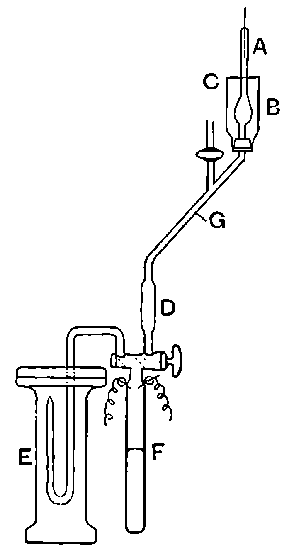
Fig. 61.
The emanation from 60 milligrams of radium bromide in solution was allowed to collect for 8 days and then drawn off through the inverted siphon E (Fig. 61) into the explosion burette F. This gas consisted for the most part of hydrogen and oxygen, produced by the action of the radiations on the water of the solution. After explosion, the excess of hydrogen mixed with emanation was left some time in contact with caustic soda, placed in the upper part of the burette, in order to remove all trace of carbon dioxide. In the meantime the upper part of the apparatus had been completely evacuated. The connection C to the pump was closed, and the hydrogen and emanation were allowed to enter the apparatus, passing over a phosphorous pentoxide tube D. The emanation was condensed in the lower part of the capillary tube A, by surrounding it with the tube B filled with liquid air. The process of condensation was rendered manifest by the brilliant luminosity of the lower part of the tube. The mercury from the burette was then allowed to run to G, and the apparatus again completely evacuated. The connection of the pump was again closed, the liquid air was removed and the volatilized emanation forced into the fine capillary tube A. Observations were then made, from day to day, of the volume of the emanation. The results are given in the table below.
Time Volume Time Volume
Start 0·124 cub. mm. 7 days 0·0050 cub. mm.
1 day 0·027 „ 9 „ 0·0041 „
3 „ 0·011 „ 11 „ 0·0020 „
4 „ 0·0095 „ 12 „ 0·0011 „
6 „ 0·0063 „ 28 „ 0·0004 „
The volume contracted with the time, and was very small after a month’s interval, but the minute bubble of the emanation still retained its luminosity to the last. The tube became deep purple in colour, which rendered readings difficult except with a strong light. There was a sudden decrease in the first day, 291which may have been due to the mercury sticking in the capillary tube.
The experiments were repeated with another capillary tube and the volume of gas observed at normal pressure was 0·0254 c. mm. The gas obtained was found to obey Boyle’s law within the limit of experimental error over a considerable range of pressure. But, unlike in the first experiment, the gas did not contract but expanded rapidly during the first few hours, and then more slowly, finally reaching a volume after 23 days of 0·262 c. mm. or about 10 times the initial volume. The measurements were complicated by the appearance of bubbles of gas in the top of the mercury column. The differences observed in these two experiments are difficult to account for. We shall see, later, that the emanation always produces helium, and, in the first experiment, the decrease of the volume to zero indicates that the helium was buried or absorbed in the walls of the tube. In the second case, probably owing to some difference in the glass of the capillary tube, the helium may have been released. This suggestion is confirmed by the observation that the volume of gas, after the experiment ended, gave a brilliant spectrum of helium.
We shall see later that there is considerable evidence that the α particles expelled from radio-active substances consist of helium atoms. Since the particles are projected with great velocity, they will first be buried in the walls of the tube, and then may gradually diffuse out into the gas again under conditions probably depending on the kind of glass employed. Since α particles are projected from the emanation and also from two of the rapidly changing products which arise from it, the volume of helium should, on this view, be three times the initial volume of the emanation. If the helium produced escaped from the walls of the tube into the gas, the apparent volume of the gas in the capillary should increase to three times the initial volume in a month’s interval, for during that time the emanation itself has been transformed into a solid type of matter deposited on the walls of the tube.
Ramsay and Soddy concluded from their experiments that the maximum volume of emanation to be obtained from 1 gram of radium was about 1 cubic millimetre at standard pressure 292and temperature, and that the emanation was produced from 1 gram of radium at the rate of 3 × 10⁻⁶ c. mm. per second. This amount is in very good agreement with the calculated value, and is a strong indication of the general correctness of the theory on which the calculations are based.
173. Spectrum of the emanation. After the separation of the emanation and the determination of its volume, Ramsay and Soddy made numerous attempts to obtain its spectrum. In some of the earlier experiments several bright lines were seen for a short time, but these lines were soon masked by the appearance of the hydrogen lines. In later experiments Ramsay and Collie[267] succeeded in obtaining a spectrum of the emanation, which persisted for a short time, during which a rapid determination of the wave-lengths was made. They state that the spectrum was very brilliant, consisting of very bright lines, the spaces between being perfectly dark. The spectrum bore a striking resemblance in general character to the spectrum of the gases of the argon family.
The spectrum soon faded, and the spectrum of hydrogen began to appear. The following table shows the wave-length of the lines observed in the spectrum. The degree of coincidence of the lines of known wave-lengths shows that the error is probably less than five Ångström units.
Wave-length Remarks
6567 Hydrogen C; true wave-length, 6563; observed each time.
6307 Observed only at first; evanescent.
5975 „ „ „
5955 „ „ „
5805 Observed each time; persistent.
5790 Mercury; true wave-length, 5790.
5768 „ „ 5769.
5725 Observed only at first; evanescent.
5595 Observed each time; persistent and strong.
5465 Mercury; true wave-length, 5461.
5105 Not observed at first; appeared after some seconds; persisted and was visible during the second examination.
4985 Observed each time; persistent and strong.
4865 Hydrogen F; true wave-length, 4861.
4690 Observed only at first.
4650 Not observed when the emanation was examined again.
4630 „ „ „
4360 Mercury: true wave-length, 4359.
293The experiments were repeated with a new supply of emanation, and some of the stronger lines were observed again, while some new lines made their appearance. Ramsay and Collie suggest that the strong line 5595 may be identical with a line which was observed by Pickering[268] in the spectrum of lightning, and was not identified with the spectrum of any known gas.
Until large quantities of radium are available for the experimenter it would appear difficult to make sure how many of these lines must be ascribed to the spectrum of the emanation or to measure the wave-lengths with accuracy.
The results are of great interest, as showing that the emanation has a definite and new spectrum of the same general character as the argon group of gases to which, as we have seen, it is chemically allied.
Summary of Results.
174. The investigations into the nature of the radio-active emanations have thus led to the following conclusions:—The radio-elements thorium, radium and actinium continuously produce from themselves radio-active emanations at a rate which is constant under all conditions. In some cases, the emanations continuously diffuse from the radio-active compounds into the surrounding gas; in other cases, the emanations are unable to escape from the material in which they are produced, but are occluded, and can only be released by solution or by the action of heat.
The emanations possess all the properties of radio-active gases. They diffuse through gases, liquids, and porous substances, and can be occluded in some solids. Under varying conditions of pressure, volume, and temperature, the emanations distribute themselves in the same way and according to the same laws as does a gas.
The emanations possess the important property of condensation under the influence of extreme cold, and by that means can be separated from the gases with which they are mixed. The radiation from the emanation is material in nature, and consists of a stream of positively charged particles projected with great velocity.
294The emanations possess the property of chemical inertness, and in this respect resemble the gases of the argon family. The emanations are produced in minute amount; but a sufficient quantity of the radium emanation has been obtained to determine its volume and its spectrum. With regard to their rates of diffusion, the emanations of both thorium and radium behave like gases of high molecular weight.
These emanations have been detected and their properties investigated by the property they possess of emitting radiations of a special character. These radiations consist entirely of α rays, i.e. particles, projected with great velocity, which carry a positive charge and have a mass about twice that of the hydrogen atom. The emanations do not possess the property of permanently radiating, but the intensity of the radiations diminishes according to an exponential law with the time, falling to half value, from actinium in 4 seconds, from thorium in one minute, and from radium in about four days. The law of decay of activity does not seem to be influenced by any physical or chemical agency.
The emanation particles gradually break up, each particle as it breaks up expelling a charged body. The emanation after it has radiated ceases to exist as such, but is transformed into a new kind of matter, which is deposited on the surface of bodies and gives rise to the phenomena of excited activity. This last property, and the connection of the emanation with it, are discussed in detail in the next chapter.
295