Chapter XVI · The Gist of it all.
Reading edition
And now we draw to the close this thesis on the racehorse in Australia. We have been, after all, but wandering upon the outskirts of a very vast subject, and were we proposing to indite a work for the use of experts—breeders, owners, trainers, even, let us add, punters—our thesis would swell into a large volume, our large volume into an encyclopaedia, and our encyclopaedia into a library. And the gist of it all? Is the entire business, with all its branches and ramifications, with all the employment offered by it to thousands of people, with all the land now in use for breeding, with all those beautiful parks reserved for racing purposes, in and near the great cities, is it all designed simply to furnish an Australian holiday? I do assure you that there is involved something a very great deal deeper than that. It is the horse, the whole future and welfare of the horse, that is the great stake for which we are playing, most of us unconsciously. The day of the noble animal is not over, and its future spells infinitely more than the mere fact of whether he can run a mile in a minute and 36 seconds, or whether he can cover three miles in 5.23. During the Boer War, such a short time since, but which seems to our children, perhaps, to have been waged centuries ago, we expended an enormous amount of horse life in a country where soldiers had 52perforce to be carried on horseback, and where all the supplies for an army were dragged upon wheels, and when motor power had not yet come into its own. And in the last great death grapple, with all the petrol which was exploded, with all the motor traction used, with all the amount of transport, and of scouting by air, we still required a larger horse supply than ever before. We cannot see so clearly into the future as did the poet Tennyson, when he wrote Locksley Hall. That wonderful seer, you may remember, wrote his poem in the early ’forties of the last century, and he predicted, as plainly as words could tell, the advent of the flying machine, for use both in commerce and in war, and “all the wonders that would be.” It is not given to many to possess the true prophetic vision, but it is a simple task to foretell that war has not yet ceased upon the earth, and that we have not even begun to make reaping hooks of our spears, or spades and ploughs and harrows of our guns. It is the improvement of our horse, for general utility purposes, and for war, that is really the motive which ought to promote this racing of ours, but which poor Sir Arthur Conan Doyle, in a fatuous moment, has lately dubbed “the curse of the country.”
If the supply of horseflesh is to be maintained, if we are not prepared to let the breed die out altogether, then horse racing is the only method whereby the standard can be preserved at a proper and efficient level. Shows, agricultural and otherwise, are powerless in their endeavour to accomplish this end. Magnificent looking creatures bred for the ring, only too surely and quickly prove themselves to be abject failures when tested on the course or in the field. Vitality, stamina, courage, soundness, are the qualities which we desire to perpetuate in our breeds. The show ring does not test a single one of these. The winning post must be our only guide.
Is it doing its duty in the matter? This might be a matter for endless debate, but it is safe to say that it is not doing that duty nearly so well as it might. For in our play we are so apt to forget that, after all, it is not only sport that we are following, but that perhaps the safety of our Australian nation lies in the qualities of endurance and of speed in those beautiful creatures which we are looking upon as our playthings of to-day. One’s mind invariably flies, whilst thinking over these matters, to a future and a possible “War of Defence.” Britain, let us imagine, is hampered with a Continental foe. America is on her back, and fighting for her life upon the seas. And we are lying here in the sunshine, a beautiful woman without means of defence, without oil for our motors, without ammunition for our guns, without horses for our men. With ammunition, and with half a million of splendid horses, and even more splendid men, we might do wonders, even without oil, until help could arrive. Without horses and ammunition we would be immediately destroyed. And we are not taking the trouble to breed chargers and transport horses for the purposes of war. Indian buyers, private dealers, your own eyesight, will tell you that we are not producing the quantity, nor the quality which we were so proud of fifty, forty, aye, even thirty years ago. We have become careless. Our young men do not desire the glorious companionship which their fathers enjoyed, that loving friendship between horse and man. They fizz through their stations now in a motor car, or possibly they even fly through the air to the back of the run, and are home for luncheon. Their sires and their grand-sires on these distant excursions camped out for nights, their saddle for a pillow, their horses, in hobbles, not far distant from their side. My young gentleman of to-day could do it all if he tried, but he does not care to ride, and hunting is a bore. But what will his son be? It is the old, old story. Read your Gibbon, study your Grote.
53“All Empires tumble, Rome and Greece,
Their swords are rust, their altars cold.”
You know the old and sacred saying, “At sunset, when the sky is red, you know that the weather will be fine,” and also, “When the fig tree putteth forth her leaves, ye know that summer is nigh.” And Rome and Greece fell because they would not take the trouble to see that the sky was red, or that the fig tree was putting forth her leaves. And we are travelling on exactly the same road. Not many people care to read about the “Buried Cities of Crete.” The story carries a tremendous lesson. The ancient Cretans, whose women wore high-heeled shoes, and hobble skirts, and other abominations of civilisation, were so strong in their sea power that they neglected the means of defence on land. Ruins, buried deep beneath the soil, tell us the sad story to-day. A foreign power, despised perhaps, but now grown strong, sprang at their throats so suddenly that it took the Islanders completely by surprise. The blackened walls, the charred rafters, thirty feet below ground, preach their sermon to those who care to read. Neither does one ever forget what took place at the great conference at Vienna between the Powers when Napoleon had at length been chained and was languishing in his little island kingdom and prison of Elba. There had been much discussion, bitter wrangling, but matters were at length approaching a more or less satisfactory conclusion. Then, unheralded, there burst into that august assembly a messenger, “bloody with spurring, fiery with hot haste.” “Napoleon has escaped and has landed in France.” A moment’s silence, and the ambassadors with one accord fell a-laughing. After all their grave debates, with the waste of so many millions of words, the whole edifice of their deliberations was thrown to the ground by one sweep of the hand. So may it be to-morrow. A League of Nations may meet and deliberate. The representatives, perhaps, will disagree. Ere they can turn round, one Power, which is, may be, the best prepared, declares war. Necessity, when nations are in dire distress, choking for air and starving for their daily bread, knows no law. Will we never learn our lesson not to put our trust in Princes, no, nor in the children of men? Therefore, let us foster our horses by every means in our power, and place our dependence rather upon them. And let us remember that the race course, the hunting-field, and the polo grounds are the nurseries and gymnasiums of the breeds both of horse and man. The thoroughbred is the keystone of the arch, the cornerstone of the building.
And yet one knows so well that prophecy is all in vain, that our rulers only smile and imagine a vain thing, and that no seer has any honour in his own country, until the words are proven to be true, and then it is all too late. Bitter was the fate of Cassandra, that ancient prophetess of Troy, whom no man could believe, and bitter still the lot of anyone who tries once more to read the writing on the wall, and give it voice.
“Then like a raven on the wind of night
The wild Cassandra flitted far and near,
Still crying, ‘Gather, gather for the fight,
And brace the helmet on and grasp the spear,
For lo, the legions of the night are here!’
So shriek’d the dreadful prophetess divine;
But all men mock’d and were of merry cheer;
Safe as the Gods they deem’d them, o’er their wine.”
But, with the tremendous importance of the end in view, the improvement of the thoroughbred horse, is our sport sufficiently fulfilling that end? That is 54a question which is indeed a hard one to determine, and one great camp may give its voices to the “Ayes,” and one may roar in unison for “No.”
There is one thing, and perhaps only one thing, quite certain. Our horse has increased in size. The fifteen-hands-two of the great winners of a hundred years ago have swollen in their average dimensions somewhere in the neighbourhood of sixteen-two. This may not, however, indicate allround improvement. A good big one, we know, is better than a good little one on the course, but I question if the rule holds good, either in the battle or the hunting-field. Ormonde beat The Bard because he outstrode him down the Epsom hill, but The Bard might have carried his master, with his twelve stone ten, had he had the opportunity, more safely and more speedily to the end of a forty minutes run, than his great conqueror on the race course over the mile and a half of Epsom Downs.
And we have gained in speed. There can be little doubt of that. If the inexorable test of the “Winning Post” has not compelled us to breed from our best, and if, in the course of the flying centuries, the result has not been a march upwards, then Heaven help us and our methods. But do you think that stamina and soundness have improved along with our size and our speed? That, too, is hard to tell. And yet it is probable that it is so. Races now are real tests of the stayer. In the days of Fisherman, and Voltigeur, The Flying Dutchman, Plenipotentiary, Bay Middleton, and before their time, races were not run in a manner to prove stamina. More frequently there was much loitering on the way in the two, three, and four mile bouts between the steeds of our ancestors. To-day we run the two miles all the way from pillar to post, and Archer’s three minutes and fifty-two seconds for the Melbourne Cup has dwindled to the three twenty-four and a half claimed by Artilleryman. Twenty-seven seconds difference means at least two furlongs, and that takes catching. Well, admitting that we have marched forwards in the matter of both speed and stamina, surely there is much more unsoundness to-day than there was one hundred years ago, or even fifty years since. At the first blush one would say “Yes.” But on second thoughts one does not feel quite so sure. Herod was “a bleeder,” and bleeding has been not uncommon in his descendants. It is one hundred and sixty-four years ago since Herod was foaled. We rear regiments of racers now, where our forebears bred squadrons. And yet “bleeding” is not so very rife after all. But we hear more about it, with an active press focussing its microscope on every individual racer in the land. And roaring, you ask? Well, Pocahontas roared, and Prince Charlie made a fearful noise, and Belladrum was indistinguishable from a fog-horn, and Ormonde did more than whistle, but in Australia, at least, this is a defect, an actual unsoundness, which we do not so very often see—or hear. But we are breeding bad knees, bad feet, and round joints, and with the extra weight of the enlarged frames, ligaments and muscles cannot bear the strain. Yet this was always so. Bay Middleton had a mysterious foot and leg, Whalebone’s near fore-foot was contracted, and all were “pumiced”—whatever that might mean. He was “the most double-jointed horse I ever saw in my life,” was the verdict of that celebrity’s groom. Whitelock was “a naggish horse with a big, coarse head and plumb forelegs.” Flat, thin-soled feet were the “bane of lazy Lanercost,” Rataplan “always went proppy on his long fore pasterns,” and “Dundee’s suspensory ligament went so badly in the Derby that after that race his fetlock nearly touched the ground.” Partisan had a “clubby foot.” Touchstone had “very fleshy legs,” and his “near fore ankle was never very good.” And so on we could go, from the Adam of horses to our own most rapid, modern times, which these 55grandchildren of ours will shortly call “the old times.” But I cannot say if the “Sport” is improving; I fancy not. I was talking to Walter Hickenbotham the other day, the doyen of the profession of trainers, or at least one running in double harness in that capacity with old Harry Rayner, of Randwick. Walter was recalling the “old days” of his youth. Meetings were fewer then, and railways were a comparative rarity where his paths led him. Mr. C. M. Lloyd was his “boss.” Riding a mare and leading Swiveller, Walter would leave the station on one of those beautiful, bright, health-giving mornings of the late summer or early autumn, with just a touch of frost in the clear air. The boy, with the buggy and the gear, the feed, and all the other necessaries, had gone on before. From station to station, ’twixt sunrise and sundown, the little cavalcade would press steadily on. Mr. Lloyd, no doubt, would follow in a few days with his tandem or the four-in-hand. And so from meeting to meeting they would go. Round Wagga, Hay, Bathurst, Deniliquin, Gundagai, Goulburn, a great circuit, would they wander, taking with them the romance and glamour of the Turf in their train. You can imagine the stir and enthusiasm at the stations as they came. Nothing was too good for them, either for man or beast. Everyone welcomed them, and the old greybeards, in the evenings, beneath the big gum tree, while the boxes were being done out, and the horses meanwhile were held in the shade, would talk horse, and nothing but horse, by the yard. Some might even remember having seen Rous’ Emigrant or Manto, and another might have come from Yorkshire, and had known all about Sledmere and Sir Tatton Sykes. And the racing was more for the fun of the thing then, and the owners betted more like gentlemen between themselves. And ere the country circuit was completed, horse and man had travelled almost a thousand miles, and had won many a Cup, and much fine gold. And then, calling in at the station to drop their burdens, they would be off to the Metropolis to take down the numbers of the swells which trained there, ere settling down for the short, dark winter days at home. Good days those, jolly days, grand days! And is it not so good now? No? Alas! I fear that it is not in the sport, not in the horses, not in the world at large, that we find changes for the worse. All things are developing, evolving, marching upwards. It is in us, the individual men, to whom we must look to find “the weary change.” And yet even we must take comfort.
“Tho’ much is taken, much abides; and tho’
We are not now that strength which in old days
Moved heaven and earth; that which we are we are.”
57
PAINTINGS OF RACEHORSES
BY MARTIN STAINFORTH
58The figures in brackets are the Bruce Lowe family numbers of each horse. (†) signifies no family number.
59
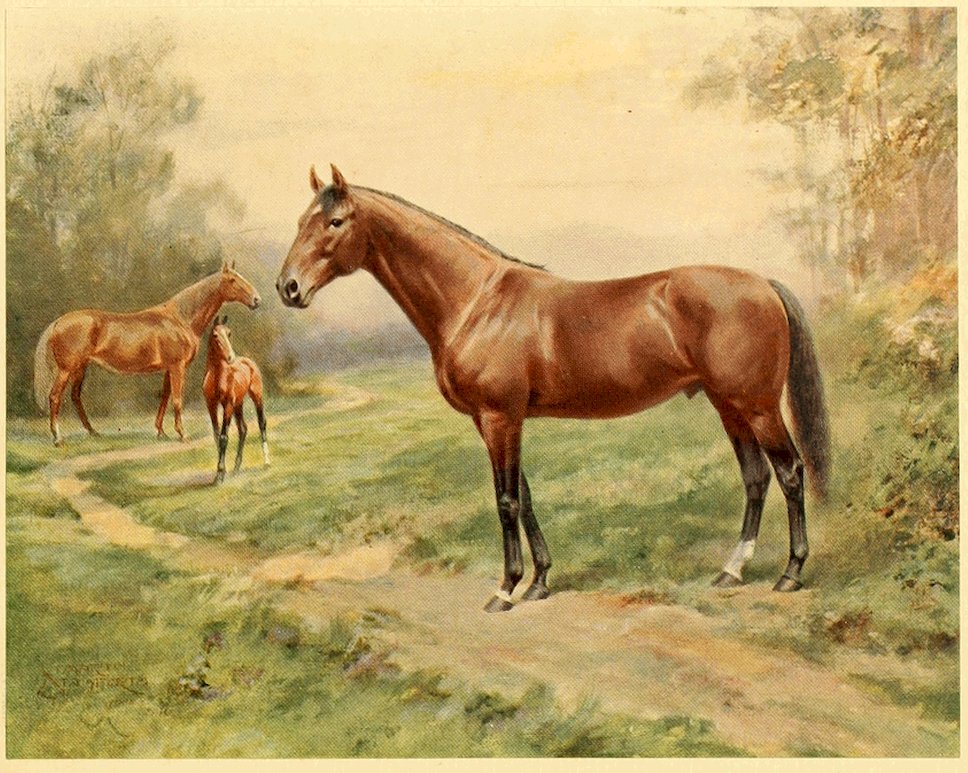
PLATE 2. MUSKET (3) imp. Brown Horse, 1867, by Toxophilite—half sister to Gen. Peel’s dam. Winner of the Ascot Stakes, and 9 of his 11 last races. Imported to New Zealand in 1878. Sire of Carbine, Trenton, Hotchkiss, Nordenfeldt, Maxim, Martini-Henri, etc. Died 1885. From a painting of the horse, at the age of 18 years, in the possession of the artist.
61
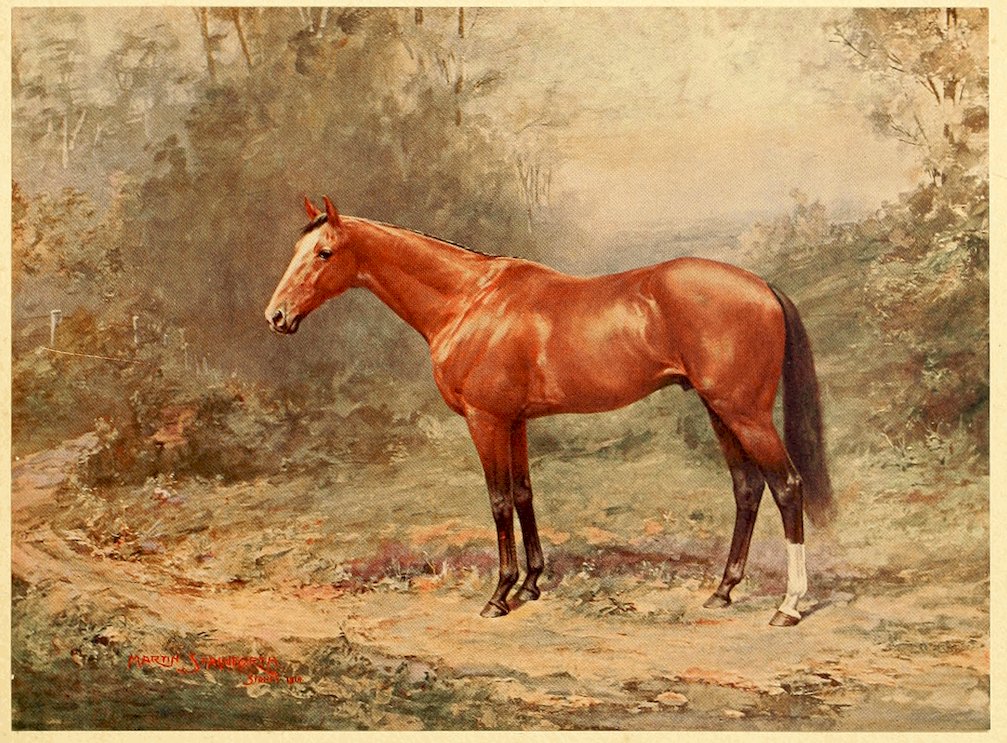
PLATE 3. CARBINE (2). Bay Horse, 1885, by Musket (imp.)—Mersey (imp.). Winner of £29,626. Sire in Australia of Wallace, La Carabine, etc. Exported to England in 1895, where he sired Spearmint, Greatorex, Fowling Piece, etc. Died 1914 at Welbeck, England. From a painting of the horse, at the age of 6 years, in the possession of Mr. F. G. White.
63
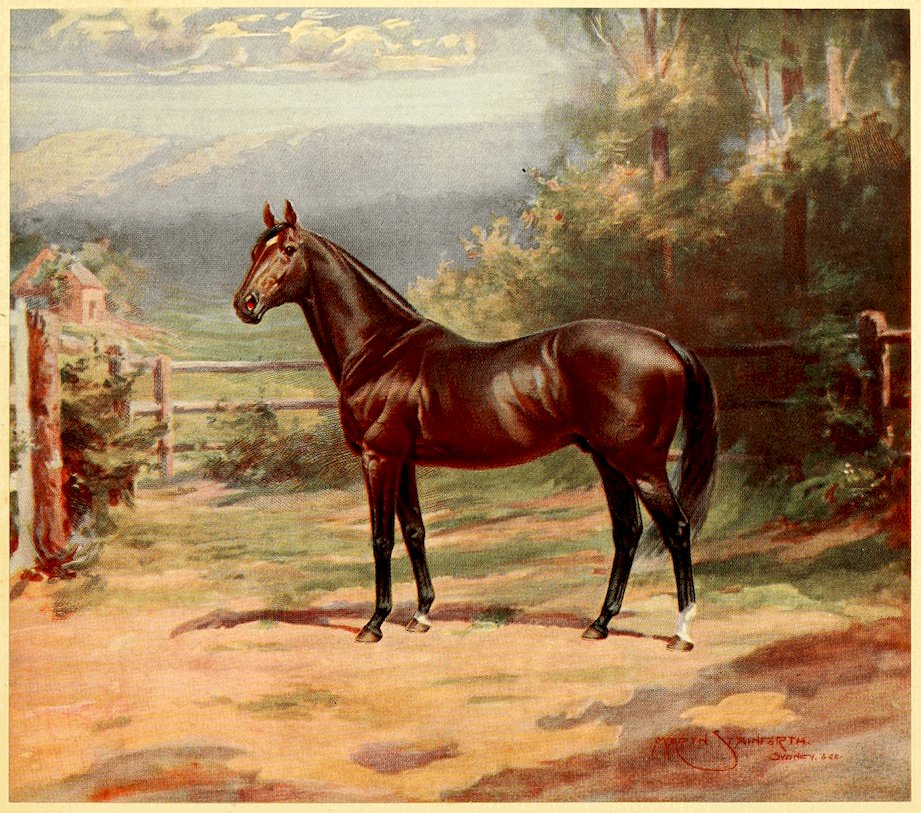
PLATE 4. TRENTON (18). Brown Horse, 1881, by Musket (imp.)—Frailty. Winner of good races in N.Z. and Australia, and sire of Wakeful, Aurum, Revenue, Auraria, etc. Exported to England in 1895, where he sired Torpoint, etc. Died 1905. From a painting of the horse, at the age of 14 years, presented to the A.J.C. by Sir William Cooper.
65
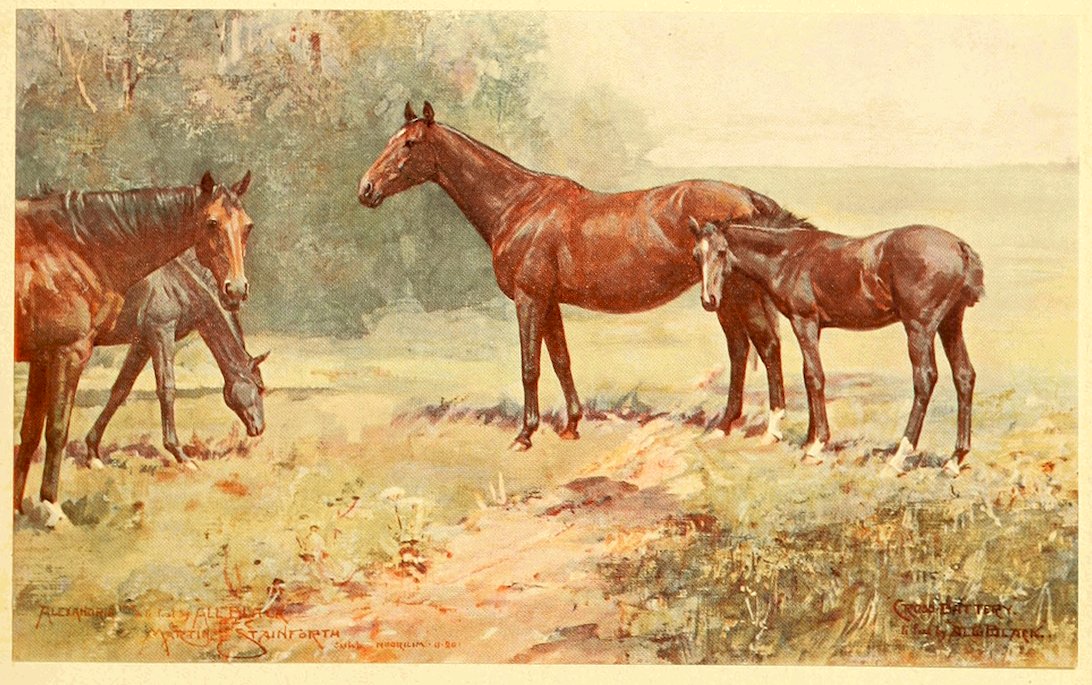
PLATE 5. CROSS BATTERY (7). Brn. Mare, 1902, by Stepniak—Firecross. Dam of Artilleryman (Melb. Cup), and ALEXANDRA (13) imp., Bay Mare, 1904. Dam of Kingsburgh (Melb. Cup), by Persimmon—Ambleside. With foals at foot by All Black (imp. sire of Desert Gold, etc.). The property of Mr. Norman Falkiner, Noorilim, Victoria. From a painting of the mares, at the ages of 18 and 16 years respectively, in the possession of Mr. Falkiner.
67
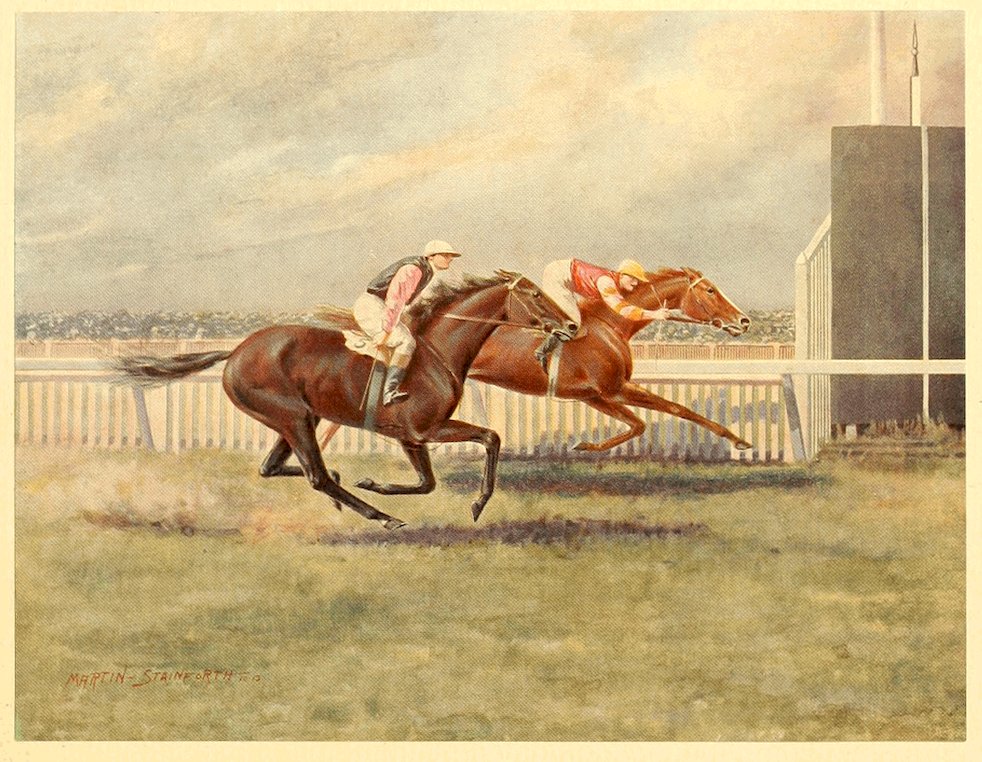
PLATE 6. THE FINISH FOR THE V.R.C. FLYING STAKES, 1902, 7 furlongs, Flemington, Victoria. Ibex, ridden by Jas. Barden, steals the race from the great Wakeful. From a painting in the possession of Jas. Barden.
69
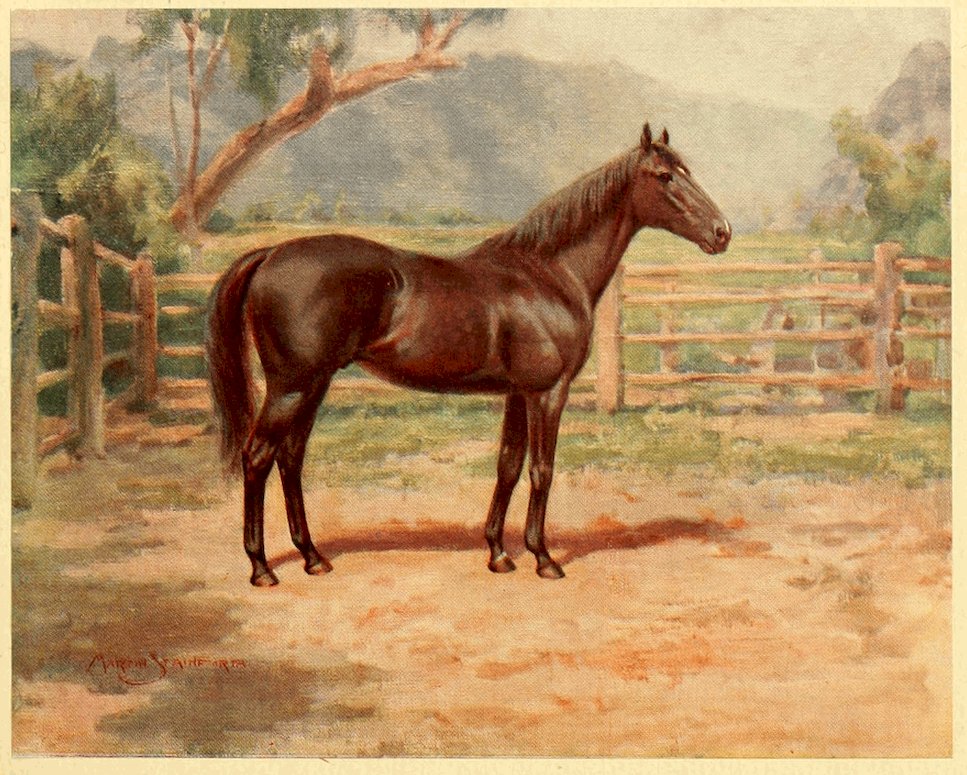
PLATE 7. MALTSTER (21). Brown Horse, 1897, by Bill of Portland (imp.)—Barley (imp.). Winner of the A.J.C. and V.R.C. Derbies, etc. Premier sire of Australia on five different occasions, among his progeny being Alawa, Malt King, Desert Rose, Popinjay, Maltine, etc. From a painting of the horse, at the age of 23 years, in the possession of the artist.
71
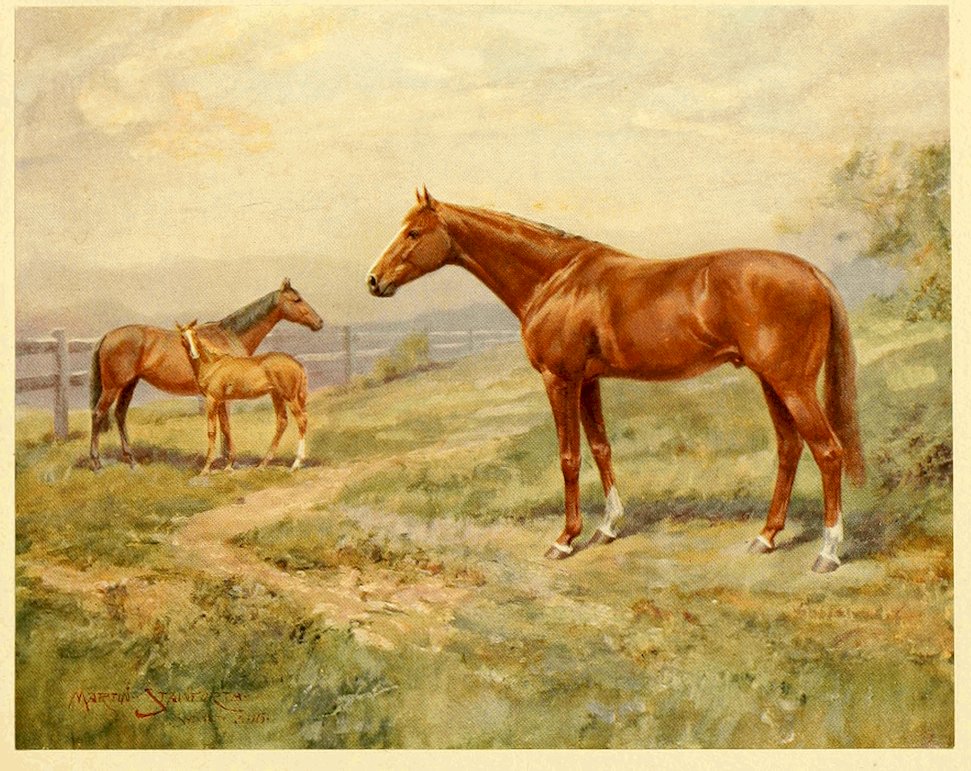
PLATE 8. WALLACE (3). Ches. Horse, 1892, by Carbine—Melodious. Winner of £6,116, including V.R.C. Derby, Sydney Cup, etc. Sire of winners of over £250,000, including Trafalgar, Aurous, Emir, Mountain King, etc. Died in 1917. From a painting of the horse, at the age of 12 years, in the possession of the artist.
73
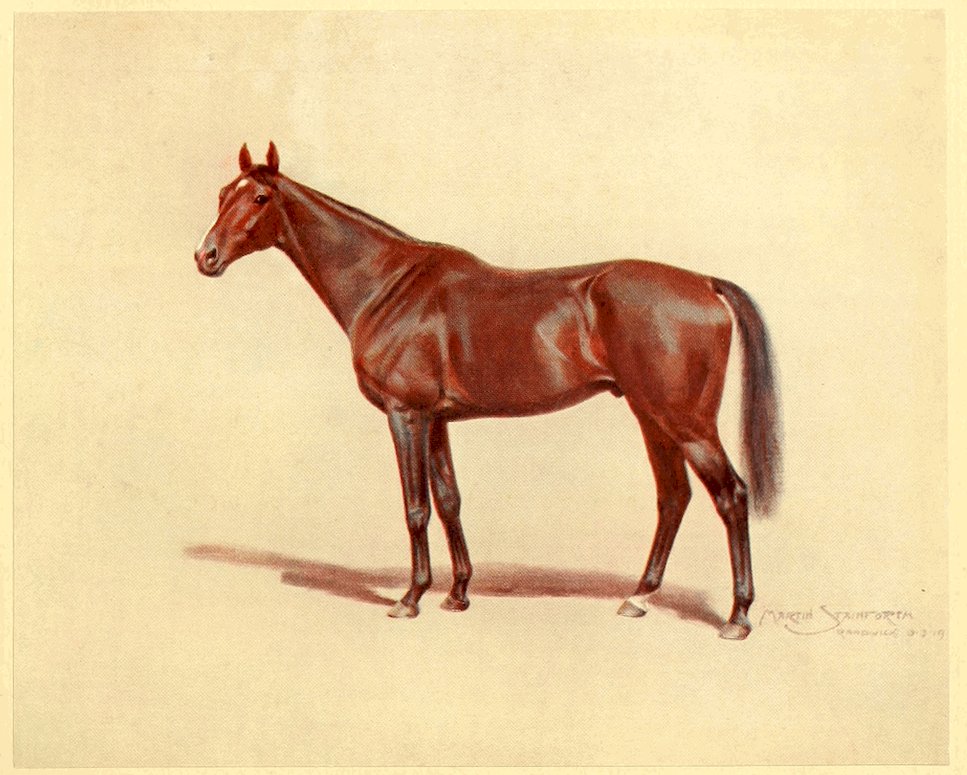
PLATE 9. LANIUS (7) imp. Brown Horse, 1911, by Llangibby—Mesange. Winner in England of the Rous Memorial Stakes, Jockey Club Stakes, and £11,406. Imported to Australia in 1917 and won A.J.C. Plate, Cumberland Stakes, etc., before retiring to the stud in 1919. The property of Dr. Syme, Victoria. From a painting of the horse, at the age of 8 years, in the possession of Mr. Ken Austin.
75
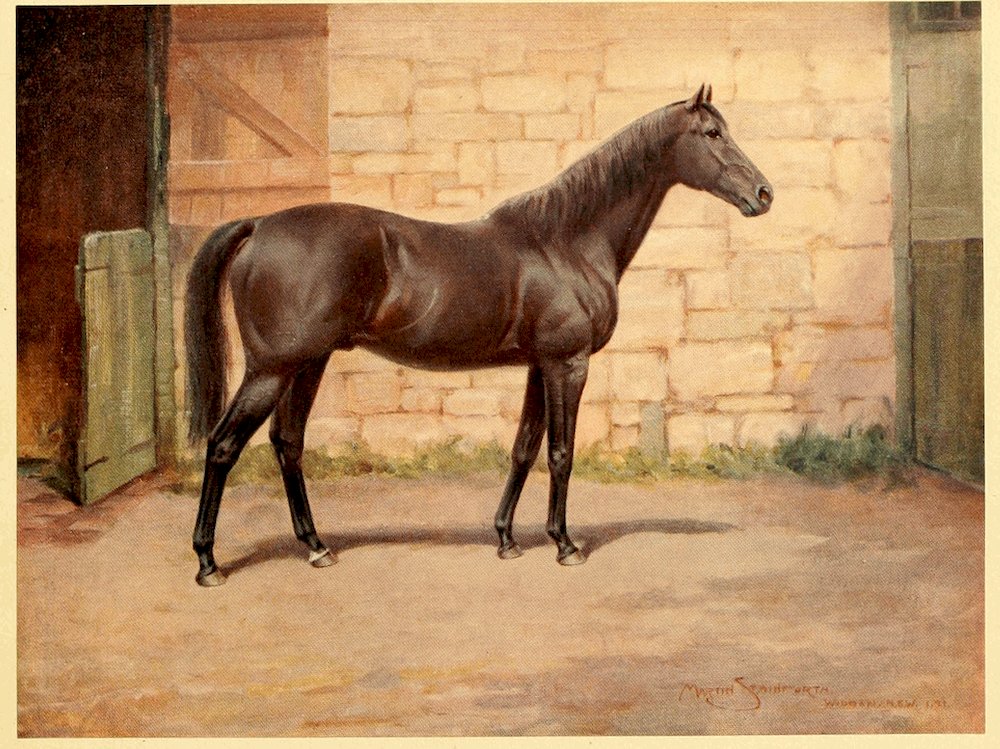
PLATE 10. LINACRE (8 imp.). Bay Horse, 1904, by Wolf’s Crag—Lismaine. Winner Champion Breeders’ Foal Stakes, Atlantic Stakes, etc. One of the leading sires of Australia; his progeny include Dame Acre, Mistico, Tangalooma, Panacre, Lordacre, etc. The property of Messrs. A. W. and A. E. Thompson, Widden Stud, N.S.W. From a painting of the horse, at the age of 17 years, in the possession of the artist.
77
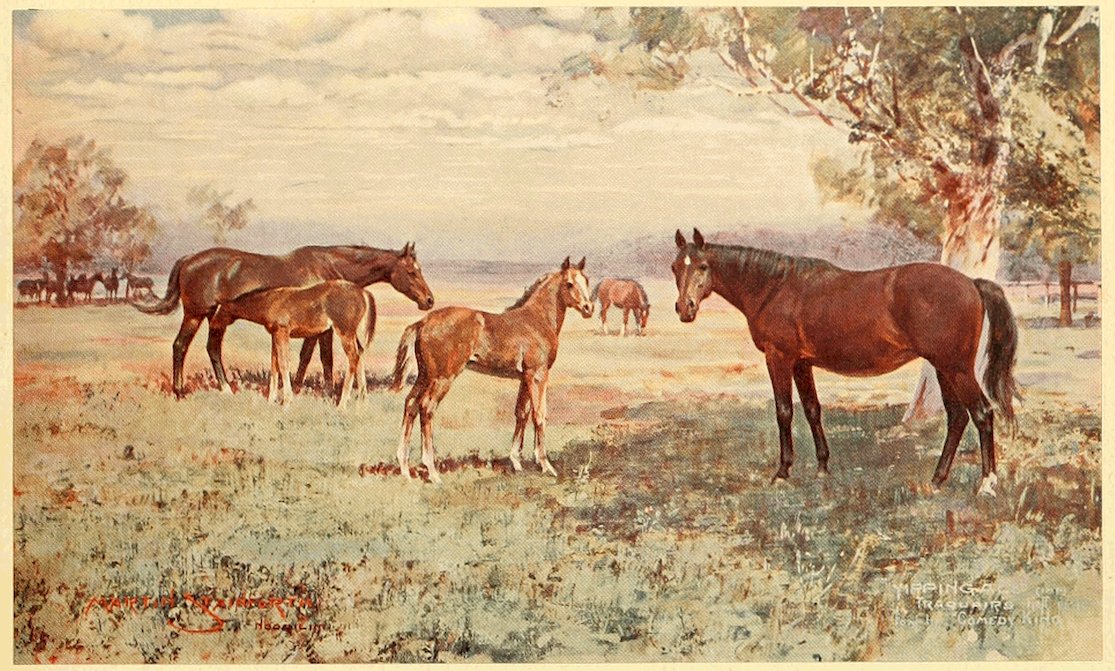
PLATE 11. YIPPINGALE (1) imp. Bay Mare, 1909, half sister to Traquair (imp.), by William the Third—Chelandry. With foal at foot by Comedy King (imp.). The property of Mr. Norman Falkiner, Noorilim, Victoria. From a painting of the mare, at the age of 11 years, in the possession of Mr. Falkiner.
79
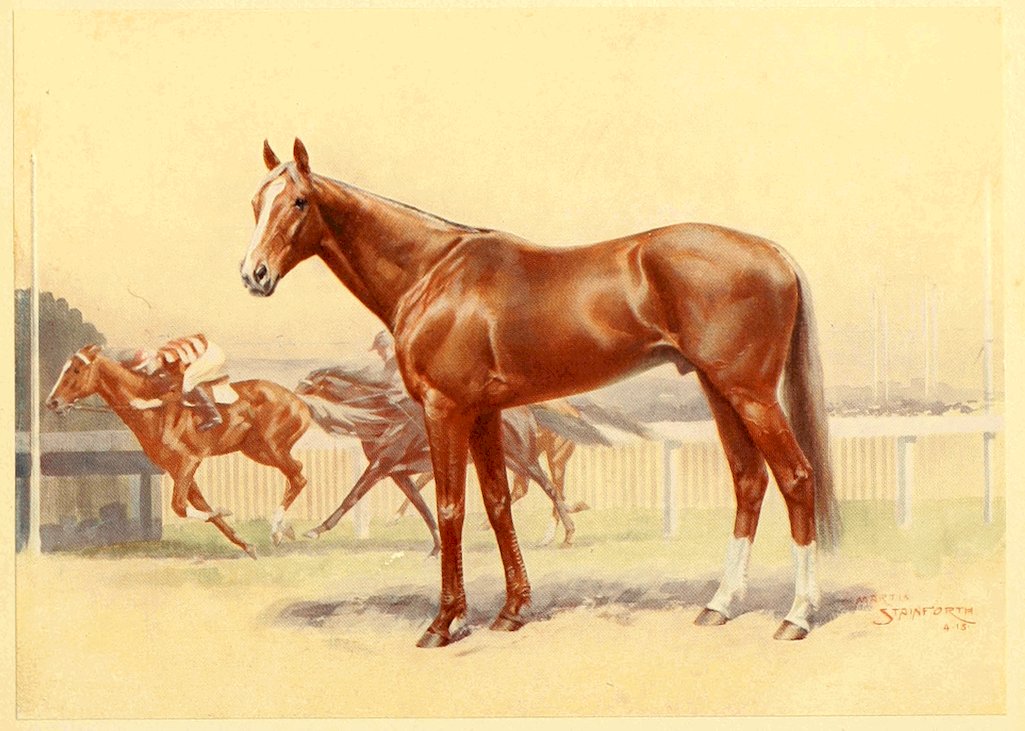
PLATE 12. TRAFALGAR (4*). Ches. Horse, 1905, by Wallace—Grand Canary. Winner of £22,111, and a high-class stayer. Now at the stud in N.S.W. Sire of Visibility, Heart of Oak, Annexit, etc. Owned by the Executors of the late Walter Mitchell, N.S.W. From a painting of the horse, at the age of 7 years, in the possession of Dr. Stewart McKay.
81
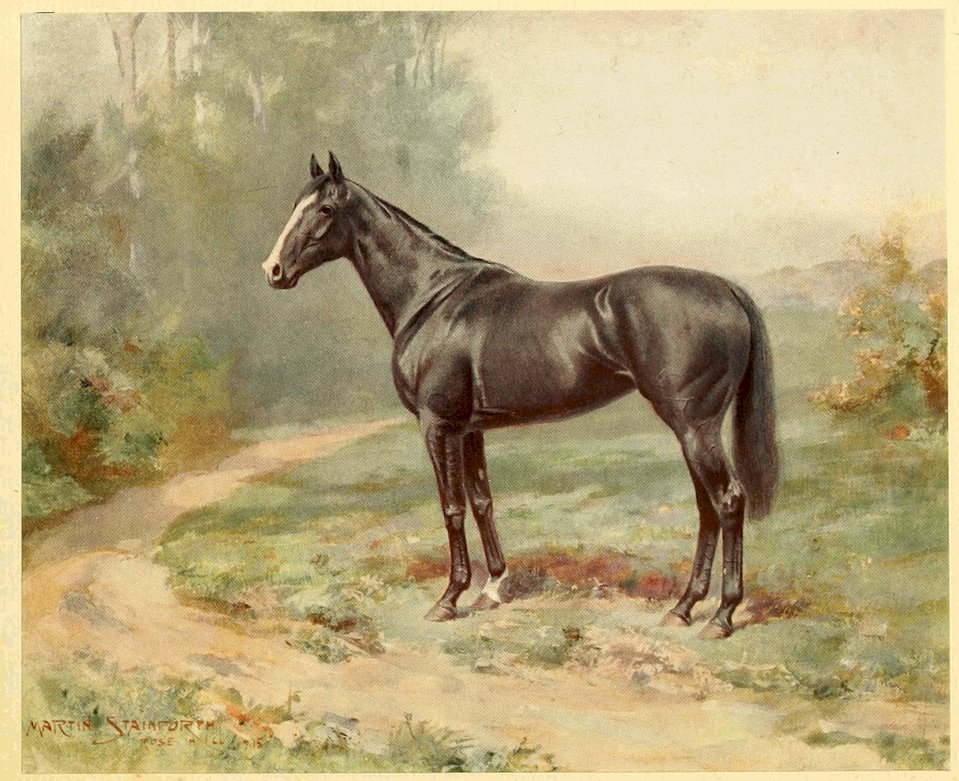
PLATE 13. BRATTLE (1). Brown Mare, 1910, by Maltster—Astron. Winner V.A.T.C. Oakleigh Plate, etc. Owned by Mr. W. Booth, N.S.W. From a painting of the mare, at the age of 4 years, in the possession of Dr. Stewart McKay.
83
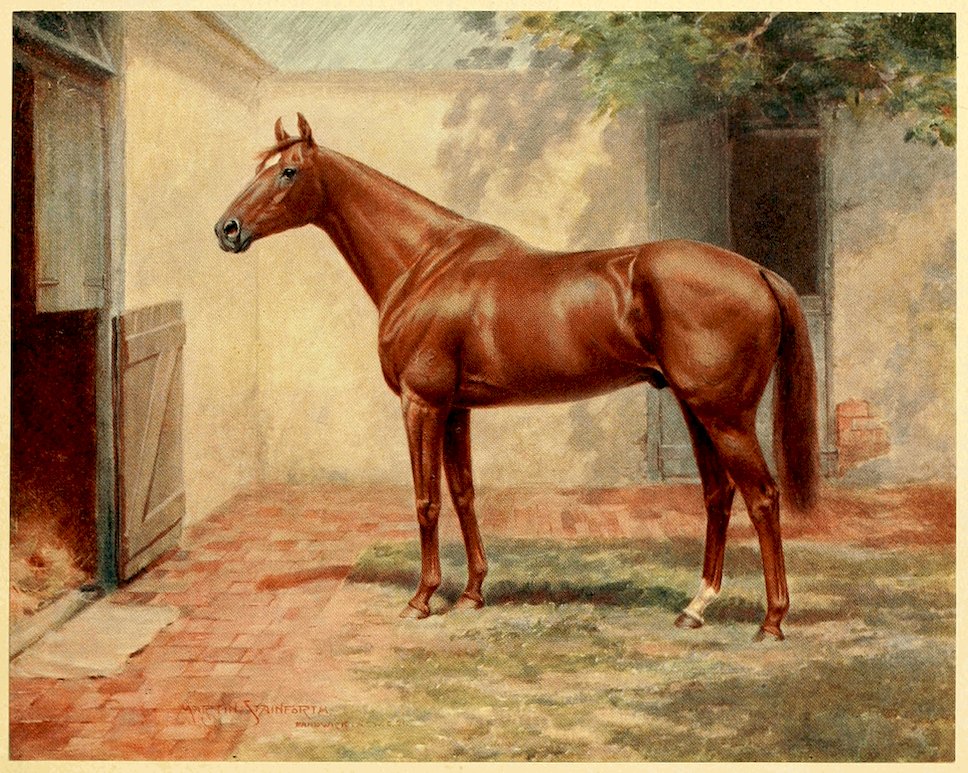
PLATE 14. POITREL (3). Ches. Horse, 1914, by St. Alwyne (imp.)—Poinard. Winner of £26,919, including Melbourne Cup carrying 10 st., and all the principal long-distance weight-for-age races of Australia. A very high-class stayer. Retired to his owners’ (Messrs. W. and F. A. Moses) stud in 1921. From a painting of the horse, at the age of 6 years, in the possession of the artist.
85
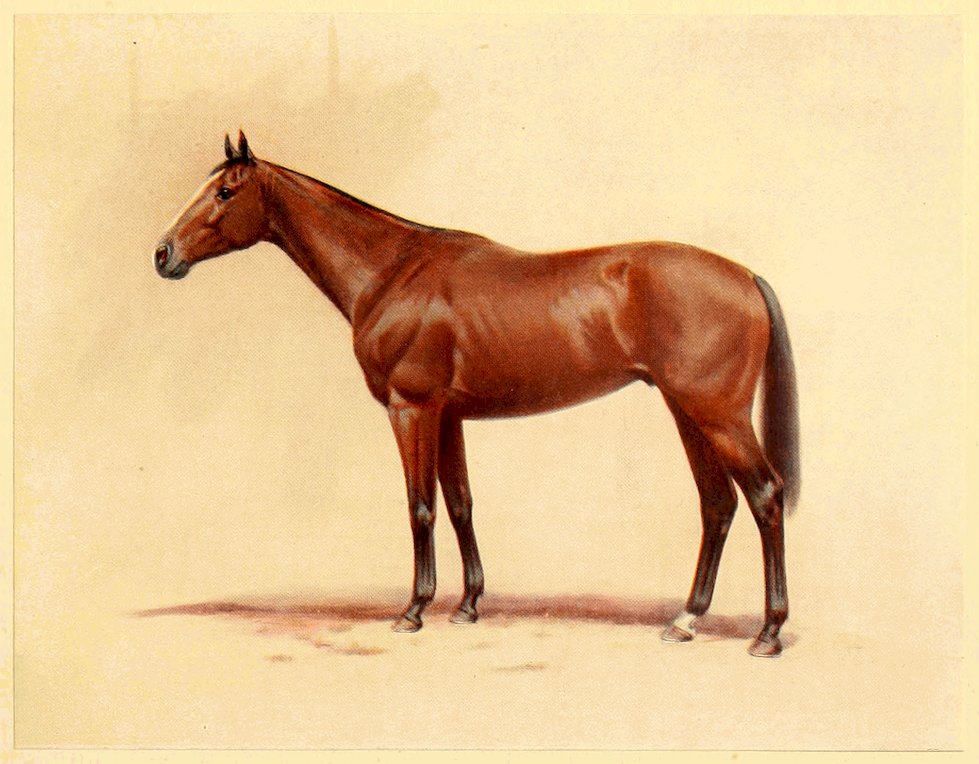
PLATE 15. GLOAMING (26). Bay Gelding, 1915, by The Welkin (imp.)—Light (imp.). Winner of 43 races out of 46 starts to date of publication, and £28,443. One of the most brilliant horses bred in Australia. Owned by Mr. G. D. Greenwood, N.Z. From a painting of the horse, at the age of 6 years, in the possession of the artist.
87
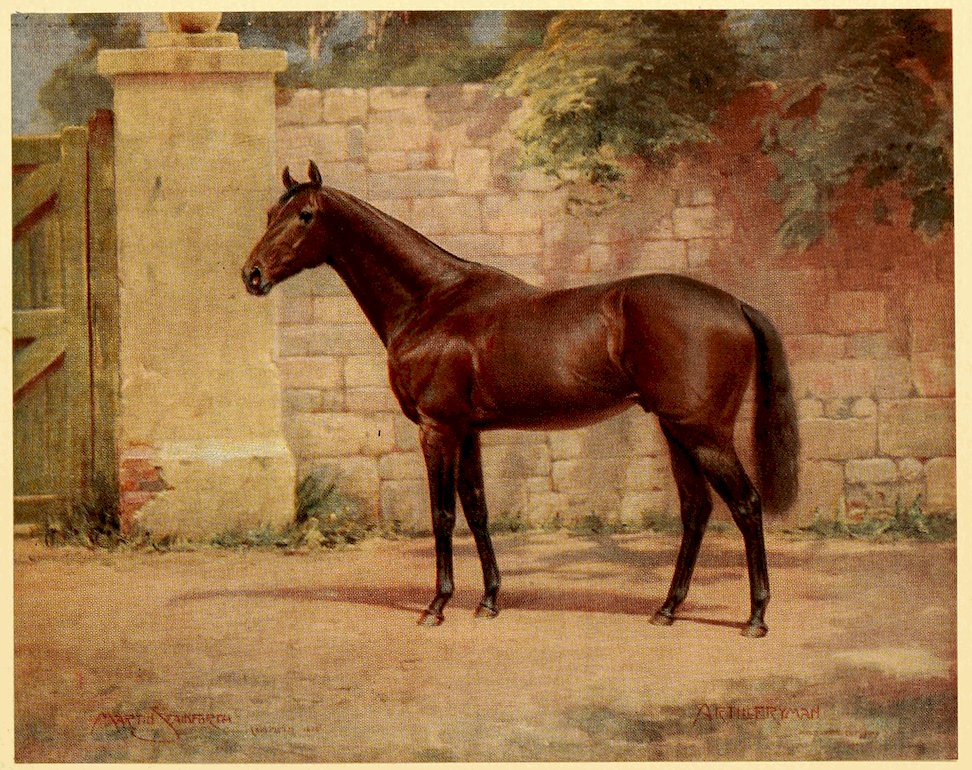
PLATE 16. ARTILLERYMAN (7). Brown Horse, 1916, by Comedy King (imp.)—Cross Battery. Winner V.R.C. Melbourne Cup, dead-heated A.J.C. Derby, etc. Died in 1920. From a painting of the horse, at the age of 4 years, presented to the A.J.C. by Sir Samuel Hordern.
89
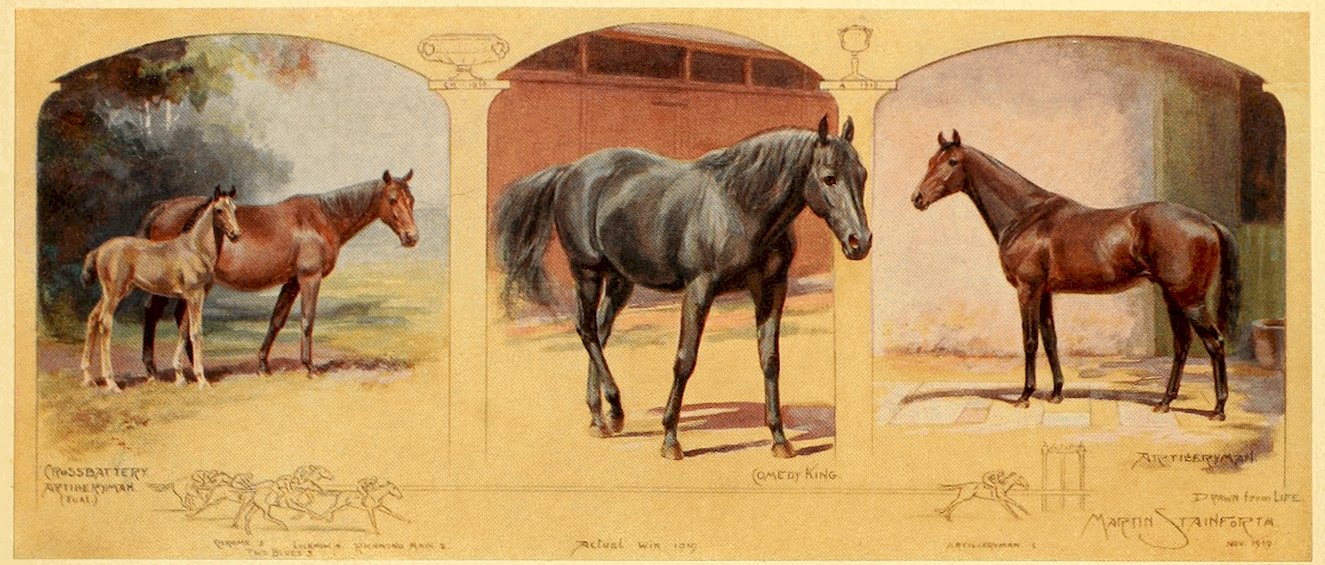
PLATE 17. TRIPTYCH. Cross Battery, with Artilleryman as a foal at foot in 1916. Comedy King (imp.) the sire of Artilleryman. Artilleryman, winner of the V.R.C. Melbourne Cup, 1919. From a painting in the possession of Sir Samuel Hordern.
91
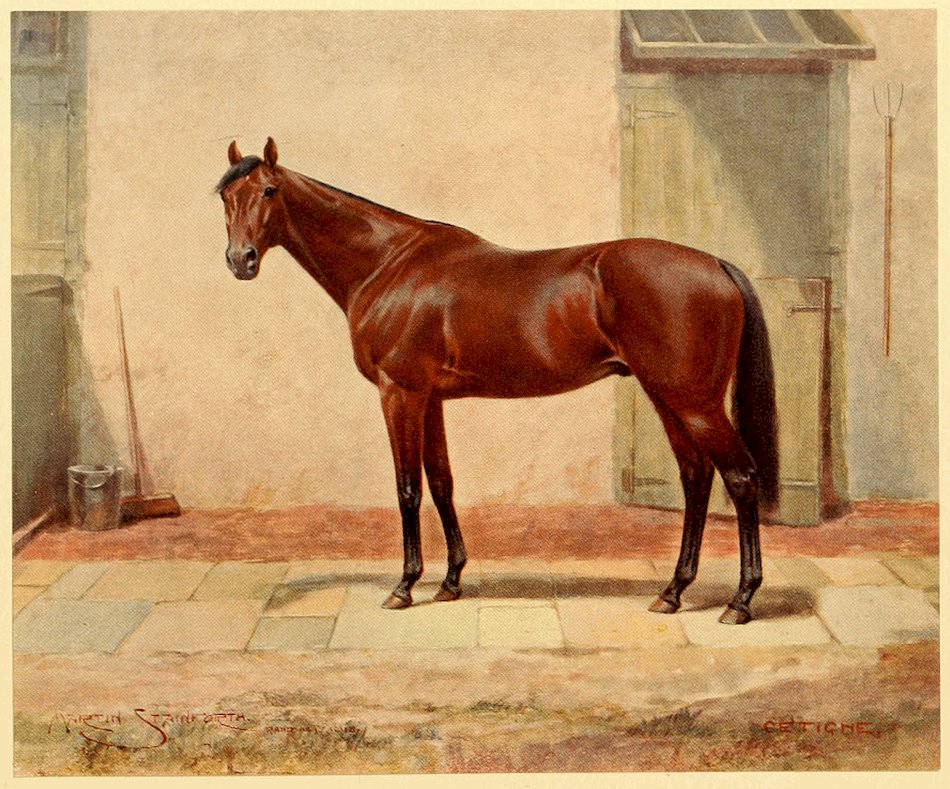
PLATE 18. CETIGNE (29). Bay Horse, 1912, by Grafton (imp.)—Pretty Nell. Winner of £27,216, and second on the list of winning Australian racehorses. Retired to the stud in 1921. Owned by Mr. T. A. Stirton, Dunlop Stud, N.S.W. From a painting of the horse, at the age of 7 years.
93
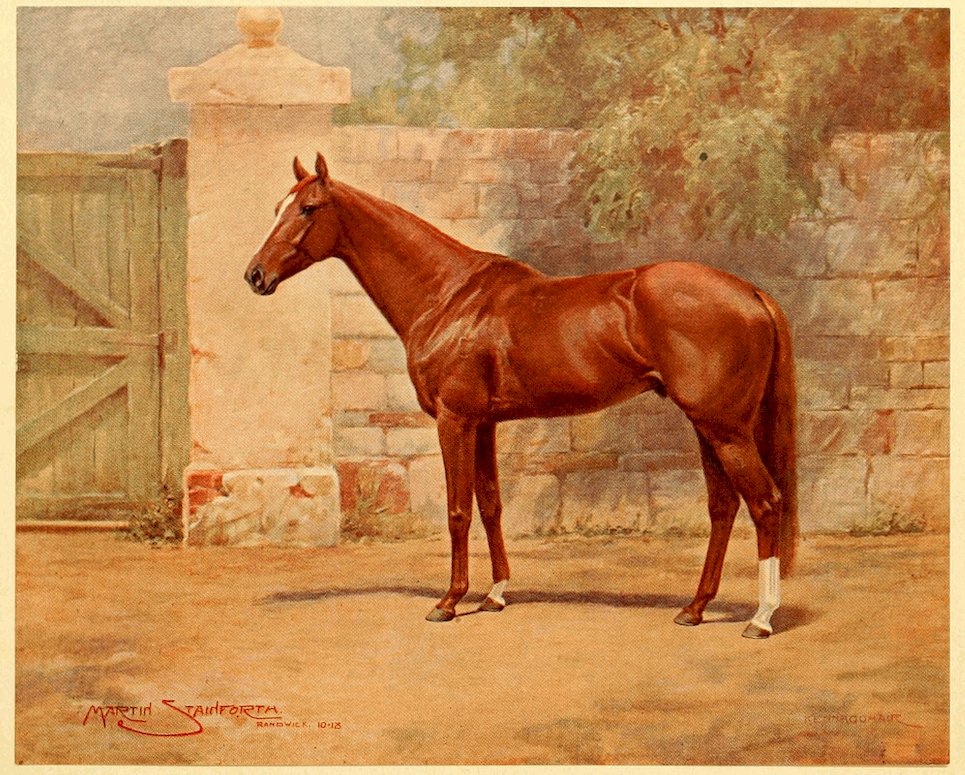
PLATE 19. KENNAQUHAIR (2). Ches. Horse, 1914, by Kenilworth (imp. Fr.)—Calluna. Winner of £17,126, and a very fine individual and stayer. Retired to the Mungie Bundie Stud in 1922. From a painting of the horse, at the age of 6 years, in the possession of Mr. W. M. Borthwick.
95
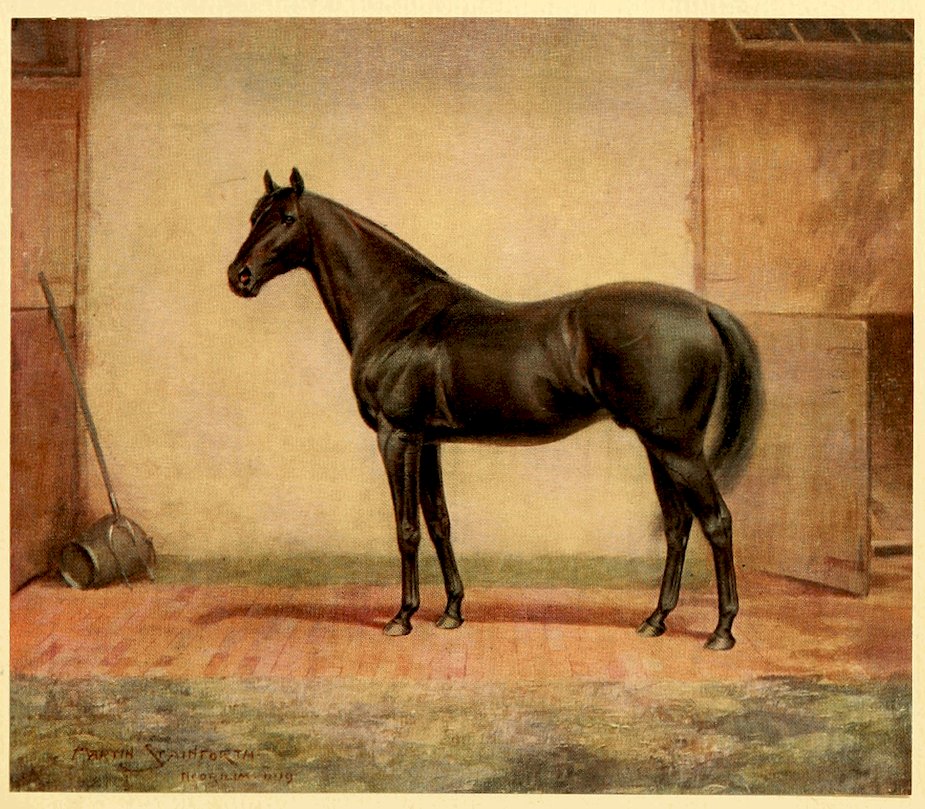
PLATE 20. COMEDY KING (7) imp. Black Horse, 1907, by Persimmon—Tragedy Queen. Winner of the Melbourne Cup, V.R.C. All-Aged Stakes, etc., and £12,945. One of the most successful stallions in Australia, having sired Artilleryman, Biplane, Fiscom, Folly Queen, etc. The property of Mr. Norman Falkiner, Noorilim Stud, Victoria. From a painting of the horse, at the age of 13 years, in the possession of Mr. Ken. Austin.
97
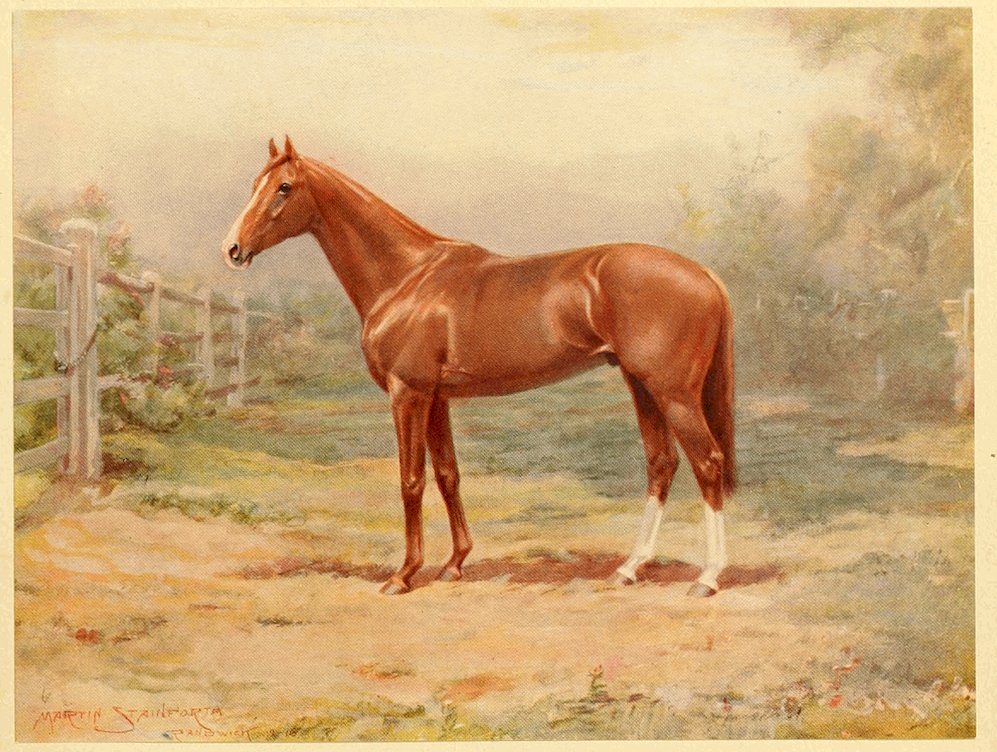
PLATE 21. WOORAK (31). Ches. Horse, 1911, by Traquair (imp.)—Madam. Winner of £17,000, and the most brilliant horse of his time. Retired to the stud in 1917 and a very successful stallion. Sire of Soorak, Salrak, Yanda, etc. Raced by Mr. L. K. S. Mackinnon, Victoria. From a painting of the horse, at the age of 5 years, in the possession of Dr. Stewart McKay.
99
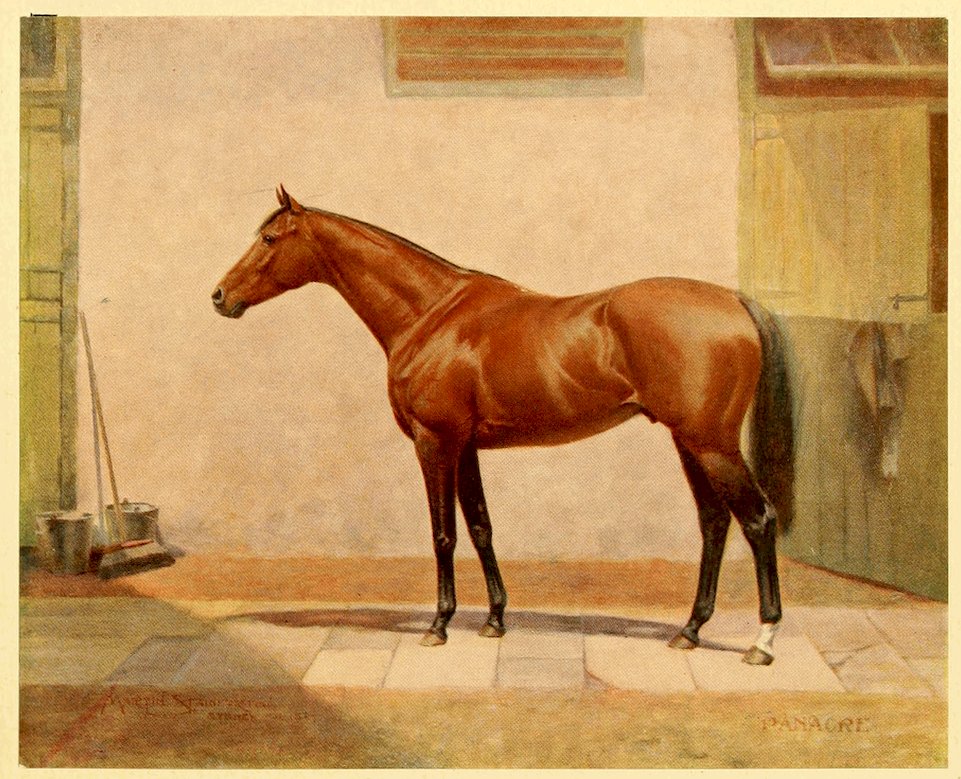
PLATE 22. PANACRE (†). Brn. Horse, 1912, by Linacre (imp.)—Panara. Winner of the A.J.C. Epsom Hcap., etc. Retired to his owner’s (Mr. J. C. Wood) stud in 1921. From a painting of the horse, at the age of 5 years, in the possession of Mr. J. Campbell Wood.
101
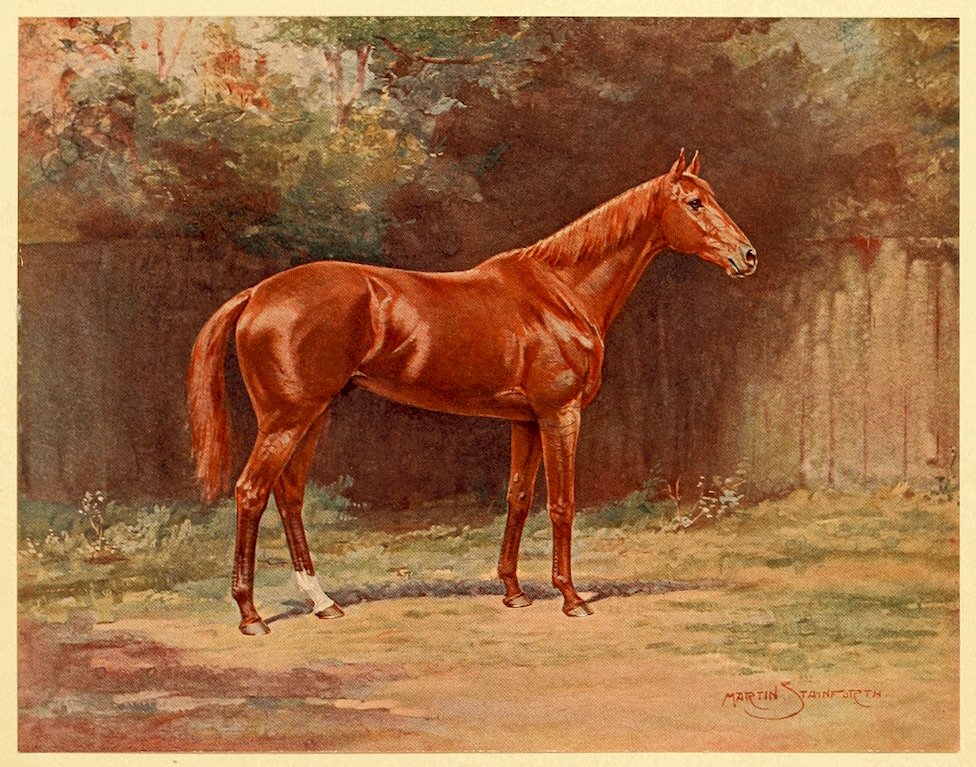
PLATE 23. EURYTHMIC (5). Ches. Horse, 1916, by Eudorus (imp.)—Bob Cherry. The largest stake winner of Australia, having won £33,066, including the Sydney Cup with 9 st. 8 lbs. Owned by Mr. E. Lee Steere, W.A. From a painting of the horse, at the age of 5 years, in the possession of the artist.
103
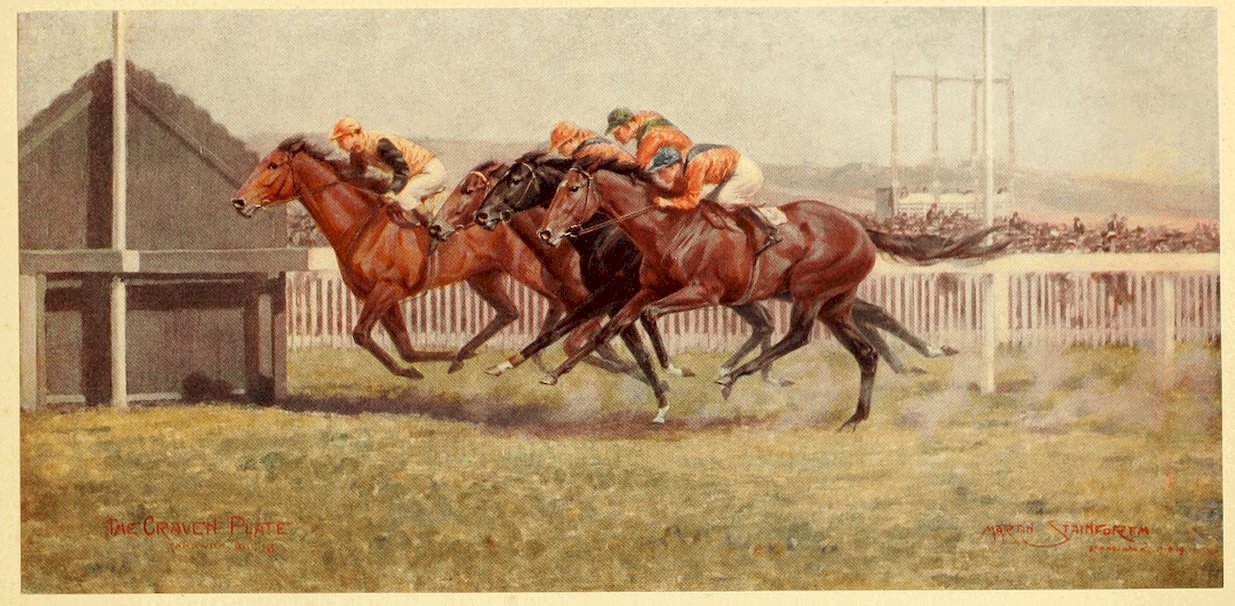
PLATE 24. THE FINISH FOR THE A.J.C. CRAVEN PLATE, 1918, 1¼ miles, Randwick, N.S.W. Reading from the rails: Cetigne (A. Wood) first, Desert Gold (fourth), Wolaroi (second), Estland (third). From a painting in the possession of Mr. W. A. Crowle.
105