APPENDIX C
Reading edition
NOTES ON LANGUAGES IN THE EAST OF NETHERLANDS NEW GUINEA
By SIDNEY H. RAY, M.A.
I. INTRODUCTION
In considering the languages of Netherlands New Guinea it is convenient to divide the territory into six geographical divisions. These are:—
1. The North-western Coast and Islands (Waigiu, Salawati, and Misol).
2. The Western shore of Geelvink Bay and the islands adjacent (Mefor, Biak, and Jobi).
3. The Peninsula of Kumava (Orange Nassau) with the islands between Ceram and the Ké group.
4. The Southern and Eastern Shores of Geelvink Bay.
5. The North Coast from Kurudu Islands to Humboldt Bay.
6. The South-eastern Coast from Kamrau Inlet to the Bensbach River on the boundary between Netherlands and British territory.
The present notice only refers to languages in the three last of these divisions.
At the Western end of the South shore of Geelvink Bay is the district of Wandammen, of which the language is fairly well known. For this we have a vocabulary with grammatical examples (9),26 and also for Windessi, which is the same language, a mission text-book. Eastward from Wandammen the numerals only are recorded (7), but at the Southern point of the Bay, in the district around Jamur Lake we have the collections made by Van der Sande during the Wichmann Expedition of 1903 (8). He gives a vocabulary of Angadi, an island in the Jamur Lake, some words of the Nagramadu dialect on the North-west, and the numerals of Goreda on the South of the lake. The languages of the Western Shore of Geelvink Bay are represented only by numerals (7) but there is more information of the language of Pauwi at the mouth of the Wamberam or Amberno or Mamberamo River, where F. van Braam Morris collected a vocabulary published by Robidé van der Aa in 1885 (6). This was considered faulty by de Clercq.27
Westward along the Northern coast very little linguistic material is available, and the few words recorded show great differences. The places of which the speech is known are, on the mainland: Takar, Tarfia and Tana Merah, and on the islands: Liki (in the Kumamba Group), Moar (called also Wakde), Masimasi and Jamna (4, 5).
For the region about Humboldt Bay we have short vocabularies of Jotafa by various collectors, and a fuller one by G. L. Bink (2), also Sentani lists by P. E. Moolenburg (3) and van der Sande (8). Moolenburg also gives a list from Seka, West of the Bay.
For the Southern shore of Netherlands New Guinea, we have nothing but vocabularies, none of very large extent, the most extensive being that of Merauke in the extreme West (15) which has also been ably discussed by Dr. N. Adriani.28
Commencing at Kamrau Inlet, the languages of the shore and islands are illustrated by the Kowiai vocabularies of Miklucho-Maclay (13), the papers of G. W. Earl29 and the lists of S. Muller (10), the last two being derived from the collections made during the voyage of the Triton under Lieut. Modera in 1828. The following languages are named:—
Lobo at Triton Bay (including Namatote, Aiduma, Mawara, and Kaju-Mera). Wuaussirau, inland on the Kamaka-Wallar Lake. Mairassis, inland from Lobo. Lakahia, on Telok Lakahia. Kiruru, on Telok Kiruru. Utanata, on the Utanata River.
Westward of the Utanata a vocabulary of the language spoken on the Mimika River people was obtained by Mr. Wollaston in 1910-11. A list of the same language is given also in the account of the South-west New Guinea Expedition of the Royal Netherlands Geographical Association.30 The latter work contains a few words of the language used at the mouth of the Kupĕra Pukwa River.
The language of Mĕraukĕ has been recorded by J. Seijne Kok (15), and by J. C. Montague and E. F. Bik,[C] that of Toro by S. Bik.31
II. CLASSIFICATION OF THE LANGUAGES.
Of the three languages in the northern part of Eastern Netherlands New Guinea that of the Jotafa of Humboldt Bay has been ably discussed by Dr. Kern,32 who decides that in phonology, construction, numeration and word store it presents many points of agreement with the Mefoor or Nufōr of the North-west. But it undoubtedly also contains many words which are of non-Indonesian origin. The Sentani and Pawi languages seem to have very few or no words similar to the Indonesian, and may probably be found to be Papuan languages. But nothing is known of the grammar. The language of Wandammen presents agreements with the Mefoor (or Nufōr) in vocabulary and also in some points of grammar. It will probably be found to fall into the same class as the Nufōr and Jotafa. The languages of the north coast and islands also show a mixture of Indonesian with other words. So little is known of the structure of the languages in the Kumava Peninsula that their place cannot be determined with certainty. The numerals and much of the vocabulary appear to be Indonesian,33 but there are Papuan forms in the Grammar.
The Lobo languages of the Kowiai district on the south coast appear to be Indonesian, but those inland and south of Geelvink Bay have a distinct connection with those on the south coast west of the Kowiai district, and with those at the Utanata River and beyond the Mimika, at least as far as the Kupera Pukwa River. Beyond this point nothing is recorded until Princess Marianne Strait is reached, and here of two words known, one is Mĕraukĕ.34 The latter language extends to the Boundary. All west of the Lobo appear to be Papuan.
Using the scanty means available, the languages of the Eastern part of Netherlands New Guinea may be thus provisionally classified:—
NORTH COAST AND ISLANDS (INCLUDING EAST AND SOUTH SHORE OF GEELVINK BAY).
Papuan.SekaWest of Lake Sentani.
SentaniLake Sentani.
Moki (?)Hinterland of Tana Mera Bay.
...Tana Mera.
Tarfia (?)Coast West of Tana Mera Bay.
TakarMainland East of Mamberamo R.
Wamberan? Mamberamo R.
PauwiVillages on Lower Mamberamo R.
AngadiIsland in Jamur Lake.
GoredaSouth of Lake Jamur.
NagramaduNorth-West of L. Jamur.
ManikionNorth of McCleur Inlet (Telok Berau).
Indonesian35 JotafaHumboldt Bay.
JamnaIsland opposite Takar.
MasimasiIsland West of Jamna.
MoarIslands West of Masimasi.
KumambaIslands and Coast West of Moar and Takar.
WaropinEast shore of Geelvink Bay.
MohrIsland opposite Waropin.
TandiaCoast South of Waropin.
JaurSouth-West shore of Geelvink Bay.
DasenerWest of Jaur.
Wandammen North of Dasener.
SOUTH COAST.
Papuan.MairassisInland from Lobo.
WuaussirauOn Kamaka Wallar Lake.
LakahiaOn Telok Lakahia.
KiruruOn Telok Kiruru.
UtanataInland from Utanata River.
MimikaInland from Mimika River.
Kupera Pukwa Kupera Pukwa River.
MĕraukĕCoast between the Kumbĕ River and the British Boundary.
ToroBensbach R.
Indonesian. OninNorth of Kumava Peninsula.
KapauerNorth-West of Kumava Peninsula.
KarufaSouth of Kumava Peninsula.
LoboKowiai Coast and Islands of Namatote, Mawara, Aiduma, and Kaju-mera.
III. COMPARATIVE NOTES ON THE ANGADI-MIMIKA GROUP OF LANGUAGES.
This group consists of the Angadi, Nagramadu, Goreda, Utanata, Lakahia, Mimika and Kupera Pukwa dialects, and perhaps also Kiruru.
1. Sound changes.36
A comparison of vocabularies shows a certain amount of sound change between the dialects. Thus Angadi m becomes b in Utanata and Mimika and vice versa.37
Ex. Angadi muti, Mimika and Utanata buïti, bamboo. Angadi mopere, Nagramadu mobere(bu), Mimika bopere, navel. Angadi mirimoi, Utanata birimbu, Mimika birim, nose. Angadi mau, Utanata mouw, Mimika bauwe, foot. Angadi tohoma-pare, Mimika to-mari, arm.
The Angadi m is represented sometimes by mb in Mimika, but is retained in Lakahia and Kiruru. Utanata examples are not found.
Ex. Angadi mi, Lakahia mu, Kiruru mi, Mimika mbi, mbu, water. Angadi metaho, Mimika mbatau, spit. Angadi imiri, Mimika imbiri, shin. Mimika amuri is Kupera Pukwa ambori.
Angadi in some words loses k or g which appears in Mimika and Lakahia.
Ex.Angadi irĕa, Mimika irĕka, Utanata eriki, fish. Angadi kauwa, Mimika kaukwa, woman. Angadi maare, Mimika makarĕ, armlet. Angadi măe, Mimika mbage, Utanata make, cry, weep. Angadi hehe, Lakahia eika, finger-nail. Angadi (nata)pairi, Mimika pigeri, skin.
A few words show an interchange of r and n between Mimika and Lakahia.
Mimika marĕ, Lakahia mana, finger. (Utanata to-mare, Angadi mahare, hand.) Mimika iribu, Utanata and Angadi iripu, Lakahia ini-fa, knee. Mimika amuri, Utanata amure, Angadi amore, Lakahia amuno, bow, Kupera Pukwa ambori.
2. Vocabulary.
The great likeness of the dialects may be illustrated by the following examples:—
Angadi.Utanata.Mimika.
Arm.to (in compounds)tōtoLakahia esu-rua (?)
Arrow.ka-tiaro (in bundle)tiăretiari
Boat.kukuku
Chin.kepare..kepare
Coconut.utiriuteriuteriKupera Pukwa otiri.
Dog.uwiriwuriwiriLakahia iwora, Nagramadu iwŏra, Kupera Pukwa uweri.
Ear.ihaniiänīene
Eye.mămemamemame
Fire.utămaiutautaLakahia ŭsia, Kiruru uta, Nagramadu uha.
Give.kema..kema
Hair.rup-ereuirīviriKupera Pukwa, uïri
Hand. maharetu-maremarĕLakahia, mana (finger).
Head.rupauupauwkapa-uĕLakahia uwua.
House.kămekamīkamĕ
Iron.jau (pot)(puruti)tau
Laugh.okookuoko
Lip.iriiri (mouth)iriKiruru uru (mouth).
Moon.purăuranpuraLakahia bura.
Mountain..(pamogo)pukareLakahia bugura, Wuaussirau wara.
Neck.amoiïemaimaLakahia umia, Nagramadu umeke.
Paddle.pápōpohLakahia boa.
Pig.ŏhŏūuLakahia u(fa), Nagramadu ŏhă, Kupera Pukwa uwĕ.
Rain.kekekomakkeLakahia ge(fa), Kiruru kē.
Sago.amata(kinani)amotaLakahia ama, Nagramadu ĕma, Kupera Pukwa amĕta.
Sleep.eteeteeteKupera Pukwa ete.
Sugarcane...monemŏniLakahia moni(fa).
Sun.jăūyouwyauLakahia aya.
Tongue.meremaremalīLakahia mara.
Tooth.titititititiNagramadu si.
Wind.kimirilowrikimireKiruru kemuru.
3. Pronouns. These are given only in Mimika for the singular number, and in Utanata for the first person singular, but the words for “I,” Mimika doro and Utanata area are unlike. In Mimika the possessive is shown by the suffix -ta, which is used also with other words. Dorota, mine, oro-ta, yours, amare-ta his, wehwaída-ta of another man. Wehwaída is compounded apparently of uwe (rí) man and awaída other. In Mairassis “I” is omona.
4. Numerals. No numerals are given by Müller or Earl for Utanata. “People of Utanata had very little knowledge of counting. When wishing to make known any number, they made use of the word awerí and counted on their fingers and toes.”38 In Angadi, Nagramadu, Goreda, Lakahia and Mimika, the numbers appear as follows:
Angadi.Nagramadu.Goreda.Lakahia.Mimika.
1. janăūwănadiunakwaonarawainakwa
2. jaminatiaăbåmăjămaniniabomayamani
3. jaminati-janăūwaăbåmă-nadi..(torua)yamani-inakwa
4. awaitămă-jaminatia abama-båmŏ..(fāt)ama-yamani
5. măhăre-ajăheraurimăma-ribamaheri-herori (rim)..
6. măhăre-janăūwamariba-nadi..rim-onarawa..
10. măhăre-jăminatiamăma răbåmătăoru....
These show a numeration only as far as two. “Three” and “four” are made by additions, 2 + 1 = 3 and 2 + 2 = 4, except in Angadi where awaitămă-jaminatia means “another two” with which cf. the Mimika awaida, other. Măhăre, maheri, mari in the words for “five” also mean “hand,” abbreviated to mă in măma of Nagramadu. The Goreda tăoru given for “ten,” is the Angadi tăöru, much, Mimika takiri, many. In Lakahia the words for “three,” “four,” “five,” “six” have the Ceram numerals which are also used in Lobo and Namatote. The Mairassis and Wuaussirau numerals agree with one another, but differ entirely from those of the Angadi-Mimika group.
OneTwoThreeFourFiveSixTen
Mairassis tangauw amoōi karia āi iworo iwora-mōi werowa-mōi
Wuaussirau anau amōi karia aiwera iworo iwor-tanau iwor-toki-tani
The low numeration in all these languages may be regarded as an indication of their Papuan character.
5. Construction.
A few grammatical forms which appear to be indicated in the vocabularies may be noted here.
a. The possessive with pronouns and pronominal words is indicated by a suffix -ta. Mimika, doro-ta, of me, mine; oro-ta, thine; amare-ta, his; wehwaída-ta, of another man. In Angadi several compound words end in nata, which thus appears to be a noun, na (thing?), with the possessive suffix; and it seems possible to explain such words as ută-nata, firewood; kara nata, head of javelin—i.e. fire-thing-of, javelin-thing-of. Cf. also nata pairi given by v. d. Sande for “skin,” with Mimika pīgīri, skin, which suggests that nata pairi means skin of something.
b. The adjective follows the noun. Utanata warari napetike, water big, river.
c. A noun in the genitive relation precedes its substantive. Mimika bau mame, leg’s eye, ankle; iwau makarĕ, belly’s band. Angadi mahare hehe, finger nail; māū hehe, toe nail; mirimoi ipa, nose hole, nostril; ihani ipa, hole in ear lobe; ămore eme, bow’s rattan, bowstring.
d. The subject precedes the verb. Angadi jăū hinau-mara, sun rises (?), morning; jăū emapojemia, sun sets (?), evening.
e. The object also precedes the verb. Angadi ihani aimeri, ear pierce; mirimoi aimeri, nose pierce.
These five points indicate a Papuan structure of the languages.
6. Comparison with Merauke and the Languages of British New Guinea West of the Fly River.
The Papuan languages usually show so few agreements in vocabulary that the likeness of words, unless frequent, cannot be held to establish relationship. In the comparative vocabulary, words and numerals are added from the languages on British Territory.39 These show a few likenesses, which may, however, be accidental.
Arm. Mimika to, Dungerwab tond, Dabu tang, Miriam tag, Kiwai tu
Arrow. Mimika tiari, Kiwai tere.
Arrow barb. Mimika imari, Kiwai were.
Basket. Mimika temone, Kunini diba, Jibu dimba, Mimika eta, Kiwai sito, Mowata hito.
Bird. Mimika pateru, Bugi pa (?), Dabu papa (?).
Earth. Mimika tiri, Bangu tiritari.
Eat. Mimika namuka, Bangu jamukwa.
Elbow. Mimika to-mame, Mowata tu-pape.
Fire. Mimika uta, Miriam ur.
Forehead. Mimika metar(re), Bangu mithago, Miriam mat.
Head. Mimika kapane, Bangu kambu.
Iron. Mimika tau, Dungerwab tod.
Nose. Mimika birim, Dabu murung, Saibai, Miriam pit.
Pig. Mimika ap, Meranke sapi.
Rat. Mimika kemako, Bugi makata, Saibai makas, Miriam mokeis.
Shore. Mimika tiri, Dungerwab tredre.
Sleep. Mimika ete, Bangu ete-betha, Dungerwab eda-bel, Miriam ut-eid.
Tree. Mimika uti, Kiwai ota.
IV. MALAYAN INFLUENCE ON THE SOUTH COAST OF NETHERLANDS NEW GUINEA.
In a discussion of the languages of the south-eastern shores of Netherlands New Guinea, the extent of Malay influence in that region must be taken into account. Mr. William Churchill has lately put forward a theory that the Polynesian people entered the Pacific not only by coasting along the northern shores of New Guinea to the Solomon Group, but also by a passage through Torres Straits, and thence along the south-eastern coast of British New Guinea to the New Hebrides.40 On tracing the languages westward from Polynesia, it is an indisputable fact that many words which are identical with Polynesian are found in use along the shores of British New Guinea, though they are not used in a Polynesian syntax, or in the simplified forms usual in the Eastern tongues. It is also a fact that many of these same words are current also in the western islands of Indonesia. For example, hua, fruit; ina, mother; lala, blood; lau, leaf; au, I; ruma, house; inu, drink; utu, louse; tohu, sugar cane, and many other words are identical in the south-east of British New Guinea and in Ceram. But in British New Guinea the languages which show likeness to Polynesian end abruptly at Cape Possession, and are not found west of that point.41 Hence it becomes important to inquire how far the similar tongues of Amboyna and Ceram have influenced the New Guinea languages to the east of them. That there is such an influence is plain from the vocabularies of the languages. Indonesian words, such as the Onin (10) kayu, wood; tanigan, ear; nifan, tooth; fenu, turtle; mani, bird; afi, fire, are of common occurrence in the islands of the Arafura Sea, and on the coast of the mainland. But these words are more common in the west, and gradually disappear towards Torres Straits, and are not found beyond. In Rosenberg’s Karufa list (12) we find such characteristically Indonesian words as ulu, hair; mata, eye; uhru, mouth; taruya, ear; nima, hand; ora, sun; uran, moon; niyu, coconut. Words of this kind are found also in Lobo (10) and Namatote (13), as, for example, wuran, moon; labi, fire; nima, hand; nena, mother; rara, blood; metan, black; tobu, sugar cane; wosa, paddle; matoran, sit; mariri, stand. Some of these words seem to have passed into Utanata (10) and Lakahia (13), and apparently, though not so freely, into Wuaussirau (13), Mairassis (10), and Mimika (14). The Kiruru vocabulary of Maclay does not appear to show any words of this kind. The following are examples of Indonesian or Ceram words in the Utanata-Mimika group of languages.
Utanata uran, Lakahia bura, Mairassis furan, Mimika pura, Ceram wulana, moon. The Angadi has also pura.
Lakahia bugura, Wuaussirau wara, Mimika pukare, Ceram uhara, mountain. Utanata has pamogo.
Utanata pō, Lakahia boa, Mimika poh, Ceram wosa, paddle.
Utanata kai, Ceram kai, wood. For this the Mimika is uti.
A word of much interest in this region is turika or turi. This is given by Muller in his Ceram list as turika, knife, in Lobo turi, Onin tuni. Maclay gives the Ceram (Keffing) as turito, Namatote and Wuaussirau turi, also for “knife.” The word does not appear in Angadi or in the list of Ekris (19). Though not apparently used in Merauke turik has travelled eastward as far as Torres Straits and the Fly River, and even to the borders of the Papuan Gulf. Thus Bangu turik, Dabu turikata, Sisiami (Bamu R.) turuko, and Tirio turuko mean “knife” (i.e. iron knife). In Bugi, Saibai, Mowata and Kiwai, turika and in Murray Island tulik mean “iron.”42
Dr. N. Adriani has pointed out some words adopted from Malay in Merauke and also some apparent agreements between that language and Indonesian languages generally,43 but there is no evidence of any language from Ceram having passed through the Torres Straits. Agreements between the Merauke and Papuan languages to the east are also pointed out by Dr. Adriani44 but these are no evidence of the passage of a Polynesian fleet, as they are not Polynesian words, and the languages using them have no Polynesian syntax. Mr. Churchill’s theory of the Polynesian entry into the Pacific by way of Torres Straits cannot therefore be maintained.
V. A COMPARATIVE VOCABULARY OF LANGUAGES IN THE NORTH EAST AND SOUTH EAST OF NETHERLANDS NEW GUINEA AND OF BRITISH NEW GUINEA WEST OF THE FLY RIVER.
The following vocabulary is arranged strictly in Geographical order. The North Eastern Languages follow from East to West, from Seka to Manikion, and the South Eastern from Onin to the Boundary and thence along the South Coast of British Territory to the Western or Right Bank of the Fly River.
The following authorities have been quoted:—45
1. Seka. P. E. Moolenburg. Tijd. v. Indische Taal xlvii. 1904.
2. Jotafa [and Sentani in ( )]. G. L. Bink in ibid. xlv. 1902.
3. Sentani. P. E. Moolenburg. Bijdragen. t.d. Taal. Ned Indië (7) v. 1906.
4. Tanah Merah, Tarfia, Takar, Jamna, Masimasi, Moar (i.e. Wakde) and Kumamba. G. G. Batten. Glimpses of the Eastern Archipelago, 1894.
5. Arimoa. A. B. Meyer. Über die Mafoor’sche, 1874.
6. Pauwi. P. J. B. C. Robidé v. d. Aa. “Reisen van Braam Morris.” Bijd. t.d. Taal. Ned. Indië. (4) x. 1885.
7. Wamberan, Waropin, Mohr, Tandia, Dasener, Jaur. Fabritius. Tijd. v. Indische Taal. iv. 1885.
8. Angadi, Goreda, Nagramadu, Manikion. G. A. J. v. d. Sande in “Nova Guinea.” Vol. III. 1907.
9. Wandammen. G. L. Bink. Tijd. v. Indische Taal. xxxiv. 1891.
10. Onin, Lobo, Mairassis, Utanata. S. Muller. Reisen, 1857.
11. Kapaur. C. J. F. le Cocq d’Armandville. Tijd. v. Indische Taal. xlvi. 1903.
12. Karufa. H. v. Rosenberg. Der Malayische Archipel. 1878.
13. Namatote, Wuaussirau, Lakahia, Kiruru. N. v. Miklucho Maclay. Tijd. v. Indische Taal. xxiii. 1876.
14. Mimika. MS. Dr. A. F. R. Wollaston.
15. Merauke. J. Seijne Kok. Verband. v. h. Batav. Genootsch. v. Kunsten lvi. 1906.
16. Bangu, Bugi, Dabu, Mowata, Kunini, Jibu, Tagota. Reports of Cambridge Anthropological Expedition. Vol. III. 1907.
17. Parb, Saibai, Kiwai, and Tirio. MSS. S. H. Ray.
18. Nufor. J. L. v. Hasselt. Hollandsch. Noefoorsch Woordenboek, 1876.
19. Ceram. A. v. Ekris. Woordenlijst v. Ambonsche Eilanden. Mededeel. v. h. Ned. Zendings Genoots, viii. 1864-65.
20. Tuburuasa, Karas. (Islands between Ceram and Onin.) P. J. B. C. Robidé v. d. Aa. Reisen naar Ned. Nieuw-Guinea, 1879.
COMPARATIVE VOCABULARY.
Man. Man.Woman. Vrouw.Head. Hoofd.Eye. Oog.Ear. Oor.
Seka......subirutjare
Jotafatantemoirabunaduwindutĕni
Sentanidohmīfarem, (panemyŏrå, (yerohanggei, (angei
Arimoakabun (white...dabromasamanaseroro
Pauwimaombanedba...kikiaknĭperemba
Angadiwerekauwărupaumămeihani
Nagramadu......yabimă...ehăra
Wandammen muababienrupairĕnetatelajau
Oninmararamatapaisonimpatinmatapatintanigan
Kapaurneméhārtombŏhārkendakendepper
Karufamutangkimaisoidaumuhmatataringa
Namatotemurwanamerwineumumatatunguzingangu
Lobomarowanamawinamonongo, umunmatalongotringango
Mairassisfatakowaeweinanguwunambutunewirana
Wuaussirautaturobueweikoteraobiatuobiru
Lakahiaodacirayamauwuamanagayawana
Kiruru............yawatsha
Utanatamarowanakuranīupauwmamehianī
Mimikauwerikaukwa, ainakapanemameene
Meraukeamnanggabubtī, savĕ, īsus(?) iwogĕpakīndĕkambīt
Bangu......kambutitaroba, tarup
Parbartemarbmortarambtongal
Bugilamalabeneqetkalyelaandra
Daburabumurebunkutikaparan, ika
Saibaigarakaziipökazikuiködan, purkakaura
Mowataauanaoroboepurudamarihepate, gare
Kuninibinam, imamagebi, ulemopeireutablame
Jibuvientete, regakongamopuyereyekrom
Kiwaidubuoroboepurudamarisepate, gare
Tirioamiamikinasuyapuruparitipamata
Tagota...moreamkanaparituap
Nufōrsnunbienrewurimgasiknasi
Cerammalona, mandai, makwai, manawalmahina, bina, leuto pepinauru, ulumata, maatarina, talina
Tuburuasamaruanamapataunīnmatanpuontaningan
Karaskianampaasnakalunkangirikulokeim
Nose. Neus.Tongue. Tong.Tooth. Tand.Hand. Hand.Sun. Zon.
Sekahā......na (nabērā, arm)...
Jotafasumerikiñohtibimitap
Sentaniyoifēuwje, (tjemegeragera, (posadisu
Arimoasirinomataroumata......
Pauwikimpariakimsibakabruakibawia (arm)tebia
Angadimirimoimeretitimahareyăū
Nagramadu...yămănăraisi......
Wandammen swŏnêtaperêderĕnesiwarabawor
Oninwirinerinifannemienrera
Kapaurkănomba, kănungagengabumĕhien-tābtānkĕmina
Karufasikai......nimang-utaohra
Namatoteiyaonguyaeiyonguzwiutiongusiŭsionguoro-matawuti
Lobosikaiongokariongoruwotongonimango-utaorah
Mairassisnambinenegunsikaokorwitaonguru
Wuaussirauombionsabiorasuaduunguru
Lakahiaonomamaraifaesuruaaya
Kiruruunuga...uru...yauburawa
Utanatabirimbumaretitimarehdyauw
Mimikabīrimmalītitimarĕyau
Meraukeanggīpunummanggatsanggakatŏnī
Bangu...thaminatertambiaepotha
Parbmebelepenjitoltondabiard
Bugiwededangamailengetrang-qabyabada
Dabumurungdogmarngui, ngoiatang-koryabada
Saibaipitinöidanggetgoiga
Mowatawodiwatotoropeibuanaratu-pata (palm)iwio
Kuninikekewetagiriuimwebimu
Jibusokuvrateorkakyemaloma
Kiwaiwodiwototoropeiawatu-pata (palm)sai
Tirionoroseimasūtikiriuainea
Tagotamiuuokam...dari
Nufōrsnŏrikaprēndinasirwasiori
Ceramhiru, inu, ninu, ilimei, mē, māniki, niri, nityi, niorima, lima, baraurematai, leamatai, leamanyo, deamatae
Tuburuasanirīngkwēri...tangannera
Karasbustangbelein...taanïōn
Moon. Maan.Star. Ster.Rain. Regen.Stone. Steen.Fire. Vuur.
Seka...............
Jotafasembiendortābātaijări
Sentaniara, (aroh...(yatuga, (duwaī
Arimoa.........fati...
Pauwi...............
Angadipură...kehe...ută-mai
Nagramadu......emoya...uhă
Wandammen sembaisiberereramarebukiadia, adyat
Oninpunonoapatin-no-farereunanopātiapi
Kapaurkoba, keba, kabahmbābkĕriwārtōm
Karufauranŏmakamalangerahlawi
Namatotewuranomomaomo...labi
Lobofurankomakomakomah...lawi
Mairassisfuranwaniwaniyamo...iworo
Wuaussirauanganeonburiyamu...iworo
Lakahiaburamawenagefa...ŭsia
Kiruru...imarukē...uta
Utanatauran...koma...uta
Mimikapuramakokeomanīuta
Meraukemandauovom, uvumheĕkatarĕtakavĕ
Bangu......narunjartanmeni
Parbtugiu...nou...pend
Bugikakqataiyuguladaderiu
Dabuqar, qakpiroiguraidadaryu, dumbrel
Saibaimulpal, kizaitituiarikulamui
Mowataganumezogubowiarinora-apiera
Kuninimabiewalengupemagezulimuie
Jibumobigujepironorapara
Kiwaisaganagugimauburo, wisaikuraereera
Tiriokorameapapaiōukokumasuze
Tagotamanodurupa...tamagajau
Nufōrpaikătaruwa, samfarimĕkem,kĕrufōr
Ceramhuran, ulano, buranmarit, kolomali, kamali, umaliouran, ulan, kialhatu, batuhau, au
Tuburuasapunafinmaunangpatilawi
Karaspakmasseerkekaljaardien
Water. Water.Pig. Varken.Fish. Visch.Coconut. Kokos-noot.House. Huis.
Seka............pā
Jotafananuporigehnīnoduma
Sentanibu(yokukakohime
Arimoadano......niwi...
Pauwimemba.........hŭsia
Angadimiŏhŏireăutirikãme
Nagramadu...ŏhă...măgrabeya
Wandammen kambupisaidiyaankadianio
Oninwearipapiosairirurohrumaso
Kapaurkĕrandur, kalapaji, măma heirno’urwuri
Karufaualar...dohndiniyutsaring
Namatotewălarboidondiniu (?)sarin
Lobowalarbōidondeniusarin
Mairassiswatabembakuratuowahwatara
Wuaussiraukaiwembekuratuobowata
Lakahiamuraufanemawuinayafa
Kirurumi............
Utanatawarariuherikauterikami
Mimikambi, mbuu, apiirĕkautērikamĕ
Meraukedakabasikĕpararĕ, pararamisĕ, onggat, wīmapsava, aha
Bangutauqarrouguthauanangarboot, munka
Parbnoukimbangurargh, kwogh, keumongo
Bugingisimbelgalbangemāē
Dabuinemule,chimela, sasapudingoi, guvima
Saibaingukiburumwapiurabmud
Mowataoboboromoariminaoimoto
Kunininīeblomeibuiamete
Jibuniaworomawajiumeta
Kiwaioboboromoirisinaoimoto
Tirioopaseperakopomasapu-mutiraturie
Tagotamaukaminao.........
Nufōrwārbeyeniyensrabonrum
Ceramwaer, wael, kwaelhahu, apalian, ianoniwer, niwel, nimel, nikwel, nooloruma, luma
Tuburuasawêre...se...kapalla
Karaspere...soor...kawe
COMPARATIVE VOCABULARY, NUMERALS.
One. Een.Two. Twee.Three. Drie.Four. Vier.
Sekaahi (ari?)hitjunhetunnabu
Jotafatherosforau
Sentaniimbaibenamegŭri
Tana Merahogosaraisaibonaondoafisoronto
Tarfiatuksearhotorfauk
Takarafateninawanawa-jengkinawa-nawa
Jamnatesrutaufau
Masimasikīsrutoufo
Moarhibetirutoufau
Kumambatèslutaurfau
Pauwipa-saripa-ripa-rosipa-rasi
Wamberantenamabisa......
Waropinwo-siowo-ruowo-rowo-ako
Mohrtataruruoroao
Angadijanăūwăjăminatiajaminati-janăūwăawaitămă-jaminatia
Goredaunakwajămanini......
Nagramadunadiăbåmăăbåmă-nadiăbåmŏ-båmŏ
Tandianeirusiturusiattesi
Dasenerjosersurutoruati
Jaurreberedureürea
Wandammensirimondutŏruatê
Manikionhomhŏaihomoihŏku
Oninsanuwatenifāt
Kapauerhĕre-wohĕre-rīkhĕre-terīhère-ngara
Karufasimoksirueititohrubahdi
Namatotesamosirueititorufāt
Lobosamosiruetituwrufāt
Mairassistangauwamōikariaāi
Wuaussirauanauamoikariaaiwera
Lakahiaonarawaabomatoruafāt
Mimikainakwayamaniyamani-īnakwaama-yamani
Meraukezakodienaiena-zakodiena-iena
Bangunambu, nambiyethombi, kethembiyethoasar
Parbambiurtumbilambitutubiar
Bugitarangesametakinagingi-metakinatopea
Dabutupi-dibikumi-rivikumi-rerigakumi-rivi-kumi-rivi
Saibaiwara, uraponuka, ukasaruka-modobigaluka-uka
Mowatanaunetoa......
Kuniniiepaneneninesaeneneni-neneni
Jibuyepakuraiepa (finger)kuraiepakuraiepa
Kiwainaunetewanetewa-naunetewa-netewa
Tirioorokamisekamisorakomiseka-miseka
Tagotauradagamitigananmitiga-mitiga
Nufōrsai, ŏsērdui, surukiorfiak
Ceramisa, sārua, lua, dua, rotiteru, telu, tolu, toruhaa, hata, ata, fāt
Five. Vijf.Six. Zes.Ten. Tien.Twenty. Twintig.
Sekanaplannaplahiamplahariamplanaplan
Jotafamimiāmmăndŏsīmronduminarōsmanisayām
Sentanimehembaimehinimbaimehinmehembaimegohri
Tana Merahogosaraidemean......
Tarfiarimmana-tuksimafarufaru...
Takarnawa-nawa-jengki.........
Jamnajim, rim...sinafui...
Masimasirim...sanafu...
Moarrim.........
Kumambalim...sanafun...
Pauwipa-rinisiponensiputaonsi...
Wamberan............
Waropinrimo.........
Mohrrimo.........
Angadimăhărè-ajăhe-raurimăhărè-jană-ūwămăhăre-jămi-natia...
Goredamahère-hèrori...tăóru...
Nagramadumăma-ribamariba-nadimăma-răbåmă...
Tandiamarasi.........
Dasenerrimbi.........
Jaurbreiare.........
Wandammenrīmrīmi-sirisurasnun-tupesi
Manikionsirkem.........
Oninnimanempusuaputi-nuwa
Kapauerhĕre-tembuhere-tembu-here-wopra’ato mdijowo
Karufarimirom-simoksiputjasiúmput-rueiti
Namatoterimrim-samotifutsaombutueti
Loborimirim-samosiwutsyasekumat-rueti
Mairassisiworoiwora-mōi (? 7)werowa-moiyauw-nat-makia
Wuaussirauiworoiwor-tanauiwor-toki-tanitoki-amoi
Lakahiarimrim-onarawa......
Mimika............
Meraukeiena-iena-zakod.........
Bangutambothoinimbo......
Parbtumbi-tumbi-yambia.........
Bugimandagabendala...
Dabutumu.........
Saibai............
Mowata............
Kuniniimegubematemate (wrist)dare (breast)...
Jibukuraieparibenda (wrist)mua (breast)...
Kiwai............
Tiriomiseka-miseka-oroka.........
Tagotauradaga (?)moti-taba-nanmoti-tatan...
Nufōrrīmonemsamfursamfur-di-suru
Ceramrima, lima, dimanē, nena, nō, onamhusane, husā, utsyahuturua
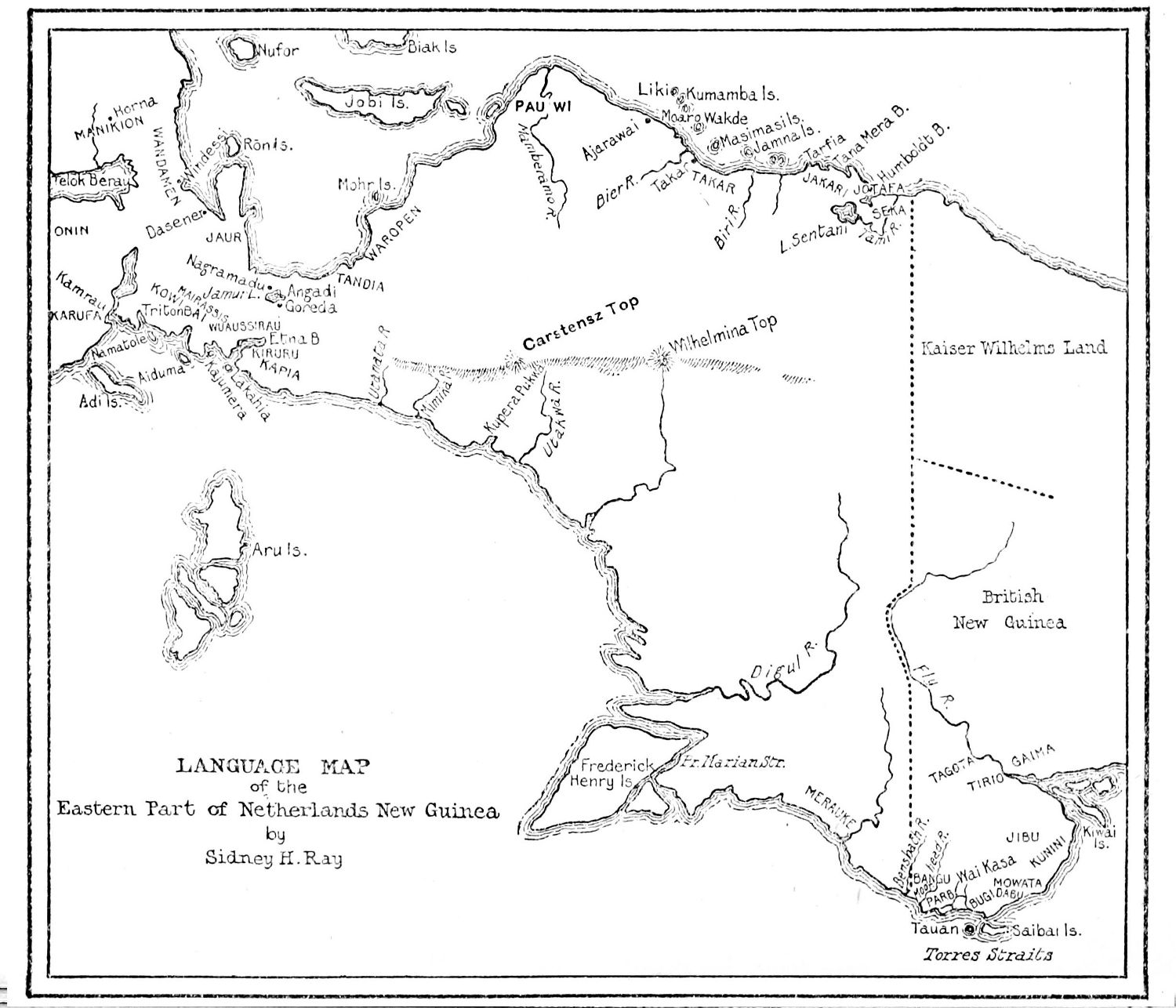
LANGUAGE MAP of the Eastern Part of Netherlands New Guinea Sidney H. Ray
LIST OF WORDS USED BY THE PAPUANS IN THE DISTRICT OF THE MIMIKA RIVER, S. W. DUTCH NEW GUINEA.
AboveOpo
Acid{Tite Imakemàn
AnimalIrĕka (also “fish”
AnkleBau-mámĕ
AntWámé
Arm{To-marī To
Arm-bandMaka-rĕ
ArriveMainaumà
ArrowTīari
(barb of)Imari
AtapWurī
AxillaEmmabu
Back (of man)Ata
BambooBúiti
BananaKau
(plantation of)Kauti
Band (of rattan worn round middle) Iwau-mákarĕ
BandicootPúruga
Bark (of tree)Pīkī
Basket{Temme
Eta
BeadsKamburi
BeanKawetī
Beard{Keparise
Kepa bíri
Burídi
Pakúti
Bed (mat)Kápiri
BeeImoho
BeetleBuruta
BelchMbau
BellyIwau
Big{Atwa
Iwáko
Bird{Páteru
Páturu
(of Paradise{Yamuku
Yau
Bitter{Tite
Imakemàn
BlackIkako
BloodMaréte
BluntYamenà
BoatKu
Bodice (of woven fibre)Paitĕ
BodyNata
BottleKárepa
BowAmúri
Bow-stringKima
Breast (of woman)Auwĕ
(of man)Pītī
BreatheTúa
BrokenTáka
ButterflyWīrī
ButtockAtabú
Calf (of leg)Ewambugu
CanoeKu
Cap (worn by widows)Ubauta
Carve (to)Maramu
CassowaryTu
CentipedeArowī
CoconutUtēri
CheekAwár(re)
ChildAidru
ChinKepáre
CicadaWéako
ClothPīkī
ClubMoánne
CloudsApu
CockatooPukī
ColdYu
CombTa
CopulateIpĕ
CoughOtah
Crab{Peja
Epor(re)
Bī
CrayfishBĭ
CrocodileTīmaku
Cry (weep)Mbágĕ
Cut (to)Embe
Cuscus (Phalanger)Apui
DanceDirin-dirin
DeepEmúku
DogWīrī
DrinkTomagu
DrumEmmĕ
EarÉne
Ear-ringTīrawōnĕ
Earth (sand)Tīrī
EatNamúka
EelMbatarúbia
EggTareté
ElbowTo-mámé
ExchangeAkóra
EyeMámé
EyebrowMambīrī
FarAwakopíre
FatAtwa
FeatherIdī
FingerMárĕ
Finger-nailMarē
FireUtá
(stick)Utamau
FishIrĕka
Fly (insect)Oboö
Flying-foxIéa
FootBauwe
ForeheadMétár(re)
GhostNíniki
GiveKéma
GrassUmetir(re)
GrasshopperAtŏkŏ
GreenOtopu
HairVīrī
HandMarĕ
HeAmárepa
HeadKapa-uĕ
HeavyIkīti
HeelMbautep(e)
HisAmareta
HiccoughUrri
HornbillKumai
HornetImŏkŏ
HouseKámĕ
IDoro
IllNamúti
Image (carved)Betoro
IronTau
KneeIrību
LanceUruna
LaughOko
LeafE
LegAtīrī
LightningMarapiti
LipsIrī
LittleMimiti
LizardInamo
Lizard (frilled)Wago
LoinsYaïmi
ManUweri
ManyTákiri
Mat (of pandanus)Au
MelonAnĕtĕ
MineDorota
MoonPura
MosquitoItjī
MountainPúkare
MouthBa
MoustacheMbu-tīrĭ
NavelBoporĕ
NeckIma
NewAigu
NodKiparu
NoseBīrim
(secretion of)Bīndī
Old man of villageNatu
OneInakwa
OrchidIdarōnĕ
OtherAwaida
Other manWehwaida
Other man’sWehwaidata
PaddlePoh
PalateTībanne
PapayaTĕnà
ParrotAkīma
PearlOmab(e)
PenisKamàrē
(case)Kamare-po(ko)
Pig{U
Api
PigeonParúa
Pillow (wooden)Yamate
Pine-appleMakadĕtĕ
PrawnMbi
PumpkinNabru
PythonPīmī
RainKe
RainbowParakĕta
RapidsKamáwa
RatKemako
RattanKima
RedEpĕró
RibsPárĕrŏ
RiceWátē
RipePu
RiverIuata
Road (track)Mako
RopeTemmà
SacrumWagamau(e)
SagoAmŏta
(beater)Wapúri
Sago-bowlPámagu
SapNamī
ScorpionPurumbaä
SeaTakarī
ShallowTaparī
SharpYánakŏ
ShellParau
Shell-fishUwo
ShinImbīrī
ShoreTīrī
ShoulderTa-rī
Shoulder-bladeTo-bābŭ
SkinPīgerī
SkullUpau
SleepEté
SnailTapoko
SnakeApako
SneezeYaiē
SpearUruna
(wooden)Potaku
SpitMbatau
StarMako
StealOtemu
Stick (of club)Wu
Sting-rayKaū
StoneOmanī
SuckAu
Sugar-caneMŏnī
SunYau
SweatPapitī
Sweet potatoPamu
SwimTīmago
Tear (a)Bágumbú
ThighI
ThroatKīmárĭ
Thumb}Ipau
Great Toe
ThunderUraki
TiredToh
TobaccoKapakī
To-dayWauwà
ToesBauwē
To-morrowKaúmuta
TongueMalī
ToothTītī
TreeUti
TurtleMbiambu
TwoYamani
UpsetPīro
ViperMágu
VomitMbau
WaterMbi
Mbu
(make)Gīgī
WetNata
WhistleWiramogo
WhiteNaputiàre
WindKīmīr(e)
WomanKaukwa
Aina
WoundNatŭ
WristMarapŭmĕ
YawnMbápoh
YellowTaier(re)
YouOro
YourOrota