Part 1 — PUZZLES AND ODDITIES.
Reading edition
1.
My FIRST the heats of July pack With rows of milk-pans down the back; September fills them all with starch, And, though they neither drill nor march, Each has a warlike name: October plucks my honors off, And down I’m thrown to floor or trough: Perchance the mill to powder turns Or smouldering fire to ashes burns My rough and useless frame. A weaver’s loom my SECOND fills In dozens of tall cotton mills, Before the shuttle, o’er and through, Has thrown the filling straight and true, And made each ending fast. My WHOLE a house in corners set, Has swung as long as time, and yet A trap for foolish folk shall swing, And lessons to the wiser bring, As long as time shall last.
Answer
2.
What is that which we often return, but never borrow?
Answer
3.
Can you tell me of what parentage Napoleon the First was?
Answer
4.
What was Joan of Arc made of?
Answer
5.
Why ought stars to be the best Astronomers?
Answer
6.
What colors were the winds and the waves in the last violent storm?
Answer
7.
In what color should a secret be kept?
Answer
8.
How do trees get at their summer dress without opening their trunks?
Answer
9.
Why am I queerer than you?
Answer
10.
Mr. Premium took my FIRST, and he wrote to Captain Smith, And said: “Sir, do my SECOND to my THIRD, forthwith.” Now, Mr. P., you see, though a millionaire he be, Could not, without my WHOLE, have sent Captain Smith to sea.
Answer
11.
Two pronouns find, but mind they suit, And then between them “a—t” put: The combination quickly yields What may be seen on Scotland’s fields. Now, for the first word, substitute Another pronoun that will “suit;” When this is done, ’twill bring to view What every day is seen by you.
Answer
12.
Me the contented man desires, The poor man has, the rich requires, The miser gives, the spendthrift saves, And all men carry to their graves.
Answer
13.
A BUSINESS ORDER.
“J. Gray: Pack with my box five dozen quills.”
What is its peculiarity?
Answer
14.
Those who have me not, do not wish for me; those who have me, do not wish to lose me; and those who gain me, have me no longer.
Answer
15.
Although Methusaleh was the oldest man that ever lived, yet he died before his father.
Answer
16.
If Moses was by adoption the son of Pharaoh’s daughter, was he not, “by the same token,” the daughter of Pharaoh’s son?
Answer
17.
What is the best time to study the book of Nature?
Answer
18.
What is the religion of Nature in the spring?
Answer
19.
There is an article of common domestic consumption, whose name contains six letters, from which may be formed twenty-two nouns, without using the plurals. What is it?
Answer
20.
What word is that, of two syllables, to which if you prefix one letter, two letters, or two other letters, you form, in each instance, a word of one syllable?
Answer
21.
What was the favorite salad at the South, in the spring of 1861?
Answer
22.
There was a thing, ’twas two days old Ere Adam was, of yore; Before that thing was five weeks old, Adam was years four-score.
Answer
23.
What’s that which on four limbs doth move When first it sees the light, But walks erect on two at noon, And creeps on three at night?
Answer
24.
A sailor launched a ship of force, A cargo put therein, of course; No goods had he he wished to sell; Each wind did serve his turn as well; To neither port nor harbor bound, His greatest wish to run aground.
Answer
25.
A merry maid, whose pleasant name Was my sweet FIRST. Under a tree She sat, and sang my THIRD, as free As the wild crows, that without dread, My SECOND called above her head. Anon she turned, (with a last look Above, below,) unto her book— My WHOLE the author. Guess the same.
Answer
26.
The three most forcible letters in our alphabet?
Answer
27.
The two which contain nothing?
Answer
28.
The four which express great corpulence?
Answer
29.
The four which indicate exalted station?
Answer
30.
The three which excite our tears?
Answer
31.
What foreign letter is an English title?
Answer
32.
What foreign letter is a yard and a half long?
Answer
33.
What letter will unfasten an Irish lock?
Answer
34.
When was B the first letter of the alphabet, while E and O were the only vowels?
Answer
35.
What letter is always more or less heavily taxed?
Answer
36.
What letter is entirely out of fashion?
Answer
37.
Why is praising people like a certain powerful opiate?
Answer
38.
Prove that a man has five feet.
Answer
39.
WHAT AM I?
I was once the harbinger of good to prisoners.
I add to the magnitude of a mighty river.
I am a small portion of a large ecclesiastical body.
I represent a certain form of vegetable growth.
A term used by our Lord in speaking to His disciples.
A subordinate part of a famous eulogy.
I am made useful in connection with the Great Western Railway.
Answer
40.
5005E1000E,
5005E1000E.
The name of a modern novel.
Answer
41.
Two words in French are often spoken; Of home and love the fondest token: But, strange to say it, one of these Is English, from beyond the seas; And though the thing seems quite absurd, It means the same as t’other word.
Answer
42.
You fain would win fair Julia’s heart— “Have I the power?” you’d ask her, But, from your lips the words won’t part— “’Tis not an easy task, Sir!” “I know ’tis not, for one so shy.” “Well, how shall I begin, Sir?” “Be what you ask her,” I reply, “And, ten to one, you’ll win, Sir!”
Answer
43.
My FIRST is company; my SECOND shuns company; my THIRD calls together a company; and my WHOLE entertains company.
Answer
44.
My FIRST is a sound, of tranquillity telling,— A cozy and complaisant sound for your dwelling. A place which for criminals fittest is reckoned, Yet where saints find ineffable peace, is my SECOND. Or, where niggardly natures, who hunger and thirst For the wealth of this world, keep their hearts, is my FIRST; While my SECOND’S a measure you’ll know at a glance, For ’tis shortest in Flanders, and longest in France. Oh! my WHOLE is a name widely known, well beloved, A name blessed on earth, and in Heaven approved; Crowned by Faith and Good Works with so holy a light That angels, themselves, thrill with joy at the sight.
Answer
45.
Dr. Whewell being asked by a young lady for his name “in cipher,” handed her the following lines:
You 0 a 0, but I 0 thee,— Oh, 0 no 0, but oh, 0 me; And O, let my 0 no 0 go, But give 0 0 I 0 you so!
Answer
46.
Why was the execution of Charles the First voluntary on his part?
Answer
47.
How is Poe’s “Raven” shown to have been a very dissipated bird?
Answer
48.
Set down four 9’s so as to make one hundred.
Answer
49.
The cc 4 put 00000000. si
Answer
50.
John Doe to Richard Roe, Dr.
To 2 bronze boxes $3 00
1 wooden do 1 50
1 wood do 1 50
——
This bill was canceled by the payment of $1.50. How?
Answer
51.
When was Cowper in debt?
Answer
52.
What animal comes from the clouds?
Answer
53.
My FIRST is one of mystic three, Who go where goes true Liberty; Sets with the sun, with him to rise, Lives in the flame and with it dies; Fades with the leaf that earthward flies. My SECOND cleaves the morning air, Floats through the evening still and fair; Now soars beyond the mountain crest, Now flutters downward to its rest, Now broods upon some hidden nest. My WHOLE long since the prairie trod, Now rests beneath the prairie-sod; Yet still upon the river stands, And calls the stranger to the lands Which Reminichia’s[1] cliff commands.
Answer
54.
I saw a peacock with a fiery tail I saw a blazing comet pour down hail I saw a cloud all wrapt with ivy ’round I saw a lofty oak creep on the ground I saw a beetle swallow up a whale I saw the foaming sea brimful of ale I saw a pewter cup sixteen feet deep I saw a well full of men’s tears that weep I saw wet eyes in flames of living fire I saw a house as high as the moon and higher I saw the glorious sun at deep midnight I saw the man who saw this wondrous sight!
An incredulous friend actually ventured to doubt the above plain statement of facts, but was soon convinced of its literal truth.
Answer
55.
Charles the First walked and talked half an hour after his head was cut off.
Answer
56.
At the time of a frightful accident, what is better than presence of mind?
Answer
57.
Why was the year preceding 1871 the same as the year following it?
Answer
58.
Why do “birds in their little nests agree?”
Answer
59.
What did Io die of?
Answer
60.
Why did a certain farmer out West name his favorite rooster ROBINSON?
Answer
61.
How do sailors know there’s a man in the moon?
Answer
62.
How do sailors know Long Island?
Answer
63.
What does a dog wear in warm weather, besides his collar?
Answer
64.
If you transpose what ladies wear, ’Twill plainly show what bad men are: Again, if you transpose the same, You’ll see an ancient Hebrew’s name: Change it again and it will show, What all on earth desire to do.
Answer
65.
Two brothers, wisely kept apart, Together ne’er employed; Though to one purpose we are bent, Each takes a different side. To us no head nor mouth belongs, Yet plain our tongues appear; With them we never speak a word, Without them, useless are. In blood and wounds we deal, yet good In temper we are proved; From passion we are always free, Though oft with anger moved. We travel much, yet prisoners are, And close confined, to boot; Can with the swiftest horse keep pace, Yet always go on foot.
Answer
66.
Translate:
Je suis capitaine de vingt-cinq soldats; et, sans moi, Paris serait pris.
Answer
67.
Je suis ce que je suis, et je ne suis pas ce que je suis. Si j’étais ce que je suis, je ne serais pas ce que je suis.
Answer
68.
Mus cucurrit plenum sed Contra meum magnum ad!
Answer
69.
Mens tuum ego!
Answer
70.
The title of a book: Castra tintinnabula Poëmata.
Answer
71.
Motto on a Chinese box: Tu doces!
Answer
72.
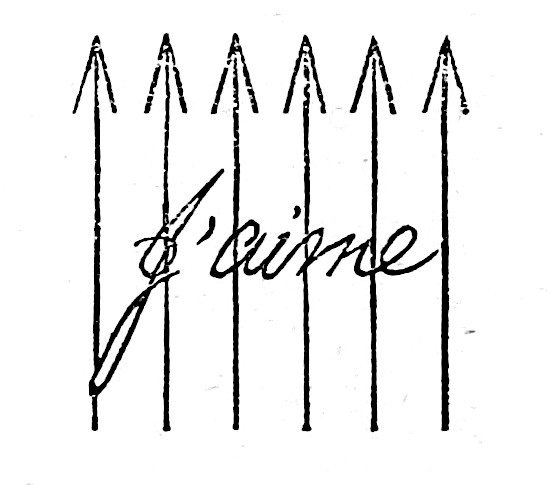
Answer
73.
Translate:
Quis crudus enim lectus, albus, et spiravit!
Answer
74.
Ecrivez: “J’ai grand appétit,” en deux lettres.
Answer
75.
Monosyllabic I, and a reptile, I trow; But, cut me in twain, I form syllables two. I’m English, I’m Latin, the one and the other; And what’s Latin for one half, is English for t’other.
Answer
76.
Ever running on my race, Never staying in one place, Through the world I make my tour Everywhere at the same hour. If you please to spell my name, Backward, forward, ’tis the same.
Answer
77.
In my FIRST my SECOND sat; my THIRD and FOURTH I ate; and yet I was my WHOLE.
Answer
78.
TONIS ADRESTO MARE. O Mare! Eva si formæ, Formæ ure tonitru; Iambicum as amandum, Olet Hymen promptu! Mihi his vetas annæ se, As humano erebi; Olet mecum, mare, to te, Or Eta Beta Pi. Alas, plano more meretrix; Mi ardor vel uno, Inferiam ure artis base Tolerat me urebo. Ah me! ve ara scilicet To laudu vimin thus. Hiatu as arandum sex— Illuc Ionicus! Heu! sed heu! vixin, imago, Mi missis mare sta! O cantu redit in mihi Hibernus arida? Everi dafur heri si; Mihi resolves indu; Totius, olet Hymen cum Accepta tonitru!
Answer
79.
From these five squares take three of the fifteen sides, and leave three squares.
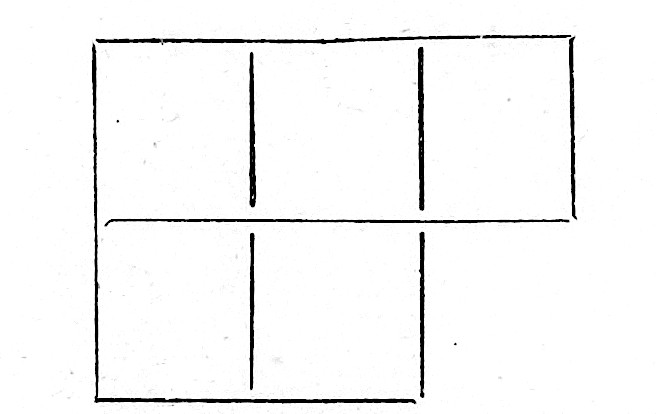
Answer
80.
Divide this figure into four equal and uniform parts.
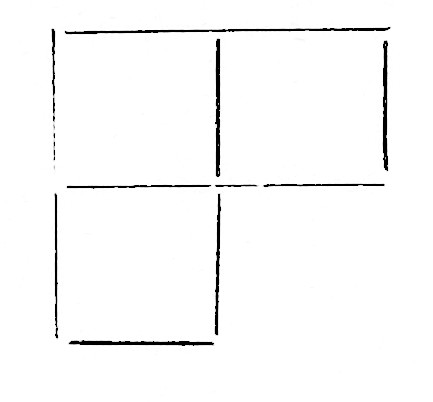
Answer
81.
Four things there are all of a height, One of them crooked, the rest upright. Take three away, and you will find Exactly ten remains behind: But, if you cut the four in twain, You’ll find one-half doth eight retain.
Answer
82.
To divide eight gallons of vinegar equally between two persons; using only an eight-gallon, a five-gallon, and a three-gallon measure?
Answer
83.
A certain miller takes “for toll” one tenth of the meal or flour he grinds. What quantity must he grind in order that a customer may have just a bushel of meal after the toll has been taken?
Answer
84.
To prove that two are equal to one:
Let x = a: Then, x2 = ax, x2 − a2 = ax − a2, (x + a)(x − a) = a(x − a), x + a = a, 2a = a, 2 = 1.Q. E. D.
Where is the fallacy?
Answer
85.
As two Arabs, who had for sole provision, the one five, and the other three loaves of bread, were about to take their noonday meal in company, they were joined by a stranger who proposed to purchase a third part of their food. In payment he gave them, when their repast was finished, eight pieces of silver, and they, unable to agree as to the division of the sum referred the matter to the nearest Cadi, who gave seven pieces to the owner of the five loaves, and but one piece to the owner of the three loaves. And the Cadi was right.
Answer
86.
A man went to a store and bought a pair of boots for six dollars. He put down a ten dollar bill, and the merchant having no change, sent for it to a neighboring bank, and gave it to him. Later in the day one of the bank clerks came in to say that the ten dollar bill was a bad one, and insisted that the merchant should make it right, which he did. Now, how much did he lose by the whole transaction?
Answer
87.
A man bought twelve herrings for a shilling; some were two pence apiece, some a halfpenny, and some a farthing. How many did he buy of each kind?
Answer
88.
My FIRST is the last of me; My SECOND is not so much; And my WHOLE is entirely destitute of my FIRST.
Answer
89.
There is a word of plural number, A foe to peace and tranquil slumber; Now, any word you chance to take, Adding an s will plural make; But if you add an s to this, How strange the metamorphosis! Plural is plural then no more, And sweet what bitter was before.
Answer
90.
“Charge, Chester, charge! On, Stanley, on!” Were the last words of Marmion. Had I been in Stanley’s place, When Marmion urged him to the chase, You then would very soon descry, What brings a tear to every eye.
Answer
91.
My FIRST, if you do, will increase; My SECOND will keep you from Heaven, My WHOLE—such is human caprice— Is seldomer taken than given.
Answer
92.
When may a man reasonably complain of his coffee?
Answer
93.
Why does a duck put her head under water?
Answer
94.
Why does she take it out again?
Answer
95.
In what terms does Shakespeare allude to the muddiness of the river on which Liverpool lies?
Answer
96.
If the B mt put: If the B. putting:
So said one, but another replied: How can I put: when there is such a-der?
Answer
97.
Why is a man who never bets, as bad as one who bets habitually?
Answer
98.
When is a bonnet not a bonnet?
Answer
99.
Twice ten are six of us; Six are but three: Nine are but four of us; What can we be? Would you know more of us? I’ll tell you more; Seven are five of us, Five are but four!
Answer
100.
As I was going to St. Ives’ I met seven wives; Each wife had seven sacks, Each sack had seven cats, Each cat had seven kits,— Kits, cats, sacks and wives, How many were going to St. Ives’?
Answer
101.
Helen, after sitting an hour, dressed for a walk, at length set out alone, leaving the following laconic note for the friend who, she had expected, would accompany her:
2 2 8.
Answer
102.
Come and commiserate one who was blind, Helpless and desolate, void of a mind; Guileless, deceiving; though unbelieving, Free from all sin. By mortals adored, still I ignored The world I was in. King Ptolemy’s, Cæsar’s, and Tiglath Pilezer’s Birth days are shown; Wise men, astrologers, all are acknowledgers, Mine is unknown. I never had father or mother Alive at my birth. Lodged in a palace, taunted by malice, I did not inherit by lineage or merit, A spot on the earth. Nursed among pagans, no one baptized me, Sponsor I had, who ne’er catechised me; She gave me the name to her heart that was dearest; She gave me the place to her bosom was nearest; But one look of kindness she cast on me never, Nor word of my blindness I heard from her ever. Encompassed by strangers, naught could alarm me; I saved, I destroyed, I blessed, I alloyed; Kept a crown for a prince, but had none of my own; Filled the place of a king, but ne’er had a throne; Rescued a warrior, baffled a plot; Was what I seemed not, seemed what I was not; Devoted to slaughter, a price on my head, A king’s lovely daughter watched by my bed. How gently she dressed me, fainting with fear! She never caressed me, nor wiped off a tear; Ne’er moistened my lips, though parched and dry, What marvel a blight should pursue and defy? ’Twas royalty nursed me wretched and poor; ’Twas royalty cursed me in secret, I’m sure. I lived not, I died not, but tell you I must, That ages have passed since I first turned to dust. This paradox whence? this squalor, this splendor? Say, was I king, or silly pretender? Fathom the mystery, deep in my history— Was I a man? An angel supernal, a demon infernal? Solve it who can.
Answer
103.
A blind beggar had a brother. This blind beggar’s brother went to sea and was drowned. But the man that was drowned had no brother. What relation to him, then, was the blind beggar?
Answer
104.
Two brothers were walking together down the street, and one of them, stopping at a certain house, knocked at the door, observing: “I have a niece here, who is ill.” “Thank Heaven,” said the other, “I have no niece!” and he walked away. Now, how could that be?
Answer
105.
“How is that man related to you?” asked one gentleman of another.
“Brother or sister I have none, But that man’s father was my father’s son.”
Answer
106.
Describe a cat’s clothing botanically.
Answer
107.
What is that which boys and girls have once in a lifetime, men and women never have, and Mt. Parnassus has twice in one place?
Answer
108.
Why is the highest mountain in Wales always white?
Answer
109.
To what two cities of Massachusetts should little boys go with their boats?
Answer
110.
There kneels in holy St. Cuthbert’s aisles No holier Father than Father Giles: Matins or Vespers, it matters not which, He is ever there like a saint in his niche; Morning and midnight his Missal he reads, Midnight and morning he tells his beads. Wide-spread the fame of that holy man! Potent his blessing, and dreaded his ban: Wondrous the marvels his piety works On unbelieving heathen, and infidel Turks, But strangest of all is the power he is given To turn maidens’ hearts to the service of Heaven. St. Ursula’s Prioress comes to-day, At holy St. Cuthbert’s shrine to pray, She comes with an offering; she comes with a prayer; For she leads to the altar the Lady Clare. Mary Mother! how fair a maid To yield the world for the cloister’s shade! She yields, to-morrow, her gold and lands For the Church’s use, to the Church’s hands, Renounces the world, with its pleasures and wiles, And to-day she confesses to Father Giles: Slight is the penance, I ween, may atone For all of sin she hath ever known! “Daughter! since last thou didst kneel for grace, Hath peace in thy heart found a dwelling-place? From thy breast hast thou banished each idle thought? Save thy spirit’s weal hast thou pined for naught?” Moist is her kerchief, and drooped her head, But my FIRST is all that poor Clara said. “Daughter! thy cheek hath grown pale and thin— Is thy spirit pure and chastened within? Gone from thy voice is its ancient mirth? Are thy sighs for Heaven? Thy tears for earth?” For earth are her sighs, yet poor Clara knows My SECOND no more than the spring’s first rose! Why doth he tremble, that holy man, At eye so sad, and at cheek so wan? Less burning the tears, less bitter the sighs Heaven asks from its willing votaries! And, alas! when my ALL weeps as Clara weeps, Holy Church gaineth more than she ofttimes keeps!
Answer
NOTABLE NAMES.
111.
One name that means such fiery things I can’t describe their pains and stings.
Answer
112.
Red as an apple, or black as night: A heavenly sign, or a “perfect fright.”
Answer
113.
Place an edible grain ’twixt an ant and a bee, And the well-beloved name of a poet you’ll see.
Answer
114.
Each human head, in time, ’tis said, Will turn to him, though he is dead.
Answer
115.
A little more Than a sandy shore.
Answer
116.
The dearest, “sweetest, spot on earth to me,” And, just surpassing it, a name you’ll see.
Answer
117.
A head-dress.
Answer
118.
Inclining to one of the four parts of the compass.
Answer
119.
A mineral and a chain of hills.
Answer
120.
A metal, and a worker in metals.
Answer
121.
A sound made by an insect; and a fastening.
Answer
122.
A sound made by an animal; and a fastening.
Answer
123.
A sound made by an animal, and a measure of length.
Answer
124.
A Latin noun and a measure of quantity.
Answer
125.
A bodily pain.
Answer
126.
The value of a word.
Answer
127.
A manufactured metal.
Answer
128.
To agitate a weapon.
Answer
129.
A domestic animal, and what she cannot do.
Answer
130.
Which is the greater poet, William Shakespeare or John Dryden?
Answer
131.
A barrier before an edible; a barrier built of an edible.
Answer
132.
One-fourth of the earth’s surface, and a preposition.
Answer
133.
One-fourth of the earth’s surface, and a conjunction.
Answer
134.
A song; to follow the chase.
Answer
135.
A solid fence, a native of Poland.
Answer
136.
An incessant pilgrim; fourteen pounds weight.
Answer
137.
A quick succession of small sounds.
Answer
138.
Obsolete past participle of a verb meaning to illuminate.
Answer
139.
A carriage, a liquid, a narrow passage.
Answer
140.
To prosecute, and one who is guarded.
Answer
141.
A letter withdraws from a name to make it more brilliant.
Answer
142.
A letter withdraws from a name and tells you to talk more.
Answer
143.
Why is a man who lets houses, likely to have a good many cousins?
Answer
144.
What relation is the door-mat to the door-step?
Answer
145.
What is it that gives a cold, cures a cold, and pays the doctor’s bill?
Answer
146.
What is brought upon the table, and cut but never eaten?
Answer
147.
What cord is that which is full of knots which no one can untie, and in which no one can tie another?
Answer
148.
What requires more philosophy than taking things as they come?
Answer
149.
What goes most against a farmer’s grain?
Answer
150.
Which of Shakespeare’s characters killed most poultry?
Answer
151.
THE BISHOP OF OXFORD’S RIDDLE.
I have a large box,1 two lids,2 two caps,3 two musical instruments,4 and a large number of articles which a carpenter cannot dispense with.5 I have always about me a couple of good fish,6 and a great number of small size;7 two lofty trees,8 and four branches of trees;9 some fine flowers,10 and the fruit of an indigenous plant.11 I have two playful animals,12 and a vast number of smaller ones;13 also, a fine stag,14 and a number of whips without handles.15
I have two halls or places of worship,16 some weapons of warfare,17 and innumerable weather-cocks;18 the steps of a hotel;19 the House of Commons on the eve of a division;20 two students or scholars,21 and ten Spanish gentlemen to wait upon their neighbors.22
To these may be added, a rude bed;a the highest part of a building;b a roadway over water;c leaves of grass;d a pair of rainbows;e a boat;f a stately pillar;g a part of a buckle;h several social assemblies;i part of the equipments of a saddle-horse;j a pair of implements matched by another pair of implements much used by blacksmiths;j several means of fastening.k
Answer
152.
Be thou my FIRST in study or in play, Through all the sunny hours which make the day. Go to my SECOND, and do not despise Her useful teachings, wonderful and wise: Yet, for this purpose, never be my WHOLE, Nor seek to wander from a wise control.
Answer
153.
Be sure you do my FIRST, whene’er you see My SECOND in the garden or the tree; But set my WHOLE upon the open plain If you would have a plenteous crop of grain.
Answer
154.
My FIRST is a house men love to view; My SECOND you do when you fasten your shoe; My THIRD is one of a loving two; My WHOLE I fain would be with you.
Answer
155.
1. A common fish, or an Eastern bay; 2. Part of a visage, or self to say; 3. The lowest part of window or door; Whole. The end of a will that was made before.
Answer
156.
I have a little friend who possesses something very precious. It is a piece of workmanship of exquisite skill, and was said by our Blessed Saviour to be an object of His Father’s peculiar care; yet it does not display the attribute of either benevolence or compassion. If its possessor were to lose it, no human ingenuity could replace it; and yet, speaking generally, it is very abundant. It was first given to Adam in Paradise, along with his beautiful Eve, though he previously had it in his possession.
It will last as long as the world lasts, and yet it is destroyed every day. It lives in beauty after the grave has closed over mortality. It is to be found in all parts of the earth, while three distinct portions of it exist in the air. It is seen on the field of carnage, yet it is a bond of affection, a token of amity, a pledge of pure love. It was the cause of death to one famed for beauty and ambition. I have only to add that it has been used as a napkin and a crown, and that it appears like silver after long exposure to the air.
Answer
157.
When the king found that his money was nearly all gone, and that he really must live more economically, he decided on sending away most of his wise men. There were some hundreds of them—very fine old men, and magnificently dressed in green velvet gowns with gold buttons. If they had a fault, it was that they always contradicted each other when he asked their advice—and they certainly ate and drank enormously. So, on the whole, he was rather glad to get rid of them. But there was an old lay which he did not dare to disobey, which said there must always be:
“Seven blind of both eyes; Ten blind of one eye; Five that see with both eyes; Nine that see with one eye.”
Query: How many did he keep?
Answer
158.
Why are not Lowell, Holmes, and Saxe the wittiest poets in America?
Answer
159.
Why did they call William Cullen Bryant, Cullen?
Answer
160.
Why do we retain only three hundred and twenty-five days in our year?
Answer
161.
What seven letters express actual presence in this place; and, without transposition, actual absence from every place?
Answer
162.
Is Florence, (Italy,) on the Tiber? If not, on what river does it lie? Answer both questions in one word.
Answer
163.
Is there a word in our language which answers this question, and contains all the vowels?
Answer
164.
What is it that goes up the hill; and down the hill, and never moves?
Answer
165.
What ’bus has found room for the greatest number of people?
Answer
166.
In describing a chance encounter with your doctor, what kind of a philosopher do you name?
Answer
167.
My FIRST is of my SECOND made, And holds within its ample bound, The grosser things of human trade, From half a ton to half a pound. But mostly from a barren isle, Named from the land of Bajazet, Where tropic sunbeams fiercely smile, It brings a crystalled muriate. But, in the land of Moslem mosque, Of cool sherbet, and scimitar, Of harem dark and fair kiosk, It hath an office fouler far Than e’en the headsman’s sinecure: For slighted loves and jealousies It finds a never-failing cure Deep in the dark Borysthenes. The fleecy flocks on Scotia’s hills; The snow-crowned plant on Georgia’s soil, The Linum with its pale blue bells, My SECOND yield to human toil. To shelter from the sun and storm, It hangs in most unseemly shape Around the beggar’s shriveled form; Or fits a dandy, or an ape. The gentle Rizpah, when the ire Of Gibeon poured its bloody gall, Did to the courts of Death retire To watch the murdered sons of Saul: More truly great was Aiah’s child, As on my WHOLE she sat alone, To fright the wolf and vulture wild, Than coward Saul upon his throne. And ever—symbol dark of doom, A type of deep humility— My WHOLE speaks of the fearful tomb, The coffin, shroud, and cypress tree; Save in the far-off Orient, Where Light’s own spotless color Is with the tears of mourners blent, And made the type of dolor.
Answer
168.
What physician stands at the top of his profession?
Answer
169.
Would you rather an elephant killed you, or a gorilla?
Answer
170.
Why is an amiable and charming girl like one letter deep in thought, another on its way toward you, another bearing a torch, and another slowly singing psalms?
Answer
171.
Why is Emma, in a sorrowful mood, one of a certain sect of Jews?
Answer
172.
Why is she, always, one of another sect?
Answer
173.
What English writer would have been a successful angler?
Answer
174.
What is that which you and every living man have seen, but can never see again?
Answer
175.
Which is the strongest day in the week?
Answer
176.
Come from my FIRST, aye, come! The battle dawn is nigh; And the screaming trump, and the thundering drum Are calling thee to die. Fight as thy fathers fought, Fall as thy fathers fell; Thy task is taught, thy shroud is wrought; So, forward! and farewell! Toll ye my SECOND, toll! Fling high the flambeau’s light; And sing the hymn for the parted soul Beneath the silent night. The wreath upon his head, The cross upon his breast, Let the prayer be said, and the tear be shed, So, take him to his rest! Call ye my WHOLE, aye, call The lord of lute and lay; And let him greet the sable pall With a noble song to-day. Go, call him by his name; No fitter hand may crave To light the flame of a soldier’s fame On the turf of a soldier’s grave.
Answer
177.
Oh, gloomy, gloomy, is my FIRST To all who step within! But doubly gloomy to the one Who dwells there for his sin. Oh, silent, silent, are the tongues Of those who are my NEXT! Oh, never be unkind to them, Or with their failings vexed. Oh, kindly fall sweet pity’s words Upon the outcast’s heart! My WHOLE will tell how oft they come Their blessing to impart.
Answer
178.
What a common man often sees; What a king or emperor seldom sees; What GOD never sees?
Answer
179.
A shining wit pronounced, of late, That every acting magistrate Is water in a freezing state.
Answer
180.
I’m rough, I’m smooth, I’m wet, I’m dry; My station low, my title high; The king my lawful master is,— I’m used by all, though only his.
Answer
181.
My FIRST’S a stream in classic land; My SECOND all well understand Who traveled much by public aid Ere steam ingenious man obeyed. My FIRST, when cut in two again, Has part in shedding light ’mong men; My SECOND, though ’tis no disgrace, Writes wrinkles on the human face. My WHOLE is not of recent birth, But something proved of real worth, Whose task is to facilitate The movements of the Ship of State.
Answer
182.
I am a king; my palace low, yet rule I with extensive sway; Great kings had Egypt long ago, but yet I reigned before their day; To epicures my reign I owe more than to any other thing— Though guillotine I undergo, it keeps me not from being king. With head cut off, I am a king; with neck cut off and head left on, I will be king: yes! I’ll be king though head and neck should both be gone. If head and foot I both should lose, a blood relation you’d espy; For, then, a kin I would disclose: now tell, I pray, what king am I?
Answer
183.
My FIRST is in the cornfield seen; My SECOND in the hedges green; My WHOLE from glossy vines you glean.
Answer
184.
What is the smallest room in the world?
Answer
185.
What is often found where it does not exist?
Answer
186.
What is that which is lengthened by being cut at both ends?
Answer
187.
When do your teeth usurp the functions of your tongue?
Answer
188.
What word is that to which if you add one syllable, it will be shorter?
Answer
189.
What is that which is lower with a head than without one?
Answer
190.
What vice is that which people shun if they are ever so bad?
Answer
191.
Which travels at greater speed, heat or cold?
Answer
192.
My FIRST hath teeth, yet ’tis no man; It hath no hands, yet work it can. My NEXT hath teeth, for ’tis a man, Or ’tis an herb dried on a pan. My WHOLE hath no teeth: ’tis no man, ’Tis eaten oft by all his clan.
Answer
193.
A maid sat sewing in castle hall, Near an arching window in the wall; And again and again her song she rehearsed As she placed on her lover’s kerchief my FIRST, For her lover was coming from foreign land To give her his heart, and to claim her hand. Ah! in foreign dungeon her lover lay, Where stone on stone shut out every ray. He never the hand of the maiden would clasp; He was held by my SECOND’S iron grasp. With feverish thirst he calls for drink— Ere long he hears the rattle and clink Of the jailer’s keys, as he brings the cup, And bids the prisoner drink it up. Eagerly, quickly, he slakes his thirst. Heaven pity the maid! In that draught accurst, Is mingled my WHOLE; and, with failing breath, The doomed man sinks in the arms of death.
Answer
194.
A word I am of letters seven, A name to noble women given; Take three away, (the last I mean,) And I’m a man fit for a queen; Remove one more, and, lo! you’ll see That I my former sex will be; Another drop, and two remain Which tell I am a man again.
Answer
195.
No rose can boast a lovelier hue Than I can when my birth is new: Of shorter date than e’en that flower, I bloom and fade within an hour. Though some in me their honor place, I bear the stigma of disgrace; Like Marplot, eager to reveal The secret I would fain conceal. Fools, coxcombs, wits, agree in this, They equally destroy my peace; Though ’gainst my will to stoop so low, At their command I come and go.
Answer
196.
When a blind man drank tea, how did he manage to see?
Answer
197.
Why is a mouse like grass?
Answer
198.
What is the key-note of good breeding?
Answer
199.
What is the typical “Yankee’s” key-note?
Answer
200.
If you were on the second floor of a burning house and the stairs were away, how would you escape?
Answer
201.
My FIRST is nothing but a name; My SECOND still more small; My WHOLE is of so little fame, It has no name at all.
Answer
202.
A carpenter made a door and made it too large; he cut it again and cut it too little; he cut it again and made it fit.
Answer
203.
A wagoner, being asked of what his load consisted, made the following (rather indirect) reply:
Three-fourths of a cross, and a circle complete; An upright, where two semi-circles do meet; A right-angled triangle standing on feet; Two semi-circles, and a circle complete.
What is it?
Answer
204.
Why need people never suffer from hunger on such a desert as Sahara?
Answer
207.
How do the arks used for freight on the Mississippi River, differ from Noah’s Ark?
Answer
208.
In what order did Noah leave the Ark?
Answer
209.
What is Majesty deprived of its externals?
Answer
210.
Dreaming of apples on a wall, And dreaming often, dear, I dreamed that if I counted all, How many would appear?
Answer
211.
What is most like a bee in May? “Well, let me think: perhaps—” you say; Bravo! you’re guessing well to-day.
Answer
212.
Three sisters at breakfast were feeding the cat; The first gave it sole: Puss was grateful for that; The next gave it salmon, which Puss thought a treat; The third gave it herring, which Puss wouldn’t eat. (Explain the conduct of the cat.)
Answer
213.
John went out; his dog went with him; he went not before, behind, or on one side of him; then where did he go?
Answer
214.
If spectacles could speak to their wearers, what ancient writer would they name?
Answer
215.
Part of a foot with judgment transpose, And the answer you’ll find just under your nose.
Answer
216.
A feeling all persons detest, Although nearly by every one felt; By two letters fully expressed, By twice two invariably spelt.
Answer
217.
My FIRST implies equality; my SECOND is the title of a foreign nobleman; and my WHOLE is asked and given a hundred times a day with equal indifference; yet is of so much importance that it has saved the lives of thousands.
Answer
POSITIVES AND COMPARATIVES.
218.
Where runs the land far out into the sea, The children shout and frolic in their glee.
Answer
219.
Among the singers half a score were found, But not a voice so sweet as his in sound.
Answer
220.
He vowed he never would forgive, Though twice two years and more he lived.
Answer
221.
The noble tree spread out its mighty arms, Above the house bedecked in painted charms.
Answer
222.
He planted there his wheat and corn, While birds flew high in early morn.
Answer
223.
He paid the lawyer when the suit was won, Glad that his dread of sad defeat was done.
Answer
224.
The timid creature wildly looking ’round, Shrinks back in deadly terror from the sound.
Answer
225.
He vowed to prosecute, because A neighboring drain unsavory was.
Answer
226.
How would the Teuton manage to exist, If this enchanting beverage he missed?
Answer
227.
How delightful ’twould be to recline at your ease, And list to the harp, with its rare melodies!
Answer
228.
A gay young man, without ideas, Oft wearies where he fain would please.
Answer
229.
Famed more for genius than good looks; I went there to procure her books.
Answer
230.
The broad expanse, denied his waking sight, He saw in visions both by day and night.
Answer
231.
It brought the miser to his grave; Even his strong box could not save.
Answer
232.
1. Because he will not work for one, 2. The other he will be.
Answer
233.
1. The ship came gaily sailing in; 2. Now who so strong as he?
Answer
234.
1. If hungry, you may have it all; 2. A funeral pile, you see.
Answer
235.
1. Drive home your ball, and come and eat 2. The cakes prepared for tea.
Answer
236.
1. While the poet sang his “Farewell, thou sweet river!” 2. It roamed in forests near, as wild and free as ever.
Answer
237.
1. Add sugar, more sugar! His grimaces see! 2. Swift rider, bold robber, fierce savage is he.
Answer
238.
1. Hand the beverage ’round, adding cream as you go, 2. From the uppermost, down to the lowermost, row.
Answer
POSITIVES, COMPARATIVES, SUPERLATIVES.
239.
Pos., A pronoun; Com., A period of time; Sup., Fermenting froth.
Answer
240.
Pos., A knot of ribbon; Com., An animal; Sup., Self-praise.
Answer
241.
Pos., A reward; Com., Dread; Sup., A festival.
Answer
242.
Pos., To reward; Com., A fruit; Sup., An adhesive mixture.
Answer
243.
Pos., A meadow; Com., An unfortunate king; Sup., The smallest.
Answer
244.
Pos., In a regular line; Com., With an appetite fine; Sup., ’Twill be done when we dine.
Answer
245.
Pos., Busy, noisy, and cheerful. Com., The thought of it saddening and tearful; Sup., Its roar and its fierce claws are fearful.
Answer
246.
Pos., The end of all time; Com., Judge of music and rhyme; Sup., The Orient clime.
Answer
247.
Pos., Denotes a bond or tie; Com., In the centre it doth lie; Sup., The billows break on it and die.
Answer
248.
Pos., An American genius; Com., To turn out or to flow; Sup., An office, an express, a place, a piece of timber.
Answer
249.
Pos., To depart; Com., To wound; Sup., A visible spirit.
Answer
250.
Pos., Pleasant, dreary, wet or dry; Com., If ’tis light or heavy, try, On your scales, before you buy; Sup., Don’t spend money foolishly!
Answer
251.
A gentleman who had sent to a certain city for a car-load of fuel, wrote thus to his nephew residing there:
“Dear Nephew ; Uncle John.”
Presently he received the following reply:
“Dear Uncle : James.”
Answer
252.
Why is a man up stairs, stealing, like a perfectly honorable man?
Answer
253.
Why is a ship twice as profitable as a hen?
Answer
254.
Why can you preserve fruit better by canning it, than in any other way?
Answer
255.
Twelve kinds of things in fact, not fiction, Behind a veil of contradiction. ** * * * All dressed in silk, with stately grace, We stand with ready ears, And yet the sounds that greet the place Not one among us hears.1 We’re keen and quick our holes to find And run in lively mood, And yet we’re footless quite and blind, Although our eyes are good.2 Our perfect heads can’t give us sense, Though we are naught without them;3 Our useful tongues are mere pretense— No talk or taste about them.4 Our locks though fine can ne’er be combed;5 Our teeth can never bite;6 Our mouths from out our heads have roamed, And oft outgrow them quite.7 Our hearts no pity have, or joy, Yet they’re our richest worth;8 Our hands ne’er waved at girl or boy, Or anything on earth.9 Alive are we, yet buried quite; Our trust is in our eyes; They help us out through darkest night, Though sight stern fate denies.10 We sally forth when day is done, And set the owls a-hooting, And, though we have no bow or gun, We often go a-shooting.11 Our souls, alas! are dull and low, Down-trodden, from the start; Yet who shall say, in weal or wo, They’re not our better part?12
Answer
256.
Within this world a creature once did dwell, As sacred writings unto us do tell, Who never shall be doomed to Satan’s home, Nor unto God’s celestial Kingdom come; Yet in him was a soul that either must Suffer in Hell, or reign among the just.
Answer
257.
What best describes, and most impedes, a pilgrim’s progress?
Answer
258.
Why is a girl not a noun?
Answer
259.
What part of their infant tuition have old maids and old bachelors most profited by?
Answer
260.
What is that which never asks any questions, and yet requires many answers?
Answer
261.
What quadrupeds are admitted to balls, operas, and dinner-parties?
Answer
262.
If a bear were to go into a linen-draper’s shop, what would he want?
Answer
263.
When does truth cease to be truth?
Answer
264.
How many dog-stars are there?
Answer
265.
What is worse than raining cats and dogs?
Answer
266.
Why is O the only vowel that can be heard?
Answer
267.
Why is a man that has no children invisible?
Answer
268.
What is it which has a mouth, and never speaks; a bed, and never sleeps?
Answer
269.
Which burns longer, a wax or sperm candle?
Answer
270.
Why is a watch like an extremely modest person?
Answer
271.
LORD MACAULAY’S LAST RIDDLE. Let us look at it quite closely, ’Tis a very ugly word, And one that makes me shudder Whenever it is heard. It mayn’t be very wicked; It must be always bad, And speaks of sin and suffering Enough to make one mad. They say it is a compound word, And that is very true; And, when they decompose it, (Which, of course, they’re free to do)— If, of the letters they take off And sever the first three, They leave the nine remaining As sad as they can be: For, though it seems to make it less, In fact it makes it more, For it takes the brute creation in, Which it left out before. Let’s try if we can mend it— It’s possible we may, If only we divide it In some new-fashioned way, Instead of three and nine, then, Let’s make it four and eight; You’ll say it makes no difference, At least not very great: But only see the consequence! That’s all that needs be done To change this mass of sadness To unmitigated fun. It clears off swords and pistols, Revolvers, bowie-knives, And all the horrid weapons By which men lose their lives; It wakens holier feelings— And how joyfully is heard The native sound of gladness Compressed into one word! Yes! four and eight, my friends! Let that be yours and mine, Though all the hosts of demons Rejoice in three and nine.
Answer
272.
A word by grammarians used in our tongue, Of such a construction is seen, That if, from five syllables one is removed, No syllable then will remain.
Answer
273.
Formed long ago, yet made to-day, I’m most in use when others sleep; What few would like to give away, And none would like to keep.
Answer
274.
A lady was asked “What is Josh Billings’ real name? What do you think of his writings?” How did she answer both questions by one word?
Answer
275.
Why is Mr. Jones’ stock-farm, carried on by his boys, like the focus of a burning-glass?
Answer
276.
A by <. The name of a book, and of its author.
Answer
277.
What word in the English language contains the six vowels in alphabetical order?
Answer
278.
If the parlor fire needs replenishing, what hero of history could you name in ordering a servant to attend to it?
Answer
279.
My FIRST is an insect, my SECOND a quadruped, and my WHOLE has no real existence.
Answer
280.
If the roof of the Tower of London should blow off, what two names in English history would the uppermost rooms cry out?
Answer
281.
MY FIRST. In the glance of the sun, when the wild birds sing, I start in my beauty to gladden the spring; I weep at the morning marriage, and smile On the evening tomb, though I die the while.
MY SECOND. I wander; I sin; though a breath may make All my frame an effeminate nature take, And a manly dignity that, as well, Can of mastery and lordship tell.
MY WHOLE. I have startled the world to jeering and mirth, Since that, earthly, I dared to withdraw from the earth; But I stay, though cut off in my prime, far more Enlivening and life-full than ever before.
Answer
282.
One hundred and one by fifty divide, Then, if you add naught to the right or left side, The result will be one out of nine—have you tried?
Answer
283.
I am composed of five letters. As I stand, I am a river in Virginia, and a fraud. Beheaded, I am one of the sources of light and growth. Beheaded again, I sustain life; again, and I am a preposition. Omit my third, and I am a domestic animal in French, and the delight of social intercourse in English. Transpose my first four, and I become what may attack your head, if it is a weak one, in your efforts to find me out.
Answer
284.
Unto a certain numeral one letter join—sad fate! What first was solitary, you now annihilate.
Answer
285.
My FIRST was heard to “hurtle in the sky, When foes in conflict met in olden time”; My SECOND none can yield without a sigh, Though it has oft been forfeited by crime; My WHOLE, its ancient uses gone, is found On sunny uplands, or in forest ground.
Answer
286.
Can you tell me why A hypocrite’s eye Can better descry Than you can, or I, Upon how many toes A pussy-cat goes?
Answer
287.
Walked on earth, Talked on earth, Boldly rebuked sin; Never in Heaven, Never in Hell, Never can enter in.
Answer
288.
There is a certain natural production that is neither animal, vegetable, nor mineral; it exists from two to six feet from the surface of the earth; it has neither length, breadth, nor substance; is neither male nor female, though it is found between both; it is often mentioned in the Old Testament, and strongly recommended in the New; and it answers equally the purposes of fidelity and treachery.
Answer
289.
We are little airy creatures, All of different voice and features: One of us in glass is set; One of us is found in jet; One of us is set in tin; One a lump of gold within: If the last you should pursue, It can never fly from you.
Answer
290.
My FIRST is a point, my SECOND a span; In my WHOLE often ends the greatness of man.
Answer
291.
Wherever English land Touches the pebbly shore, My FIRST lies on the sand, Changing forevermore. My SECOND oft, I’m told, State secrets will hold fast, But, to a key of gold ’Tis known to yield at last. Fond mother, tender wife, With agonizing soul,— The exile, sick of life,— Have looked and sighed my WHOLE.
Answer
292.
I begin with a thousand, I end with a hundred; My middle’s a thousand again; The third of all vowels, the ninth of all letters, Take their place in the rest of the train: My WHOLE is a thing you never should do,— At least, you don’t like it, if tried upon you!
Answer
293.
A word which always speaks of shame I pray you, reader, now to name: Eleven parts my whole contains, To guess them you must take some pains. Three groups there be which stand related; The first with many a word is mated: The second speaks of favor rare; The third of plenty everywhere. Cut off the first; and shameful grows As fair as any garden rose; Cut off the last, and lo! ’tis plain, The word is full of shame again.
Answer
294.
The eldest of four brothers did a sound business; the second, a smashing business; the third, a light business; and the youngest, the most wicked business. What were they?
Answer
295.
Cut off my head, and singular I am, Cut off my tail, and plural I appear; Cut off both head and tail, O wondrous fact! My middle part remains, though naught is there. What is my head cut off? A sounding sea. What is my tail cut off? A roaring river. Far in the ocean’s depths I fearless play; Giver of sweetest sounds, yet mute forever.
Answer
296.
I’m a creature most active, most useful, most known, Of the thousands who daily perambulate town. Take from me one letter, and still you will see I’m the same as I was; just the same, to a T. Take two letters from me, take three, or take four, And still I remain just the same as before: Indeed I may tell you, although you take all You cannot destroy me, or change me at all.
Answer
297.
My FIRST is up at break of day, And makes a welcome voice heard, And goes to bed in twilight gray, Though neither child nor song-bird. My SECOND’S known to tongue and pen; Is fast to all the church walls, Is always seen in nurseries, And often when the snow falls. In green and yellow always dight, Though melancholy never, My WHOLE shines bright with golden light, And emerald, forever.
Answer
298.
To fifty add nothing, then five, Then add the first part of eighteen; A desert would life be without it, But with it, a garden, I ween.
Answer
299.
What tree bears the most fruit for the Boston market?
Answer
300.
Why is the end of a dog’s tail, like the heart of a tree?
Answer
301.
Why is a fish-monger not likely to be generous?
Answer
302.
Take away my first five, and I am a tree. Take away my last five, and I am a vegetable. Without my last three, I am an ornament. Cut off my first and my last three, and I am a titled gentleman. From his name cut off the last letter, and an organ of sense will remain. Remove from this the last, and two parts of your head will be left.
Divide me into halves, and you find a fruit and an instrument of correction. Entire, I can be obtained of any druggist.
Answer
303.
Why was Elizabeth of England a more marvelous sovereign than Napoleon?
Answer
304.
A SQUARE-OF-EVERY-WORD PUZZLE.
I.
The desert-king, Whose presence will Each living thing With terror fill.
II.
Of this word ’tis the mission To be a preposition, Giving you a notion Of onward, inward, motion.
III.
This charm to blend, The myriad roses of Cashmere you ask Their subtle essences to one small flask Freely to lend.
IV.
The middy, to his labor trained, The sun by sextant viewed; And said that Phœbus had attained His greatest altitude.
Answer
305.
A prophet exists, whose generation was before Adam; who was with Noah in the Ark, and was present at the trial of our Lord. The only sermon he preached, was so convincing as to bring tears to the eyes and repentance to the heart of a sinner. He neither lies in a bed nor sits in a chair; his clothing is neither dyed, spun nor woven, but is of finest texture and most brilliant hue. His warning cry ought to call all sluggards from their slumbers: he utters it in every land and every age; and yet he is not the Wandering Jew.
Answer
306.
I have but six letters; I’m little, you see; Yet millions of people have wondered at me; My 2, 6, 5, 1, you possess, and yet seek; My 6, 4, 1, renders the strongest man weak; My 5, 3, 2, 1, is both pronoun and noun, And my 5, 1, 2, often have builded a town; To my 3, 5, 6, 4, 1, men sometimes have prayed, And my 4, 6, 5, 1, through most forests have strayed; My 6, 3, 5, has been to mystify you, And devout men oft utter my 6, 5, 1, 2.
Answer
307.
(Fill the blanks with the names of British Authors.)
A —— upon the —— shore was seen, I looked again, and it no —— was seen.
Answer
308.
A —— who of riches had great store, Was fain to keep a —— upon his door.
Answer
309.
A —— trod the desert, —— and ——, And, slow but sure of —— made good his way.
Answer
310.
I see with every man a thing No man on earth hath ever seen; Yet calm reflection still would bring It face to face with him, I ween; ’Twould be before him plain as day, Yet not be what he saw, I say.
Answer
311.
1. I have wings and I fly, though I’m not called a bird; 2. I am part of a hundred, e’en more than a third; 3. I am “A No. 1” with the most of mankind; 4. In France and in Germany me you will find; 5. My FIFTH in your hand you may frequently see; 6. And my WHOLE it is dreary and wretched to be.
Answer
312.
Blanks to be filled with the names of noted authors.
A little child, ——, ——, and full of grace, Threw back her —— and showed her smiling face; Meek as the —— she by a ribbon led, As o’er the —— in the —— dawn she sped; Fleet as the —— when to the —— the —— Called, and the sportsman —— not at morn; Against her —— more than paltry gold, I could not —— my heart, however cold.
Answer
313.
You need not —— my inquiring friend, If, asking me if I am on the mend, You find me still in no —— frame; Upon an —— lay all the blame; And though it may not —— seem to mope, I could not —— my pain to please the ——.
Answer
314.
Than myself in my normal condition, nothing could be lighter or more airy. I am composed of six letters and four syllables. Deprived of my first two and transposed, I am the haunt of wild beasts; transposed, I am a human being more dangerous than a wild beast; transposed again, I am part of a fence; robbed of my last letter, and again transposed, I am a melody; or I am that noun without which there would be no such adjective as my WHOLE.
Answer
315.
CHRISTMAS DINNER.
The first course consisted of a linden tree, and some poles. The second, of a red-hot bar of iron, a country in Asia, and an ornament worn by Roman ladies, accompanied by a vegetable carefully prepared as follows: one-sixth of a carrot, one-fourth of a bean, one-half of a leaf of lettuce, and one-third of a cherry. For dessert, a pudding made of the interment of a tailor’s implement; some points of time, and small cannon-shot from Hamburg.
Answer
316.
My FIRST can be a useful slave, Obedient to your will; Yet let him once the master be, He’ll ruin, rage, and kill. To do my SECOND through the air, Oft men have tried in vain, Yet, if you look, you’ll find it there, Upon your window-pane. My WHOLE on summer nights is seen A fairy lamp to light the green.
Answer
317.
Seen more by day; heard more by night: I help the old to better sight; Chameleon-like, my food is air, And dust to me is dainty fare.
Answer
NUTS TO CRACK.
318.
What nuts were essential to the safety of ancient cities?
Answer
319.
What nut is a garden vegetable?
Answer
320.
What nut is a dairy product?
Answer
321.
What nut is dear to bathers?
Answer
322.
What nut is used to store away things in?
Answer
323.
What nut is a breakfast beverage?
Answer
FOR AMATEUR GARDENERS.
324.
Plant the early dawn, and what flower will appear?
Answer
325.
What spring flowers are found in the track of an avalanche?
Answer
326.
What early vegetable most resembles a pain in the back?
Answer
327.
What flower is most cultivated by bad-tempered persons?
Answer
328.
If a dandy be planted, what tree will come up?
Answer
329.
Why is a gardener a most fortunate antiquary?
Answer
330.
What herbs will spoil your brood of chickens?
Answer
331.
Man cannot live without my FIRST; By day and night ’tis used, My SECOND, though disliked by all, By none can be refused. My WHOLE is never seen by day, Nor ever seen by night; Yet shows in eyes suffused with tears, In faces wan and white.
Answer
332.
FIRST.
Something we too early sigh for; What, through life, too hard we try for; What, alas! too many die for.
SECOND.
Upon my SECOND, in a boat, We lightly toss or idly float; Or bathe within its wavelets clear,— (The word to Tennyson is dear.)
THE WHOLE.
A lovely vale well known to fame, Of which a fabric bears the name, Well worthy of the proudest dame.
Answer
333.
My SECOND went to the side of my FIRST, And stayed through the WHOLE for the air; There were croquet and singing And bathing and swinging, And chatting with maidens so fair.
Answer
334.
Two heads I have, and when my voice Is heard afar like thunder, The lads and maids arrested stand, And watch and wait with wonder. Quite promptly I’m obeyed, and yet ’Tis only fair to say My master bangs me right and left, And him I must obey.
Answer
335.
I am useful on a farm, and on shipboard. Transpose me and I am not out of place on your tables, though I am most at home on the other side of the world. Change me to my original form, and remove my middle, and I become a part of your face.
Answer
POSITIVES AND COMPARATIVES.
336.
He brings his bill for service done And straightway mounts his steed.
Answer
337.
The little rascal plays his pranks, Then runs away with speed.
Answer
338.
Now see the youth with nimble tread As step by step he mounts!
Answer
339.
How well the story he’ll relate! How rapidly he counts!
Answer
340.
Then give me but my Arab steed, And well I’ll shave his head.
Answer
341.
Oh! what a horrid, noisy bell! The noontide meal is spread.
Answer
342.
It was myself—mistake me not— Whose wrath was kindled at the thought.
Answer
343.
The sombre tree grew at the foot of the mountain: Just where the pitcher we filled at the fountain.
Answer
344.
The debts he’s contracted to you and to me, By the silver that’s in it, will canceled be.
Answer
345.
Beside the brook one summer day When Nature all was merry, I saw a gypsy maiden stray, As brown as any berry. She, with the limpid waters quenched her thirst, And picked a simple salad of my FIRST. The woodbine and the eglantine, The clematis and mallow, Delight to twine and interwine Beside that streamlet shallow; And, kissed by sunlight, and caressed by dews, My SECOND in the ambient air diffuse. The sun went down; the twilight fell; Out shone the stars unnumbered; Each flowret closed its honeyed cell, And Nature softly slumbered. While, pale and cold, across the heavens stole In modest, maiden majesty, my WHOLE.
Answer
346.
The following puzzle was first published in 1628, and was reprinted in Hone’s Every-Day Book for 1826:
A vessel sailed from a port in the Mediterranean, with thirty passengers, consisting of fifteen Jews and fifteen Christians. During the voyage a heavy storm arose, and it was found necessary to throw overboard one-half the passengers, in order to lighten the ship. After consultation, they agreed to a proposal from the captain, that he should place them all in a circle, and throw overboard every ninth man until only fifteen should be left. The treacherous wretch then arranged them in such a way, that all the Jews were thrown overboard, and all the Christians saved. In what order were they placed?
Answer
347.
pOl pol pol
Pol POL PoL
ST
Answer
348.
A man building a barn, wished to place in it a window 3 ft. high by 3 ft. wide. But, finding there was not room enough, he had it made half the size intended, without altering height or width.
Answer
349.
PERSIAN RIDDLE.
Between a thickset hedge of bones, A small, red dog now barks, now moans.
Answer
350.
I contain only two syllables. My FIRST implies plurality; my SECOND, sound health. My WHOLE is the name of a profligate earl who was the third husband of a queen noted alike for her beauty and her misfortunes. He died insane and in exile; and the beautiful queen, after being queen consort in one country, and reigning sovereign in another, spent nineteen years in captivity, and was finally beheaded on the 8th of January, 1587.
Answer
351.
A celebrated line from Shakespeare.
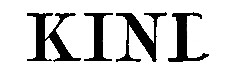
Answer
352.
The blacksmith with hammer of musical —— Forges a chain of a ponderous —— His hands are brawny and black as —— But he loves his work as well As his neighbor goldsmith at ease in a —— Twisting fine gold to the size of a —— And weaving a trifle light as —— For the delicate ear of a belle.
Answer
353.
TRANSMUTATIONS.
1. A letter made crazy by being placed in order.
2. A letter becomes an island when surrounded by a belt.
3. A letter is pleased when set on fire.
4. A letter falls in love when it is beaten.
5. A letter is hated when it is examined.
6. A letter becomes a sailor when it leaves the house.
7. A letter is filled with crystals when it becomes a creditor.
8. A letter becomes musical when it is made thick.
9. A letter changes its shape when empty.
10. A letter is seen when it is spotted.
11. Another is seen when taken in hand.
12. When a letter is perforated it draws near the ocean.
13. It costs money for a letter to be thoughtful.
14. A letter is always slandered when it becomes noted.
What letters are they?
Answer
354.
My FIRST a liquid path is made By something used in foreign trade. My SECOND pours from out his throat To weary ones a welcome note, Coming, a sure and pleasant token That winter’s icy chain is broken. My WHOLE I’ve found in purple bloom, Or clothed in white ’mid forest gloom, Leaves, petals, sepals, all in threes— A triple triplet, if you please.
Answer
355.
On muster-day the boys were —— Each nerve to show a splendid —— When suddenly the cry, ’Tis —— Proclaims ill luck begun; From fine cockades the beauty —— Adown their uniforms are —— The streams that spoil their fun. Crestfallen, homeward they are —— When lo! a bright bow over —— Tells that the rain is done.
Answer
356.
Brilliant with white and golden light I blossom in the shade; Emblem of purity and truth, Though of two falsehoods made.
Answer
357.
The egotist my FIRST employs To consummate his bliss, The school-boy finds it in a noise, The lover in a kiss. When on the field, in dread array, Opposing legions wait the fray, When trumpets sound and banners wave, The watchword “Victory or the Grave” Where’er my SECOND may be found, The bravest knights will there abound. What though my THIRD the soldier spurns With undisguised disdain, To it the farmer gladly turns To cultivate the plain. My WHOLE a gallant warrior’s name, The idol of the fair; A wizard celebrates his fame— You’ll find my subject there.
Answer
358.
A little word of syllables three, Holds in its heart a mystery. I walk the earth; I climb the sky; Full fierce below, serene on high; I lead the field, I lead the fold, I call to mind the fleece of gold. Four times ten centuries ago, When Abraham’s shepherds watched by night, Their flocks upon the fields below, Above, the stars’ mysterious light, The heavenly host all followed one Whose name proclaimed his mission high, He “went before and led the way,” We joined his train submissively. At length, as centuries rolled on, His leadership and prestige gone, In turn I led the flocks on high,— As on the earth, so in the sky. When many centuries again Had joined the eternal past, I found the fate of all create Was mine—was mine—at last! And while, my ancient honors lost, I yield to my changed destiny, Another chief the starry host In stately march precedes on high. (To make the enigma more complete, If to this word of syllables three, A personal pronoun be prefixed, The three reduced to two you’ll see: And this new word will just express What everything earthly does in time, Life’s bitter sooner than its sweets,— So end the riddle and the rhyme.)
Answer
359.
What kind of paper is most like a sneeze?
Answer
360.
Why did Edward Everett like to write his own name?
Answer
361.
Why would not the same name be a good exercise in writing?
Answer
362.
A farmer had ten apple trees to plant. He desired to place them in five rows, having four in each row. This he succeeded in doing. How?
Answer
363.
Quotation from Shakespeare:
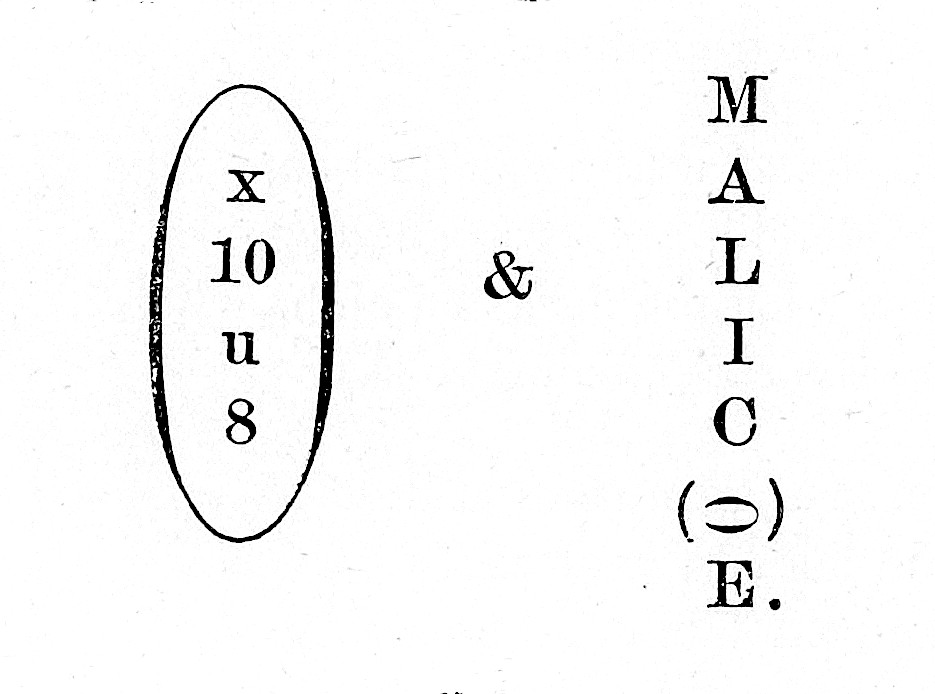
Answer
364.
One little boy said to another: “I have an own and only sister, but she has no brother.” How was that?
Answer
365.
If stately Edith give her —— To Reginald, ’twill end my —— For it transcends my utmost —— To make a hero of a ——
Answer
366.
On grassy upland chirps the —— Sad in the valley roams the —— Thinking of bright hours too soon —— Humming in misery “Non è ——” He thinks not of the west so brightly —— Nor listens to the faint and distant —— But dreams of the false fair to whom is —— The wo which never, never, will take ——.
Answer
367.
Convert the following into a couplet, perfect in rhyme and rhythm, without adding or omitting a single letter:
“O Deborah, Deborah! wo unto thee For thou art as deaf as a post.”
Answer
368.
One and the same word of two syllables, answers each of the following triplets:
I. MY FIRST springs in the mountains;
MY SECOND springs out of the mountains;
MY WHOLE comes with a spring over the mountains.
II. MY FIRST runs up the trees;
MY SECOND runs past the trees;
MY WHOLE spreads over the trees.
III. MY FIRST runs on two feet;
MY SECOND runs without feet;
MY WHOLE just glides away.
IV. To catch MY FIRST, men march after it;
To capture MY SECOND, they march over it;
To possess MY WHOLE, they go through a march before it.
Answer
369.
Said the Moon to the Sun: “Is the daylight begun?” Said the Sun to the Moon: “Not a moment too soon. You’re a full Moon,” said he; She replied, with a frown, “Well! I never did see So uncivil a clown!”
Query: Why was the Moon so angry?
Answer
370.
It is as high as all the stars, No well was ever sunk so low; It is in age five thousand years, It was not born an hour ago. It is as wet as water is; No red-hot iron e’er was drier; As dark as night, as cold as ice, Shines like the sun, and burns like fire. No soul, nor body to consume— No fox more cunning, dunce more dull; ’Tis not on earth, ’tis in this room, Hard as a stone, and soft as wool. ’Tis of no color, but of snow, Outside and inside black as ink; All red, all yellow, green and blue— This moment you upon it think. In every noise, this strikes your ear, ’Twill soon expire, ’twill ne’er decay; Does always in the light appear, And yet was never seen by day. Than the whole earth it larger is, Yet, than a small pin’s point, ’tis less; I’ll tell you ten times what it is, Yet after all, you shall not guess! ’Tis in your mouth, ’twas never nigh— Where’er you look, you see it still; ’Twill make you laugh, ’twill make you cry; You feel it plain, touch what you will.
Answer
371.
My FIRST, so faithful, fond and true, Will ne’er forsake or injure you; My SECOND, coming from the street You often trample under feet; My THIRD you sleep on every night, Serene and calm, without affright; My WHOLE is what you should not be When talking with your friends or me.
Answer
372.
My FIRST is a little river in England that gave name to a celebrated university; my SECOND is always near; my THIRD sounds like several large bodies of water; and my WHOLE is the name of a Persian monarch, the neighing of whose horse gave him a kingdom and a crown.
Answer
373.
A horse in the midst of a meadow suppose, Made fast to a stake by a line from his nose; How long must this line be, that, feeding all ’round, Permits him to graze just an acre of ground?
Answer
374.
FIRST, A house where man and beast Find themselves at home; SECOND, Greatest have and least Wheresoe’er you roam; THIRD, A pronoun, meaning many, (You must add an L); ALL, The manner of our meeting When you ring my bell.
Answer
375.
A DINNER PARTY.
THE GUESTS,
(Who are chiefly Anachronisms and other Incongruities.)
The First: Escaped his foes by having his horse shod backward.
Second: Surnamed, The Wizard of the North.
3d: Dissolved pearls in wine; “herself being dissolved in love.”
4th: Was first tutor to Alexander the Great.
5th: Said “There are no longer Pyrenees.”
6th: The Puritan Poet.
7th: The Locksmith King.
8th: The woman “who drank up her husband.”
9th: The Architect of St. Peter’s, Rome.
10th: The Miner King.
11th: Surnamed The King Maker.
12th: The woman who married the murderer of her husband, and of her husband’s father.
13th: The Architect of St. Paul’s, London.
14th: The man who spoke fifty-eight languages; whom Byron called “a Walking Polyglot.”
15th: A death-note, and a father’s pride.
16th: The Bard of Ayrshire.
17th: The Knight “without fear, and without reproach.”
18th: Refused, because he dared not accept, the crown of England.
19th: Whose vile maxim was “every man has his own price.”
20th: The king who had an emperor for his foot-stool.
21st: The conqueror of the conqueror of Napoleon.
22d: The inventor of gunpowder.
23d: The king who entered the enemy’s camp, disguised as a harper.
24th: The greatest English navigator of the eighteenth century.
25th: The inventor of the art of printing.
26th: Whom Napoleon called “the bravest of the brave.”
27th: Who first discovered that the earth is round.
28th: The diplomatic conqueror of Napoleon.
29th: The inventor of the reflecting telescope.
30th: The conqueror of Pharsalia.
31st: The inventor of the safety lamp.
32d: First introduced tobacco into England.
33d: Discovered the Antarctic Continent.
34th: The present poet laureate of England.
35th: His immediate predecessor.
36th: The first of the line.
37th: Surnamed “the Madman of the North.”
38th: The young prince who carried a king captive to England.
39th: First sailed around the world.
40th: Said “language was given us to enable us to conceal our thoughts.”
41st: The Father of History.
DISHES, RELISHES, DESSERT.
1: Natural caskets of valuable gems.
2: Material and immaterial.
3: The possessive case of a pronoun and an ornament.
4: A sign of the zodiac, (pluralized).
5: One-third of Cesar’s celebrated letter, and the centre of the solar system.
6: Where Charles XII. went after the battle of Pultowa.
7: Whose English namesake Pope called “the brightest, wisest, meanest of mankind.”
8: A celebrated English essayist.
9: Formerly a workman’s implement.
10: The ornamental part of the head.
11: An island in Lake Ontario.
12: Timber, and the herald of the morning.
13: A share in a rocky pathway.
14: The unruly member.
15: The earth, and a useful article.
16: An iron vessel, and eight ciphers.
17: A letter placed before what sufferers long for.
18: Like values, and odd ends.
19: A preposition, a piece of furniture, and a vowel, (pluralized).
20: An insect, followed by a letter, (pluralized).
21: The employment of some women, and the dread of all.
22: A kind of carriage, and a period of time.
23: A net for the head, an organ of sense, an emblem of beauty.
24: By adding two letters, you’ll have an Eastern conqueror.
25: Five-sevenths of a name not wholly unconnected with Bleak House and Borrioboola Gha.
26: An underground room, and a vowel.
27: Skill, part of a needle, and to suffocate, (pluralized).
28: Antics.
29: An intimation burdens.
30: What if it should lose its savor?
31: Where you live a contented life; a hotel, and a vowel.
32: The staff of life.
33: What England will never become.
34: Scourges.
35: Running streams.
36: A domestic fowl, and the fruit of shrubs.
37: Married people.
38: A Holland prince serene, (pluralized).
39: To waste away, and Eve’s temptation, (pluralized).
40: Four-fifths of a month, and a dwelling, (pluralized).
41: Busybodies.
42: What Jeremiah saw in a vision.
43: Very old monkeys.
44: Approach convulsions.
45: Small blocks for holding bolts.
Answer