~FOREIGN CORRESPONDENCE.~
Reading edition
(By Atlantic Cable.)
Leaving Rome, I have called next on NAPOLEON, at Paris. He sent word, through OLLIVIER, that be wanted to see me. He looks old. Some medical man has put forth the idea that he has BRIGHT'S disease. An English attache just asked me whether that has any reference to JOHN BRIGHT. As the latter is a Quaker, the first symptom of this disease must have been shown long ago, when the Emperor said, "The Empire is Peace." I satisfied my friend, however, that the case was not one of that Kidney.
Well, the Emperor asked me, "What do they say of me in America?"
"Sire, we think you are very wise, to accept the inevitable, and make a virtue of it."
"Wise, of course. Disinterested, too!"
"Pardonnez moi. Not ever wise, of course. Mexico was a folly, you know."
"I know; though if you were not PUNCHINELLO, you should not say it. Will my son reign in France?"
"Sire, I am not an oracle. But they have a proverb in my country, that it never rains but it pours."
"Je n'entends pas. The plebiscite was rather a neat thing!"
"Worthy of its author. The old story; heads I win, tails you lose. But, will your Majesty say what you think of the Pope?"
"That old Popinjay! He has been my folly, greater than Mexico. He would have gone to Gaeta, or to perdition, long ago, but for Madame!"
"And the Council?"
"Ha, ha, ha, ha, ha!"
"What do you think of BISMARCK?"
"Monsieur, I detain you too long. You have, I am sure, an engagement. Bon jour!"
Apropos of the Emperor, it is said that, on the suggestion of England's proposal to take charge of Greece, and clean out the brigands, if the King and ministers there would resign,—Col. FISK telegraphed on to NAPOLEON, offering to take charge of the government of France, as a recreation, among his various engagements. He does not even require the Emperor to withdraw; be can run the machine about as well with him as without him.
As to the Plebisculum, they say that EUGENIE asked for masses to be said in all the churches for its success. NAPOLEON preferred to make his appeal to the masses outside of the churches.
ITALY.
Bishop VERELLI last week declared, in a sermon, that railroads, telegraphs, and the press, were all inventions of the devil. A correspondent of the Tribune at once sent him word that this was a mistake. HORACE GREELEY had already proved that railroads and telegraphs were inventions of British Free Trade; and that the press had been invented by his grandfather, for the promulgation of protection.
Since the telegram came through Florence, of a serious riot at Filadelfia, in Italy, a tourist from Penn's city of brotherly love understood it to be that Col. TOM FLORENCE was seriously hurt in a riot at Philadelphia! I telegraphed for him, to my old friend the Colonel, and learned, with satisfaction, that not a hair of TOM'S head had been shortened.
ENGLAND.
In Parliament, an interesting debate occurred the other night. Mr. DAWSON moved a resolution condemning the raising of large revenue in India from opium. Mr. WINGFIELD opposed the resolution, arguing that opium was less hurtful than alcohol. Mr. TITMOUSE, a young member, added that arsenic is less hurtful than strychnine; also, that this is less injurious than prussic acid. Mr. GLADSTONE did not see what that had to do with the case. Neither did I.
Mr. DENNISON hoped that mere sentiment would not be suffered to interfere with the prosperity of India. Mr. TITMOUSE then suggested the sending of the volunteer Rifles to take immediate possession of China; that would not be sentimental, but practical. Mr. HENLEY believed that to be a more costly affair than he was prepared for; but, whenever the interest of England required it, he was ready. What are the lives of a hundred million Chinese to the financial prosperity of England? Mr. GLADSTONE considered that opium was merely a drug, after all. It was not worth while to consume the time of the House about it. And so the resolution was lost.
PRIME.
~A Mathematical Problem.~
If one United States Marshal can capture a Fenian General surrounded by his army, in five minutes, how long would it take him to capture the army?
THE PLAYS AND SHOWS. Kant is admitted to be one of the greatest of the German philosophers. (That fact has nothing whatever to do with the Plays and Shows, but the artist insisting upon making K the initial letter of this column, the writer was obliged to begin with Kant—Kelley being hopelessly associated in the public mind with pig-iron, and all other metaphorical quays from which he might have launched his weekly bark being unreasonably spelled with a Q.) German philosophy, however, resembles Italian Opera in one particular: it consists more of sound than of sense. Both have a like effect upon the undersigned, in that they lead him into the paths of innocence and peace; in short, they put him to sleep. A few nights since he went to hear Miss KELLOGG in Poliuto. He listened with attention through the first act, drowsily through the second, and from the shades of dreamland in the third. Between the acts he lounged in the lobbies and heard the critics speak with sneering derision of the complimentary notices of the American Nightingale which they were about to write, while they expressed, with sardonic smiles, a longing for the day when they would be "allowed"—such was their singular expression—to "speak the truth about Miss KELLOGG as a prima donna." And while he sat with closed eyes during the third act, wondering whether he should believe the critics in the flesh, or their criticisms in the columns of their respective journals, he saw rehearsed before him a new operatic perversion of MACBETH, as unlike the original as even VERDI'S MACBETTO, and quite as inexplicable to the unsophisticated mind. And this is what he saw:
Scene, the Dark Cave in fourteenth street. In the middle a Cauldron boiling. Thunder—and probably small beer—behind the scenes. Enter three Witches.
1st Witch. Thrice the Thomas cat hath yowled.
2d Witch. Thrice; and once the hedge-hog howled.
3d Witch. All of which is wholly irrelevant to our present purpose, which is to summon what my friend Sir BULWER LYTTON would call the Scin-Laeca, or, apparition of each living critic from the nasty deep of the cauldron, and to interview him in order to hear what he really thinks of Miss KELLOGG.
lst Witch "Round about the cauldron go, In the poisoned whiskey throw Lager, that on coldest stone, Days and nights hast thirty one."
Enter MACSTRAKOSCH. "How now, you secret black and midnight hags, what is't you do?"
All "A deed that under present circumstances it would be superfluous to name."
MacStrakosch. "I conjure you by that which you profess, (how'er you come to know it,) answer me to what I ask you."
lst Witch. "Speak."
2d Witch. "Proceed."
3d Witch. "Out with it, old boy."
MacStrakosch. "What do these fellows really think, whom we compel to write so sweetly of our own Connecticut prima donna?"
All "Come high or low, come jack or even game, We'll answer all your questions just the same."
Thunder. An apparition of a critic rises.
MacStrakosch.
"Tell me, thou unknown power, what thinkest thou Of our own native nightingale?"
Apparition. "Her voice is clear and bright, but far too thin For a great singer.—Such in truth she's not. Dismiss me!" (Descends.) MacStrakosch. "Dismissed thou shalt be if thy editor Will listen to our singer's and MAECENAS' plaint. But one word more." Thunder. Second apparition of a critic rises. Apparition. "Her voice is good in quality, but then There's not sufficient of it for a queen Of the lyric stage. Yet such she claims to be, But is not. Now dismiss me." (Descends.) MacStrakosch. "Yea; and I will unless thy master's ear Be deaf to the demand of good society. Let me hear more!" Thunder. Third apparition of a critic rises. Apparition. "Her lower notes are bad, her upper notes Forced, reedy, and most sadly often flat; 'Tis folly to compare her with the great Full-voiced and plenteous Parepa. Now Dismiss me if thou wilt." MacStrakosch. "Sacrilegious wretch! I have thy name Upon my tablets. Thy official head Comes off at once. Call up, ye midnight hags, Another of these villains." Thunder. Fourth apparition of a critic rises. Apparition. "Her acting, like her voice, is cold and hard; Not thus did GRISI, GAZZANIGA or CORTESI act when their warm Southern blood Throbbed in the passionate pulse of VIOLETTA, NORMA, or the Spanish LEONORE. Dismiss me, quick." MacStralosch. "Thon diest ere to-morrow's sun shall set, Or never more advertisement of mine Shall grace the columns of thy journal. Next." Thunder. Fifth apparition of a critic rises. Apparition. "She in the same in everything she sings; Her 'Gilda,' her 'Amina,' or her 'Marguerite,' Her 'Leonora,' or her 'Daughter of The Regiment,' are one and all the same Fair lady decked in different stage costumes. Better dismiss me, now. I've told the truth, And may continue that unseemly practice." MacStrakosch. "This is past bearing. Are there any more Of these rude fellows waiting to be summoned?"
Thunder. Eight apparitions of critics rise and pass over the stage, reciting the following chorus:
Apparitions.
"She has a pretty little voice, and uses it In pretty little ways. If she would sing In pretty little theatres she'd make a hit In pretty little parts. That's everything That can be said for her. Cease then to claim That "KELLOGG" should be writ next GRISI'S name."
The apparitions vanish. An alarm of drums is heard, and MATADOR awakes to find that he is still enduring Poliuto, and that a sporadic drum in the orchestra, which has broken loose from the weak restraints of the conductor's discipline, is making Verdi unnecessarily hideous.
And as he passed once more and finally through the lobby, he heard a critic remark, "She is the same in everything she sings;" and another reply, "Yes, she has a pretty little voice, and uses it nicely, but she is by no means a great singer." Struck by the similarity of these remarks to those made by the apparitions in his vision, he began to doubt whether his dream did not, after all, contain a large alloy of truth, and the more he thought on the subject the more he was led to believe that for once he had really heard the critics of the New York press indulging in an unrestrained expression of honest opinion.
MATADOR
~Bingham on Rome.~
"Talk to me at this time of day about Borne being the Mother of Arts!" cries Mr. BUNCOMBE BINGHAM, M.C. PUNCHINELLO fervently hopes that at no time of the day will anybody ever talk to BINGHAM about Borne being the Mother of Arts. The reason therefor is obvious. "Why, sir," says BINGHAM, "there is more of that genius which makes even the marble itself wear the divine beauty of life, more of that power to-day in living America, than was ever dreamed of in Rome, living or dead!" We think we hear BINGHAM exclaim, with the gladiator-like championship of Art for which he is renowned—"Bring on your MICHAEL ANGELOS; produce your CHIAROSCUROS, your MASANIELLOS, your SAVONAROLAS and the rest of 'em—but show me a match for VINNIE REAM!"
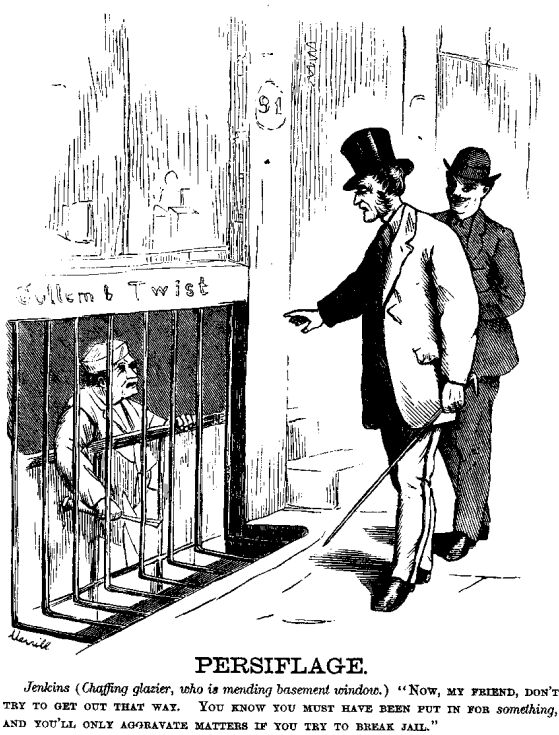
Jenkins (Chaffing glazier, who is mending basement window.) "NOW, MY FRIEND, TRY TO GET OUT THAT WAY. YOU KNOW YOU MUST HAVE BEEN PUT IN FOR something, AND YOU'LL ONLY AGGRAVATE MATTERS IF YOU TRY TO BREAK JAIL."]
~Chinopathy.~
Did the gentleman who threw a brick at a dog on a very hot day (when no doubt that inoffensive animal was in a stew) imagine that he had hit upon the whole of the common Chinese materia medica? PUNCHINELLO is gravely told that a Celestial doctor is about to come to New York, whose favorite prescriptions, in accordance with Chinese practice, "will be baked clay-dust, similar to brick-dust and dog-soup." In one of these remedies the medical acumen of PUNCHINELLO recognizes a homoeopathic principle. Man having been made out of the dust of the earth, nothing is so well adapted to cure him as baked clay. Every man's house is now not only his castle, but his apothecary shop. A brick may be considered a panacea, and may be carried in the hat. Taken internally, it will go to the building up of the system. Applied to the head it is good for fractures. Dog-soup has an evident advantage over the usual prescriptions of Bark.
~Greek Meeting Greek.~
We learn that "a naval architect named DUNKIN claims to have constructed a new style of vessel, impervious to rams, shell, or shot." Now, then, where is our friend, Captain ERICSSON? The Captain has a torpedo which he is anxious to explode, near a strong vessel belonging to somebody else. He says it will blow up anything. DUNIN says nothing can blow up his vessel. A contest between these very positive inventors would be a positive luxury—to those who had nothing to risk. We bet on the torpedo.
~The "New Muscle".~
It was a mere joke, that stuff about the "new muscle in the human body," said to have been found by an English anatomist. It simply meant that, the Oyster Months being past, the "human body" begins to be nourished with soft-shell clams.