Volume 99 — FROM OUR YOTTING YORICK, P.A.
Reading edition
Aboard the Yot "Placid," bound for Copenhagen (I hope).
DEAR EDITOR,
You told me when I set sail (I didn't set sail myself, you understand, but the men did it for me, or rather for my friends, Mr and Mrs. SKIPPER, to whose kindness I owe my present position—which is far from a secure one,—but no matter), you said to me, YORICK Yotting has no buffoonery left in him? I too, who was once the life of all the Lifes and Souls of a party! Where is that party now? Where am I? What is my life on board? Life!—say existence. I rise early; I can't help it. I am tubbed on deck: deck'd out in my best towels. So I commence the day by going to Bath. [That's humorous, isn't it? I hope so. I mean it as such.]
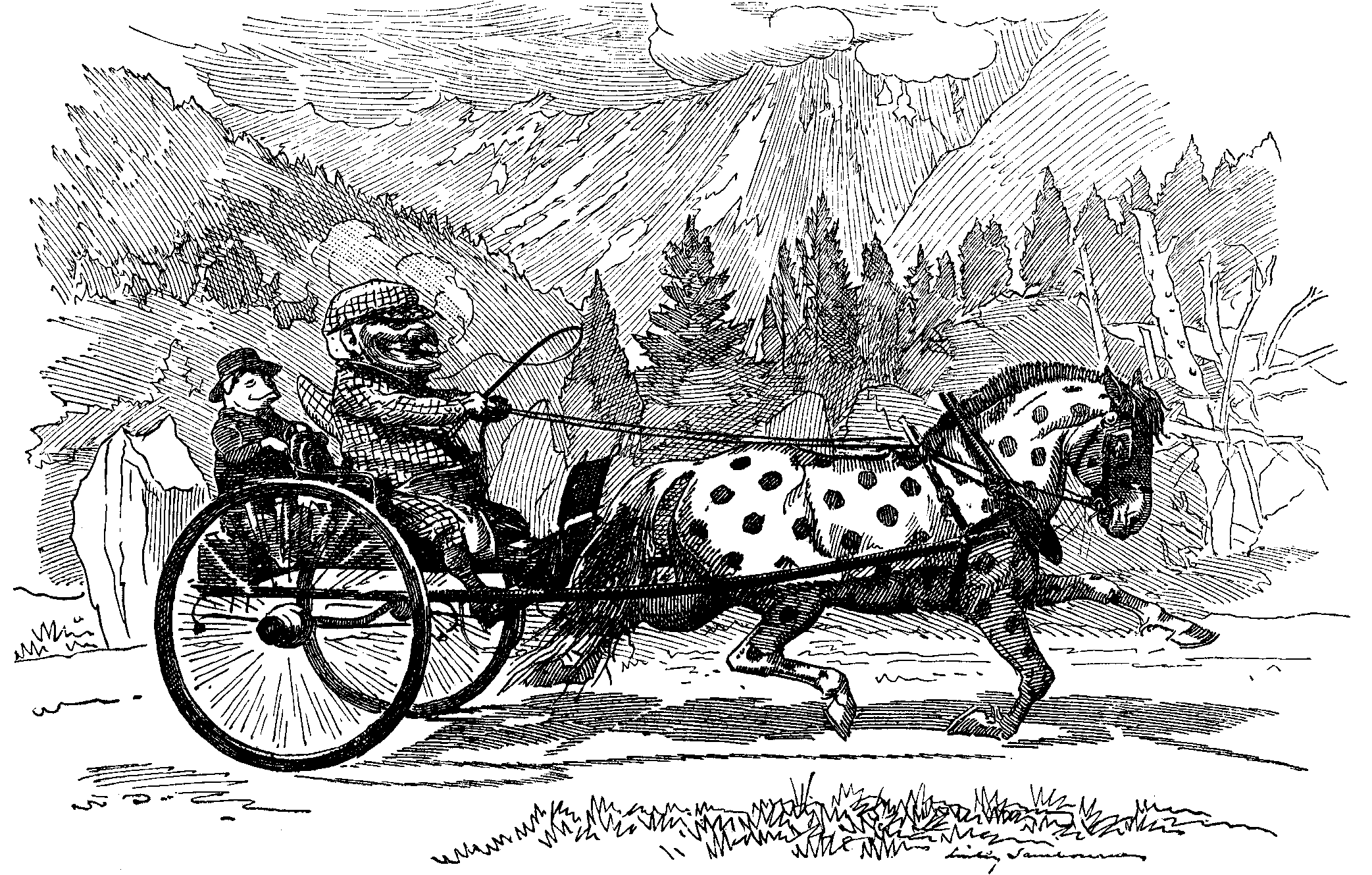
"Send me notes of your voyage to Sweden and Norway, and the land of Hamlet. You'll see lots of funny things, and you'll take a humorous view of what isn't funny; send me your humorous views." Well, Sir, I sent you "Mr. Punch looking at the Midnight Sun." pretty humorous I think ("more pretty than humorous," you cabled to me at Bergen), and since that I have sent you several beautiful works of Art, in return for which I received another telegram from you saying, "No 'go.' Send something funny." The last I sent ("The Church-going Bell," a pretty peasant woman in a boat—"belle," you see) struck me as very humorous. The idea of people going to Church in a boat!
What was I to do? Well—here at last I send you something which must be humorous. It looks like it. Mr. Punch driving in Norway, in a cariole. Mr. Punch anywhere is humorous; and with TOBY too; though I am perfectly aware that TOBY, M.P., is in his place in the House; but then TOBY is ubarquitous. That's funny, isn't it?—see "bark" substituted for "biq," the original word being "ubiquitous." This is the sort of "vürdtwistren" at which they roar in Sweden.
It's all très bien (very well) but how the deuce can you be funny in the Baltic? Why call it Baltic? For days and nights at sea, sometimes up, more often down, and a sense of inability coming over me in the middle of the boundless deep. Alas, poor YORICK!
Then breakfast. Then lunch. Then dinner. No drinking permitted between meals: to which regulation. I am gradually becoming habituated. It is difficult to acquire new habits. Precious difficult in mid-ocean, where there isn't a tailor. [Humorous again, eh?] I now understand what is the meaning of "a Depression is crossing the Atlantic." There's an awful Depression hanging about the Baltic.
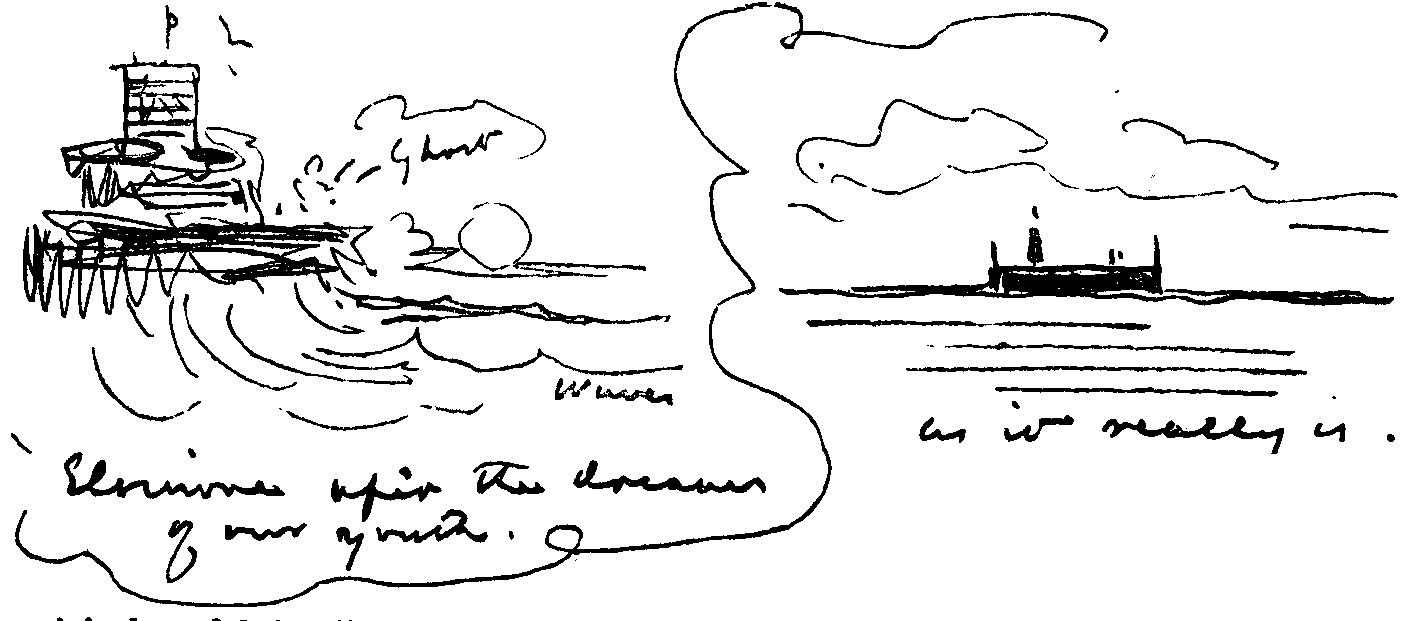
I send you a sketch of Elsinore, as I thought it would be, and Elsinore as it is. Elsinore is like the Pumping Works at Barking Creek. And I've come all this way to see this!! Elsinore! I'd rather go Elsewhere-inore,—say, Margate.
Think I shall put this in a bottle, cork it up, and send it overboard, and you'll get it by Tidal Post. Whether I do this or not depends on circumstances over which I may possibly have no control. Anyhow, at dinner-time, I shall ask for the bottle. When you ask for it, see that you get it.
Yours truly,
JETSAM (or Yotting Artist in Black and White).
10 A.M. Swedish time 9.5 in English miles. Longitude 4 ft. 8 in. in my berth. Latitude, any amount of.
AN EXCELLENT RULE.—We are informed that "extreme ugliness" and "male hysteria" are admitted as "adequate disqualifications" for the French Army. If the same rule only applied to the English House of Commons, what a deal of noise and nonsense we should be spared!
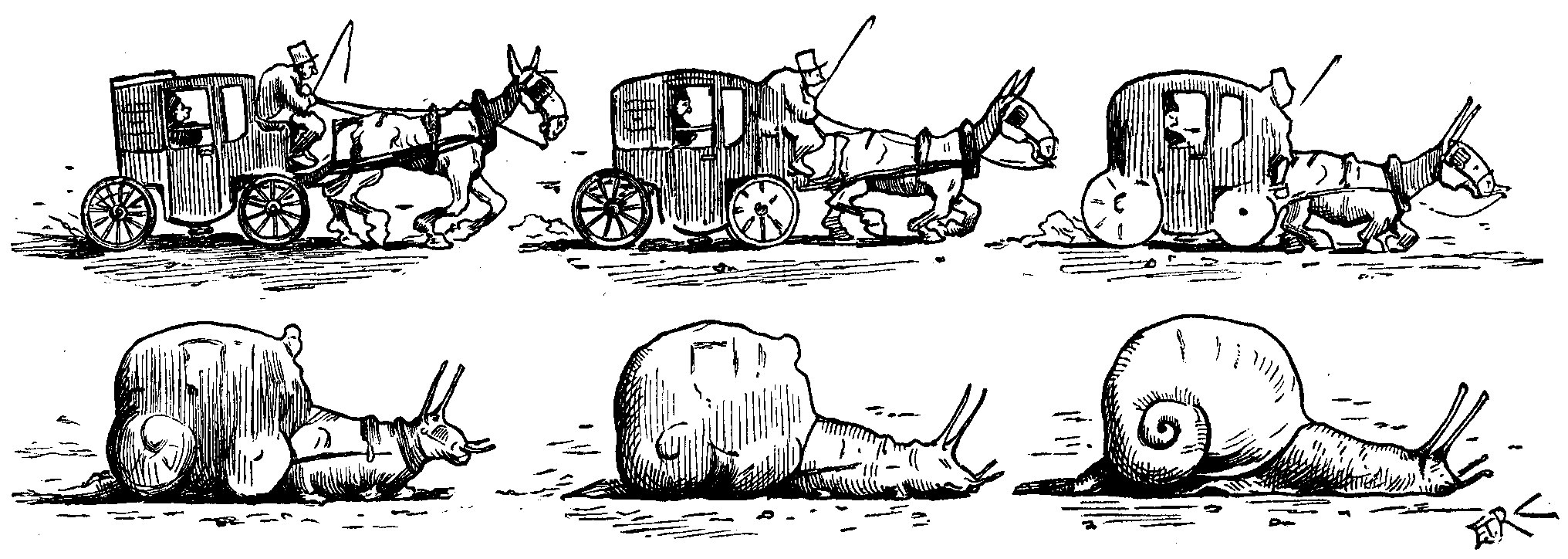
A METROPOLITAN METAMORPHOSIS.
The Awful Result of Persistent "Crawling."
THE DYING SWAN.
(Latest Version, a long way after the Laureate.)
"THAMES 'SWAN UPPING.'—The QUEEN'S swanherd and the officials of the Dyers' and Vintners' Companies arrived at Windsor yesterday on their annual 'swan-upping' visit, for the purpose of marking or 'nicking' the swans and cygnets belonging to HER MAJESTY, and the Companies interested in the preservation of the birds that haunt the stream between London and Henley. It is said that the Thames swans are steadily decreasing owing to the traffic on the upper reaches of the river, and other causes detrimental to their breeding."—The Times.
I. July was wet,—a thing not rare— With sodden ground and chilly air; The sky presented everywhere A low-pitched roof of doleful grey; With a rain-flusht flood the river ran; Adown it floated a dying Swan, And loudly did lament. It was the middle of the day, The "Swanherd" and his men went on, "Nicking" the cygnets as they went. II. The "Swanherd" showed a blue-peaked nose, And white against the cold white sky Shone many a face of those Who o'er the upper reaches swept, On swans and cygnets keeping an eye. Dyers and Vintners, portly, mellow Chasing the birds of the jetty bill Through the reed clusters green and still; And through the osier mazes crept Many a cap-feathered crook-armed fellow. III. The lone Swan's requiem smote the soul With the reverse of joy. It spake of sorrow, of outfalls queer, Dyeing the floods once full and clear; Of launches wildly galumphing by, Washing the banks into hollow and hole; Sometimes afar, and sometimes a-near. All-marring 'ARRY'S exuberant voice, With music strange and manifold, Howling out choruses loud and bold As when Bank-holidayites rejoice With concertinas, and the many-holed Shrill whistle of tin, till the riot is rolled Through shy backwaters, where swan-nests are; And greasy scraps of the Echo or Star, Waifs from the cads' oleaginous feeds, Emitting odours reekingly rank, Drift under the clumps of the water-weeds, And broken bottles invade the reeds, And the wavy swell of the many-barged tug Breaks, and befouls the green Thames' bank. And the steady decrease of the snow-plumed throng That sail the upper Thames reaches among, Was prophesied in that plaintive song.
DOING IT CHEAPLY.
A re-action against the extravagance which marked the entertainments of the London Season of 1890 having set in, the following rules and regulations will be observed in the Metropolis until further notice.
1. Persons invited to dinner parties will be expected to furnish their own plate and linen, and some of the viands and wines to be used at the feast.
2. To carry out the above, a menu of the proposed meal will form a part of every card of invitation, which will run as follows:—"Mr. and Mrs. —— request the honour of Mr. and Mrs. ——'s company to dinner, on —— when they will kindly bring with them enough for twelve persons of the dish marked —— on the accompanying Menu, P.T.O."
3. Persons invited to a Ball will treat the supper as a pic-nic, to which all the guests are expected to contribute.
4. On taking leave of a hostess every guest will slip into her hand a packet containing a sum of money sufficient to defray his or her share of the evening's expenses.
5. Ladies making calls at or about five o'clock, will bring with them tea, sugar, milk, pound-cake, cucumber sandwiches, and bread and butter.
6. As no bands will be furnished at evening parties, guests who can play will be expected to bring their musical instruments with them. N.B. This does not apply to pianofortes on the premises, for which a small sum will be charged to those who use them.
7. Should a cotillon be danced, guests will provide their own presents, which will become the perquisites of the host and hostess.
8, and lastly. Should the above rules, compiled in the interest of leaders of Society, be insufficient to keep party-givers from appearing in the Court of Bankruptcy, guests who have partaken of any hospitality will be expected to contribute a gratuity, to enable the Official Receiver to declare a small and final dividend.
PERQUISITES.—"Nice thing to belong to National Liberal Club," observed Mr. G., who didn't dine at that establishment for nothing, "because, you see, they go in there for 'Perks.'"
"NOBLESSE OBLIGE!"
(Latest Reading.)
Noblesse oblige! And what's the obligation, Read in the light of recent demonstration? A member of "our old Nobility" May be "obliged," at times, to play the spy, Lay traps for fancied frailty, disenthrall "Manhood" by "playing for" a woman's fall; Redeem the wreckage of a "noble" name By building hope on sin, and joy on shame; Redress the work of passion's reckless boldness By craven afterthoughts of cynic coldness; Purge from low taint "the blood of all the HOWARDS" By borrowings from the code of cads and cowards! Noblesse oblige? Better crass imbecility Of callow youth—with pluck—than such "nobility"!
HOME-ING.—Dr. BARNARDO'S delightfully simple plan of getting a little boy to sign an affidavit to the effect that he was so happy at Dr. BARNARDO'S Home, Sweet Home, and that, wherever he might wander, there was really no place on earth like Dr. BARNARDO'S Home, may remind Dickensian students of a somewhat analogous method apparently adopted by Mr. Squeers when, on his welcome return to Dotheboys Hall, he publicly announced that "he had seen the parents of some boys, and they're so glad to hear how their sons are getting on, that there's no prospect at all of their going away, which, of course, is a very pleasant thing to reflect upon for all parties." The conduct of such parents or relatives who send children or permit them to be sent to Dr. BARNARDO'S Home, Sweet Home, where, at all events, they are well fed and cared for, bears some resemblance to that of Graymarsh's maternal aunt, who was "short of money, but sends a tract instead, and hopes that Graymarsh will put his trust in Providence," and also to that of Mobb's "mother-in-law," who was so disgusted with her stepson's conduct (for DICKENS meant step-mother when he wrote "mother-in-law"—an odd lapsus calami never subsequently corrected) that she "stopped his halfpenny a-week pocket-money, and had given a double-bladed knife with a corkscrew in it to the Missionaries, which she had bought on purpose for him." We don't blame Dr. BARNARDO—much; but we do blame these weak-knee'd parents and guardians, who apparently don't know their own minds. In the recent case which was sarcastically treated by the Judge, Dr. B. found that he could buy GOULD too dear.