Volume 99 — IN THE KNOW.
Reading edition
(By Mr. Punch's Own Prophet.)
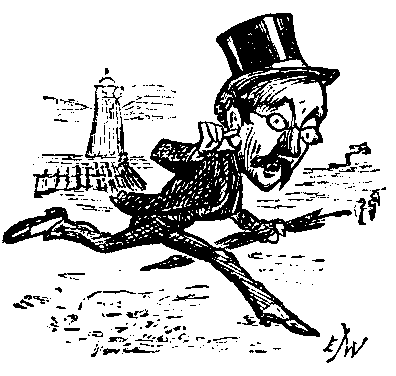
Readers of this journal will be surprised to learn that I am penning these lines from Blancheville, which as everybody, except the chief of the chowder-heads, knows is the most important town of one of the principal departments of France. Nothing but an overwhelming sense of what is due to myself, to my readers, and to my country, would have dragged me from the Metropolis at this season of the year. But a distinction was offered to me, a distinction so unique and so dazzling that I felt that it would not be fair to my fellow countrymen, of all ages, and of every party, if I failed to take advantage of it, and thus to present to the envious world the proud spectacle of an Englishman honoured by the great French nation. I will narrate the matter as briefly as is consistent with my respect for accuracy, and with my contempt for the tapioca-brained nincompoops who snarl, and chatter, and cackle at me in the organ of Mr. J. Last Friday I received this telegram:—
Blancheville, Friday.
The inhabitants of Blancheville, in public meeting assembled, felicitate you on stupendous success of all your prophecies. Desiring to honour you in the name of France, the mother of glorious heroes, and the eldest daughter of Liberty, they have awarded to you the Montyon prize for virtue, and have selected you as Rosier en perpétuité de Blancheville, a new post never before held by a man. Presentation on Sunday. Come at once.
(Signed) CARAMEL, Maire de Blancheville.
I started that evening. In the course of the following day I reached Blancheville. The people, in their holiday attire, were gathered in thousands at the railway station. M. CARAMEL, accompanied by the Préfet and the Sous-Préfet, all in their tricolor sashes, was the first to greet me. Saluting me on both cheeks, he called upon the world to witness that this was indeed a great day for Blancheville. My escort, under the command of General Count CROUTAUPOT, then formed up. I mounted the gilded Car of Victory, specially provided for the celebration, and, amidst the plaudits of the assembled millions, I was drawn by a specially-selected band of Enfants de la Patrie (a sort of body-guard, composed entirely of the French aristocracy) to the palace, which had been prepared for my reception. At the banquet, in the Town Hall, the healths of the QUEEN and of M. CARNOT were followed by a lengthy speech, in English, from my brother CARAMEL (we have sworn fraternity), in which he declared that the centuries looked down and redazed in this joice, and that it was a delight for him to carry a toast to the illustrious visitor who had deigned to come to Blancheville. On the following day the ceremony took place. I transcribe and translate from Le Petit Colporteur de Blancheville, the chief local journal, an account of what took place.
"On this day, so great and glorious for our France, it is not possible to refrain from tears of joy and satisfaction. We have made him Rosier en perpétuité de Blancheville, him the proudest and most sympathetic writer who has dazzled Europe since the great and illustrious PLUMEAU" (a local author of repute) "departed from us. The history of this day must be written. Let us essay to do it as it should be done. In the early morning twelve selected maidens, robed in muslin and lilies, sang the Tocsin de la Patrie outside the Palace where our guest reposed. Soon afterwards he himself appeared in flowing white garments, and showered blessings upon their heads. He descended. He entered the four-in-hand-teams which the Maire had, as a compliment to England, made up with a char-à-banc of the neighbourhood. Thus he was drawn to the Market Place, where some of our bravest veterans fired in his honour a thundering salute. The beautiful and admirable Madame CARAMEL then advanced to him with a wreath of roses in her hand. She crowned him with it, saying, 'Wear this for Blancheville. Nobly hast thou earned it.' With difficulty the illustrious author preserved his calm. A tear sparkled in his eye. He bent low, and in a voice choked with emotion, thanked the citizens of our town. Then mounting on a milk-white steed, and surrounded by the young men of the district, he received from the Préfet the Prix Montyon for virtue."
The rest is too flattering. I am hastening home. The QUEEN has been graciously pleased to permit me to wear the Prix Montyon at Court. Can a man want more?
Yours, in all humility,
LE ROSIER DE BLANCHEVILLE.
A PUFF AT WHITEHALL.
(A piece of extravagance faintly suggestive of a Scene from "The Critic.") Lord GEORGE PUFF and Sir JOHN BULL discovered attending a rehearsal of the Naval Estimates.
Lord George. And now I pray your particular attention, Sir JOHN, as this is the best thing in my play—it is a spectacular effect called the Summer Manoeuvres.
Sir John. And no doubt costly, Lord GEORGE?
Lord George. You are right, Sir JOHN, as you will have an opportunity of finding out—hereafter. But to the argument. It is supposed that the British Fleet is at war with, indeed, the British Fleet.
Sir John. A very clever idea.
Lord George. I flatter myself it is, and novel too. It is true that occasionally the ships comprising the British Fleet have run into one another in the past just as if they had been at war, but then they were avowedly at peace, and now they are undoubtedly the reverse. Do you take my meaning?
Sir John. Well, not clearly. How do you show that the British Fleet is at war with the British Fleet?
Lord George. Ah, there comes in my art, and I think you will confess I have a very pretty wit. You see I divide the British Fleet into two parts—one part represents the enemy and the other part represents itself like the House of Commons, a most representative body. That is clear, I hope?
Sir John. Certainly—one is the British Fleet, and the other is not the British Fleet. But is there no bond of union?
Lord George. Most assuredly there is—you pay for both. But, pardon me, I beg you will not further interrupt me. So, now that we have the two Fleets face to face, or, I should say, bow to starn, we proceed exactly as if there were a real quarrel between them. We spend money on coal, we spend money on pay, we spend money on ammunition. Nay, by my life, we spend money on everything—just as we should do if war were really declared! That's simple enough.
Sir John. I confess your plan does seem simple.
Lord George. And there is more behind. We are not satisfied with merely spending money—we learn a lesson as well. Come, you must confess that surprises you?
Sir John. Well, I admit that generally, where there is any spending of money, it is I who learn the lesson.
Lord George. Good—distinctly good! But let us be serious. Well, when we are carrying on a war by every means in our power, we fancy that one Fleet is chasing the other. They both have equal speed, and we give one Fleet twenty-four hours' start of the other, and will you believe me that, although the first follows the second as fast as may be from the beginning to the end of the manoeuvring, they never see one another! On my life—never! They never see the British Fleet, because it's not in sight!
Sir John. But could you not have learned all this without so great an expenditure of money?
Lord George. Well, no, Sir JOHN—not at the Admiralty!
Sir John. And how do you end the farce?
Lord George. In the usual fashion, Sir JOHN (ignites blue fire)—in smoke!
[The characters are lost in the fog customary to the occasion. Curtain.
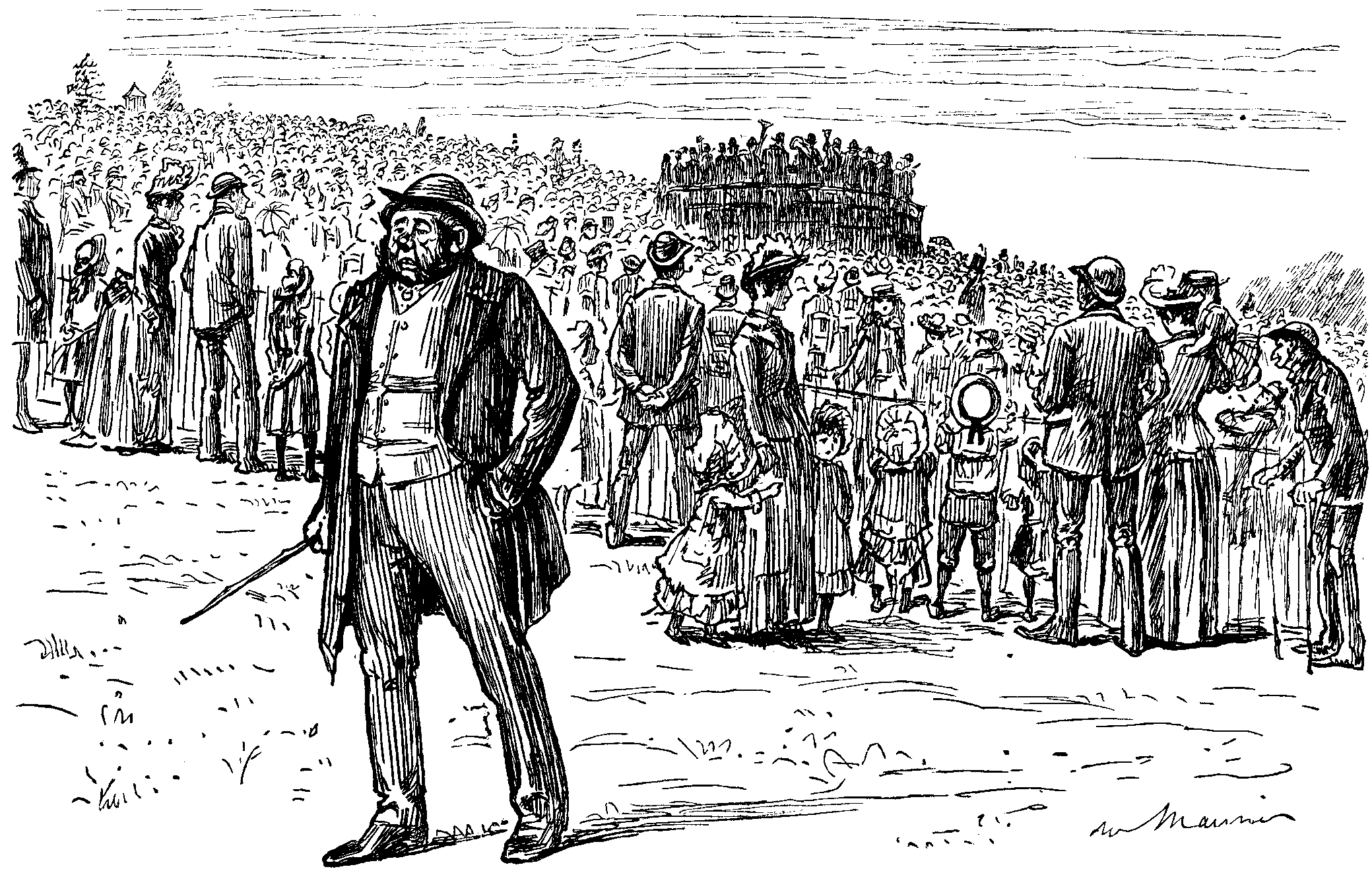
A SEVERE SABBATARIAN.
Mr. Bung (Landlord of "Ye Pygge and Whistle"). "SUNDAY LEAGUE, INDEED! I'D SUNDAY LEAGUE 'EM, IF I'D A CHANCE!—BREAKIN' THE LORD'SD'Y, AND HINTERFERIN' WITH MY TRYDE!"
"SHADOWED!"
Shadowed! Ay, even in the holiday season, The Statesman, in his hard-earned hour of ease, Is haunted by forebodings, and with reason. What is that spectre the tired slumberer sees? The foul familiar lineaments affright him; Its pose of menace and its pointing hand To caution urge, to providence invite him, To foil this scourge of the Distressful Land. Who does not fear to speak of Forty-Seven, When that same Shadow darkened all the isle? Is it abroad once more? Avert it, Heaven! On Order's lips it chills the dawning smile; Awakener of hushed fears and hatreds dying, Blighter of more than Nature's genial growth, Herald of hungering lips, of children crying, To hold thee imminent all hearts are loth. Vain holiday nepenthe, sport's unbending, The Statesman's burdened brain may not forget. His cares are ceaseless and his toils unending, Memories embarrass and forebodings fret. The gun, the golf-club, and the rod avail not In his tired heart to make full holiday; E'en amidst pastime he must watch, and fail not, Approaching ills, the shadows on the way. Shadowed! And not by common gloom, poor Minister! The passing shades that chequer every course. This spectral presence is as stern and sinister As atra cura on the rider's horse. Before, the vision of the helpless peasant! Behind, the famine phantom black and grim! How should the holiday-hour, to all so pleasant, Bring gladness true or genuine rest to him? Wake! There is need for provident prevision, For watchful eye, and for most wary hand. In mellow Autumn's interlude Elysian The old grim Shadow strikes across the land. May Heaven arrest its course, avert its terror, And keep the Statesman who this foe must fight From careless blindness and from blundering error, Such as of old lent aid to the Black Blight.
"Jack Sheppard Reversed."
This is the title of an amusing article in last week's Saturday Review. It is not the story of JACK SHEPPARD once more done into rhyme. The title so happily selected is thoroughly justified by the doings of an eccentric and original burglar, who, broke into a prison! This certainly was JACK SHEPPARD reversed with a vengeance! The hero of the escapade is said to be a tinted native of Barbadoes—his portrait should be published as a companion to the "penny plain" of his prototype as "twopence coloured."
Cardinal Manning's Precedence.
It does not need heraldic lore The Cardinal's place to find. Of course he'll always come before The ones who are behind.
THE PHAGOCYTE.
(The Story of a Blood Feud.)
[A microscopist has found an organism called the Phagocyte in the blood, which pursues and devours the Bacilli.]
Strange the tale that Science tells. Here are some devouring cells: Ever watchful night and day, They the vile Bacillus slay; Wot we well he fears the bite Of the guardian Phagocyte. Hour by hour the fight goes on, Till the silent battle's won; Vainly do Bacilli shirk When their deadly foe's at work; Every microbe faints with fright At the fearsome Phagocyte. Should the Phagocyte not keep Faithful ward, but go to sleep; Then Bacillus, in high glee, Works his will on you and me; Danger would be ours to-night, But for that same Phagocyte. Such a tale of Science seems Like the offspring of wild dreams; Fiction surely, in good sooth, Can invent no tale like truth. Stranger story none could write Than this of the Phagocyte. The Astronomer descries Worlds on worlds beyond our eyes; 'Neath the microscope weird things Erst unseen whirl round in rings; Hence it is that we indite Stanzas to the Phagocyte.
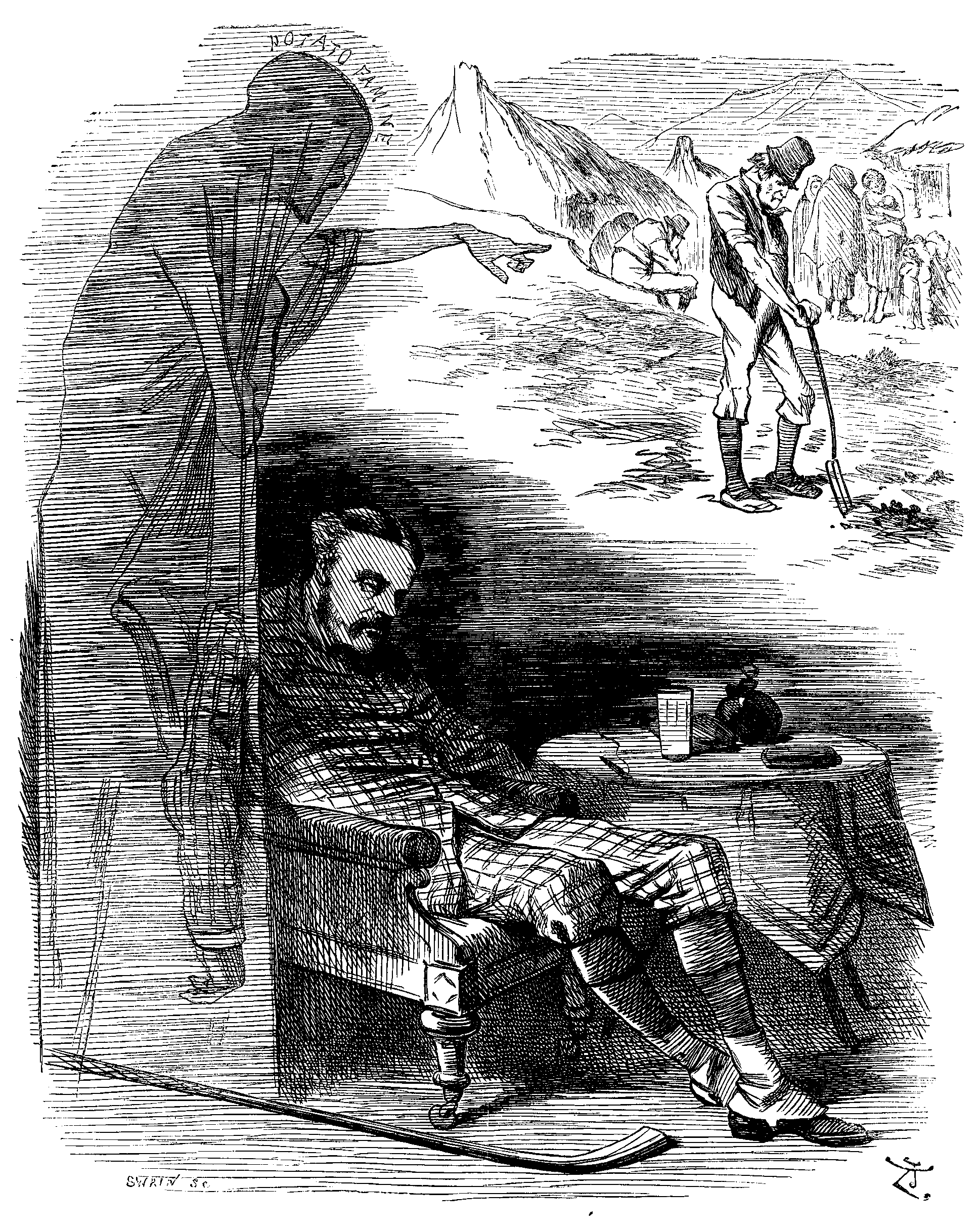
"SHADOWED!"
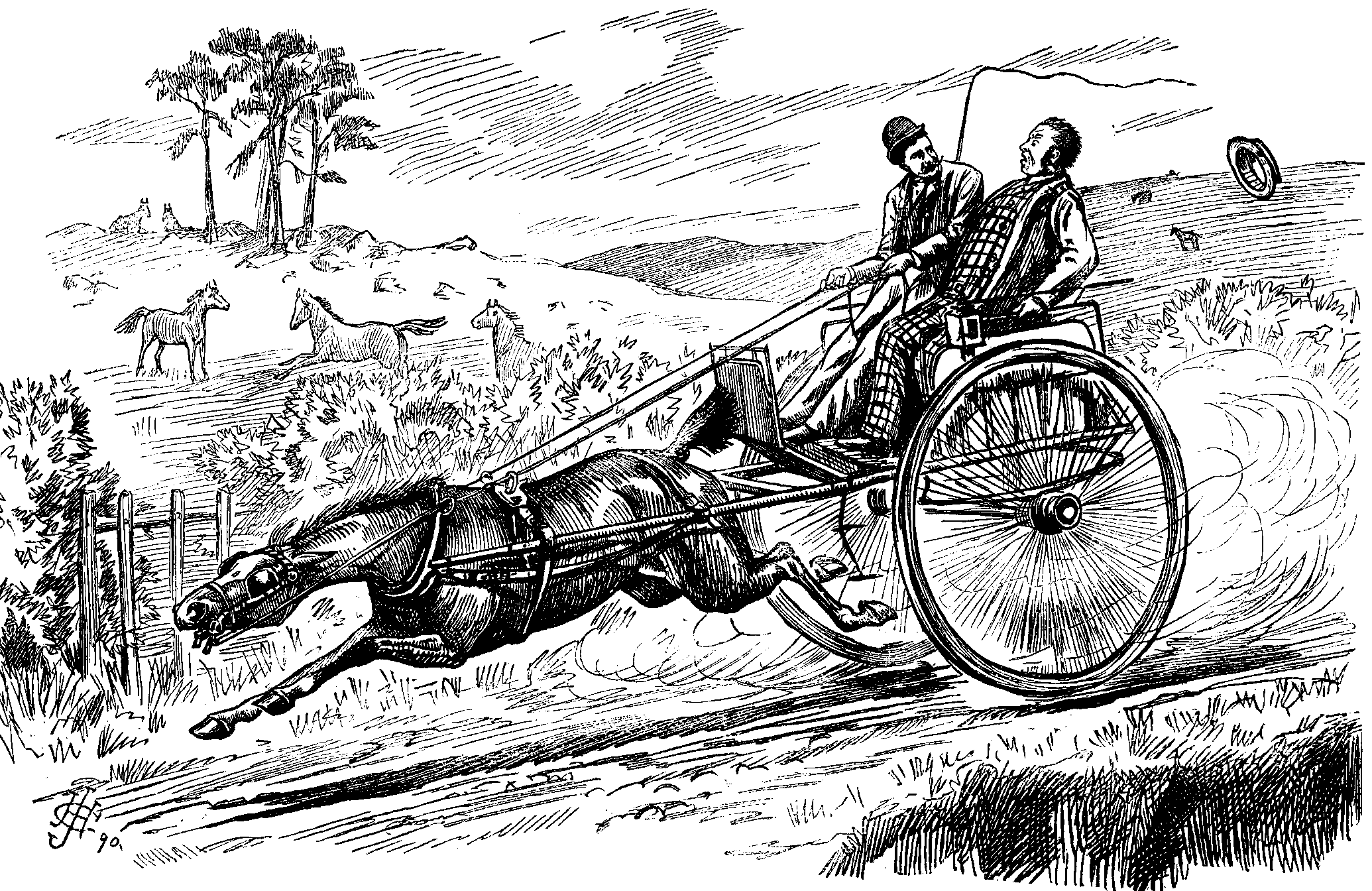
A SPECULATIVE OFFER.
Driver. "NOW, TOM, WHEN WE ARRIVE AT THE TURN, I'LL SELL YOU THE DOG-CART FOR A SOV!"