Volume 99 — ESSENCE OF PARLIAMENT.
Reading edition
EXTRACTED FROM THE DIARY OF TOBY, M.P.
House of Commons, Monday, August 4.—GEORGE CAMPBELL been with us many Sessions; heard and seen a good deal of him, but really seems only now to be coming out. Has taken up the Police Bill, "and I wish," says HENRY MATTHEWS, sotto voce, "the Police would in return take him up." GEORGE literally overwhelms the place, breaks out everywhere; began at earliest moment with question of precedence. Cardinal MANNING been granted precedence on certain Royal Commissions. "Why should the Cardinal be thus honoured?" GEORGE wants to know. "There is the Moderator of the Scotch Free Church. Why shouldn't he, too, have princely rank?"
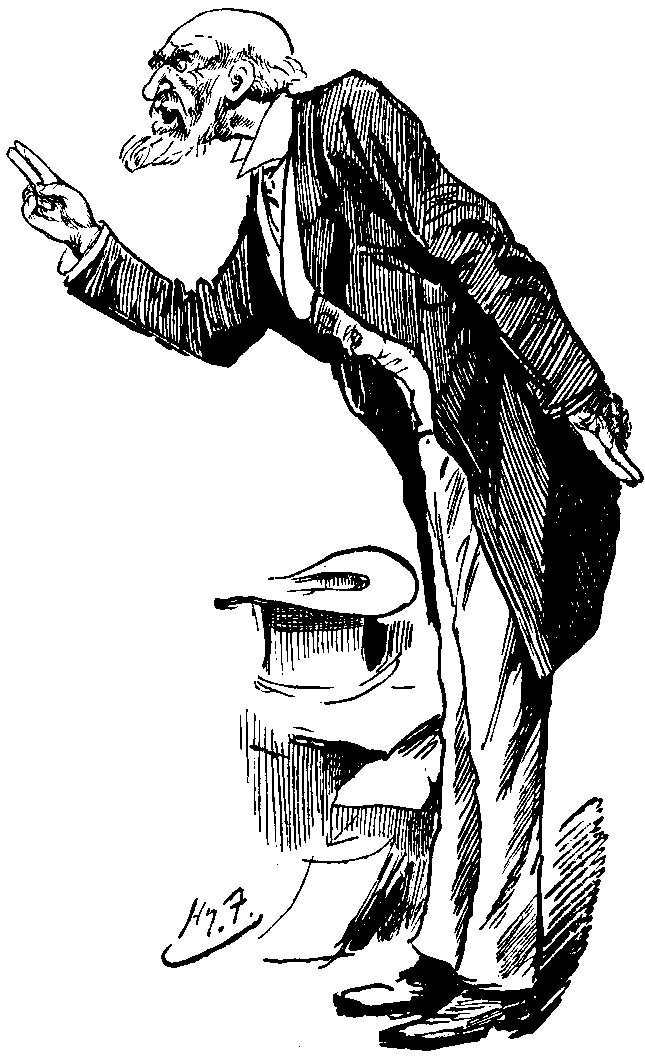
The Campbell is speaking, oh dear, oh dear!
The Campbell is speaking, oh dear, oh dear!
And nobody ever cries, "Hear, hear, hear!"
When the Campbell is speaking! Oh dear, oh dear!
LORD ADVOCATE snubs CAMPBELL, and he momentarily resumes his seat. Ten minutes later shrill cry of pibroch heard again. Everyone knows that CAMPBELL is coming, and here he is, tall, gaunt, keen-faced, shrill-voiced, wanting to know at the top of it which of HER MAJESTY'S Ministers advises HER MAJESTY on questions of precedence?
"There is," said GORST, reflectively gazing on his manly form, "one precedence we would all concede to CAMPBELL. We would gladly write on the bench where he usually sits—
'Not lost, but gone before.'"
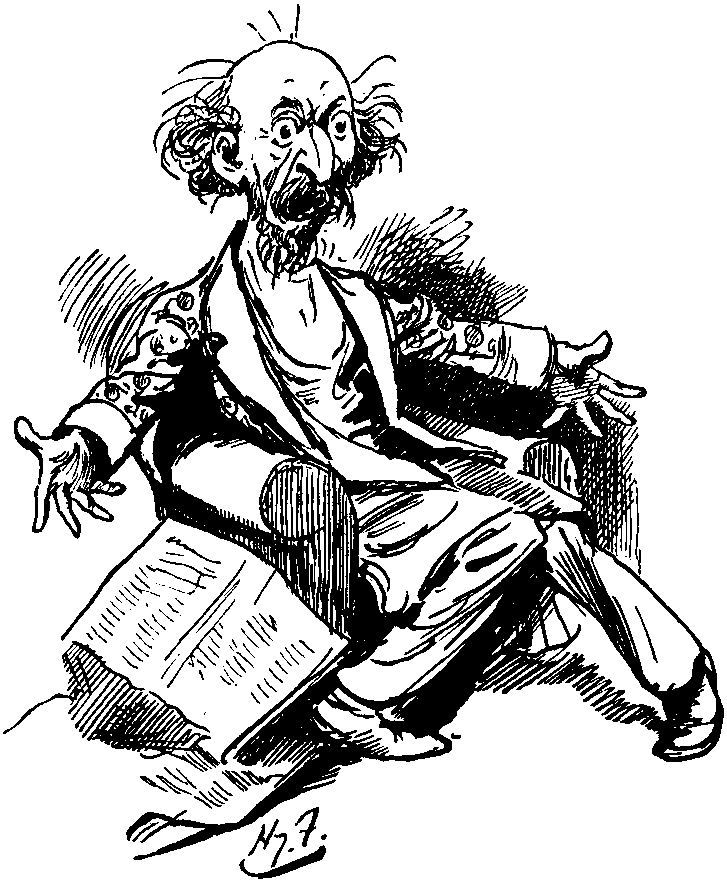
FANCY PORTRAIT OF ALGERNON CHARLES SWINBURNE.
On reading the Parliamentary report in Wednesday's Times.
"Mr. W.H. Smith. I asked my colleagues near me whether they had seen or read the publication—(Mr. A.C. Swinburne's poem about Russia) and none of them had."
"And this," exclaimed Algernon Charles Swinburne, the poet, "this is fame!"
But which is his seat? Usually the lank form and the shrill voice simultaneously uprise from the middle of the second Bench behind Mr. G.; but GEORGE has a little way of pleasantly surprising the House. Members looking across see this Bench empty. "Ah! ah!" they say to themselves, "the CAMPBELLS are gone. Now we'll have a few minutes' peace and get on with business." Suddenly, à propos of anything that may be going on, or of nothing at all, the unmistakeable voice breaks on the ear from under the shadow of the Gallery, from the corner of the Bench, sometimes from below the Gangway, and a deep low groan makes answer. Again a little while and this seat is vacated; the Minister in charge of Bill, looking hastily round, flatters himself that CAMPBELL really has gone, when lo! from some other remote and unfrequented spot the terrible cry is uplifted, and, without looking up, men know CAMPBELL is making his fifteenth speech.
"On the whole," says PLUNKET, "I'm not sure that the habits of POE'S raven were not less irritating. It is true that on its first arrival it hopped about the floor, wherein it resembles our honourable friend; but afterwards, having once perched upon the pallid bust of Pallas, it was good enough to remain there. Bad enough, I admit; but surely that situation preferable to ours, not knowing from moment to moment from what particular quarter CAMPBELL may next present himself."
Business done.—Police Bill obstructed.
Tuesday.—HANBURY came down to-day full of virtuous resolution and stern resolve. Privileges of House of Commons have been struck at, and through him; DARTMOUTH, Lord-Lieutenant of Staffordshire, has been writing things in the papers; rebukes HANBURY, "as a Magistrate for Staffordshire," for having made certain speech in. Commons about Grenadier Guards. HANBURY hitherto said nothing in public on the matter; has been in communication with DARTMOUTH by post and telegram; has boldly vindicated privileges of Commons; has brought the insolent Lord Lieutenant to his knees; but till this moment has made no public reference to the part he played. Has borne, unsoothed by companionship, the sorrow of the House of Commons.
Now hour has struck; he may come to the front, and, with habitual modesty of men, indicate rather than describe the imperishable service he has done the Commons. House, all unconscious of what is in store for it, wantons at play. Innumerable questions on paper. SUMMERS coming up fresh with batch of new conundrums. PATRICK O'BRIEN "having had his attention called" to some verses by SWINBURNE, proposes to read them. House wickedly delighted at prospect of SWINBURNE being haltingly declaimed with North Tipperary accent localised by companionship with the Town Commissioners of Nenagh; SPEAKER thinks it might be funny, but wouldn't be business; so PATRICK: having begun, "Night brings but one red star—Tyrannicide," is sternly pulled up. OLD MORALITY says he's never seen "the publication;" has asked friends near him, and everyone says he has neither seen, heard, nor read of it. "The House," says the SPEAKER, by way of crushing ignominy, "has no control over the poet SWINBURNE."
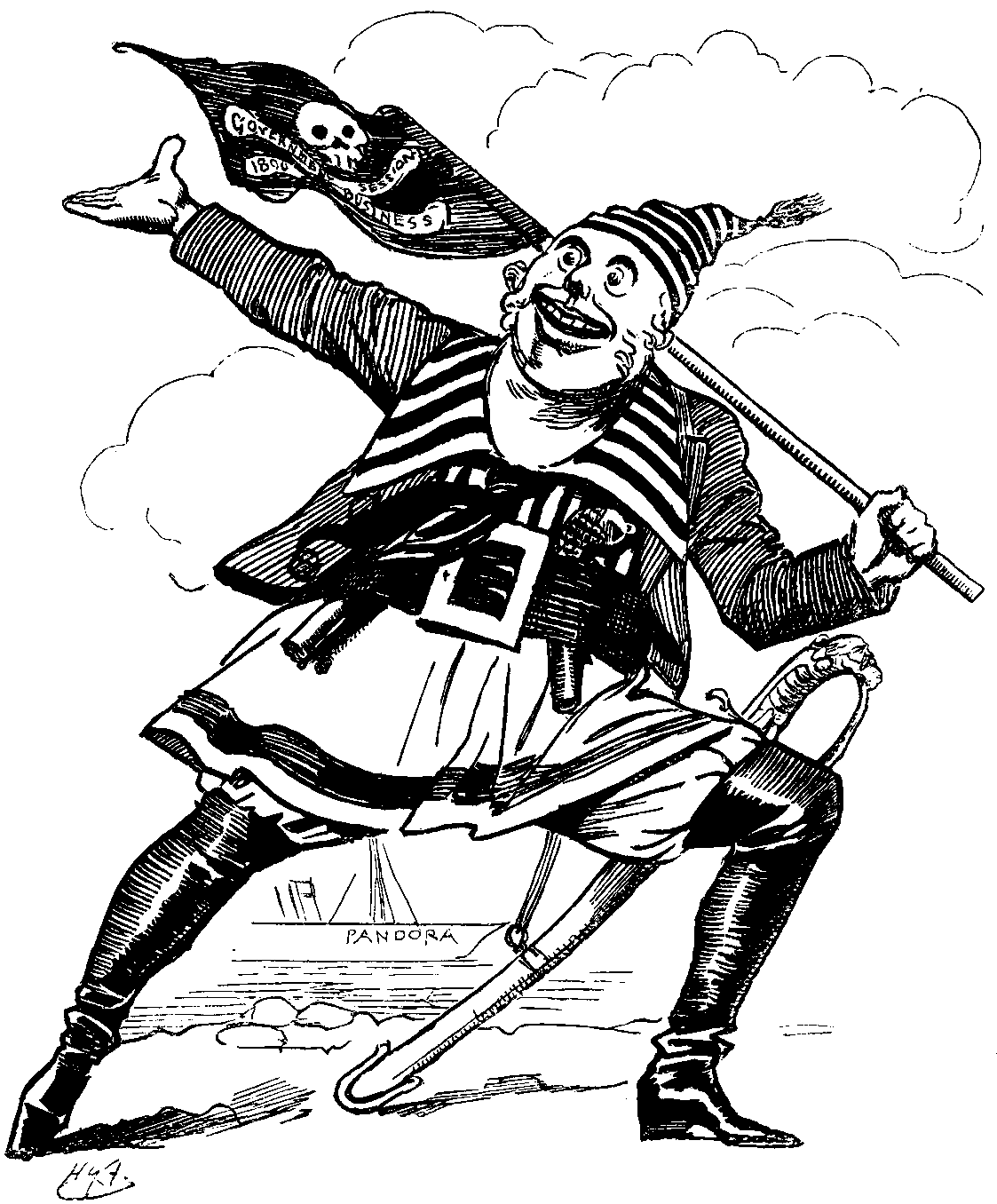
W.H. SMITH AS "THE ROVER OF THE SEAS."
"ONCE MORE ON BOARD THE LUGGER, AND I AM FREE!"
So House deprived of its anticipated lark; all the while HANBURY, with hands in pockets, sits staring gloomily forth, rather pitying than resentful. House of course does not know what is in store for it; still this trifling at the very moment when, though all inconspicuously, the Commons have been saved from contumelious outrage, racks the soul that carries with it the momentous secret.
At last HANBURY'S opportunity comes! Rises slowly, solemnly, to full height; in deep base tones, asks permission to make personal statement. House instantly alert, and attentive; baulked of its fun with PATRICK, here is promise of fresh larks. HANBURY, his profound base notes sometimes trembling with emotion, proceeds to unfold his story; reads long letter from Dartmouth; Members, discovering that the portentous business relates to some trumpery correspondence in the newspapers, begin to cough, shuffle their feet, and even cry "Agreed!" HANBURY stops aghast. Can it be possible? When he has been vindicating privileges of Commons, can Members thus lightly treat incident? But he will read them another letter, one he wrote to Lord DARTMOUTH. Anguished roar burst forth from House; louder cries of "Agreed! Agreed!" HANBURY, gasping for breath, looks round from side to side. They cannot understand; will read them another letter; begins; storm increases; HANBURY persists. Surely House will be delighted to hear his final rejoinder to DARTMOUTH? On the contrary, House will have no more; and HANBURY, pained and panting, resumes his seat, and business goes forward as if he had not interposed.
Business done.—A sudden rush. All contentious Bills through final stage.
Saturday.—Session suddenly collapsed. "Like over-ripe tree," says Prince ARTHUR, dropping into poetry, "the fruit has fallen in a night." Benches nearly empty; Votes passing in basketsful; prorogue next week; to-day, practically, last working time. OLD MORALITY just come in, in serge suit; left his straw hat in his room; off shortly on cruise in Pandora; already shipped store of nautical phrases. Putting his open hand to the side of his mouth, he (when GEORGE CAMPBELL was making one of his last speeches), shouted out, "Belay there!" SPEAKER pointed out that this was not Parliamentary phrase. If Right Hon. Gentleman wanted to move the Closure, he should do so in the form provided. OLD MORALITY, standing up, hitching his trousers at the belt, scraping his right foot behind him, and pulling his forelock, retorted—
"I ask your honour's pardon; but these lubbers are so long-winded." "Order! Order!" said SPEAKER.
Said good-bye, wishing him luck on the voyage; at parting pressed on my acceptance a little book; found it a copy of the Golden Treasury Edition of Sir THOMAS BROWN'S Religio Medici; page 167 turned down; passage marked; read these words:—
"Though vicious times invert the opinions of things and set up a new ethics against virtue, yet hold thou fast to OLD MORALITY."
"I will," I said; and pressing his hand sheered off.
Business done.—All.