Volume 98 — ESSENCE OF PARLIAMENT.
Reading edition
EXTRACTED FROM THE DIARY OF TOBY, M.P.
House of Commons, Monday, May 5.—Next year is my Jubilee—mine and Mr. Punch's. Pup and dog, have known House of Commons for nigh fifty years. Of course not so intimately as within the last eight or nine years; but ever since I took my seat on piles of bound volumes at feet of the Master, have kept one eye on Parliament.
Never saw a scene to equal what took place to-night. When House met, good deal of talk about yesterday's Labour Demonstration. Everybody agreed it was enormous, unprecedented, momentous. The Working Man demands a day of eight hours' labour, and will see that he gets it. Still talking about the matter in whispers. Second Heading of Budget Bill under discussion; Shaw-Lefevre on legs, protesting against increased expenditure on Army and Navy. Undertakes to show it is absolutely unnecessary. Beginning his demonstration when hand of clock touched hour of Six. Speaker rose with cry of "Order! Order!" Shaw-Lefevre resumed seat; afraid he had, in exuberance of eloquence, committed some breach of order. Members crowded in to hear what Speaker had to say.
"This House," he said, as soon as silence restored, "will now adjourn. At least I must withdraw; and unless it can be shown that Deputy-Speaker has been in bed all day, or otherwise idling his time, you cannot go on. Under ordinary circumstances, House meeting at Three o'clock, we should have adjourned sharp at Eleven to-night; but the fact is, my day's work began at Ten this morning. That is a necessity of my position. With interval of hasty meals, I have been accustomed to work a maximum of twelve hours a day, often running up to fourteen. That, however, now over. Settled by Working Man that Labour Day should not exceed Eight Hours. We will, therefore, now break up. I daresay some of you Hon. Gentlemen, engaged at the Bar or in affairs in the City, commenced your work even earlier than Ten?"
"Sir," said Old Morality, "I do not know whether I am in order in speaking after the clock has struck Six, and so extending our legal day. I will, however, promise to be brief. In fact, I rise merely to confirm your view, Sir, of our position. For my own part, I have been closely engaged in the business that pertains to performance of my duty to the Queen and Country, since an hour earlier than Ten this morning, and I think I may say the same for my friends near me on this Bench. [Ashmead-Bartlett: "Hear, hear!"] We were, as usual, prepared to go forward with our work, to sit here till whatever hour was necessary to accomplish it. Without abating one jit or tottle—"
Sir William Harcourt: "The Right Hon. Gentleman probably means one jot or tittle."
Old Morality: "In accordance with my habit, Sir, I meant what I said. As I was saying, when perhaps somewhat unnecessarily interrupted by the Right Hon. Gentleman, I do not abate one tit or jottle of my desire to perform my duty where duty is doo; but since our friend the Working Man has declared in favour of a labouring day confined to Eight Hours, we must needs follow him."
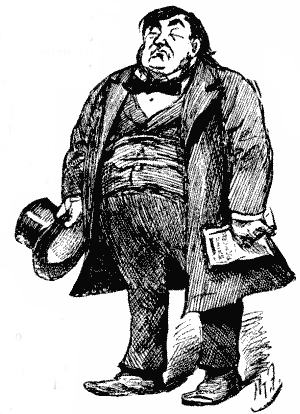
Bolton bolting.
Old Morality packed up his papers; Jokim locked up red box containing papers relating to Budget Scheme; Harcourt rose to continue discussion; discovered that Speaker had gone, and Serjeant-at-Arms removed Mace; so, at few minutes past Six, got off with plenty of time to enjoy that recreation, and cultivate those family relations, not less dear to a Member of Parliament than to the more 'orny 'anded son of toil. Odd at this early hour to hear cry of Doorkeeper, "Who goes home?"
"Well," says Member for St. Pancras, "I think I'll be Bolton." And he bolted. Business done.—- New Eight Hours' Day arrangement came into operation. Entirely successful.
Tuesday.—Ritchie a mild-mannered man, six feet high, and of genial temperament. But there are some things he can't stand. One is, to assume that Government Bill dealing with Local Taxation involves Compensation for disestablished publicans.
"I must say," he observed, just now, glaring on Caleb Wright, "that I object to the word Compensation which the Hon. Gentleman has used in his question."
What Government had done was to propose measure for the extinction of licences. Of course, a little money would pass. Jokim, in Budget Scheme, made provision to enable County Council to buy out publicans. "But to call such a transaction Compensation is," Ritchie added, his left eye twitching in fearsome manner on Caleb Wright, "preposterous."
That being so, House went into Committee on Allotments Bill, and drummed away till sitting suspended.
At Evening Sitting, Bob Reid brought on Motion raising sort of British Land Question. Wants to empower Town Councils and County Councils in England and Scotland to acquire, either by agreement or compulsorily, such land within their district as may be needed for the requirements of the inhabitants. House naturally shocked to find a Member proposing to discuss any phase of Land Question apart from Ireland. Interposition of Great Britain in this connection regarded as impertinence. Compromise arrived at; agreed to leave out Scotland. On these terms Debate went forward.
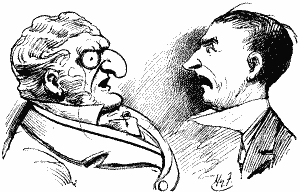
The Emphatic Noes.
Chaplin in charge of case for Government. At last, in his natural position, temporary Leader of the House.
Chaplin (aside), "Glamis and Thane of Cawdor! the greatest is behind."
How different from ancient days and nights, when he sat below Gangway in corner seat, that is, when he could get it. Couldn't always; sometimes presumptuous person forestalled him. Even when there, with notes of treasured speech in swelling breast pocket, by no means certain he would find opportunity of convincing House. Others step in, and edge him on into ignominious dinner hour. Now a Minister of the Crown, with a new Department created for his control; to-night in charge of Government business. Old Morality off early, full of restful confidence.
"Chaplin's looking after things," he said, as he made himself comfortable in his room. "Needn't bother; all will go right. Great thing for a First Minister to have a man he can thoroughly depend on."
"At least, Toby," Chaplin said, "those were his remarks as reported to me. I will not deny that they are gratifying."
At the proper time—at his own time—the Minister for Agriculture rose, and, positively pervading the premises, utterly demolished Bob Reid, his supporters, his arguments, and his resolution.
"Chaplin," said John Morley, watching him with admiring glance, "always reminds me of Victor Hugo's description of the Rev. Ebenezer Caudray. You remember him in Les Travailleurs de la Mer? Haven't the book with me, but translation runs something like this:—'He had the gracefulness of a page, mingled with the dignity of a Bishop.' Never knew that Victor Hugo was personally acquainted with Chaplin; but he certainly here hits off his characteristics in a phrase."
Business done.—Miscellaneous, and not much.
Thursday.—"Where do you put the Cow?"
"Was ever man interrupted with such a question in such circumstances?" asked Jesse Collings, unconsciously quoting Tristram Shandy's father.
Circumstances sufficiently strange to make a man quote Sterne, even if he'd never read his masterpiece. House in Committee on Budget Bill. Storey moved Amendment on Clause 26, dealing with exemption from Inhabited House Duty of tenement buildings. Chancellor of the Exchequer taken part in the Debate. Charles Russell said a few words. House in most serious, not to say depressed mood. Subject particularly inviting for Jesse; always advocated welfare of Working Classes; now seized opportunity to descant on theme. Detailed with growing warmth arrangements desirable for perfecting sanitation of houses for Working Classes; when Tanner, crossing arms and legs, and cocking head on one side, with provoking appearance of keen interest, suddenly submitted this problem:—
"Where do you put the Cow?"
Opposition laughed. Ministerialists cried, "Order!" Various courses open to Jesse. Might have assumed air of interested inquiry. Cow? What Cow? Why drag in the Cow? Might have slain Tanner with a stony stare, and left him to drag his untimely quadruped off the ground. But Jesse took the Cow seriously. Allowed it to get its horns entangled amid thread of his argument. Glared angrily upon the pachydermatous Tanner, and having thus played into his hands, loftily declared, "I do not propose to take any notice of the insult."
"It makes me smile," said Swift MacNeill, walking out for fear Goschen should hear his smile and clap a penny on his Income-Tax.
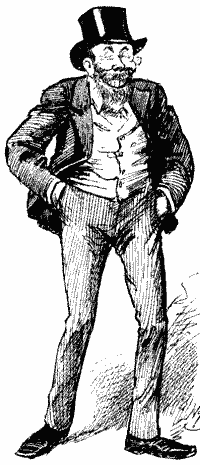
"It makes me smile."
A long night for Jokim, wrestling for his Budget. Ominous gathering on Front Bench. Mr. G., not seen lately, comes down. To him foregathers Harcourt. Assaults on Budget begun from below the Gangway. Proposed to postpone clauses on which Local Budget Bill will be built up. Jokim shakes his head. Mr. G. amazed at his refusal to listen to reasonable suggestion. Harcourt rises, meaning to run atilt at Jokim. Chairman of Committees puts out his foot, nearly trips him up. Harcourt turns and bends on Courtney expressive glance. Never much love lost between these two. Now Courtney in official position can snub Harcourt—and does. Shall Harcourt go for him? Shall he take him up in his powerful arms and tear him to pieces with delighted teeth? A moment's pause, whilst Harcourt, towering at table, toying nervously with eyeglass, looks down on Chairman who has just ruled him out of order. Shall he? Struggles with his suddenly awakened wrath, gulps it down, turns aside to talk of something else.
Not to-night, but some night there will be wigs (especially Courtney's) on the green.
Business done.—Budget in Committee.
Friday.—Met Markiss walking with weary footsteps from Lords. Curiously depressed air. "Anything happened at East Bristol?" I asked. "But you cannot have heard yet."
"No; nothing to do with bye-elections," said the Markiss, with sob in his throat. "It's Wemyss; touched me to the quick; was to have made speech to-night on Socialistic legislation of last two years. Hadn't slightest idea what he meant. Came down to-night a little late; found House up. Wemyss wouldn't deliver his speech in my absence; thing didn't come off; so Lords went home. That's what I call personal devotion. Supposed to be hard cynical man, but you see I have my soft places, and Wemyss has touched me."
Not a dry eye between us as the Markiss moved off.
Business done.—Pleuro-pneumonia in House of Lords.