VOLUME 93, October 15th 1887.
Reading edition
edited by Sir Francis Burnand.
'ARRY ON OCHRE
Dear Charlie,
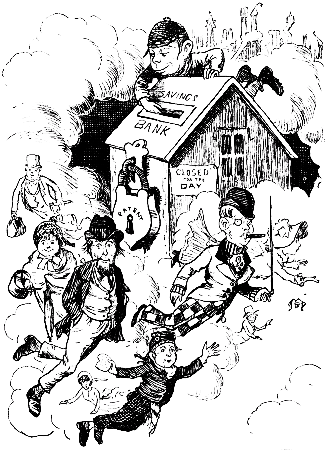
Hoctober, my 'arty, and 'Arry, wus luck! 's back in town, Where it's all gitting messy and misty; the boollyvard trees is all brown, Them as ain't gone as yaller as mustard. I do 'ate the Autumn, dear boy, When a feller 'as spent his last quid, and there's nothink to do or enjoy. Cut it spicy, old man, by the briny, I did, and no error. That Loo Was a rattler to keep up the pace whilst a bloke 'ad a brown left to blue. Cleared me out a rare bat, I can tell yer; no Savings Bank lay about her. Yah!—Women is precious like cats, ony jest while you strokes 'em they purr. Lor', to think wot a butterfly beauty I was when I started, old pal! Natty cane, and a weed like a hoop-stick, and now!—oh, well, jigger that gal! Cut me slap in the Strand ony yesterday, Charlie, so 'elp me, she did. Well, of sech a false baggage as Loo is, yours truly is jolly well rid. Wot a thing this yer Ochre is, Charlie! The yaller god rules us all round. Parsons patter of poverty's pleasures! I tell yer they ain't to be found. If you 'aven't the ha'pence you're nothink; bang out of it, slap up a tree. That's a moral, as every man as is not a mere mug must agree. They talks of "the Masses and Classes,"—old Collars is red on that rot!— There is ony two classes, old pal, them as 'as it and them as 'as not. The Ochre, I mean, mate, the spondulicks, call the dashed stuff wot you please. It's the Lucre as makes Life worth livin', without it things ain't wuth a sneeze. O Charlie, I wish I'd got millions! I ought to be rich, and no kid. I feel I wos made for it, Charlie. To watch every bloomin' arf quid, Like a pup at a rat 'ole is beastly. Some stingy 'uns carn't go the pace, But I know I should turn out a flyer, and so ought to be in the race. Oh, it ain't every juggins, I tell yer, who's built for the bullion, dear boy! You must know the snide game that's called "Grab," you must know what it means to "enjoy." Neither one without tother's much use, but the true Ochre Kings are the chaps As can squeeze millions out of "the Masses." They win in life's game, mate, by laps. That's jest wot "the Masses" is made for; them asses I calls 'em, old man, Same letters, same thing, dontcher know. Yus, Socierty's built on this plan. Many littles makes lots, that's the maxim; and he is the snide 'un, no doubt, Who can squeeze his lot out of the littles of half the poor mugs who're about. Twig, Charlie, old twister? Yer sweaters, yer Giant Purviders, and such Is all on that lay. Many buds, and one big bloated Bee, that's the touch! Wy, if bees was as many as blossoms, or blossoms as few as the bees, Him as nicked a whole hive to hisself would find dashed little honey to squeeze. The honey—or money—wants massing, that's jest wot the Masses can do— And the "Classes," my boy, are the picked 'uns, as know 'ow to put on the screw. That's the doctrine of "Dannel the Dosser," a broken-down toff, as I know; And if Dannel ain't right, I'm a Dutchman. That's ow yer big money-piles grow. Rum party the Dosser is, Charlie—I can't make him out, mate, not quite. Laps beer, when he can, like a bricky, though brandy's his mark. His delight Is to patter to me about Swelldom, Socierty, wot he calls gammon— That's Ochre, dear boy, dontcher know. I suppose arf his gab is sheer mammon. He eyes me in sech a rum style, Charlie, sort of arf smile and arf sneer, Though he owns I'm a Dasher right down to the ground—when he's well on the beer. A pot and a pipe always dror him, and I'm always game to stand Sam, For his patter's A1, and I pump 'im,—a lay as he stands like a lamb. "You ought to be rich, my young Cloten!" sez he. It's a part of his game To call me nicknames out of Shakspeare, and so on; but "Wot's in a name?" "My brain and your 'eart now together, would make a rare Dives," says "Dosser." I don't always know wot he means, and I doubt if he does, poor old josser! 'Owsomever, the Ochre's my toppic. Some jugginses talk about "Thrift," Penny Savings' Bank bosh, and that stuff. Wouldn't 'ave their dashed brains at a gift. Save, hay,—out of two quid a week! No, it doesn't fetch me in that shape. You must swag in this world to get rich; if yer carn't, it's no bottles to scrape. The Turf or the Stock Exchange, Charlie, would suit me, I'd trust to my luck, And my leariness, not to get plucked like that silly young Ailesbury duck, Wot's life without sport? Wy, like billiards without e'er a bet or a fluke, And that's wy I'd be a Swell Bookie—that is if I carn't be a Dook. In fact if I 'ad my own chice, I should jest like to double the part, As I fancy a few on 'em do. Oh, Jemimer! jest give me a start. With a 'undered or two, and the Ochre I'd pile 'twould take waggons to carry. The world loses larks, mate, you bet, when among the stone-brokers is
'Arry.
Turning To the Left.—At a recent meeting of the Court of Common Council (in the teeth of a strong opposition of some of the members of the Board) it was decided to exclude strangers and the Press during a part of the proceedings. The matter under secret consideration, it is said, was the appointment by the Recorder of the Assistant-Judge of the Mayor's Court. It is rumoured that, acting on the opinion of Mr. R. S. Wright, (with him the Attorney-General) the Court decided not to confirm that appointment. But why all this mystery? What had the Councillors to fear? Obviously, they could be doing nothing wrong if they were sustained by Wright!
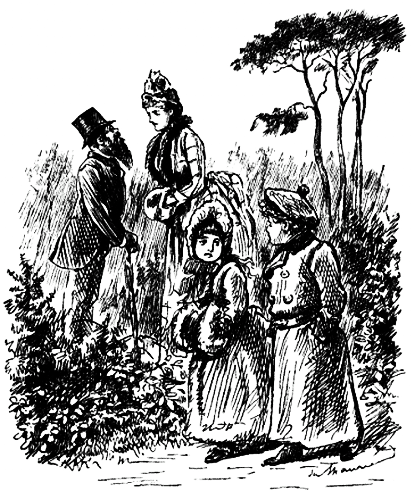
JUMPING AT CONCLUSIONS.
"Who's that tiny little Gentleman talking to Mamma, Tom?" "Mr. Scribbins, the Writing Master at our School." "Ah! I suppose he teaches Short-hand!"
A LORD MAYOR'S DAY IN DUBLIN.
(A Lay of the Criminal Law Amendment Act.)
"Shure it's Balfour would be troublin', meeself Lord Mayor o' Dublin, But every charge he makes I'll meet in fashion you'll call nate; For I'll face the accusation that he brings against the Nation, Attired from head to foot, my boys, in all my robes of State. "So on with hat and gown, boys, for we're goin' through the town, boys, And you must help your City's Chief to make a real display," Thus Tim Sullivan he cried out, as straightway he did ride out, In civic pomp to near the Court on that eventful day. And Town Councillors in numbers, woke from their normal slumbers, And, donning gowns and tippets, rose and put on all they knew, And with approbation glancing at the City Marshal, prancing On a hired hack, they followed him, a rather motley crew. At length the Court they entered, when attention soon was centred, On a squabble that had risen about the Sword and Mace: For some swore they were not able to lie upon the table, Though the Lord Mayor hotly argued it was their proper place. So when 'twas shown quite plainly, after pushing for it vainly, Beyond the "bar" the civic baubles had to be conveyed, With vow that none should floor them, their guardians upstairs bore them, And in the front seats flaunted them conspicuously displayed. Then up stood Mr. Carson, quite as quiet as a parson, And read out his indictment with a settled, stone-like face, Till Tim Healy, quick replying, rose then and there, denying That the Counsel for the Crown had a shadow of a case. And then as legal brother argued each against the other, The while Tim Sullivan reclined in all his civic blaze, O'Donel he looked vexed there, and he seemed somewhat perplexed there, As if the matter struck him as involved in doubtful haze. But after some reflection, with a soupçon of dejection, He announced that he had settled (though, doubtless, mid some fears He might stir up Balfour's fury), there was no case for a jury. His judgment was received in Court with hearty ringing cheers. Then, wild with exultation, up rose Mayor and Corporation, And, greeted by the crowd without, were cheered along the way, Til the Mansion House on nearing, the mob cried, 'midst their cheering, A speech they wanted, and would hear what he had got to say. Then Tim Sullivan he spouted;—the mob they surged and shouted, And the upshot of the speech was this, that if, through legal flaws, By any chance your way you see, to battle with the powers that be, You're hero both and martyr if you break the Saxon's laws. So it's no use, Balfour, troublin' the Civic powers of Dublin; For if you do, you know that they will meet you just half way; And if fresh accusation you but bring against the Nation, The City shure will answer with another Lord Mayor's Day!
THE REAL GRIEVANCE OFFICE.
(Before Mr. Commissioner Punch.)
An Official of Epping Forest introduced.
The Commissioner. Now, Sir, what can I do for you?
Witness. You can confer a favour upon me, Sir, by correcting some sensational letters and paragraphs on "Deer-Maiming in Epping Forest," that have lately appeared in the newspapers.
The Commissioner. Always pleased to oblige the Corporation. Well, what is it?
Witness. I wish to say, Sir, that deer-shooting in Epping Forest, so far as its guardians are concerned, is not a sport, but a difficult and disagreeable duty?
The Commissioner. A duty?
Witness. Yes, Sir, a duty; because, in fulfilment of an agreement with the late Lords of the Forest Manors (to whom we have to supply annually a certain amount of venison), and in justice to the neighbouring farmers, whose crops are much damaged by the deer, we are obliged to keep down the herd to a fixed limit.
The Commissioner. But how about the stories of the wounded animals that linger and die?
Witness. We have nothing to do with them—we are not in fault. I mean by "we" those who have a right to shoot by the invitation of the proper Authorities.
The Commissioner. But are not the poor animals sometimes wounded?
Witness. Alas, yes! Unhappily the forest is infested by a gang of poachers of the worst type, and it is at their door that any charge of cruelty must be laid. So far as we are concerned, we kill the deer in the most humane manner. We use rifles and bullets, and our guns are excellent shots. As no doubt you will have seen from the report of the City Solicitor, such deer as it has been necessary to kill, have been shot by, or in the presence of, two of the Conservators renowned for their humanity and shooting skill.
The Commissioner. It seems to me that you should put down the poachers.
Witness. We do our best, Sir. You must remember the Corporation has not been in possession very long. We have to protect nearly ten square miles of forest land, close to a city whose population is counted by Millions.
The Commissioner. Very true. Can I do anything more for you?
Witness. Nothing, Sir. Pray accept my thanks for affording me this opportunity of offering an explanation. I trust the explanation is satisfactory?
The Commissioner. Perfectly. (The Witness then withdrew.)
THE OCTOPUS OF ROMANCE AND REALITY.
(As much Fact as Fancy.)
"I had one curried, and found it most excellent—something like tender tripe."—Extract from Mr. Tuer's Letter.
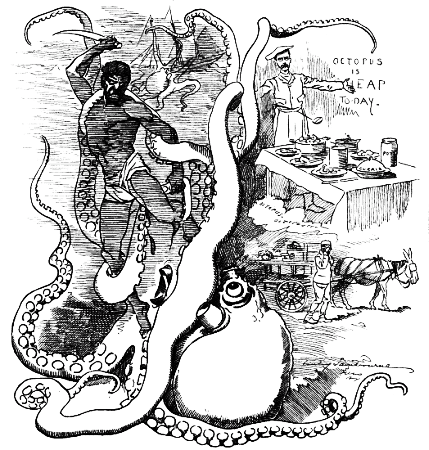
"Devil-fish" of Victor Hugo, Dread Pieuvre of caves where few go But are made your palsied prey, Where are now your gruesome glories, Dwelt upon in shocking stories? Realism a big bore is "Octopus is cheap to-day!" You who, worst of ocean's gluttons, Swallowed man, his boots, and buttons, Cooked in this familiar way? You who, in the tales of dreamers, Sucked down ships and swallowed steamers, Made the prey of kitchen schemers? "Octopus is cheap to-day!" Swallowed, you colossal cuttle? Nemesis is really subtle! Carted on the Coster's tray, Dressed in fashions culinary, Which the cunning chef will vary After every vain vagary? "Octopus is cheap to-day!" Your huge arms, so strong, so many, Like tarantula's antennæ_, Just like tenderest tripe, they say! Only wait a little longer, Turtle soup—as from the Conger— They will make from you, but stronger. "Octopus is cheap to-day!" Octopus—or is't Octōpus?— Fame, that should outshine Canopus, All too swiftly fleets away. Yet our feelings it must harrow, That your demon-fame should narrow To cook-bench and coster barrow. "Devil-fish is cheap to-day!"