Volume 93 — THE CHIMES.
Reading edition
(Dickens once again adapted to the Season and the Situation.)
High up in the steeple of an old old Tower, of ancient foundation, somewhat incongruous and complicated in design, but of sound Constitution—as everybody, even the angriest campanological opponents, admitted—far above the light and the noise of the town, if far below the flying clouds that shadow it, dwelt the Chimes I tell of.
They were old Chimes, trust me. Centuries ago those Bells had been hung by our ancestors, so many centuries ago, that the register of their first suspension, the record of their first peal, was lost in antiquarian mist as impenetrable as the darkness of the belfry corners on a starless November night. They had had their donors and sponsors, these Bells; but time had mowed down their donors, and mislaid the names of their sponsors, and they now hung nameless and dateless, but sound and sonorous still, in that high old Tower, time-worn but steadfast and four-square to all winds, Party or otherwise, that have blown or that shall blow.
Not speechless though. Far from it. They had clear, loud, lusty, sounding voices, had these Bells; and far and wide they might be heard upon the wind. Much too sturdy Chimes, moreover, were they, to be dependent upon the mere pleasure of the wind, of any of the winds—Party or otherwise—aforementioned. They had been pulled at by many generations of ringers, pulled at sometimes skilfully, often awkwardly and ill; sometimes in tune, and with the well-ordered harmony which was natural to them; sometimes again, wildly and wilfully, by incompetent or angry ringers, ringers ill-matched and ill-accordant, who did their worst to mar their melody, and spoil their tunefulness, and upset their time, and make them sound, in the great Singer's words:—
"Like sweet bells jangled, out of tune, and harsh."
But the fault was ever less in the Bells than in the Bell-ringers. Cracked were they not, nor were they cacophonous; let their clappers swing free, and keep their throats unrusted and unclogged, and in skilled, and loyal, and well-conducted hands, they would ever sound out strongly and sweetly, and send forth on and against the wildest and angriest of the winds aforesaid, most excellent and inspiring music.
Toby knew them well, those Bells, as did his great and genial Master. Toby was not a canine casuist. Being but a simple and loyal dog, he invested them with a strange and solemn character. They were so mysterious and mighty; often heard, and never seen; so high up, so far off, and so full of such a deep, strong melody, that he regarded them with a species of awe; and sometimes when he looked up at the dark arched windows in the tower, he half expected to be beckoned to by something which was not a Bell, and yet was what he had heard so often sounding in the Tower, the Spirit, namely, of Loyalty and Love, of Honour and of Home. For all this, Toby scouted with doggish disdain—being, like his Master, as sensible as loyal—a certain occasionally flying rumour that the Chimes were haunted, as implying the possibility of their being connected with any Evil thing. And Toby—no unlicked cub, but a considerate, composed old dog,—never puppyishly barked at the Bells. He would as soon have thought of baying the moon.
But he often had occasion to yap, warningly or reprovingly, at the Bell-ringers!
Bow-wow-wow! It was the voice of Toby. It meant not, this time, either warning or reproof; rather amicable acknowledgment, and just a little surprise. Not fear, oh, no! not fear.
A Voice—was it a vision-voice, or the accents of the biggest of the Bells, or was it, perchance, the veritable Voice of Time himself, naturally and fitly vocal and audible at this particular Season?—sounded strangely through the shadowy belfry. Thus it seemed to speak, in words curiously pertinent to the moment, though Toby seemed to have heard them before in other connection and in other circumstances.
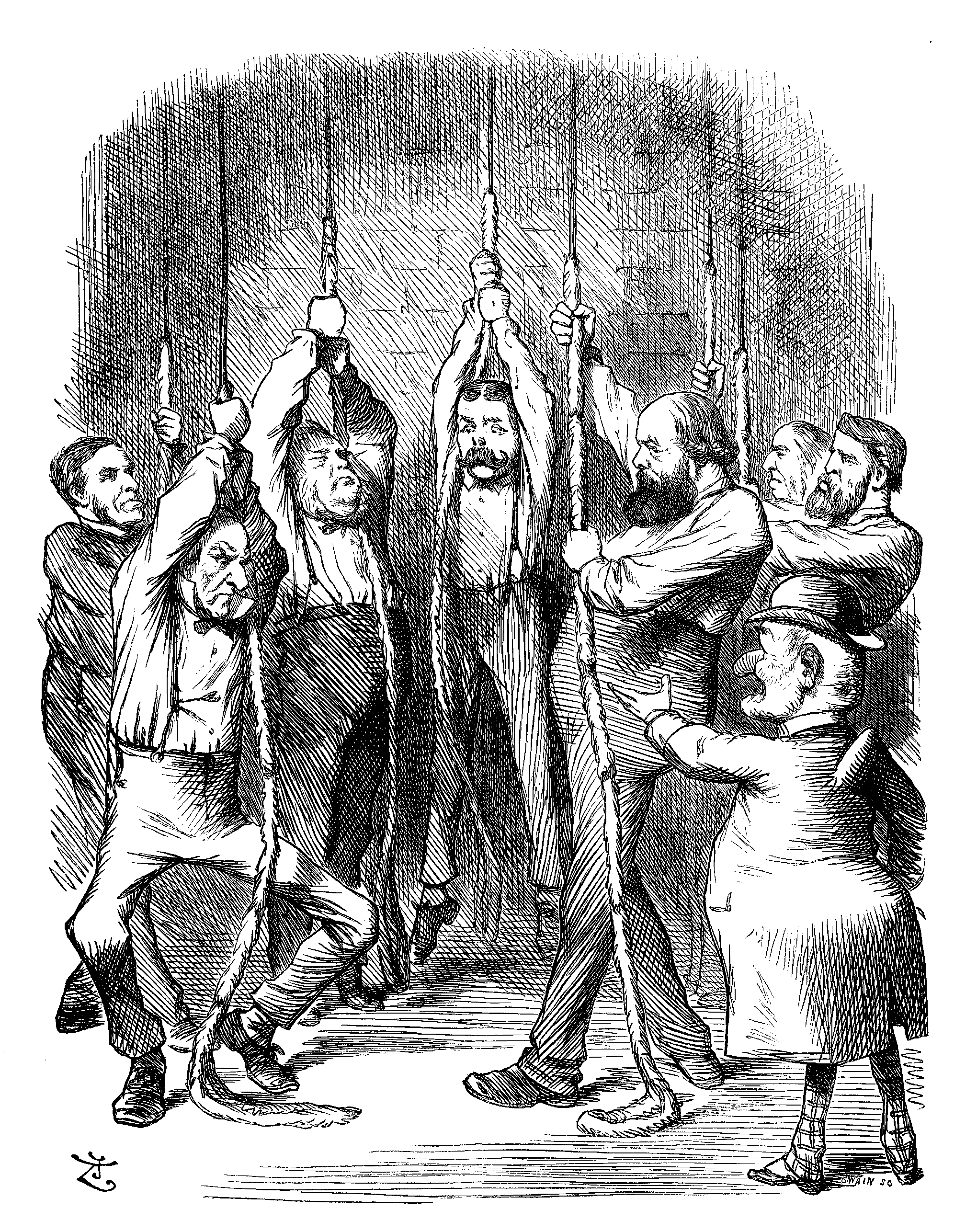
THE CHIMES.
Mr. Punch. "NOW THEN, MY LADS! ALL TOGETHER FOR ONCE!—CHRISTMAS TIME, YOU KNOW!!"
"The Voice of Time cries to Man, Advance! Time is for his advancement and improvement; for his greater worth, his greater happiness, his better life; his progress onward to that goal within its knowledge and its view, and set there in the period when Time and he began. Ages of darkness, wickedness, and violence have come and gone—millions uncountable have suffered, loved, and died—to point the way before him. Who seeks to turn him back, or stay him in his course, arrests a mighty engine which will strike the meddler dead, and be the fiercer and the wilder, ever, for its momentary check!"
"A rub for the reactionaries!" mused Toby.
"Who puts into the mouth of Time, or of its servants, a cry of lamentation for days which have had their trial and their failure, and have left deep traces of it which the blind may see—a cry that only serves the present time, by showing men how much it needs their help when any ears can listen to regrets for such a past—who does this does us wrong."
"A flout for our Fair-Traders!" thought Toby.
"Who hears in us, the Chimes, one note bespeaking disregard, or stern regard, of any hope, or joy, or sorrow, of the many-sorrowed throng; who hears us make response to any creed that gauges human passions and affections, as it gauges the amount of miserable food on which humanity may pine and wither, does us wrong."
"What would the contemners of the people's claims, the deriders of the people's miseries, make of that, I wonder?" meditated Toby.
"Who hears us echo the dull vermin of the earth, the Putters Down of crushed and broken natures, formed to be raised up higher than such maggots of the time can crawl or can conceive, does us wrong."
"Pity the shriekers for unlimited Suppression can't hear this!" cogitated Toby.
Bow-wow-wow! Again it was the voice of Toby. This time it did mean warning, if not reproof. Not anger exactly; anger alone is scarce suited to the Christmas season.
The Bell-ringers were going it. With plenty of energy, unquestionably, but with scarcely as much discretion as might be desired. A rather mixed lot. Each one individually an excellent hand at the rope, no doubt. Evergreen Will, of the leonine front, and flying silvery whisps of hair! Black-a-vised Bob, of the broad shoulders and resolute tug. Stolid, but sturdy Harty, of the firmly-planted feet and granite grip! Fiery though mild-featured Joachim; sombre, smug-faced, but enthusiastic John! Last, though perhaps hardly least (in his own estimation, at all events), rattling Randolph, light-weight, none too firm of footing, but full of dash, and game to attempt a triple bob-major all by himself.
"Pull away, Bob," cried impetuous Will, eagerly.
"Steady, Will!" exclaimed Black-a-vised Bob, sardonically.
"Keep time, for goodness sake, John," said accurate Joachim.
"Want your bell to be heard above all the rest!" murmured sombre John.
"Are you trying to hang yourself, or pull the belfry down, Randolph," muttered stolid Harty, beneath his moustache.
"Oh, confound it; I could lick the lot of you!" shouted little Randolph, tugging tremendously at his rope, and fairly carried off his feet by the recoil.
"Bow-wow-wow!" barked Toby.
"Right, my dog!" said his Master. "Good Bell-ringing, my boys, requires combination and subordination, unity of purpose as well as union of powers. A bull-like power of pull is not enough, or, by Jove! you'd all be crack campanologists. Come, Gentlemen, a Christmas Carillon at least should not be all cacaphonous crash and clatter. All together, my lads, for once; or, rather, keep time, and touch, and tune, with due regard to the perfection of the peal and the credit of the glorious old Chimes!"