Volume 93 — THE PLUCK OF GGGRRANDDDOLLLMANN'S CAMP.
Reading edition
(A Story of the Welsh Gold Fields.)
By Britt Part.
There was commotion in Gggrrandddolllmann's Camp. It could not have been a fight, for in those days, just when gold had been discovered on Welsh soil, such things as fights were unknown. And yet the entire settlement were assembled. The schools and libraries were not only deserted, but Jones's Coffee Palace had contributed its tea-drinkers, who, it will be remembered, had calmly continued their meal when even such an exciting paper as the Grocers' Journal had arrived. The whole Camp was collected before a rude cabin on the outer edge of the clearing. Conversation was carried on in a low tone, but the name of a man was frequently repeated. It was a name familiar enough in the Camp—"W. E. G.—a first-rate feller." Perhaps the less said of him the better. He was a strong, but, it is to be feared, a very unstable person. However, he had sent them a message, when messages were exceptional. Hence the excitement.
"You go in there, Taffy," said a prominent citizen, addressing one of the loungers; "go in there, and see if you can make it out. You've had experience in them things."
Perhaps there was a fitness in the selection. Taffy had once been the collector for a Trades Union Society, and it had been from some informality in performing his duty that Gggrrandddolllmann's Camp was indebted for his company. The crowd approved the choice, and Taffy was wise enough to bow to the majority.
The assemblage numbered about a hundred men. Physically they exhibited no indication of their past lives and character. They were ordinary Britons, and there was nothing to show they had been less contented than their neighbours; and yet these men, in spite of their loneliness, had never wanted for a single reform. Until now they had been absolutely satisfied with their lot.
There was a solemn hush as Taffy entered the Post Office. It was known that he was reading the despatch. Then there was a sharp querulous cry—a cry unlike anything heard before in the Camp. It was muttered by Taffy. He told them that the document called upon the whole community to ask for Disestablishment and Home Rule. The Camp rose to its feet as one man. It was proposed to explode a barrel of dynamite in imitation of the Irish Nationalists, but in consideration of the position of the Camp, which would certainly have been blown to pieces, better counsels prevailed, and there was merely a cutting of bludgeons from the trees the levelling of which W. E. G. was known to love so well.
Then the door was opened, and the anxious crowd of men, who had already formed themselves into a queue, entered in single file. On a table lay the document they had come to read.
"Gentlemen," said Taffy, with a singular mixture of authority and ex officio complacency; "gentlemen will please pass in at the front door and out of the back. Them as wishes to contribute anything towards the carrying out of the written wishes of the document will find a hat handy."
The first man entered with his hat on; he uncovered, however, as he looked at the writing, and so unconsciously set an example to the next. In such communities good and bad actions are catching. As the procession filed in, comments were audible. "A lot for the money!" "Just like him!" "Gets a deal into three lines!" And so on. The contributions were as characteristic. A life assurance policy, a pledge to abstain from intoxicating drinks, several volumes on political economy.
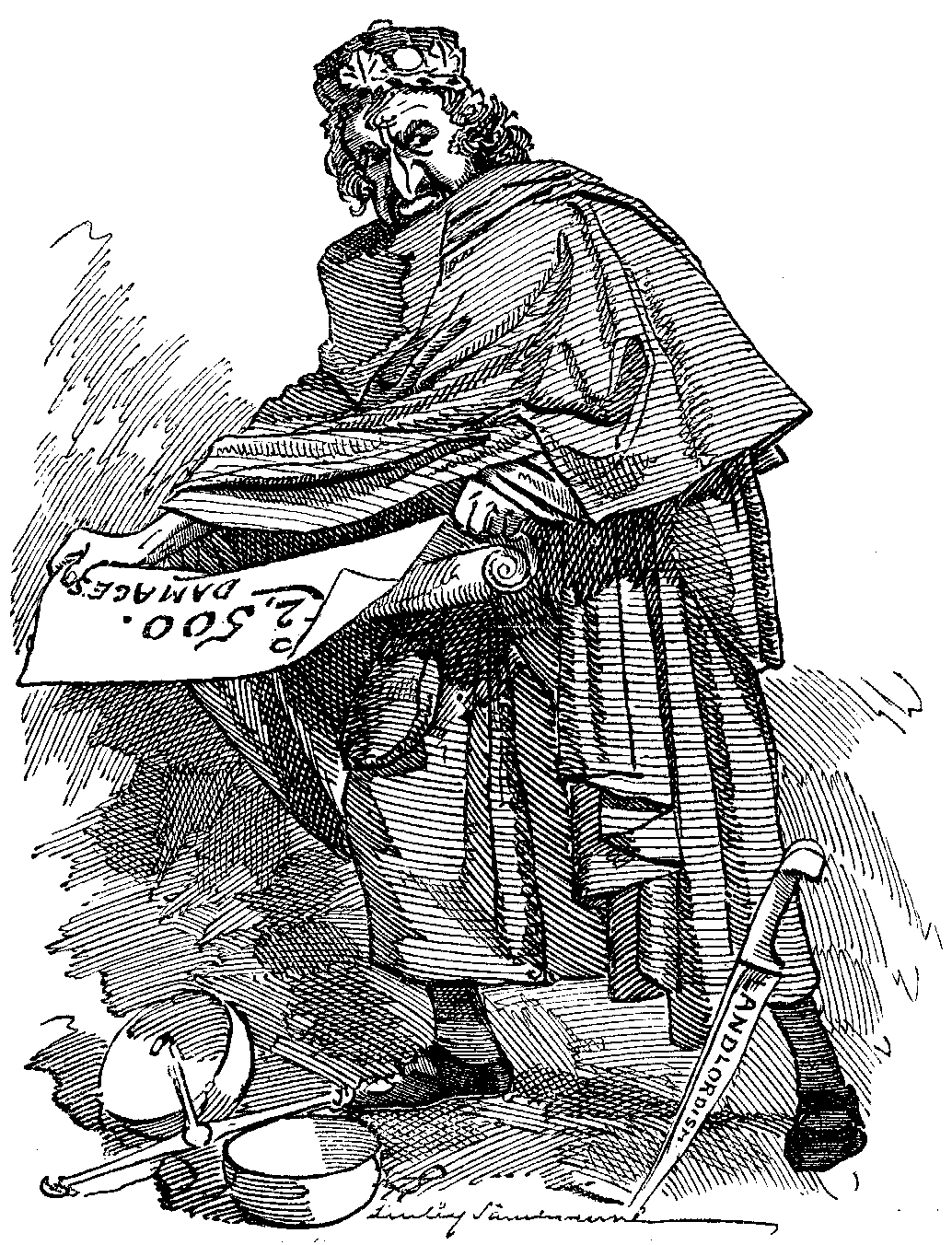
THE NEW SHYLOCK.
From a Portrait sketched by the Great McDermott, Q.C., during a recent Irish Trial.
So the despatch was read and re-read a score of times, and it was found necessary to give it a name. The natives of Wales are generally sagacious, and so they gave it the name of the Pluck. For the sake of the Pluck they did everything. It was certain, of late, they had not been very successful. They had certainly not paid their rents, and refused to patronise the Parson, and so the work of degeneration began in Gggrrandddolllmann's Camp. Instead of working as of old, the inhabitants gave up labour and shouted to one another. They repeated the phrases of the despatch crying, "Be worthy of yourself, gallant little Wales," "Remember Michelstown!" and went to sleep. Before the arrival of the despatch they had been a clean, hard-working, thrifty race. Latterly, however, there had been a rude attempt to let things go from bad to worse. The newly discovered mines were deserted and all industry was at a discount. "It is the Pluck of Gggrrandddolllmann's Camp that's doing it," said Taffy, as he gazed at the document as it lay on the table before him.
But at length things came to a crisis. The converted miners, as it has been explained, refused to work, and then neglected to pay their rents. Then came evictions, supported by the law. There was a confusion of staves and bayonets, buck-shot and black-thorn sticks. The Camp disappeared amidst much excitement. Some of the Campers emigrated, and others were sent to gaol. Taffy was missing. At length he was found in a ditch, holding a postcard bearing some warlike words, and signed "W. E. G."
"I have got the Pluck with me now," he said, as he was arrested; and the strong man, clinging to the thin document so full of wild advice, as a drowning man is said to cling to a straw, was marched off to prison!