Volume 93 — WHY HE WENT.
Reading edition
Some doubts having been expressed in influential quarters as to the genuine character of the Manifesto alleged to have been recently put forth to the European Powers by Prince Ferdinand on his entry into Bulgaria, the following, whatever subsequent changes may have been diplomatically introduced into it prior to publication, may be confidently regarded as an authentic transcript of that document in its original form.
To the Crowned Heads of Europe, and others whom it does or does not concern, greeting, &c.
Be it known to those who have been interested in, and somewhat mystified by our recent movements, that we, Ferdinand the First, by the voice of the Regents, and the will of the Great Sobranje, elected Monarch of Bulgaria, wishing to make clear and explain why that we, having originally held aloof from any idea of acceptance of the post, and even having snubbed the Deputation who came to offer it to us in the name of the Bulgarian people, have apparently at the eleventh hour, to the exasperation of Russia, the consternation of the Porte, the indifference of Germany, the annoyance of Austria, the chagrin of France and the hearty amusement of England, suddenly turned round, and accompanied by a small portmanteau and a suite of two, accepted the situation and started on a penny steam-boat for Sofia, wish to make statement as follows:—
Having discovered upon inquiry that the palace required re-papering and was sadly out of repair, with both gas and water-rates seven quarters in arrear, while it appeared that both the throne and crown would have to be hired, and possibly only a lame omnibus horse available for our use at the Coronation procession, and taking in regard the fact that no guarantee was forthcoming that our allowance from the Civil List would touch anything like £150 a-year, we at first reluctantly decided, spite its undeniably flattering nature, to decline the offer so spontaneously made to us. And we conveyed as much to the delegates who received the news crestfallen, and were about to depart in sulky silence when a telegram arrived from Sofia of such an encouraging and startling description, that it seemed, to us at least, to put the question in an entirely fresh and original light, and in one that we felt might make us waver in our determination. It simply announced the fact that the Government, never doubting of our acceptance of the crown, had already taken the bull by the horns, and ordered at a local Ready-Made Clothing Establishment a complete brand-new Uniformfor us to wear the moment we set our foot on Bulgarian soil. "Buttons and all?" we asked. "Buttons and all!" was the reply. This gracious and patriotic, and quite unexpected act profoundly touched us. Indeed, it decided us; and when it was further intimated to us that the bill would not be sent in to us, but go to increase the deficit in the forthcoming Budget, we did not hesitate, but accepted the full responsibilities of the situation, and informed the Deputation that, spite the hostile attitude of Europe, we would go to Sofia, and at least "try it on."
Thus, and for this reason, we have started on our venturesome journey, whether or not to a successful issue the future alone can show. We have, however, made provision for emergency, and stipulated that, in the event of any sudden revolution obliging us to scuttle back again over the frontiers post haste, the uniform in question shall be regarded as our own personal property, and not be liable to be claimed as a royal perquisite, and altered to fit our possible successor. This, then, is the true statement of the reason that has induced us to assume the recent attitude that we have felt constrained to take in the face of the European Powers, concerning whom we may add, in conclusion, that their laughter if they are amused, or their howling if they are angered, are at the present moment equally matters of supreme indifference to us.
(Signed)
Ferdinand, Prince Elect of Bulgaria.
ESSENCE OF PARLIAMENT. EXTRACTED FROM THE DIARY OF TOBY, M.P. House of Lords, Monday, August 8.—Curious debate in Lords. As everyone knows, George Ranger has given notice to Volunteers that some of his tenants in neighbourhood of Wimbledon object to the assembling of Camp, and so the tents must be struck. As Commander-in-Chief, George Ranger is, of course, specially solicitous for the prosperity and convenience of the great and singularly cheap adjunct to regular forces. But as between a landlord's interest and a patriot-soldier's sentiments sentiment must take back seat. Nice thing to talk about in after-dinner speeches, and at opening of Bazaars; but, George Ranger regrets to say, quite another pair of sleeves in actual life. So Camp must be struck. To-night Wemyss brings on Motion deprecating contemplated procedure. Removal of the Camp, he said amid cheers, would be "nothing short of a national calamity." Would endanger progress if not existence of Volunteer movement. Dook behaved most nobly. Declared with tear in his voice that he would not be obstacle to free course of debate. Lest Peers of England should be awed by his presence when discussing matter of "national interest," G. R would withdraw, which he did!
Noble Lords made free use of their liberty. Wantage who, fresh from his command at Wimbledon, knows all about it, deplored the contingency. Spencer effectively brought the ultimate ends of his left-hand whisker to witness that driving-out of Volunteers from Camp would be "a public disaster." Harris hinted, on behalf of Government, that British tax-payer might somehow be brought into this domestic disturbance, of course with hand in breeches-pocket. Might indemnify George Ranger against loss real or imaginary, and so keep Camp for Volunteers.
House of Commons at the moment just entered Committee of Supply, pricked up its ears as rumour reached it. Sage of Queen Anne's Gate observes that, by merciful dispensation of providence rare in this direction, Lords cannot vote money in relief of Royal Dukes or otherwise, and Commons may have something to say about Wimbledon when question brought before it.
Business done.—Committee of Supply.
Tuesday.—Lords adjourned at 5.40 this afternoon. Peers left House as if bomb had exploded. Only Rosebery giving notice that early next Session he will "call attention to constitution of House of Peers, and move Resolution." Peers of older creation, like Brabourne, shocked; whilst Old Mother Hubbard—only just picked up a bargain set of robes, nearly new—very uneasy.
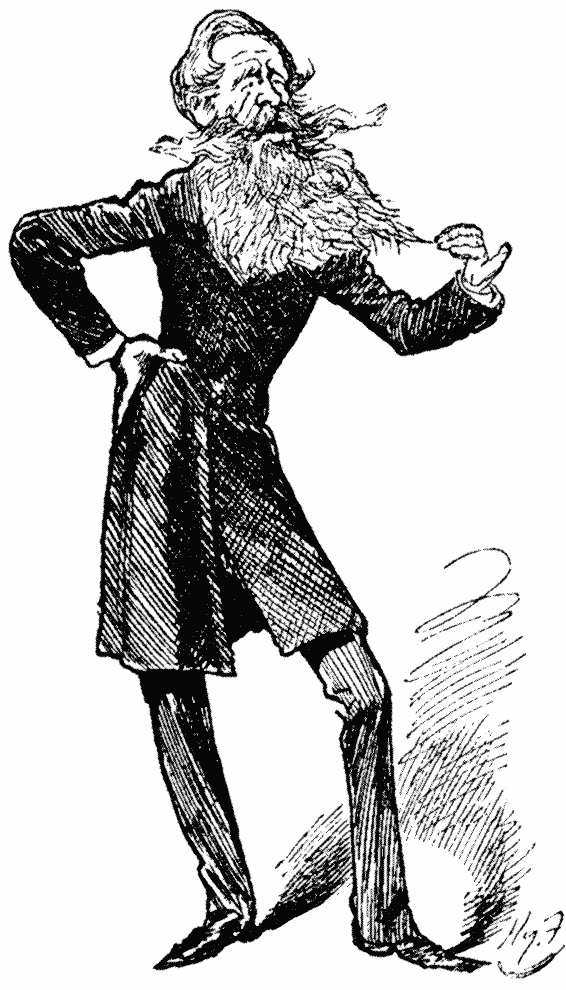
Earl Sp-nc-r introduces Incontrovertible Argument.
"These young Radicals," said Brabourne, adjusting his ill-fitting coronet, "never satisfied. Must always be bringing themselves to front, and reform everything. Why not leave our sacred House to itself. Rosebery, everybody knows, yearns after the Commons, an institution which I believe is situated in some parts of this building. I, for one, very glad to get rid of him. Will undertake, if I can get support (which I don't doubt), to bring in Bill, legalising Rosebery's dismantling himself, and his being qualified to sit in the Commons." Hubbard (forget his new name) offers to back the Bill. "Yes," said Brabourne, "that will do admirably. You'll stand for new Peers, and so whole House will be represented. Impossible that we, of the Ancient Peerage, can brook impertinence of this kind."
In Commons sitting impartially divided between Scotch votes in Supply, and Technical Education Bill, explained by Hart-Dyke. Hard to say which division duller. Scotch debate lightened by rather massive joke of proposing to reduce salary of Secretary for Scotland by £1,000. Unanimous protest of Scotch Members against this office being held by Member of House of Lords. If there was £1,500 to be pouched, why should not representative of the people have it, instead of being lavished upon bloated member of the aristocracy? Things looked so serious, that Lord Advocate put up to beg that Members be satisfied with discussion as far as it had gone, promising opportunity for renewal to-morrow, when (though didn't mention this) care will be taken to have present force strong enough to resist raid on Scotch office. Proposal unsuspiciously assented to.
Business done.—Supply.
Wednesday.—A nicht wi' Burns. A good drizzling Scotch mist from noon till Six o'Clock. Scotch Lunacy, Sheriff of Lanarkshire, Secretary for Scotland, Scotch Technical Instruction Bill were among subjects dealt with. Might have been going on now had not one of the Scotch Members, feeling his brain softening, moved the Closure. Old Morality woke up from his sleep in condition of righteous indignation. Here was audacity, indeed! An obscure Scotch Member presuming to poach on his preserves, to interfere with his sacred privilege of moving Closure! Began in tones of mingled sorrow and anger to protest. Speaker interposed. Reminded him that Closure motion could not be debated. Must be put forthwith. So done. Flood of talk stopped. Bill under discussion read Second Time, and Old Morality led out, pallid and palpitating.
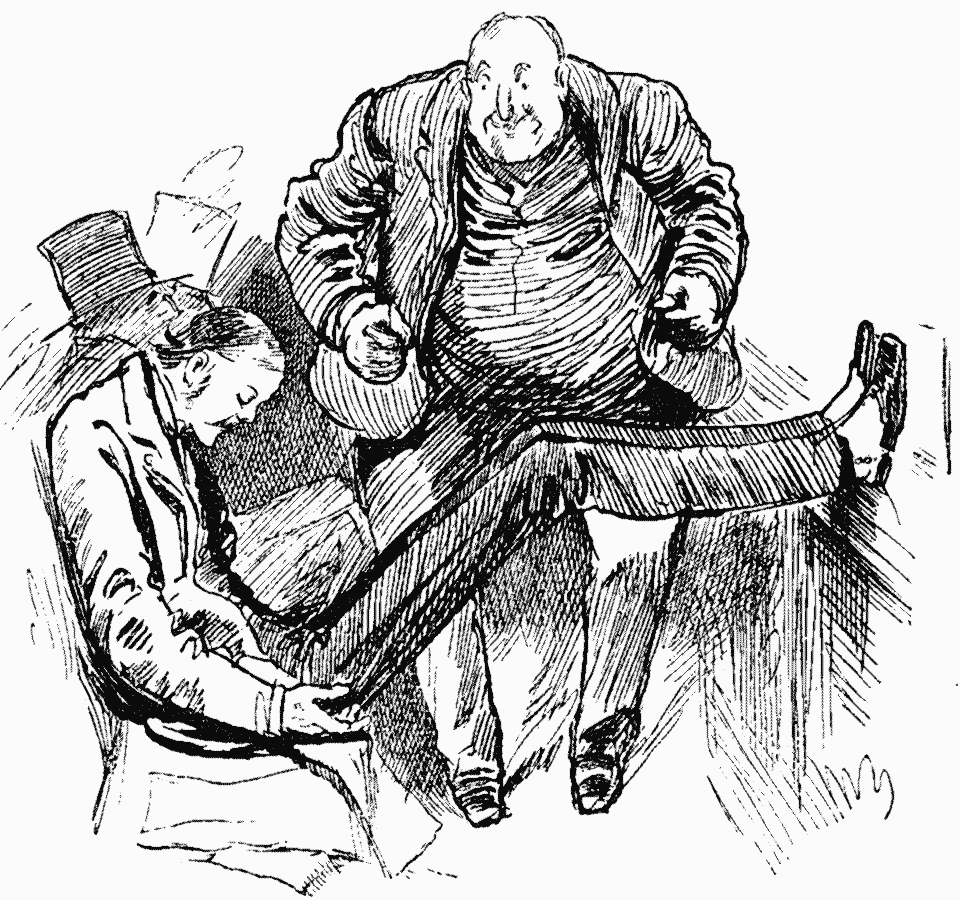
"Obstruction!"
Lord Advocate coming back from visiting him, finds passage obstructed by Arthur Balfour. Shall he jump over, or crawl under? Either difficult on August day for a stout gentleman. So whispers across barricade that "Smith's much cut up," and sits down on hither side.
Business done.—All Scotch.
Thursday.—Very small attendance in Commons. Considerably over forty remain on Opposition Benches to support Sage of Queen Anne's Gate's demand for Adjournment, in order to discuss cost and consequences of Drummond Wolfe's pic-nic in the East. Soon as gained consent, general exodus, and Sage cheerfully chats across deserted floor with Goschen, who takes incessant notes. John Dillon, who, what with intolerable interposition of Scotland yesterday, has not made speech since Tuesday, breaks in and shows that, next to Ireland, Egypt is most distressful country that ever yet was seen. Conversation drags along till after Ten o'Clock, when it dies of sheer inanition. Then Government Allotment Bill on. Harcourt makes discovery that it promises only one acre and no cow at all. Goschen hauled up again to whipping-post. Taunted with sudden conversion to principle of compulsion. True, didn't like compulsion. Had always said so, but "impossible for a single member of a Government to carry out his views on every point;" whereat Opposition grinned.
Business done.—Allotments Bill read Second Time.
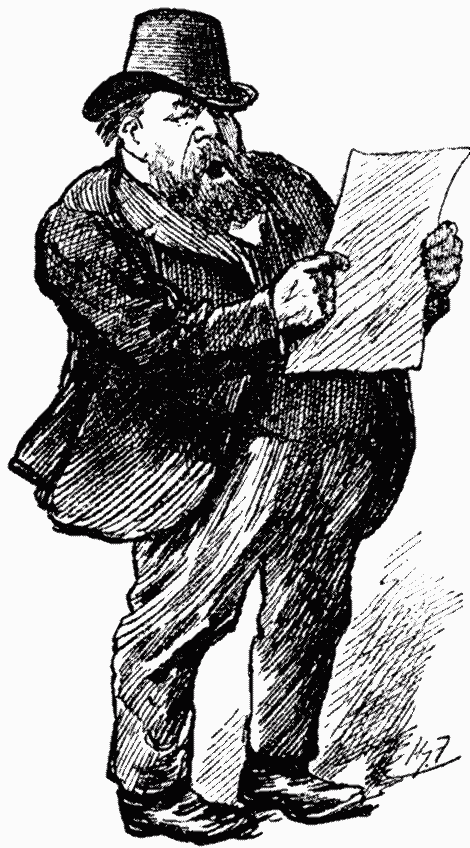
"Clywch! Clywch!"
Friday.—Some sensation in moderately crowded House at Question Time, when report ran round Benches that Sir John Puleston, Knight, was approaching. Slight reaction of disappointment when he entered. Vague, though prevalent notion, he'd come down in knightly costume, with vizor down (or up, as the case may be), armed "cap and pie," as Gent-Davis says, with lance in rest, and Squire in attendance. On contrary, lounged in just as if nothing had happened, with slightly preoccupied look and little start of surprise when congratulated on honour Government had done itself. "Oh! ah! yes! Know what you mean. Thanks. It's very hot, ain't it?" he said, making way through throng of congratulators. "Clywch! Clywch!" roared Abraham, humorously looking over newspaper announcing Knighthood.
"What's the matter with you?" I asked. "What are you clucking about?"
"I was only coughing in my native tongue," he said. "Clywch! Clywch!"
Various reasons suggested why Puleston made Knight just now. Howard Vincent says it's because he's the only Member for English borough that can pronounce the word "Eisteddfod," and knows the plural isn't "Eisteddfods". Whatever the reason, everyone heartily pleased. The new Knight, they say, will keep his own Table Round. Dean's Yard, Eight o'Clock. Dress optional.
Business done.—Row about Lords' Amendments to Irish Land Bill.