Volume 93 — ESSENCE OF PARLIAMENT.
Reading edition
EXTRACTED FROM THE DIARY OF TOBY, M.P.
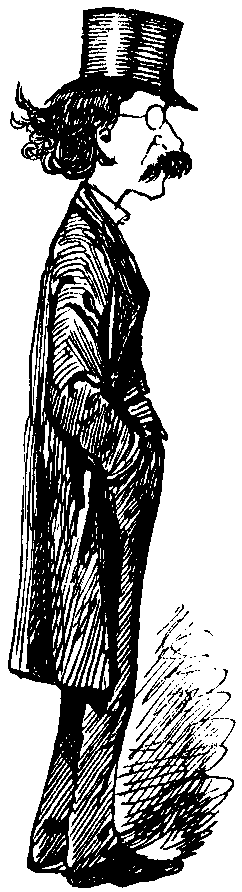
E. H. P-ck-rsg-ll.
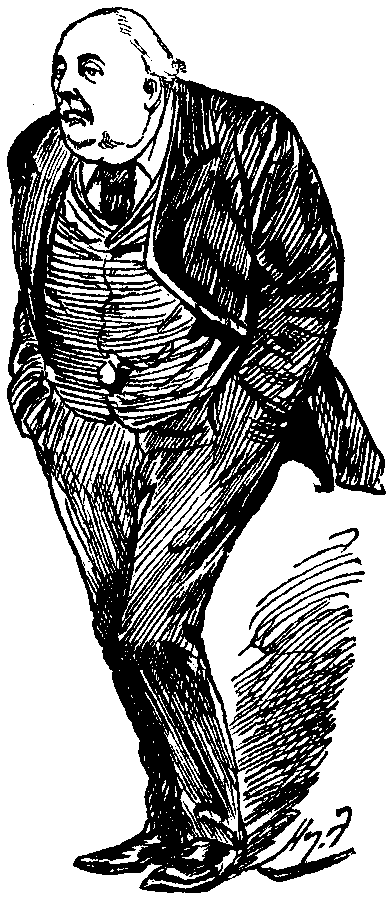
M-cl-n interposes.
Monday Night, August 1.—Prince Louis of Battenberg had better be making inquiries as to return trains for Germany. W. Redmond "has had his attention called to him," and Pickersgill has his eye upon him. German Prince been appointed to command of Dreadnought over thirty British Officers who had precedence for promotion. W. Redmond elicited more general cheering than usually falls to his lot when he wanted to know what reason could be given for so extraordinary a mark of confidence? Georgy Hamilton explained that there was best possible reason. Prince Louis a heaven-born sea-Captain. No one like him among ordinary Britishers. Appointed to Dreadnought simply because he was best possible man. Then Pickersgill came to front. Couldn't object to First Lord's personal preference, but gave notice that if Prince Louis were confirmed in command of Dreadnought he would move that his salary be disallowed. More cheers. Idea of German Princeling holding office, however honourable, without drawing a salary struck Commons as comical. Subject seemed to drop here. But Commerell, having by this time had another question on other subject put and answered, collected his thoughts, rose and begged to say that "Prince Louis of Battenberg served under me, and a more efficient officer——" Here sentence came to abrupt conclusion. Angry cries of "Order!" stormed round gallant Admiral. Commerell a man of proved valour, as the Victoria Cross worn on his breast on Jubilee Day and other high festivities testifies. But his bronzed cheek blanched under this assault. He stared round a moment speechless, and resumed his seat.
House in Committee through long hours on Irish Land Bill. Dulness enlivened towards midnight by encounter between Chamberlain and Grandolph. Chamberlain began it; Grandolph by no means backward. Rebuked Chamberlain for "characteristic sneer," upon which Chamberlain smartly retorted. The interesting episode concluded by Hartington announcing his intention to vote against Chamberlain and with the Government. Harcourt much pleased.
"This is only the beginning," he said. "Grandolph and Chamberlain have evidently quarrelled. Hartington doesn't bind himself to go with Chamberlain; and altogether the Unionist Party seems a little disunited."
Business done.—Irish Land Bill in Committee.
Tuesday.—Questions over there was a pretty scene. John Dillon complained of allegation in provincial newspaper that he had applauded a statement that in a riot at Belfast several children and a young lady school-teacher, the daughter of Lord Sligo's Agent, were seriously hurt. Hadn't proceeded far with explanation when voice from neighbourhood of Treasury Bench called out, "It is true!"
"Who says it's true?" shouted John, flashing a baleful glance on Treasury Bench.
At first he thought the interrupter was Old Morality, but his air of perfect innocence repulsed suspicion. Was it De Worms, turning as, it is written, his family sometimes do? Edward Clarke looked more guilty, so John "named" him; denied the soft impeachment. Halsey admitted it, and was backed up by half-a-dozen Members, including Maclean. Bore personal testimony to having heard the applause when incident was mentioned.
"I say it is true!" they repeated one after the other.
"And I say it is false!" John Dillon roared, and proceeded to denounce Members opposite in language which speedily brought up the Speaker.
After a while Maclean again interposed. Demanded to be heard whilst he asserted in detail the general accuracy of the newspaper paragraph, whilst of course acquitting Dillon "if he said he did not join in applause." Parnellites, oddly enough, left all the fighting to John, who was finally put down by Speaker. After this pleasant interlude, House resumed Committee on Land Bill. Proceedings dolorous, and House empty. At one time sitting nearly brought to end by a Count.
Business done.—Irish Land Bill.
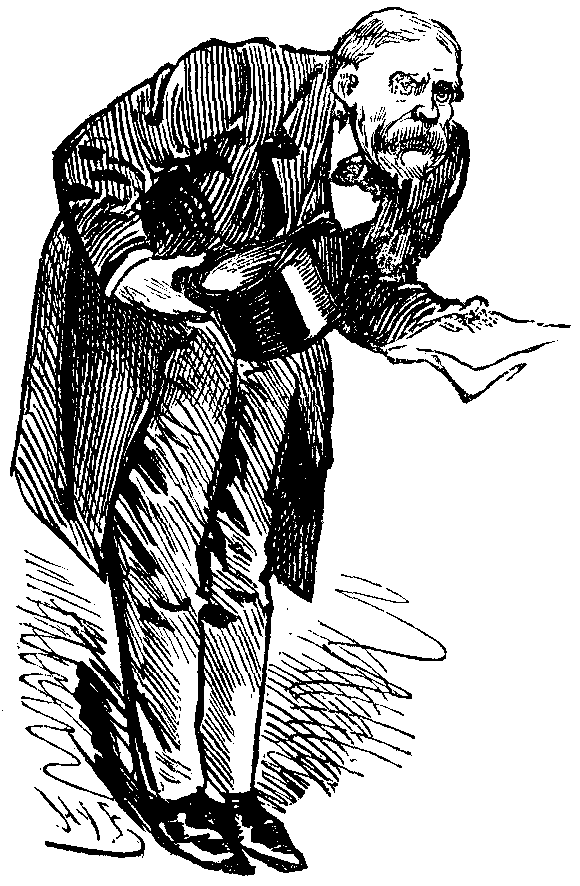
Enter Tr-v-ly-n.
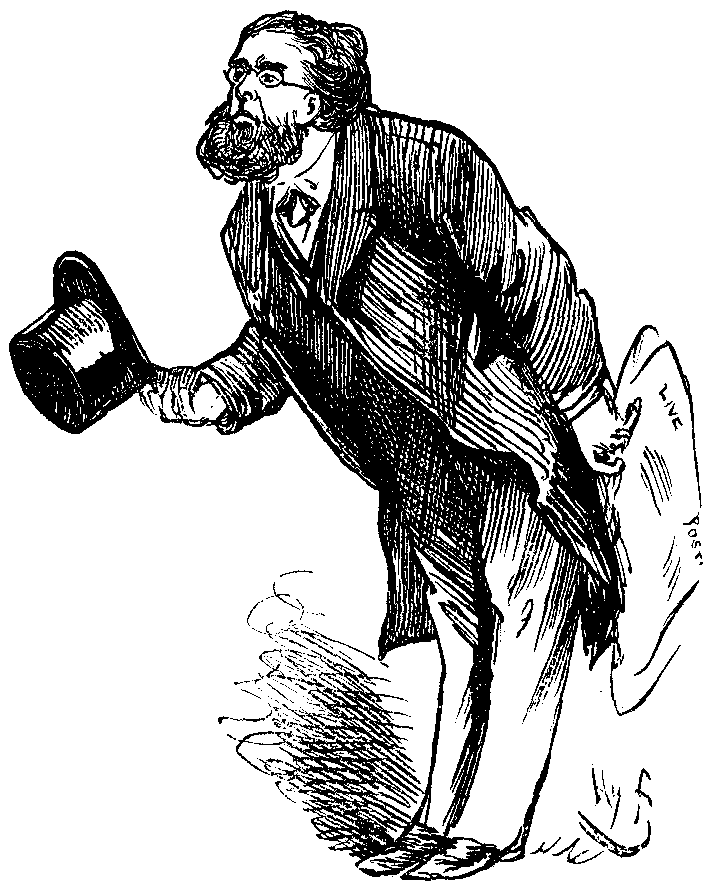
Exit R-ss-ll.
Thursday.—Enter Trevelyan; exit Edward Russell, the latter carrying with him the consciousness of that rare possession—popularity with both sides of the House. Everybody sorry he has gone, especially "the Dissentient Liberals." As Plunket says, "He was the gentlest-mannered Radical in the House." Crowded House. Trevelyan brings his sheaves (1401) with him, in shape of rattling majority won at Glasgow. Everybody there but Hartington and Chamberlain. Meeting in such circumstances with old colleague would have been too touching. But older colleagues, under wing of Gladstone, in full force. Determined to kill the fatted calf for the returning prodigal. Gladstone would, of course, play the part of Aged Parent; Trevelyan the repentant son. But who was to stand for the fatted calf? General impression that Harcourt best suited by natural gifts for the character. Harcourt's habitual modesty not to be overcome. "Wouldn't," he said, "like to play such a prominent part." Finally agreed that they should "imagine the calf." All went admirably well. Might have been managed by that veteran strategist the Sage of Queen Anne's Gate.
Childers and Cameron (both out of step with new Member) personally conducted him to Table. Enormous cheering, which Childers gently deprecated. "No, my good friends," he said. "This is very kind of you. But there's really no credit due to me. I bring our young friend up because I, too, am a Scotch Member. Perhaps my success at Edinburgh may have given fillip to Liberalism in the Lowlands. But pray don't mention it. Any little services I may have rendered are overpaid by this magnificent ovation."
More cheers when new Member was introduced to Speaker. Delighted to see him. Had often heard his name. Pleased with this opportunity of making his personal acquaintance. Should be sure to know him again if he met him. All this lively and entertaining. But great scene artistically conceived for end of play. Trevelyan, passing round back of Speaker's chair, proceeding in search of quiet seat, beheld strange spectacle on Front Opposition Bench. There was the Aged P. signalling from his tent. Signal taken up by retainers and carried down crowded bench. Only in the place of honour must the new Member sit. Never made so much fuss of before. Last time took oath and seat, no particular notice taken of double event. What had happened in meantime? Had he grown more eloquent; had he performed some conspicuous service; or had he increased in personal esteem of those who know him? The latter impossible. In the former no change. He had merely kicked over traces and was now come back to run in them. Thought of this with some bitterness. But reception well meant. There was the Aged P. violently beckoning with venerable forefinger, and the errant son made his way up to him, fell on his neck and kissed him——this of course in a Parliamentary sense.
Business done.—Army Estimates.
Friday.—House of Lords rent to its centre by deadly, blood-curdling, butter-melting controversy. Question is, shall it be Butterine or Margarine? The usually hostile camps streaked with enemies. A Noble Lord, who stands stoutly for Butterine, finds himself seated with another Peer, who swears by Margarine, and vice versâ. When division comes there is woful cross-voting. It is Basing who appropriately brings on subject, and Wemyss who moves that the compound be called Butterine, instead of Margarine. Everyone in high spirits, sustained by a free collation, served out at the door. This attraction rather militated against full success of debate. Noble Lords "asking for more," of course having to linger outside till they'd eaten it. Basing (long known to us as Sclater-Booth) revelled in his subject, and thanked the Markiss he was made a Peer in time to take part in discussion. Argyll brought his massive mind to bear on Butterine; Granville toyed with the subject; and Wemyss was more than usually emphatic. Bramwell had promised to speak for Butterine. Place empty when turn came.
"Where's Bramwell? He should be up next," said Wemyss.
"Ah," said Rosebery,
"Would you know where last I saw him, He was eating bread and butterine."
Messengers despatched to corridor and Bramwell brought in with his mouth full. A stirring debate, but Butterine was nowhere. Bramwell having demonstrated Margarine was "not the correct name for the substitute known as Butterine," their Lordships by large majority voted for Margarine.
Business done.—In Commons Land Bill again.