Volume 159 — NEW RHYMES FOR OLD CHILDREN.
Reading edition
The ——.
I never know why it should be So rude to talk about the ——. What funny folk we are! I think we’ve got the jealous hump Because we see we’ll never jump So skilfully and far. For, if one’s nibbled by a gnat Or harvest-bugs or things like that, One seldom keeps it dark; One may enlarge upon the tale If one is gobbled by a whale Or swallowed by a shark; But if you speak about the bite Of this abandoned parasite You’re very, very rash; So sure is it to raise a frown I dare not even write it down; I simply put a ——. None but an entomologist Will quite admit the things exist, And generally they insist On using other names; For, when at night Professors leap Out of their scientific sleep Because these little devils keep Playing their usual games, They never shout, "It seems to be A something, something, something ——!" (The word is never used, you see, Except by artisans); No, as they fling the bedclothes high They give a wild but cultured cry, "Confound it! Botheration! Hi! A Pulex irritans!" A. P. H.
Our Ruthless Motorists.
"Triumph 1920 4 h.p. Model H, also Baby, both brand new; sacrifice, £5 off each."
Motor Journal.
"It was intended to hold mock trials in order to familiarise women with court procedure and ’legal shibboleths.’
When I saw her to-day, Miss —— said that ’techniaclities’ would have been a better word."—Evening Paper.
We hate to contradict a lady, but we cannot agree.
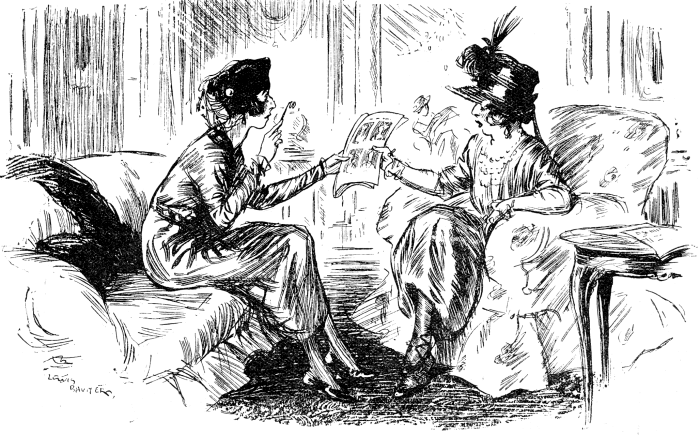
Aggrieved Profiteeress (studying photographs of the Peerage). "Well, I don’t see as they’ve any call to look that ’aughty. Like as not me an’ you’d be wearin’ coronets this minute if all our ancestors ’adn’t a-been cut off in the Wars of the Roses, or somethink."
WORKING FOR PEACE.
(Extracts from the Diary of Mr. John Robert Boffkins, Trade Union Leader.)
Monday.—Rose with a heart over-flowing with love towards my fellow-men. Industrial strife must cease. Strikes are a barbarous and futile method of redressing wrong. Rather think that an increase in wages of two shillings a day would appeal to our members. Must inquire.
Tuesday.—Have confirmed my opinion that a two-shillings’ increase would appeal to our members. They all seem enthusiastic over the suggestion. They appear to be under the impression that the idea is their own. It is not. It is mine. If it materialises I shall be most popular. But I am all for peace. A strike is out of the question. I shall spare no effort to prevent one.
Wednesday.—Presented formal demand to employers to-day. Told our members they must be firm to the bitter end. The two-shillings’ increase is their strict due, and, if we present a united front, the grasping capitalist will be brought to his knees. Am working night and day for peace.
Thursday.—Pointed out to the employers that a strike is inevitable unless they give way. We can make no concession. My whole energies are concentrated on preventing a strike. Told our members that unless they remain firm the employers will crush them. A strike would be a national calamity and might spell ruin to the country.
Friday.—The possibility of a strike looms larger. Can nothing be done to prevent it? Informed the employers that we declined to abate one iota of our claim. "All or nothing" is our motto. Also refused to go to arbitration. Warned the employers that a strike means starvation for women and children. The prospect appals me.
Saturday.—The employers, who seem to be determined on a strike, have offered the men two shillings if they will consider the question of working five days a week instead of four. We refused their offer and demanded that our claim should be conceded unconditionally by noon, failing which our members would cease work.
Later.—The strike has commenced. Heaven knows that I did everything to prevent it which human being could do. The capitalists seem to have made up their minds to force civil war and all its horrors upon the country. The spectacle of little children starving causes me acute distress.
A GUIDE TO GREATNESS.
[Mr. Jacob Epstein maintains in The Daily Mail that a man to be a creative genius must lead an orderly domesticated life.]
I courted the Muse as a stripling, Immured in a Bloomsbury flat, And yearned for the kudos of Kipling For fees that were frequent and fat; But editors, far from discerning The worth of the pearls that I placed At their feet, had a way of returning The same with indelicate haste. But, espousing, a year or two later, The sweetest and neatest of wives, I found, after peeling a tater Or imparting a polish to knives, I could scribble with frenzy and passion, That the breaking of coal would inspire, In a truly remarkable fashion, My soul with celestial fire. Serenity reigns in the household; I’ve cancelled my grudge against Fate; My lyrical efforts are now sold At a simply phenomenal rate; And, whether I’m laying the lino Or bathing the babes, I regard The job as a cushy one: I know The way to succeed as a bard.
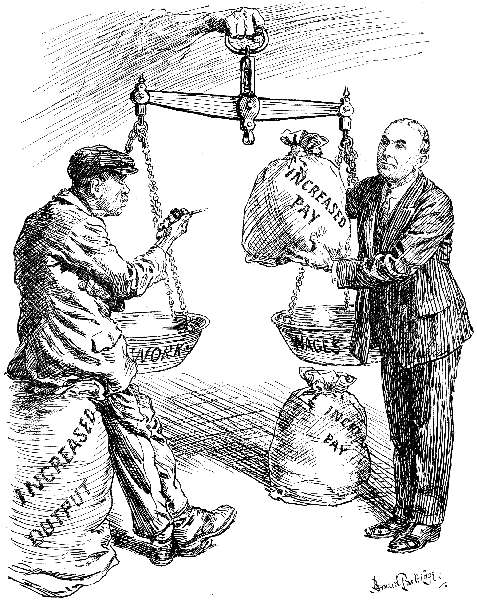
THE SCALES OF JUSTICE.
Sir Robert Horne. "I WANT TO KEEP THE BALANCE. NOW THEN, BOTH TOGETHER."
The Miner. "NO. YOU BEGIN—AND THEN PERHAPS I’LL THINK ABOUT IT."
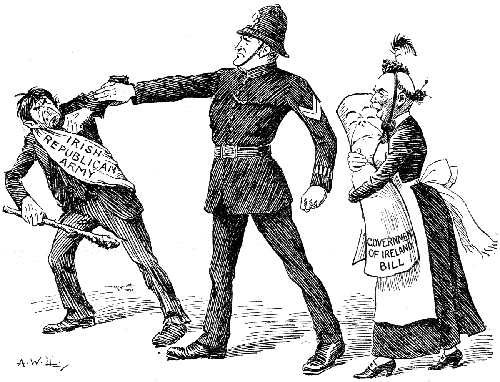
P. C. Greenwood. "Arrah! Get out wid yez and let the lady pass."