Volume 159 — THE KORBAN BATH.
Reading edition
[Korban—"It is a gift"—Hebrew (or some such language).]
With some reluctance I return to the subject of baths. I went into the matter of bathrooms pretty carefully a few months ago, but since I have been in this hotel I see that there are one or two aspects of hotel bathing which still require attention.
To begin with, there is the question of the Korban or free bath. It is, of course, a scandal that a bath should be an extra, and an eighteen-penny one at that. After all, what is the bathroom for? We are not charged extra for smoking in the smoking-room or drawing in the drawing-room; why should we be bled for bathing in the bathroom? At the same time this practice does provide the visitor with the wholesome sport of Korban bathing. The object of the game is, of course, to have as many baths as possible which are not put down in your bill; and many are the stratagems which are employed.
The true sportsman attempts the feat just before dinner, because at that time there are sentries posted in every corridor. Ostensibly they are maids waiting to assist any lady who has a crisis while dressing, but no real pretence is made that they are there for any other purpose than to charge you for as many baths as possible. On my corridor there is a post of no fewer than three sentries, and it is extremely difficult to evade them. The only thing to do is to get to know three nice ladies on the same floor and arrange for them to have a dressing crisis simultaneously and go on having it for about a quarter-of-an-hour.
This needs a good deal of organisation. However smoothly the operation begins, one of the dressing crises nearly always collapses too soon, and the sentry catches you on your return journey.
For the lady visitor the problem is comparatively simple. I should mention that it is a perfectly legitimate manœuvre to get your bath put down to somebody else if you can do it; and the crack lady-player usually wraps herself in an unobtrusive bath-wrap, shrouds her head, modestly conceals her face, slips into a friend's room to borrow some Crème-Limon and, after an interval, rushes noisily out of the friend's room to her bath, which, with any luck, is charged to her friend's account.
The beginner at the game contents himself with less complicated ruses. Sometimes he has his bath late at night, when the sentries have been taken off; but, as the lights go out en masse at eleven, even this operation has to be carefully timed. There is nothing much gloomier than a bath by candle-light, except perhaps a bath in the dark. Hundreds, however, of both sorts are endured in this hotel.
The more brazen or the more timid simply walk into the bathroom fully dressed during the day, carrying a number of dirty golf-balls in their hands, and towels in their pockets and sponges up their sleeves, and issue later fully dressed with clean white golf-balls in their hands. It is generally thought, however, that this device is just a little—I mean it's not exactly—you know what I mean.
The Korban Bath Rules will probably remain unwritten for many a day, but I earnestly hope that before next summer the traditions and etiquette of bath-warfare as between individual hotel-visitors will be codified and issued in an intelligible form. At the moment the most extraordinary confusion prevails, and no one can tell whether any particular stratagem will be hailed with applause as a bold and legitimate operation of war or universally condemned as a barefaced piece of bath-hoggery. Recently, for example, an extremely courteous, not to say gallant, old gentleman was severely lectured by a lady for digging himself in on the mat and maintaining his position there till she emerged. She stated with, I think, considerable force that she had passed the age when a lady likes to be seen coming out of a bathroom with disordered locks; she also said that he was ruining her chance of a Korban bath by drawing attention to the fact that there was somebody inside.
He replied with equal force that, whenever he considerately withdrew from the mat in order to let a lady escape unseen, some less scrupulous combatant (usually one of his own daughters) immediately rushed the position, and he was not going to be had in that way again, though as a matter of fact, while they were arguing the matter out, somebody actually did this, so he was.
Now what is the way out of this dilemma? The only solution I see is the Sponge System, by which every competitor puts down a sponge, as one puts down a ball at the first tee. In this way definite claims can be staked out in rotation without congestion of the avenues of approach. I hope this system will be generally adopted next summer and, if it is used in conjunction with my Progress Indicator (which shows by a moving needle what stage the person bathing has reached), it ought to work very smoothly. But there must be no hanky-panky, no sharp practice with caddies; every sponge must be put down by one of the players in person. And there must be none of that regrettable collusion between husband and wife which has brought such discredit on the present system.
There was a very bad case of this the other day. A certain wife used to entrench herself in the bathroom early and remain in it till her husband—a heavy and persistent sleeper—arrived. When you rattled angrily at the door-knob she said very sharply, "Who is that?"—in itself a sufficiently disturbing thing. Even in the present days of shamelessness and crime there are few men who care to confess openly that they have angrily rattled at the bathroom door. If you said sheepishly, "It is Smith" or "Thompson" or "Lord Bumble," a heavy silence fell, broken only by those gentle watery sounds which it is so maddening to hear from without. When her husband arrived and answered the challenge with "It is I, Arthur," sounds of feverish activity were heard within, and a new bath was immediately turned on.
Casting all scruples to the winds, seven desperate men rehearsed the password, "It is I, Arthur;" seven desperate men presented themselves in a single morning and murmured lovingly, "It is I, Arthur." None of them had a bath. Seven times the good lady opened the door and beheld Smith or Thompson or Lord Rumble or nobody. And seven times she bolted back into the burrow again. She remained undefeated. Her husband got his bath.
I wonder what devilry she would be up to under the Sponge System.
A. P. H.
A Novelty from the Past.
"Antique, over a hundred years old, oak sideboard, brand new ... Apply after 6.30."
Evening News.
Surely after this candour there is no help to be got out of the twilight hour.
"Mr. Robert ——, who is now manager, entered his late employer's service three or four months after he commenced, and remained with him until he gave up."
Local Paper.
"They have their exits and their entrances"—the former in this case being the more satisfactory.
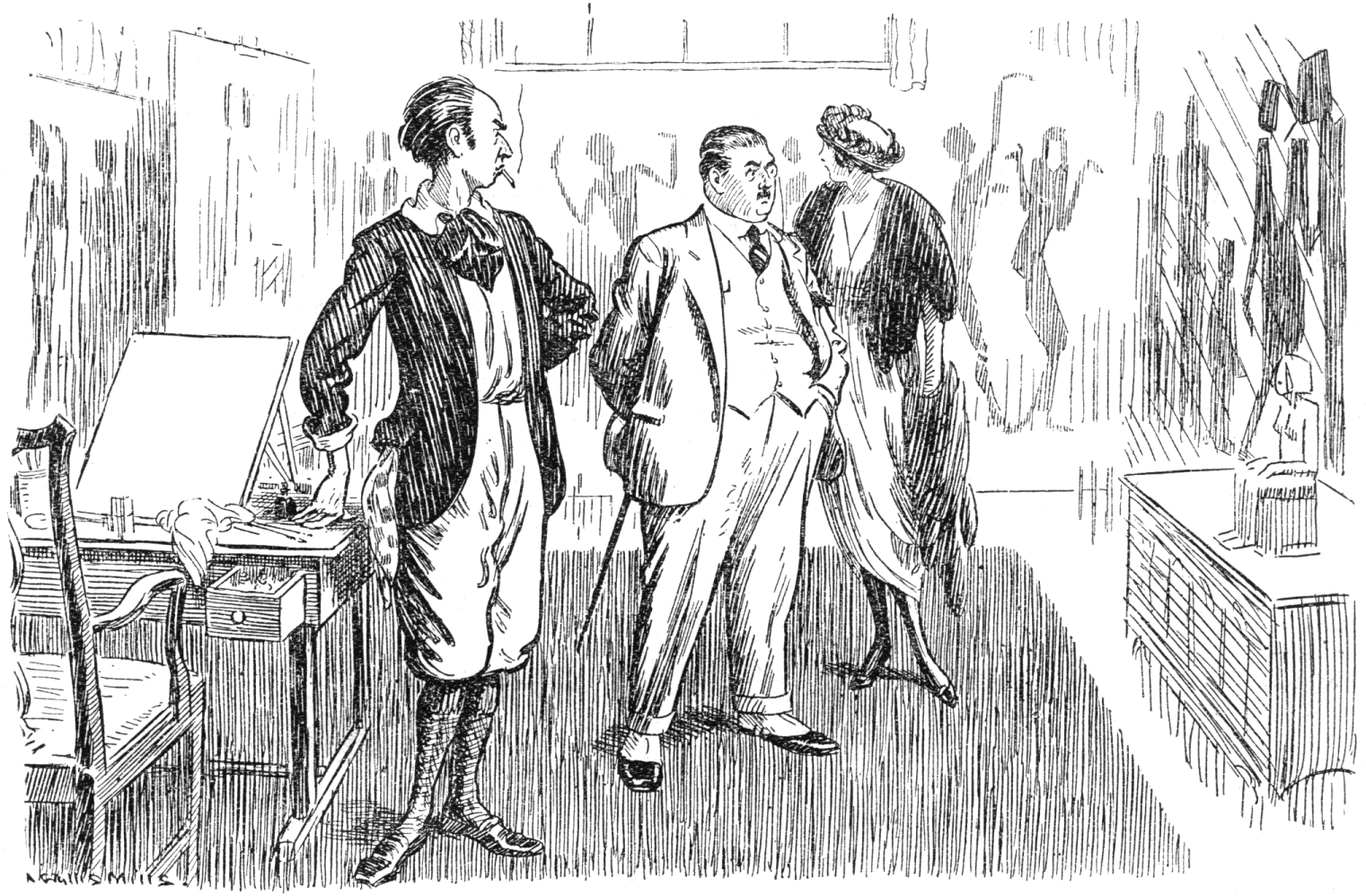
Intending Purchaser (to Artist, who is selling his house.)"Did you put those figures on the walls?"
Artist (modestly, though regarding them as a strong asset.) "Oh, yes—I—"
Intending Purchaser. "Well, they don't really matter. A coat of whitewash would soon put that right."
WHEN AND IF.
(It is rumoured that Mr. Balfour is shortly going to the House of Lords.)
When Balfour goes to the Lords— For the Upper Chamber's adorning— The Lower House, if it has any nous, Will have solid reason for mourning; For he has no axes to grind; His strategy injures no man, And his keen sword play in the thick of the fray Is a joy to friend and foeman. When Balfour goes to the Lords, To strengthen that gilded muster, 'Twill be sad and strange if he has to change The name he has crowned with lustre; For already there's "B. of B.," A baron of old creation; And Whittingehame is an uncouth name For daily pronunciation. If Balfour goes to the Lords, Will the atmosphere, I wonder, With the placid balm of its dreamful calm Bring his nimble spirit under? Or will he act on the Peers Like an intellectual cat-fish, Or startle their sleep with the flying leap Of a Caribbean bat-fish? If Balfour goes to the Lords— But can the Commons spare him? Besides I'm sure that a coronet's lure Is the very last thing to ensnare him; And I'd rather see him undecked With the gauds that merely glister, In the selfsame box with Pitt and Fox And Gladstone—a simple Mister. Still if he goes to the Lords, Whatever, his style and title, For the part he has played in his country's aid 'Twill be but a poor requital; For he never once lost his nerve When the outlook was most alarming, And always remained, with shield unstained, Prince Arthur, the good Prince Charming.
"Mrs. Hawke would be glad to employ a Wren for domestic work."
Advt. in Daily Paper.
Will she have to "live in"?
"If it be true, as Shelley said, that 'a thing of beauty is a joy for ever,' the good people of Roydon are to be congratulated on the new bridge over the River Stort."
Local Paper.
But, supposing Keats, for instance, said it, will that make any difference?
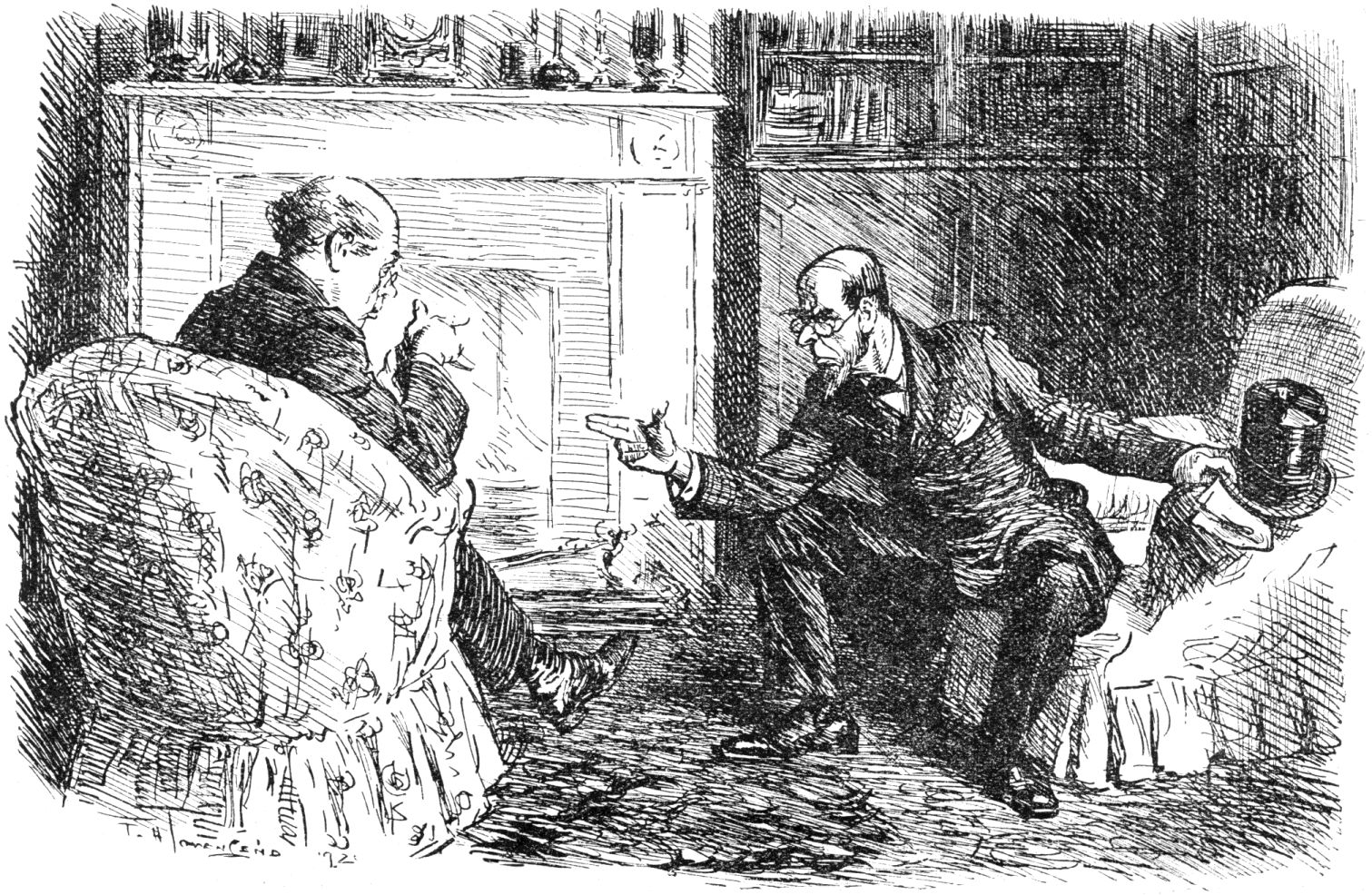
Enlightened Minister. "I canna understand your objection to dancing, Mr. McTavish. We have biblical authority for it. David himself danced."
Elder. "Ay, but no wi' a pairtner."