Volume 159 — PRISCILLA PAINTS.
Reading edition
"There was a lot of men in the boat," said Priscilla from behind the table, where she sat daubing with little energetic grunts.
"Oh, there were, were there?" I answered from behind The Times.
Confident of arousing my enthusiasm in the end, she continued to issue tantalising bulletins about the progress of the great work.
"It was an all-colour boat," she told me, "purple and yellow and green."
"A very nice kind of boat too," I agreed.
"And the biggest man of all hadn't got any body at all."
I suggested weakly that perhaps the biggest man of all had left his body behind on the table at home. The suggestion was scorned.
"No, he hadn't never had any body at all, this man," she replied. And then, as my interest seemed to be flagging again, "They all had very rosy faces; and do you know why they had?"
"I don't, I'm sure."
"Because they'd eaten up all their greens."
Vanquished at last, I went over to visit the eupeptic voyagers. Seven in all, they stood in their bright boat on a blue sea beneath a round and burning sun. Their legs were long and thin, their bodies globular (all save one), and their faces large. They were dressed apparently in light pink doublets and hose, and on his head each wore a huge purple turban the shape of a cottage loaf, surmounted by a ragged plume. They varied greatly in stature, but their countenances were all fixed in the same unmeaning stare. Take it all in all, it was an eerie and terrible scene.
"I don't quite see how the boat moves along, Priscilla," I said; "it hasn't any oars or sail."
It was a tactless remark and the artist made no reply. I did my best to cover my blunder.
"I expect the wind blew very hard on their feathers," I said, "and that drove them along."
"What colour is the wind?" inquired Priscilla.
She had me there. I confessed that I did not know.
"It was a brown wind," she decided, impatient at my lack of resource, and slapped a wet typhoon of madder on the page. There was no more doubt about the wind.
"And is the picture finished now?" I asked her.
"No, it isn't finished. I haven't drawn the pookin yet."
The pookin is a confusion in the mind of Priscilla between a pelican and a toucan, because she saw them both for the first time on the same day. In this case it consisted of an indigo splodge and a long red bar cutting right through the brown wind and penetrating deeply into the yellow sun.
"It had a very long beak," observed Priscilla.
"It had," I agreed.
I am no stickler for commonplace colours or conventional shapes in a work of art, but I do like things to be recognisable; to know, for instance, when a thing is meant to be a man and when it is meant to be a boat, and when it is meant to be a pookin and when it is meant to be a sun. The art of Priscilla seems to me to satisfy this test much better than that of many of our modern maestri. Strictly representational it may not be, but there are none of your whorls and cylinders and angles and what nots.
But I also insist that a work of art should appeal to the imagination as well as to the eye, and there seemed to me details about this picture that needed clearing up.
"Where were these men going to, Priscilla?" I asked.
"They was going to Wurvin," she answered in the tone of a mother who instructs her child. "And what do you think they was going to do there?"
"I don't know."
"They was going to see Auntie Isabel."
"And what did they do then?"
"They had dinner," she cried enthusiastically. "And do you know what they did after dinner?"
"I don't."
"They went on the Front to see the fire-escape."
It seemed to me now that the conception was mellow, rounded and complete. It had all the haunting mystery and romance of the sea about it. It was reminiscent of the Ancient Mariner. It savoured of the books of Mr. Conrad. It reminded me not a little of those strange visitations which come to quiet watering-places in the novels of Mr. H.G. Wells. When I thought of those seven men—one, alas, disembodied—so strangely attired yet so careful of elementary hygiene, driven by that fierce typhoon, with that bird of portent in the skies, arriving suddenly with the salt of their Odyssey upon their brows at the beach of the genteel and respectable Sussex town, and visiting a perhaps slightly perturbed Auntie Isabel, and afterwards the fire-escape, I felt that here was the glimpse of the wild exotic adventure for which the hearts of all of us yearn. It left the cinema standing. It beat the magazine story to a frazzle.
"And who is the picture for, Priscilla?" I asked, when I had thoroughly steeped myself in the atmosphere.
"It's for you," she said, presenting it with a motley-coloured hand; "it's for you to take to London town and not to drop it."
I was careful to do as I was told, because I have a friend who paints Expressionist pictures, and I wished to deliver it at his studio. It seems to me that Priscilla, half-unconsciously perhaps, is founding a new school of art which demands serious study. One might call it, I think, the Pookin School.
Evoe.
WHEN CHARL. COMES OVER.
It is said that Mr. Charles Chaplin, a prominent citizen of Los Angeles, Cal., has employed the greater part of the last few days in mopping his brow, sighing with relief and exclaiming "Gee!"
Mr. Chaplin declares that missing the boat for England recently was the narrowest escape from death he has ever enjoyed. But for having been thus providentially prevented from visiting his native land in the company of Miss Mary Pickford and Mr. Douglas Fairbanks (better known as "Mary" and "Doug." respectively) he would have come back to the dear homeland all unprepared for what would surely have happened to him no less than it happened to his illustrious colleagues in the film world.
Since his promised visit to our shores cannot long be delayed, he has already begun elaborate preparations for travelling in safety. He is growing a large beard and is learning to walk with his toes turned in. A number of his teeth will be blackened out during the whole of his European tour, and his hair will be kept well-ironed and cropped short.
He has engaged a complete staff of plain-clothes pugilists to travel with him everywhere and to stand on guard outside his bathroom door. They will also surround him during meal-times to prevent admirers from grabbing his food to hand down to their children as heirlooms.
He is being measured for a complete outfit of holeproof clothing, and his motor will be a Ford of seventeen thicknesses, with armoured steel windows, and fitted with first-aid accessories, including liniment, restoratives and raw steak. His entourage will include a day doctor, a night doctor, a leading New York surgeon and a squad of stretcher-bearers.
It has been suggested to him that a further precaution would be not to advise the Press of the date of his arrival; but that he considers would be carrying his safety-first measures to a foolish extreme.
STOP-PRESS NEWS.
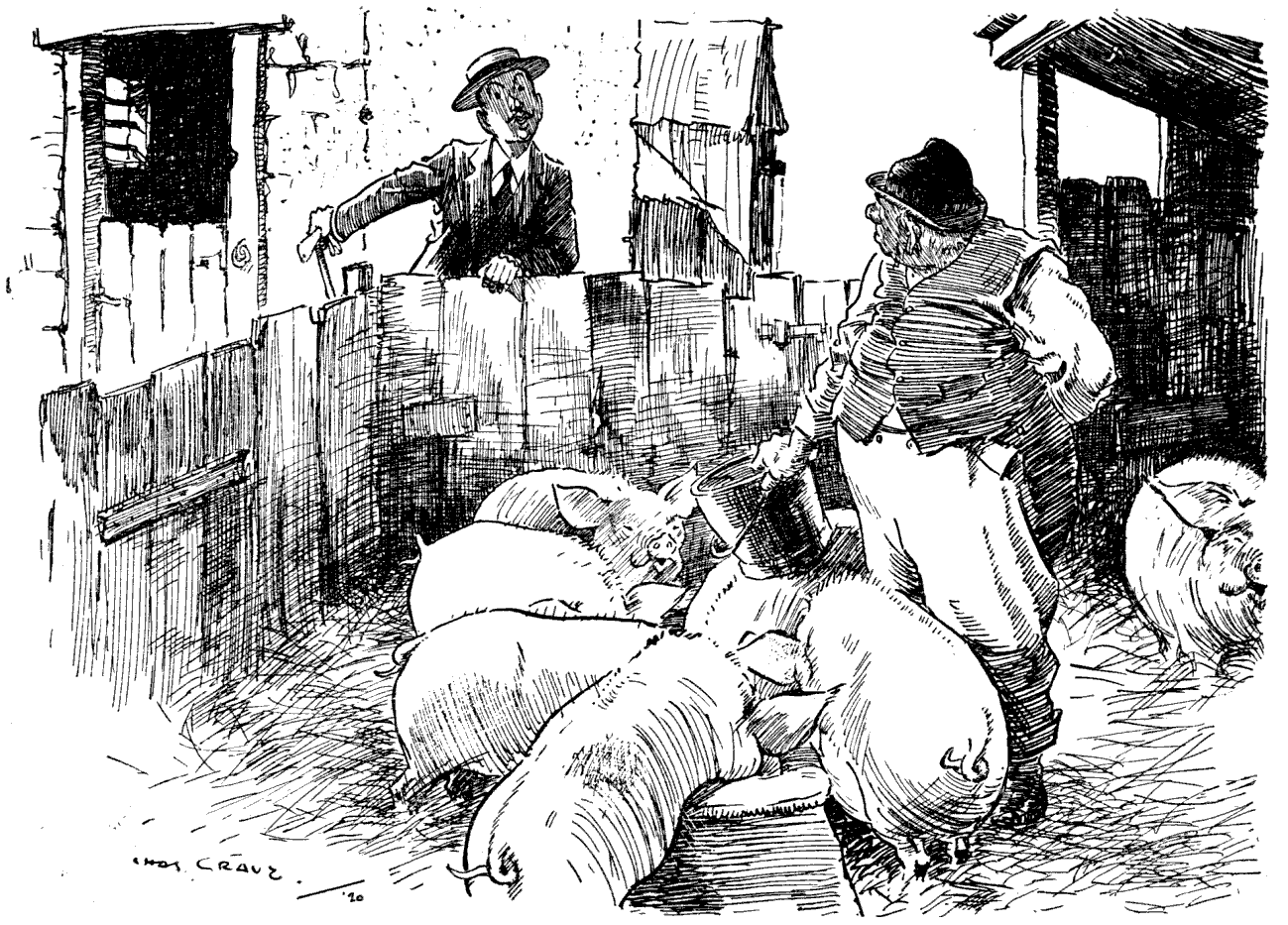
Observant Visitor. "I say—excuse me, but your hat is knocked in."
Farm Hand. "Whoi, I've knowed that for the last seven year."
A TRAGEDY OF REACTION.
It was a super-poet of the neo-Georgian kind Whose fantasies transcended the simple bourgeois mind, And by their frank transgression of all the ancient rules Were not exactly suited for use in infant schools. But, holding that no rebel should shrink from fratricide, His gifted brother-Georgians he suddenly defied, And in a manifesto extremely clear and terse Announced his firm intention of giving up free verse. The range of his reaction may readily be guessed When I mention that for Browning his devotion he confessed, Enthroned above the Sitwells the artless Muse of "Bab," And said that Marinetti was not as good as Crabbe. At first the manifesto was treated as a joke, A boyish ebullition that soon would end in smoke; But when he took to writing in strict and fluent rhyme His family decided to extirpate the crime. Two scientific doctors declared he was insane, But likely under treatment his reason to regain; So he's now in an asylum, where he listens at his meals To a gramophone recital of the choicest bits from Wheels.
The Return to Woad.
"The bride's mother was handsomely attired in heliotrope stain."—Canadian Paper.