Volume 158 — A NOTE TO NATURE,
Reading edition
accounting for my previous silence in an unusually temperate March and also presenting an ultimatum.
Ye great brown hares, grown madder through the Spring! Ye birds that utilise your tiny throttles To make the archways of the forest ring Or go about your easy house-hunting! Ye toads! ye axolotls! Ye happy blighters all, that squeal and squat And fly and browse where'er the mood entices, Noting in every hedge or woodland grot The swelling surge of sap, but noting not The rise in current prices! But chiefly you, ye birds, whose jocund note (Linnets and larks and jays and red-billed ousels) Oft in those happier springtides now remote Caused me to catch the lyre and clear my throat After some coy refusals! Ay, and would cause me now—I have such bliss Seeing the star-set vale, the pearls, the agates Sown on the wintry boughs by Flora's kiss— Only the trouble in my case is this, I do not feed on maggots. Could I but share your diet cheap and rude, Your simple ways in trees and copses lurking; But no, I need a pipe and lots of food, A comfortable chair on which to brood— Silence! the bard is working. Could I but know that freedom from all care That comes, I say, from gratis sets of suitings And homes that need not premium nor repair Except with sticks and mud and moss and hair, My! there would be some flutings. So and so only would the ivory rod Stir the wild strings once more to exaltation; So and so only the impetuous god Pound in my bosom and produce that odd Tum-tiddly-um sensation. And often as I heard the throstles vamp, Pouring their liquid notes like golden syrup, Out would I go and round the garden tramp, Wearing goloshes if the day were damp, And imitate their chirrup. Or, bowling peacefully upon my bike, Well breakfasted, by no distractions flustered, Pause near a leafy copse or brambled dyke, And answer song for song the black-backed shrike, The curlew and the bustard. But now—ah, why prolong the dreadful strain?— Limply my hand the unstrung harp relaxes; The dear old days will not come back again Whatever Mr. Austen Chamberlain Does with the nation's taxes. Lambs, buds, leap up; the lark to heaven climbs; Bread does the same; the price of baccy's brutal; And save (I do not note it in The Times) They make exemptions for evolving rhymes, Dashed if I mean to tootle!
Evoe.
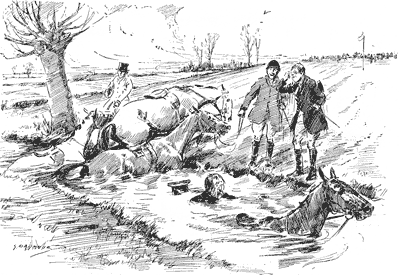
Sportsman (just emerged from the brook). "Four in, did you say? Dash it all—just my luck. Got my glasses all mud and can't see ther fun."
THE METHODS OF GENIUS.
(By our Special Literary Parasite.)
The public already know something of the painful difficulties under which novelists labour at the present moment owing to the paper shortage and the enhanced cost of book production. But "the economic consequences of the Peace" by no means exhaust the handicaps of the conscientious and sensitive novelist. We are glad therefore to note the efforts of The Daily Graphic to enlist the sympathy of the public on behalf of this sorely tried and meritorious class. Our contemporary tells us, for example, of one momentous writer who was reduced to dictating blindfold "because the facial peculiarities of first one and then another amanuensis" upset her equanimity. Then there is the tragic story of Mr. R.L. Hitchens, who, being engaged to write an article against time, sent out for a stenographer, who on arrival proved to be a man with a large black beard of so sinister an aspect that Mr. Hichins was forced to dismiss him and write the article in his own hand. Yet Mr. Hichens is not easily put off, for we learn that he finds he works best in big hotels and not, as we might have guessed, in the sequestered tranquillity of a minaret.
To some writers solitude is the true school of genius. Yet Sir Lewis Morris found some of his happiest thoughts come to him while travelling in the Underground, while Mr. W.B. Yeats records a similar experience as the result of a journey on the top of a tram-car. Your advanced modernists, with Marinetti at their head, find their best stimulus to creative effort in the clang and clatter of machinery. Per contra, to return to The Daily Graphic, Mrs. C.N. Williamson must have pretty things to look at "in business hours." But the happiest of all our authors is Madame Albanesi, who "finds her brain-spur in a blank sheet of paper, and not the ghost of an idea what she is going to write about." Less fortunate writers labour assiduously only to leave the minds of their readers a blank, without the ghost of an idea of what the author has been writing about.
It is a pity that Mr. W.L. George, in his interesting survey of modern writers of fiction in the English Review, has told us nothing about the methods of the "Neo-Victorians" and "Semi-Victorians," the "Edwardians" and "belated Edwardians," and the "Georgians" and "Neo-Georgians." With all these classes he deals faithfully. But his criticism is purely literary. He fails to tell us the things that every reader wants to know. It is all very well to say that the neo-Georgians "paint in ink," but he ought to have mentioned whether it is green or red. Does Miss Dorothy Richardson dictate to the sound of trumpets, garbed in crimson trouserloons? Does Mr. Arnold Bennett cantillate his "copy" into the horn of a graphophone or use a motor-stylus? Does Mr. Siegried Sassoon beat his breast with one hand while he plays the loud bassoon with the other? Does Mr. Alec Waugh use sermon-paper or foolscap? Does Mr. Aldous Huxley keep a tame gorilla? These are the really illuminating details that we hunger for. Without them it is impossible to appreciate the artistry of our young Masters. Mr. W.L. George has given us a glimpse of the working of their brains; let him now reveal to us the secrets of their workshops.
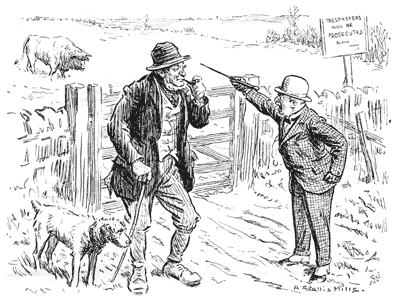
"There's that dashed bull of yours in my field again! One of thses days I'll—I'll—wring its confounded neck!"