Volume 156 — BACK TO THE CAM.
Reading edition
College head-porters as a class assuredly rank amongst the dignified things of the earth. One may admire the martial splendour of a Brigadier-General, and it is not to be denied that Rear-Admirals have a certain something about them which excites both awe and delight, but they are never quite the same thing as a college head-porter. There may be weak spots in the profession, and indeed in one or two of the less self-respecting colleges the head-porters scarcely rise above the level of the Dons; but these are distinctly exceptional. As a class they stand, as I said, amongst the dignified things of life.
Parsons is our head-porter, and perhaps he is the sublimest of them all. Freshmen raise their squares to him, and Oriental students can rarely bring themselves to enter the porter's lodge during their first term without previously removing their shoes. Few except fourth-year men have the temerity to address him as "Parsons" to his face; it seems such an awful thing to do, like keeping a chapel in bedroom slippers or walking arm-in-arm with a Blue. You feel awkward about it.
In order to give you a shadowy idea of Parsons' majesty I must hark back for a moment to a certain day in November, 1914, when Biffin and I, after a brief dalliance with the C.U.O.T.C., left Cambridge to join our regiments. It was pouring with rain, but we were elated in spirit; we had our commissions; things were going to happen; we felt almost in case to jostle a constable. As we passed out through the porter's lodge Parsons sat at his table, imperturbable and austere, his eagle eyes flashing from beneath his bushy brows and his venerable beard sweeping his breast. At that moment Biffin, overwrought with excitement, forgot himself.
"Cheerio, Parsons, old cracker," he shouted wildly; "how's the weather suit your whiskers?"
Then, realising the enormity of his act, he turned suddenly pale, dashed out into the road and dived panic-stricken into the waiting taxi. We made good our escape.
Those seven stars represent the War. I take a childlike pleasure in dismissing Armageddon in this brusque fashion. If you have had anything at all to do with it you will understand.
Having been demobilised at a relatively early date, out of respect for our pivotal intellects, Biffin and I were bound for Cambridge, to take up the threads of learning where WILHELM had snapped them some years previously. Both of us have changed a little. Biffin has been burnt brown by the suns of Egypt, while I wear a small souvenir of Flanders on my upper lip.
"I wonder if Parsons will remember us," said Biffin as the train thundered into the station.
"Of course he will," I replied. "Parsons never forgets anything."
"I doubt it," said Biffin.
As our taxi drew up before the portals of Alma Mater the first person we saw, standing on the steps of the porter's lodge, was Parsons. He was as Olympian as ever. As soon as you saw him you felt that, though they might abolish compulsory Greek or introduce a Finance Tripos, they would never be able to subdue the ancient spirit of the University. A single glimpse of Parsons, standing erect in all his traditional glory, showed up people like Mr. H.G. WELLS in their true perspective in a moment. It did one good.
We approached him. "Good afternoon, Parsons," we said, with a brave attempt at sang-froid.
Parsons regarded us. "Good afternoon, Mr. Jones," he said to me. Then his eyes rested on Biffin. "Good afternoon, Sir," he said.
Biffin nudged me, "He's forgotten me," he whispered. Parsons continued to subject him to an implacable scrutiny. At length he spoke again. "As to your question, Mr. Biffin, which I have had no earlier opportunity of answering, I may say that what you were pleased to allude to as my whiskers—a colloquialism I do not myself employ—are entirely impervious to and unaffected by any climatic variations whatsoever. Your rooms, Sir, are on Staircase B."
True Hospitality.
"Lecture by Rev. W. ——. 'The Dragon, The Beast and The False Prophet.' All welcome."—Scotsman.
"Scotch reels, corner dances, and waltzes were favourites at the Masons' ball on Tuesday evening. Dancers fought shy of the fog-trot which has proved so popular at other dances."—Scots Paper.
Perhaps they were afraid of missing their steps in the dark.
"Detroit to-day completed its first year as the world's largest 'dry' city. The city has prospered during the past year both financially and industrially. Murders, suicides, embezzlements, assaults, robberies and drunkenness were reduced by half."—Daily Mail.
The record of drunkenness seems still rather high for a teetotal city.
A CAUTIOUS DICTATOR.
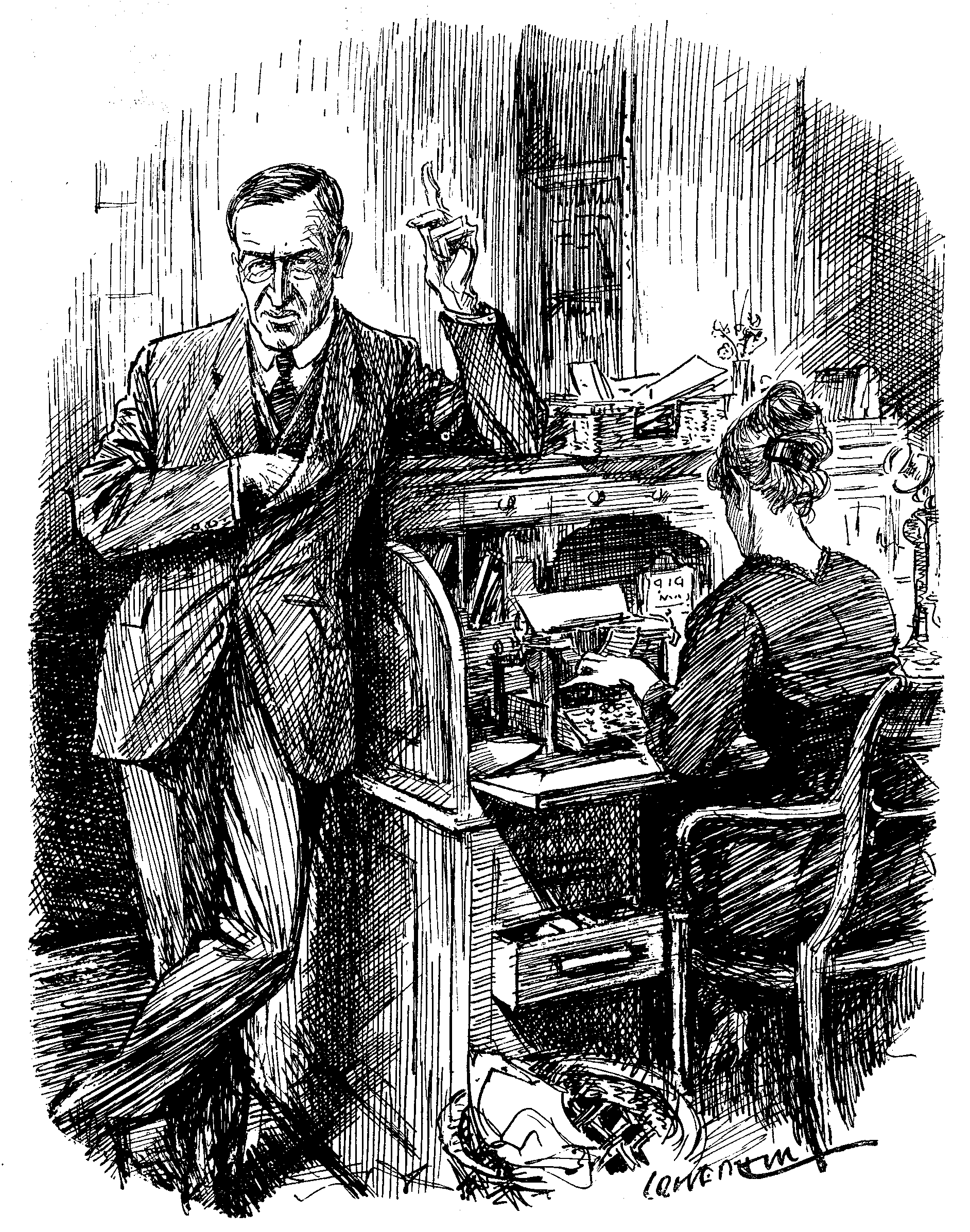
PRESIDENT WILSON (dictating a message to the American Nation). "AT LAST WE MAY FAIRLY SAY THAT THE DOVE OF PEACE HAS SIGHTED DRY LAND." (Pauses). "ONE MOMENT—I'M NOT QUITE SURE THEY'LL LIKE THAT WORD 'DRY.'"
[The New York World asserts that President WILSON has promised to set aside the Prohibition Law if he finds that popular opinion is opposed to it.]
MR. WILL JONES, M.C., D.C.M., AND MR. RONALD MONTMORENCY (TOTAL EXEMPTION 1917—WORK OF NATIONAL IMPORTANCE) AS THEY APPEAR IN THE LEADING PARTS OF THE MELODRAMA "IN HIS COUNTRY'S NEED." Reading from left to right: MR. MONTMORENCY, MR. JONES.
SAFETY FIRST.
The fact being now established to the satisfaction of the authorities that the public is composed almost exclusively of drivelling idiots, a campaign has been instituted for adding to the decorations of London by placarding the walls with hints on how to avoid various violent deaths.
We are surrounded now by blood-curdling photographs of people being run over by omnibuses or dribbled along the street by horses attached to brewers' drays, these illustrations being accompanied by explanatory notes as to the inevitable result of crossing roads with your eyes shut or your fingers in your ears and endeavouring to alight from moving omnibuses by means of the back somersault or the swallow dive. We are also implored to make quite sure, before alighting from a train, that it is really at a station.
As this admirable propaganda is only in its infancy, I submit the following additions to its collection of horrors, which may perhaps inspire others even cleverer than myself to evolve new methods of protecting the public from themselves.
TUBES.
A picture of a widow wringing her hands with grief, and under it this pungent hint: "This is the widow of a man who tried to light his cigarette on the 'live rail.'"
A picture of a man who has been cut in half, with, say, a crisp little couplet:—
"Here are two portions of Benjamin Yates Who scorned the request to 'stand clear of the gates.'"
A photograph of the interior of a hospital ward full of patients, with the following: "Interior of a ward in the Bakerdilly Hospital, exclusively for patients who stepped off the moving staircase with the wrong foot."
TRAINS.
A picture of a stately building standing in its own grounds with the description: "The N.S.E. & W. Railway Orphanage for children whose parents crossed the line by the track instead of the footbridge."
A picture of a decapitated body with the poignant comment:—
"Be warned by the ending Of Ferdinand Goschen Who leaned out of window While the train was in motion."
And perhaps a few general hints such as:—
(1) In stepping off an omnibus always alight feet first.
(2) In crossing crowded thoroughfares, proceed through the traffic, not under it.
(3) Before stepping from the pavement make quite sure that there is a road there, etc., etc.
Imagination, colour—that's all that's wanted, and if this propaganda is carried far enough the safety of the public will be assured, for either they really will try not to be killed while travelling or walking in the streets, or they will stay indoors altogether.
A Disciplinarian.
"SCHOOLMISTRESS'S RESIGNATION."
Miss —— will have the satisfaction of knowing that she has left her mark on those who have passed through her hands."—Provincial Paper.
"Closing scores in the professional golf match were Newman 14,835; Inman 13,343."—Provincial Paper.
This high scoring was due, we understand, to the large number of losing hazards which had to be negotiated.
"Aerial fights to and from towns on the coast are to be a feature of Hythe's holiday season."—Belfast Weekly News.
We are all in favour of popularising aviation, but we think this is over-doing it.
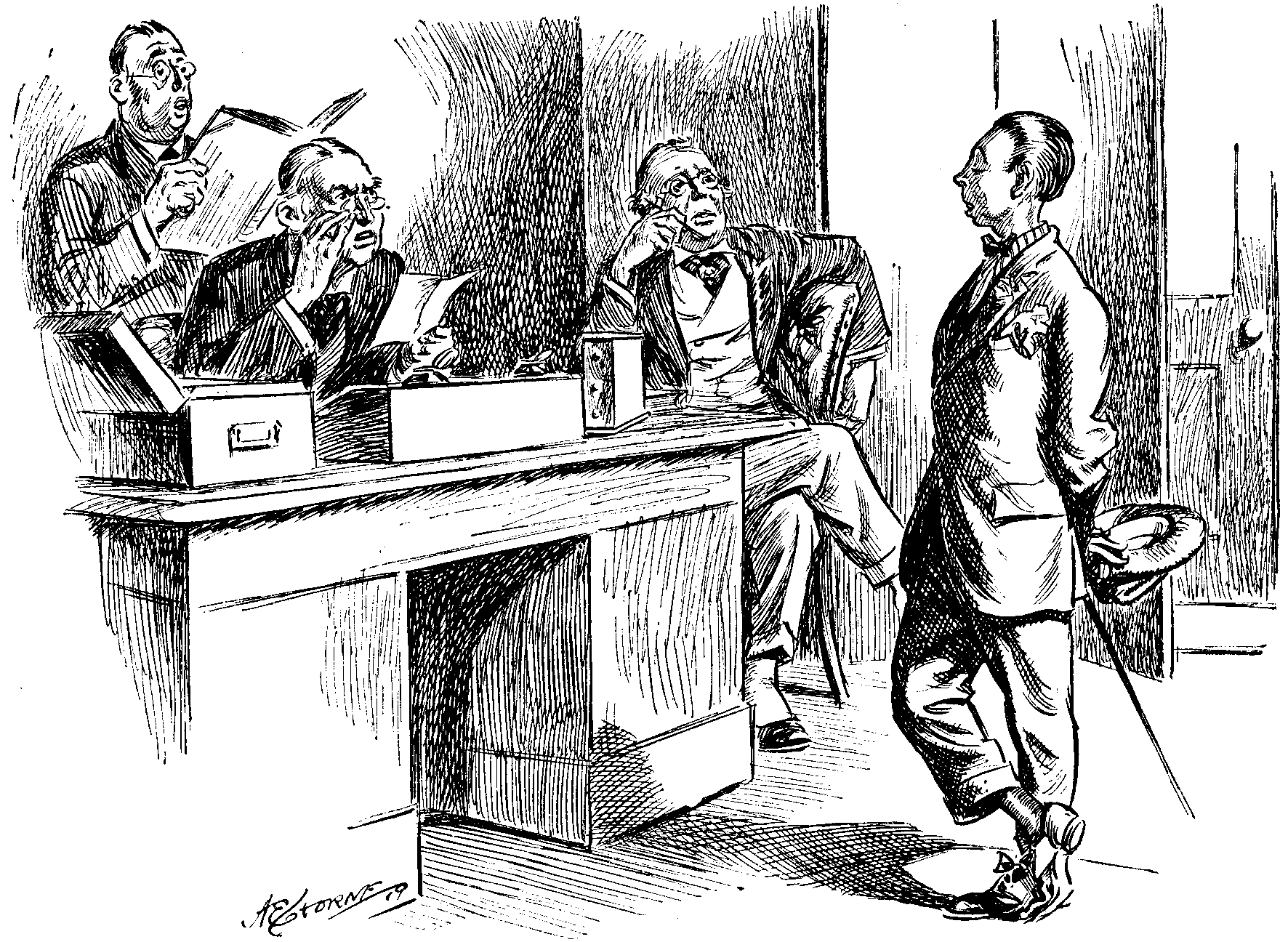
Director of old-established firm. "I HOPE YOU DON'T SMOKE?" The new "Boy." "NO—GIVEN IT UP. FIND IT 'PUFFS' ME FOR JAZZIN'."