Volume 156 — PUMPENHEIM.
Reading edition
When Adolf Hans Pumpenheim, farmer, was brought up for trial as a civil offender it is not too much to say that a shudder passed through the members of the Summary Court, which consisted of Major Blenkin and myself. This emotion was due not so much to the unprepossessing appearance of the prisoner as to the enormity of his offence.
He was charged upon two different counts: firstly, with being in illegal possession of two tins of corned beef and one cake of soap, the property of the British Government; secondly, with having offered a bribe of fifty marks to Second-Lieutenant Robinson in order to escape arrest.
The charge was translated to the prisoner by an interpreter, who in his turn appeared to feel the gravity of the occasion. He alluded with bated breath to the topic of corned beef; he slid, so to speak, over the soap; only in the mention of the fifty marks did his voice ring out confidently, as though righteous indignation had overcome the baser sentiment of pity. Pumpenheim listened in silence. When invited to plead Guilty or Not Guilty he made no reply.
Judges are only human. I cannot state that his innocence was presumed.
The evidence was brief. A corporal of foot police, after examining the articles produced in court, pronounced them to be indubitably two tins of corned beef and a cake of soap, and further declared that he had found them in the prisoner's house, no troops being at that time billeted upon him. Second-Lieutenant Robinson deposed that upon his arrival the prisoner had thrust a fifty-mark note into his hand, accompanying the action with gestures and grimaces suggestive of bribery.
Here we all looked at Pumpenheim. His features afforded no sign of intelligence or even of interest. For his particular benefit the evidence was translated. He was further invited to question the witnesses or to call testimony on his own behalf. To these offers he responded with a shrug indicating that he waived all rights.
The court was therefore cleared, and Major Blenkin and I proceeded to consider our verdict, with no other company than the dozen empty stools which had faced us during the trial, and which represented the inalienable right of the civil population to attend the court if they pleased. Custom forbids me to divulge the finding or the sentence. It will suffice to say that justice was tempered with mercy. We were about to readmit the prisoner, his escort and the imaginary public when my partner in the suppression of crime was struck by an idea.
"Look here," asked Major Blenkin, "what about the moral aspect?"
I hesitate to argue with Blenkin about moral questions, on which he speaks with authority. I therefore awaited his next remark.
"The moral aspect," Blenkin went on, "is most important. I intend to impress this fellow. I shall tell him that if he had been a French peasant and had offered a bribe to a German officer he would have been put against a wall and shot. Do you agree?"
I considered the proposition.
"No," I said, "I don't."
Blenkin threw me a suspicious glance. "Why not?" he asked.
"Too many assumptions," I said.
Blenkin bridled indignantly. It was on the tip of his tongue to charge me with being a pro-German. He controlled himself and rang a bell. "I shall hold to my own opinion," he remarked with some asperity.
The prisoner, his escort and the interpreter were marched in. Adolf Hans Pumpenheim created the customary diversion by turning to the right on the command, "Left turn," and the sergeant-major made the customary comments, undeterred by the prisoner's ignorance of English. The imaginary public filed in and occupied the vacant stools.
When this bustle had subsided, the finding and the sentence were read by Blenkin and duly translated by the interpreter. Pumpenheim was quite impassive, and maintained his composure throughout the small financial transaction which followed. He counted out his notes with an air of fatalism. Having obtained a receipt for the fine he made us a little bow and turned to leave the court.
"One moment," said Major Blenkin.
"Einen Augenblick," echoed the interpreter. Pumpenheim faced about and stood to attention.
Blenkin cleared his throat. "I will not dwell upon the moral aspect of your case," he said. The prisoner's features expressed neither relief nor surprise, but polite inquiry. Blenkin, slightly ruffled, enlarged upon the heinous nature of the crime and the leniency of the sentence. Finally he produced his masterpiece of comparison—the French peasant, the German officer, the attempted bribe, the execution. When the last grim lines of the imaginary history had been translated for him, Pumpenheim felt some observation on his part to be called for.
"So-o?" he said, "so-o?"
But I heard incredulity in his voice. Blenkin read it in his face. The prisoner did not believe a word of the tale. He was indifferent to the homily.
Blenkin, defeated, leaned back in his chair. "I give it up," he said. "You have a try at him."
I looked at Pumpenheim. His narrow eyes turned to me.
"If you had offered the money to a German officer," I said, and the interpreter repeated the words—"if you had offered the money to a German officer he—might—have—taken—it."
Slowly a look of comprehension crossed the face of Adolf Hans Pumpenheim. It was like sunrise upon his grey and stubbly countenance, where three days' growth of beard had thriven in the soil of the guard-room. He was not altogether happy, for he had been found guilty and had paid a fine. But in the course of this ceremony, which appeared to him mystical and obscure, he had encountered one familiar idea, one thought within his power of understanding. Rectitude was a stranger to him, but corruption an old friend: He was not abashed; rather, on the contrary, he was cheered and encouraged. I could see that his heart warmed to me in particular, and I believe that but for his respect for the Court he would have paid me the compliment of a wink.
"Let him go," said Blenkin; and the Court adjourned for lunch.
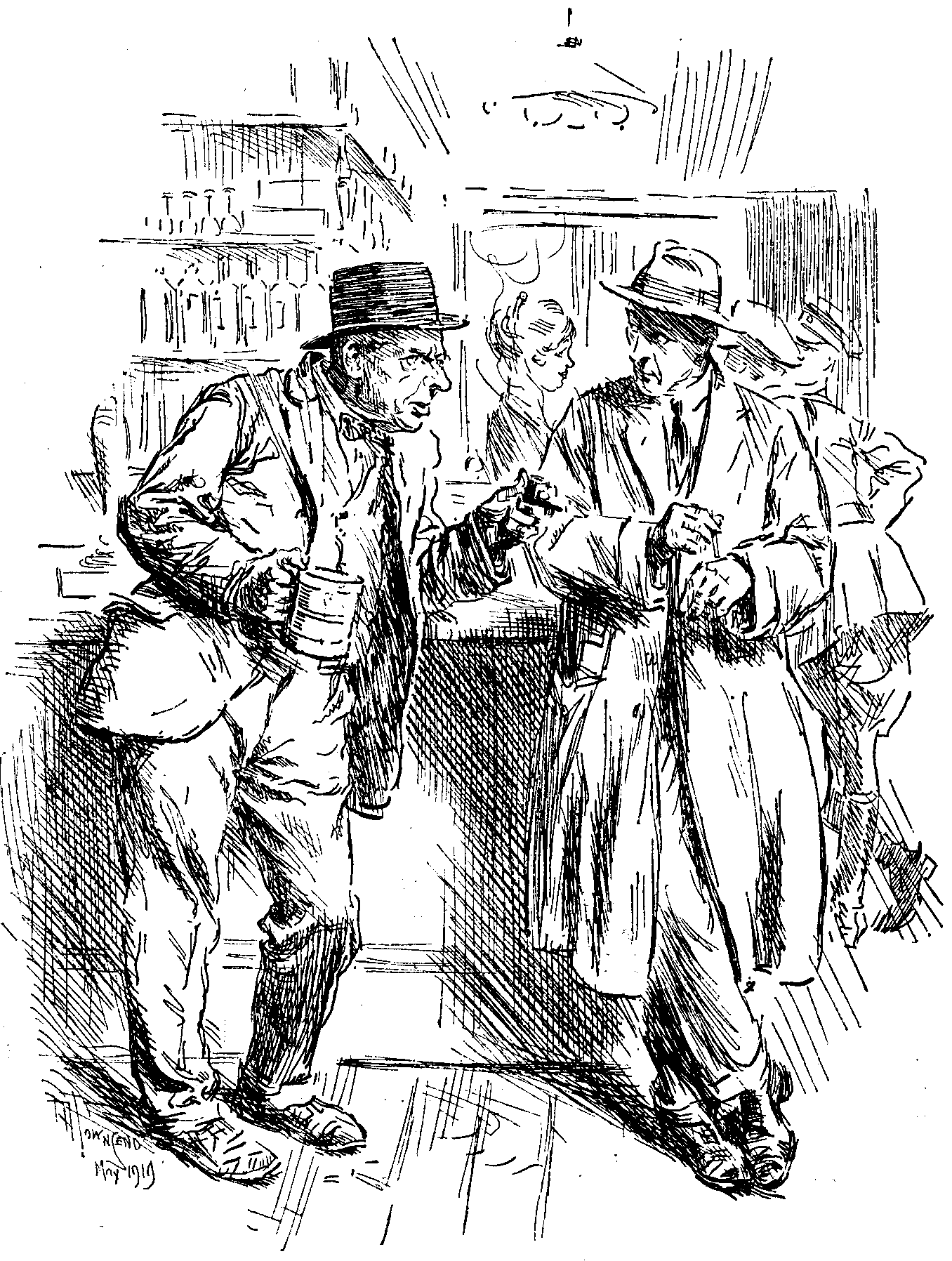
"SETTLED PEACE! I TELL YOU THERE'S NO SUCH THING. I BURIED THE HATCHET WITH MY STEP-MOTHER AFTER TEN YEARS, AND NEXT MORNING SHE WROTE, 'I'M GLAD YOU'VE SEEN THE ERROR OF YOUR WAYS.'"
"At Newcastle, this afternoon, the airmen, had a great reception. The Lord Mayor handed each a book of views of Newcastle and a box of cigarettes."—Pall Mall Gazette.
Who says England is not a land for heroes to live in?
The Editor regrets.
A few weeks ago there appeared in Punch, under the title "A Germless Eden," some verses sent in by an unknown contributor. The Editor is now informed that the original version of these lines was the work of Mr. ARTHUR GUITERMAN, of New York, who published them in 1915 with Messrs. HARPER AND BROTHERS in The Laughing Muse, a collection of his humorous verse. The Editor begs both author and publishers to accept his sincere regrets.
From a summing-up:—
"If the plaintiff was telling the truth, he had only himself to blame."—Provincial Paper.
If judges say this sort of thing, no wonder perjury is on the increase.
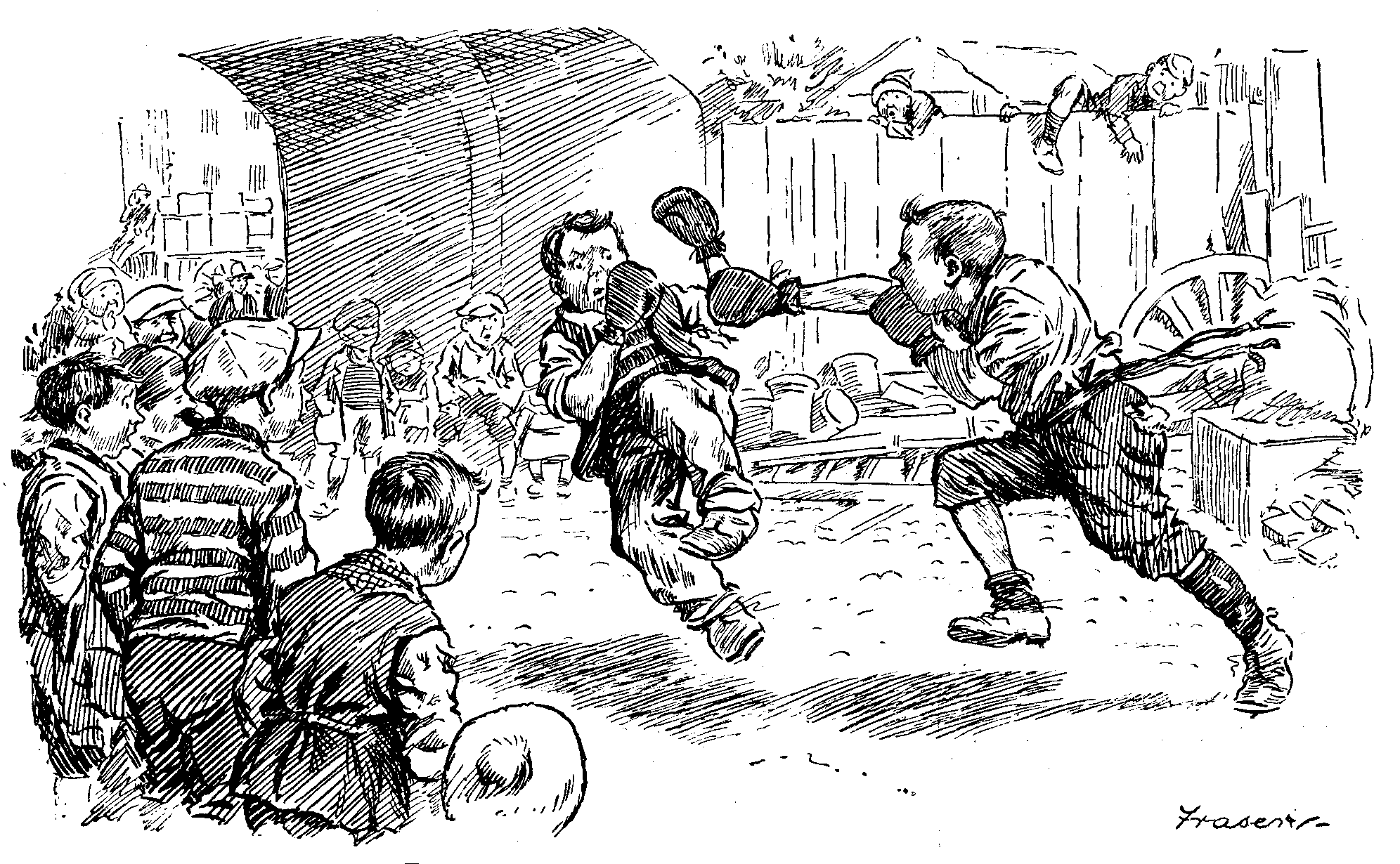
"'ERE, EASY ON A MINUTE; WE AIN'T SHOOK 'ANDS YET."
MÉLISANDE'S POINT OF VIEW.
"About rabies," said Angela.
"Well?" said I patiently.
"Well, about Mélisande," said Angela.
"What about Mélisande?" I replied.
"Oh, you know quite well what about Mélisande," said Angela; "about her and Peggy playing so much together. Is it quite wise, do you think? I've been bothering about it for some days now; cats are such queer things and a cat with rabies would be so dreadfully dangerous."
"There I quite agree with you," I answered meditatively. "Though I have rather excepted Mélisande from the general rule I have always considered a cat an exceedingly dangerous animal, and a cat with rabies is, of course, ten times worse; it simply oughtn't to be allowed."
"I felt sure you would agree with me," said Angela.
Mélisande is a staid creature of placid demeanour and generous proportions. It had never occurred to me hitherto to associate her with rabies, and I still felt that she herself would scoff at the idea.
We were gathered round the fire, my wife, my daughter and I; Angela seated on what is known, I believe, in upholstering circles as a humpty, while Peggy lay on her tummy on the floor, pencil in hand and a sheet of paper before her; she was chewing the pencil with the ruminating air of one who awaits inspiration. I myself occupied the armchair.
"You know," said Angela presently, "I think Mélisande has seemed worried about something the last few days. I do hope the poor dear isn't bothering about rabies. One so often hears of people actually producing a disease merely by thinking a lot about it. By the way, I'm told that one of the earliest manifestations of rabies is a desire to bite inanimate objects; if we see her doing that we shall know that the time has come to act."
At this juncture Mélisande entered the room through the open window.
Her manner exhibited a curious blend of dignity and caution; I could more readily have suspected my own mother of having rabies. She advanced slowly towards us till suddenly her eye lighted on Peggy, who still chewed her pencil awaiting inspiration.
Mélisande stopped as though she had been shot; I could only surmise that the sight of Peggy thus occupied had confirmed her darkest suspicions. With one wild shriek of terror she fled from the room.
THE NEGLECTED PROBLEM.
O dear and delectable journal that daily Appeasest my hungering mind With items recounted or gravely or gaily Of doings at Margate, Mayfair or Old Bailey, Or paragraphs rare and refined On "Who will the forthcoming cinema star be?" "What horse to support with your shirt for the Derby;" "How much will the next price of beer at the bar be?" "Are halibuts blind?" A question arises I prithee examine And ponder the pull that it has Over headings like "Foch and Parisian Gamine," "Are Bolshevists really believers in Famine?" Or "Vocalist Lynched at La Paz." I look for it oft and in vain and say, "Blow it! There must be an answer and England should know it." Here, then, is the problem that's haunting the poet: Does Germany Jazz?
"William Henry ——, aged 110, fell off a tree whilst out playing with other boys and broke his right leg."—Provincial Paper.
We hope it will be a lesson to him for the rest of his life.
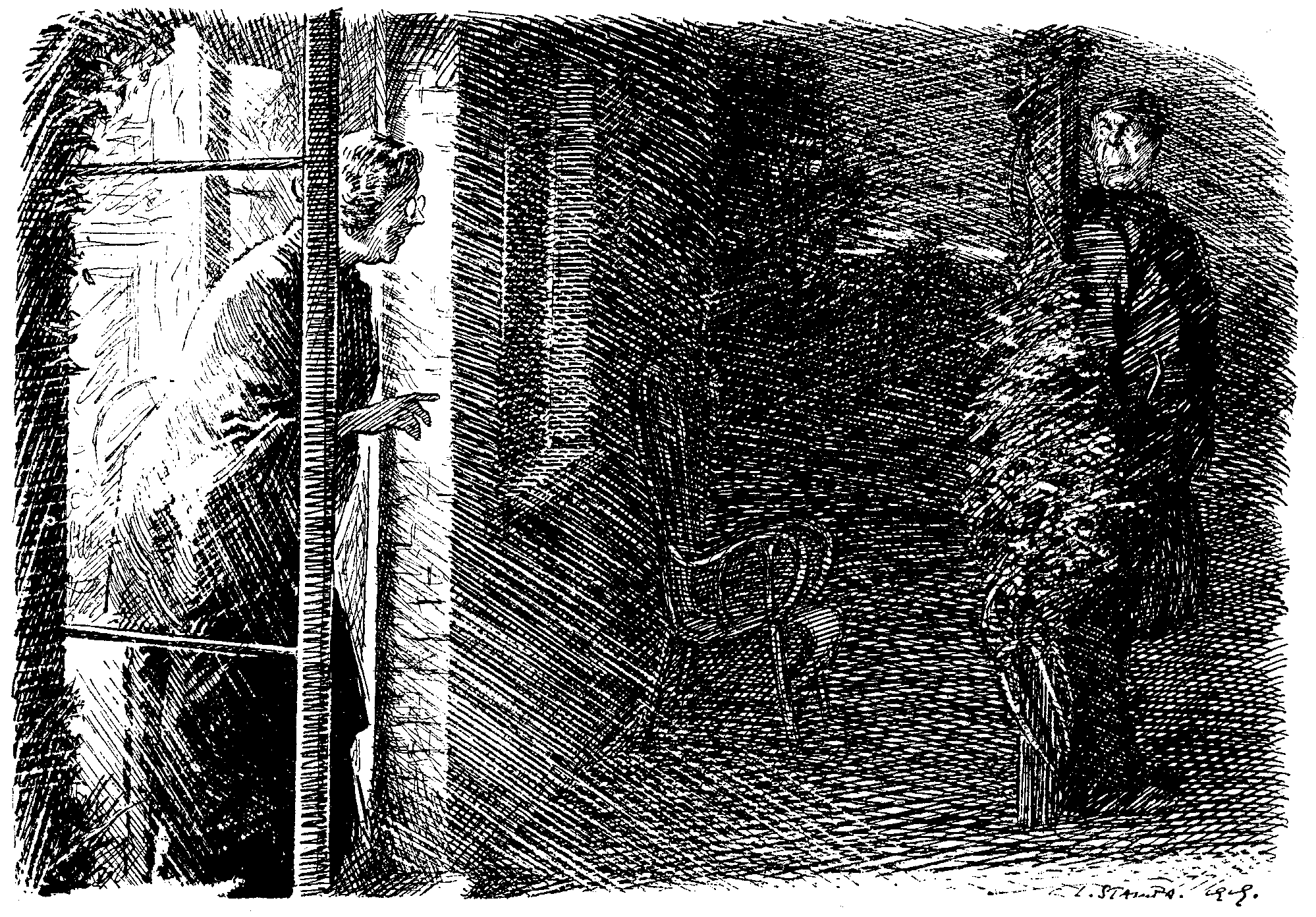
Gentle Creature (who fancies she has heard the customary sound of her cat tapping at the window to be let in). "NAUGHTY, NAUGHTY ADOLPHUS! COME IN AT ONCE, LIKE A GOOD BOY!"
BIRD NOTES.
Nature Study has recently been recommended by a well-known Daily Paper as a means of gradual relaxation from war-worry. Mr. Punch would therefore like to contribute for so noble an end a few ornithological notes, having for a long time been addicted to the observation of bird-life.
CUCKOO.—This bird, which obtained its name on account of the similarity of its note to that of the Cuckoo-clock, was one of the earliest sufferers of the housing problem, which it successfully solved by depositing its eggs in the nests of other birds.
SEAGULL.—When the eggs of this bird are hatched the mother-parent feeds its young on the glutinous substance that oozes from sea-weed—hence "Mother Seagull's Syrup."
THROSTLE.—See THRUSH.
PIGEON.—This bird was used as a message-carrier with great success during the War. An attempt to cross it with the Parrot, to enable it to deliver verbal messages, was unfortunately a failure.
SPARROW.—Bird-fanciers experience great difficulty with this bird when kept in captivity, as it frequently develops jaundice, in which case it can only be sold under the name of "Canary," at a big difference in price.
GUILLEMOT.—The name "Guillemot" is derived from the French word "Guillemot," which means a Guillemot.
LARK.—The protective instinct in this bird is very marked. Although nesting on the ground it soars high into the sky for the purpose of leading aviators and balloonists away from its young.
GOLDFINCH.—A favourite cage-bird. The best method of catching the goldfinch is to wait until it settles on the lowest branch of a tree, then approach it from behind and gently tap its right wing with your right hand. This causes it immediately to turn its head to see who has touched it; you can then bring up your left hand unnoticed, into which it falls an easy victim.
BULLFINCH.—Another popular cage-bird. The best method of capturing it, which differs widely from that in use with the Goldfinch, is as follows:—Hang head downwards from the fork of an old tree in order to resemble a dead branch, having previously covered yourself with some adhesive matter. In this position you should wait until as many Bullfinches as you want have settled on your clothes and stuck there; then climb down from the tree and have them scraped off into a large cage.
BARN OWL.—This bird invariably builds its nest in empty houses. There will be no nests this year.
STARLING.—Threepence was placed on the head of this destructive bird last year in many parts of England. The old way was to put salt on its tail.
BLUE TITMOUSE.—The nest of this active little bird is often situated in most extraordinary places. It is frequently found inside village pumps, and in consequence is much persecuted by local milkmen. It is feared that unless The Daily Mail can be persuaded to take up the cause of this unfortunate bird it will soon be faced with extermination.
ROOK.—The chief difference between this bird and the Crow is found in the way in which its name is spelt.
THRUSH.—See THROSTLE.