Volume 156 — THE ARCHAEOLOGISTS;
Reading edition
OR, THE FIGHT AGAINST REACTION.
MY DEAR KNOTT,—It has occurred to me that since the closing of our little V.A.D. depôt there is a good deal of energy in Filby without a suitable outlet, and I am writing to you on the matter as I feel sure you will have some helpful suggestion to make.
Of course a great deal of this energy might be profitably expended on the ever-increasing spiritual needs of the parish, but I feel that if some society of a secular character were got up just now it would be helpful, especially to the female portion of our community.
Miss Timlin has suggested a Philatelic Society, and I shall be pleased to hear your views on her proposal.
Believe me, Yours ever sincerely,
THEODORE BLAND.
"DEAR VICAR,—I have your letter and quite agree as to the advisability of starting some society for working off the latent energy which has accumulated since the demise of the War and the consequent closing down of War activities. I do not however fancy Philately as a safety-valve. I suppose one could stand up to stick stamps in a book, and would get a certain amount of physical exercise in going about swapping duds and duplicates, but generally speaking it is a sedentary occupation and, to my mind, a selfish one.
As you ask for a suggestion from me, I propose an Archaeological Society. The pursuit of Archaeology has this advantage: it connotes digging, an aptitude for which has been distinctly fostered here by the allotment habit.
As for our objective, without going further than Filby there is the alleged tunnel leading from the ruins of the nunnery to no one knows where. It would be interesting to know whether the thirteenth-century Lord of Filby had a private way (on the score of feudalities) to the Ursuline convent, or whether the good nuns had a back-way to the Old Swan for the conveyance of mead, sack and such other strong waters as the times and licensing laws afforded. But perhaps the tunnel, like most things, is controlled, and a mandamus (which, I take it, is a kind of ecclesiastical coupon) would be required before we could touch it.
Of course there are a mound and the foundations of an old wall in my paddock which the Society are welcome to tackle. Don't you think they would do to begin on?
Yours sincerely,
ARCHIBALD C. KNOTT.
MY DEAR KNOTT,—Many thanks for your valuable help. I think you may expect quite a good turn up of members on Tuesday. I have always thought that the tumulus in your field might yield some interesting archaeological find. The land and a former mansion were part of the Convent demesne, as you probably know. I am sorry that I shall not be present as I have to attend the Bishop's Conference at Bray Chester, which is expected to last a week or two.
Wishing you all success and with kind regards to yourself and Mrs. Knott,
I am, Yours ever sincerely,
THEODORE BLAND.
MY DEAR VICAR,—Thanks for yours. I am very sorry you have been called away at such a time.
The first meeting was so successful that a second was fixed for Wednesday. But enthusiasm seemed to flag on Wednesday evening, as nothing of interest had been discovered.
A few die-hards agreed to put in some hours' digging on Thursday, when Colonel Stacey and Mrs. Cottingham each dug up a Roman bronze coin (both denarii, I fancy) from the mound. This of course acted as a great stimulant, and we had a bumper meeting on Friday. Stacey, I understand, intends to read a paper, at the first indoor meeting of the society, on the Roman occupation of Filby-in-the-Wold. The mound is now levelled, and the wall foundations have all been dug up and carted away; but the latter yielded nothing of interest.
Hoping that the Conference is going as you would wish,
I am, Yours sincerely,
ARCHIBALD C. KNOTT.
P.S.—Couldn't you touch up the Bishop on the subject of the Convent tube?
DEAR VICAR,—We have had an archaeological strike. The mound is levelled, the wall foundations have disappeared, and so have the diggers. I am afraid the Society are now awaiting your return to give them a lead. My grounds, alas, have produced nothing beyond the two denarii.
Yours sincerely,
ARCHIBALD C. KNOTT.
[Extract.]
DEAR BOY,—Your mother and I are delighted that you will be demobbed in about a week from now.... By the way you will be glad to hear that we can start making that second tennis-court in the paddock as soon as you get back. I have had the remains of what was known as Knott's Folly in your great-grandfather's day removed, at a total cost of two denarii (which had been lying in a drawer in my dressing-room for years); not so bad, considering the present cost of labour. But of this more anon.
Your affectionate
FATHER.
A CRICKET BARGAIN.
(Before the match.)
We meet as foes, my James, this summer weather, But sterner summers saw us twain in league; Shoulder to shoulder have we stood together On Q.M.S. fatigue. So, when (ninth wicket down) to-day I enter Upon my tenure of the crease and gaze Nervously at you, having taken centre, Remember bygone days. Abate your skill, so shall my nerves grow firmer, Till driving seems the easiest of jobs, And passers-by shall pause and haply murmur, "Golly, can that be HOBBS?" Do this for me, and you'll discover later How fame awaits the generous and good; A few long hops shall win a glory greater Than ever break-back could. If for a ball or two you let me smite you, Running amok with dashing bat and bold, My Muse shall have instructions to requite you Even an hundredfold. You shall she hymn in strains that do not falter, Proclaim of you for all who run to read:— "He sacrificed his length on friendship's altar; He was a pal indeed."
FOR THE CHILDREN.
At this season, when their own children are already counting the days that lie between them and their holidays, Mr. Punch appeals to his kind readers not to forget the greater needs of the children in our elementary schools. The cost of sending them away to the sea or countryside for fresh air and change of scene is constantly increasing and the Children's Country Holidays Fund cannot keep up its good work without generous help. There can be no better way of making a Peace-offering than by helping to build up the health and strength of the new generation. Mr. Punch begs that liberal gifts may be sent to the Secretary of the Fund at 18, Buckingham Street, Strand, W.C.2.
SCENES FROM OUR GREAT FILM: "AUDACITY DOWN THE AGES."
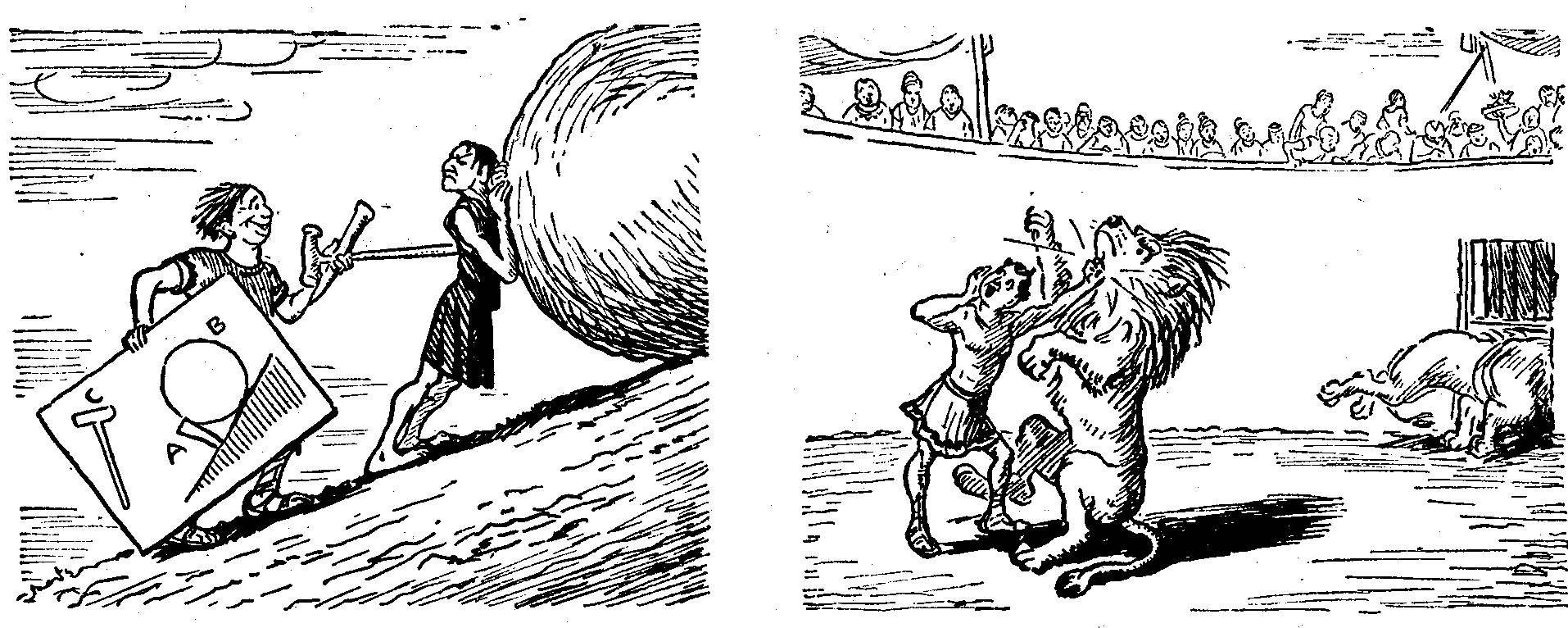
MYTHICAL ENGINEER MAKING A SUGGESTION TO SISYPHUS. GLADIATOR CALLING FOR MORE AND LARGER LIONS.
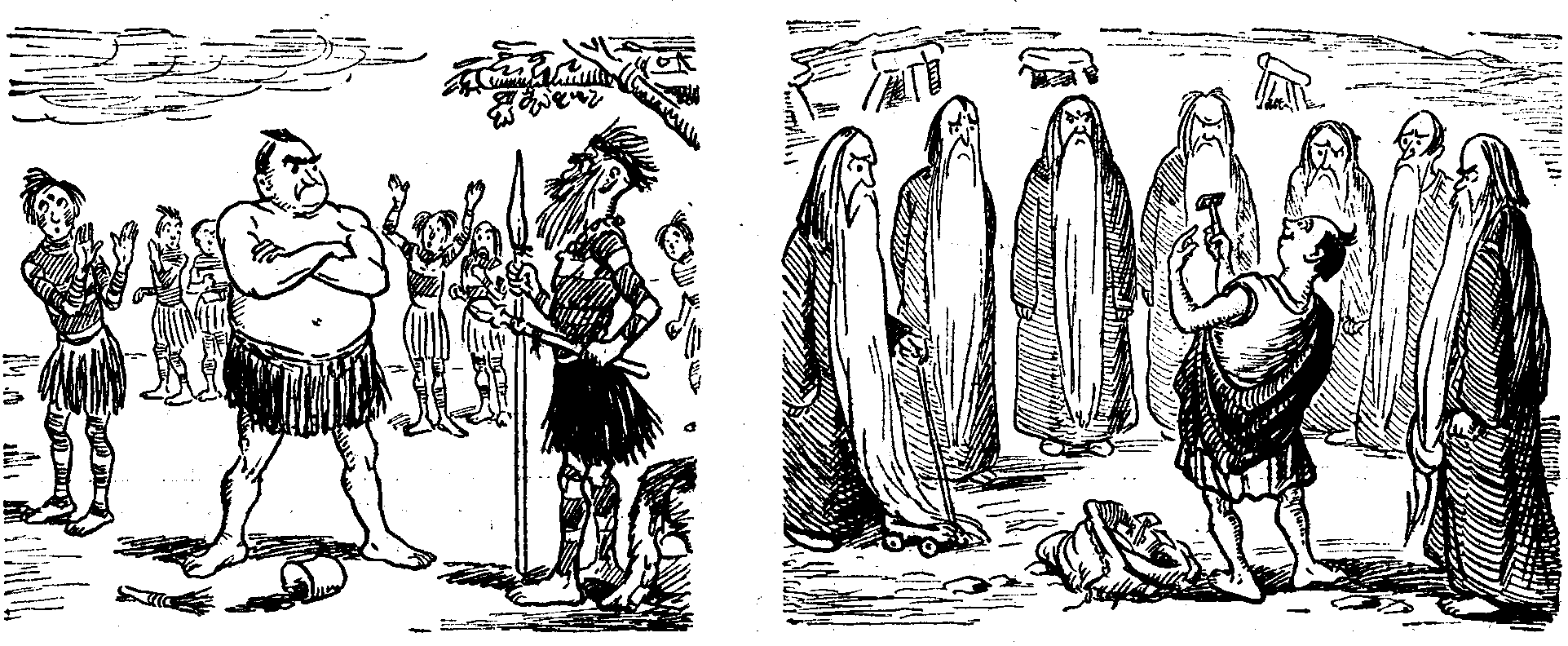
ANCIENT BRITON DEFYING HIS CHIEF, AND REFUSING TO WOAD. ROMAN COMMERCIAL TRAVELLER TRYING TO SELL SAFETY RAZORS TO THE DRUIDS.
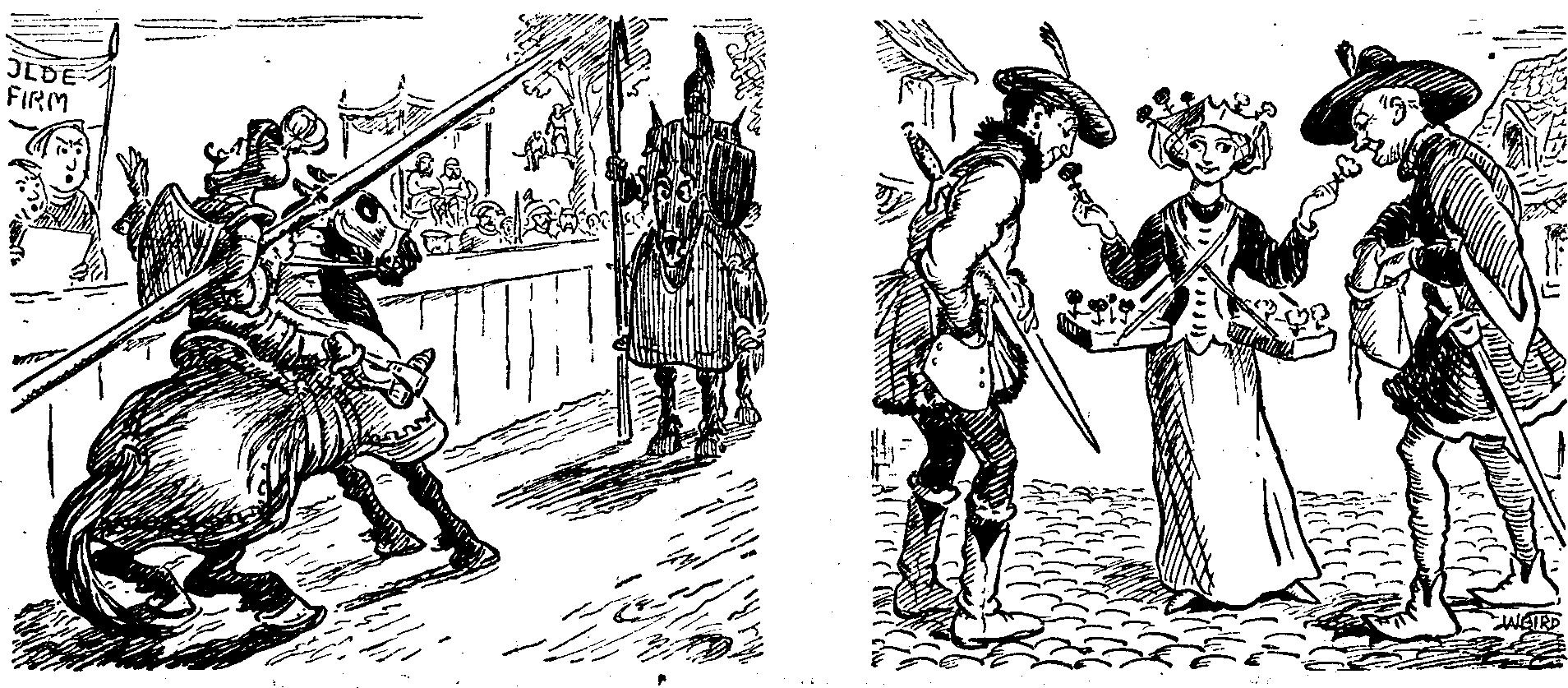
KNIGHT, ABOUT TO UNDERGO THE "TRIAL BY COMBAT," OFFERING TO BACK HIMSELF "TO WIN OR A PLACE." AMBIDEXTROUS FLOWER-GIRL SELLING RED AND WHITE FAVOURS DURING THE WARS OF THE ROSES.
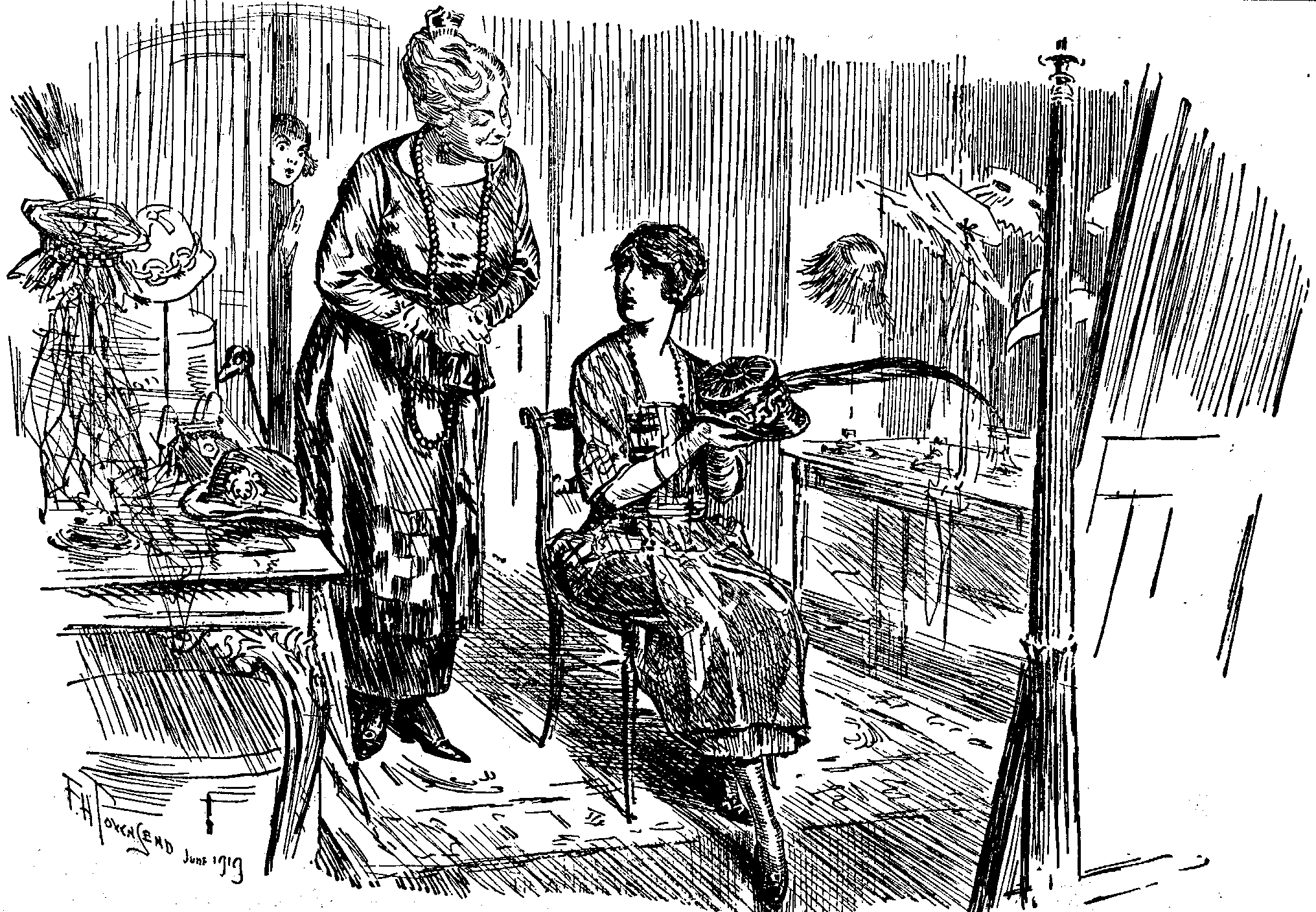
Milliner. "THAT MODEL IS FIFTEEN GUINEAS, MODOM." Customer. "HOW MUCH WOULD IT BE IF THE FEATHER WERE REMOVED?"
Milliner. "FIFTEEN-AND-A-HALF GUINEAS, MODOM. YOU SEE, LABOUR IS SO DEAR."
ON THE HIGH C.'S.
Doubtless you have often heard Of the thrush, that gladsome bird, Who will warble any day, Be it cold or wet or gray. I suppose her mother taught her That the worms are fond of water, So that neither sleet nor slush Bridles that eupeptic thrush. Such a one was Johnny Carr (Sub-Lieutenant R.N.R.). I have never caught him yet Out of sorts when it was wet; He will hum when tempests howl, Whistle midst the thunder's growl, And I've seen him sing for joy, Clinging to a punctured buoy, While his gallant T.B.D. Sank beside him in the sea. No one knows exactly when or Why he came to call it tenor, But the fact remains he sang With a subtle nasal twang Just because he liked to do so (He was Carr, but not CARUSO), And with such a force of lung That, whatever tune he sung, It was like a projectile With a range of twenty mile. 'Twas the thirty-first of May. On that memorable day, Flitting like a restless ghost Somewhere off the Danish coast, His destroyer, all agog, Butted through the clinging fog, When for just a space the gray Mists of morning rolled away. Ah! but how their pulses beat When they saw the High Seas Fleet Nosing noiseless as a dream Barely half-a-mile abeam; Then the filmy mists anew Blotted everything from view. John, astounded at the sight, Sang aloud with all his might. But the German, seeing nought, Only hearing what he thought Must be twelve-inch guns at least Firing at him from the East, Felt that it was time to hook it, Saw his chance and boldly took it. Northward fast he sailed once more Till he heard the Lion roar, And before he could retreat he Found himself engaged with BEATTY, Who, as you already know, Led him on to JELLICOE. There I leave him, for, you see, All the rest is history. All the rest? Well, not quite all; For perhaps you may recall How, when night was falling fast, A reverberating blast Far away was dimly heard Which, the sailormen averred, Was the Germans who had strayed In amongst the mines we laid. They were wrong. The fighting over, Johnny's ship returned to Dover, And the sound they heard afar Was the jocund voice of Carr Singing fit to burst his torso, Like the song-thrush (only more so).
"ROYAL ARMY MEDICAL CORPS FUND.—At the Savoy Hotel, on June 11, at 8 p.m. Service dress—khaki with trousers—or evening dress, with miniatures."—Times.
The price of clothes was bound to lead to something of this sort.
From an article on "The Representative Man":—
"Gladstone and John Bright alike came out of Lancashire. How natural to fmgeine etther of those startling ogposites proclaiming with entire conviction, that when he samped himself he foundthimself to be a 'Typical Englishman.' The diversity of types however does not help us much."—Indian Paper.
True, we find it most confusing.
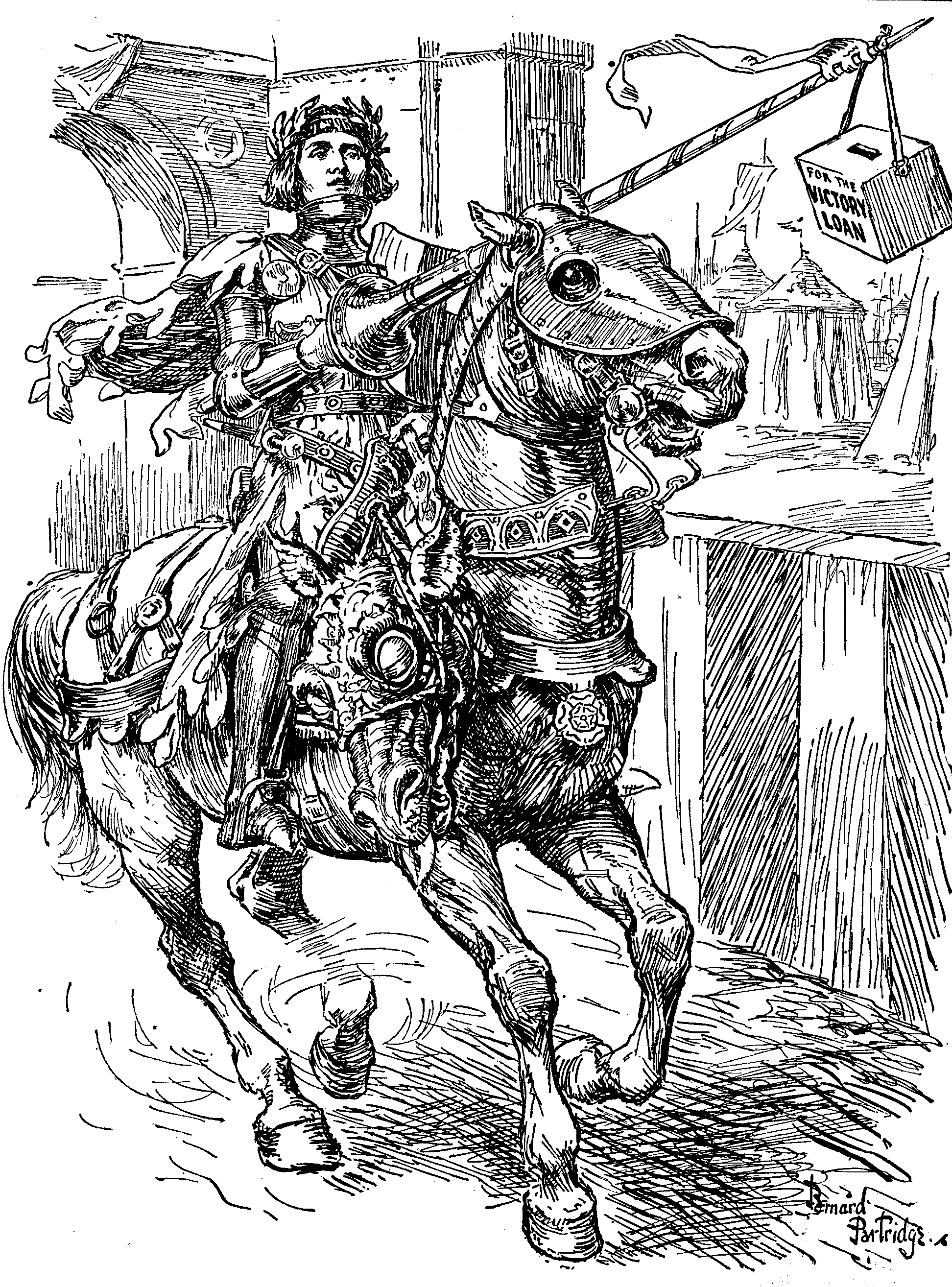
IN THE SUBSCRIPTION LISTS.
SAINT GEORGE COLLECTS FOR MERRIE ENGLAND.
THE PUFF UNIVERSAL.
["A Father," writing in The Times of June 10th, protests vigorously against the cult of "powdered noses."]
When the deadly sky-rover Came frequently over And London was darkened at night, Girls powdered their noses (Or so one supposes) As lamp-posts were painted with white; But now when full moons Bring no bombs or maroons, I ask is it proper or right? Amanda's complexion Will challenge inspection— 'Tis healthy and rosy and fine; But she says that if powder Were never allowed her Her nose would infallibly shine. Did Victorian Flossie Or Gladys, when glossy Of nose, to such methods incline? No, they patiently scrubbed it, Rough-towelled and rubbed it Until it was brought into line. We have long been acquainted With ladies who painted To mimic a juvenile mien; But I'd ban sans compassion The powdering fashion When practised by sweet seventeen; And I wish that wise mothers And sensible brothers Would let their abhorrence be seen. I'm only "a father," Old-fashioned and rather Deficient in stiffness of spine, So, feeling unequal To facing the sequel, My name I'm unwilling to sign; For the call for more powder Grows stronger and louder From every daughter of mine, And any restriction Of puffs or nose-friction Would end in a general "shine."
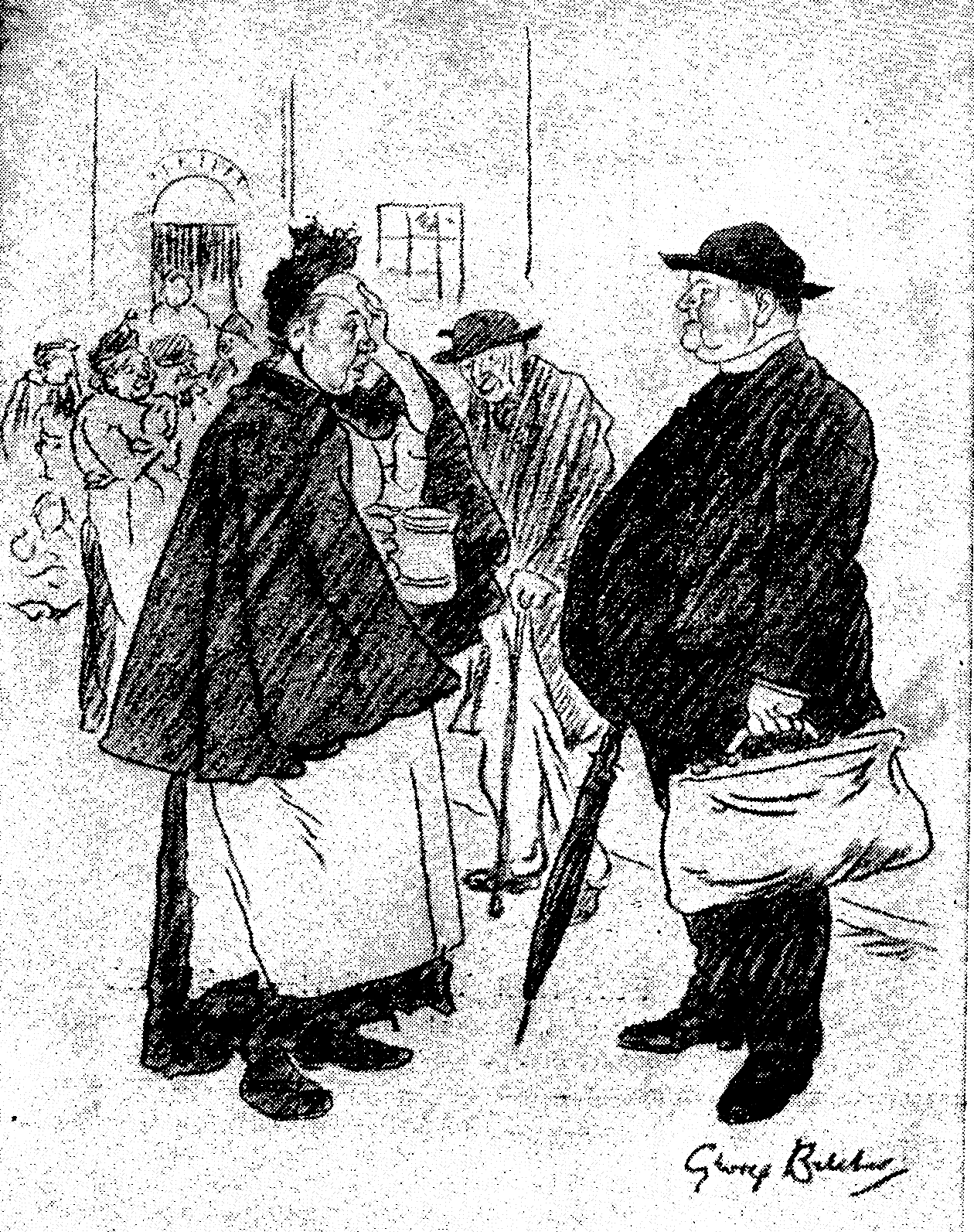
Vicar. "I'M SORRY TO HEAR THAT YOUR HUSBAND IS IN GAOL AGAIN, MRS. STIBBS. STEALING A WATCH, EH?"
Mrs. Stibbs. "YES, SIR. BUT 'TAIN'T 'IS FAULT THIS TIME. THE MAGISTRATE SAID 'ISSELF THAT JOE DIDN'T KNOW THE DIFFERENCE BETWEEN 'MEUM AND TOOUM,' AN' IN 'IS IGNORANCE 'E'D DONE A BIT O' 'TOOUMING.'"
OUR MOVIE-MINISTERS.
(Deductions by a Political Expert.)
The admirable plan of transplanting Ministers admittedly doing excellent work in their departments just as they are settling down in the saddle, though generally commended by supporters of the Government, is meeting with a certain amount of criticism. Appointments which show "imagination" are, it is urged, shorn of their possibilities when the holders are moved on just when they are beginning to provide the public with sensation.
Speculations are rife as to the appointment of a new Minister of Education, and the best-informed opinion inclines to the view that Sir ERIC GEDDES, who has occupied his present position for quite a number of weeks, will succeed Mr. FISHER. Some experts however hold that the PREMIER has a magnificent opportunity for displaying his imagination by the choice of Mr. WELLS, who is burning to disprove the recent astounding allegation of General WILSON that the War could not have been won without the Universities. The chief objection to Mr. WELLS, however, is that he cannot be transferred, because he is not already in office; and this drawback also operates in the case of Mr. SMILLIE and Mr. BOTTOMLEY.
In this context it is to be noted that Lord READING (so at least we understand from the peculiarly plaintive smile which he wears in recent photographs) is much disappointed that the claims of Mr. T.P. O'CONNOR to the post of Ambassador at Washington have so far failed of due recognition. American antagonism over the Irish Question has not been conciliated by this strange oversight.
Things that might have been worded differently.
From the official organ of the Surplus Government Property Disposal Board:
"Sales by Auction of Surplus Horses by arrangement with the Food Production Department of the Board of Agriculture."
"A grand Mahogany Bedstead, 9-1/2' x 8', with posts and testers complete, meant for Rajas and Zemindars. Can also accommodate 4 middle-class people comfortably. Going for Rs. 500."—Advt. in Indian Paper.
Mr. KENNEDY JONES will kindly call the attention of the Middle Classes Union to this proposed congestion.
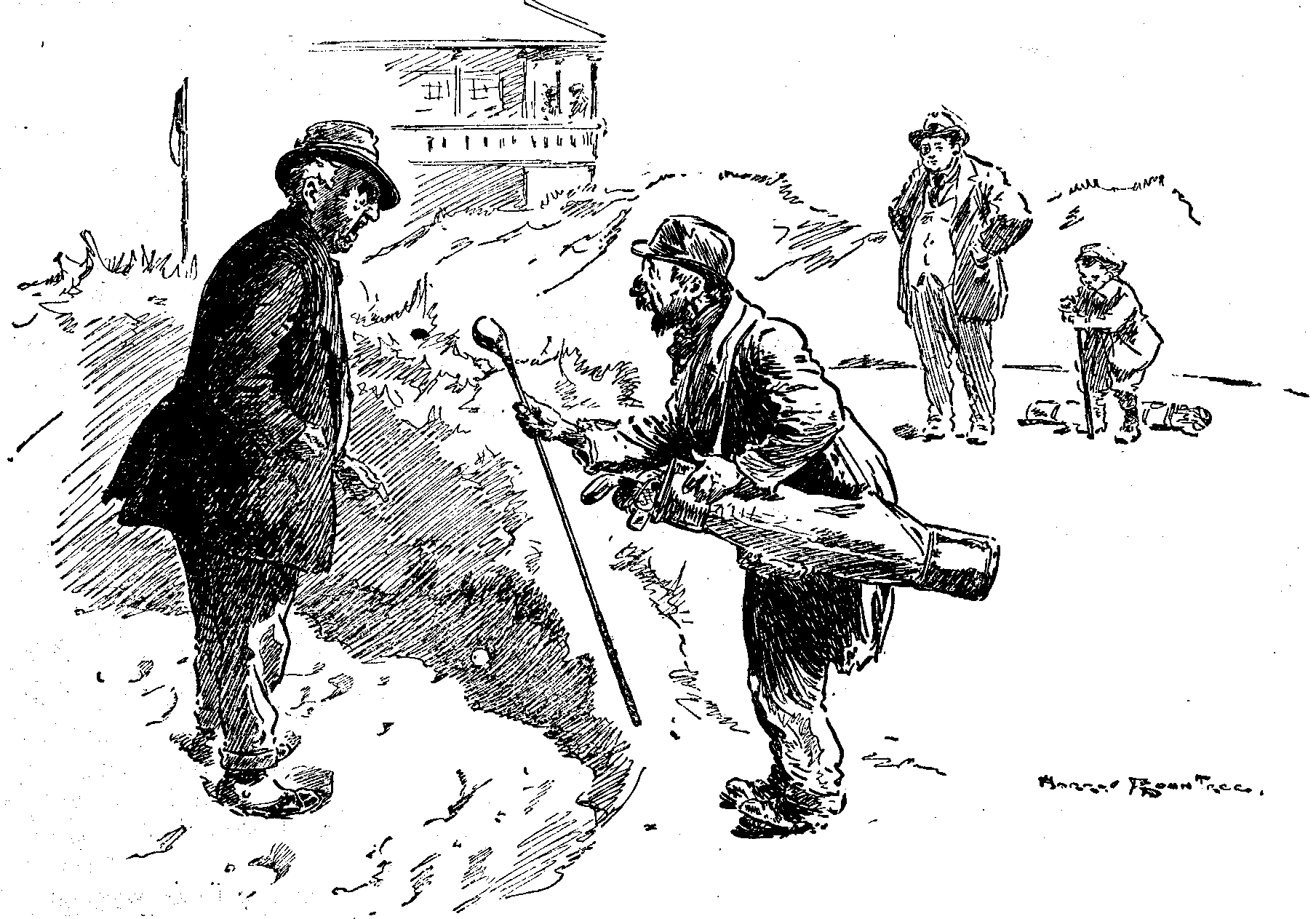
PLAYING THE 18TH—LAST ROUND OF THE DAY.
"YOU FOOL, CADDIE! HOW CAN I PLAY FROM THAT LIE WITH A WOODEN CLUB?"
"SORRY, SIR. I'VE JUST CLEANED THE IRONS."