Volume 156 — A MILITARY EDUCATIONAL PROBLEM.
Reading edition
Dear Mr. Punch,—I write to ask your advice. As you know, the Army Council in its wisdom decreed that the Army, before being demobilised, must be educated. I have been chosen as one of the Educators.
My efforts to lead the Army into the paths of light and learning were crowned with success until in an evil moment I undertook to teach Private Goodbody. This genial ornament of our regimental sanitary squad is especially anxious to plumb the mysteries of arithmetic. When he had, as I thought, finally mastered the principle that if you borrow one from the shillings' column you must pay it back in the pounds' column, I set him the following sum:—
"Supposing you owed the butcher sixteen shillings and three pence halfpenny and took a pound note to pay him with, how much change ought he to give you?"
Private Goodbody scratched his head for several minutes and at last decided that he did not know.
"But come, Goodbody," I urged, "surely it's quite easy." And I repeated the question.
"I don't know, Sir; I don't never have no truck with butchers," he declared emphatically. "I leaves that 'ere to the missus."
"Ah!" I said, "and how does she get the money to pay him?"
"I gives it 'er," said Goodbody.
"What does she do with the change?" I asked next.
"Gives it back to me, I reck'n," he answered.
"Well," I continued, "if you don't know how much change there ought to be when you give her a pound and she spends sixteen shillings and three pence halfpenny, how do you know she gives you back the right amount?"
Private Goodbody eyed me with something suspiciously like contempt.
"If my missus started playin' any o' them monkey tricks on me, givin' the wrong change an' sich, I'd put it acrost 'er," he said.
And there the matter rests for the present. I feel that I should not lead Private Goodbody any further into the intricacies of his subject until he has solved my problem. This he resolutely professes himself unable to do, and begs to be allowed to leave it and plunge into the giddy vortex of the multiplication table.
Yours faithfully, MENTOR.
"A cable message of 100 words from London to Johannesburg to-day, at 2s. 6d. a word, costs £1 10s."—Evening Paper.
We suppose the Post Office makes a reduction for taking a quantity.
THE WIND.
The day I saw the Wind I stood All by myself inside our wood, Where Nurse had told me I must wait While she went back through the white gate To fetch her work ... I don't know why, But suddenly I felt quite shy With all the trees when Nurse was gone, For quietness came on and on And covered me right round as though I was just nobody, you know, And not a little girl at all... But then—quite sudden—HER torn shawl Came through the trees; I saw it gleam, And SHE was near. Just like a dream She looked at me. Her lovely hair Was waving, waving everywhere, And from her shawl—all tattery— There blew the sweetest scents to me. I didn't ask her who she was; I didn't need to ask, because I knew! ... That's all ... She didn't wait; She went—when Nurse called through the gate.
"HOT WATER BATTLES—Best quality rubber, from 4/3 each." —Parish Magazine.
A new kind of tank warfare, we suppose.
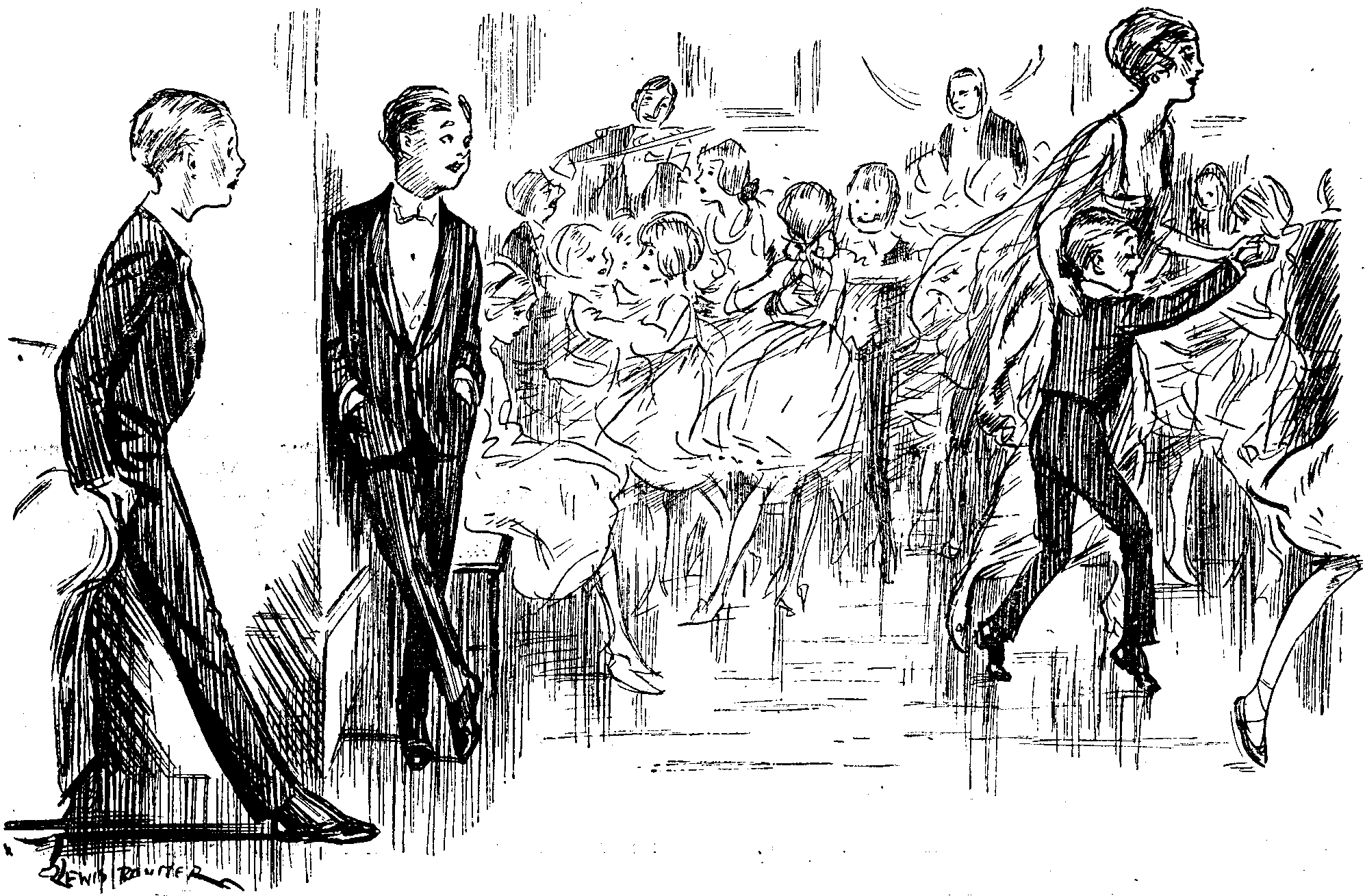
OUR DANCING MEN.
"WHO'S THE SLIGHTLY ANCIENT DAME THAT THAT KID BINKS HAS BEEN DANCING WITH ALL THE EVENING?"
"I DUNNO. YOUNG BINKS DOESN'T EITHER. BUT HE SAYS SHE'S THE ONLY WOMAN IN THE ROOM WITH A GLIMMERING OF HOW TO 'JAZZ.'"