Volume 156 — A THREATENED SOURCE OF REVENUE.
Reading edition
The POSTMASTER-GENERAL and the CHANCELLOR OF THE EXCHEQUER are at this moment the most melancholy of men. For the last few months they had been quietly chuckling to themselves over one of the most brilliant ideas that ever adorned the annals of Government. But the best laid schemes gang aft agley.
While publicists and economic experts were shaking their grey hairs over the prospect of national bankruptcy, the P.M.G. and the C. of E. were weeping jazz tears of joy as the national debt lifted before their eyes "like mist unrolled on the morning wind." And then certain unsophisticated Members of a new, a very new, House of Commons began their deadly work. As a result the main scheme of national solvency is in danger.
There are those who still think that the franchise was extended to women merely as an objective piece of political justice. I hate cynicism, and I should be the last to throw cold water on an ideal, but, as I said, the real fruits of that political master-stroke are in danger.
While millions of enfranchised women were quietly engaged in writing twice a week to their particular Member, at three half-pence a time (or more), they were unconsciously assisting the considered policy of His Majesty's Government, which was that such letters should be written and remain unanswered; that more letters and still more should be written, stamped and posted to demand an answer, and that still more should be written to friends and relations exposing the grave lack of courtesy at Westminster.
But, alas! certain Members, with monumental naïveté, have thought fit to take their correspondence seriously. They have put questions to Ministers. They have in so many crude words openly on the floor of the House referred to "the increase in the number of letters which Members now receive from their constituents on parliamentary matters, owing to the recent additions to the franchise and its extension to women." They have pleaded for the privilege of "franking" their answers. Could perversity go further? What woman will continue to write to a Member who satisfies her curiosity? And what of the unwritten, unstamped, unposted letters of just indignation to friends and relations?
The P.M.G.'s laconic answer to this monstrous request, "I do not think it would be expedient," was highly commendable as a feat of Ministerial restraint. But the gloom that has settled on him is only too solidly grounded. These afflicted Members are out to raise a sentimental public opinion in support of their silly demand. Then, of course, the Government will capitulate, and the country will go Bolshevik from excessive taxation.
Will not all patriotic women constituents write at once to their Members and point out the folly of this agitation?
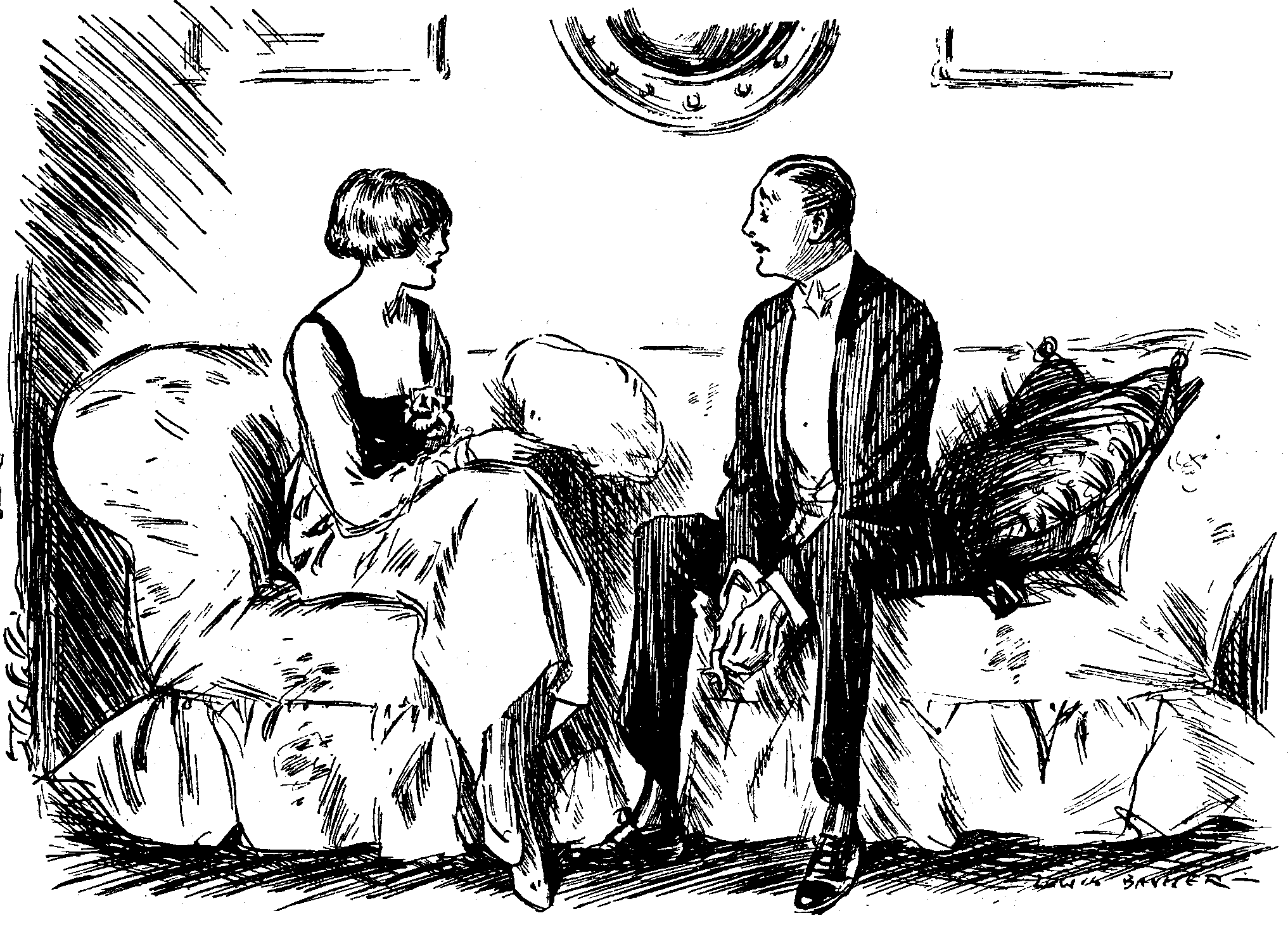
"I SHALL NEVER FIND ANYONE ELSE LIKE YOU. YOU SEE, YOU'RE SO DIFFERENT FROM OTHER GIRLS."
"OH, BUT YOU'LL FIND LOTS OF OTHER GIRLS DIFFERENT FROM OTHER GIRLS."
OLD SOLDIERS.
They dug us down and earthed us in, their hasty shovels plying, Us the poor dead of Oudenarde, Ramillies, Waterloo; We heard their drum-taps fading and their trumpet fanfares dying As they marched away and left us, in the dark and silence lying, Home-bound for happy England and the green fields that we knew. We slept. The seasons went their round. We did not hear the rover Winds in our coverlets of grass, the plough-shares tear the mould; We did not feel the bridal earth thrill to her April lover Nor hear the song of bees among the poppies and the clover; Snow-fall or sun to us were one and time went by untold. We woke. The soil about us shook to the long boom of thunder— War loose and making music on his crashing brazen gongs— The sharp hoof-beat, the thresh of feet stirred our old bones down under; Wheels upon wheels ground overhead; then with a glow of wonder We heard the chant of Englishmen singing their marching songs. Blood of our blood! We heard them swing a-down the teeming highways, As we swung once. We heard them shout; we heard the jests they cast. And we dead men remembered then blue Junes in Devon by-ways, Star-dusted skies and women's eyes, women with sweet and shy ways. These were their race! We strove to rise, but the strong clay held us fast. Year in, year out, along the roads the ceaseless wagons clattered; Listened we for an English voice ever, ever in vain; Far in the west, year out, year in, terrible thunders battered, Drumming the doom of whom—of whom? Hope in our hearts lay shattered.... Then we heard the lilt of Highland pipes and English songs again. On, ever on, we heard them press; their jaunty bugles blended Proudly and clear that we might hear, we dead men of old wars, How the red agony was passed and the long vigil ended. Now may we sleep in peace again lapped in a vision splendid Of England's banners marching onwards, upwards to the stars.
PATLANDER.
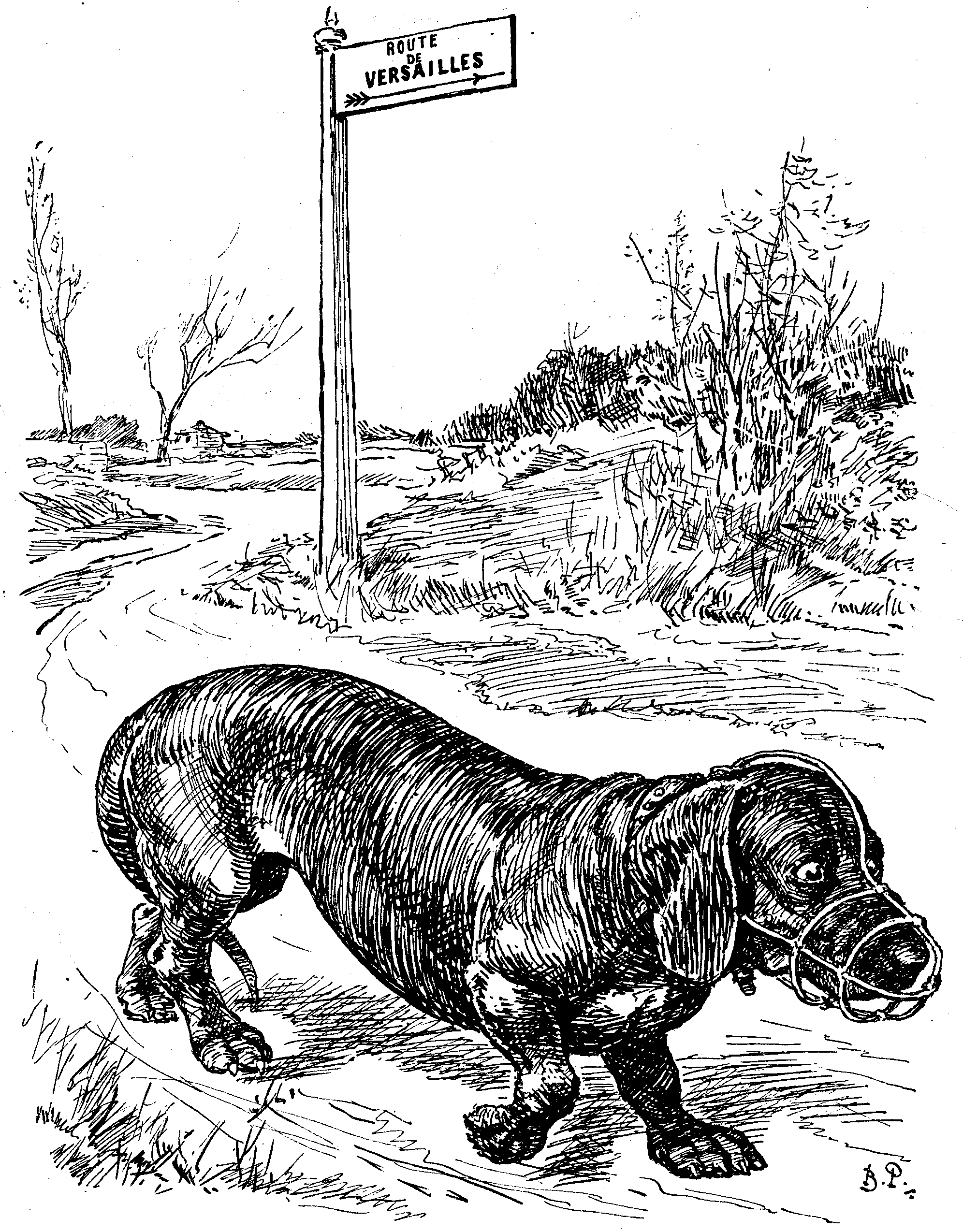
THE MILITARY MUZZLE.
FRITZ. "AFTER ALL, IT'S NOT MUCH GOOD BARKING WHEN THEY'VE STOPPED MY BITE."
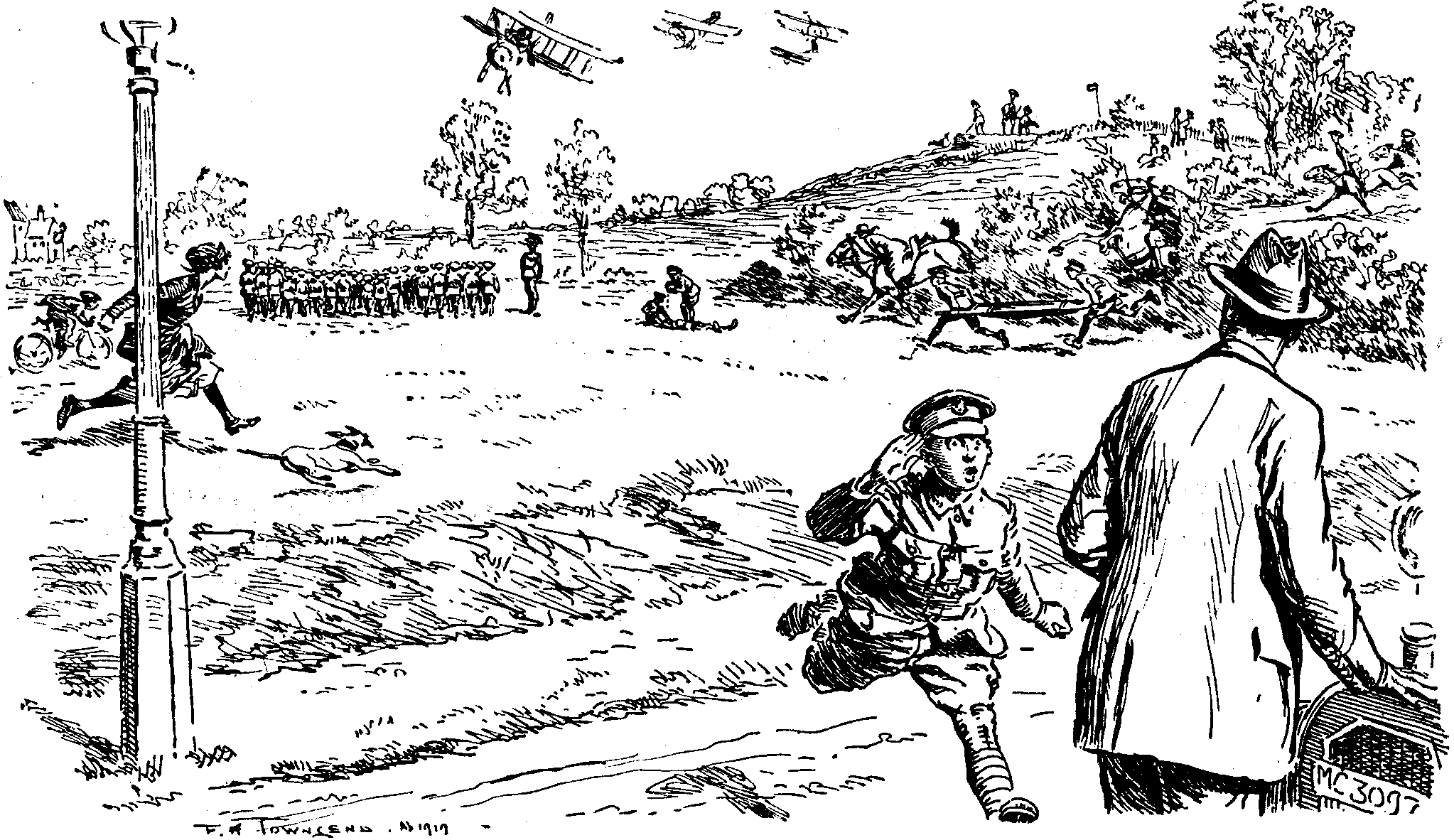
OUR SENSITIVE YOUTH.
Cadet. "'SCUSE ME, SIR—ARE YOU A DOCTOR? THERE'S A BOY FAINTED."
Doctor. "AH—FATIGUE, I SUPPOSE?"
Cadet. "No, SIR. THE SERGEANT SPLIT AN INFINITIVE."
BRAINS AND BALDNESS.
BY OUR MEDICAL EXPERT.
(With acknowledgments to "The Times").
Baldness among men is undoubtedly on the increase, and various reasons have been assigned for its appearance in an exacerbated form. In particular the stress and strain of the War have been mooted, and the argument is reinforced by such words as Chauvinism, which, Mr. LLOYD GEORGE is probably not aware, is derived from chauve. War is a solvent of equanimity; in the cant but expressive phrase it becomes harder to keep one's hair on. Again, inter arma silent Musae. Fewer people have been playing the pianoforte, an exercise which has always exerted a stimulating effect on the follicles. Our political correspondent at Paris writes that M. PADEREWSKI'S once luxuriant chevelure has suffered sadly since he has taken to politics, but that after playing for a couple of hours to Mr. BALFOUR a distinct improvement was noticeable.
But no very clear exposition of the subject has yet been forthcoming, and this is all the more extraordinary when it is considered that baldness is really a very unsightly and distressing condition.
The sensitiveness of JULIUS CAESAR on this score is notorious. CIMABUE, of whom Mr. LLOYD GEORGE has probably never heard, was a martyr to alopecia seborrhoica, and the case of the Highland chieftain MacAssar is too well known to call for detailed survey. Yet the strange fact remains that hitherto sustained scientific investigation has been lacking, though there is assuredly a great, if not perhaps a vital, need for it. No one can afford to say that, if this apparently, simple malady were studied, facts of the utmost value to hatters would not be forthcoming. One can only express regret that those fortunate interviewers who have been allowed to describe the cranial developments of eminent men should have failed to profit by their opportunities for examining the "area of baldness," which corresponds to the distribution of the Vth nerve, the branches of which come out from the brain by the eye-sockets. Such investigations will never be properly carried out and co-ordinated without the establishment of a Hair Ministry, which is one of the clamant needs of reconstruction. It is an open secret that the question was discussed a year ago and set aside for the curious reason that of the three persons whose candidature was most powerfully supported two were bald, and the third was the Member for Wigan.
Meanwhile a start has been made by the unofficial activities of a small committee of experts in trichology, and their conclusions, published in an interim report, are worth recording. They are as follows: "That the 'area of baldness,' should an illness supervene, will certainly suffer to a greater extent than the more vigorous ones. Illness, as is well known, tends to interfere with the nourishment of the skin and to establish an atrophic diathesis of the follicular ganglia. The patient's hair may all come out, or, and this often happens, it may come out only in one area—the area of baldness."
In a minority report, signed by only one of the committee, the strange theory was expounded that genius developed in a direct ratio with the loss of hair between the temporal regions and the crown of the head. It was also pointed out that in a great number of TURNER'S pictures a special feature was the prominence given to bald-headed fishermen in high lights. This observation does not seem to represent a scientific attempt to handle the problem; but it should not be rashly dismissed on that account.
In a further article we hope to deal with the effect of hard hats on the conductivity of the branches of the Vth nerve, the mentality of the Hairy Ainus and other cognate questions.
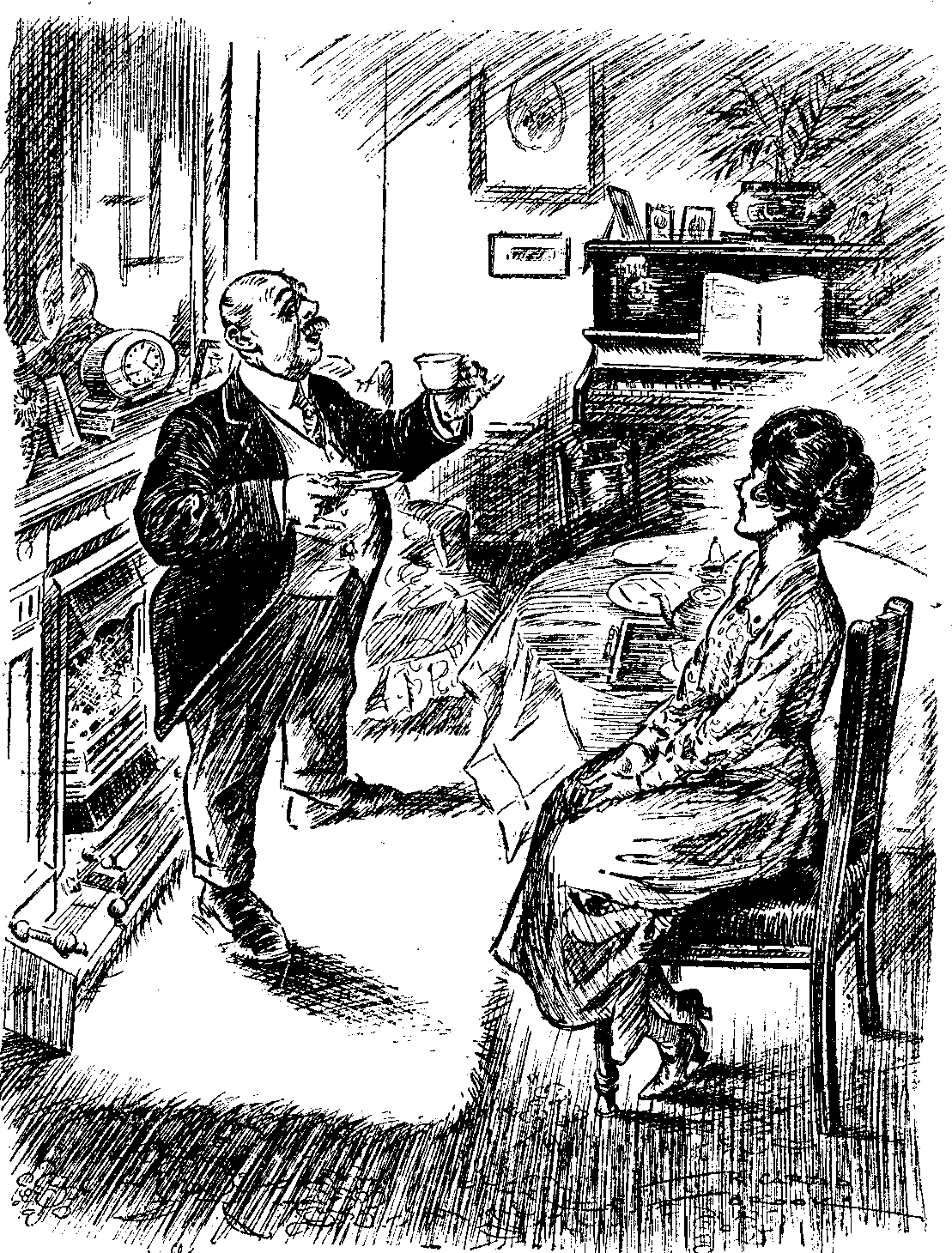
Mr. 'Iggins (describing his first experience in lawsuit). "'IS LORDSHIP SEZ, 'YOU CAN GO. THE CASE IS ADJOURNED SINE DIE. WELL, I WASN'T GOING TO LET 'IM THINK I DIDN'T RUMBLE 'IS LAW-TALK, SO I JUS' GIVES 'IM A WINK AN' SEZ, 'RIGHT-O! GOOD BYE-EE!'"