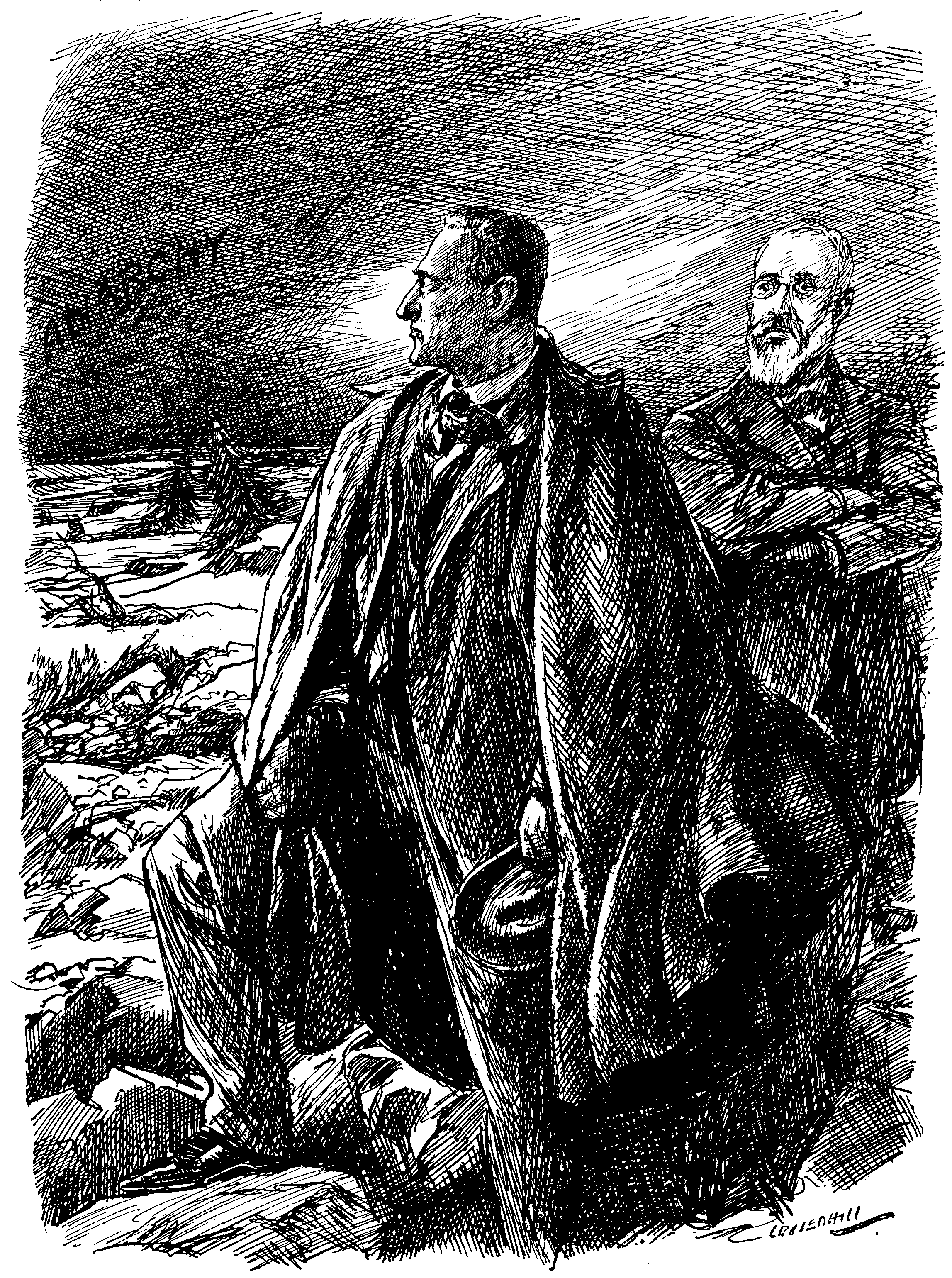
Volume 153 — HEART-TO-HEART TALKS.
Reading edition
(Herr MICHAELIS: Marshal VON HINDENBURG.)
Herr M. Good morning, my dear Marshal. I am glad we have been able to arrange a meeting, for there are certain points I wish to settle with you.
Von H. I am, as always, at your Excellency's service; only I beg that the interview may not be prolonged beyond what is strictly needful. Time presses, and much remains to be done everywhere.
Herr M. But I have the commands of the ALL-HIGHEST to speak with you on some weighty matters. He himself, as you know, has several speeches to make to-day.
Von H. Oh, those speeches! How well I know them. I could almost make them myself if I wanted to make speeches, which, God be thanked, I do not need to do.
Herr M. No, indeed. Your reputation rests on foundations firmer than speeches.
Von H. You yourself, Excellency, have lately discovered how fallacious a thing is a speech, even where the speaker honestly tries to do his best to please everybody.
Herr M. You are very kind, my dear Marshal, to speak thus of my humble effort. The result of it has certainly disappointed me.
Von H. What was it that LEDEBOUR said of it? Did he not describe it as "a political hocus-pocus"? Such men ought to be at once taken out and shot. But we Prussians have always been too gentle in our methods.
Herr M. We have. It is perhaps our only fault; but this time we must see that we correct it. In any case, to be so misunderstood is most painful, especially when one has employed all one's tact.
Von H. Ah, tact. That is what you are celebrated for, is it not?
Herr M. HIS IMPERIAL MAJESTY has more than once been graciously pleased to compliment me upon it. And he, if anyone, is a judge of tact, is he not?
Von H. I have not myself any knowledge of it, so I cannot say for certain. Does it perhaps mean what you do when you entirely forget in one speech what you have said or omitted to say in a previous speech?
Herr M. (aside). The old fellow is not, after all, so thick-skulled as I thought him. (Aloud) I will not ask you to discuss this subject any more, but will proceed to lay before you the commands of HIS MAJESTY.
Von H. I shall be glad to hear them.
Herr M. Well, then, to cut the matter as short as possible, HIS MAJESTY insists that there shall be a victory on the Western Front.
Von H. A victory?
Herr M. Yes, a victory. A real one, mind, not a made-up affair like the capture of Langemarck, which, though it was certainly captured, was not captured by us, but by the accursed English. May Heaven destroy them!
Von H. But it was by HIS MAJESTY'S orders that we announced the capture of Langemarck.
Herr M. I know; but he is graciously pleased to forget that, and to desire a genuine victory now.
Von H. Tell him I cannot promise. We have done our best at Verdun, at Lens and at Ypres, but we have had to retreat everywhere. Our turn may come another time, but, as I say, I cannot promise.
Herr M. Please go on doing your best. It is so annoying and temper-spoiling for HIS MAJESTY to make so many speeches of a fiery kind, and never to have a victory—at least not a real one for which Berlin can hang out flags. Besides, if we don't get a victory how shall we ever get a good German peace? And peace we must have, and that very soon.
Von H. Don't talk to me of peace. War is my business, not peace; and if I am to carry on war there must be no interference. If the ALL-HIGHEST does not like that, let him take the chief command himself.
Herr M. God forbid!
LINES TO A HUN AIRMAN,
WHO AROUSED THE DETACHMENT ON A CHILLY MORNING, AT 2.30 A.M.
Oh, come again, but at another time; Choose some more fitting moment to appear, For even in fair Gallia's sunny clime The dawns are chilly at this time of year.
I did not go to bed till one last night, I was on guard, and, pacing up and down, Gazed often on the sky where every light Flamed like a gem in Night's imperial crown;
And when the clamant rattle's hideous sound Roused me from sleep, in a far distant land My spirit moved and trod familiar ground, Where a Young Hopeful sat at my right hand.
There was a spotless cloth upon the board, Thin bread-and-butter was upon me pressed, And China tea in a frail cup was poured— Then I rushed forth inadequately dressed.
Lo! the poor Sergeant in a shrunken shirt, His manly limbs exposed to morning's dew, His massive feet all paddling in the dirt— Such sights should move the heart of even you.
The worthy Corporal, sage in looks and speeches, Holds up his trousers with a trembling hand; Lucky for him he slumbered in his breeches— The most clothed man of all our shivering band.
The wretched gunners cluster on the gun, Clasping the clammy breech and slippery shells; If 'tis a joke they do not see the fun And damn you to the worst of DANTE'S hells.
And Sub-Lieutenant Blank, that martial man, Shows his pyjamas to a startled world, And shivers in the foremost of our van The while our H.E. shells are upwards hurled.
You vanish, not ten centimes worth the worse
For all our noise, so far as we can tell;
The blest "Stand easy" comes; with many a curse
In two brief hours we must arise and shine! O willow-waly! Would I were at home Where leisurely I breakfasted at nine And warm and fed went officeward to roam!
So come again, but at another time, Say after breakfast or some hour like that, Or I will strafe you with a viler rhyme— I will, by Jove! or eat my shell-proof hat.
"The Rev. T.F. —— officiated in the church yesterday for the first time since his return from a four months' spell of work in connection with the Y.M.C.A. Huns in France."—Provincial Paper.
We congratulate him upon his discovery of this hitherto unknown tribe.
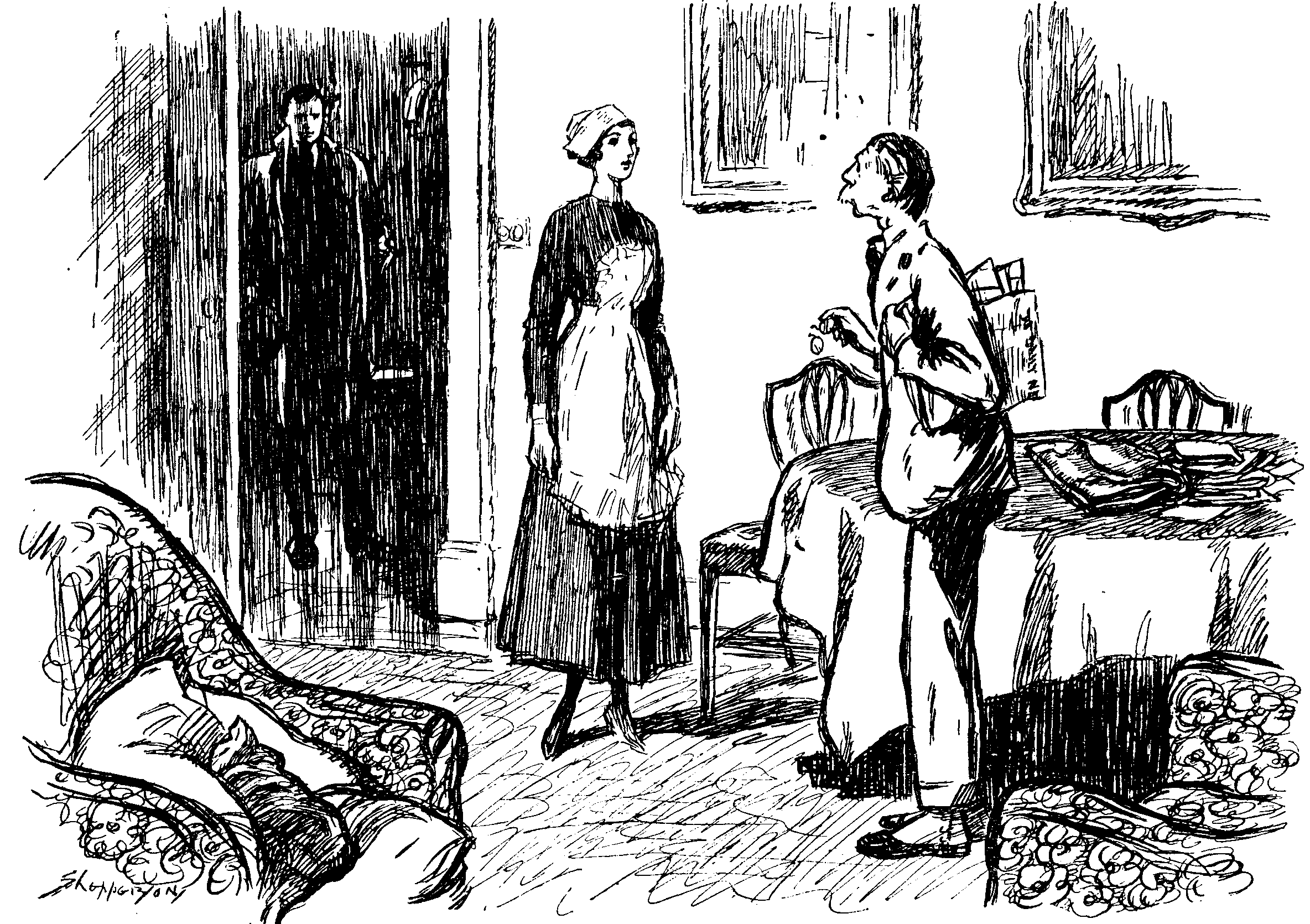
GLIMPSES OF THE FUTURE.
Maid. "MR. JONES, SIR—HIM WOT KILLED SEVENTEEN GERMANS IN ONE TRENCH WITH HIS OWN 'ANDS—'AS CALLED FOR THE GAS ACCOUNT, SIR."
THE LITTLE MATCH-GIRL.
(With apologies to the shade of HANS ANDERSEN.)
It was late on a bitterly cold showery evening of Autumn. A poor little girl was wandering in the cold wet streets. She wore a hat on her head and on her feet she wore boots. ANDERSEN sent her out without a hat and in boots five sizes too large for her. But as a member of the Children's Welfare League I do not consider that right. She carried a quantity of matches (ten boxes to be exact) in her old apron. Nobody had bought any of her matches during the whole long day. And since the Summer-Time Act was still in force it was even longer than it would have been in ANDERSEN's time.
The streets through which she passed were deserted. No sounds, not even the reassuring shrieks of taxi-whistles, were to be heard, for it costs you forty shillings now (or is it five pounds?) to engage a taxi by whistle, and people simply can't afford it. Clearly she would do no business in the byways, so she struck into a main thoroughfare. At once she was besieged by buyers. They guessed she was the little match-girl because she struck a match from time to time just to show that they worked. Also, she liked to see the blaze. She would not have selected this branch of war-work had she not been naturally fond of matches.
They crowded round her, asking eagerly, "How much a box?" Now her mother had told her to sell them at a shilling a box. But the little girl had heard much talk of war-profits, and since nobody had given her any she thought she might as well earn some. So she asked five shillings a box. And since these were the last matches seen in England it was not long before she had sold all the ten boxes (including the ones containing the burnt ends of the matches she had struck to attract custom).
The little girl then went to the nearest post-office and purchased two pounds' worth of War Loan. The ten shillings which remained she took home to her mother, and since the good woman did not understand the principles of profiteering she was well pleased.
But alas for the little girl! one of her customers, doubting the honesty of her intentions, had informed the policeman. She was subsequently taken into custody, and the magistrate is now faced with the problem as to whether she is a good little girl in that she put money into War Loan, or a bad little girl in that she followed the example of the profiteers.
Our Helpful Press.
From a recipe for jam:—
"Add the fruit and boil 40 minutes. Glucose and sugar in equal parts can be used if sugar is unobtainable."—Daily Sketch.
"To lease or rent a fine family residence, healthy locality, one mile from Mandeville fully furnished with good accommodation for a large family standing on ten acres of good grazing land with many fruit trees has two large tanks, recently occupied by judge Reece."—Daily Gleaner (Jamaica).
Anything for coolness.
Extract from a speech by Mr. BROMLEY on the eight-hours' day:—
"They had endeavoured after long weary waiting to bring to fruition in due time what had been the first plank in their programme for thirteen years."—Morning Paper.
But the plank, as might be expected, has, as fruit-growers say, "run to wood."
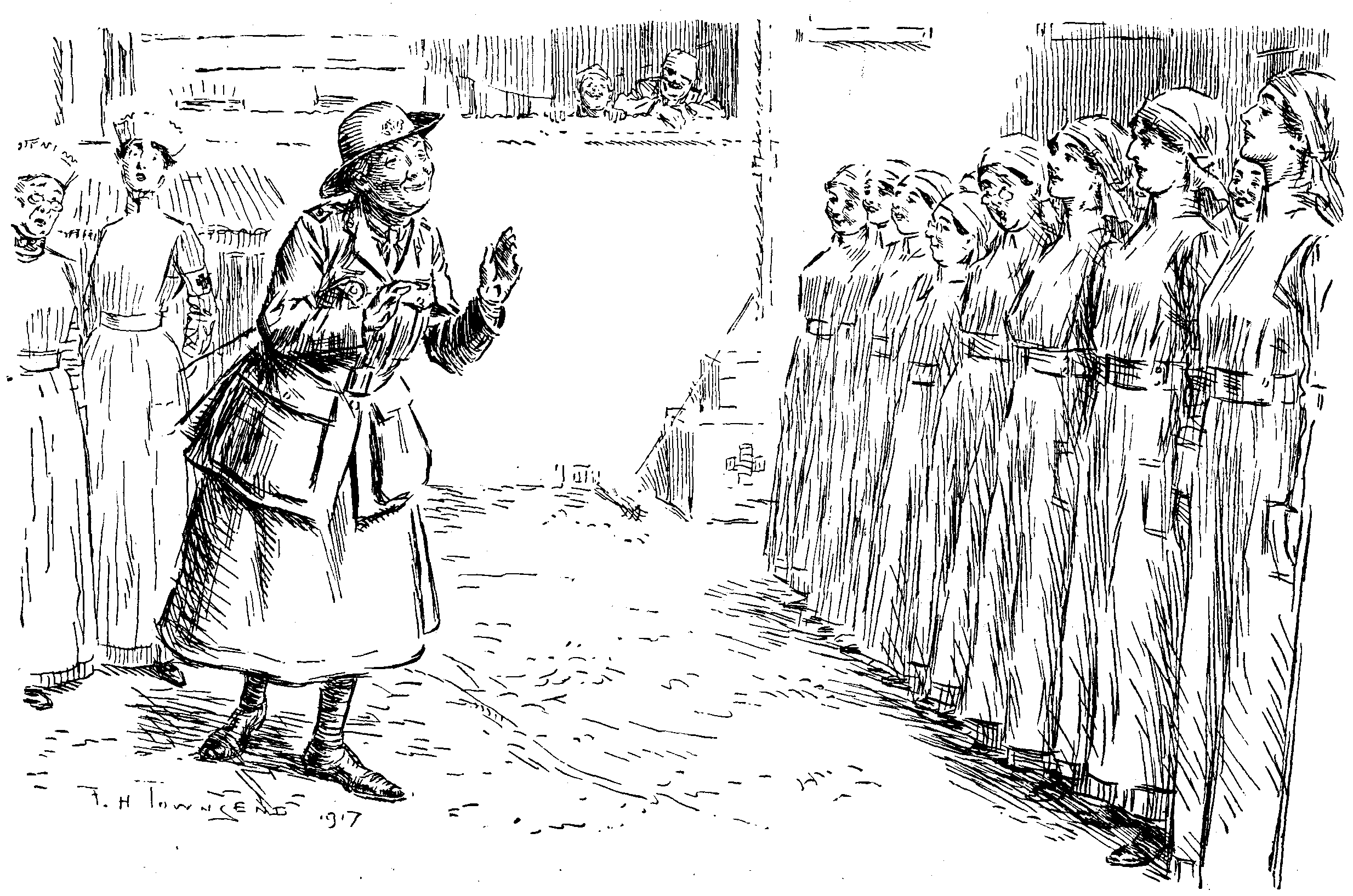
Colonel (asked to review V.A.D. Corps, and not wishing to spring an order on them). "NOW, I'M GOING TO ASK YOU LADIES TO FORM FOURS."
THE PASSING OF THE COD'S HEAD.
(A Romance of Chiswick Mall.)
It was because the dustman did not come; It was because our cat was overfed, And, gorged with some superior pabulum, Declined to touch the cod's disgusting head; It was because the weather was too warm To hide the horror in the refuse-bin, And too intense the perfume of its form, My wife commanded me to do the sin, To take and cast it in the twinkling Thames— A practice which the neighbourhood condemns. So on the midnight, with a strong cigar And scented handkerchief, I tiptoed near, But felt the exotic fragrance from afar; I thought of ARTHUR and Sir BEDIVERE: And it seemed best to leave it on the plate, So strode I back and told my curious spouse "I heard the high tide lap along the Eyot, And the wild water at the barge's bows." She said, "O treacherous! O heart of clay! Go back and throw the smelly thing away." Thereat I seized it, and with guilty shoon Stole out indignant to the water's marge; Its eyes like emeralds caught the affronted moon; The stars conspired to make the thing look large; Surely all Chiswick would perceive my shame! I clutched the indecency and whirled it round And flung it from me like a torch in flame, And a great wailing swept across the sound, As though the deep were calling back its kith. I said, "It will go down to Hammersmith. "It will go down beyond the Chelsea flats, And hang with barges under Battersea, Will press past Wapping with decaying cats, And the dead dog shall bear it company; Small bathing boys shall feel its clammy prod, And think some jellyfish has fled the surge; And so 'twill win to where the tribe of cod In its own ooze intones a fitting dirge, And after that some false and impious fish Will likely have it for a breakfast dish." The morning dawned. The tide had stripped the shore; And that foul shape I fancied so remote Lay stark below, just opposite next-door! Who would have said a cod's head could not float? No more my neighbour in his garden sits; My callers now regard the view with groans; For tides may roll and rot the fleshly bits, But what shall mortify those ageless bones? How shall I bear to hear my grandsons say, "Look at the fish that grand-dad threw away"?
A.P.H.
From a South African produce-merchant's letter:—
"As so many of our clients were disappointed last year ... we are taking time by the fetlock and offering you this excellent quality seed now."
To be sure of stopping Father Time you must collar low.