Volume 153 — ESSENCE OF PARLIAMENT.
Reading edition
Monday, July 16th.—In the course of a discussion on "rope" in War-bread Mr. THORNE accused the West-End bakeries of mixing white flour with the "G.R." variety, and so supplying their wealthy customers with better bread than is procurable by his own constituents. Although no official confirmation of this charge was forthcoming Mr. THORNE appeared to be convinced of its accuracy. In his opinion the Government, following the historic example of PHARAOH, should give the bread to the people and the rope to the bakers.
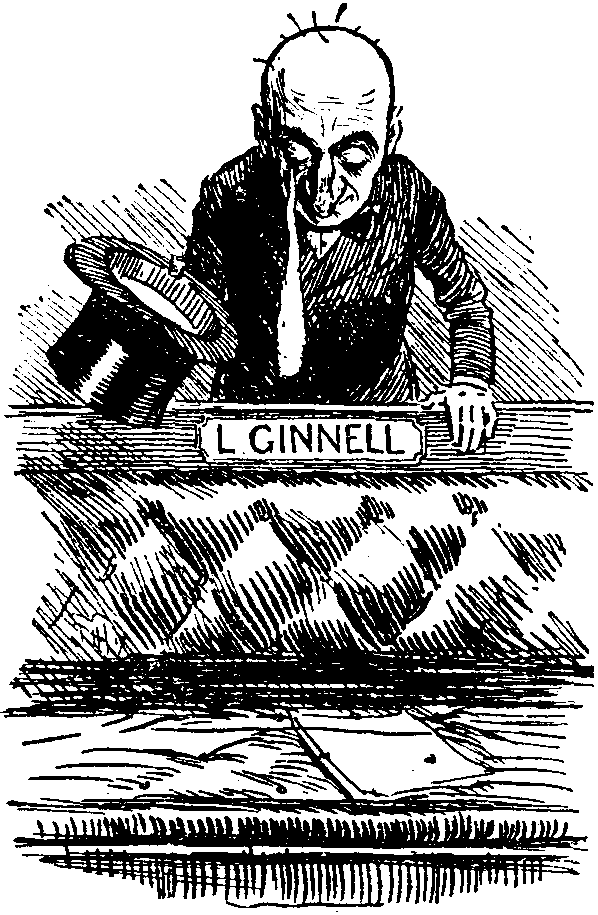
THE EMPTY SEAT.
MR. PUNCH DROPS A SILENT TEAR AT THE DEPARTURE OF ONE OF HIS BEST PUPPETS.
It might not be accurate to say that in the matter of beer the Irishman wants but little here below, but he certainly wants that little strong; and being, in spite of a popular impression to the contrary, a seriously-minded person, he resents any reduction of his gravity. Mr. BRIDGEMAN'S gentle reminder that no Irish brewer need avail himself of the new regulations unless he pleases quite failed to satisfy the Nationalists that a new item had not been added to Ireland's catalogue of grievances.
Tuesday, July 17th.—For some weeks Mr. GINNELL has been absent from his place. No one has gone so far as to suggest that the Roll of the House should be called in order to bring back the hon. Member to his Parliamentary duties. But considerable curiosity was aroused by his recent statement that he proposed to make one more appearance at Westminster before retiring permanently to Ireland to watch over the growth of the Sinn Fein Republic. To-day was the day. Question 45, "Mr. Ginnell, to ask the Prime Minister, &c., &c.," was eagerly awaited. There was no saying that the hon. Member, if dissatisfied with the reply, would not hurl the Mace at the CHANCELLOR OF THE EXCHEQUER, so as to ensure a properly dramatic exit. At last No. 45 was reached; but Mr. GINNELL was not there to put it. Once more the Saxon intellect had been too slow to keep up with the swift processes of the Celtic cerebellum. Mr. GINNELL has on more than one occasion made what his compatriots call a "holy show" of himself; but he refuses to do this sort of thing to order.
Mr. HOUSTON is still harping upon the CHANCELLOR OF THE EXCHEQUER'S recent confession of his ship-owning gains, and laboured hard this afternoon to convince the Committee that shipowners in general were in no sense profiteers. He failed, however, to avert the wrath of Mr. DENNISS, who declared that if, after what had been revealed, any shipowner was made a peer, he should move to abolish the peerage.
This day the KING in Council decreed that the Royal House should forthwith abandon all German titles and be known henceforth as the House of Windsor. No one will be better pleased than Mr. SWIFT MACNEILL, who for months past has been unsparing in his efforts to purge the Upper House of enemy peers, and to-night had the satisfaction of seeing a Bill for that purpose read a second time. His prophecy that such a measure could be passed in three minutes was not quite borne out; but that was chiefly because the hon. Member himself occupied a quarter-of-an-hour in complaining of the Government's delay in introducing it.
Wednesday, July 18th.—Sir HENRY DALZIEL has been labouring under the delusion that the R.N.A.S. and the R.F.C. are so mortally afraid of trespassing upon one another's aerial preserves that the former will not attack an enemy plane travelling over land, or the latter over sea. Dr. MACNAMARA for the Navy, and Mr. MACPHERSON for the Army, informed him that there was no truth in the suggestion; but Colonel CLAUDE LOWTHER, remembering that there were once Two Macs who delighted in spoofing their audiences, refused to be comforted until categorically assured that between R.N.A.S. and R.F.C. there is "sufficient cohesion."
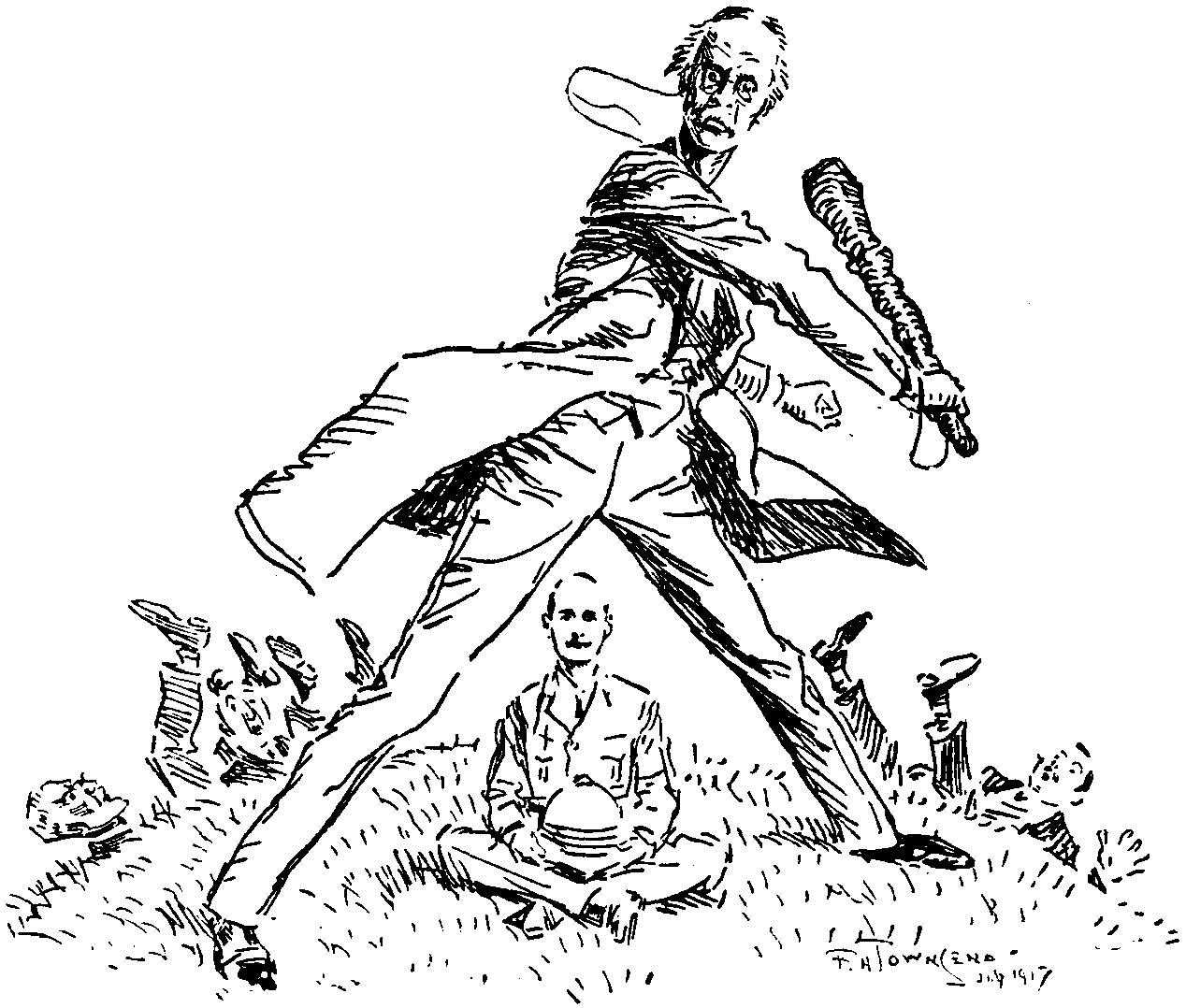
LORD HARDINGE'S CHAMPION.
MR. BALFOUR LETS OUT.
This was BALFOUR's day. Never since he gave up the Leadership of the Unionist Party six years ago has he more completely dominated the scene. Mr. BONAR LAW had announced that the Government had on third thoughts decided not to set up a new tribunal to try the persons affected by the Mesopotamia Report. The military officers would be dealt with by the Army Council. As for Lord HARDINGE, the Government, "on the representations of the FOREIGN SECRETARY," had again refused his proffered resignation. If any Members disapproved, let them propose a Vote of Censure or move the adjournment.
It was perhaps fortunate for the Government that Mr. DILLON accepted the challenge. During the War the Member for East Mayo has lost such authority in the House as he once possessed. Criticism on the conduct of the campaign from one who boasts that he has never stood upon a recruiting platform lacks sincerity. Mr. BALFOUR, always at his best when defending a friend, laid about him lustily, and convinced the majority of the House, not very friendly at the outset, that it would be an act of gross injustice to remove a great public servant because the Commission—on whose evidence, without further inquiry, you could not hang a cat—had reported adversely on his conduct in an entirely different capacity.
To add to the force of this appeal came Sir HEDWORTH MEUX'S striking testimonial—"I have known Lord Hardinge from a boy." After that, small wonder that the House rejected Mr. Dillon's motion by 176 to 81.
Thursday, July 19th.—The only thing that keeps Mr. Reddy at Westminster is his delight in acting as Chorus to Major Pretyman Newman. Whenever the hon. and gallant Member asks a question Mr. Reddy, in a piping voice of remarkable carrying power, immediately puts another, designed to throw doubt upon his personal prowess or his military capacity. Major Newman had several Questions on the Paper this afternoon, and, as he had just announced the withdrawal of his valuable support from a Government so lost to all sense of propriety as to welcome Messrs. Churchill and Montagu to its fold, Mr. Reddy's comments were awaited with pleasurable anticipation.
Alas! for once he was not in his place. Even when Major Newman elicited the damning information that some members of the Dublin Metropolitan Police occasionally employ a German barber there was no penetrating voice from the back benches to ask, "Why doesn't the honourable Mimber go and shave them himself?"
Mr. Jowett wants the Home Secretary to withdraw the permission he gave some time ago "to employ women on the night-turn in wool-combing." Several much-married Members are afraid that whatever he may decide the objectionable practice will continue.