Volume 153 — WHISPER, AND I SHALL HEAR.
Reading edition
There's nothing like a newspaper for spreading disease. You wake up in the morning, feeling fit to do a day's digging on your allotment; you come down to your breakfast singing a Rhonddalay and eat more than your allowance. Then you open the newspaper, glance at the latest accession to the ranks of the Allied Powers, and suddenly, "Plop!" you find there is a new disease raging, and before you know where you are you discover that you have got it badly.
That is how I discovered that I was the possessor of a heart murmur. By putting my hand on the spot under which I had been taught, and still believed, my heart to be, I felt rather than heard a distinct burbling.
I went to the telephone and fixed up an appointment with a specialist.
"It's only a murmur now," I said when I reached the consulting-room, "only a mere whisper, but——"
The doctor tapped me vigorously. Being very absent-minded I said, "Come in," the first time.
"You were rejected for this, I suppose?" he said.
"No, cow-hocked or spavined, I forget which," I said. "This hadn't started then."
The rite was quite a lengthy one, and at the conclusion the heartsmith said, "M—yes, there is a slight murmuring, certainly."
He wrote me out a prescription, and I felt the murmur myself distinctly when parting with three of the greater Bradburys and three shillings.
On the way home I ran into Beatrice.
"Well, old thing," she said, "what's the matter? I saw you coming out of Dr. Cox's."
"Yes," I said. "I've got a heart murmur. I don't know what the poor things been trying to say, but it's been murmuring like anything all the morning."
"Perhaps you're in love," she suggested.
"By Jove, I never thought of that. I wonder," I said, "if it's anything to do with you. If this were not such a public place you might like to put your head against my top left-hand waistcoat pocket and listen. Perhaps it's saying something about you."
"Have you taken to writing poetry about me?" she said. "That's always a sign."
"Now I come to think of it," I said, "I did feel a bit broody the other day, and hatched a line or two, but I can't say for certain that I had you in my mind. The lines ran like this:—
"Oh, glorious female, like a goddess decked, No wonder that we crawl on bended knee—"
"Rotten," said Beatrice. "You couldn't have been thinking of me. I'm not a female."
"You have the right plumage for the hen-bird," I said. "However, what did me was 'decked.' I could only think of three rhymes, 'wrecked,' 'flecked' and 'stiff-necked.' You're not any of those by any chance?"
"There's 'circumspect', suggested Beatrice.
"Ah! Come and have lunch," I said, "and we'll talk it over. Some place where I can hold your hand and really find out if you are the cause of it all."
"Do you think I ought to?" she said.
"Good heavens! Of course you ought," I said. "It's most important. My heart's only murmuring now, but it may start shouting soon, and a silly ass I shall look walking about in the street with a heart yelling 'Beatrice' at the top of its voice."
As regards meat and drink I consider that Beatrice overdid it for a war-time lunch. She didn't give me any time to hold her hand, she was so busy.
"It's curious," I said, as I watched the amount of food that was going her way, "but my heart seems to have stopped murmuring altogether."
"Has it?" she said. "Oddly enough, mine's begun."
"Your luncheon has overstrained you," I said.
I had a letter from Beatrice the next morning.
DEAR JIMMY (she wrote),—You were wrong. Mine was a real murmur. It's been coming on for some time, but not on your account. It's murmuring for Basil Fludger. He's on leave, and we fixed things up last Tuesday. I didn't tell you when I met you, because I was afraid you wouldn't want to take me to lunch, and I did enjoy it. Yours ever, BEATRICE.
If my heart gets really noisy I do hope it won't shout for Beatrice. It would be so useless.
"Let us go hence, my heart; she will not hear" (Swinburne).
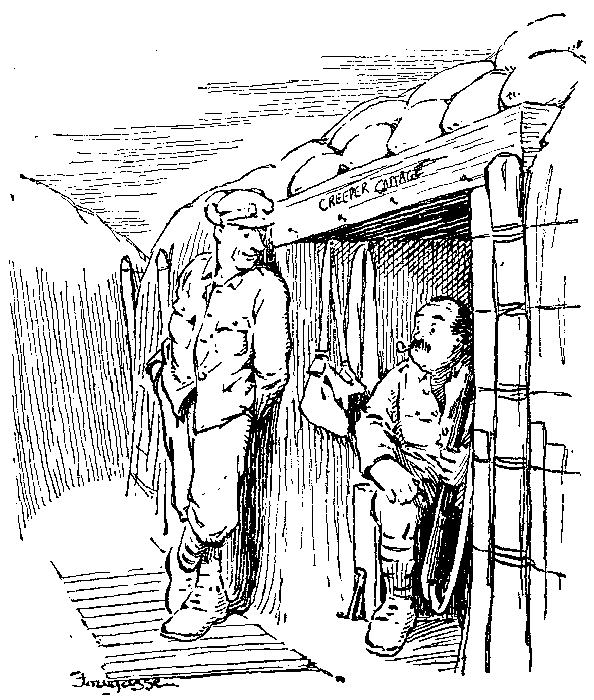
"HEARD THE LATEST RUMOUR UP FROM THE BACK, GEORGE? WAR'S GOING TO BE OVER NEXT WEEK."
"HO. WELL, I HOPE IT DON'T UPSET MY GOING ON LEAVE NEXT TUESDAY."
CIGARISTICS
["According to an enterprising American scientist a man's character can be told from the way he smokes a cigar."—Weekly Paper.]
For, instance, a man who snatches a cigar from somebody else's mouth and smokes it himself may be assumed to be of a grasping disposition.
The man who while smoking a cigar burns his finger is a man of few words and quick of action. Plumbers never burn their fingers like that.
The man who smokes his cigar right through without removing it from his mouth is a deep thinker. Lord NORTHCLIFFE always smokes one cigar right through before deciding what England really wants, and two when he has to decide which Cabinet Minister must go.
The man who accepts a cigar from a friend, lights it, sniffs and drops it behind his chair has no character worth mentioning.
Mem. for Agriculturists.
Protect the birds and the insects will be in their crops. Destroy the birds and the crops will be in the insects.
"S.P. (Lincoln).—Humming-birds don't hum with their mouths. The humming is the vibration of their wings while flying—for the same reason that a blue-bottle or an aeroplane hums."—Pearson's Weekly.
So it is not the pilot rubbing his feet together, as we had been taught to believe.
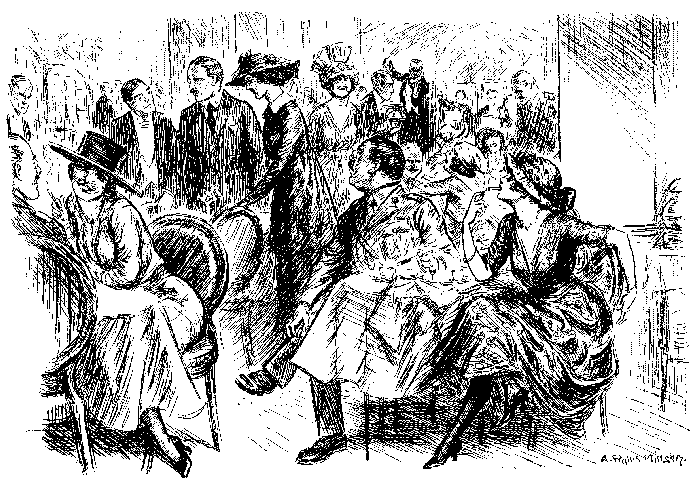
Uncle. "BY JOVE, THERE'S A NICE QUIET-LOOKING GIRL JUST COME IN. WONDER WHO SHE IS.' Niece. "HAVEN'T THE FOGGIEST. MUST BE PRE-WAR."