Volume 152 — THE SHERWOOD FORESTERS.
Reading edition
Deep in the greenwood year by year Bold Robin Hood, a knightly ghost, Has eased the purse that bulged the most And stalked the wraiths of Rufford deer; And, as the centuries speed away, Has seen his oak and birk-land shrink, Where teeming cities on its brink Crowd in on Sherwood of to-day. But still each year the outlaw-king, By Normanton and Perlethorpe spire, Has watched the beeches' emerald fire Flare upward in the leaping spring; Each heather-time has found his own Eyrie of rest where Higger Tor Shimmers in purple as before King Cœur-de-Lion held his throne. And Foresters away "out there," Sons of his sons, have surely seen A figure clad in Lincoln green Glide by them swiftly, thin as air; And, yarning in the creepy dark, Have told of arrows, cloth-yard long, Whistling before them clean and strong, Of Huns that got them, pierced and stark; How when their line is making good, In charge or trench, as Sherwoods can, Soft-footed, ever in the van, Stalks the bold ghost of Robin Hood.
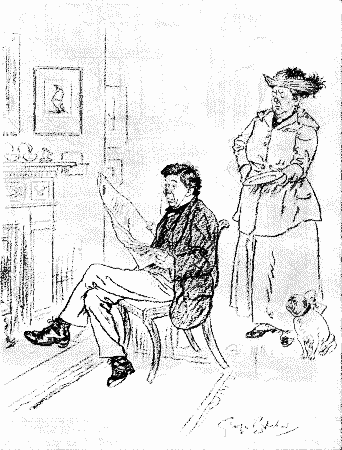
Mrs. Jones (suspiciously, to Jones, who is kept on strict rations). "Somebody has eaten Fido's dinner."
THE SECRETS OF HEROISM.
"Don't talk about heroism," said Sergeant William Bingley, "until you know what it is—and isn't.
"There were two men in my platoon over there that I'd match against any other two in the British, Allied, or Enemy armies for the biggest funks on earth; two boys from the same town, as unlike as cross-bred puppies, but cowards to the ankles.
"They were the only two that didn't volunteer for a listening picket one night, and I felt so ashamed of them that I decided to mention it.
"'You nickel-plated, glass-lined table-ornament,' I said to Ruggles when I found him alone, 'aren't you ashamed to form a rear rank alone with Jenks every time you're asked to do anything?'
"I knew they hated each other, and I thought I'd draw him, but he hadn't a word for himself.
"'Tell me what you joined for,' I said more persuasively, for he had been in the Army over a year. 'You're the only man in the company, bar your friend Jenks, that turns white at the pop of a cork out of a Worcester sauce bottle.'
"He stroked the bit of hair behind his right ear and let slip a grin like the London and Country mail slots at the G.P.O.
"'I'll tell you, Sergeant,' he said. 'I never had much heart for soldiering, and I only joined up when I did to spite the girl that jilted me. She jilted me for Jenks, and no sooner did she say the word to him than she talked him into enlisting too.... That's why I'm no good. Every time I remember I'm a soldier I think of her laughing at me, and I feel a fool.'
"'Well,' said I, 'she must be proud of you both, for you're the weariest, wonkiest pair of wash-outs I ever swore at.'
"I didn't send for Jenks; I could guess his excuse. He had obviously about as much spirit for fighting as Ruggles, and he was just hanging on and trying not to get hurt before the War stopped.
"We had a few weeks out of the trenches after my chat with Ruggles, and one afternoon I came upon them enjoying a hearty, homely, ten-round hit, kick, and scramble in a quiet corner near their billet. They looked as if they meant it, but they finished up in about ten minutes, hugging each other in six inches of mud. Ruggles got up first, and while he waited for Jenks he turned on his Little Tich smile. It worked; Jenks smiled too, and the rivals went off together like brothers.
"I said nothing, and forgot them again—clean forgot them, until, a week later, Jenks came to me in Number Seven with a yarn about a crater and a sniper, and might he go and perforate him.
"I had noticed the sniper myself, so I sent Jenks to chase a broom and picked my own men for this job that mattered. I'd no sooner done it than Ruggles marched up and asked to be made one of the party.
"I just stared at him, and his grin stretched half an inch each way.
"'I saw Jenks asking you,' he told me, 'and I won't be behind Jenks. Besides, it was me told him of the sniper.'
"'It's a change for you two to be worrying over snipers,' I said.
"'Well, you're not grumbling at that, are you, Sergeant?' said he.
"'I am not,' I said. 'And I hope you'll keep it up until we're relieved.'
"'You watch us,' he answered.
"I did. It was Ruggles that put his bayonet into the machine-gunner that had knocked out half the company. He took the last two bullets in his arm and side; and it was Jenks that put himself between Ruggles' head and the revolver that would have made pulp of it if Jenks hadn't got the hand that held it. He took the bullet in his cheek.
"I saw them in the dressing-station when the shouting was over. Ruggles was laughing at what Jenks's face would look like when it was out of bandages. The bullet had taken away about a third of an ear. Jenks was cursing because it hurt to laugh back.
"'Never mind,' I said to him with a wink at Ruggles, 'I warrant there's some little girl who won't laugh at you when you get back home. She has more to be proud of now than your face.'
"'Then you're wrong, Sergeant,' he answered quietly. 'She's changed her mind. She's his girl now.'
"I looked at Ruggles. He wouldn't catch my eye, but a blush was working round towards his neck.
"'And I've changed my mind too,' said Jenks. 'D'you think I'd have taken those risks I took to-day if there was a girl at home worrying over every casualty list? A man's a fool to risk breaking a heart to try to get a medal.'
"'Ay, that's the way you look at it,' said Ruggles, as red as beetroot. 'But I bet the Sergeant's glad she's changed her mind. I never knew your equal for a clammy coward, Jim, before she chucked you up.'
"Jenks began to look black. 'There were two of us, anyway,' he said.
"'P'r'aps there were,' Ruggles agreed cheerily. 'But what's the good of making a show of your soldiering unless there's someone at home looking on and caring?'"
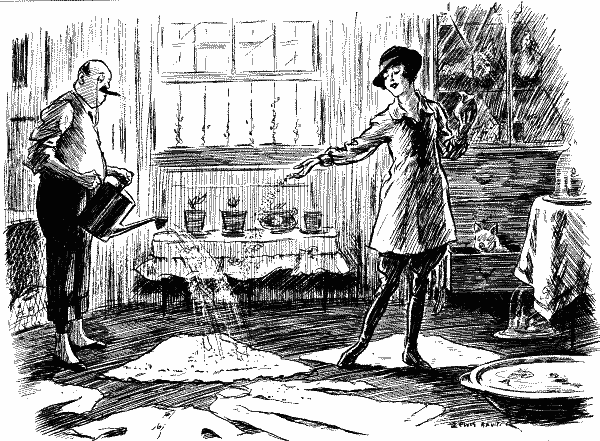
INTENSIVE CULTURE FOR FLAT-DWELLERS.
Sowing early mustard and cress on winter underclothing.
"The National War Savings Committee is issuing a two-penny cookery book, giving a host of simple remedies for economical dishes." Birmingham Daily Mail.
Some of them do upset the internal economy, no doubt.
"St. Quentin Canal, in spite of the damage reported to have been done to it by the Germans, will probably still be an important military obstacle. It is, for instance, when full of water, over eight feet deep." Daily News.
When full of beer it becomes absolutely impassable.
Extract from a regimental notice:—
"I am glad to inform you that a Special Order ... guarantees your admission to this Regiment on your release from the Postal Service.... If attested and passed into Class A for Service, you should apply to your Recruiting Officer, who will post you and forward you here on an A.F. B. 216."
An appropriate and convenient arrangement.
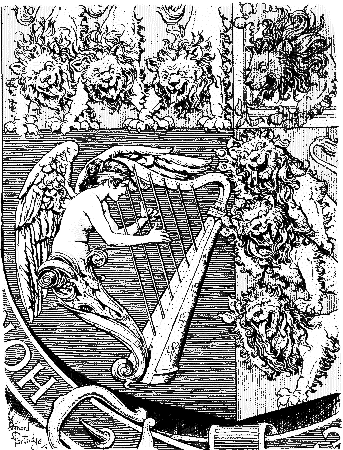
ERIN TAKES A TURN AT HER OWN HARP.
With Mr. Punch's sincere good wishes for the success of the Irish Convention.
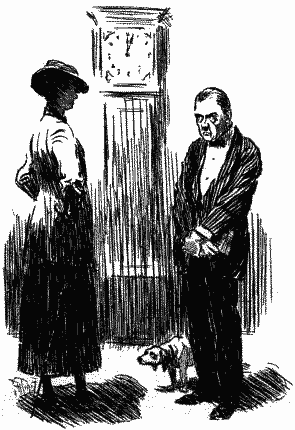
IN HAPPY DAYS TO COME.
Non-Politician (in remote country-house, to wife on her midnight return from county town). "Mabel, you've been voting."