Volume 152 — THE BREAKING OF THE FETTERS.
Reading edition
ELLA REEVE.
One can't be too careful how one boasts, especially if there is the chance of the boast being put quickly to the proof. In fact, it is better perhaps not to boast at all.
I was sitting with a friend and a stranger in a London restaurant, having joined their table for coffee. The stranger, on introduction, turned out to be connected with the stage in some capacity as agent, and among his regular clients were the managers of various big provincial theatres, for whom he provided the leading lights of pantomime, or, as he would call it, panto. Panto was indeed the mainstay of his business; it was even the warp and woof of his life. He lived for panto, he thought panto, and he talked panto. No one, according to him, had a more abysmal knowledge of principal boys with adequate legs, principal (if that is still the word) girls with sufficient voices, contralto fairy queens with abundant bosoms, basso demon kings, Prince Dandinis, Widow Twankays, Ugly Sisters, and all the other personages of this strange grease-paint mythology of ours. Listening to him, I learned—as those who are humble in spirit may learn of all men. I learned, for example, that Ugly Sisters are at Christmas-time always Ugly Sisters, and very often use again the same dialogue, merely transferring themselves from, say, Glasgow to Wigan, or from Bristol to Dublin; and this will be their destiny until they become such very old men that not even the kindly British public will stand it any longer. England, it seems, is full of performers who, touring the halls from March to December, are then claimed for panto as her own, arriving a little before Christmas not less regularly than the turkey; and the aim of all of them is as nearly as possible to do the next Christmas what they did last Christmas.
Not only did my new acquaintance know all these people, their capabilities and the lowest salary that could be offered to them with any chance of acceptance, but he was also, it seemed, beloved by them all. Between agent and client never in the history of the world had such charming relations subsisted as between every pro. on his books and himself.
It was then that Ella Reeve came in.
Accompanied by two expensive-looking men, whose ancestors had beyond any doubt crossed the Red Sea with Moses, this new and glittering star, who had but just "made good," or "got over," or "clicked" (my new acquaintance used all these phrases indiscriminately when referring to his own Herschellian triumphs as a watcher of the skies), walked confidently to a distant table which was being held in reserve for her party, and drew off her gloves with the happy anticipatory assurance of one who is about to lunch a little too well. (All this, I should say, happened before the War. I am reminded of it to-day by the circumstance that I have just heard of the death of the agent whom I then met.)
The impact of the lady on this gentleman was terrific.
"Look, look!" he said. "That's Ella Reeve, one of my discoveries. She was principal boy at Blackpool two years ago. I put her there. She got fifteen pounds a week, and to-day she gets two hundred. I spotted her in a chorus, asked her to call and see me, and this is the result. I made her. There's nothing she wouldn't do for me, she's so grateful. If she knew I was in the room she'd be over here in a jiffy."
Having told us all this, he, being a very normal man, told it again, all the while craning his neck in the hope that his old client (she had now, it seemed, passed out of his hands, having forsaken panto for London and revue) might catch sight of his dear face. But she was far too much occupied either with the lobster on her plate or with the yellow fluid, strange to me, that moved restlessly in a long-stemmed shallow glass at her side.
And then, being, as I say, not in any way an eccentric or exorbitant character, the agent told it us a third time, with a digression here and there as to the deep friendships that members of his profession could form and cement if only they were decent fellows and not mere money-grubbing machines out for nothing but their commission. "That's what the wise man does," he concluded; "he makes real friends with his clients, such as I did with Ella Reeve. The result is we never had any hitches, and there's nothing she wouldn't do for me. She's a darling!"
Getting a little tired of this, but obviously anything but unwilling to shake the new star's slender hand and listen to the vivacious flow of speech from such attractive lips, my friend said at last, "Well, as you and she are such pals, and as she has only to know that you are here to jump over the tables to get to you, why not send your card to her?"
The agent agreed, and we watched the waiter threading his way among the tables towards that one at which the new and grateful star was seated and hand the card to her.
The end of this story is so tragic that I should prefer not to tell it.
Ella Reeve took the card, read it, laid it down, and resumed conversation with her friends. She did not even glance in our direction.
I felt sorry for the agent, whose mortification was very real, though he made a brave effort to carry it off; and now that he is dead I feel sorrier. As for Ella Reeve (which is not really her name, but one which with great ingenuity I devised for her from the French: thus, Elle arrive) I often see her, under her true style, in her triumphs, and I always wonder whether her treatment of the agent, or his assurance of her dependence on his cordiality, represents more nearly the truth. She looks such a good sort. Some day, when the War is over, I must acquire a shiny tall hat and a glossy shirt front and a youthful manner and get someone to introduce me, and then, bit by bit, extract the truth.
Meanwhile the fact remains that it is dangerous to boast.
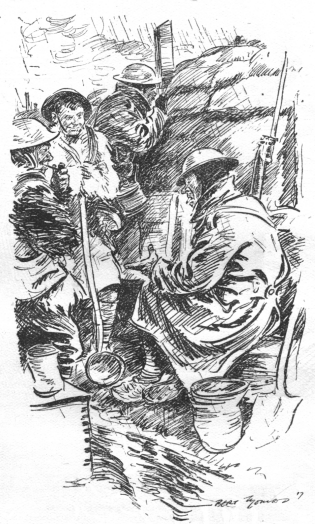
Tommy (back from Blighty). "YUS, I GRANT YER A BIT O' LEAVE'S ALL RIGHT. BUT IT'S AWFUL DEPRESSIN', TOO, AT HOME—NOTHIN' BUT WAR—WAR! IT GIVES YER THE FAIR 'UMP."
"JAPANESE POLITICS.
PRIME MINISTER'S ATTACK ON THE DIET."—Daily Paper.
We wouldn't be the Food Controller in Japan for anything.
"Wanted situation as Groom Coachman or Coachman General; disengaged early in March; can milk and care motor if required."—Irish Paper.
A modern improvement, we suppose, on "the cow with the iron tail."
"At a special meeting of the Duma held to-day, the Minister for Agriculture, M. Rittich, in reply to an urgent question on the measures for supplying Petrograd, stated the supplies were sufficient for the present. Difficulties in purchase are due to excessive building and storing by individuals in the shape of rusks."—Daily Chronicle.
No authority for this remarkable statement is given, but we suspect the Russky Invalid.
"A trifle of a trinket for his women-folk is the only saving as an insurance for the poor against famine and starvation for a rainless day."—A Native Writer in "The Times of India."
KIPLING was right, East is East and West is West.
"The undersigned has great pleasure in informing all the ladies, gentlemen and the other travellers in the Station that a very nice comfortable motor car can be obtained on hire from him for a walk in or out of the Station for any period of time at very reasonable charges."—Peshawar Daily News.
The petrol shortage evidently extends to India.
"Ireland is accustomed to disappointment; she is accustomed to what she signalises as betrayal, but her spirit remains unbroken, and she goes on her way undaunted to seek, it may be by new methods and a new road, her appointed gaol."—Manchester Guardian.
Irishmen may justifiably resent this cynicism on the part of an old friend.
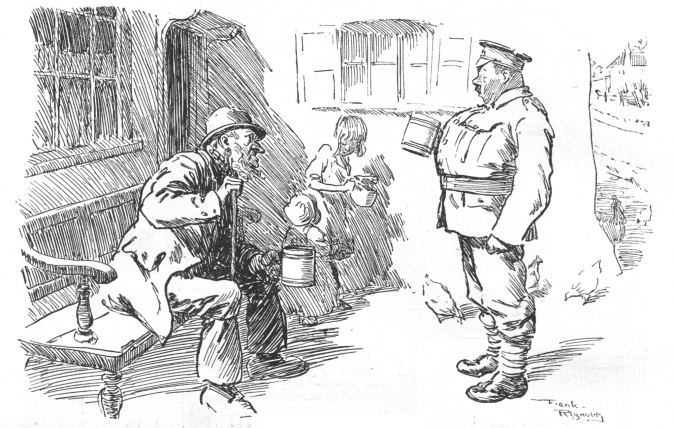
A MODIFIED SALIENT.
The Old 'Un (surveying recently called-up warrior). "WELL, JARGE, YOU'M STILL TURR'BLE FAT, BUT THE ARMY DO ZEEM TO 'AVE REARRANGED IT, LIKE."
GOLD BRAID.
Same old crossing, same old boat, Same old dust round Rouen way, Same old narsty one-franc note, Same old "Mercy, sivvoo play;" Same old scramble up the line, Same old 'orse-box, same old stror, Same old weather, wet or fine, Same old blooming War. Ho Lor, it isn't a dream, It's just as it used to be, every bit; Same old whistle and same old bang, And me to stay 'ere till I'm 'it. 'Twas up by Loos I got me first; I just dropped gently, crawled a yard And rested sickish, with a thirst— The 'eat, I thought, and smoking 'ard ... Then someone offers me a drink, What poets call "the cooling draft," And seeing 'im I done a think: "Blighty," I thinks—and laughed. I'm not a soldier natural, No more than most of us to-day; I runs a business with a pal (Meaning the Missis) Fulham way; Greengrocery—the cabbages And fruit and things I take meself, And she has daffs and crocuses A-smiling on a shelf. "Blighty," I thinks. The doctor knows; 'E talks of punctured damn-the-things. It's me for Blighty. Down I goes; I ain't a singer, but I sings; "Oh, 'oo goes 'ome?" I sort of 'ums; "Oh, 'oo's for dear old England's shores?" And by-and-by Southampton comes— "Blighty!" I says and roars. I s'pose I thort I done my bit; I s'pose I thort the War would stop; I saw myself a-getting fit With Missis at the little shop; The same like as it used to be, The same old markets, same old crowd. The same old marrers, same old me, But 'er as proud as proud.... The regiment is where it was, I'm in the same old ninth platoon; New faces most, and keen becos They 'ope the thing is ending soon; I ain't complaining, mind, but still, When later on some newish bloke Stops one and laughs, "A blighty, Bill," I'll wonder, "Where's the joke?" Same old trenches, same old view, Same old rats and just as tame, Same old dug-outs, nothing new, Same old smell, the very same, Same old bodies out in front, Same old strafe from 2 till 4, Same old scratching, same old 'unt, Same old bloody War. Ho Lor, it isn't a dream, It's just as it used to be, every bit; Same old whistle and same old bang And me out again to be 'it. A.A.M.
THE NEW POSTER.
"The important now development in the cotton situation is that the ½ Prime Minister has consented to receive a deputation."—Manchester Guardian.
All the same, he refused to adopt a ½ measure.
"The history of the development of the ¾eppelin is well-known."—Daily Chronicle.
Particularly since our airmen ceased to give it any quarter.
From an official notice of the sale of an enemy business:—
"Lot 2. The goodwill of the business of the company attaching to goods shipped from England to Nigeria, marked with the unregistered or common-law trade-marks known as 'Eagle on Rocks' and 'Lion and Flag.'"
We are not surprised to hear of the "Eagle on Rocks" when it had the "Lion and Flag" after it.
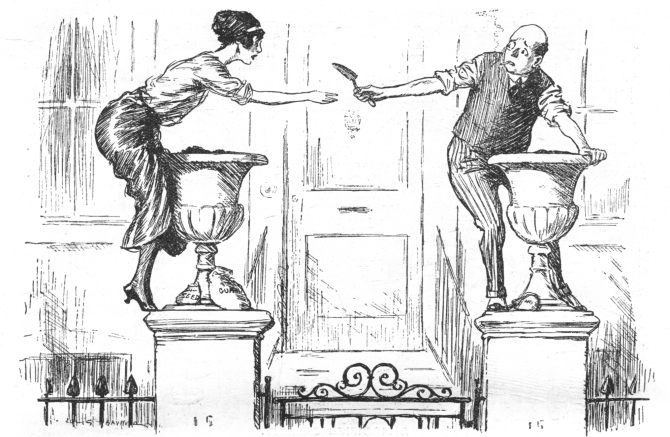
TILLERS OF THE SOIL.
STUDY OF URBAN DWELLERS PREPARING FOR THE WORST.
THE JOY-RIDER AT THE FRONT.
(Being a free version of Mr. BERNARD SHAW'S articles in "The Daily Chronicle" on his visit to the seat of War.)
"Since the good man, RAMSAY MACDONALD, while touring in the East Went out to shoot the tiger, that homicidal beast, The most electrifying humanitarian stunt Has been my khaki joy-ride along the British Front. "It wasn't my own suggestion; I went as the Government's guest, Invited to see how the brass-hats were running the show on the West; I've never been sweet on soldiers, but I only went for a week, And it gave me heaps of chances of studying war technique. "If they really thought to convert me by the loan of a khaki suit, Or by conferring upon me the right to claim a salute, It wouldn't at all surprise me, for dullards have always tried To bribe true men of genius to take the popular side. "Well, I went, I saw, I 'joy-rode,' and my verdict remains the same; There's no use having a country unless she's always to blame; For of all the appalling prospects that human life can lend The worst is to be unable to play the candid friend. "Men talk of France, the Martyr; of her precious blood outpoured; Of the innocent helpless victims of the brutal Hunnish horde; Presuming, insensate idiots, to label as beast and brute The race that has always held me in the very highest repute! "While France has failed completely, at least in those later days, To show appreciation of my Prefaces and Plays; It wouldn't be therefore worthy of a genuine superman To show undue compassion for the sorrows of 'Marianne.' "And as for the sheer destruction of noble and ancient fanes Which the prejudiced Hun-hater indignantly arraigns, The simple truth compels me in honesty to state That the style of some ruined buildings was utterly second-rate. "But to quit these trivial matters—let weaklings wail and weep, The loss of a few cathedrals will never affect my sleep— What lifts this Armageddon to an altitude sublime Is the crowning fact that it gave me a perfectly glorious time. "As an ultra-neutral observer I entered the battle zone And emerged unmoved, unshaken, with a heart as cool as a stone; No sight could touch or daunt me, no sound my soul untune; From pity or tears or sorrow I still remained immune. "I own that before my arrival I felt an occasional qualm Lest the shock of the unexpected might shatter my wonted calm; But it gave me the richest rapture to find I was wholly free From the crude and vulgar emotions that harass the plain V.C. "I inspected the great war-engine, and, instead of its going strong, I saw that in each of its workings there was always something wrong; In fact, with the old black powder and the obsolete Brown Bess The chances of missing your target were infinitely less. "The so-called arm of precision scores only by lucky hits, Though the 'heavies' and high explosives may possibly blow you to bits; I saw one corpse on my 'joy-ride,' the head had been blown away, And the thought of this painless ending produced in me no dismay." Now he's back in the finest feather from his holiday with the Staff, And we're sure that no one will grudge him the meed of this epitaph: "He went through the fiery furnace, but never a hair was missed From the heels of our most colossal Arch-Super-Egotist."
"GREAT WHITE SALE.
UNREPEATABLE BARGAINS IN LINGERIE."—Daily Paper.
We respect this reticence.
"The public are responding but slowly to the appeal of the Post Office to facilitate the delay of correspondence in London by using the new numbered addresses."—Daily Mail.
If that is really the object, why hurry?