Volume 152 — NURSERY RHYMES OF LONDON TOWN.
Reading edition
(Second Series.)
XVIII.
Bayswater.
The Bays came down to water— Neigh! Neigh! Neigh! And there they found the Brindled Mules— Bray! Bray! Bray! "How dare you muddy the Bays' water That was as clear as glass? How dare you drink of the Bays' water, You children of an Ass?" "Why shouldn't we muddy your water? Neigh! Neigh! Neigh! Why shouldn't we drink of your water, Pray, pray, pray? If our Sire was a Coster's Donkey Our Dam was a Golden Bay, And the Mules shall drink of the Bays' water Every other day!"
XIX.
Kentish Town.
As I jogged by a Kentish Town Delighting in the crops, I met a Gipsy hazel-brown With a basketful of hops. "You Sailor from the Dover Coast With your blue eyes full of ships, Carry my basket to the oast And I'll kiss you on the lips." Once she kissed me with a jest, Once with a tear— O where's the heart was in my breast And the ring was in my ear?
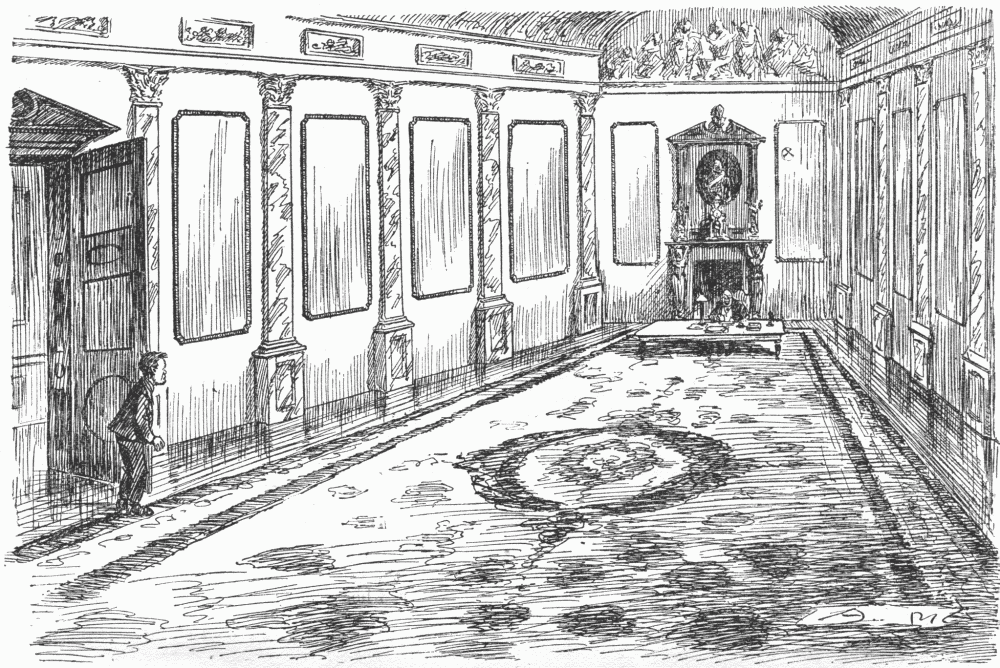
"Head of Government Department (in his private room in recently-commandeered hotel). "Boy! Bring some more coal!"
WAR'S ROMANCES.
[Now that fiction is occupying itself so much with military matters, it is necessary to warn the lady novelist—as it used to be necessary in other days to warn her in relation to sport—to cultivate accuracy. There is a constant danger that the popular story will include such passages as follow.]
"Corporal Cuthbert Crewdson," said the Colonel in a kindly voice, "your work has been very satisfactory—so much so that I have decided to promote you. From to-day you will no longer be Corporal, but Lance-Corporal." With a grateful smile our hero saluted and retired to draw his lance at the Adjutant's stores.
"Darling," cried the handsome young private, "I told the Colonel of our engagement, and he said at once I might bring you to tea at our Mess any Sunday afternoon."
One night, as Private Jones and the Sergeant-major were strolling arm-in-arm through the High Street...
"Remember," said the old Major, eyeing his eighteen-year-old subaltern son with a shrewd affectionate glance, "a little well-placed courtesy goes a long way. For instance, if a Sergeant should call you 'Sir,' never forget to say 'Sir' to him."
Osbert, his cane dangling from his left hand and with Mabel at his side, sailed proudly down Oxford Street. Suddenly a Tommy hove in sight. At once Osbert passed his stick to his other hand, leaving the left one free. The next moment the man was saluting, and Osbert, bringing up his left hand in acknowledgment, passed on.
"It is always well to be scrupulously correct in these little details," he explained.
Mildred, her heart beating rapidly, stood shyly behind the muslin curtain as George, looking very gallant in khaki, strode past the window with his frog hopping along at his side.
Sidney Bellairs, apparently so stern and unbending on parade, was adored by his men. Often he had been known, when acting as "orderly officer" (as the officer is called who has to keep order), to carry round with him a light camp-stool, which, with his unfailing charm of manner, he would offer to some weary sentry. "There, my boy, sit down," he would say, without a trace of condescension.
Lord Debenham succeeded because even in small things he could look ahead. "Ethelred," he would say to his batman, "there is to be a field-day to-morrow, so see that my haversack, water-bottle and slacks are put ready for me in the morning."
"Very good, my lord," the orderly would answer.
Marmaduke sprang forward. The Hun's bomb, its pin withdrawn, was about to explode. Coolly removing his costly gold-and-diamond tie-pin, he thrust this substitute into the appointed place in the terrible sizzling bomb, and stood back with a little smile. The next moment his General stepped towards him and pinned to his breast the Victoria Cross.
Colonel Blood belonged to the old school—irascible, even explosive, but at bottom a heart of gold. Often after thrashing a subaltern with his cane for some neglect of duty he would smile suddenly and invite the offender to dine with him at the Regimental Mess as if nothing had happened.
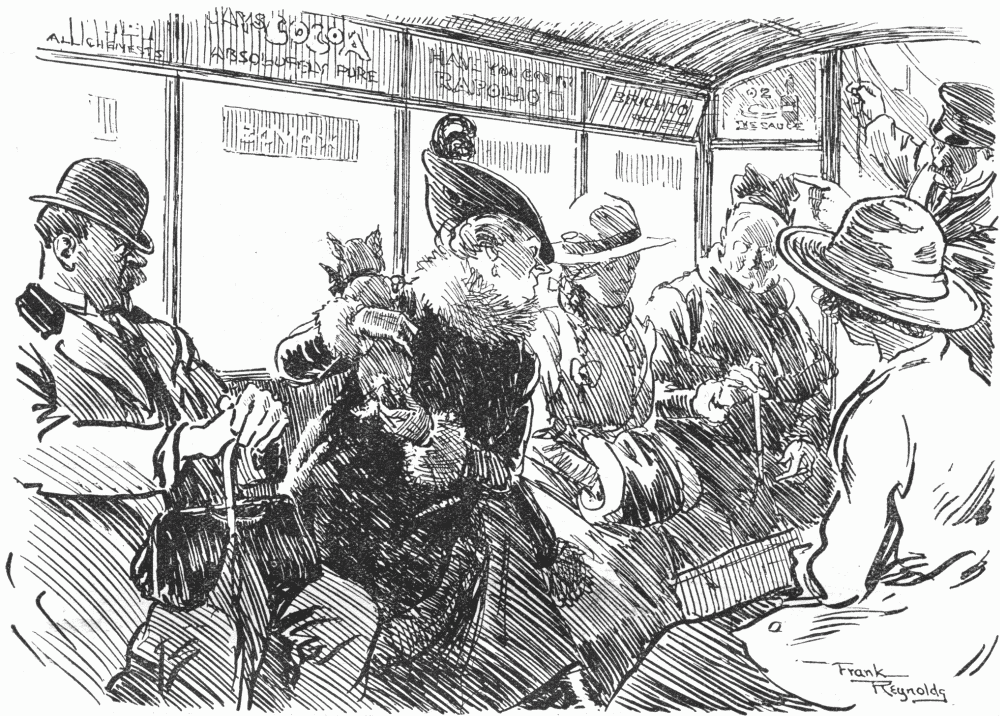
Lady (asking for the third time). "Have we reached No. 234 yet?"
Conductor. "Yes, Mum. Here you are." [Stops bus.]
Lady. "Oh, I didn't want to get out. I only wanted to show my little Fido where he was born."
A NEW DANGER.
"I don't know if you realise," said Ernest, "that since Army signalling became fashionable a new danger confronts us."
"If you mean that an enthusiast might start semaphoring unexpectedly in a confined space and get his neighbour in the eye, I may say that I have thought of it," I answered. "But it isn't worth worrying very much about. He wouldn't do it more than once."
"It isn't that," said Ernest. "It's something much more subtle and insidious. It is the growing tendency in ordinary conversation to use 'Ack' for A, 'Beer' for B, 'Emma' for M, 'Esses' for S, 'Toe' for T, etc. When you told me you were going to see your Aunt at 3 P.M., for instance, you said '3 Pip Emma.' And it isn't as if you were at all good at Semaphore or Morse either.
"Imagine," he continued, "the effect upon a congregation of the announcement from the pulpit that the Reverend John Smith, Beer Ack, will preach next Sunday. Or upon a meeting when told that Mr. Carrington Ponk, J. Pip, will now speak. Think of Aunt Jane and all her Societies," he went on gloomily. "Imagine her saying that she's going to an Esses Pip G. meeting to-morrow. It's a dreadful thought. It will extend to people's initials, too. The great T.P. will be Toe Pip O'Connor. Something will have to be done about it."
"There's only one thing to be done," I said. "You must get into Parliament and bring in a Bill about it. All might yet be well if you were an Emma Pip."
The Hungry Huns.
"The Berliner Tageblatt's correspondent states that the ground at St. Pierre Vaast has been converted into a marsh in which half-frozen soldiers, wet to the skin and knee-deep in mud, absorb the shells." —New Zealand Paper.
"The dispute, he claimed, was not started by the employees, but by the employer making sweeping reductions in the ages of the men." —Daily Paper.
If he wants to do this sort of thing with impunity he should employ women.
A Food Problem.
Dear Mr. Punch,—Please do tell me. Must I count sausages under the meat or the bread allowance? I do so want to help my country faithfully. —Yours, Worried Housewife.
"Reward 2s. 6d. Lost, a small Silver Toothpick, value sentimental." —Nottingham Evening Post.
The latest thing in love-tokens.
"After a debate lasting three days, the Senate rejected the motion approving Mr. Wilson's Nose."—The Bulletin (Lahore).
The Senate has since shown its impartiality by registering its profound disapproval of the Kaiser's Cheek.
"A special constable has received the Silver Medal of the Society for Protection of Life from fire for his gallantry in mounting a ladder at a local fire last May and rescuing a cook."—Daily Paper.
It is understood that members of the regular "force" consider that he showed some presumption in not leaving this particular task to them.
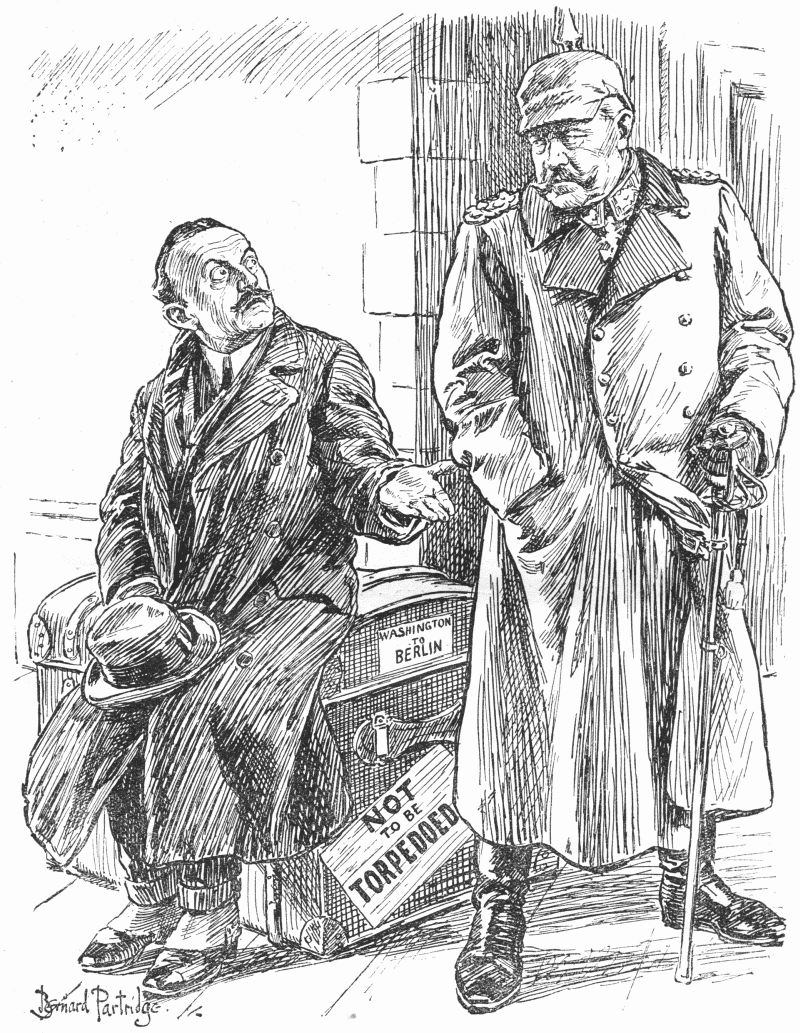
BLIGHTED PROSPECTS.
Bernstorff (bitterly). "PRETTY MESS YOU'VE MADE OF IT WITH YOUR NEW FRIGHTFULNESS. I'VE LOST MY JOB!"
Hindenburg (also bitterly). "WELL, YOU'RE WELCOME TO MINE."
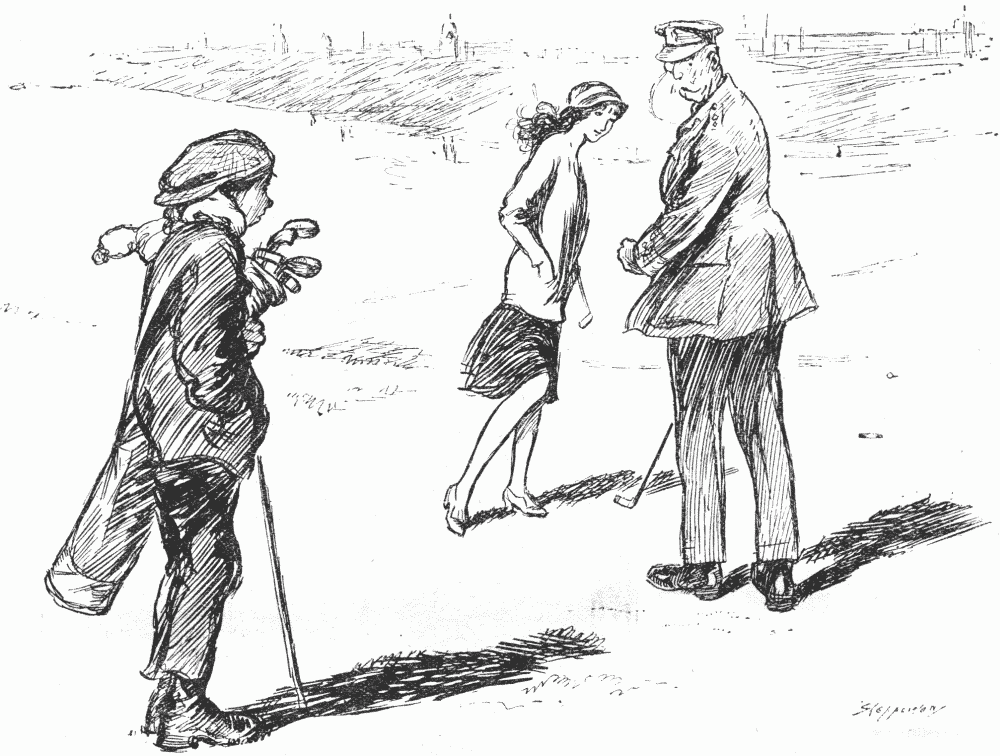
Dug-out (who has been put off on the last three greens by his caddie sneezing, and has now foozled his putt again). "Confound you! Why didn't you sneeze? I was counting on it."