Volume 152 — SPOOP.
Reading edition
A REPERTORY DRAMA IN ONE ACT.
["A repertory play is one that is unlikely to be repeated."—Old Saying.]
CHARACTERS.
John Bullyum, J.P. (Member of the Town Council of Mudslush). Mrs. Bullyum (his wife). Janet (their daughter). David (their son).
SCENE.—The living-room of a smallish house in the dullest street of a provincial suburb. [N.B.—This merely means that practically any scenery will do, provided the wall-paper is sufficiently hideous. Furnish with the scourings of the property-room—a great convenience for Sunday evening productions.] The room contains rather less than the usual allowance of doors and windows, thus demonstrating a fine contempt for stage traditions. An electric-light, disguised within a mid-Victorian gas-globe, occupies a conspicuous position on one wall. You will see why presently. When the curtain rises Janet, an awkward girl of any age over thirty (and made up to look it) is seated before the fire knitting. Her mother, also knitting, faces her. The appearance of the elder woman contains a very careful suggestion of the nearest this kind of play ever gets to low-comedy.
Janet (glancing at clock on mantelpiece). It's close on nine. David is late again.
Mrs. B. He's aye late these nights. 'Tis the lectures at the Institute that keeps him.
[N.B.—Naturally both women speak with a pronounced accent, South Lancashire if possible. Failing that, anything sufficiently unlike ordinary English will serve.
Janet. He's that anxious to get on, is David.
Mrs. B. Ay, he's fair set on being a town councillor one day, like thy feyther.
Janet (quietly). That 'ud be fine.
Mrs. B. You'd a rare long meeting at the women's guild to-night.
Janet (without emotion). Ay. They've elected me to go to Manchester on the deputation.
Mrs. B. You'll like that.
Janet (suppressing a secret pride so that it is wholly imperceptible by the audience). It'll be well enough. I'm to go first-class. (A pause.) Young Mr. Inkslinger is going too.
Mrs. B. (with interest). Can they spare him from the boot-shop?
Janet. He's left them. He's writing a play.
Mrs. B. (concerned). Dear, dear! And he used to be such a steady young fellow.
[All that matters in their conversation is now finished, but as the play has got to be filled up they continue to talk for some ten minutes longer. At the end of that time—
Janet (glancing at clock again). It's half-past nine, and neither of they men back yet.
[Which means that, while the attention of the audience was diverted, the stage-manager must have twiddled the clock-hands round from behind. This is called realism.
Mrs. B. Listen! Yer feyther's comin' now.
[A door in the far distance is heard to bang. At the same instant John Bullyum enters quickly. He is the typical British parent of repertory; that is to say, he has iron-grey hair, a chin beard, a lie-down collar, and the rest of his appearance is a cross between a gamekeeper and an undertaker.
Bullyum (He is evidently in a state of some excitement; speaks scornfully). Well, here's a fine thing happened.
Mrs. B. What is it, feyther?
Bully, (showing letter). That young puppy, Inkslinger, had the impudence to write me asking for our Janet. But I've told him off to rights. He's nobbut a boot-builder.
Janet (in a level voice). Ye're wrong there, feyther. Bob Inkslinger's a dramatist now.
Bully, (thunderstruck). What?
Janet (as before). He's had a play taken by the Sad Sundays Society.
Bully. Great Powers, a repertory dramatist! And I've insulted him!—me, a town councillor. (He has grown white to the lips; this is not easy, but can be managed.) There'll be a play about me—about us, this house—everything. But (passionately) I'll thwart him yet. Janet, my girl, do thee write at once and say that I withdraw my opposition to the engagement.
Janet (dully). But I don't want the man.
Bully, (hectoring). Am I your feyther or am I not? I tell you you shall marry him. And what's more, he shan't find us what he looks for. No, no (with rising agitation), he thinks that because I'm a town councillor I'm to be made game of, does he? Well, I'll learn him different! (Glaring round) This room—it's got to be changed. And you (to Janet) put on a short frock, something lively and up-to-date—d' ye hear? At once!
Mrs. B. (as Janet only stares without moving). Well, I never.
Bully. And let's have some books about the place—BERNARD SHAW—
Janet (icily). He's a back number now, feyther.
Bully. Well, whoever's the latest. Then you must go to plays and dances, lots of dances. (Struck with an idea) Where's David?
[As he speaks David enters, a tall ungainly youth with spectacles and a projecting brow.
David. Here I yam, feyther.
Bully. It's close on ten. (Hopefully) Have ye been at a night-club?
David. I were kept late at evenin' class.
Bully. Brr! (In an ecstasy of fury) See ye belong to a night-club before the week's out. (He does his glare again.) I'll establish frivolity and a spirit of modernism in this household, if I have to take the stick to every member of it.
Janet (springing up suddenly). Feyther! (A pause; she collects herself for her big effort.) Feyther, I'm one o' they dour silent girls to whom expression comes hardly, but (with veiled menace) when it does come it means fifteen minutes' unrelieved monologue. So tak' heed. We're not wanting these changes, and to be up-to-date, and all that. I'm happy as I am, and so's David. He has his hope of the council, and the bribes and them things. And I've my guild and my friends, with their odd clothes and variable accents. That's the life I want, and I won't change it. I won't—
[Quite suddenly she breaks from them and rushes out of the room, slamming the door after her. The others remain silent, apparently from emotion, but really to see if there will be any applause. When this is settled in the negative old Bullyum speaks again.
Bully, (slowly and as if with an immense effort). Why couldn't she wait?... She might have known we wouldn't decide anything—that we never do decide anything—because it would be too much like a rounded climax. Well (rousing himself), let's put out the gas. [He moves heavily towards the conspicuous bracket.
David (protesting). But, feyther, 'tisn't near time for bed yet.
Bully, (grimly). Maybe; but 'tis more than time play was finished. And this is how.
[He turns the tap. A few moments later the light is switched off with a faintly audible click, and upon a stage in total darkness the curtain falls.
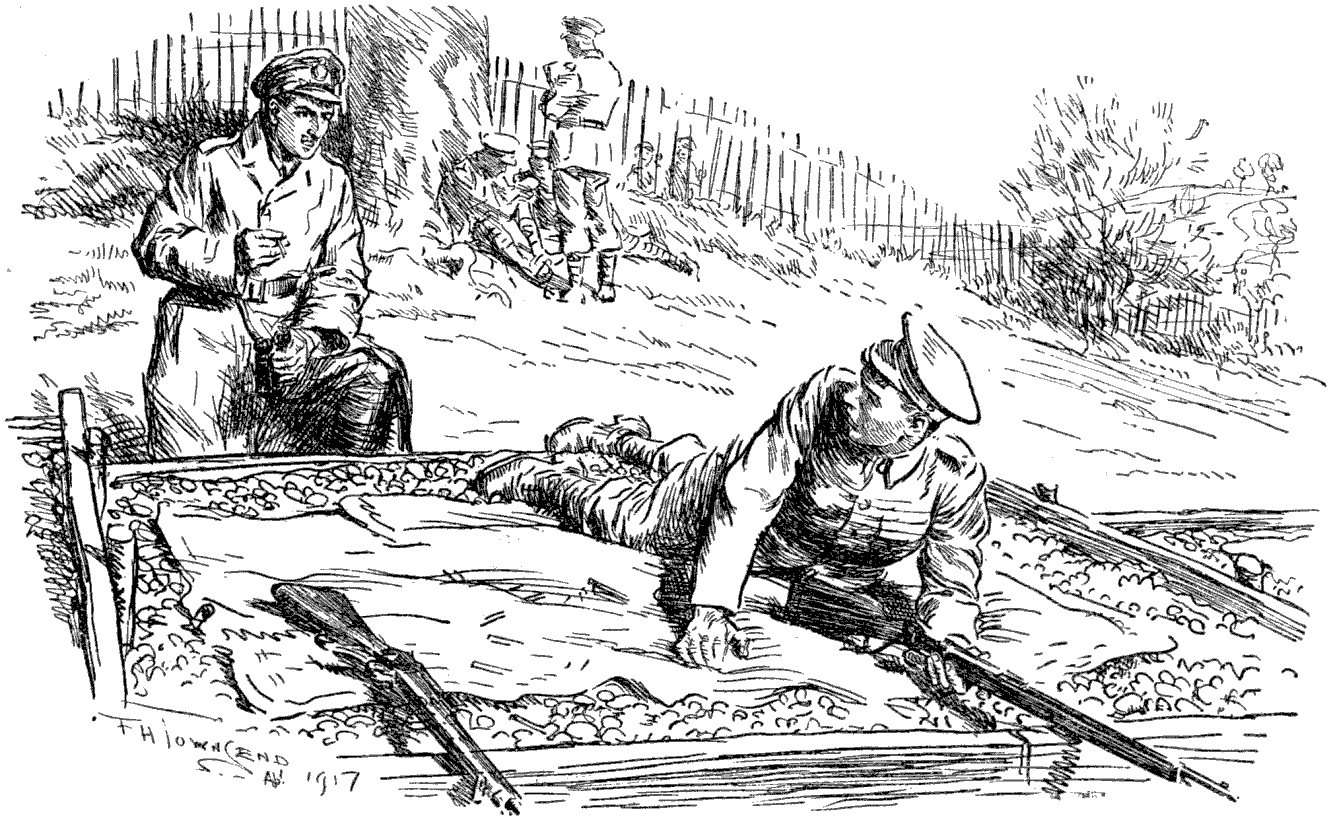
Officer (anxious to pass his recruit who is not shooting well). "DO YOU SMOKE MUCH?"
Recruit. "ABOUT A PACKET OF WOODBINES A DAY, SIR."
Officer. "DO YOU INHALE?" Recruit. "NOT MORE THAN A PINT A DAY, SIR."
THE WOBBLER.
My friend, whom for the purpose of concealing his identity I will call Wiggles, opened fire upon me on March 1st (coming in like a lion) with this:
"DEAR WILLIAM,—I have not been well and my doctor thinks it might do me good to come to Cornwall for a few weeks. May I invite myself to stay with you?..."
I accepted his invitation, if I may put it so, and on March 6th received the following:—
"DEAR WILLIAM,—I am not, as I think I said, at all well, and my doctor considers I had better break the journey at Plymouth, as it is a long way from Malvern to Cornwall. Would you recommend me some hotels to choose from? I hope to start by the middle of the month ..."
I recommended hotels, and on the 12th heard from him again:—
"DEAR WILLIAM,—I am very obliged to you. In this severe weather my doctor says that I cannot be too careful, and I doubt if I shall be able to start for ten days or so. Has your house a south aspect, and is it far from the sea? I require air but not wind. And could you tell me ..."
I told him all right, though as a guest I began to think him a little exigeant. But he was unwell.
On the 17th he answered me:—
"DEAR WILLIAM,—I understand you live quite in the country. Would you tell me whether a doctor lives near to you and whether you have a chemist within reasonable distance? My doctor, who really understands my case, won't hear of my starting until the wind changes: but I hope ..."
I drew a map showing my house, the nearest chemist's shop, the doctor's surgery and a few other points of interest, such as Land's End and the Lizard. This I sent to him, and on the 22nd he replied:—
"DEAR WILLIAM,—I acknowledge your map with many thanks. There is one more thing. My doctor insists on a very special diet. Can your cook make porridge? I rely very largely on porridge for breakfast and ..."
I saw myself smiling at Lord DEVONPORT and wired back, "Have you ever known a cook who couldn't make porridge?"
And on the 27th he issued his ultimatum:—
"DEAR WILLIAM,—I have consulted my doctor and he thinks I ought not to tempt Providence by travelling at present, so I have decided to remain in Malvern. I do hope ..."
To this I replied:—
"DEAR WIGGLES,—Holding as you do the old pagan view of Providence, you are quite right not to tempt it. The loss is mine. I hope you will soon be rather less unwell."
Then I went away for three days without leaving an address, and when I returned it was to learn that Wiggles had arrived on the previous evening. And in my study I found him, together with four wires (two to say he wasn't coming and two to say he was) and a table loaded with prescriptions.
He eats enormously.
INKOMANIA.
(Suggested by Mr. SIMONIS' recently published volume.)
O Street of Ink, O Street of Ink, Where printers and machinsts swink Amid the buzz and hum and clink; By night one cannot sleep a wink, There is no time to stop or think, One half forgets to eat or drink, One's brains are knotted in a kink, One always lives upon the brink Of "happenings" that strike one pink. One day the dollars gaily chink, The next your funds to zero shrink. And yet I'm such a perfect ninc- Ompoop I cannot break the link That binds me to the Street of Ink.
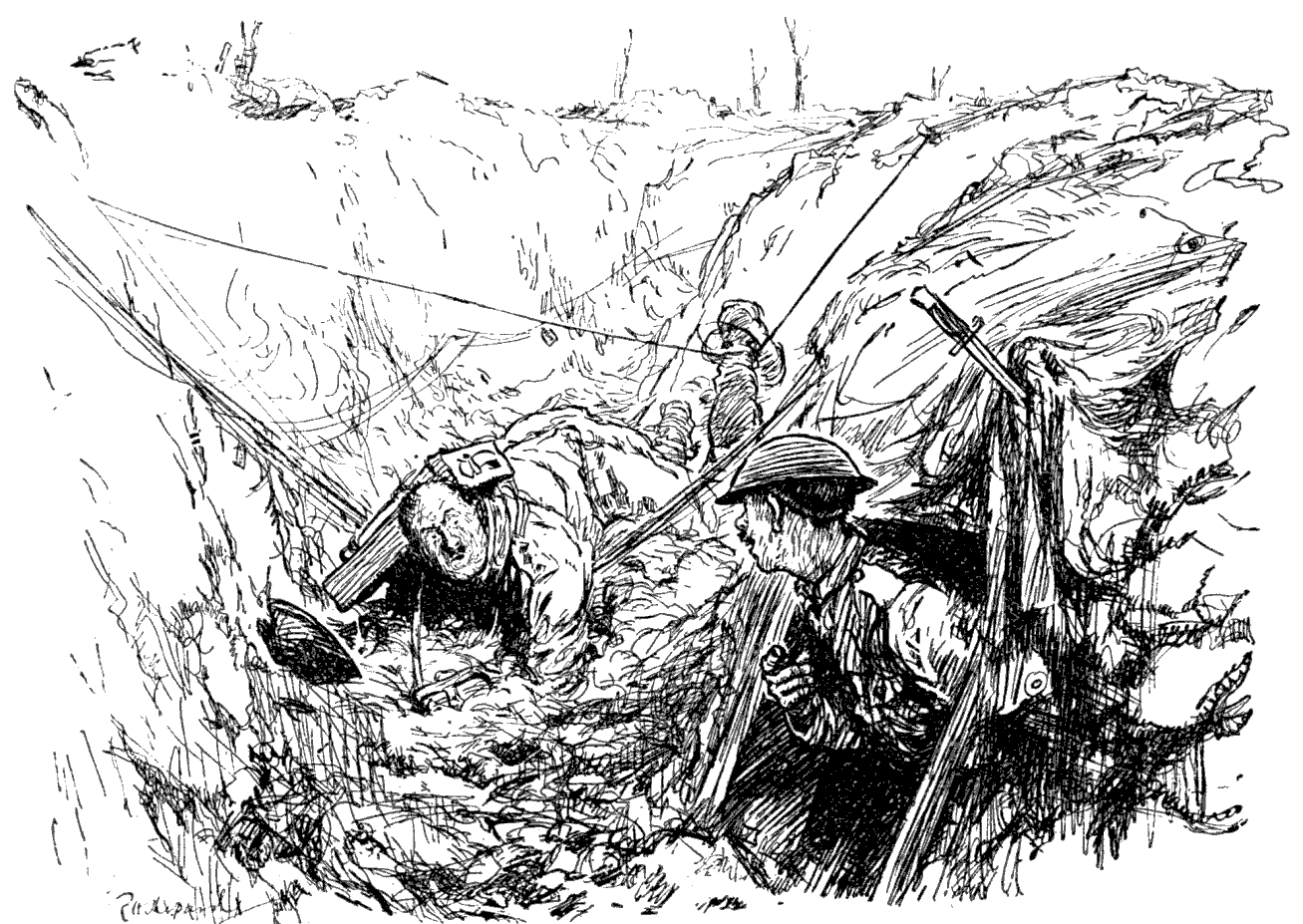
Tommy (to Officer who has only arrived in the trench by accident). "IF YOU'RE A-LOOKIN' FOR THE BURIED CABLE, SIR, IT'S FURTHER ALONG."
CHILDREN'S TALES FOR GROWN-UPS.
VI.
THE CAT AND THE KING.
The cat looked at the King.
She was the boldest cat in the world, but her heart stood still as she vindicated the immemorial right of her race.
What would the King say? What would the King do?
Would he call her up to sit on his royal shoulder? If so, she would purr her loudest to drown the beating of her heart, and she would rub her head against the royal ear. How splendid to be a royal cat!
Or perhaps he would appoint her Mouser to the King's Household, and she would keep the King's peace with tooth and claw.
Or perhaps she would become playmate to the Royal children, and live on cream and sleep all day on a silken cushion.
Or—and this is where her heart ceased to beat—perhaps she would pay the price of her temerity and the Hereditary Executioner would smite off her head.
She had put it boldly to the test, to sink or swim. What would the King do?
The King rose slowly from his throne and passed out to his own apartments, whilst all the Court bowed.
The King had not noticed the cat.
The Ruling Passion.
"A Russian official accredited to this country, in an interview with a representative of the Morning Post yesterday, said:—Potatoes."— Evening Times and Echo (Bristol).
"I could well enter into the feelings of this lad's colonel when, with a lint in his eye, he descrihimbed as 'a riceless youngster.'"—Civil and Military Gazette.
We fear that the insertion of the bandage in the colonel's eye must have prevented him from forming a true appreciation of the young fellow.
Headline to a leading article in The Evening News:—
"WATCH ITALY AND RUSSIA."
Extract from same:—
"We ought to keep our eyes fixed on the Western front."
Correspondents should address their inquiries to Carmelite, Squinting House Square.
HERBS OF GRACE.
VI.
ROSEMARY.
Whenas on summer days I see That sacred herb, the Rosemary, The which, since once Our Lady threw Upon its flow'rs her robe of blue, Has never shown them white again, But still in blue doth dress them— Then, oh, then I think upon old friends and bless them. And when beside my winter fire I feel its fragrant leaves suspire, Hung from my hearth-beam on a hook, Or laid within a quiet book There to awake dear ghosts of men When pages ope that press them— Then, oh, then I think upon old friends and bless them. The gentle Rosemary, I wis, Is Friendship's herb and Memory's. Ah, ye whom this small herb of grace Brings back, yet brings not face to face, Yea, all who read these lines I pen, Would ye for truth confess them? Then, oh, then Think upon old friends and bless them.
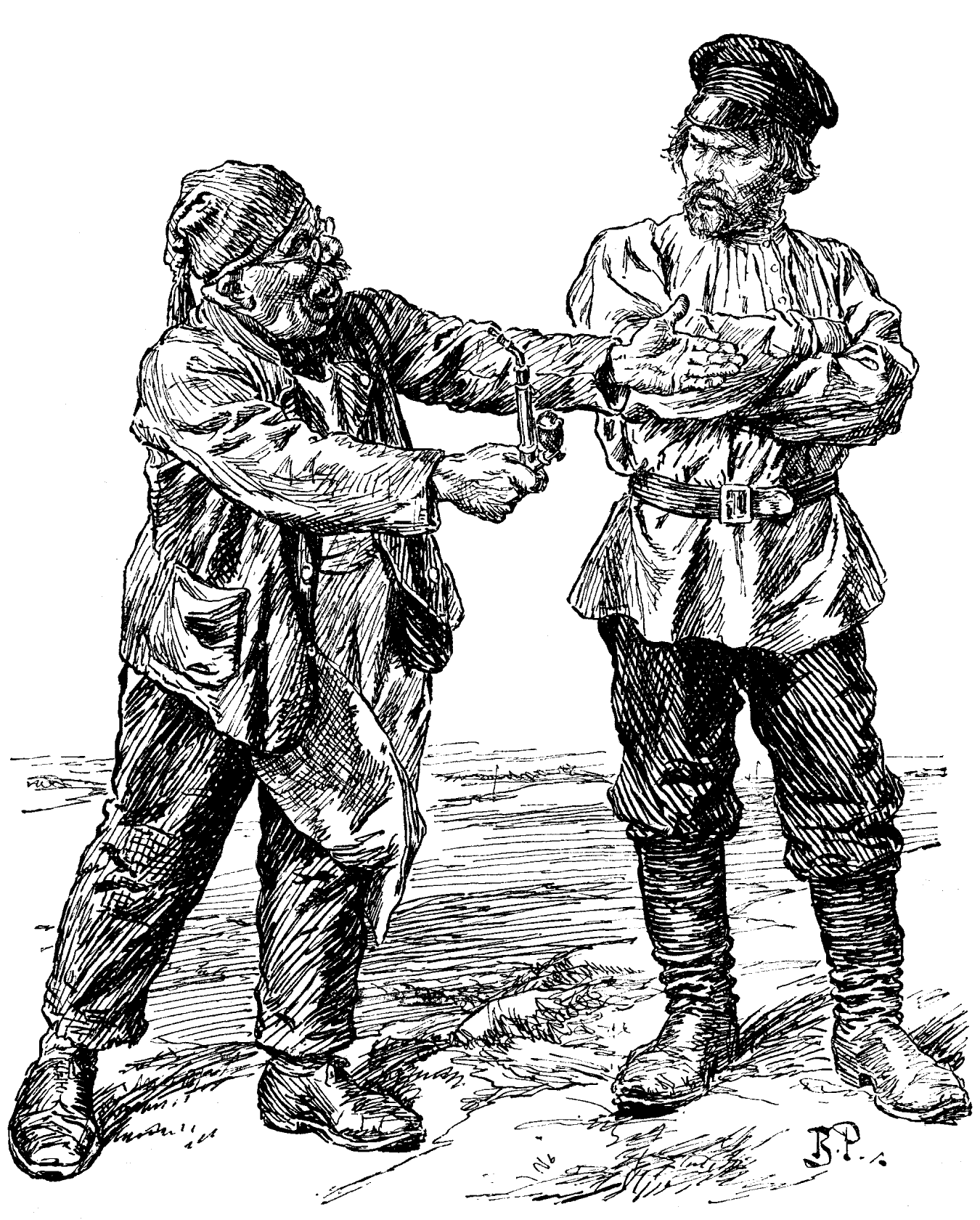
VICTORY FIRST.
GERMAN SOCIALIST. "I HOLD OUT MY HANDS TO YOU, COMRADE!"
RUSSIAN REVOLUTIONARY. "HOLD THEM UP, AND THEN I MAY TALK TO YOU."
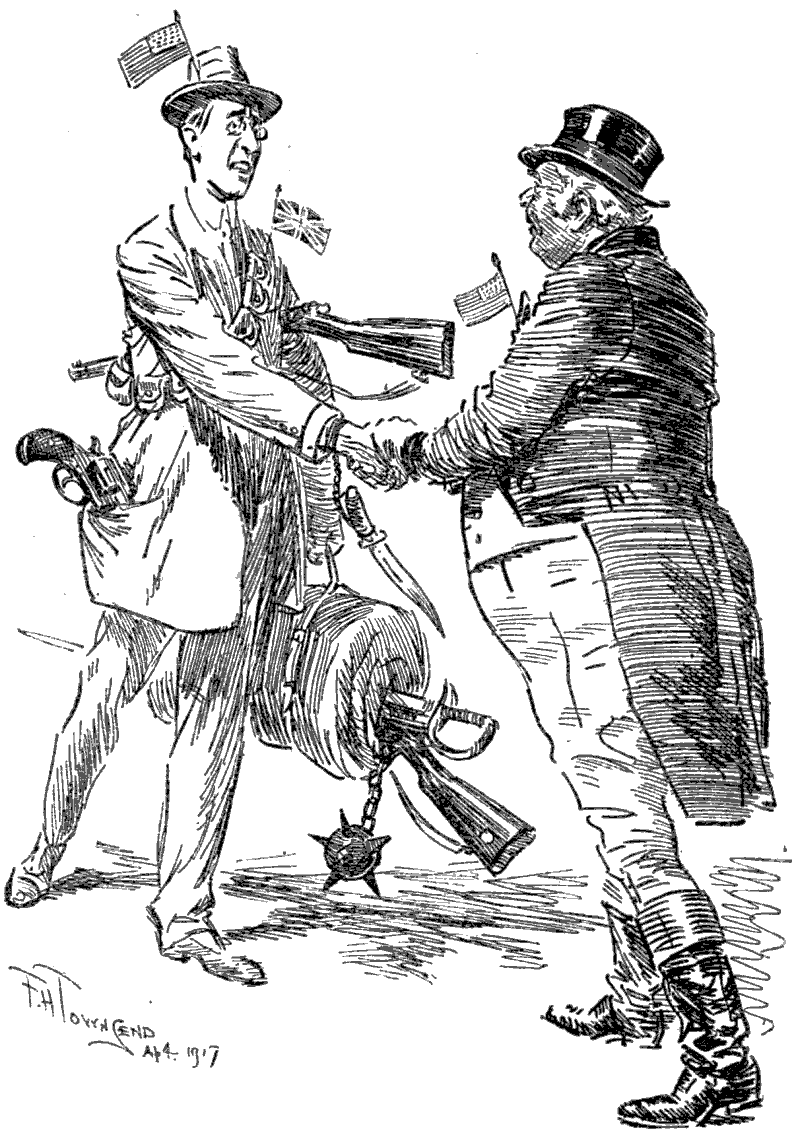
THE UNITED STATES OF GREAT BRITAIN AND AMERICA.
John Bull (to President Wilson). "BRAVO, SIR! DELIGHTED TO HAVE YOU ON OUR SIDE."