Volume 150 — AT THE PLAY.
Reading edition
"Please Help Emily."
The date at which Emily needed so much assistance was clearly ante bellum, for there is no mention of hostilities, no gun-fire is heard from the direction of Westende, and Belgium is still bathing. But it must have been only just before the War, for the emancipation which the female sex here enjoys is marked by an extreme modernity. A decade or two ago we might have been shocked at the spectacle of a young lady turning up at a bachelor's flat at 9 A.M. on a Sunday in a ball-frock, after a night out at a dancing-club. Lately we have learnt to bear such escapades without flinching. But it was not so with Emily's guardian, Sir Samuel Lethbridge, very Victorian in his stuffy prejudice in favour of the decencies; and it was necessary to put him off with a tale of her sudden departure to Brussels to render first aid to an aunt stricken with mumps. In order to give colour to this fabrication Emily urges Dick Trotter, the bachelor of the flat (as soon as he returns from his own night out), to conduct her to the alleged invalid. He consents, but not without protest, for he is a roué of the old school and cannot approve of these platonic adventures; besides, he is about to se ranger by marriage with somebody else and (a matter of detail, but most inconvenient) is under contract to take her to Brighton for the day.
A fairly preposterous start, you will say; yet the delightful naturalness which Miss Gladys Cooper and Mr. Charles Hawtrey bring to the situation gives it almost an air of possibility. But, once we are at Ostend, and have been introduced to Trotter's incredibly inappropriate fiancée (she is a niece of the same aunt and has followed under protection of a tame escort), we are prepared to launch freely and fearlessly into the rough and tumble of farce.
It is in vain that Miss Gladys Cooper, over her petit déjeuner, preserves a natural demeanour, even to the point of talking with her mouth full; the light humour of the First Act declines to the verge of buffoonery. The devastating confusions which ensue in the matter of identity and relationship (in our author's Ostend you assume, till corrected, that all couples are married); the intervention of the local gendarmerie, headed by a British detective; the arrest of half the party (including the aunt, arrived in perfect health and ignorance en route for England) on a nameless charge in connection with Emily's suspected abduction—all this is in the best Criterion manner.
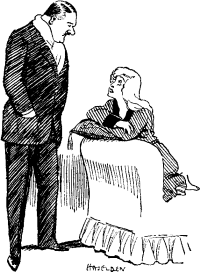
EMILY GIVES DICK THE GLADYS EYE.
Richard Trotter Mr. Charles Hawtrey.
Emily Delmar Miss Gladys Cooper.
In the Third Act, though we never recover the rapture of the First, the humour touches a higher level; but what it gains in finesse it loses in spontaneity. Here we meet Emily's father, returned from lecturing in the States on social ethics. The scandal of his daughter's conduct leaves him indifferent, for a long and varied experience of the morals of many lands, in the course of which he has married as many as eighteen wives, having made a point of adopting for the time being the system—polygamous or other—of the country in which he happens to find himself, has taught him that nothing is right or wrong except as local opinion makes it so. We are allowed to gather that heredity may have had some influence in the moulding of Emily's character; and if we may hope for its continuance into the next generation there seems every prospect that the children she may bear to Trotter (now released from Julia and free to marry the right woman) will not have their development hampered by excess of prudery.
Mr. Charles Hawtrey as Trotter played with his old easy skill and seemed to take a more than usual interest in the play. He was supported (as they say) by a particularly brilliant cast, including Miss Lottie Venne as the aunt, Mr. Eric Lewis as Emily's father, Mr. Frederick Kerr as Sir Samuel, Miss Helen Haye in the thankless part of Julia, and Mr. Nigel Playfair as a self-effacing phantom of a lover. All were in great form; but, next to Miss Gladys Cooper, whose natural charm and ingenuous espièglerie were a perpetual delight, I offer my profoundest compliments to the short but extraordinarily clever performance of Mr. H. R. Hignett as Trotter's man Francis. This is the day of stage valets, but he was an exceptional treasure. To a quiet taste for philosophy he added an infinite tact; and by the lies which he poured into the telephone to cover his master's breach of engagement to Julia he moved Emily, herself a gifted artist, to admiration.
The author, Mr. H. M. Harwood, must be congratulated on a farce that at its best was really excellent fun. And he may take it for flattery, if he likes, when I say that a good deal of his dialogue might be adapted into the French without offending our gallant Allies on the ground of a too insular squeamishness.
O. S.
THE INDURATION.
Think not, dear love, because my cheek With grief grows neither grey nor hollow, Because no pharmacist I seek In quest of arsenic to swallow, Because I do not wince and weep By day and night for cardiac pains, That my fond passion falls on sleep, Or, secondly, my worship wanes. For these are strenuous days of strife That steel the soul of every Briton; Sterner and stronger grows our life Till simple bards become hard-bitten; So when, each Thursday, I propose (As usual) to wed my fair, I frankly find her changeless "No's" Not half so poignant as they were.
From an almanack of appropriate quotations:—
"January 27. Thursday. German Emperor born, 1859. O welcome, pure-ey'd Faith, white-handed Hope, Thou hovering angel, girt with golden wings.—Milton."
"If men well up in years would cultivate a habit of breathing properly and always holding themselves erect when walking and sitting, we would find fewer elderly people bent double when we do."—Daily Express.
Our gay contemporary has been caught bending on this occasion.
"He asked the Government not to muzzle the ox that laid golden eggs."—The Daily Argosy (Demerara).
It wasn't really an ox; it was a bull.
From a country retail chemist's appeal to the Local Tribunal for his son's exemption from Military Service:
"I cannot dispense with him"—or, presumably, without him.
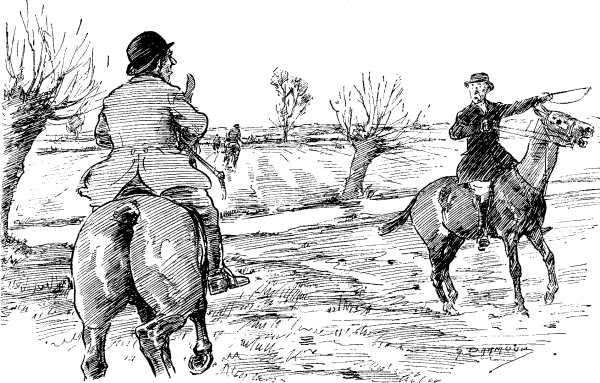
ONCE BIT, TWICE SHY.
Sporting Lawyer. "If you'll take my advice you'll come to the bridge!"
Old Farmer. "Na fear! Six-and-eightpence for t' advice? I'd rather chance a duckin'."