Volume 107 — INS AND OUTS.
Reading edition
"Cricket was a far superior game to golf or tennis," said Lord Knutsford to the members of the Victoria Park Cricket Association; and he went on to tell a story of the first introduction of cricket to Tonga, one of the Pacific Islands. Everybody took up the game so heartily that State affairs were allowed to slide altogether, and at last the King of Tonga had to lay down rules as to the times when the game might be indulged in. "Even then the Prime Minister was with difficulty prevented from bowling during forbidden hours." For Tonga read Westminster—where a good deal of tongue—ah!—goes on—and we get a result something like this:—
"After the usual luncheon interval, the Leader of the Opposition and the ex-Umpire-General faced the delivery of the First Commissioner of Stumps and the Scorin' Secretary. The punishment inflicted by the former on the bowling led to a Cabinet crisis, ending in the Secretary of State resigning his office and the leather to the Lord High Wicket-keep. The result of this change was soon apparent, for the Leader of the Opposition was clean bowled by a quotation from Hansard, and his place was taken by a prominent member from below the Opposition Gangway.
"As the score still mounted, the Ministry decided to apply the Closure to the game, an effort which was resisted by the whole force of the Opposition, armed with pads and wickets. During the all-night innings which ensued the Prime Minister retired hurt, and the Ministry were finally driven into the Pavilion, where they expressed a decided intention, in consequence of the underhand bowling of their opponents, of at once appealing to the country. The Committee of Lords' has placed its veto on these disorderly proceedings, and 'Down with the Lords' is likely to be the Ministerial rallying-cry during the forthcoming Election."
A Literary Discovery.—It has been hitherto thought that only two "G. O. M.'s" existed, the one, par excellence, being The G. O. M., and the other, the Right Hon. G. O. Morgan. But there is a third, and he is Ge-o M(eredith). No more at present.
Title for a Temperance Tale.—Under the Red Nose!
THE DAY OF SMALL THINGS. No novels now, but novelettes; Cigars give place to cigarettes. Titanic "suns" to twinkling "stars," Pictures to sketches, "pomes" to "pars"; Bonnets to things like housemaids' caps, Banquets to tit-bits, books to scraps, And three-vol novels to "short stories." Gibbon-like length and epic glories, Like mammoths and cave-bears, are gone, Earth brings not back the mastodon; The microbe takes its place. They kill us Not by a giant, but bacillus. Monsters, huge dragons, Laidly Worms, We fear no more, 'tis unseen "germs" That floor us in our life's full pride. We want a "Jack the Germicide," And not the Giant Killer now. Behemoth and the big bow-wow Are gone; for aught not smart and little We do not care one jot or tittle!
Familiar Latin Quotation (adapted for the use of Empire, Alhambra, and Music Halls generally).—"Spectaculum veniunt; venit inspector; out tipsy."
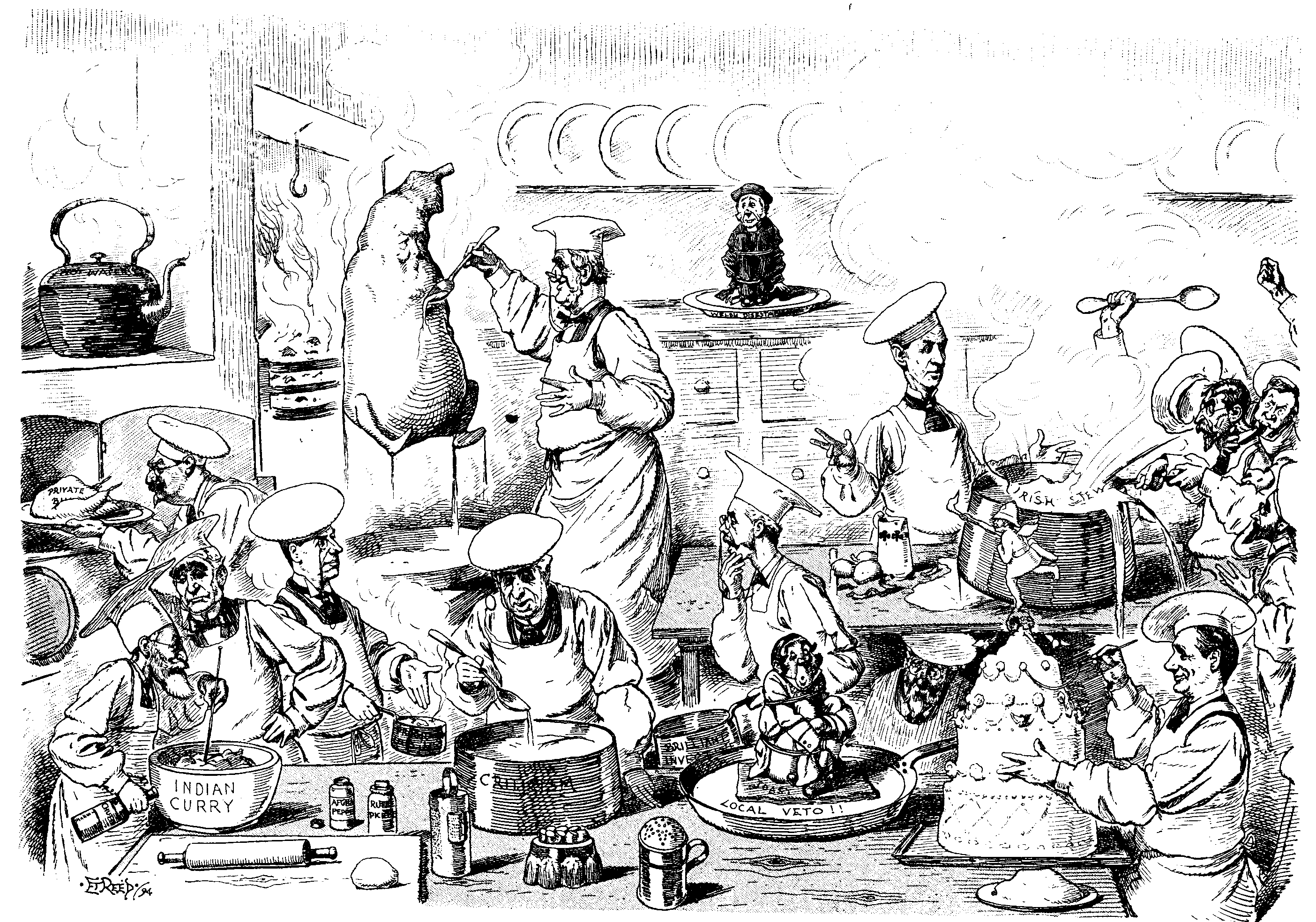
IMPROVEMENTS IN THE HOUSE OF COMMONS.
II.—Improved Kitchen Arrangements.
BEAUTIES OF BOLOGNA. Not those, along the route prescribed To see them in a hurry, Church, palace, gallery, described By worthy Mr. Murray. Nor those detailed as well by whom But Baedeker, the German; The choir, the nave, the font, the tomb, The pulpit for the sermon. No tourist traps which tire you out, A never-ending worry; Most interesting things, no doubt, Described by Mr. Murray. Nor yet, O gastronomic mind— In cookery a boss, sage In recipes—you will not find, I mean Bologna sausage. Not beauties, which, perhaps, you class With your own special curry; Not beauties, which we must not pass If led by Mr. Murray. I sing—alas, how very ill!— Those beauties of the city, The praise of whose dark eyes might fill A much more worthy ditty. O, Ladies of Bologna, who The coldest heart might flurry, I much prefer to study you Than Baedeker or Murray! Those guide-book sights no longer please; Three hours still, tre ore, I have to lounge and look at these Bellissime signore. Then slow express—South Western goes Much faster into Surrey— Will take me off to other shows Described by Mr. Murray. But still, Signore, there will be, By your sweet faces smitten, One Englishman who came to see What Baedeker has written. Let Baedeker then see the lot In frantic hurry-scurry. I've found some beauties which are not Described by Mr. Murray.
CLIO AT SALCOMBE. (Funeral of James Anthony Froude.) Scarce Clio's self, calm-soul'd historic Muse, Praise to her fiery votary may refuse, Though lacking somewhat the judicial poise Of clear mind unperturbed by faction's noise, And creed's fanatic clamour, valued most But her who heads the grave recording host. His vivid pictures live; his virile touch (Though oft of the too little or too much Ardently heedless in his passionate flow Of words that wake and thoughts that warmly glow), Quickens the past, and moves the patriot heart Of British manhood. His the stylist's part, The partisan's impressiveness. He missed The highest height, clear, cloudless, morning-kissed. But long will he be dear to those who love The picturings that charm, the words that move; And the grave Muse may well let fall a tear, And lay her tribute laurel on his bier.
Neat and Appropriate.—To the Prowlina Prys and their allies, the Visiting Injustices, may be addressed the ancient charge made against certain spies, "Nay, but to see the nakedness of the land have ye come."
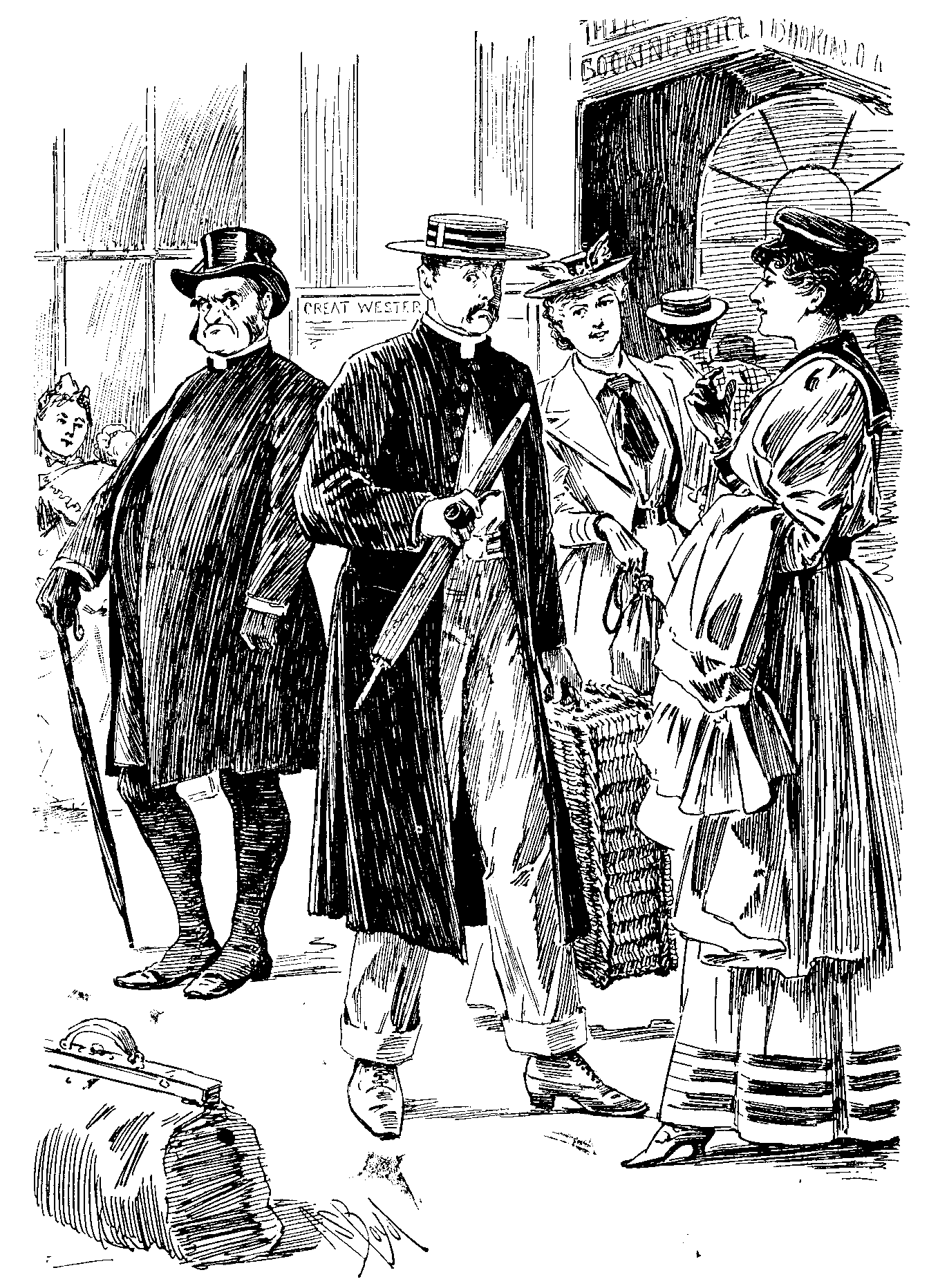
A SKETCH AT PADDINGTON.
The Reverend Motley, who makes one of a River-Party, fancies he met a Glance of Recognition from the Eye of his somewhat austere Bishop, and feels a trifle uncomfortable.
PAT THE PATRIOT. (His reflection after reading of the Boa-bolting incident at the Zoo.) St. Patrick had a potent fist, And was a saint right clever, When he gave the snakes and toads a twist And bothered them for ever. But och! here's a betther plan than Pat's! 'Twould have saved the saint much bother Had he trated the snakes like Kilkenny cats, And made them swallow each other. And even now 'twould save much row In the shplit-up Oirish Parthy, Could McCarthy's "bolt" end Redmond's revolt, Or Redmond swallow McCarthy!
Sporting.—'Arry is delighted to hear that there is a two-year-old running named 'Arriet. "It's spelt Ariette I know," he says, "but that's just French cussedness."
TO A WOULD-BE DESPOT. "Could I but rule!" with emphasis you say; Then, doubtless, evil would be swept away. How to begin, of course, is your affair, Such practical arrangements are your care; Our task would be no more than to obey! Injustice then would speedily decay, Merit, and only merit, then would pay; Which means, perhaps, I'd be a millionaire Could I but rule! Well, many kings have lived and reigned their day; I rather doubt if your despotic sway Would quite fulfil the objects of your prayer; Many have tried, and ended in despair, And you, perhaps—But still you answer "Nay, Could I but rule!"
The Real "Sun of York."—Frank Lockwood, Solicitor-General.