THE CHRONICLES OF A RURAL PARISH.
Reading edition
II.—THE PUBLIC MEETING.
I promised last week that the third chapter should be devoted to my meeting, and a Winkins's word is as good as his bond, in point of fact, if anything a trifle better. But I think I ought first to mention that since the account of my interview with Mrs. Letham Havitt and Mrs. Arble March appeared in print, I have been subjected to the annoyance of receiving an anonymous letter. I should be the last to suggest that either of these ladies, for whom my admiration is equalled only by my respectful awe, had anything to do with this missive, but here is what it contained. "It is easy to jeer at Woman, but be warned in time. Her day will come. Already, married or single, she may vote, already County Councils tremble at her word. Treat Woman with respect, or it will be the worse for you." These last words were written in red ink. I confess I'm not easily frightened, but I don't like this kind of thing. And all my wife says is that it serves me right for getting mixed up in these public affairs at my time of life, and that I ought to know better.
"You're not fitted for it, Timothy," she says, "and you'll only be made a fool for your pains." I am very fond of my wife, but I wished she wasn't a prophetess.
It is time to come to the meeting. It was held in the Voluntary Schoolroom, granted to me by the Vicar, on the express condition that I should be strictly non-political. The room was crammed with persons, men and women, married and single. The Vicar brought his daughters, two charming girls. Black Bob and his mates were there, in solid rows, whilst Mrs. Havitt and Mrs. March both turned up, attended by body-guards—the one of Women Liberals, the other of Primrose Leaguers. When the Chairman rose at half-past seven it is no exaggeration to say that the scene was striking and impressive. Then, two minutes later, I rose, and commenced my magnum opus of oratory. I had fifty-two pages of notes, I drank six glasses of water, and twenty-three people left before I had done, which was not until an hour and five minutes had elapsed. I don't for a moment complain that twenty-three left; my complaint is that the number was so few. My peroration, to which I had devoted days of care, somehow hardly had the effect I had hoped for.
"This is indeed a memorable year," I said; "a year of truly rural significance. It remains with you to show that you are prepared to rise to the height of the occasion. If you do this, if you grasp firmly the benefits which this Act offers you, then when next New Year's Day the gladsome bells ring out once again to tell a listening world that one year is dead and that another lives, they will sound all the clearer, all the more joyous, because they ring in a year in which Mudford will have a Parish Council."
Then I sat down, amidst subdued applause, which, I admit, disappointed me. The Vicar's daughters never even took the trouble to applaud at all, and both seemed to have something to confide to their handkerchiefs. Black Bob whispered to his neighbour, "Laying it on thick to-night, isn't he?" I wonder what he meant.
After this commenced a torrent of questions, forty-six in all before they were done. May I never live to have such another experience! All the points I had evaded, because I had not understood them, came up with hardly a single exception. One man asked, "Can the Parish Council remove the parson?"—a most embarrassing question, which evoked roars of laughter from the audience, and a look of indignation from the Vicar. And the awful conundrums!—most of which I had to content myself with giving up. Here is one. "Supposing only eight people come to the Parish Meeting, and a Parish Council of seven has to be elected, and suppose seven of the eight are nominated for election, and the seven are elected chairmen of the Meeting in succession, and have all to retire because they are candidates for the Council, and suppose the eighth man cannot read or write, and when he's proposed as chairman, goes home, how will the Parish Council be elected?" I simply said I would consult my lawyer, and, if necessary, take counsel's opinion.
Of course there was a vote of thanks, and of course it was carried. When I got home, my wife, who had declined to go, asked me how it had all gone off. "My dear Maria," was all I said; "you are quite right. A man at my time of life ought never to start taking part in public affairs."
THE DOOM OF THE MINOR POETS. When Minor Poets grew so rife, They found a Minor Poet's life Was very little fun The Spirit of the Age they prayed They might be melted down, and made Into a Major one. Each had a very little spark Of genius, that in the dark Might clearly be discerned. But in a universal glare! Who could perceive a rushlight, where By myriads they burned? The Spirit heard the prayer they urged, That all their merits might be merged In one enduring Fame: "Yet, ere you all are whelmed and gone, You," she declared, "must fix upon The Major Poet's name." Up rose a mighty clamour then, For Smith proposed the cognomen Of Smith, in ardent tones. "More suitable for high renown," Cried Brown, "appears the name of Brown." Jones advocated Jones. Expecting yet some verdict clear, The Spirit waited half a year, Then spread her wings and fled, But ere she fled, pronounced this curse: "You all shall read each other's verse Till all of you are dead!" Some, overburdened by the doom, Sank speedily into the tomb. In padded cells and lone There wander others, who abuse All day the volumes they peruse, But never ope their own!
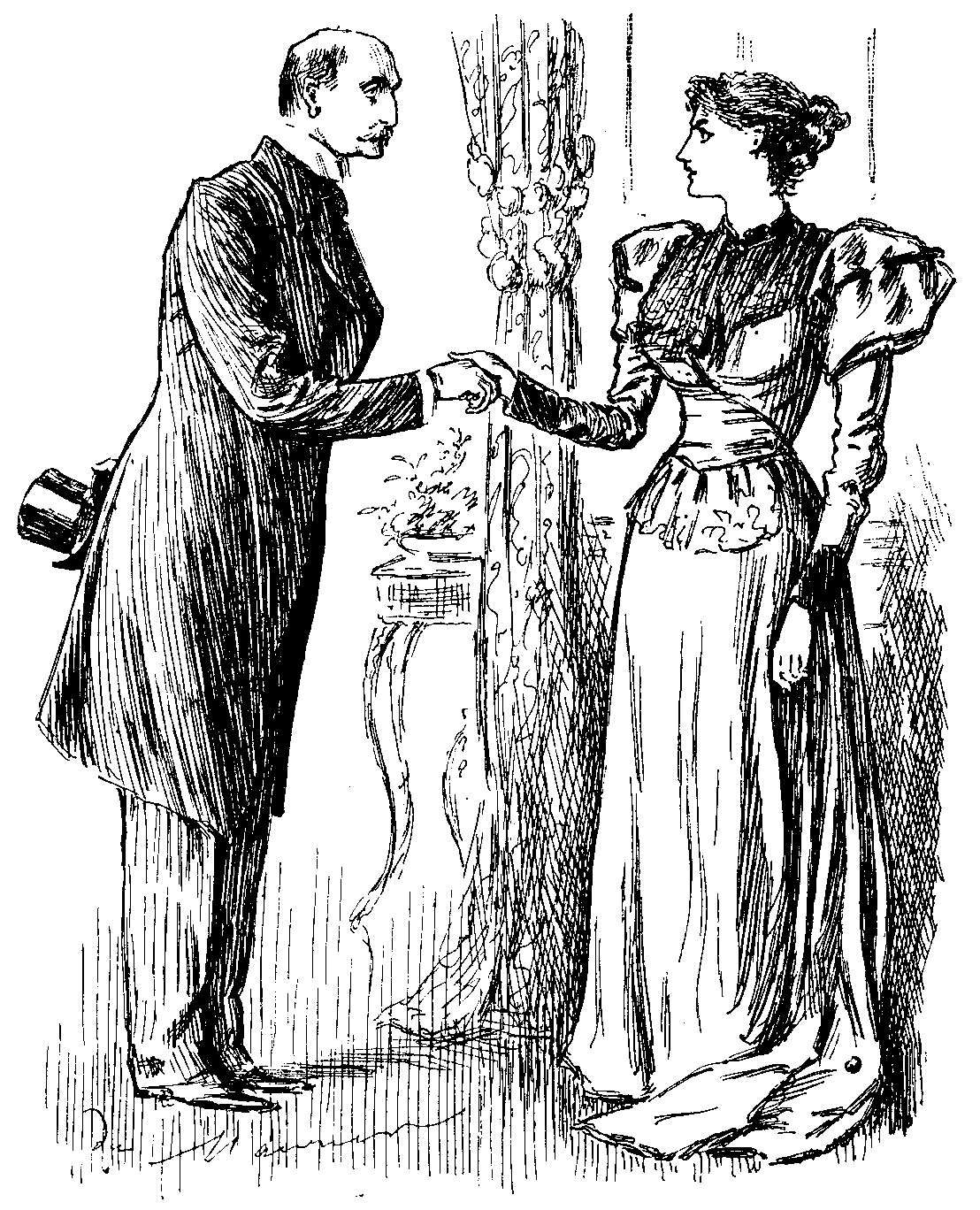
THINGS THAT ARE SAID.
"Now, Major do your very best to come to us on Tuesday. I shall expect you. But if you can't come, of course I shall not be disappointed!"
CROSSED! (To a Girl at a Distance.) Why must you go four thousand miles away? It throws our correspondence out of gear! I cannot cable to you ev'ry day— It's much too public, and it's rather dear! You write for sympathy—I sympathise; You get my answer ten days after date, And then, with spirits sky-high, you despise My poor attempts your sorrow to abate! Meanwhile, to my hilarious last-but-one Here comes your late but similar reply; But now my turn at dumps has just begun— I can't enjoy your triumphs while I sigh! And so our moods go see-saw, up and down, Our letters cross, perversely cold or fond! There's only one redress—come back to town, And then we'll meet, and cease to correspond!