COUNTING THE CATCH.
Reading edition
A Waltonian Fragment.
First Piscator, R-s-b-ry. Second Piscator, H-rc-rt.
First Piscator. Oh me, look you, master, a fish, a fish!
[Loses it.
Second Piscator. Aye, marry, Sir, that was a good fish; if I had had the luck to handle that rod, 'tis twenty to one he should not have broken my line as you suffered him; I would have held him, as you will learn to do hereafter; for I tell you, scholer, fishing is an art, or at least it is an art to catch fish. Verily that is the second brave Salmon you have lost in that pool!
First Piscator. Oh me, he has broke all; there's half a line and a good flie lost. I have no fortune, and that Peers' Pool is fatal fishing.
Second Piscator. Marry, brother, so it seemes—to you at least! Wel, wel, 'tis as small use crying over lost fish as spilt milk; the sunne hath sunk, the daye draweth anigh its ende; let us up tackle, and away!
First Piscator. Look also how it begins to rain, and by the clouds (if I mistake not) we shal presently have a smoaking showre. Truly it has been a long, rough day, and but poorish sport.
Second Piscator. Humph! I am fairly content with my catch, and had all been landed that have been hookt—but no matter! "Fishers must not rangle," as the Angler's song hath it.
First Piscator. Marry, no indeed! (Sings.)
O the brave fisher's life It is the best of any! He who'd mar it with mere strife Sure must be a zany. Other men, Now and then, Have their wars, And their jars; Our rule still Is goodwill As we gaily angle. We have hooks about our hat, We have rod and gaff too; We can cast and we can chat, Play our fish and chaff too. None do here Use to swear, Oathes do fray Fish away. Our rule stil Is goodwill. Fishers must not rangle.
Second Piscator. Well sung, brother! Oh me, but even at our peaceful and vertuous pastime, there bee certain contentious and obstructive spoil-sports now. These abide not good old Anglers' Law, but bob and splash in other people's swims, fray away the fish they cannot catch, and desire not that experter anglers should, do muddy the stream and block its course, do net and poach and foul-hook in such noisy, conscienceless, unmannerly sort, that even honest angling becometh a bitter labour and aggravation.
First Piscator. Marry, yes brother! the Contemplative Man's Recreation is verily not what it once was. What would the sweet singer, Mr. William Basse, say to the busy B's of our day; Dubartas to B-rtl-y, or Mr. Thomas Barker, of pleasant report, to Tommy B-wl-s?
Second Piscator. Or worthy old Cotton to the cocky Macullum More?
First Piscator. Or the equally cocky Brummagem Boy?
Second Piscator. Or Dame Juliana Berners to B-lf-ur?
First Piscator. Or Sir Humphrey Davy to the haughty autocrat of H-tf-ld?
Second Piscator. Wel, wel, I hate contention and obstruction and all unsportsmanlike devices—when I am fishing.
First Piscator. And so say I. (Sings.)
The Peers are full of prejudice, As hath too oft been tri'd; High trolollie lollie loe, high trolollie lee!
Second Piscator. The Commons full of opulence,
And both are full of pride. Then care away and fish along with me!
First Piscator. Marry, brother, and would that I could always do so. But doomed as we often are to angle in different swims, I may not always land the big fish that you hook, or even——
Second Piscator. Wel, honest scholer, say no more about it, but let us count and weigh our day's catch. By Jove, but that bigge one I landed after soe long a fight, and which you were so luckie as to gaff in that verie snaggy and swirly pool itselfe, maketh a right brave show on the grassie bank! And harkye, scholer, 'tis a far finer and rarer fish than manie woule suppose at first sight!
[Chuckleth inwardly.
First Piscator. You say true, master. And indeed the other fish, though of lesser bigness, bee by no manner of meanes to be sneezed at. Marry, Master, 'tis none so poor a day's sport after all—considering the weather and the much obstruction, eh?
Second Piscator. May bee not, may bee not! Stil, I could fain wish, honest scholer, you had safely landed those two bigge ones you lost in Peers' Pool, out of which awkward bit of water, indeed, I could fain desire we might keep all our fish!
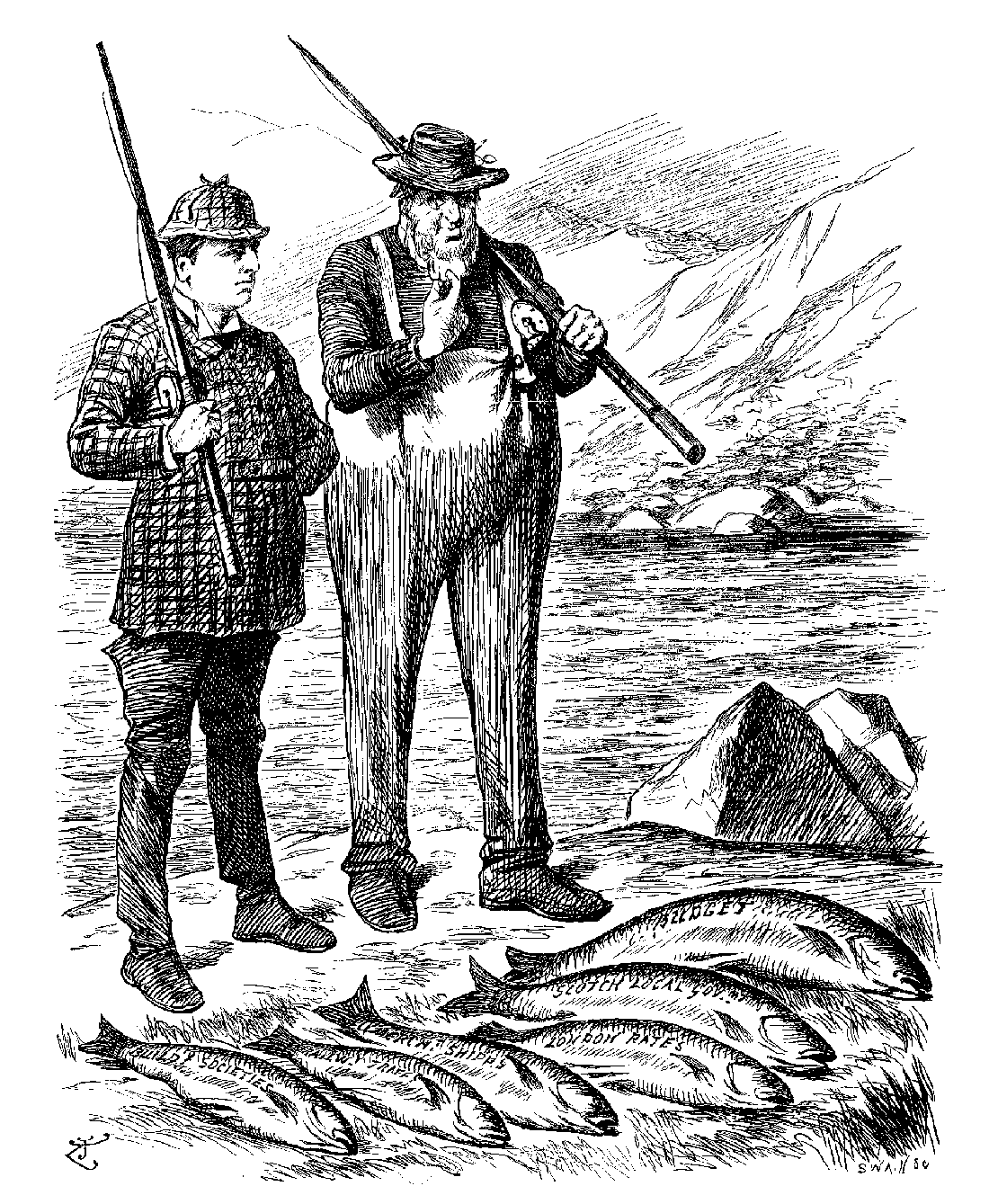
COUNTING THE CATCH.
Rosebery. "NOT SUCH A BAD DAY AFTER ALL!" Harcourt. "NO! WISH YOU'D LANDED THOSE OTHERS ALL THE SAME!!"
TO A WOULD-BE AUTHORESS. Though, Maud, I respect your ambition, I fear, to be brutally plain, No proud and exalted position Your stories are likely to gain;
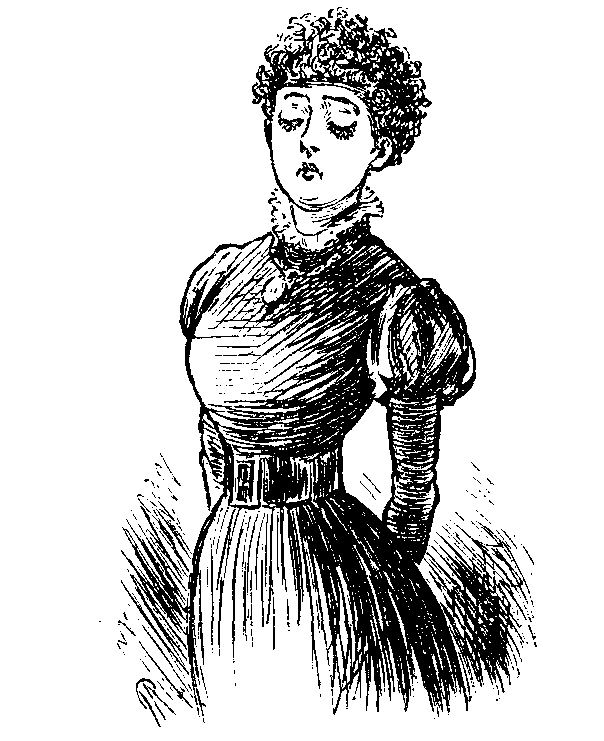
And, frankly, I cannot pretend I Regard with the smallest delight The vile cacoëthes scribendi Which led you to write. Your talk is most charming, I know it, You readily fascinate all, But yet as a serious poet Your worth, I'm afraid, is but small; Your features, though well-nigh perfection, Of the obstacle hardly dispose That you haven't the faintest conception Of how to write prose! You think it would be so delightful To see your productions in print? Well, do not consider me spiteful For daring discreetly to hint That in this too-crowded profession, Where prizes are fewer than blanks, You'll find the laconic expression, "Rejected—with thanks." And so, since you do me the pleasure To ask for my candid advice, Allow for your moments of leisure Some other pursuit to suffice; And, if you would really befriend me, One wish I will humbly confess,— Oh, do not continue to send me Those reams of MS.!
A MODERN TRAGEDY. Our hostess told us off in pairs, I had not caught my partner's name, But learned, when half way down the stairs, She long had been a Primrose Dame; And, ere the soup was out of sight, She'd found, and left behind, her text on A speech, if I remember right, Attributed to Mr. Sexton. And I—I sat and gasped awhile, And only when we reached the pheasant, Assuming my politest smile, And with an air distinctly pleasant, Attempted firmly to direct Her flow of talk to other channels, Books—shops—the latest stage-effect— The newest ways of painting panels. I tried in vain. "Ah, yes," she said, "And that reminds me—this Dissent"— And thereupon began, instead, Discussing Disestablishment! The case was clearly hopeless, so I hazarded no more suggestions, But merely answered Yes or No At random, to her frequent questions. Yet, while that gushing torrent ran, I made a solemn private vow That, though no ardent partisan, Those Ministers I'll vote for now Who'll introduce a drastic bill To bring about her abolition, To banish utterly, or kill The modern lady-politician!
THE OYSTER AND THE SPARROW. A Pessimistic Tale. At Whitstable one summer day, An oyster gave his fancy wings; He very indolently lay In bed, and thought of many things; Of what his life had been; of weeks All spent in having forty winks— You know an oyster never speaks, But lies awake in bed, and thinks. He thought, with pardonable pride, That he had never worked—a plan Which showed, it cannot be denied, That he was quite a gentleman. He lived more calmly in his sea Than any Bishop; never crossed In any sort of wishes, he Had never loved, and never lost. No cruel maid had ever spurned His heart, such grief no oyster knows; Nor hatred ever in him burned Against the rival whom she chose.
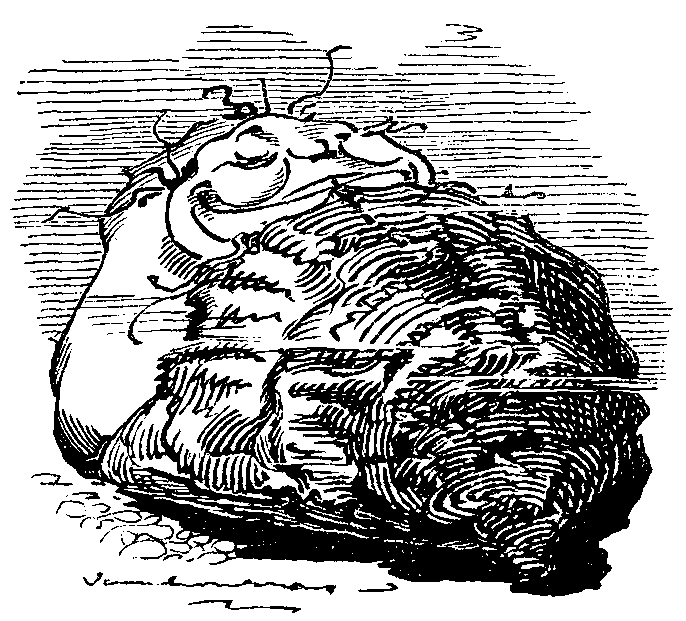
Yet, when considered, all appeared Too softly calm, too free from strife; He thought, and, sighing, stroked his beard, "There does not seem much use in life." By chance, upon this very day A London sparrow, for a minute, Was thinking somewhat in this way Of life, and what the deuce was in it, And how he fluttered up and down, Like Berthas, Doras, Trunks, or Yankees— His nest was far above the town, Upon the buildings known as Hankey's. He thought, with pardonable pride, Unlike a pampered, gay canary, He worked—it cannot be denied That "Laborare est orare." He worked with all his might and main, Yet now he chirped with some misgiving, "Shoot me if I know what I gain, There does not seem much use in living." Soon after this the bird and fish Were slain by old, relentless foes, When death was near, each seemed to wish! To keep his life—why, no one knows. The bird was knocked upon the head— A crack no gluing could repair; The oyster rudely dragged from bed, Died from exposure to the air. They helped in one great work, at least, To make some greedy beings fat; The oyster graced a City feast, The bird was eaten by the cat.
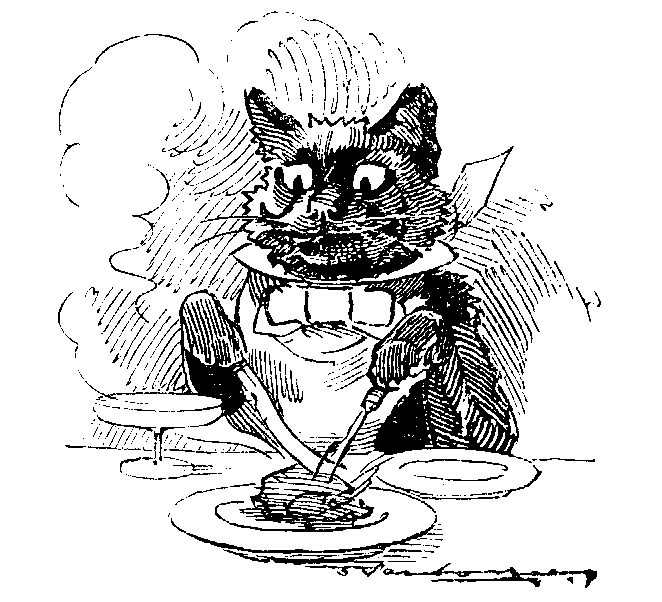
Thus, though they led such different lives, One fat from sloth, from work one thinner, Their end was that for which man strives, And mostly ends his days with—dinner!
VERSES TO THE WEATHER MAIDEN. Lady, the best and brightest of the sex, Whose smile we value, and whose frown we fear, Let me proclaim the miseries that vex The numerous throng who all esteem you dear; 'Tis not that you habitually appear Serenely contemplating the Atlantic In raiment which, if fashionable here, Would greatly shock the properly pedantic, Make Glasgow green with rage, and Mrs. Grundy frantic; Your classical costume a true delight is To all who study you from day to day, And even if it hastens on bronchitis It serves your graceful figure to display: But now your thousand fond admirers pray Amid the tumult of the London traffic And in each rural unfrequented way— "O weather-goddess, look with smile seraphic And prophesy 'Set Fair' within the Daily Graphic!" Too long, too long, each worshipper relates, You've told of woe with melancholy glance, Predicted new "depressions" from the States, Or "V-shaped cyclones" nearing us from France; Our summer flies, oh, herald the advance Of decent weather ere its course be ended, Put your umbrella down, and if by chance Piscator grumble, let him go unfriended, Heed not his selfish moan, but give us sunshine splendid! Our confidence towards you never flinches, Let others be unceasingly employed In working out the barometric inches, Or tapping at the fickle aneroid, Wet bulb and dry we equally avoid, In you, and you alone, our hopes remain, Then be not by our forwardness annoyed, Nor let our supplications rise in vain,— Oh, Daily Graphic maid, smile, smile on us again!
THE YELLOW RIDING-HABIT. Chang, he had a yellow jacket Fitting rather nice and slick; When the garment got the sack, it Made him simply deathly sick; And he swore, with objurgations, It was due—or he'd be hung— To the fiendish machinations Of a man who rhymed with Bung. But his lord in mild, celestial, Manner moralised and said— "There are other really bestial Things I might have done instead; Might, in point of fact, have tied you To a poplar with a splice, And explicitly denied you Every claim to Paradise. Nay, I even wondered whether I should play another card, And reduce your dorsal tether By a matter of a yard; Or curtail your nether raiment, (This I waived as rather coarse,) Or appropriate your payment As a marshal of the force. But I gave you just a gentle, If humiliating, shock, Much as any Occidental Castigates the erring jock, Who in place of freely plugging At a reasonable rate, By irregularly lugging Lets a rival take the plate. Thus I delicately hinted It was time to jog your gee; And the proper view is printed, In the pagan P. M. G., Namely, that you might be chary Of a deal of sultry dirt, And do better in an airy Waistcoat with a cotton shirt. Doubtless habits have a lot to Do with character as such, Yet the prophet warns us not to Trust in colour very much; And indeed your yellow custard Came to smack of rotten cheese, Since they took to making mustard Books and Asters over-seas."
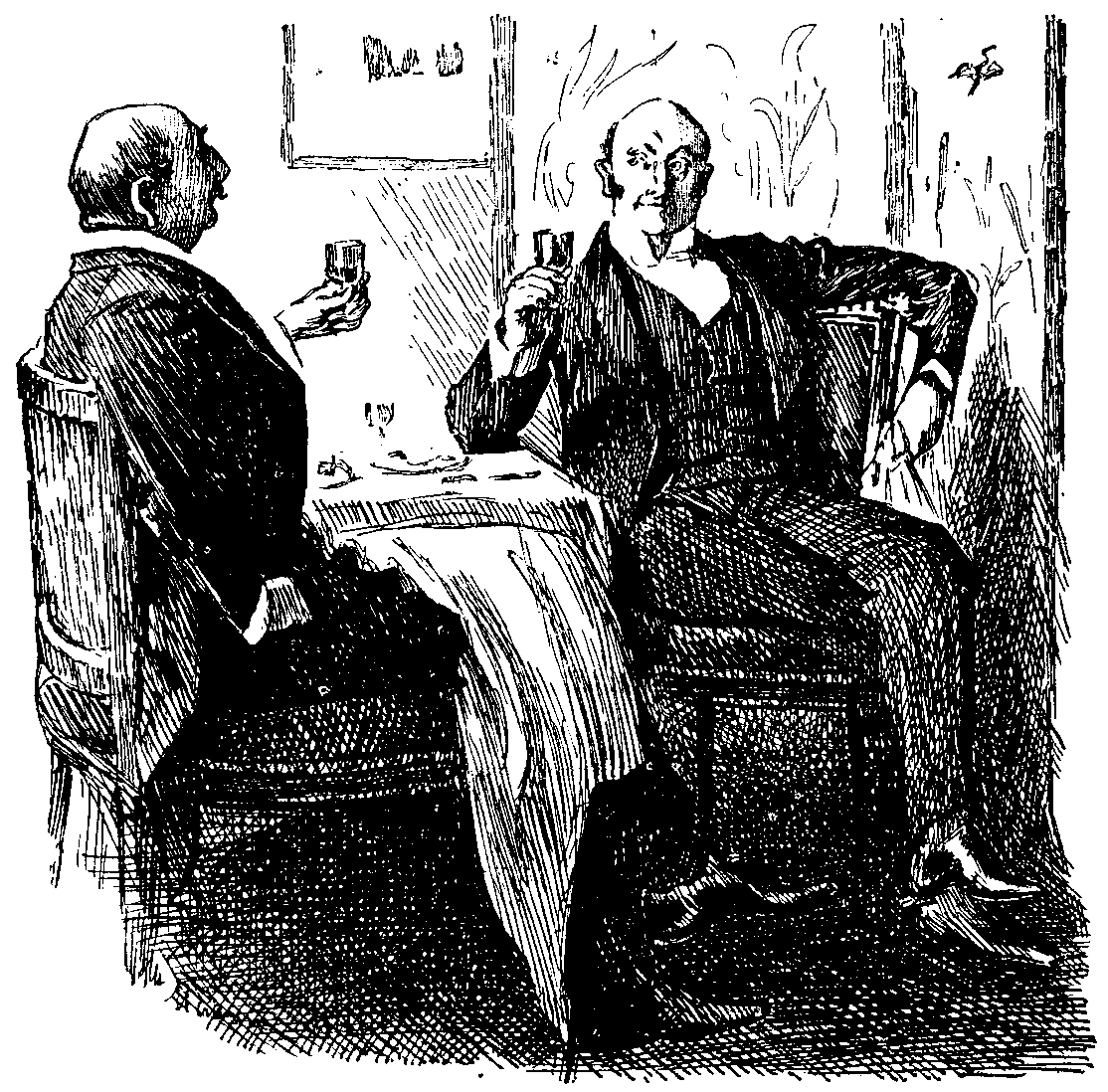
PEARLS BEFORE SWINE.
The Vicar. "What do you think of that Burgundy? It's the last Bottle of some the dear Bishop gave me. It cost him Eighteen Shillings a Bottle!"
The Major. "Very nice! But I should just like you to try some I gave Twelve Shillings a Dozen for!"
Noble Half Hundred!!! "We mean to keep our Empire in the East!" So sang the music halls with noisy nous, Well, one thing now is very clear at least, Our Empire in the East can't keep—a House! Is our Indian Government fairly cheap? men ask Are Anglo-Indian rulers wise and thrifty? The Commons meet to tackle that big task, And Fowler's speech is listened to by—Fifty!