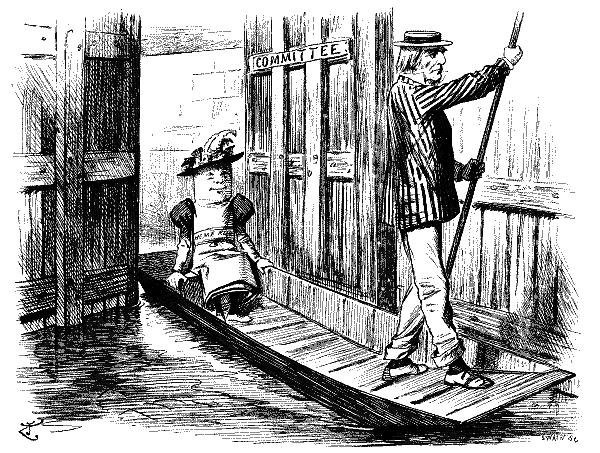
AT THE WORLD'S WATER SHOW.
Reading edition
The performance has begun. Captain Boyton has just descended the Chute in a boat, with a bevy of lightly-clad young ladies waving flags with shrill enthusiasm. Canadians, Indians, and Negroes row various craft containing Beauties of the Ballet about the Lake. An elderly Negress stands on an island, and waves a towel encouragingly at things in general. Two Clowns, accompanied by a futile individual disguised as a Frog, start to run round the margin of the Lake with a gallant determination to be funny, but abandon the attempt after making a quarter of the distance, and complete the circuit with a subdued and chastened demeanour.
Mr. Bravo (to Mr. Blazzey, enthusiastically). Capital show this—wonderfully well arranged!
Mr. Blazzey (screwing up his eyes). Y—yes. Better if they'd had water running down the incline, though, and sent all the boats in that way.
Mr. Bravo. Don't see how they could pump up water enough for that, myself; and if they did, it would all run through at the sides!
Mr. Blazz. (ignoring any hydraulic difficulties). Oh, they could have dodged that if they chose; anyway, that's how it ought to have been managed!
Miss Frivell (to Mr. Hoplight). I can hardly believe this is the same place where Buffalo Bill gave his performance only last year, can you? It all looks so different!
"I find no difficulty in recognising it, myself."
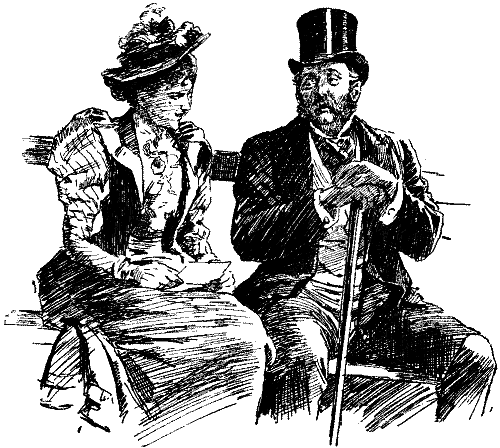
Mr. Hopl. (after ponderous consideration.) I find no difficulty in recognising it, myself. The difference you observe is due to the fact that the arena which was originally constructed for—er—displays of horsemanship requires to undergo some considerable—er—structural alterations before being equally well adapted to a performance in which—er—boating and swimming form the—er—principal features.
Miss Friv. (with exemplary gravity). I see. You mean there must be water?
Mr. Hopl. Water is undoubtedly an—er—indispensable element in such an exhibition.
Miss Friv. How clever of you to know that! But perhaps someone told you?
Mr. Hopl. (modestly). I arrived at it by the—er—light of my own unassisted intelligence.
Miss Friv. Did you? Not really! "How far that little candle throws his beams!" (To herself.) I didn't mean to be so rude as that! But he's no business to be such a bore!
Mr. Bravo (after the Sculling-race between Ross and Bubear). That was a good race, eh? They're the champion scullers, you know.
Mr. Blazz. Don't see the point of setting 'em to race here, though. Rather like running the Derby in a riding-school!
A Sympathetic Lady (during the Swimming-race). How well those girls do swim! I suppose they go under first, and then come up again. But how damp they must get, to be sure, doing that twice a day! I daresay they never get their hair properly dry from one week's end to another. I should think that must be so uncomfortable for them, you know. However, they seem to be having plenty of fun among themselves. I wish we could hear what they are saying; but there's so much to look at, that one misses most of it!
[A Pontoon is moved out into the centre of the Lake, and three "Rocky Mountain Wonders" give an entertainment on board. The first Wonder constructs the letter A with himself and two high ladders, up which the other two run nimbly. They meet at the top with mutual surprise, and a touch of resentment, as if each had expected at least to find solitude there. The Second Wonder lies down on his back resignedly, and the Third, meanly availing himself of the opportunity, stands on his friend's stomach, and strikes an attitude. Both descend and bow, in recognition of applause, and then each starts up his ladder again—only to meet once more at the top, more surprised and annoyed than ever. The Third Wonder refuses to be appeased unless he is allowed to hold the Second head downwards by the ankles. After further amenities of this kind they come down, apparently reconciled, and are towed back to the shore.
Miss Friv. Is that supposed to be an illustration of life on the Rocky Mountains?
Mr. Hopl. (bringing the full powers of his mind to bear on the subject). I should be inclined to doubt myself whether it afforded any accurate idea of either the industry or the—er—relaxations peculiar to that region, which can hardly be favourable to such pursuits.
Miss Friv. They might find it useful for escaping from a grizzly, mightn't they?
Mr. Hopl. Hardly, if, as I have always been given to understand, the grizzly bear is an equally expert climber. I imagine their title of "Rocky Mountain Wonders" is merely indicative of their—er—origin, and that their performances would indeed excite more wonder in their native country than anywhere else. One should always guard against taking these things in too literal a spirit.
[Miss F. assents demurely, and is suddenly moved to mirth, as she is careful to explain, by the sight of a Nigger, which, Mr. H. very justly remarks, is scarcely a subject for so much amusement.
Mr. Bravo (after the Corps de Ballet have performed various evolutions on a large raft). I call that uncommonly pretty, all those girls dancing there in the sunlight, eh?
Mr. Blazz. Pretty enough—in its proper place.
Mr. Bravo (losing his patience at last). Why, hang it all, you wouldn't have the Ballet danced under water, would you?
Mr. Blazz. Well, it would be more of a novelty, at any rate.
[Mr. Bravo decides that "it was a mistake to come out with a chap like Blazzey."
In the Shilling Seats.
A Small Sharp Boy (with an admiring Father, Mother, and Grandmother). Father, why ha' them Injuns all got feathers stuck round their 'eds like shuttlecocks, eh? Is it to show as they're in the terbaccer line, eh, Father? Is the gentleman on the bicycle a real demon, eh, Father? Ain't he like what a real demon is? Why ain't you never seen one, Father? Think you'll ever see one, eh? Why's that man going right up atop of that pole for? Why is he goin' to jump off? Will he git drownded, eh, Father? Don't he ever git drownded? Could you dive off from as 'igh as that with your legs tied? Could Uncle Bill? Could Gran'ma, with 'er legs tied?
[&c., &c.
During the Walrus Hunt.
Shilling and Sixpenny Spectators. That's the police station on that boat where the two Bobbies are.... 'Ere's a rummy couple coming along in this boat! See the bloke with the bald 'ed, and the ole girl in a pink bonnet?... There, they've run slap into them others, and the ole bloke's got his 'eels in the air. Oh, dear, oh, dear!... Look at the bobbies tryin' to run 'em in. Lor, they're all pourin' water on to each other's 'eds as 'ard as they can go! 'Ere's the ole walrus swimmin' up now, d'ye see? And the ole Clown a fishin' for 'im. 'E's bin an' dragged 'im 'in 'ed foremost! Look at the walrus a duckin' o' the ole woman. Hor, hor, if ever I see the like o' that! Is that like 'ow they 'unt walruses, Father, eh? Blest if the ole walrus ain't got into the station 'ouse after 'em. Look at 'em all gittin' out on the roof—in they jump! And the ole girl goin' in backards, hor, hor! And the other bloke any'ow. See the 'ole admiral in the cocked 'at a takin' sights through 'is spy-glorss! Now they're gittin' the 'arpoon ready. There, they've copped 'im—it's all over! Well, that was a good lark, and no mistake!
At the Landing-Place—after Shooting the Chutes.
Oh, it was perfectly splendid! We put the rugs right over our heads, and didn't get wet a bit!... I don't know if you're aware of it, my dear, but you've got black streaks all down your face. Gracious! it's the dye from my veil. Do I look very dreadful, dear? Well, it shows, of course—but I wouldn't touch it, or you'll make it worse.... This lot got a ducking, and no mistake—look at 'em—ho, ho!... I say, dear old chap, you ought to have come too—it was ripping! Splashed? No, nothing to speak of. Eh? "My hat?" What's wrong with it? Oh, confound it all! I only took a front seat to oblige those two girls. Yes, I can see they're giggling at me as well as you can. Look here, old fellow, do you know if there's a place here where I can get my hat ironed, and buy a collar and tie? Because I've got to meet the Chaffingtons here, and dine with 'em and that. "So have you?" Then that's why you backed out of going down the Chute! Why the deuce didn't you say so? Oh, if you're going to stand there laughing like a fool, I'm off! I may just have time to—— Hang it; there are the Chaffington girls! Is my collar too beastly limp? you might tell a fellow!
TO A DROSHKY-DRIVER.
(By a Quondam Fare.)
Here's a health to you, Gospodin Ivánoff— Or whatever your name may chance to be— Of vodka I'll toss you a full stakán off (A tumbler, I mean, of eau de vie); And I'll sing you fortissimo con furore Your national hymn, in a cheerful key, ('Twill colour with local tone my story, To start with your "Bozhe Tsaryá khrani").
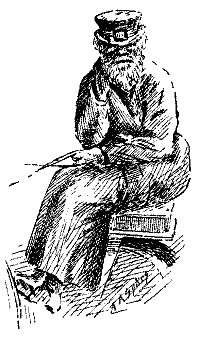
'Twas a lively morning, my hirsute Jehu, In Petersburg once we together spent; And now in my sketch-book I still can see you (The annexed for your portrait's humbly meant). Your costume resembled in part a butcher's— A dull blue gown of a vast extent, With top-boots, like each of the other kutschers And shocking bad hat, all "bashed" and bent.
Ere long you called me your "little brother," Or else—your knowledge of Court to show— (What one Russian "High Excellence" styles another) "Vuisókoprevoskhodítelstvo." You wanted to learn how to greet an acquaintance In English; I said, to be comme il faut, That "God save the Queen" was the proper sentence— I own that my hoax was a trifle low.
A large percentage, my gay izvostchik, I failed of your jokes to understand; But I safely say you displayed the most cheek Of any I've met by sea or land. When you pitched me clean out on the Nevski pavement, With syllable brief I loudly banned; But as dam in your lingo "I'll give" (you knave!) meant, You grinned, and for "tea-money" held your hand. I shall never forget that awful jolting I got as you whirled me round about In your backless car; for your bumping, bolting, You really, my Vanka, deserved the knout. Well, I won't say "Good-bye," but "Do svidanya"— Though whether we'll meet again I doubt; If you ever should wander to far Britannia, I fear you will probably find me "Out."
Motto for Professors of Palmistry.— "Palmam qui meruit ferat." i.e., "Who has paid his money may bare his palm."
It is proposed to establish a fire-station, "with fifty men, on the Thames Embankment." For what purpose? In case of anybody setting the Thames on Fire?
Mrs. R. says she never has toast for breakfast, but always "fresh-airated bread."
THE MOAN OF A THEATRE-MANAGER.
Who gets, by hook or crook, from me Admittance free, though well knows he That myriads turned away will be? The Deadhead. Who, while he for his programme pays The smallest silver coin, inveighs Against such fraud with eyes ablaze? The Deadhead. Who to his neighbour spins harangues, On how he views with grievous pangs The dust that on our hangings hangs? The Deadhead. Who, in a voice which rings afar, Declares, while standing at the bar, Our drinks most deleterious are? The Deadhead. Who aye withholds the claps and cheers That others give? Who jeers and sneers At all he sees and all he hears? The Deadhead. Who loudly, as the drama's plot Unfolds, declares the tale a lot Of balderdash and tommy-rot? The Deadhead. Who dubs the actors boorish hinds? Who fault with all the scenery finds? Who with disgust his molars grinds? The Deadhead. Who spreads dissatisfaction wide 'Mongst those who else with all they spied Had been extremely satisfied? The Deadhead. Who runs us down for many a day, And keeps no end of folks away That else would for admittance pay? The Deadhead. Who keeps his reputation still, For recompensing good with ill With more than Pandemonium's skill? The Deadhead. Who makes the bankrupt's doleful doom In all its blackness o'er me loom? Who'll bring my grey head to the tomb? The Deadhead.
"THE WAY THEY HAVE IN THE NAVY."
(Adapted to the Requirements of the Army.)
"There was no doubt about it," queried the Quartermaster to the Adjutant, "the Chief certainly desired me to execute him?"
"That is unquestionably my impression," replied the Adjutant.
"Yes, and it never does to question his orders," continued the Quartermaster; "it makes him so wild if he fancies that you are disobeying his commands."
"Quite so," admitted the Adjutant; "and so the best thing is to carry them out. As you know, obedience is 'the first law of a soldier.'"
"Still, to shoot a man for nothing, does seem a little hard."
"How do we know it's for nothing? You may be sure the Chief has his own reasons for everything."
And so the two warriors walked to the barrack square and sent for the unfortunate Private Thomas Atkins. As the order was conveyed to the quarters of the rank and file, men lounged out of the mess-room, and discussed the Colonel's orders. It seemed "a bit strange," but it was not for them to dispute the chief's command. And, as they spoke, Private Thomas Atkins was produced. He had a clean defaulter's sheet.
"On my word, I really trust that there may be some mistake," said a Brigade-Surgeon-Lieutenant-Colonel M.D. "But, as I am not now attached to the battalion, I have no right to interfere."
Private Thomas Atkins was marched to a wall, ordered to right-about turn, and then (under the command of the Quartermaster) shot.
Then the civil power, in the person of a police-constable, thought it time to interfere, and arrested the officer immediately in command.
"Dear me!" exclaimed the Colonel, subsequently; "how exceedingly absurd! I wanted the Quartermaster to give him a new suit, and he thought I asked him to shoot him! You fellows really ought to be more careful!"
But nothing could be done, because the matter had passed into the hands of the civil power.
And, all things taken into consideration, it was just as well that they had.
THE BALLAD OF DEPARTED PIPPINS.
(Some Way after Villon and Rossetti.)
Tell me, now, where has it departed, That fine old apple, the Ribstone Pippin, The rosy-coated, and juicy-hearted, I loved, when a "nipper," my teeth to slip in?
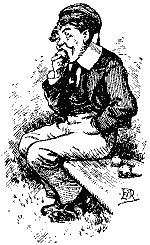
Where is the Russet we boys thought rippin'? (Though its sharpness sometimes started the tears?) Oh! such-like often I've spent my "tip" in— But where are the apples of earlier years?
Where's the King Pippin, the sun-brown one? And where is the Catshead, light Spring green? (Which gave, while eating, such glorious fun, If—after munching—some dule and teen)? And where is the Golden Knob, whose sheen Would draw the wasps all about our ears? (Sometimes in our mouths, if they were not seen)— But where are the apples of earlier years?
White watery things from the land of the Yankee, And sugary shams from the Austral seas, They sell us—at sixpence per pound! No, thankee! I have no palate for frauds like these. There's not an apple that now could please Poor Eve so much as to waken fears. Ah, the luscious Pippins youth crunched at ease! But where are the apples of earlier years? Nay, never ask if your fruiterer's heard Of "a decent pippin" (the huckster sneers!) Except with this for, an overword— But where are the apples of earlier years?
Rather Mixed.—In the sale of wines at Christie's last week, Lot 136 is described as "3 dozen of sherry, 1842, been to West Indies, more or less." Now, why this mystery? Why not make a clean breast of it? Is it meant that the sherry called in at only one or two of the Indies? or did it only set half way on the voyage to the group? We should learn more or be told less.
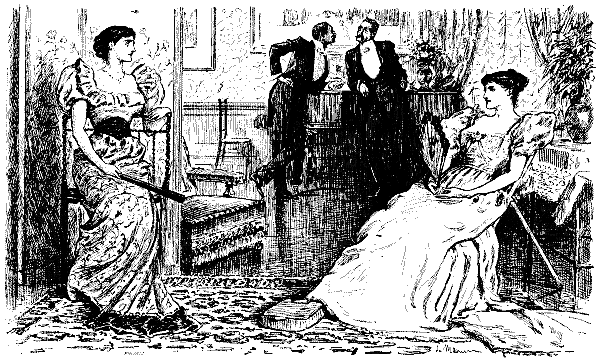
FELINE AMENITIES.
Fair Visitor. "Do Play something, Dear! I love to hear your Music!"
Fair Hostess. "Sorry, Dear, but this Piano is so dreadfully out of tune! That's the worst of living in Apartments! My Music-Master says that to use such a Piano as that is fatal to real Playing! But won't you play something, Dear?"
THROUGH THE LOCK.
Grand Old Puntsman pipes up:—
"Lock! Lock! Lock!" Heaven be thanked, we're through it! Spite of crush, and jam, and shock, That's the way to do it! Now for a fair "flowing tide," Verdurous banks and shady! Yes, we're through. I'm glad, aren't you, Eh, my little lady? "Lock! Lock! Lock!" Trim the punt, sweet, prythee! You look nice in your new frock! Fresh as osier withy. How they strove your togs to tear; Hinder, or capsize us! But, hurroo! we've scrambled through! Nought need now surprise us! "Lock! Lock! Lock!" Faint cry, far before us! Lot of toffs my efforts mock; Menace us in chorus. Swear they'll swamp us at the weir. Fate there's no controlling, But the Grand Old River Hand Puts his faith in pol(l)ing!
Sit tight, my dear, and as we drop down with the tide towards the next lock, I'll sing you a new river-song to an old air. [Sings.
And did you ne'er hear of a jolly old punting man, Who near Westminster his calling doth ply? He handles his pole with such skill and dexterity, Winning each "No" and enchanting each "Aye." He looks so neat, he steers so steadily, The ladies all flock to his punt so readily; And he's so celebrated for courage and care, That he's seldom in want of a freight or a fare. But o'er his last passenger rivals made merry. She did look so feeble, and frightened withal: "A fair sample this of your fine Irish ladies! In a Party like yours won't she kick up a squall?" Thus oft they'd be chaffing, and shouting and jeering, But 'twas all one to Willy; he stuck to his steering; For hissing or hooting he little did care, He handled his pole, and looked after his fare. And ah! just to think now how strangely things happen! He poled along, caring for no one at all; By a crush in the lock, foes his fare meant alarming, And hoped in deep water she fainting might fall. But he bade the young damsel to banish all sorrow, "If they block us to-day, dear, we'll get through to-morrow." And now the old Puntsman is through! But they swear They'll yet flummox the future of him and his fare!
Good Gracious!—Mrs. R. went to Lord's the other day, to see Doctor Grace play. She says, "Until then I had no idea he was a man of such splendid physic."
SYMPATHY.
A Colloquy after the Eton and Harrow Cricket Match.
Old Buffer to Small Boy, solicitously:—
Why are you hoarse, my little lad, So husky and so hoarse? Your voice is almost gone! 'Tis sad! You'll seek advice, of course? Diphtheria is much about! And—well you know, there's cancer!!! Dear me, you're choking now! Don't shout, But write me down an answer.
Small Boy to Old Buffer, spasmodically:—
Cancer—be blowed!—Cricket—of course! Harrow—for years—has beaten; And—I've been howling till I'm hoarse To see 'em—licked by Eton!!! Hooray!!!
THE MOAN OF THE MINOR POET.
This (says Mr. James Payn) is what Tom Hood wrote about the treatment meted out to the Minor Poet in his time:—
"What is a Modern Poet's fate? To write his thoughts upon a slate— The critic spits on what is done, Gives it a wipe—and all is gone."
And this (says Mr. Punch) is the Minor Poet's reply to-day:—
I write not on a slate, but foolscap fair: It falls to the Waste-paper Basket's care. If not, the Minor Poet's still ill-fated, 'Tis by some Minor Critic now he's "slated." Far better than that stabber's spiteful lunge, Were "a clean slate" and kind oblivion's "sponge."